Many theological systems divide deities into clear categories of good and evil, but Shiva, the Great Destroyer, stands out for blending destruction and renewal. He does more than end existence; he dissolves both the ego and the physical world to make way for a new creation.
Looking at his roles as both a strict ascetic and a cosmic dancer, we see that destruction is viewed as a necessary step for spiritual freedom.
This article brings together key accounts from the Rig Veda and the Shiva Purana to trace how Shiva evolved from a Vedic storm-god to the supreme ascetic of later texts. By examining local folklore through the Linga Purana, we build a profile that distinguishes the ancient idea of cosmic destruction from modern Western ideas of ‘evil.’ [View Full Bibliography ↓]
Summary
Key Takeaways
| Attribute | Details |
| Names | Mahadeva, Pashupati, Nataraja, Rudra, Maheshwara, Shambhu |
| Title | The Destroyer, Lord of Animals, King of Dance, The Auspicious One |
| Gender | Male (also manifests as Ardhanarishvara, half-male and half-female) |
| Role | Cosmic destroyer, supreme ascetic, patron of yogis and arts |
| Followers | Ganas, Nandi, Bhutas, Yogis, and various celestial beings |
| Powers | Omniscience, mastery over time, destruction via the third eye, rejuvenation |
| Appearance | Blue throat, matted hair, crescent moon, three eyes, holding a trident |
| Etymology | Derived from Sanskrit meaning “The Auspicious One” or “Benevolent” |
| Associated Figures | Parvati (Consort), Ganesha and Kartikeya (Sons), Vishnu, Brahma |
| Weaknesses | Deep attachment to devotees, susceptibility to extreme penance |
| Opposing Deva/Avatar | None (Integral part of the Trimurti; occasionally Rudra’s fierce forms) |
| Pantheon | Hindu (with roots in the Vedic Rudra) |
| Primary Sources | Rig Veda, Shiva Purana, Mahabharata, Ramayana, Linga Purana |
Who or What is the Great Destroyer?
The Auspicious One is a major deity in Hinduism and is the third member of the Trimurti, the divine trio. Unlike other gods who live in heavenly palaces, he is often shown as a wandering ascetic in cremation grounds or on the snowy peaks of Mount Kailash. He stands for the supreme consciousness that remains after the material world ends at the close of a kalpa, or cosmic age.
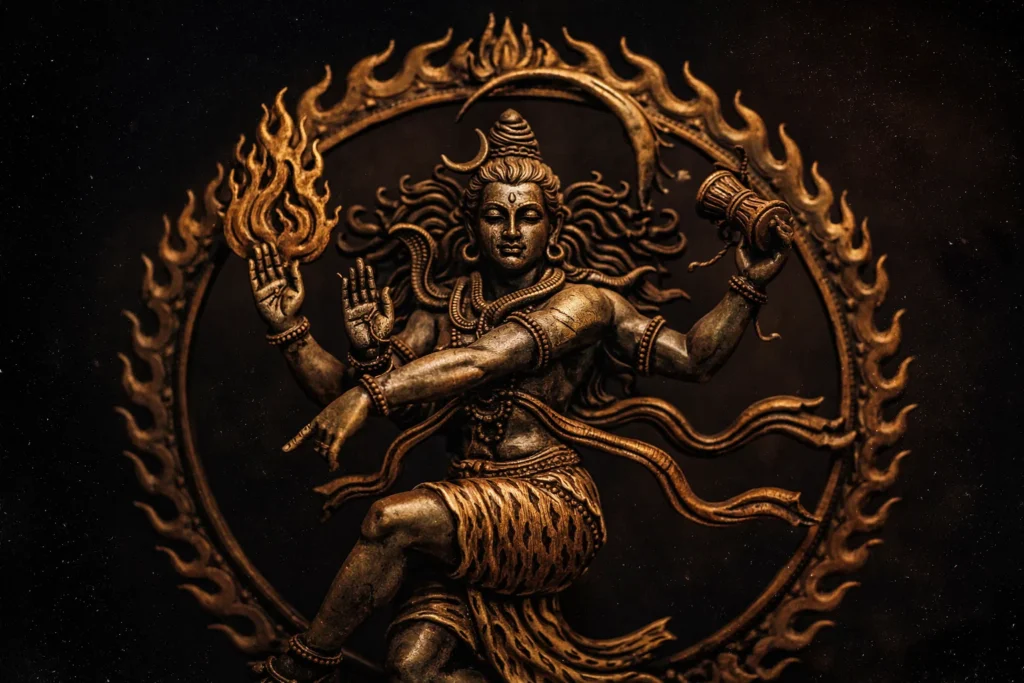
He is both a family man and a hermit, a kind protector and a strict judge. His nature is full of contrasts: he sits still in deep meditation, but also performs the Tandava. This powerful dance keeps the universe in balance. He supports yoga, meditation, and the arts, and as Dakshinamurti, he teaches wisdom through silence.
“Shiva” Meaning
The name comes from the Sanskrit word śiva, which means ‘auspicious,’ ‘favorable,’ or ‘kind.’ This name was first used as a gentler way to refer to the god, originally called Rudra, meaning ‘Howler’ or ‘The Terrible One,’ in early Vedic texts. Over time, calling him ‘Auspicious’ became a way to calm the fierce storm-god, and it eventually became his main name.
In the Puranas, the name also means ‘one who purifies everyone just by being spoken.’ The change in his name over time shows how he went from being the wild and unpredictable Rudra of the Vedas to the more organized and thoughtful Mahadeva.
Some language experts think the name may come from a Proto-Dravidian word for ‘red’ (civa), which fits with the god’s old links to the sun or fire. Other names like Shambhu (Source of Happiness) and Shankara (Giver of Joy) highlight his kind side, even though he is also a destroyer.
How to Pronounce “Shiva” in English
The name is pronounced SHEE-vuh. The first part uses a soft ‘sh’ and a long ‘ee’ like in ‘sheep.’ The second part is a short, gentle ‘vuh,’ like the ‘a’ in ‘sofa.’ Try not to stress the ‘v’ too much; it should sound smooth.
What Does the Great Destroyer Look Like?
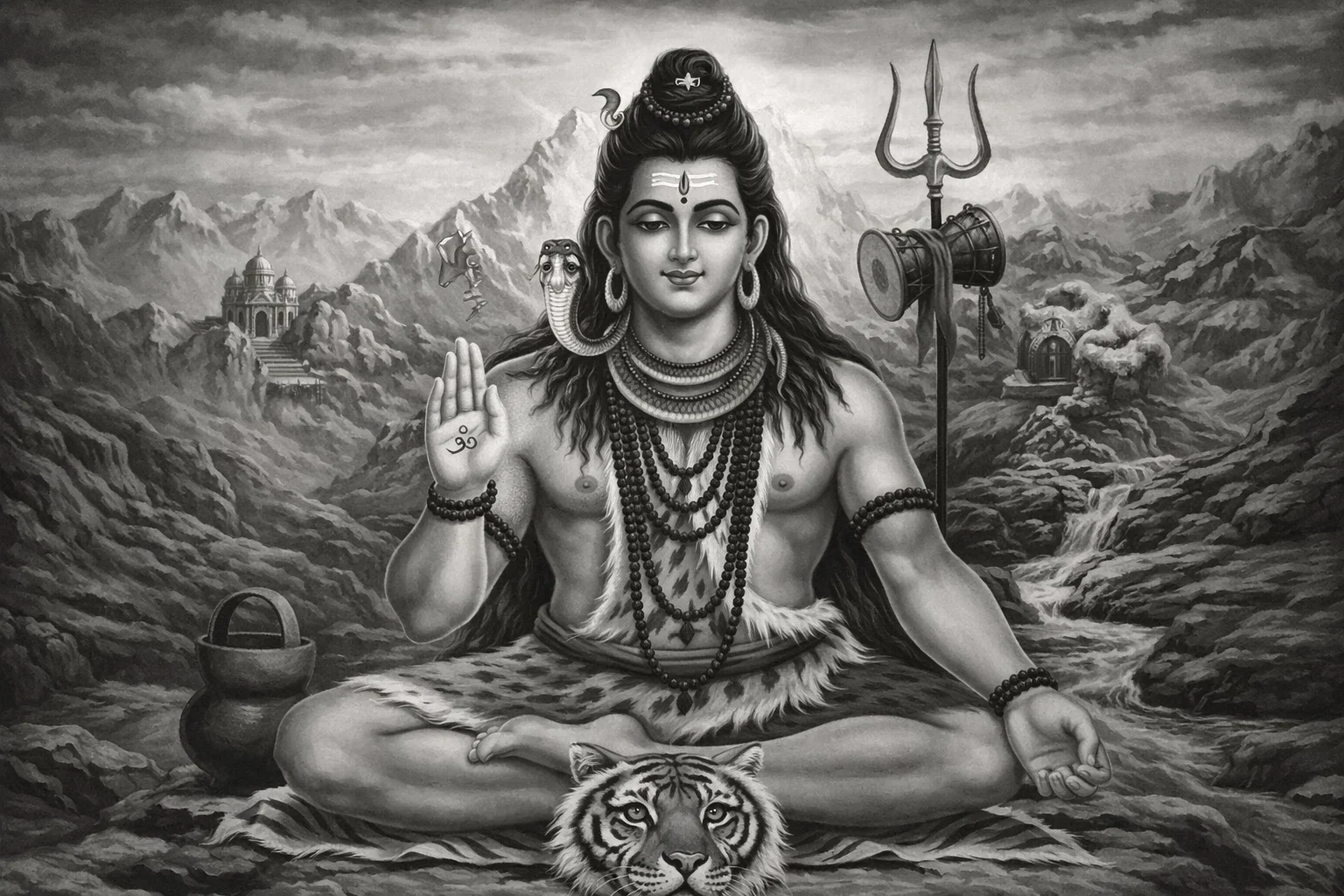
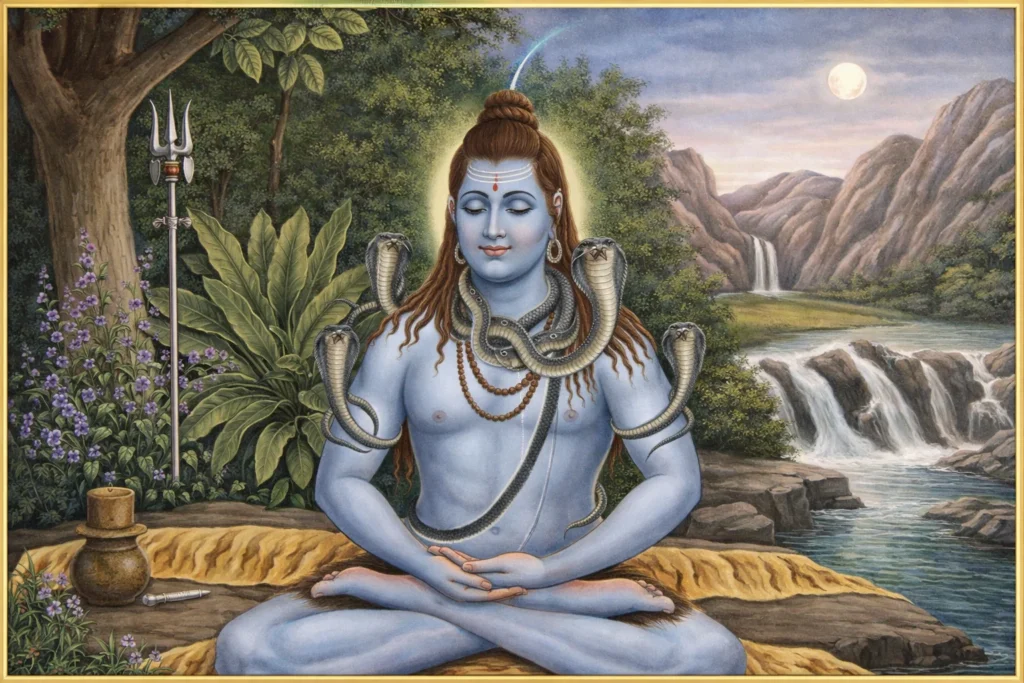
Traditional art and texts like the Shilpa Shastra show the god with a pale or ash-covered skin, which stands for his distance from worldly things and his link to cremation grounds, where all bodies return to dust. His most famous feature is the third eye on his forehead, which only opens during great destruction or to burn away desire (Kama).
His hair is matted (jata), showing his control over life and the wind. The crescent moon in his hair stands for his power over time and the mind’s cycles. He is often shown with a blue throat (Nilakantha) because he swallowed the Halahala poison to save the universe.
A snake around his neck means he has power over ego and death. He usually wears a tiger skin and holds a trident (Trishula) and a drum (Damaru), which made the first sounds of creation.
Origins
The oldest records of this god are in the Rig Veda, where he is called Rudra, a fierce god of storms and hunting.
In early Vedic rituals, Rudra was not a main entity and was often asked to hold back his ‘burning arrows’ and protect cattle. Over time, his wild traits mixed with local ascetic traditions, creating the classic figure seen in later stories.
During the Puranic period, stories about him grew to include his marriages to Sati and then Parvati, making him a key figure among the gods. This change shows how he moved from being a wild force of nature to a deeper symbol of the Atman, or Self.
You may also enjoy:
Rāga: The Seductive Demon of Passion and Desire in Buddhist Lore
October 16, 2025
What Is a Qareen and Why Does It Follow Every Human Being?
October 8, 2025
Andrealphus: The Peacock Demon Who Twists Minds and Bodies
January 19, 2026
Lamia: The Queen Cursed to Devour the Children of Others
January 7, 2026
Who Was Abezethibou, the Fallen Angel Who Opposed Moses?
October 1, 2025
Birth
Most traditions say the Great Destroyer is Svayambhu, meaning he appeared of his own accord and has no parents or birth. He exists before time starts and after it ends. Still, the Puranas tell different symbolic stories about how he appears in the current cycle of creation.
In the Shiva Purana, he manifests as a pillar of fire (Jyotirlinga) that has no beginning or end, challenging Brahma and Vishnu to find its limits. In other accounts, specifically the Vishnu Purana, according to lore, Rudra appeared from Brahma’s forehead when the creator’s anger manifested as a crying child. The child asked for names and places to live, and Brahma granted him eight names and eight spheres of influence.
Even with these ‘birth’ stories, most researchers agree that they symbolize how supreme consciousness enters the world we can see and experience.
Family
His family life is seen as a model for the householder stage (Grihastha), which is very different from his life as a hermit. His main partner is Parvati, daughter of the mountain king Himavat. Together, they show the union of consciousness (Purusha) and energy (Prakriti). They live on Mount Kailash with their two sons and many attendants.
| Relationship | Name |
| Parents | None (Self-manifested/Svayambhu) |
| Siblings | None (Though sometimes identified with Vishnu in a brotherly sense) |
| Spouse | Sati (first wife), Parvati (reincarnation of Sati) |
| Children | Ganesha (God of Wisdom), Kartikeya (God of War), Ashokasundari (Daughter) |
Role in Hindu Cosmology
In the cycle of Dharma and cosmic balance, the Auspicious One keeps things from falling into chaos.
In the Mahayugas, he guides the shift from the last age of darkness (Kali Yuga) to the next golden age. He is not a villain but a protector of order. Without his power to destroy, the universe would get stuck, weighed down by old karma and forms.
He is also a refuge for those on the margins of society. Unlike other gods who help only the righteous, he gives blessings to anyone—even Asuras—who shows true devotion.
This fairness often creates a central tension in Hindu stories, in which he grants power to a devotee who later becomes a threat, and Vishnu must step in.
Historical & Scriptural Records
“Ima Rudraya tavase kapardine ksayadviraya prabharamahe matih, yatha samasadvipade catuspade visvam pustam grame asminnanaturam.” (To the mighty Rudra, the one with matted hair, the ruler of heroes, we bring these prayers, so that there may be prosperity for our two-footed and four-footed creatures, and all in this village may be well-fed and free from disease.) [Rig Veda, Mandala 1, Sukta 114, c. 1500–1200 BCE]
In this early Sanskrit text, he is called Rudra, a fierce god of storms and the wild. The text highlights the main tension between his power to destroy and the community’s need for safety.
The name Kapardin (one with matted hair) appears here, and this feature is still seen in modern images as a sign of his ascetic strength and untamed nature.
Unlike later images of him as a kind protector, the Rig Veda shows him as a figure of fear who must be calmed to avoid disease. The name Rudra comes from a root meaning ‘to weep or howl,’ hinting at his link to unpredictable forces. This view aligns with the beliefs of early farming societies, in which storms or plagues were seen as ‘divine arrows’ from a wild god.
“Pancatmakam krtva deham panca-vimsati-tattvakam, tatra-stham paramatmanam pasyati jnana-caksusa.” (Having made the body five-fold, consisting of twenty-five principles, one sees the Supreme Soul dwelling therein with the eye of knowledge.) [Shvetashvatara Upanishad, Chapter 1, c. 400–200 BCE]
By the time of the Upanishads, there is a big change in language and theology. The scary hunter from the Vedas becomes the Paramatman, or Supreme Soul. This text is important because it brings in the ‘Eye of Knowledge’ (Jnana-chakshu), which later becomes the famous Third Eye in art.
Here, the focus shifts from external factors such as storms and cattle to internal ideas such as meditation and freedom. Shiva is no longer just a god to fear, but the ‘Inner Ruler.’ This period likely brought yogis and forest hermits into mainstream tradition, leading to his image as Yogishwara, the Lord of Yogis. The name ‘Auspicious One’ also becomes permanent now.
“Evamuktva sa bhagavan rudrah kala-samah prabhuh, prapasya tripuram dagdhum sankalpamakarot tada… tatas-tripuramatyartham dagdham tairyogamayaya.” (Thus spoken, the Lord Rudra, equal to Time itself, made a resolve to burn the Triple City… then the Triple City was utterly burnt by his yogic power.) [Shiva Purana, Rudra Samhita, c. 10th–11th Century CE]
This medieval text tells the story of the ‘Triple City’ (Tripura), showing Shiva as a cosmic destroyer. It clearly connects him to Kala (Time or Entropy), meaning destruction is a necessary part of the universe’s cycle.
The Tripura legend, in which three cities must align to be destroyed, is a metaphor for aligning the body, mind, and spirit toward enlightenment.
In this story, he is shown as a skilled strategist and top archer. The focus moves from his role as the Inner Soul to that of a hero who protects the gods from the Asuras. He uses ‘Yogic Power’ (Yogamaya) to burn cities rather than a weapon, showing that his main strength lies is his focused mind.
“O Lord of Animals, who dwells in the cremation ground, smeared with ashes, wearing a garland of skulls, you are the protector of those whom society has cast out.” [Regional Tamil Tevaram / Shaiva Siddhanta Hymns (Appar), c. 7th Century CE]
This South Indian text focuses on Shiva’s role as Pashupati (Lord of Animals or Souls), especially in the cremation ground (Shmashana). This image comes from the Kapalika and Pashupata groups, who practiced extreme forms of asceticism. The use of ashes (Bhasma) stands for the end of life and turning away from social class and physical beauty.
There may be a connection to much older, pre-Vedic figures. Some historians link this ‘Lord of Animals’ to ancient images from Mohenjo-Daro, which show a horned creature surrounded by animals.
His ongoing ‘outcast’ image—living in graveyards and being with ghosts (Bhutas)—shows a belief that he stands at the edge of human society, guarding the line between life and death. This folklore helped connect high-caste ideas with the real lives of forest dwellers and ascetics.
The Twelvefold Radiance and the Elemental Octad
The idea that the Great Destroyer has many forms helps explain how a single, formless spirit (Nishkala) connects with the world and its basic elements.
The Shiva Purana groups these forms into two main types: the Jyotirlingas, which are places of divine light on earth, and the Ashta-Murti, which are the main building blocks of reality.
The 12 Jyotirlingas
The twelve Jyotirlingas show how the god moves from being seen as unchanging to being active in specific places. The Linga Purana says these sites are not made by people; they are Swayambhu, or self-created. They appeared when the god became an endless column of fire to humble the other Trimurti gods.
While some see them as mere pilgrimage sites, others view them as energy centers in India’s spiritual scene, each linked to a particular type of freedom or protection.
Each Jyotirlinga acts as a special link between people and the divine. For example, at Mahakaleshwar, the daily Bhasma Aarti (offering of ashes) is more than just a ritual—it shows that the god is the only reality that lasts through time.
At Trimbakeshwar, the Linga is a small hollow with three thumb-sized forms of the Trinity, highlighting the god’s role as the base of all cosmic actions.
| Form Name | Location | Specific Attribute / Theological Significance |
| Somnath | Prabhas Patan, Gujarat | The “Lord of the Moon,” marking the site where the moon regained its luster. |
| Mallikarjuna | Srisailam, Andhra Pradesh | The “Lord of Jasmine,” embodying the union of Shakti and Shiva. |
| Mahakaleshwar | Ujjain, Madhya Pradesh | The “Lord of Time,” uniquely facing south toward the realm of death. |
| Omkareshwar | Mandhata, Madhya Pradesh | The “Lord of Om,” located on an island naturally shaped like the Pranava. |
| Kedarnath | Rudraprayag, Uttarakhand | The “Lord of the Mountains,” situated at 11,755 feet in the Himalayas. |
| Bhimashankar | Pune, Maharashtra | The “Giver of Happiness,” associated with the destruction of the demon Bhima. |
| Kashi Vishwanath | Varanasi, Uttar Pradesh | The “Lord of the Universe,” believed to grant Moksha at the moment of death. |
| Trimbakeshwar | Nashik, Maharashtra | The “Three-Eyed Lord,” representing the fusion of Brahma, Vishnu, and Shiva. |
| Baidyanath | Deoghar, Jharkhand | The “Lord of Physicians,” where the deity acts as a divine healer. |
| Nageshwar | Dwarka, Gujarat | The “Lord of Serpents,” signifying mastery over the earth and underworld. |
| Rameshwar | Rameswaram, Tamil Nadu | The “Lord of Rama,” established as a site of atonement for the killing of a Brahmin. |
| Grishneshwar | Aurangabad, Maharashtra | The “Lord of Compassion,” associated with the devotion of the woman Kusuma. |
You may also enjoy:
Andhaka: The Blind Demon Born From Cosmic Darkness
February 6, 2026
Barbas: The Lion Demon Who Spreads Disease
March 3, 2026
Who Is Abalam in Demonology? The Demon King That Serves Paimon
September 30, 2025
Mahakala: The Dark Guardian Who Consumes Evil
October 16, 2025
Who Is Futakuchi-onna, the Two-Mouthed Woman?
March 9, 2026
The 8 Rudras (Ashta-Murti)
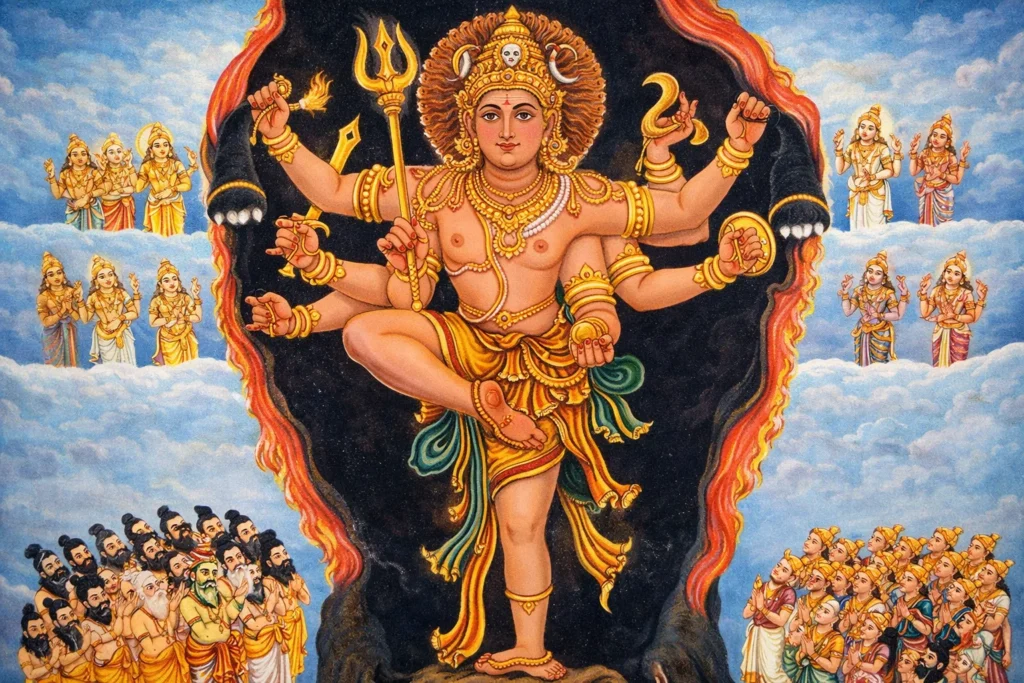
While the Jyotirlingas are found in real places, the Ashta-Murti (Eight Forms) show the god’s control over the Mahabhutas (Great Elements).
This idea means the universe is not separate from God, but is made from his own body. Each form rules a part of the world and has its own name and partner in Vedic and Puranic texts:
- Sharva (Earth): Representing the solid foundation of existence. This form sustains all life and is traditionally associated with the consort Vikeshi.
- Bhava (Water): The source of life and fluidity. As Bhava, the deity ensures the continuity of the biological cycle, paired with the consort Usha.
- Rudra (Fire): The force of digestion and cosmic destruction. This form facilitates the transformation of energy, paired with Suvarchala.
- Ugra (Wind): The vital breath (Prana) of the universe. Ugra represents the terrifying yet necessary movement of air that sustains respiration, paired with Diksha.
- Bhima (Ether/Space): The subtlest element. Bhima provides the space in which all sound and matter exist, paired with Swaha.
- Pashupati (The Soul): The “Lord of Animals” or individual souls. This form represents the spark of consciousness that inhabits biological forms, paired with Rohini.
- Ishana (The Sun): The source of physical light and sight. Ishana acts as the eye of the universe, providing the energy for growth, paired with Sarvarya.
- Mahadeva (The Moon): The regulator of the mind, nectar, and tides. This form provides cooling relief and governs the mental faculties, paired with Rohini (a different aspect of the lunar mansion).
These eight forms connect early Vedic nature worship with later Puranic ideas. By seeing the god in the sun, wind, and earth, followers understand that ‘destruction’ is really just the recycling of these eight basic parts.
This setup means that even when the universe ends, its basic parts stay within the Auspicious One, ready to be put together again in the next cycle. In this way, the Great Destroyer is really the Great Recycler, keeping the universe balanced by reusing its elements.
Myths, Legends, and Stories
The Churning of the Ocean and the Halahala Poison
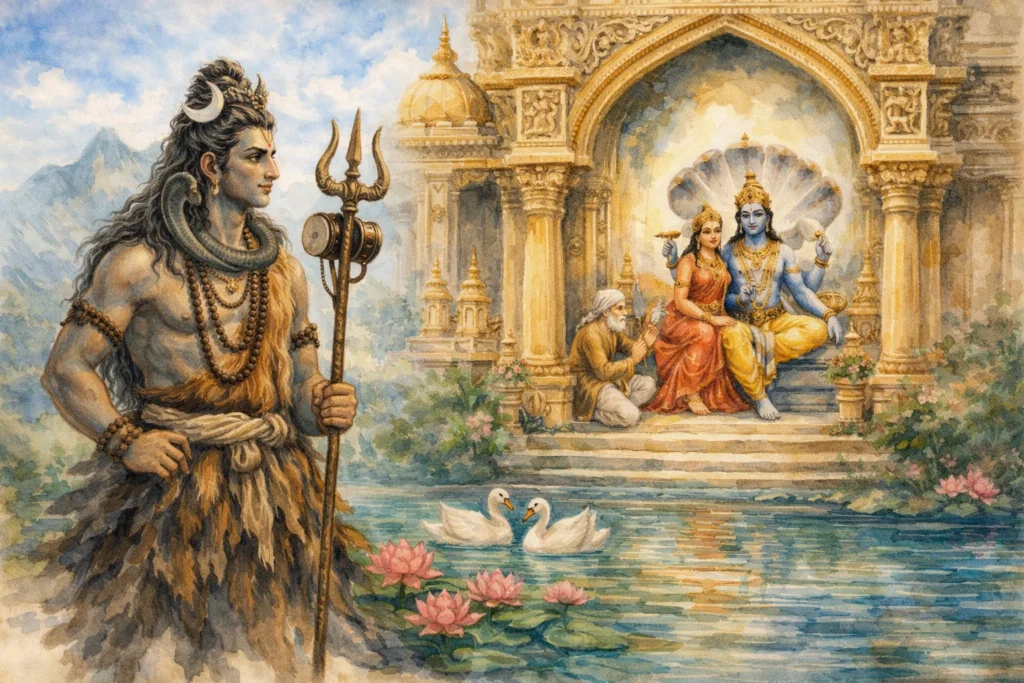
According to the Bhagavata Purana and the Mahabharata, the Devas and Asuras cooperated to churn the Ocean of Milk (Kshira Sagara) to obtain Amrita, the nectar of immortality.
Using Mount Mandara as the churning rod and the serpent Vasuki as the rope, they began the process. However, before any treasures appeared, a terrifying, lethal poison known as Halahala (or Kalakuta) began to effuse from the ocean. The fumes were so caustic that they began to blind the gods and wither the three worlds.
The terrified deities, led by Vishnu and Brahma, traveled to Mount Kailash to seek refuge. They addressed the Great Destroyer, saying, “O Lord of Lords, you are the soul of the universe. Only you can consume this poison that threatens to incinerate all of creation.”
After hearing their plea, the deity looked at the gathering toxicity with compassion. He stated, “I shall swallow this poison to ensure the safety of the world.”
He gathered the vast spread of black venom into his palms and drank it. As the liquid moved toward his stomach, his consort Parvati, fearing for the safety of the universe contained within his body, placed her hand on his throat. This act arrested the poison in his neck.
The toxicity was so potent that it turned his throat a deep, permanent blue. As a result, he earned the title Nilakantha. To cool the burning sensation of the poison, he placed the Crescent Moon on his matted hair. He was offered water by the gods, a tradition reflected in the modern ritual of Abhisheka.
The Destruction of the Triple City (Tripurantaka)
The Karna Parva of the Mahabharata details the rise of the three sons of the Asura Taraka: Tarakaksha, Kamalaksha, and Vidyunmali.
After performing severe penance to Brahma, they received the boon of the Tripura—three massive fortresses made of gold, silver, and iron. These cities were situated in different realms and could only be destroyed by a single arrow when they aligned once every thousand years.
The Asuras used these impregnable cities to terrorize the Devas and sages. The gods approached the Great Destroyer, requesting his intervention. He agreed, but required a chariot and weapons worthy of the task.
The Earth became his chariot, the Sun and Moon its wheels, and the four Vedas the horses. Brahma acted as the charioteer. Vishnu became the arrow, and Agni its tip.
As the thousand years drew to a close, the three cities began to align in the sky. The deity drew his bow, known as Pinaka. In that instant, he did not even need to release the arrow; he looked on the cities and smiled.
A single beam of energy from his Third Eye or the force of his laughter (Atthahasa) reduced the gold, silver, and iron cities to ashes simultaneously. This victory over the “Triple City” established him as Tripurantaka, the destroyer of the physical, subtle, and causal bodies of ego.
The Pillar of Fire (Jyotirlinga)
In the Shiva Purana, a dispute arose between Brahma (the Creator) and Vishnu (the Preserver) regarding who was the supreme architect of the universe. As their argument escalated, a massive, blazing pillar of light (Jyotirlinga) suddenly manifested between them. It appeared to have no beginning and no end, piercing through the highest heavens and the deepest underworlds.
Stunned, the two gods agreed to a contest: whoever found the end of the pillar would be declared supreme. Vishnu assumed the form of a great boar (Varaha) and burrowed deep into the earth for a thousand years. Brahma took the form of a swan (Hamsa) and flew upward into the firmament for an equal duration. Neither could find the limit.
While ascending, Brahma encountered a Ketaki flower falling from the sky. He persuaded the flower to lie and say he had reached the top. When they returned, Vishnu humbly confessed his failure, but Brahma claimed victory.
At that moment, the pillar burst open, and the Great Destroyer appeared in his full majesty. He cursed Brahma for his falsehood, stating he would not be worshipped in temples, and banned the Ketaki flower from his rituals. He then revealed that both Brahma and Vishnu were born of his essence, establishing the pillar as the symbol of the Infinite Truth.
The Descent of the River Ganga
The Ramayana and Brahmanda Purana recount the story of King Bhagiratha, who sought to bring the celestial river Ganga to Earth to purify the ashes of his ancestors. After years of penance, the river goddess Ganga agreed to descend, but she warned that the force of her fall from Heaven would shatter the Earth.
Bhagiratha then prayed to the Great Destroyer, the only being capable of withstanding the impact. The deity stood on the Himalayas and spread his matted hair (Jata). As Ganga plunged from the celestial world, she intended to sweep the deity away with her current. Sensing her pride, the deity trapped the entire river within his locks.
Ganga wandered through the maze of his matted hair for years, unable to find an exit. Finally, at Bhagiratha’s further request, the deity released the river in seven gentle streams.
One of these streams followed Bhagiratha’s chariot to the ocean. Because the river appeared from the deity’s hair, she is known as Jatashankari, and the deity is called Gangadhara (Bearer of the Ganga).
The Incineration of Kamadeva
The Kumarasambhava describes a period when the demon Tarakasura oppressed the gods. It was prophesied that only a son born of the Great Destroyer could slay him. However, the deity was immersed in deep, unmoving meditation following Sati’s death. To rouse him, the gods sent Kamadeva, the God of Love.
Kamadeva approached the meditating deity and released a flower arrow, intended to fire up the desire for the goddess Parvati, who was serving him. The moment the arrow struck, the deity’s meditation was disturbed.
He did not succumb to desire; instead, he felt a flash of cosmic anger at the interruption of his penance. He opened his Third Eye (Tryambaka), and a jet of fire erupted, instantly reducing Kamadeva to a pile of ash.
Kamadeva’s wife, Rati, pleaded for her husband’s life. The deity eventually relented, granting that Kamadeva would be reborn as Pradyumna, Krishna’s son.
Until then, Kamadeva would exist as Ananga (the Bodiless), representing love as a spiritual rather than a physical force. This myth shows Shiva’s absolute mastery over the senses.
You may also enjoy:
Hitotsume kozō: One-Eyed Yōkai of Japanese Folklore
February 4, 2026
Si’la: The Seductive Jinn Who Lures Travelers to Their Doom
October 9, 2025
Abura-sumashi: The Potato-Headed Yōkai That Punishes Greed
October 23, 2025
Who Is Abaddon, the Demon of the Abyss, in the Bible?
September 29, 2025
What Is a Qareen and Why Does It Follow Every Human Being?
October 8, 2025
Ancient Demons: The Real Origins of the Setcheh Myth
November 11, 2025
Comparison with Other Similar Entities
| Name | Trait/Role | Clan/Origin | Key Traits/Powers |
| Ravana | Conquest/Devotion | Rakshasa | Ten heads, invincibility boon |
| Bali | Sacrifice/Dharma | Daitya | Ruling the three worlds |
| Vritra | Drought/Obstruction | Asura | Immense size, serpent-like |
| Hiranyakashipu | Tyranny/Pride | Daitya | Boon of conditional immortality |
| Madhu | Chaos/Primordial | Asura | Born from Vishnu’s earwax |
| Mahishasura | Ambition/Ego | Asura | Shape-shifting (Buffalo) |
| Andhaka | Blindness/Ignorance | Asura | Regenerating from blood |
| Bhasmasura | Greed/Destruction | Asura | Ash-turning touch |
| Tarakasura | Oppression | Asura | Invincible except to a child |
| Jalandhara | Ocean-born Power | Asura | Strength from wife’s chastity |
Rank Among Asuras
While the Auspicious One is a Deva, his relationship with the Asura clans is complex and foundational to demonological studies. Shiva is often called Asuratosh, the “One who is easily pleased by Asuras.” Many of the most powerful leaders of the Daitya and Danava clans, such as Ravana and Banasura, were his fervent devotees.
He stands above the rivalries of the gods, acting as a supreme arbiter who rewards merit regardless of clan affiliation. In the hierarchy of the universe, he is the Ishwara (Supreme Lord) to whom even the most rebellious entities bow, making him the bridge between the celestial and the infernal realms.
Mystical Correspondences
| Attribute | Details |
| Planet | Saturn (discipline/time) or Moon (mind) |
| Zodiac Sign | Capricorn (asceticism) or Cancer (emotion) |
| Element | Ether (Akasha) or Fire |
| Direction | Northeast (Ishanya) |
| Color | White (purity/ash) or Blue (infinite) |
| Number | 5 (representing the five faces/elements) |
| Crystal/Mineral | Rudraksha (dried seeds) or Quartz |
| Metal | Mercury (associated with alchemy/Rasa) |
| Herb/Plant | Bael (Aegle marmelos) or Cannabis |
| Animal | Bull (Nandi) or Cobra |
| Trait/Role | Dissolution and Liberation |
Shiva’s cosmic power is linked to the Moon, which sits in his hair and controls both ocean tides and human moods. His connection to Saturn shows his role as Mahakala, the master of time, who brings the tough discipline needed for spiritual growth. These links highlight his calm and detached side, which is needed to let go of the old world.
On the material side, he is linked to the Ether element, which is the space where all sound and matter exist. Shiva is also connected to the Northeast, making this direction special in building traditions like Vastu Shastra.
People use Rudraksha seeds in rituals to connect with his compassion, and the Bael leaf stands for his three eyes and the three qualities (gunas) of nature.
Worship and Boons
Worship of the Great Destroyer is special in Hindu practice because it is open to everyone. While other gods may need strict rituals, he is called Ashutosh, or ‘He who is easily pleased.’ His worship is not about wealth, but about the devotee’s deep focus (Bhakti) and acts of penance (Tapasya).
Methods of Worship and Rituals
The main focus of worship is the Linga, which stands for the formless, endless pillar of light. Unlike statues of other gods, the Linga shows his beyond-the-physical nature:
- Abhisheka (Sacred Bathing): This is the most significant ritual. Devotees pour substances over the Linga to cool the heat generated by the deity’s cosmic energy and the Halahala poison. These substances include Milk (for purity), Honey (for sweetness of speech), Ghee (for victory), and Yogurt (for prosperity).
- Pancha-Brahma Mantra: Worshipers often chant the five-syllable mantra, Om Namah Shivaya. Each syllable corresponds to one of the five elements: Na (Earth), Ma (Water), Shi (Fire), Va (Air), and Ya (Ether).
- The Offering of Bael Leaves: The leaves of the Bilva (Aegle marmelos) tree are indispensable. They must be trifoliate, symbolizing the deity’s three eyes, the three Gunas (qualities of nature), and the three functions of the Trimurti.
- Bhasma (Sacred Ash): Followers draw three lines of ash (Tripundra) on their foreheads. This reminds them that the body is temporary and will one day return to the earth.
Major Festivals
The liturgical calendar features several key observances, the most prominent being Maha Shivaratri (The Great Night of Shiva):
- Maha Shivaratri: This festival is held on the 13th night or 14th day of the Phalguna month. It marks the night he performed the Tandava (Cosmic Dance) and his wedding to Parvati. Devotees fast and stay up all night in meditation, as this time is believed to boost the body’s energy.
- Sawan (Shravan Month): The whole lunar month of Shravan is dedicated to him. Thousands of ‘Kanwariyas’ walk barefoot to the Ganges to collect holy water and bring it back to their temples for Abhisheka.
- Pradosha Vrat: This ritual happens twice a month on the 13th day of each lunar half. It is considered the best time to clear negative karma through prayer.
The Nature of Boons (Varadas)
Shiva is the supreme granter of boons, often favoring those who demonstrate absolute resolve through Tapasya. Unlike the calculated boons of Brahma, the rewards granted by this deity are often vast, visceral, and sometimes paradoxical:
- Invincibility and Sovereignty: He granted the Asura king Ravana the Atma-Linga (which would make his kingdom invincible) and the celestial sword Chandrahas. However, because these boons are granted based on the merit of the penance rather than the morality of the seeker, they often require Vishnu to intervene when the seeker misuses the power.
- Weaponry (Divyastras): To the warrior Arjuna, he granted the Pashupata Astra, the most powerful weapon in the universe, after testing Arjuna’s skill in a wrestling match while disguised as a forest dweller (Kirata).
- Spiritual Liberation (Moksha): Most significantly, he is the only deity who grants the boon of Sayujya Mukti—complete merger into the divine consciousness. While other gods offer “heavenly realms,” the Great Destroyer offers the cessation of the cycle of rebirth entirely.
- Healing and Longevity: As Mahamrityunjaya (The Conqueror of Death), he is invoked to grant boons of health. The legend of Markandeya, a boy destined to die at sixteen, illustrates this; when the God of Death (Yama) came for him, the boy clutched the Linga, and the deity appeared to strike down Death itself, granting Markandeya eternal youth.
You may also enjoy:
Amdusias in the Ars Goetia: The Demon of Dark Music
December 2, 2025
Who Is Futakuchi-onna, the Two-Mouthed Woman?
March 9, 2026
Who Were the Hinn, the First Spirits of Creation?
November 12, 2025
Si’la: The Seductive Jinn Who Lures Travelers to Their Doom
October 9, 2025
Pazuzu: The Ancient Demon Who Fought Evil with Evil
November 4, 2025
Andrealphus: The Peacock Demon Who Twists Minds and Bodies
January 19, 2026
Bibliography
Author’s Note: As I studied these ancient texts, I noticed an interesting contrast between the wild, unpredictable ‘Howler’ in the Rig Veda and the calm, supreme being in the Shiva Purana. It was a real challenge to connect the raw violence of the Mahabharata’s battles with the abstract ideas in the Linga Purana. My research showed that the god’s story is not a straight line, but a complex attempt by people to turn the idea of chaos into a cycle of spiritual renewal.
- Griffith, Ralph T. H., and Arthur Berriedale Keith, translators. Complete Rig Veda in English (Sakala Shakha). Edited by Rigvedacomplete, Internet Archive ed., 2018. Internet Archive.
- Shastri, J. L., editor. The Siva-Purana, Part 1. Translated by a Board of Scholars, Motilal Banarsidass, 1970. Internet Archive.
- Shastri, J. L., editor. The Śiva-Purāṇa: Part 2. Translated by a Board of Scholars, vol. 2, Motilal Banarsidass, 1970. Ancient Indian Tradition and Mythology. Internet Archive.
- Shastri, J. L., editor. The Siva-Purana, Part 4. Translated by a Board of Scholars, Motilal Banarsidass, 1970. Internet Archive.
- Shastri, J. L., editor. The Linga Purana. Translated by a Board of Scholars, Motilal Banarsidass, 1973. WisdomLib.
- Ganguli, Kisari Mohan, translator. The Mahabharata of Krishna-Dwaipayana Vyasa. Edited and published by Pratap Chandra Roy, Bharata Press, 1883-1896. Internet Archive.
- Dutt, Romesh C., translator. The Ramayana: The Epic of Rama, Prince of India. Condensed into English Verse, 1899. Ancient Buddhist Texts, edited by Ānandajoti Bhikkhu, 2018.
- Dutt, Manmatha Nath, editor and translator.The Rāmāyana, Volume 4: Uttara Kānda. Edited by James Simmons, Project Gutenberg, 2020. Project Gutenberg. Originally published in Calcutta, 1894.
- Goyandka, C. L., editor. The Bhagavata Purana. Translated by a Board of Scholars, Gita Press, 2019. Internet Archive.
- Bhat, Vigneshwar & B, Jeevan. (2022). Connotations in The Concept of Lord Shiva – A Study of Various Indian Scriptures. 1. 279-287. ResearchGate.