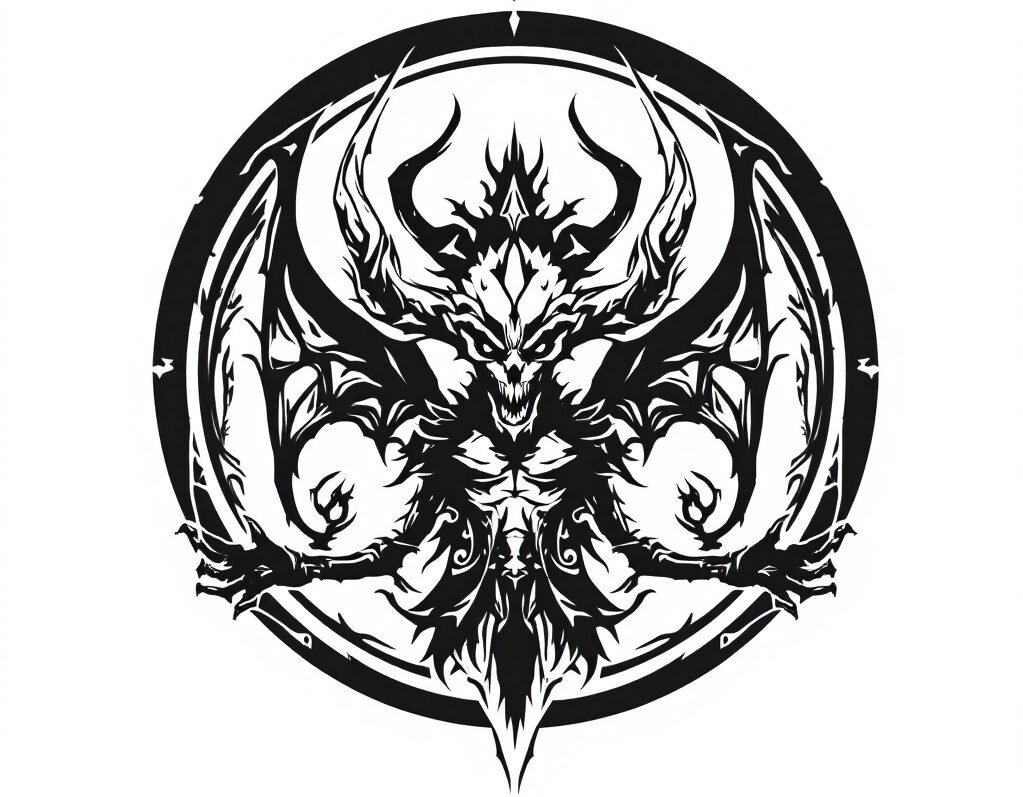
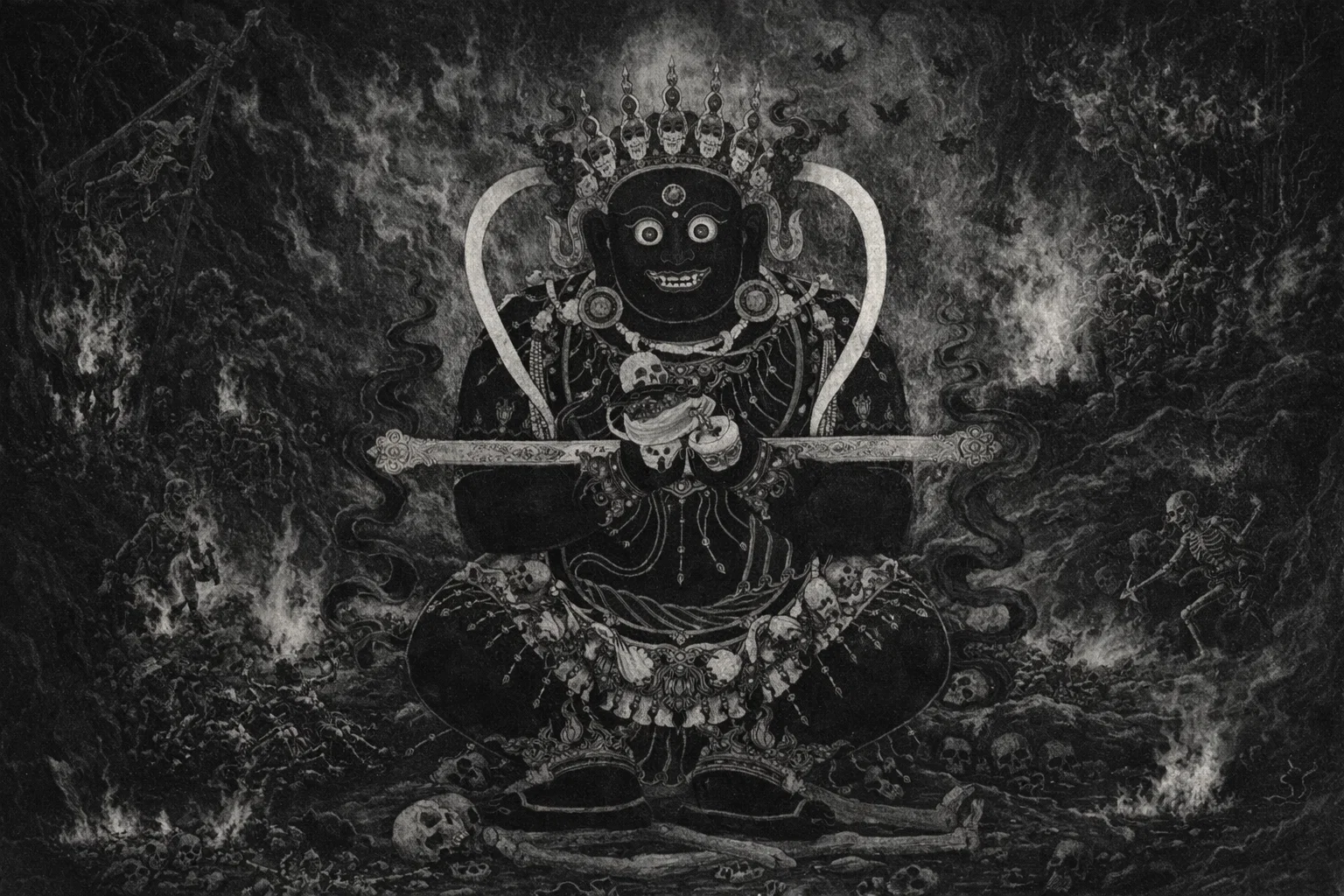
Mahakala’s transformation from a destructive force to a regulated guardian marks a major change in how spiritual disorder is managed. Instead of simply symbolizing chaos, Mahakala shows how raw aggression can be turned into a disciplined force that upholds cosmic order.
By comparing these forms with their Vedic origins, researchers can see how the idea of a ‘tamed’ deity developed to help practitioners overcome both inner and outer obstacles. Mahakala is also important in Hindu mythology; for more on his role as an avatar of Shiva, see the Hindu Demons category.
In this article, I focused on the earliest known appearances of Mahakala, especially by tracing the ‘Root Source’ through the Śrī Hevajra Tantra and later medieval rituals of Śrī Mahākāla Deva. Starting with these sources helps separate reliable tantric stories from the wider, sometimes conflicting, regional folklore. [View Full Bibliography ↓]
Summary
Key Takeaways
| Attribute | Details |
| Names | Mahakala, Dahei Tian, Daikokuten, Gonpo, Nagpo Chenpo |
| Title | Dharmapala (Dharma Protector), Lord of the Cemetery, The Great Black One |
| Region | Tibet, India, Mongolia, Japan, Nepal |
| Type | Buddhist wrathful deity, Dharmapala, Enlightened Being in demonic form |
| Gender | Male |
| Realm | Form Realm and Formless Realm (transcendent), often localized in charnel grounds |
| Obstacle/Threat | Spiritual ignorance, ego-attachment, violation of tantric vows |
| Associated Figures | Avalokiteshvara, Chakrasamvara, Palden Lhamo, Shri Devi |
| Weapon/Item | Kartika (flaying knife), Kapala (skull cup), Damaru (drum), Trishula (trident) |
| Weaknesses | Subjugation by higher Buddhas, purification through emptiness meditation |
| Associated Deity/Figure | Avalokiteshvara, Hevajra, Vajrapani |
| Pantheon | Vajrayana Buddhism, Tibetan Buddhism, Shingon Buddhism |
| Primary Sources | Mahakala Tantra, Shri Mahakala Tantra, Sadhanamala |
Who or What is Mahakala?
In Vajrayana Buddhism, Mahakala is seen as a Dharmapala, which means a protector of the teachings. Unlike ordinary spirits or harmful ghosts, he is viewed as an enlightened being who takes on a frightening form to fight negative forces and stubborn illusions. This distinction helps separate ‘enlightened’ anger from ordinary malice.
In many traditions, Mahakala is seen as the fierce form of Avalokiteshvara (the Bodhisattva of Compassion) or Chakrasamvara. His main role is to clear away anything that blocks a person’s path to enlightenment. Although he looks like a demon, with skulls, blood, and fierce expressions, his purpose is to destroy the ego and protect the sacred teachings.
“Mahakala” Meaning
The name comes from the Sanskrit words maha, meaning ‘great,’ and kala, which means both ‘time’ and ‘black.’ So, Mahakala can be translated as ‘Great Black One’ or ‘Great Time.’ This double meaning shows his role as both the force of time that eventually ends everything and the original darkness of ultimate reality, or Sunyata (emptiness).
As Mahakala’s story spread across Asia, his name and image varied across cultures. In Tibet, he is called Nagpo Chenpo, but in rituals, people often use the word Gonpo, meaning ‘Protector.’ In China, he became Dahei Tian, where some of his fierce traits were softened. In Japan, he is known as Daikokuten.
In Japan, Mahakala changed a lot, blending with local Shinto gods to become a god of wealth and the kitchen. He lost much of the fierce, demonic character he had in Indo-Tibetan traditions.
You may also enjoy:
Rokurokubi: The Yōkai That Looks Human Until Midnight
February 3, 2026
What Is Akaname, The Filth-Licking Yōkai?
October 28, 2025
Ifrit: Demon of Fire Who Serves Iblis in Islamic Tradition
September 30, 2025
Banasura: The Thousand-Armed Demon King
October 10, 2025
Rāga: The Seductive Demon of Passion and Desire in Buddhist Lore
October 16, 2025
Who Is Baal in Christian Demonology?
February 25, 2026
How to Pronounce “Mahakala” in English
The name is usually pronounced as mu-huh-KAA-luh.
- Maha: mu-huh (rhymes with ‘the-huh’)
- Kala: KAA-luh (the first ‘a’ is long, like in ‘father’).
What Does Mahakala Look Like?
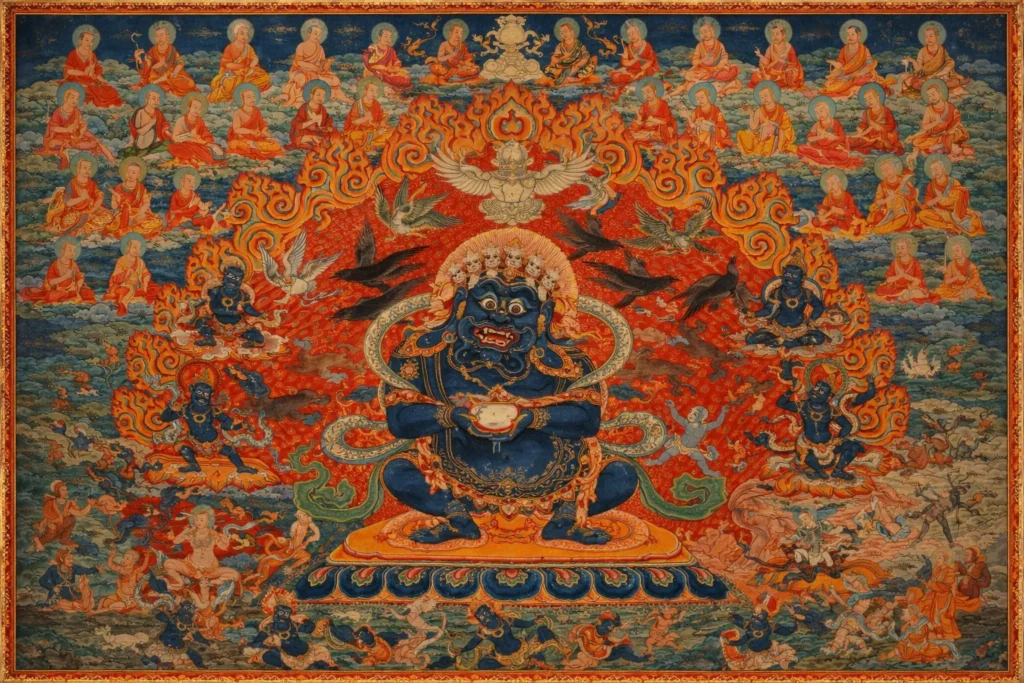
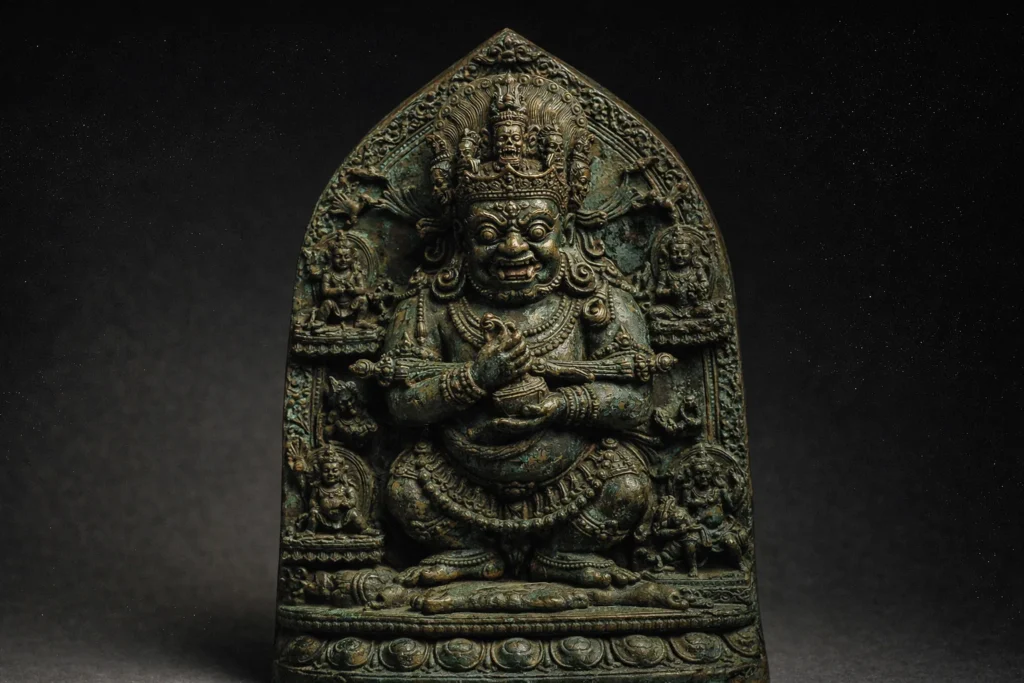
Mahakala’s appearance varies widely, with 75 distinct forms, but some features are common across most traditions. He is usually shown with deep blue or pitch-black skin, symbolizing unchanging truth. His body is often short, strong, and muscular, showing great power and stability.
He often has three bulging eyes, showing he can see the past, present, and future, and an open mouth with four sharp fangs. He wears a crown of five skulls, which stands for turning the five poisons (anger, desire, ignorance, pride, and jealousy) into five kinds of wisdom. He is also shown with a necklace of fifty severed heads and a tiger-skin loincloth.
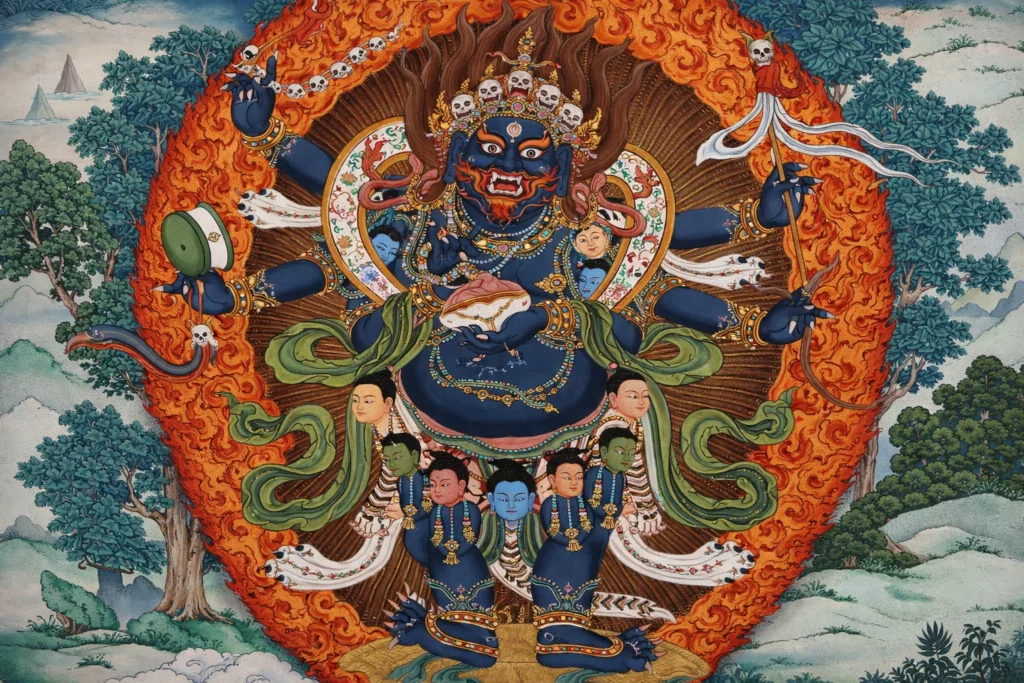
In his two-armed form, Mahakala usually has a kartika (a curved knife) to cut through the ego and a kapala (a skull cup) filled with the ‘blood’ of defeated demons, which stands for letting go of attachments.
In four-armed or six-armed forms, he may also hold a trident, a wooden gong, or a sword. He is often shown standing on two human corpses or on Ganesha, symbolizing the defeat of worldly obstacles and the end of the ego.
Origins
Mahakala’s origins are in Indian Shaivite traditions, where he was first seen as a frightening form of Shiva, the ultimate destroyer.
Around the 8th century, as Vajrayana Buddhism began to include local gods as protectors, Mahakala was adopted into Buddhism. According to legend, Avalokiteshvara saw the world entering a troubled time when peaceful methods no longer worked. Out of compassion, he created a dark-blue hung syllable, which became the fierce protector, Mahakala.
When Buddhism spread to Tibet, Mahakala became the main guardian for several important schools, especially the Sakya and Kagyu lineages. The first Buddhist texts describing him appear in the Mahakala Tantra, which explains the rituals, visualizations, and mantras used to call on him.
Over time, Mahakala’s role grew from just being a guardian to becoming a ‘personal deity’ or Yidam. Advanced tantric practitioners use him in meditation to quickly reach spiritual insight by facing their own inner darkness.
Sources
“Born from the syllable hūṁ is a vajra, black and terrifying. He should further cultivate the reality of hūṁ at the center of the vajra’s hub. Visualizing the transformation of the syllable hūṁ, he should meditate on the one whose nature is hatred: the vajra-born is deep black, the color of a blue lotus, or, with a blue-red hue, specifically visualized based on faith.” [Śrī Hevajra Tantra, 8th Century CE]
This important text is the ‘Root Source’ for Mahakala’s appearance in Buddhist tantra. Unlike earlier Buddhist texts that focused on peaceful behavior, the Hevajra Tantra brings in the idea of ‘using poison as medicine.’
In this text, Mahakala is clearly connected to turning hatred (dvesha) into pure wisdom. Visualizing him as ‘deep black’ or like a ‘blue lotus’ is not just for looks; it symbolizes the limitless, free nature of the enlightened mind, akin to the night sky or the deep ocean.
This source calls Mahakala a ‘Vajra Being,’ which means he is indestructible and represents ultimate reality. The main point in this 8th-century text is that he takes on a frightening form to show a spiritual truth that goes beyond ordinary logic or gentle teaching. This marks a time when Buddhism started to include and soften the fierce styles of Indian charnel ground traditions.
“The Lord of Pristine Awareness has six hands and a body dark blue in colour. The first two hold a curved knife and skullcup, the middle two a human skull mala and trident, the lowest two a damaru drum and lasso. Adorned with a tiger skin, garland of heads, bones and snakes, and small bells on the hands and feet. Standing in a manner with the two legs together pressing down on Ganapati.” [Sādhanamālā (Compendium of Ritual Practices), 12th Century CE]
By the 12th century, the Sādhanamālā served as a guide that organized earlier wild images into a set iconography. It gives the standard description of the Six-Armed form of Mahakala. The detail of Mahakala standing on Ganapati (the elephant-headed god) is important. While Ganapati is loved in Hinduism, here he stands for ‘worldly obstacles’ that the protector must overcome.
The kartika (flaying knife) and kapala (skull cup) stand for cutting away the ego and removing spiritual impurities. At that time, monastic life in India was under threat, so Mahakala’s image became more protective and even militaristic. He was seen not just as a meditation aid, but as the main guardian of the tradition’s survival.
“Say: ‘Hail to you, black looking one!’ on the hair. Say: ‘Hail to you, lucky Maha Ugra,’ on the arms… Say: ‘Hail to you, dissolver of the world,’ putting Vaisakha on the knees. Say: ‘Hail to you, Bhairava,’ putting Jyesta on the legs… Say: ‘Hail to you, dark fortnight,’ from the feet to the head.” [Śrī Mahākāla Deva (Shiva-Shakti Mandalam interpretation), Late Medieval/Folk Tradition Influence]
This source shows how Buddhist and Hindu ideas about Mahakala often mix together in folklore. By connecting his body to the lunar calendar and months like Vaisakha or Jyesta, the text turns him into a living symbol of cosmic time.
The name ‘Maha Ugra’ (Great Terrible One) and the link to the ‘dark fortnight’ connect him to deep fears of the night and the natural decay of the world.
Looking at history, this ritual mapping shows that Mahakala became a ‘bridge’ entity. Ordinary people often did not separate the monks’ ‘Enlightened Protector’ from Shiva, the ‘Lord of Time.’
These different names show how Mahakala gave people a sense of stability during difficult times, acting as a symbol of order when society was in turmoil.
You may also enjoy:
Hitotsume kozō: One-Eyed Yōkai of Japanese Folklore
February 4, 2026
Chort: The Sinister Slavic Demon of Chaos and Bad Luck
March 10, 2026
Mara: The Buddhist Demon King of Desire and Death
October 13, 2025
What Is a Dīv? The Terrifying Giant Demon of Persian Myth
January 22, 2026
Powers and Abilities
Mahakala’s power is considered transcendent, meaning it goes beyond the cycle of rebirth (samsara). Although he looks like a demon, his power is like that of a Buddha, making him much greater than local spirits, ghosts, or gods who are still affected by karma.
- Obstacle Removal: The ability to instantaneously dissolve physical and spiritual barriers to enlightenment.
- Ego Dissolution: The power to “flay” the practitioner’s attachment to a false sense of self.
- Command over Spirits: Authority to lead an army of dakas and dakinis to subdue malevolent entities.
- Time Manipulation: Control over the “opportune moment” for spiritual practice and the timing of death.
- Protection of Secret Teachings: The capacity to shield sacred texts and oral traditions from those who would misuse them.
Myths, Legends, and Stories
The Conversion of the Black Destroyer
In early Buddhist accounts, the entity was once a powerful worldly spirit of the charnel grounds who caused immense suffering through his unbridled rage.
The myth tells of Vajrapani, the wielder of the thunderbolt, challenging the entity to a cosmic duel. After a display of overwhelming spiritual force, Vajrapani subdued the spirit and forced him to take a vow of service.
Mahakala was then “baptized” in the wisdom of the Buddhas, retaining his terrifying strength but redirecting it solely toward the defense of the Dharma. He was bound by an oath to protect practitioners who remain faithful to their vows, becoming a “Vow-Bound” guardian.
The Six-Armed Vision of Shavaripa
A prominent legend in the Shangpa Kagyu tradition concerns the mahasiddha Shavaripa. While meditating in the Cool Grove charnel ground, Shavaripa received a direct vision of the Six-Armed manifestation. In this narrative, the deity appeared amidst a whirlwind of dark clouds and fire, surrounded by an entourage of black birds and dogs.
The deity transmitted the Sadhana (practice manual) directly to the mahasiddha, explaining that in the future, his fierce form would be necessary to protect the lineage from the “barbaric” influences of the dark ages.
This story is the foundational justification for the entity’s prominent role in Tibetan monastic life.
The Protection of the Sakya Monastery
Historical chronicles of the Sakya school describe an instance where a hostile army approached the monastery with the intent to destroy its sacred relics. The monks performed a massive invocation of the “Four-Faced” protector.
According to the accounts, the invading soldiers were suddenly gripped by a collective hallucination of a giant black creature towering over the mountains, holding a massive sword. The soldiers fled in terror without a single blow being struck. This event solidified the entity’s reputation as a “Guardian of the State” in Tibetan history.
Mahakala vs Other Similar Entities
| Demon Name | Associated Obstacle/Role | Origin/Source | Key Traits/Powers |
| Mara | Temptation and Delusion | Pali Canon | Illusions, army of demons |
| Yama | Judgment and Death | Rig Veda / Sutras | Mirror of Karma, lord of hell |
| Palden Lhamo | Protection of Lhasa | Tibetan Tantras | Diseases, divination |
| Rakshasa | Cannibalism/Violence | Ramayana / Jatakas | Superhuman strength, shape-shifting |
| Preta | Extreme Greed/Hunger | Abhidharma | Invisible, needle-thin necks |
| Asura | Pride and Warfare | Samyutta Nikaya | Combat prowess, divine jealousy |
| Yaksha | Nature/Wealth Guarding | Early Sutras | Invisibility, localization in trees |
| Kumbhanda | Vitality Theft | Lotus Sutra | Consuming human “essence” |
| Garuda | Anti-Serpent Protection | Mahayana Sutras | Flight, snake consumption |
| Vritra | Drought and Obstruction | Vedic/Buddhist Lore | Enormous size, water blockage |
Mystical Correspondences
| Attribute | Details |
| Planet | Saturn (associated with time and discipline) |
| Zodiac Sign | Scorpio or Capricorn |
| Element | Space / Ether |
| Direction | North or West (depending on tradition) |
| Color | Deep Blue or Black |
| Number | 9 or 75 (referencing the 75 forms) |
| Crystal/Mineral | Lapis Lazuli or Jet |
| Metal | Iron |
| Herb/Plant | Aconite or Black Mustard Seed |
| Animal | Raven, Black Dog, or Tiger |
| Trait/Role | Enlightened Wrath / Protection |
The mystical links to Mahakala highlight his role as a force of ending and purification. In tantric rituals, black mustard seeds are thrown into a fire to show the destruction of negative spirits. His connection to the planet Saturn shows his strict and firm discipline; he does not bargain with the ego but requires complete surrender to wisdom.
His symbolic animals, the raven and the black dog, connect him to the borderlands of the charnel ground and the afterlife.
In Tibetan art, these animals often appear with him, acting as messengers or scouts who spot problems in spiritual practice. Together, these symbols show Mahakala as the main guardian between ordinary life and spiritual freedom.
You may also enjoy:
Aeshma: The Zoroastrian Demon of Wrath and Fury
January 13, 2026
Who Is Andromalius, and Why Is He the Last Demon of the Goetia?
January 20, 2026
Chort: The Sinister Slavic Demon of Chaos and Bad Luck
March 10, 2026
What Is Jorōgumo? The Deadly Spider Woman of Japanese Myth
February 2, 2026
Ancient Demons: The Real Origins of the Setcheh Myth
November 11, 2025
Bibliography
Author’s Note: For this article, I compared early scriptures, such as the Saṃyutta-Nikāya, with detailed tantric rituals from Bhattacharyya’s Sādhanamālā. I also used research from Rana and Kalyanaraman to focus on how Mahakala changed from a Vedic time force to a Buddhist protector. This approach helped me balance the deep philosophy of the Lankavatara Sutra with practical rituals, making it clear how Mahakala’s Hindu roots differ from his special role in Vajrayana Buddhism.
- Bhattacharyya, Benoytosh, editor. Sādhanamālā. Vol. 1, Oriental Institute, 1925. Gaekwad’s Oriental Series, no. 26. Internet Archive.
- Bhattacharyya, Benoytosh, editor. Sādhanamālā. Vol. 2, Oriental Institute, 1928. Gaekwad’s Oriental Series, no. 41. Internet Archive.
- Monteiro, José Ricardo. Mahakala-Tantra. Academia.edu.
- Suzuki, Daisetz Teitaro, translator. The Lankavatara Sutra: A Mahayana Text. George Routledge and Sons, Ltd., 1932. The John C. and Susan L. Huntington Archive of Buddhist Sanskrit Manuscripts.
- Feer, Léon, editor. The Saṃyutta-Nikāya of the Sutta-Piṭaka: Part I. Sagātha-Vagga. Published for the Pali Text Society, Henry Frowde / Oxford University Press, 1884. Internet Archive.
- Kalyanaraman, Srinivasan. Mahākāla (महाकाल) Worship in Bauddham Is Evidence of Continuum of Sanātana Dharma, Hindu Religion and Temple Worship Tradition. Academia.edu.
- Rana, Poonam. (2019). The sacred Mahakala in the Hindu and Buddhist texts. Nepalese Culture. 13. 77-94. 10.3126/nc.v13i0.27503. ResearchGate.
- Significance of Mahakala worship. Wisdom Library. Retrieved on April 15, 2026.