Many nocturnal beings in the Solomonic tradition are known for physical attacks. Still, Ambolin stands out for his focus on psychological harm. Instead of just haunting the night, he uses the moments between wakefulness and sleep to create a strong sense of nighttime dread.
Looking at the demon’s role as a servant to the kings Ariton and Oriens shows that he has a special place in the infernal hierarchy. His purpose is to bypass logical thinking and reach the human subconscious directly.
This article examines modern accounts of Ambolin by comparing them with the Abramelin and Solomonic manuscripts to build a historical profile grounded on evidence. Since the demon is not mentioned in the Goetia or the Lemegeton, so he is often missed by researchers. [View Full Bibliography ↓]
Summary
Key Takeaways
| Attribute | Details |
| Names | Ambolin |
| Gender | Male |
| Role | Servant of the higher-ranking demons, primarily Asmodeus and Astaroth |
| Rank | Lesser demon; a spiritus familiaris |
| Hierarchy | Serves under Asmodeus and Astaroth |
| Powers | Functions as an attendant or familiar, carrying out the will of his masters |
| Associated Figures | Asmodeus, Astaroth, Balam, Paimon, Leviathan |
| Weaknesses | Bound by the authority of higher spiritual names and divine power |
| Opposing Angel/Saint | The Archangel Raphael (who bound Asmodeus) |
| Pantheon | Christian demonology, particularly the tradition related to the Lemegeton |
| Primary Sources | The Book of Sacred Magic of Abramelin the Mage, the Grimorium Verum |
Who or What is Ambolin?
Ambolin is a lesser demon described in esoteric texts as a familiar spirit who performs tasks for more powerful demons. He mainly serves Asmodeus, a king among demons known for lust, gambling, and extravagance, and Astaroth, a great duke associated with idleness and vanity.
Demons like Ambolin play important roles in the infernal system, often working as messengers, helpers, or agents on Earth. Although he cannot command legions, his connection to powerful demons like Asmodeus and Astaroth shows that he still has an important job.
“Ambolin” Meaning
The exact origin of the name Ambolin is unclear, which matches his status as a lesser-known entity in European occult texts. Unlike well-known demons like Baal or Lucifer, whose names have clear roots in older languages, Ambolin’s name doesn’t have a widely accepted meaning.
The name Ambolin may derive from the complex naming conventions of the Lemegeton and similar works. Names in these texts were often created or adapted from languages like Hebrew, Latin, and Greek, or changed over time as they were copied.
Since Ambolin is linked to The Book of the Sacred Magic of Abramelin the Mage, his name might have Kabbalistic or Hebrew influences. Still, there is no clear proof of this.
How to Pronounce “Ambolin” in English
The usual way to say Ambolin in English is AM-buh-lin. The stress is on the first part, “Am,” and the rest, “bo” and “lin,” are said quickly and clearly.
What Does Ambolin Look Like?
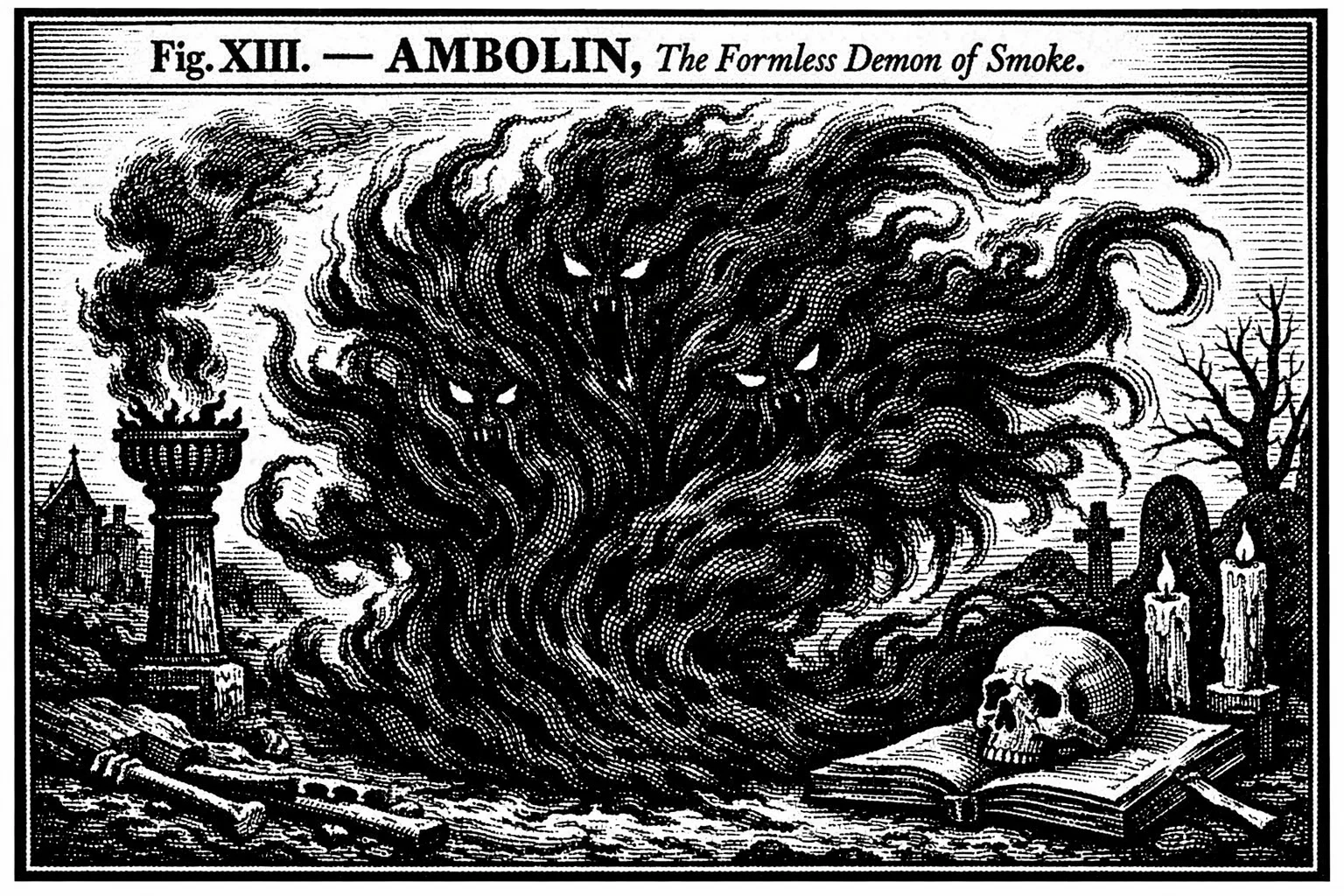
There are no detailed descriptions of what Ambolin looks like in the main sources, like The Book of the Sacred Magic of Abramelin the Mage or the Grimorium Verum. This is typical for lesser demons, especially familiar spirits, whose main role is to serve rather than to stand out.
Familiar spirits like Ambolin are usually described in vague terms, if at all. They often take on shapes that are useful or easy for their masters or the magician who controls them. These forms can change a lot, from ghostly figures to shadows to animal or mixed shapes.
You may also enjoy:
Who Is Asmodeus in Demonology and the Bible?
February 18, 2026
Ancient Demons: The Real Origins of the Setcheh Myth
November 11, 2025
Ammit: Devourer of the Dead in Ancient Egyptian Mythology
November 10, 2025
What Is a Tengu? Origins, Powers, and Dark Folklore
January 29, 2026
Rāga: The Seductive Demon of Passion and Desire in Buddhist Lore
October 16, 2025
Nasnas: The Monstrous Demon Hybrid That Haunted Pre-Human Earth
November 12, 2025
Origins
The first records of Ambolin appear in texts about summoning and controlling familiar spirits. His origins are ingrained in European occult traditions, especially those centered on King Solomon and the binding of demons.
The main early source for Ambolin is The Book of the Sacred Magic of Abramelin the Mage, a 15th-century text attributed to Abraham of Worms. This book describes a system of magic for contacting the Holy Guardian Angel and gaining control over demons.
In this book, Ambolin is clearly identified as a servant demon serving two of the Eight Sub-Princes, who themselves serve under the Four Grand Princes of Evil: Lucifer, Leviathan, Satan, and Belial.
Historical & Grimoire Records
While Ambolin does not appear in the Bible or in the earliest seminal texts of Judeo-Christian demonology, its historical record dates to the late 15th century in Buch Belial and in the early manuscripts of the Sacred Magic of Abramelin the Mage.
“Ambolin. — Under Ariton. — From the Greek’ amballo,’ to throw, or ‘ambolên,’ at the top of.” [The Book of the Sacred Magic of Abramelin the Mage, S.L. MacGregor Mathers Translation, 1898 (Based on 15th-century French Manuscript)]
This source is the main foundation for Ambolin’s place in Western esoteric tradition. Unlike the well-known Goetia, which sorts spirits by metals and planetary ranks like Duke or President, the Abramelin system uses a strict four-part hierarchy.
Ambolin is placed in the section ruled by Ariton, a king linked to the element of Water and the North. This means Ambolin was not seen as acting alone, but as a special part of a larger demonic power.
Mathers connects Ambolin’s name to the Greek word amballo, meaning “to throw” or “to delay”. This changes Ambolin from just a monster to a symbol of procrastination or disruption. In 15th-century occultism, he represented the mental blocks that could stop someone from finishing the long purification ritual needed to contact their Holy Guardian Angel.
Original:
“Die ander Schar unter dem Hauptmann Ariton: […] Ambolin, Abutes, Corcaron…” [Das Buch Belial (The Book of Belial), Jacobus de Teramo, Late 15th Century (German Manuscript tradition)]
Translation:
“The second host [or troop] under the Captain Ariton: […] Ambolin, Abutes, Corcaron…”
This early German manuscript is important because it sets out Ambolin’s role before English translations became common. In these texts, Ambolin is listed as a subordinate to Ariton, called the Captain or Prince. Unlike later Victorian ideas of huge legions, the 15th-century texts saw these groups as smaller, more specific courts.
Listing Ambolin with names like Abutes shows a change in medieval demonology, where names were created from mixed and sometimes altered Hebrew, Greek, and Latin roots to form a kind of demon name list.
At that time, demons were not seen as monsters from scary stories, but as legal figures in cosmic trials. For example, Belial is part of a story about a demonic lawsuit against Christ. Ambolin represents the administrative side of Hell, known more for his role in the demonic system than for any physical appearance.
Original:
“Ambolim, spiritus sub Ariton et Oriens. Valet ad terrores nocturnos incutiendos.” [Clavicula Salomonis (Key of Solomon) variant, 17th Century Latin Manuscript]
Translation:
“Ambolim, a spirit under Ariton and Oriens. It is effective for [or has power in] instilling nocturnal terrors.”
This 17th-century Latin version shows how Ambolin’s role changed over time. He is no longer just a name in a list, but is now described as having the power to cause nighttime terrors. This connects the earlier idea of Ambolin as an administrative demon to the modern image of him as the Demon of Nighttime Dread.
This change shows how, in the 17th century, people became interested in the ‘Pathology of the Soul.’ Demons were often described in terms of the mental or physical problems they could cause. By connecting Ambolin to night terrors, these texts offered a supernatural reason for what we now call sleep paralysis or night terrors.
This shows a move from seeing demons as legal figures to seeing them as causes of real, intense human experiences. It connects formal ritual magic with everyday fears and superstitions.
Powers and Abilities
Ambolin’s powers come from his role as a familiar spirit. His abilities help carry out his master’s harmful plans and actions.
The demon’s powers and abilities may include:
- Serving as a Dedicated Attendant: His primary power is to act as a direct and tireless servant to his masters, Asmodeus (King of Lust and Wrath) and Astaroth (Duke of Idleness and Rationalization).
- Executing Commands: He is empowered to carry out specific, practical tasks and commands given by Asmodeus and Astaroth, which are often directed toward human corruption and sin.
- Facilitating Vice: Given his association with Asmodeus, Ambolin is implicated in the promotion of lust, gambling, extravagance, and general hedonism among mortals.
- Inducing Sloth and Vanity: Through his service to Astaroth, his powers extend to fostering idleness, vanity, and the rationalization of evil, making humans susceptible to profound self-deception and moral decay.
- Aiding in Infernal Communications: He may serve as a messenger between his masters and other lesser demons or bound human agents.
- Granting Wealth or Secrets (Indirectly): Since Asmodeus and Astaroth are associated with the giving of treasures and knowledge (though always with ruinous consequences), Ambolin’s powers are used to help channel or dispense these dark gifts to those who perform the requisite dark pacts.
Ambolin and the Limbic Siege
Old grimoires list Ambolin as a sub-prince working under Oriens and Ariton. Still, his role hints at an early understanding of how the human mind works during sleep. Ambolin does not control deep sleep; instead, it focuses on the ‘limbic siege,’ which means taking advantage of the state between wakefulness and sleep.
This state is the delicate time between being awake and dreaming, when the logical part of the brain relaxes, and the emotional part is more open to suggestion. In this ‘gray zone,’ Ambolin’s influence is not seen, but felt, turning normal sounds into something frightening, like footsteps in the dark.
In world folklore, Ambolin is similar to figures like the Kashmar or ‘Old Hag’ found in sleep paralysis stories. While folk tales see these beings as lone troublemakers, the Solomonic tradition treats Ambolin as a skilled agent of fear. This shows that people in the Middle Ages saw nighttime dread as a planned attack, not just a random problem.
Ambolin erodes the sense of safety at home, acting as a ‘breaker of sanctuary.’ This keeps the magician or victim on edge, stopping them from finding spiritual or physical rest.
These links show how ideas about demons changed over time, from seeing them as physical monsters to viewing them as causes of psychological problems. Ambolin represents the ‘high-arousal’ fear response, able to trigger the body’s fight-or-flight reaction even when there is no clear threat.
Studying Ambolin is also a way to look at the history of insomnia and how people have long known that the worst fears are often created by the mind in the quiet darkness of night.
Ambolin vs Other Christian Demons
| Demon Name | Associated Sin/Temptation | Rank/Origin | Key Traits/Powers |
| Balam | Idolatry, deception | King (Ars Goetia #51) | Knowledge of past, present, and future; grants invisibility; three heads (bull, man, ram) |
| Paimon | Worldly pride, carnal desires | King (Ars Goetia #9) | Grants Dignities; commands 200 legions; knowledge of all arts and sciences; appears on a dromedary |
| Purson | False piety, materialism | King (Ars Goetia #20) | Discovers hidden things; answers questions of Earth’s creation; grants good familiars; appears as a man with a lion’s face, riding a bear |
| Zagan | Corruption, deceit | King and President (Ars Goetia #61) | Transmutes liquids (wine to water, blood to wine); makes men witty; appears as a bull with griffin wings |
| Gremory | Lust, infidelity | Duke (Ars Goetia #56) | Reveals past, present, and future; finds treasures; procures the love of women; appears as a beautiful woman riding a camel |
| Belial | Lawlessness, worthless things | King (Ars Goetia #68) | Instills pride and sin; grants high titles; appears in a fiery chariot |
| Beelzebub | Gluttony, sloth | Prince of the Seraphim (Binsfeld’s) | Commands vast armies; associated with flies and disease; a high-ranking demon of corruption |
| Mammon | Greed, avarice | Prince of Tempters (Christian Demonology) | Personification of wealth and material desire; it incites the love of money |
| Leviathan | Envy, heresy | Prince of the Seraphim (Binsfeld’s) | Controls the seas; demon of the abyss; associated with massive, untamable chaos |
| Orias | Sorcery, divination | Marquis (Ars Goetia #59) | Transmutes men into any form; gives dignities; knows the courses of the stars |
| Valefor | Theft, temptation | Duke (Ars Goetia #6) | Lures people into stealing; appears as a lion with a man’s head |
| Banshee | Misery, grief | Lesser spirit (Celtic/Irish Folklore) | Forewarns death through wailing |
| Pazuzu | Plague, drought | Ancient Mesopotamian Demon | Bringer of famine and pestilence; often invoked against the demon Lamashtu |
You may also enjoy:
Tarakasura: The Dark Demon Who Ruled Hell on Earth
December 4, 2025
Pazuzu: The Ancient Demon Who Fought Evil with Evil
November 4, 2025
Who Is the Infernal King Balam? Origins, Powers, and Occult History
February 26, 2026
Nasnas: The Monstrous Demon Hybrid That Haunted Pre-Human Earth
November 12, 2025
Palis: The Foot-Licking Desert Jinn That Drinks Your Blood
December 3, 2025
Rank in the Hierarchy of Hell
Ambolin has a lower, supporting rank in the complex system of Christian demonology. He is called a familiar spirit, which puts him far below the Kings, Dukes, Marquises, and Presidents who lead many lesser spirits.
In the system documented in The Book of the Sacred Magic of Abramelin the Mage, this relationship is clearly delineated:
- The Four Grand Princes of Evil (Lucifer, Satan, Leviathan, Belial) are at the apex.
- The Eight Sub-Princes (which include Asmodeus and Astaroth) serve under the Grand Princes.
- Ambolin and other named familiar spirits serve under the Eight Sub-Princes.
Ambolin is a loyal and important servant who carries out the orders of his two masters, both Princes of Hell. He cannot command his own legions, but working closely with these powerful figures lets him take part in major acts of evil.
His role is practical—he carries out tasks rather than giving orders, mainly focusing on sins like lust, gambling, laziness, and vanity.
Mystical Correspondences
| Attribute | Details |
| Planet | Mars (via Asmodeus), Venus (via Astaroth) |
| Zodiac Sign | Aries, Scorpio (via Asmodeus) |
| Element | Fire (via Asmodeus/Wrath) |
| Direction | South (via Fire/Wrath) |
| Color | Red (for wrath/lust), Blue/Green (for sloth/vanity) |
| Number | 9 (for its association with the 9th degree of the 9 Archangels of the Qliphoth) |
| Crystal/Mineral | Diamond or Ruby (associated with destructive passions) |
| Metal | Iron or Copper (for war/veneer) |
| Herb/Plant | Wormwood, Mandrake (plants associated with bitterness and forbidden lore) |
| Animal | Goat or Dragon (via Asmodeus), Dove or Serpent (via Astaroth) |
Ambolin’s mystical traits mostly come from his two powerful masters, Asmodeus and Astaroth, since he is too minor to have his own unique associations in the main texts. This mix of traits makes Ambolin unpredictable and highlights his role in causing chaos and different kinds of harm to people.
From Asmodeus, Ambolin gets strong links to the planet Mars and the element of Fire. Mars symbolizes conflict, energy, and aggression, which align with Asmodeus’s roles as the demon of anger, lust, and gambling. This Mars energy pushes Ambolin’s influence toward impulsive, destructive, and passionate acts. The zodiac signs Aries and Scorpio also show this mix of new passion and deep, hidden obsession, both important to Ambolin’s work.
On the other hand, serving Astaroth brings in the passive and tricky sides of Venus and the element of Earth, since Astaroth is linked to the West and has a Duke’s role.
You may also enjoy:
Apophis: The Great Serpent of Egyptian Chaos
November 11, 2025
What Is a Pishacha, the Flesh-Eating Demon of the Dead?
February 11, 2026
Who Is the Infernal King Balam? Origins, Powers, and Occult History
February 26, 2026
Allocer: Great Duke of Hell and the 52nd Spirit of the Ars Goetia
November 17, 2025
What Is a Qareen and Why Does It Follow Every Human Being?
October 8, 2025
Bibliography
Author’s Note: Ambolin is a lesser-known demon that is often overlooked. Researching this entity was challenging, but also quite interesting. For example, I noticed a strong contrast between the strict hierarchy in the Buch Belial and the intense ‘nighttime dread’ described in later Latin texts. Mathers’ 1898 translation of the Abramelin manuscript provided the much-needed linguistic background. Still, it was only by comparing these occult texts with modern studies on sleep-related hallucinations that Ambolin’s real role became clear. It is remarkable how the old idea of a ‘limbic siege’ matches today’s research on the brain’s alertness during sleep paralysis, showing that medieval grimoires may have been describing real physical experiences as demonology.
- Abraham ben Simeon, of Worms. The Book of the Sacred Magic of Abra-Melin, the Mage. Translated by S. L. MacGregor-Mathers, The de Laurence Co., 1939. Internet Archive.
- Solomon, King of Israel (attributed). The Key of Solomon the King (Clavicula Salomonis). Translated and edited by S. Liddell MacGregor Mathers, George Redway, 1889. Internet Archive.
- Weyer, Johann. Pseudomonarchia Daemonum. Edited and translated by Joseph H. Peterson, digital edition, 2000. Twilit Grotto: Esoteric Archives.
- Paris. Bibliothèque de l’Arsenal. Recueil sur les sciences occultes (Ms-2494). XVIIIe siècle. Biblissima. Featuring works attributed to Armadel, Honorius III, and Pierre Maissonneaux.
- Parker, Robert, editor. Changing Names: Tradition and Innovation in Ancient Greek Onomastics. Proceedings of the British Academy, vol. 222, Oxford University Press, 2019. ResearchGate.
- MacLehose, William. Historicising Stress: Anguish and Insomnia in the Middle Ages. Interface Focus, vol. 10, no. 3, 2020. Royal Society Publishing.
- D’Agostino, Armando and Limosani, Ivan. Hypnagogic Hallucinations and Sleep Paralysis. ResearchGate, 2010.