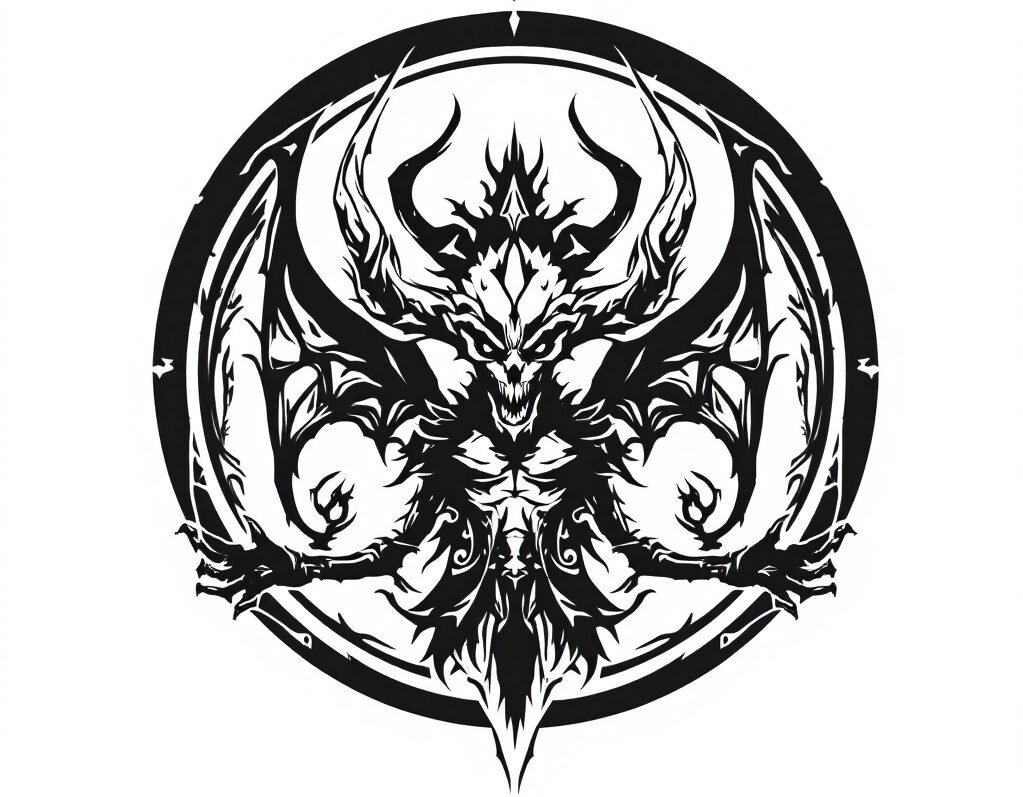
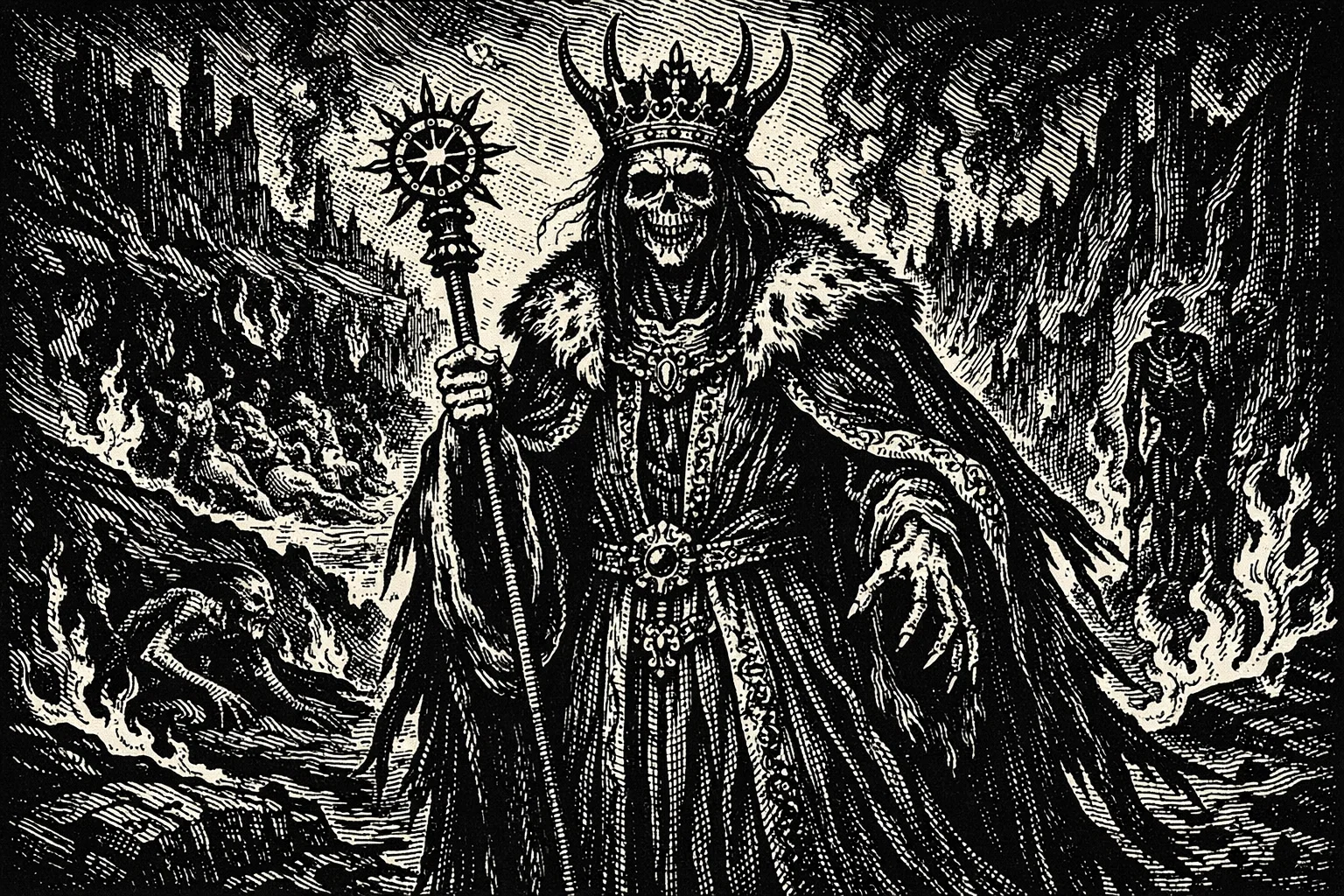
Amaymon is the opposite of the Sun among the four main points of the infernal compass. Modern grimoires often describe him as just the King of the East. Still, his deeper ties to the Egyptian “Amun” and the idea of a “poisonous breath” show that he represents decay in the air, not just physical violence.
Studying Amaymon means examining the medieval fear of invisible threats, such as slow decay and deadly winds, which symbolized the unavoidable transition from life to death.
In this article, I examined several modern stories about Amaymon by comparing them with historical sources such as the Pseudomonarchia Daemonum (1577) and the Ars Goetia, aiming to provide a fact-based historical overview. [View Full Bibliography ↓]
Summary
Key Takeaways
| Attribute | Details |
| Names | Amaimon, Maymon, Maimon, Amoymon |
| Title | King of the East, King of the South |
| Gender | Male |
| Role | Governs legions of spirits; must be bound for the successful summoning of many demons |
| Rank | Infernal King |
| Hierarchy | Superior to many of the 72 Spirits of the Ars Goetia; serves under no known superior demon |
| Legions | Vast and uncounted; commands the majority of spirits mentioned in the Goetia when he rules the East |
| Powers | Commands all lesser spirits under his dominion; causes pain and death to those who fail to properly bind him |
| Associated Figures | Ziminiar (King of the North), Corson (King of the West), Gaap (King of the South) |
| Weaknesses | Bound by the Divine Name of God; must be constrained by the practitioner’s authority |
| Pantheon | Christian Demonology (Goetic) |
| Primary Sources | The Lesser Key of Solomon (especially the preliminary instructions of the Ars Goetia), Pseudomonarchia Daemonum, The Book of Abramelin |
Who or What is Amaymon?
Amaymon is one of the four Great Kings of Hell mentioned in various Goetic and Solomonic grimoires, a tradition of ceremonial magic texts focused on the conjuration of spirits. His main role is as a ruler of one of the four main directions in the demonic hierarchy. He is usually linked to the East, where he rules over a large part of the infernal world and commands many spirits.
In rituals, the demon is not called for help but is instead restrained, along with the other Kings. This binding is important because the 72 lesser spirits of the Ars Goetia are thought to be under the control of these four Kings.
If a practitioner does not restrain the ruling King, the King might release his subordinate spirit or harm the practitioner. Because of this, Amaymon is seen as a powerful authority who must be controlled in rituals before any lesser spirit can be safely summoned.
“Amaymon” Meaning
The exact origin of the name Amaymon is unclear. Unlike many other demon names, it doesn’t have clear roots in Hebrew or Aramaic. This suggests it likely came from later European grimoires, possibly as a made-up or altered term from the Middle Ages or Renaissance.
One idea is that the name comes from the Greek word mēmōn (μημων), meaning ‘wise’ or ‘prudent,’ possibly through the Latin word memor. However, this is just a guess and would be ironic for an entity known for evil authority.
Another theory links it to Mammon, the Aramaic word for ‘wealth’ or ‘profit’ personified as an evil deity in Christian scripture. The name Maimon supports this idea, suggesting that Amaymon might be a variant spelling or an expanded version of Mammon, created to create a new, powerful demon. In some texts, he is linked to the South, a direction often connected to wealth and heat.
The ‘A-‘ at the start of Amaymon may just be added for emphasis or as a common stylistic choice in creating occult names.
How to Pronounce “Amaymon” in English
Most people in occult and academic circles pronounce Amaymon as Ah-MAY-mon or Ah-MY-mon. The emphasis is on the middle syllable, and the first ‘A’ sounds like ‘uh.’
What Does Amaymon Look Like?
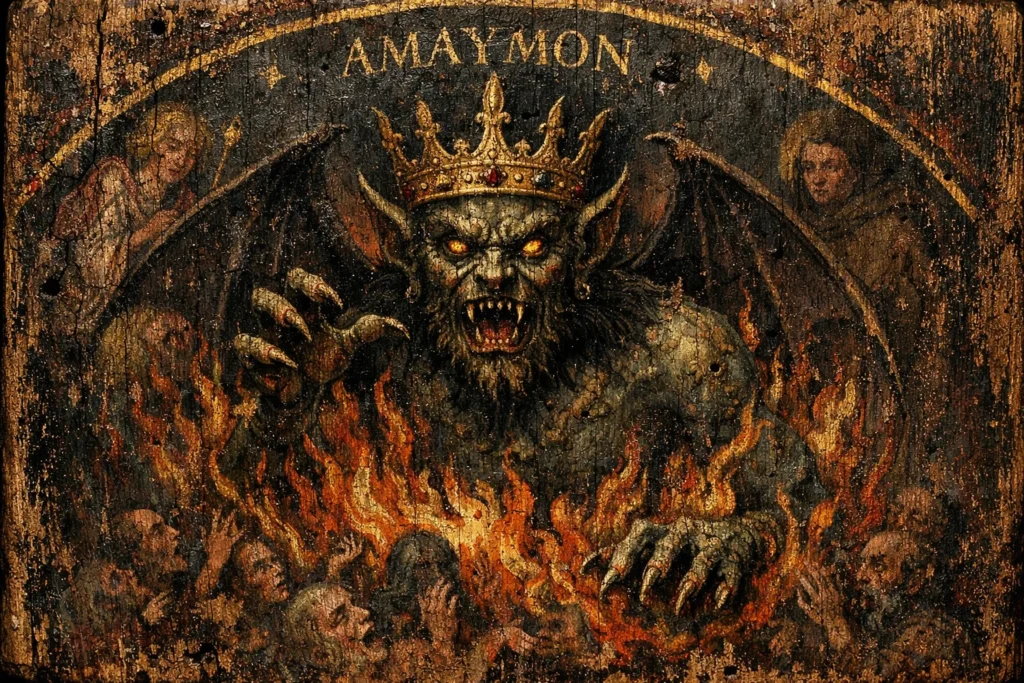
Descriptions of what this demon looks like are very rare in main sources, especially the Lesser Key of Solomon. Most grimoires focus on his rank and authority rather than his appearance. He is usually called by his name and title, which suggests that what he looks like matters less than his role as a force that binds in a certain direction.
In the Book of Abramelin, the four kings are named, but their physical forms are not described. The focus is on their rule over parts of the world. When Amaymon is described, he is often portrayed to having a frightening presence, which fits his role as King of Hell.
Because there is no set description of his appearance, Amaymon is seen as a huge, powerful force instead of a single human-like entity. He stands for the vast and uncontrollable power of the East or South.
Origins
Amaymon’s origins are found only in European grimoires, and he has no known pre-Christian or biblical background. The first records of him appear in texts linked to King Solomon from the late medieval and early modern times.
One of his earliest important mentions is at the beginning of the Ars Goetia, the first book of the Lesser Key of Solomon (17th century). This book explains how to safely summon the 72 spirits.
Amaymon is introduced right away as one of the four Great Kings who rule the world’s four parts. In the Ars Goetia, he is given the East, making him a key entity to address before controlling any lesser spirit from that direction.
Johann Weyer’s Pseudomonarchia Daemonum (1563) mentions Amaymon a bit earlier. Weyer lists the 72 spirits, and the instructions before the list also mention the four Great Kings.
Amaymon’s importance grew as the Lesser Key of Solomon was translated and shared. In these texts, he changed from a local ruler to a key force that must be controlled for rituals to be safe and successful.
In some versions, Amaymon is confused with, or takes the place of, Gaap, the King of the South.
Historical & Grimoire Records
While Amaymon does not appear in the Bible, his historical record begins in the Late Medieval period within the foundational texts of the Solomonic tradition.
Original:
Amaymon rex orientis, Gorson rex meridiei, Zimimar rex occidentis, Goap rex septentrionis, simul & ligari possunt, horis diei tertia & nona, nisi reges coram eis cogantur. [Pseudomonarchia Daemonum (Johann Weyer), 1577]
Translation:
“Amaymon king of the east, Gorson king of the south, Zimimar king of the west, Goap king of the north, may be bound together from the third hour and the ninth hour, unless the kings are compelled before them.”
In this 16th-century text, Weyer shows that Amaymon is not a lesser spirit but one of the four main Kings who rule the world’s quarters. This source is important because it ties Amaymon to certain hours of the day. Unlike the 72 Goetic demons, who are summoned for tasks, Amaymon is a key part of the infernal hierarchy. It rules the direction of the rising Sun.
The theological importance here is the ‘Inversion of the Orient.’ In Christian tradition, the East stands for Christ and the Resurrection. By making Amaymon the ruler of the East, Weyer’s source turns this idea on its head, suggesting that even the dawn is ruled by a demonic creature.
As for the spirits of the Air, they are of a middle nature between men and angels… Amaymon is the King of the East, his spirits are moist and cold, his color is white, and he appeareth in the form of a King, but with a face like a lion. [The Fourth Book of Occult Philosophy (Pseudo-Agrippa), 1655]
This 17th-century text brings a major change in how Amaymon is described. Earlier sources focused on his rank and dangerous breath, but this one gives a clear visual and elemental description. Calling him the ‘Lion-faced King’ connects him to ancient solar gods, though in a twisted way. Describing his spirits as ‘moist and cold’ uses old medical ideas to explain supernatural beings.
In language, the shift from seeing Amaymon as just an infernal king to a ‘spirit of the air’ shows a move toward Neoplatonic magic. Now, he is seen less as living in Hell and more as a planetary or atmospheric being, in line with the time’s interest in the ‘Invisible World’ and how the atmosphere works.
Moreover, thou shalt not call Amaymon, for he is a Great King, and thou canst not sustain his breath, except thou hast the Ring of Solomon. [The Lesser Key of Solomon (Lemegeton), 17th Century MS]
The Lemegeton gives clear rules for dealing with Amaymon. It stresses his ‘Poisonous Breath’ and says that the ‘Ring of Solomon’ is needed for protection. This shows a change in how practitioners relate to him: Amaymon is seen as so dangerous that you cannot be near him without a special, holy item.
The main difference here is the focus on safety. Other sources see summoning as a matter of will. Still, the Lemegeton treats Amaymon as a real danger to body and spirit. This matches the 17th-century shift from simple exorcism to complex rituals meant to contain forces too strong for people to face without protection.
Amaymon and the Theology of Decay
The fear Amaymon caused in medieval times came from his ‘poisonous breath,’ as described in the Pseudomonarchia Daemonum. This links him to the old medical idea of Miasma, which said that diseases like the plague spread through ‘bad air.’
By making Amaymon the King of the East, the direction of the rising Sun and life-giving winds, demonologists created a disturbing reversal. He stands for the corruption of breath, the element needed for life. In this way, Amaymon becomes a symbol of invisible disease, turning the air itself into a force of decay.
In language and symbolism, Amaymon is like a ‘Shadow Sun.’ While the Egyptian god Amun-Ra symbolized creative power, Amaymon symbolizes the Sun’s heat that causes things to rot.
He is the ‘Hidden One’ who has become the ‘Stagnant One.’ He can only be bound with special talismans at the times of twilight, morning and evening. This shows his role as a guardian of the Sun’s cycle. He does not work in total darkness, but in the bright desert light where heat speeds up decay.
Psychologically, the demon is a symbol of ‘Moral Sepsis.’ Just as he rules over physical decay, he also symbolizes the slow breakdown of character that occurs when secrets are kept hidden.
Unlike demons linked to sudden anger or desire, Amaymon’s influence builds up slowly and affects the environment. He is like the ‘heavy air’ in a room where people hold grudges. Studying Amaymon means facing the fact that destruction often comes quietly, as a slow change that stops growth and leads to decay.
Powers and Abilities
Amaymon’s powers come from his royal authority and his rule over a large part of the infernal world. His main abilities are governance, control, and punishment:
- Commands Lesser Spirits: He has ultimate authority over the multitude of spirits that live in the territory he governs (primarily the East, and sometimes the South). Any of the 72 spirits of the Goetia who fall under his command are completely subservient to him.
- Malicious Influence: He can spread evil and harm in the human world, especially from his assigned direction, but usually lets his subordinates handle specific actions.
- Inflicts Retribution: If a practitioner fails to properly constrain or bind him using the required holy names and ritual components, Amaymon has the power to inflict severe harm, pain, and death on the conjurer.
- Causes Confusion and Failure: If not controlled, his presence is believed to cause the whole ritual to fail, leading to confusion, mistakes, and making it impossible to command the lesser spirit.
You may also enjoy:
Erinyes: The Chthonic Goddesses Who Enforced Blood-Guilt
November 20, 2025
Rāga: The Seductive Demon of Passion and Desire in Buddhist Lore
October 16, 2025
Who Is Hariti, the Mother of Ogres in Buddhist Mythology?
December 8, 2025
What Is Baku? The Bizarre Yōkai That Eats Nightmares
January 28, 2026
Jikininki: The Japanese Ghost That Feeds on Human Corpses
February 9, 2026
The Ghul: The Flesh-Eating Demon of Arabian Folklore
October 1, 2025
Amaymon vs Other Christian Demons
| Demon Name | Associated Sin/Temptation | Rank/Origin | Key Traits/Powers |
| Asmodeus | Lust, Gambling, Extravagance | Prince/Grimoire and Talmudic | Causes strife between spouses; commands 72 legions; associated with the planet Venus |
| Belial | Lawlessness, Arrogance, Deceit | King/Biblical (Old Testament) and Goetic | Grants dignities and favors; commands 80 legions; compels lying and wickedness |
| Paimon | Blasphemy, Pride | King/Goetic | Teaches all arts and sciences; commands 200 legions; rides a dromedary |
| Balam | Cruelty, Bestiality | King/Goetic | Gives true answers of the past, present, and future; appears with three heads (man, bull, ram) |
| Baal | Idolatry, Worship of False Gods | King/Biblical (Canaanite/Goetic) | Gives invisibility; commands 66 legions; appears with three heads (man, toad, cat) |
| Purson | False Prophecy, Conceit | King/Goetic | Gives true answers about secrets; appears as a lion-headed man riding a bear |
| Zagan | Deceit, Counterfeiting | King/Goetic | Turns water into wine, oil into water; commands 33 legions; appears as a bull with griffin wings |
| Ziminiar | Authority over the North | King/Goetic | One of the four Great Kings; rules the North quarter |
| Astaroth | Sloth, Vanity | Duke/Goetic and Biblical (Phoenician) | Teaches liberal sciences; gives true answers of the past and future; rides a dragon |
| Vassago | Destruction, Frivolity | Prince/Goetic | Declares things past and future; finds lost items; one of the “good-natured” demons |
| Gaap | Hatred, Manipulation | President/Goetic | Teaches philosophy and liberal sciences; causes love or hate; transports people rapidly |
| Satan/Lucifer | Pride, Rebellion | Emperor/Biblical (Christian Theology) | Ruler of Hell; supreme tempter of mankind; the adversary |
Rank in the Hierarchy of Hell
Amaymon is ranked as an Infernal King in the demonic hierarchy of Solomonic grimoires, placing him among the top rulers in Hell. He is clearly named as one of the four Great Kings who rule the four main directions of the world. In the Ars Goetia, he is given the East. This is not just a symbol; it gives him real authority over that area and all the spirits there.
The 72 spirits of the Ars Goetia are believed to be subordinate to one of these four Kings. For example, any spirit of the East is fundamentally under Amaymon’s control.
This makes his rank higher than the 72 Goetic spirits and means practitioners must control him. His power is tied to direction and territory, making him a key entity in the infernal order. He controls many subordinates.
Mystical Correspondences
| Attribute | Details |
| Planet | Sun, possibly Mars |
| Zodiac Sign | Leo or Aries |
| Element | Fire |
| Direction | East (sometimes South) |
| Color | Red, Gold, Orange |
| Number | Six |
| Crystal/Mineral | Ruby, Carnelian |
| Metal | Gold or Copper |
| Herb/Plant | Frankincense, Tobacco |
| Animal | Lion, Serpent |
Amaymon’s mystical links are shaped by his connection to the East, which in many occult traditions is tied to Fire and the Sun. This connection shows his royal status and hints at the destructive side of his power.
Being linked to the Sun (or Mars) and the sign of Leo (or Aries) connects him to ideas of kingship, strength, heat, and command. These links suggest Amaymon is most powerful when the Sun is strongest or during times connected to fire signs in astrology.
The East is often seen as the starting point of creation and is viewed as the place of highest authority and first power. The color red and the metal gold highlight his royal status, connecting him to the wealth of a king and the strength of a commander.
You may also enjoy:
Andrealphus: The Peacock Demon Who Twists Minds and Bodies
January 19, 2026
Tarakasura: The Dark Demon Who Ruled Hell on Earth
December 4, 2025
Who Is the Jann in Islamic Mythology and Why Is He Feared?
October 2, 2025
Andhaka: The Blind Demon Born From Cosmic Darkness
February 6, 2026
What Is a Rakshasa? Meaning, Origins, and Dark Powers
January 23, 2026
Amdusias in the Ars Goetia: The Demon of Dark Music
December 2, 2025
Bibliography
Author’s Note: While putting together this demon profile, I noticed something curious: the strict hierarchies in the Lemegeton and Weyer’s Pseudomonarchia Daemonum are very different from the more changeable, elemental descriptions in the Book of Abramelin. My research shows that Amaymon evolved from a simple King of the East to a symbol of decay, especially when comparing older Latin texts with later, more dramatic sources. This study focuses on the early grimoires to remove modern additions and show that Amaymon’s ‘breath’ was once feared as a real force of decay, not just a metaphor.
- Summers, Montague. The history of witchcraft and demonology. Project Gutenberg, 28 Oct. 2025. Originally published by Alfred A. Knopf, 1926.
- Collin de Plancy, Jacques. Dictionnaire infernal: répertoire universel des êtres, des personnages, des livres, des faits et des choses qui tiennent aux esprits. 6th ed., Henri Plon, 1863. Internet Archive.
- Gasdia, Russell. Frightful Demons and Faithful Prayer: Possession, Exorcism, and Religious Sentiments in Johann Weyer’s De Praestigiis Daemonum and Reginald Scot’s The Discoverie of Witchcraft. Academia.edu.
- Abraham ben Simeon, of Worms. The Book of the Sacred Magic of Abra-Melin, the Mage. Translated by S. L. MacGregor-Mathers, The de Laurence Co., 1939. Internet Archive.
- Henson, Mitch, and Jeff Wellman, editors. Lemegeton: The Complete Lesser Key of Solomon. Metatron Books, 1999. Internet Archive.
- Weyer, Johann. Pseudomonarchia Daemonum. Edited and translated by Joseph H. Peterson, digital edition, 2000. Twilit Grotto: Esoteric Archives.
- I. Iniesta. On the origin of Ammon’s horn. Neurología (English Edition), Volume 29, Issue 8, 2014, ISSN 2173-5808, ScienceDirect.
- Kozhevnikov, Mikhail. Demon Possession in Anglo-Saxon and Early Modern England: Continuity and Evolution in Social Context. Journal of the History of the Behavioral Sciences, vol. 46, no. 1, 2010, pp. 100-02. ResearchGate.