
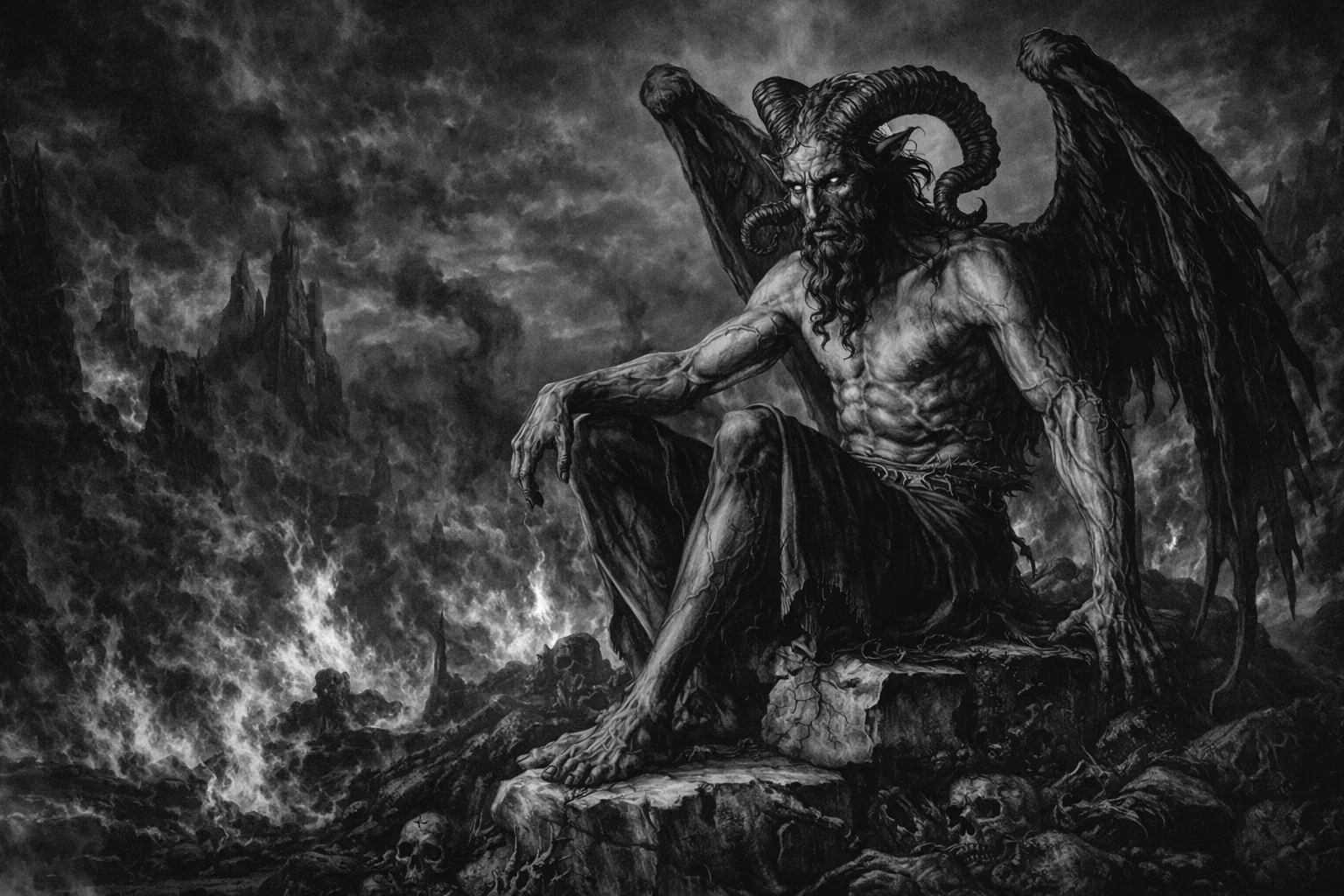
Azazel marks a key shift in Western demonology, changing from a ritual “scapegoat” in the Levant to a nentity seen as the creator of human corruption. Unlike most fallen angels, who rebel from within, Azazel stands out for teaching forbidden knowledge and giving people the tools—both real and symbolic—that led to their downfall.
Looking at how Azazel changed from a desert spirit in the Book of Enoch to a symbol of widespread sin, we see an old struggle between gaining knowledge and losing spiritual purity.
This article compares the Book of the Watchers in 1 Enoch with earlier Semitic texts on the scapegoat ritual in Leviticus 16. It shows the difference between early wilderness stories and later ideas of Azazel as a fallen angel. [View Full Bibliography ↓]
Summary
Key Takeaways
| Attribute | Details |
| Names | Azazel, Azael, Azaziel, Hazazel, Aziz |
| Title | Chief of the Se’irim, Leader of the Watchers, Prince of the Desert |
| Gender | Male |
| Role | Corruptor of humanity, teacher of forbidden warfare and cosmetics, tempter |
| Rank | Chief of the Grigori (Watchers), Prince of the Second Hierarchy |
| Hierarchy | Leader of the 200 fallen angels; subordinate to Semyaza in some texts, often considered an independent adversary |
| Legions | Commanded 200 Watchers, each leading their own respective divisions |
| Powers | Granting knowledge of weapon smithing, inciting vanity through cosmetics, and revealing celestial secrets |
| Associated Figures | Semyaza, Enoch, King Solomon, Beelzebub, Lilith |
| Weaknesses | Binding by the Archangel Raphael, imprisonment in darkness, and burial under sharp rocks |
| Opposing Angel/Saint | Archangel Raphael |
| Pantheon | Abrahamic (Jewish and Christian) |
| Primary Sources | The Bible (Leviticus), The Book of Enoch, The Apocalypse of Abraham, Dictionnaire Infernal |
Who or What is Azazel?
Azazel is a complicated entity who is sometimes seen as a demon, sometimes as a place, and sometimes as a force of evil. In early stories, he is one of the Watchers, angels who came down to Earth and lived with human women. This led to the birth of the Nephilim and the spread of corruption before the flood.
In later Jewish and Christian traditions, Azazel is portrayed as a fallen angel who either refused to honor humans or sought to usurp divine power by teaching forbidden knowledge.
Unlike other demons who possess individuals, Azazel is blamed for corrupting all of human society by introducing weapons and deception. He is often seen as an outsider who lives in empty, wild places far from divine law.
“Azazel” Meaning
Researchers often debate the origin of the name Azazel, but there are three main theories. The most common idea is that it comes from the Hebrew words for ‘goat’ and ‘to go away,’ so it means ‘the goat that departs’ or ‘scapegoat.’ This connects to the ritual in Leviticus 16, in which a goat was sent into the wilderness to bear the community’s sins.
Another theory says the name combines words meaning ‘rugged’ and ‘strong,’ pointing to a ‘rugged mountain’ or ‘cliff’ where the goat was sent. This view shifts the focus from Azazel as a demon to a place of judgment.
In the Book of Enoch, Azazel is treated as a personal name. Some researchers think it comes from a root meaning ‘to be strong’ and the ending ‘-el,’ which means ‘Strength of God.’ This may have been his name before he fell from grace.
In different translations, like the Greek Septuagint (where he is called apopompaios) and the Latin Vulgate, the name has been used both as a title for a demon and as a term for the ritual of sending away.
How to Pronounce “Azazel” in English
In English, Azazel is usually pronounced ah-ZAY-zel, with the stress on the second syllable. Other ways to say it include uh-ZAY-zuhl or AZ-uh-zel, but ah-ZAY-zel is the most common in academic and religious discussions.
What Does Azazel Look Like?
Descriptions of Azazel’s appearance vary across sources. In the Apocalypse of Abraham, he is shown as a dirty, unclean bird, especially a bird that eats dead animals, coming down on sacrifices to spoil them. This animal form highlights his role as a soul scavenger and someone who disrupts holy rituals.
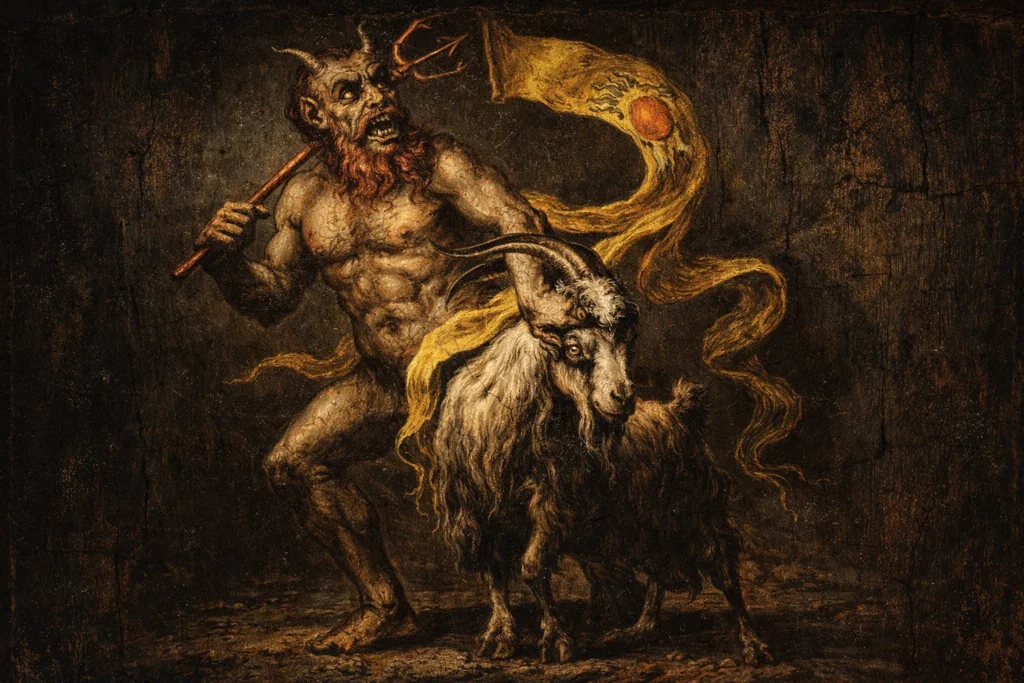
In later occult traditions, such as those in Colin de Plancy’s Dictionnaire Infernal, Azazel is described as more human-like yet still monstrous. He is often pictured as a demon carrying a banner and riding a goat or a camel.
In these images, Azazel often has several horns (sometimes seven), yellow eyes, and leathery wings, fitting the classic wild, satyr-like look. Some texts say he has a man’s face but the body of a dragon or snake, showing his tricky nature and ancient roots.
The Metallurgy of Sin
The Book of Enoch calls Azazel the main corrupter before the flood. The wrongs he is blamed for show an old warning about technology growing without moral limits.
Unlike other fallen angels who tempt people with desire, Azazel’s wrongdoing is about teaching and industry. He taught people how to make weapons and use cosmetics, which transformed society from a simple way of life to one focused on war and appearance. This means his “corruption” was not just about personal sin, but about starting a culture of war and deception.
Azazel’s story is shaped by the double meaning of his gifts: metalworking and cosmetics. In the ancient Near East, turning raw metals into tools was both respected and feared, since it could lead to violence. Azazel did not just give people weapons—he brought the idea of organized harm.
The writers of Enoch connect making iron weapons with using makeup, showing that war and vanity are closely related. Both are seen as ways people rebel against what is natural, choosing human invention over divine guidance.
From a social point of view, Azazel is like an “Anti-Prometheus.” While Prometheus gave fire to help people, Azazel gave secret knowledge that led to their downfall. This story shows the worries people had during the Second Temple period about rapid changes in cities and culture.
Azazel came to represent the hidden problems of progress. As people gained more control over the world, they often lost their sense of right and wrong. He stands for the point at which tools become weapons and skills become ways to hide the truth.
Azazel Historical & Scriptural Records
“And Aaron shall cast lots upon the two goats; one lot for the Lord, and the other lot for Azazel [לַעֲזָאזֵל]. And Aaron shall bring the goat upon which the Lord’s lot fell, and offer him for a sin offering. But the goat, on which the lot fell to be the scapegoat [Azazel], shall be presented alive before the Lord, to make an atonement with him, and to let him go for Azazel [לַעֲזָאזֵל] into the wilderness.” [Leviticus 16:8–10, Masoretic Text / King James Version, c. 6th–5th Century BCE]
This first record shows the main question about Azazel: is he a living being or just a place? The Hebrew ‘La-azazel’ is often read as ‘to the scapegoat.’ Still, many modern researchers think Azazel was a desert spirit or demon meant to take on the community’s sins.
In religious terms, this makes Azazel a kind of spiritual waste bin. Instead of being sacrificed in a holy place, the goat for Azazel is sent out to a rough, wild area. This is like ancient Near Eastern rituals in which evil was not just forgiven but sent away to the wilderness.
“And Azazel taught men to make swords, and knives, and shields, and breastplates, and made known to them the metals of the earth and the art of working them, and bracelets, and ornaments, and the use of antimony, and the beautifying of the eyelids, and all kinds of costly stones, and all colouring tinctures. And there arose much godlessness, and they committed fornication, and they were led astray, and became corrupt in all their ways.” [1 Enoch 8:1–2, R.H. Charles Translation, c. 2nd Century BCE]
In the Book of Enoch, Azazel changes from a ritual entity to an active enemy. He is no longer just a receiver of sins; he is now seen as someone who disrupts society. Unlike Semyaza, who is blamed for creating the Nephilim, Azazel is blamed for bringing harmful technology.
This text shows Azazel’s skills in metalworking and cosmetics. For Second Temple-period writers, these skills led to war and deception. By teaching people to change the world and themselves, Azazel is seen as the one who broke the natural order, allowing violence and desire to grow in the name of progress.
“And an impure bird flew down upon the carcasses, and I drove it away. And the impure bird spoke to me and said, ‘What are you doing, Abraham, on the holy heights… Leave this man, for you cannot ascend to the heights, because they will destroy you.’ … And it came to pass when I saw the bird speaking I said to the angel: ‘What is this, my lord?’ And he said, ‘This is godlessness, this is Azazel!’” [Apocalypse of Abraham, Chapter 13, c. 1st–2nd Century CE]
This story changes how Azazel is pictured. Instead of a goat or giant, he appears as an unclean bird, like a vulture. This shows his role as a spiritual parasite, waiting on the edges of holy rituals to break the link between people and the divine.
The text calls Azazel the personification of “Godlessness.” In the story, Azazel argues with Abraham and the angel Iaoel, claiming the earth belongs to him because of his fall. He says humans do not deserve the heavens. This makes Azazel the “Accuser” in the desert, showing he exists where people are tested by the divine.
“Azazel. Demon of the second order, guardian of the goat. … At the festival of the expiation, the Jews would lead to the desert a goat laden with the sins of the people. … Azazel is the standard-bearer of the subterranean armies.” [Dictionnaire Infernal, Collin de Plancy, 1863]
By the 1800s, Azazel became part of the organized ranks of European demonology. In de Plancy’s Dictionnaire Infernal, he is given the title of “Standard-Bearer,” which is a big change from his earlier role as a prisoner in Dudael. This shows that people began to see Azazel as a free and important entity in the imagined government of Hell.
In religious art and stories from this time, Azazel is still connected to the goat but is now seen as a high-ranking officer in Hell. This change matches the Romantic and Victorian interest in rebellious characters. Azazel is no longer just a symbol of chaos, but a key part of an organized underworld.
Powers and Abilities
Azazel’s powers primarily involve corrupting minds and altering the physical world. Instead of causing madness or sickness like some demons, he gives people the tools to harm themselves:
- Teaching Warfare: Azazel can teach people about working with metals and making weapons. By revealing these secrets, he helps humans create deadly tools, which leads to more violence and organized war.
- Power of Vanity: Azazel rules over cosmetics and the ‘art of deception.’ By teaching people to change their looks with makeup and jewelry, he brings in ideas of lust and false identity. This distracts people from spiritual truth and makes them focus on surface appearances.
- Celestial Knowledge: As a former angel, Azazel still knows the ‘eternal secrets’ of Heaven. He is said to reveal the movements of the planets and the secrets of the sky, leading people to practice forbidden magic and astrology.
- Control of Desolation: Azazel has power over empty, wild places. He can cause people to feel alone and isolated, drawing them into the wilderness where they are more open to his influence.
Azazel Myths, Legends, and Stories
The Imprisonment in the Desert of Dudael
When the cries of the slaughtered and the oppressed reached the gates of the Seventh Heaven, the Most High issued a decree of absolute containment against the architect of human corruption. The Archangel Raphael was sent to execute a sentence that was not merely a physical binding, but a geographical erasure.
According to the Book of Enoch (Chapter 10), Raphael did not engage in a standard celestial duel; instead, he enacted a mechanical ritual of “binding hand and foot.” He was commanded to open a jagged rift in the desert of Dudael—a name often associated with the “Kettle of God” or a place of jagged, chaotic terrain. Azazel was cast into this subterranean void, a space characterized by total sensory deprivation.
To ensure the fallen Watcher could never again influence the celestial light, Raphael “placed upon him rough and jagged rocks” and “covered his face that he might not see the light.”
This imprisonment was designed to be eternal, intended to hold him in stasis until the “Day of the Great Judgment,” at which point he is to be cast into the fire. This explains his mythological transition from a celestial prince to a “Voice from the Wilderness”—a muffled, subterranean force of chaos restricted to the desolate margins of the world.
The Temptation of Abraham
In this important encounter, Azazel manifests not as a humanoid rebel, but as a “foul bird” (often interpreted as a vulture or raven), appearing at the exact moment of the Covenant of the Pieces. As Abraham prepared his sacrifice of a heifer, a goat, and a ram, the demon descended on the carcasses, seeking to defile the sanctity of the ritual with his very presence.
Azazel spoke with a voice designed to erode the patriarch’s resolve, challenging his worthiness to approach the Divine. He whispered that the “holy heights” were not the inheritance of man and that the fire of the sacrifice would consume Abraham rather than sanctify him. This was a psychological assault aimed at severing the nascent bond between God and the lineage of Israel.
However, the Archangel Iaoel, a figure of supreme authority who holds the “Ineffable Name,” intervened. Iaoel delivered a crushing ontological rebuke, stripping Azazel of his pretension to celestial power. He declared that Azazel’s “garment” (his heavenly glory) had been set aside for Abraham, and that Azazel’s own “inheritance” was now restricted to the “unsettled places” of the earth and the sins of the wicked.
This narration establishes Azazel as the “Accuser” (Mastema), a scavenger of souls who survives by feeding on the doubt and spiritual “decay” of humanity.
Azazel vs Other Christian Demons
| Demon Name | Associated Sin/Temptation | Rank/Origin | Key Traits/Powers |
| Lucifer | Pride | Emperor / Fallen Seraph | Intellectual pride; ruler of hell |
| Asmodeus | Lust | King / Book of Tobit | Breaking marriages; inciting lust |
| Beelzebub | Gluttony | Prince / Philistine roots | Lord of the Flies; spreading rot |
| Belial | Lawlessness | Prince / Dead Sea Scrolls | Hostility toward God; worthlessness |
| Mammon | Greed | Prince / New Testament | Material wealth and avarice |
| Leviathan | Envy | Grand Admiral / Job | Sea monster; representing chaos |
| Astaroth | Sloth | Grand Duke / Ars Goetia | Teaches liberal sciences; stinking breath |
| Belphegor | Sloth/Discovery | Prince / Moabite roots | Inventions to make life easier |
| Moloch | Child Sacrifice | Prince / Old Testament | Demands sacrifice by fire |
| Abaddon | Destruction | King / Revelation | Angel of the Abyss; locust king |
| Pazuzu | Plague | King / Mesopotamian | Winds of fever and famine |
| Balaam | Avarice | King / Ars Goetia | Gives true answers to things past |
| Paimon | Obedience | King / Ars Goetia | Teaches arts and sciences |
| Behemoth | Gluttony | Grand Cupbearer / Job | Beast of the land; immense strength |
| Satan | Wrath | Prince / Biblical | General adversary and tempter |
Rank in the Hierarchy of Hell
Azazel has a special place in the ranks of Hell, often called a Prince of the Second Hierarchy. In early Jewish writings, he led the Watchers, making him higher than most fallen angels. In the Dictionnaire Infernal, he is named Chief of the Standard-Bearers of Hell’s armies, showing he has a military role.
The demon is often shown as an ancient and senior demon compared to others. While Lucifer or Satan is seen as a ruler, Azazel is the ‘field commander’ who initiated the first breach between Heaven and Earth.
He is often linked with Semyaza. In some stories, they compete to lead the Watchers. In contrast, in others, the demon is the main keeper of secrets for Semyaza. He is rarely shown as lower than the demons of the Ars Goetia because his story is older, making him one of the original fallen spirits, respected even by the Goetia’s kings.
Mystical Correspondences
| Attribute | Details |
| Planet | Saturn |
| Zodiac Sign | Capricorn |
| Element | Earth |
| Direction | North (or the Wilderness) |
| Color | Black, Dark Red |
| Number | 8 (or 10 in some numerologies) |
| Crystal/Mineral | Obsidian, Antimony |
| Metal | Iron, Lead |
| Herb/Plant | Hellebore, Hemlock |
| Animal | Goat, Vulture, Camel |
The demon is linked to the planet Saturn, which fits his role as a prisoner and a source of tough, material wisdom. Saturn stands for boundaries, time, and heaviness, much like Azazel’s imprisonment under the rocks in Dudael. He is also connected to the zodiac sign Capricorn, the Goat, which ties him to the ‘scapegoat’ ritual and the rough mountains where he was sent. These links show his role as someone who brings hard and sometimes harmful knowledge that ties people to the physical world.
Azazel is also strongly linked to the earth element, but in its most empty and barren forms. Instead of fertile soil, his earth is the sand and rocks of the desert. In occult traditions, the North is associated with darkness and the unknown, which are said to be the home of the fallen angel.
Iron and antimony are linked to Azazel because he taught people how to work with metals and make cosmetics. These materials are lasting reminders of the knowledge he gave to humanity.
Azazel’s Sigil
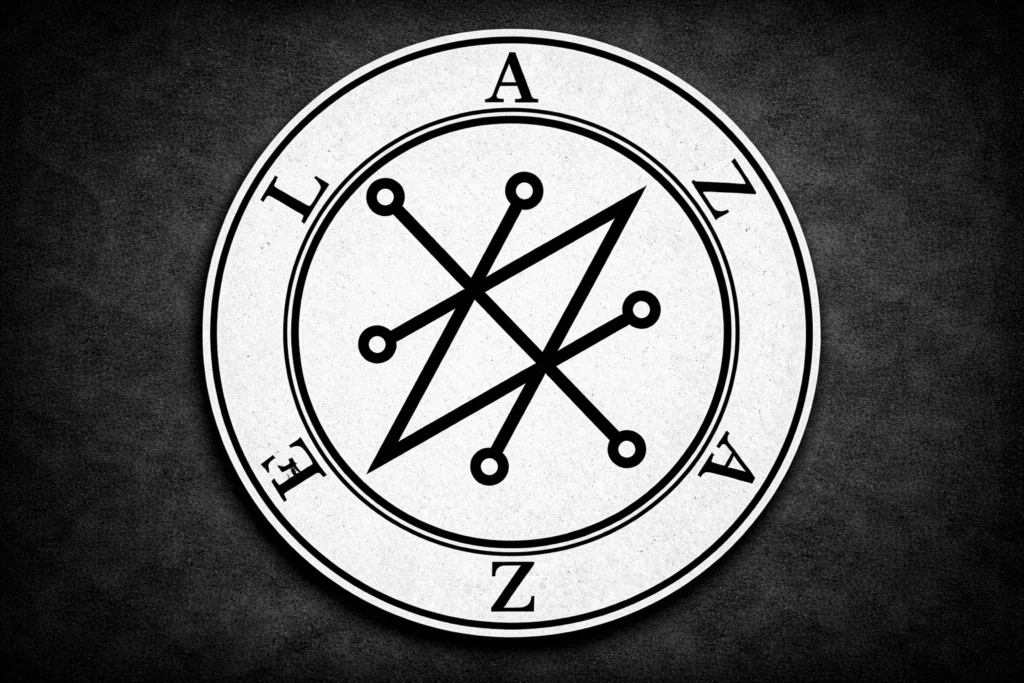
Azazel’s sigil is a symbol of his power and his link to the fallen angels. In old occult practices, sigils were like spiritual signatures that helped people connect directly with a spirit’s energy.
The sigil often includes a trident shape or lines that look like a throne or an eye, showing his past as a Watcher. In the past, people engraved these symbols on iron or lead charms to protect themselves or to gain secret knowledge about war and metalworking from Azazel.
You may also enjoy:
Who Is Ambolin, the Demon of Nighttime Dread
December 1, 2025
The Ghul: The Flesh-Eating Demon of Arabian Folklore
October 1, 2025
Apophis: The Great Serpent of Egyptian Chaos
November 11, 2025
Amdusias in the Ars Goetia: The Demon of Dark Music
December 2, 2025
Edimmu: The Mesopotamian Wind Demon That Steals Life
November 6, 2025
Bibliography
Author’s Note: As I worked on this article, I was fascinated by the theme of punishment in the Book of the Watchers and how it relates to rituals described in Leviticus 16 and the vivid images of the desert wasteland. One of the main puzzles was how to understand Azazel, who is depicted as a passive scapegoat in one version of the text but later appears as a more active rebel in other writings, such as the Dead Sea Scrolls. When I explored older references, such as de Plancy’s “Standard-Bearer” from the 19th century and the Book of Abramelin, I realized that Azazel stands out in the study of demons. His identity seems to be shaped more by his connection to the harsh wilderness than by his position in the hierarchy of Hell.
- Winter, Jay, editor. The Complete Book of Enoch. Standard English Version, Winter Publications, 2015. Internet Archive.
- Collin de Plancy, Jacques. Dictionnaire infernal: répertoire universel des êtres, des personnages, des livres, des faits et des choses qui tiennent aux esprits. 6th ed., Henri Plon, 1863. Internet Archive.
- Weyer, Johann. Pseudomonarchia Daemonum. Edited and translated by Joseph H. Peterson, digital edition, 2000. Twilit Grotto: Esoteric Archives.
- Abraham ben Simeon, of Worms. The Book of the Sacred Magic of Abra-Melin, the Mage. Translated by S. L. MacGregor-Mathers, The de Laurence Co., 1939. Internet Archive.
- García Martínez, Florentino. The Dead Sea Scrolls Translated: The Qumran Texts in English. Translated by Wilfred G. E. Watson, E. J. Brill, 1994. Internet Archive.
- Vela, Tyler. The Use of ‘Azazel’ in Leviticus 16. Academia.edu.
- Lee, S. An Examination of the Punishment Motif in the Book of the Watchers 10:4–8 in Light of Greek Myths. Journal of Ancient Judaism, 13(1), 27-51, 2021.