Most Japanese aquatic demons are seen as personifications of dangerous river currents or local floods. Yet, Akkorokamui represents the wild power of the deep ocean. It is an important distinction because it connects the traditions of the Ainu people of Hokkaido with broader Shinto beliefs in Japan, showing how a nature deity came to be recognized as a real threat at sea.
Unlike the Kappa or Umibōzu, which are known for tricking people or causing drownings, this giant cephalopod represents the raw power of the northern sea. It is seen as the ruler of Uchiura Bay, not just another predator.
To keep this research accurate and detailed, I compared the Nihon Sankai Meibutsu Zue with local Yukar oral stories. This helped me trace how the yōkai transitioned from a rare sea creature to a powerful god of the North Pacific. [View Full Bibliography ↓]
Summary
Key Takeaways
| Attribute | Details |
| Names | Akkorokamui, Atkor Kamuy |
| Translation | String-holding Kamui or tentacled deity |
| Title | Lord of Funka Bay, Great Octopus Spirit |
| Type | Yōkai, Kamui (Ainu Deity) |
| Spirit Classification | Ara-mitama (rough spirit) when disturbed; Nigi-mitama when worshipped as a protector |
| Origin | Ancient Ainu mythology; a giant creature residing in the depths of Hokkaido’s waters since the era of the gods |
| Gender | Commonly depicted as male, though occasionally considered gender-neutral |
| Appearance | A colossal red octopus reaching lengths of up to 120 meters, capable of swallowing ships |
| Kehai (Aura/Presence) | The sea and sky suddenly turn a deep, unnatural red; a pervasive smell of musk or rotted fish; water becomes still and thick |
| Powers/Abilities | Camouflage, limb regeneration, ink ejection, and the ability to manipulate tidal currents |
| Methods of Pacification | Offerings of sake and food; prayers to the deity Repun Kamuy; avoiding the bay when the water turns red |
| Habitat | Funka Bay (Uchiura Bay) in Hokkaido; deep coastal trenches of the North Pacific |
| Diet/Prey | Whales, large fish, and entire sailing vessels with their crews |
| Symbolic Item | Red coral or large fishing nets |
| Symbolism | The overwhelming power of nature; the bounty and danger of the sea; healing and regeneration |
| Associated Kami | Repun Kamuy (Ainu God of the Sea) |
| Sources | Ainu oral traditions (Yukar), regional Hokkaido gazetteers, Ezo-chi folklore collections |
The Fundamental Identity of Akkorokamui
This spirit is a key entity in Hokkaido folklore, especially in Ainu traditions. It is described as a huge, monstrous octopus living in Funka Bay. In northern legends, it has two sides: it can be a frightening monster that pulls ships underwater, but it is also a respected kamui (spirit or god) that can heal and protect people who show it respect.
This giant sea creature is closely linked to the color red, which is said to spread through the water for miles when it comes near the surface. Unlike ghosts or evil spirits that haunt homes, it stays in the sea. Akkorokamui attacks anything that enters its territory, but it also has a special place in local medicine.
Some stories say its flesh or even being near it can heal illnesses, especially those affecting the skin or limbs, showing the octopus’s ability to regrow parts.
Semantic Origins
The name comes from the Ainu language, and its roots help explain both what the creature is like and its spiritual role. The term is usually written as at-kor-kamuy. Here, at means’ string’ or ‘cord,’ probably referring to its long tentacles. Kor means “to possess” or “to hold,” and kamuy is the Ainu word for a god or powerful spirit. So, the name means “string-holding deity.”
In many historical records, especially from the Edo period, when Japanese explorers wrote about Hokkaido, the name was altered to conform to Japanese writing conventions.
While the Ainu kept their original stories, Japanese scholars sometimes grouped the spirit with other yōkai, calling it an O-tako (Giant Octopus). In some southern Hokkaido dialects, people just call it the Lord of the Bay, showing its control over Uchiura Bay.
How to Pronounce “Akkorokamui” in English
To say the name in English, break it into five syllables: Ah-koh-roh-kah-moo-ee. Each part gets about the same stress. The “Ah” sounds like in “father,” and “koh” and “roh” have a long “o.” The last part, “moo-ee,” should be said quickly, almost blending the two vowels together.
What Does Akkorokamui Look Like?
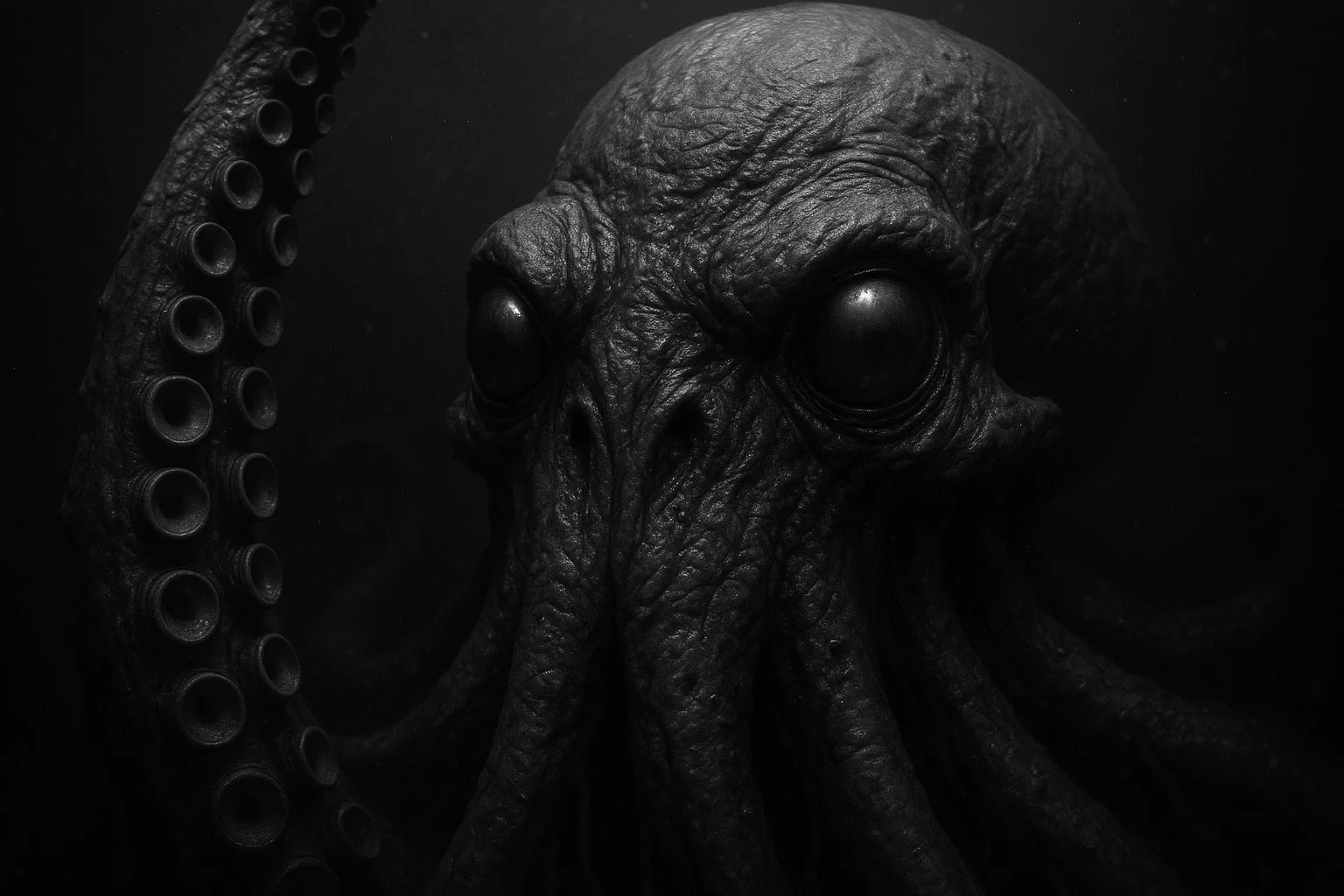
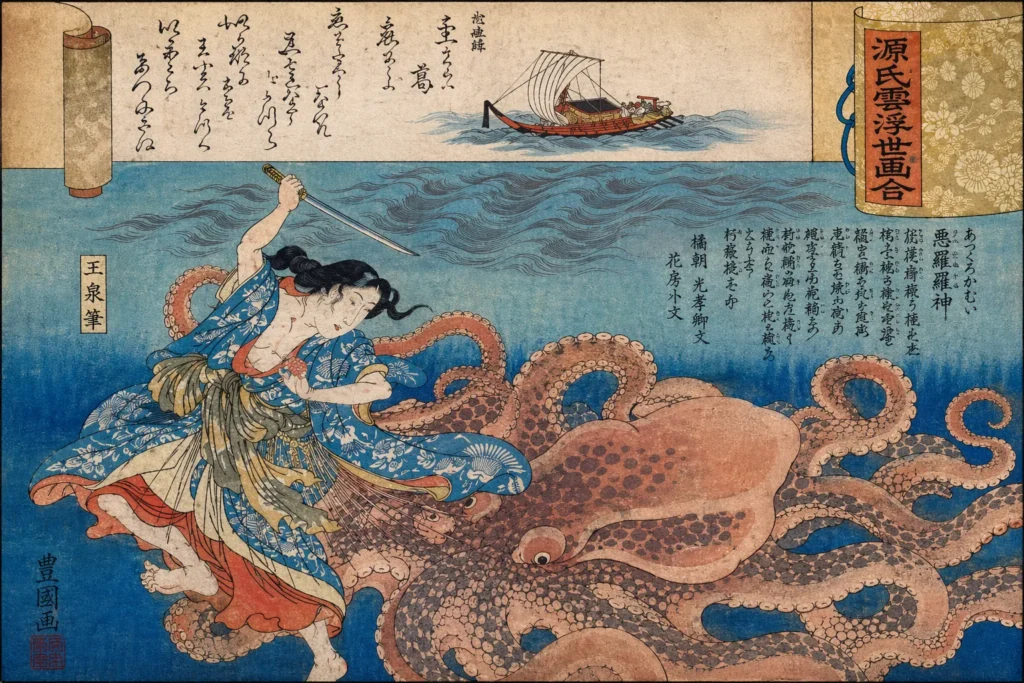
Akkorokamui is known for its huge size and bright color. Traditional stories say it is a giant octopus, often said to be over 120 meters long. Its whole body is a bright, fiery red, so intense that it can make the clouds and sky look like sunset even during the day.
Its skin is said to be smooth and shiny, and it can hide in the deep sea shadows when it is calm. Its eyes are described as huge, about the size of a large plate or a small shield, and they seem to show a cold, intelligent awareness.
Its eight huge tentacles stand out the most, with suckers strong enough to break wooden boats and hold onto whales. Unlike normal octopuses, Akkorokamui is often shown in Ainu art and Japanese scrolls with a more flowing, cloud-like shape, as if its body can grow or shrink to fill the bay.
You may also enjoy:
Who Is Adrammelech in Demonology and the Bible?
October 1, 2025
Mahakala: The Dark Guardian Who Consumes Evil
October 16, 2025
Andrealphus: The Peacock Demon Who Twists Minds and Bodies
January 19, 2026
Who Is Hariti, the Mother of Ogres in Buddhist Mythology?
December 8, 2025
Jikininki: The Japanese Ghost That Feeds on Human Corpses
February 9, 2026
Aeshma: The Zoroastrian Demon of Wrath and Fury
January 13, 2026
Origins and History
Akkorokamui’s history dates back to the period between the Muromachi period (1336–1573) and the Edo period (1603–1868), when Japanese sailors began to have greater contact with the Ainu people of Ezo-chi, now called Hokkaido.
Unlike the city yōkai made famous in the mid-1700s by artists like Toriyama Sekien, this spirit began as a kamui, a divine being in Ainu belief who ruled over the resources of Uchiura Bay. The oldest stories, found in the Yukar (Ainu sagas), describe it not just as a predator but as a guardian of the deep-sea trenches.
Looking at the timeline, I think Akkorokamui’s story reflects the many earthquakes and volcanic eruptions around Funka Bay. Interestingly, the earliest Japanese written accounts from the late 1700s match the 1781 eruption of Mount Usu.
During volcanic eruptions, deep-sea animals like the Giant Pacific Octopus (Enteroctopus dofleini) are often forced to the surface by underwater shaking and rising heat. Seeing a huge red octopus in the “sunset-colored” waters, changed by ash and sulfur, probably helped turn the spirit from a local legend into a real threat in people’s minds.
By the Bakumatsu period (1853–1867), when Japan was mapping and settling Hokkaido, the spirit became part of Japanese demon stories, as seen in writings such as those of Mogami Tokunai. These records changed its image from that of a respected nature god to that of a powerful yōkai.
My research suggests this transition reflected the “frontier anxiety” felt by Japanese sailors facing the wild northern seas. The spirit connected two worlds: it stayed the At-kor-kamuy for the Ainu, a god of renewal and tides, and became Akkorokamui for the Japanese, a monster showing the ocean’s huge, wild power.
Habitat
The spirit mainly lives in Uchiura Bay, also called Funka Bay, in southwest Hokkaido. This bay is almost landlocked, making it a deep, sheltered place full of sea life. The creature is said to stay in the deepest parts of the bay, coming up only when it is hungry or when the water gets much warmer or colder.
Stories say the spirit likes places with lots of volcanic activity. The heat from underwater vents near the mountains is believed to give it energy and its red color.
People also think it hides in rocky areas and underwater caves near the shore, where it can catch prey. The bay is considered sacred, and for centuries, sailors have watched for the red glow that signals the creature is nearby.
Famous Akkorokamui Legends and Stories
The Terror of Funka Bay
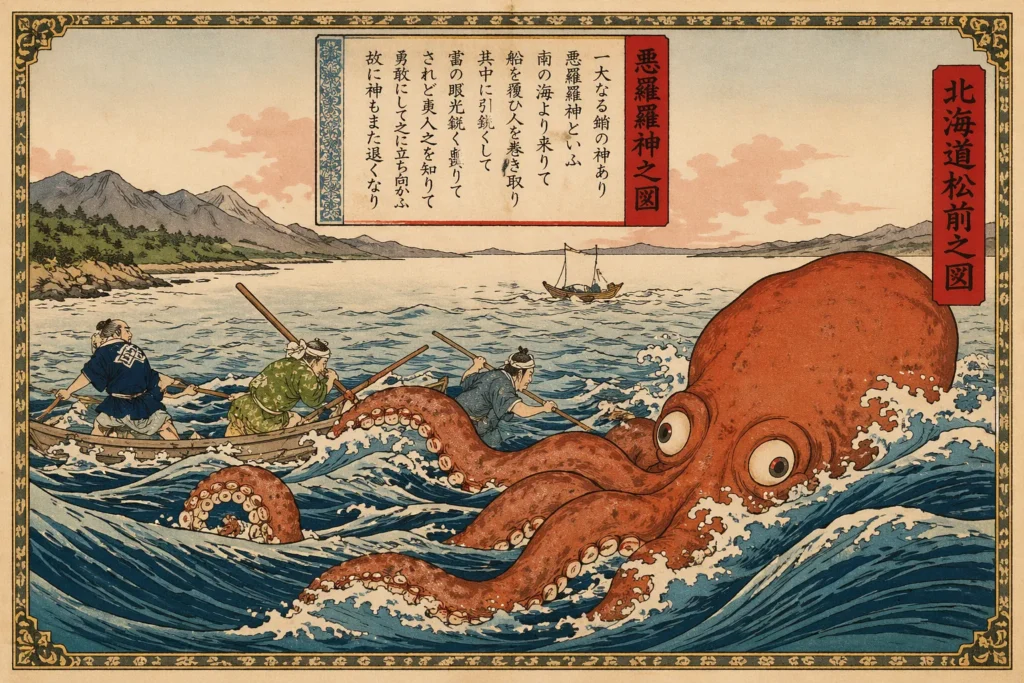
One well-known story tells of a big fishing trip during a terrible famine. Many Ainu canoes went to the middle of the bay, hoping for a big catch. As the sun set, the water around them turned the color of “crushed berries.” The fishermen realized too late that the red color was not from the sunset, but from the spirit rising from the deep.
One of the biggest canoes was grabbed by a tentacle, said to be “as thick as a pine tree,” and pulled under right away. The other fishermen hit the water with their oars and threw dried fish into the sea, begging the gods for help.
The story says the creature left only after a shaman on shore performed a desperate ritual, but the bay stayed red for three days.
The Healing Flesh of the Red God
In a kinder story, a village leader in Oshima had a serious skin disease that made his limbs weak. A local seer said only the Great Red Spirit could cure him. The leader’s son went to the bay and waited for the creature. When the water started to move, he stayed and played a ceremonial flute. The spirit rose, its huge red eye fixed on the boy.
Instead of attacking, the creature released thick, dark ink into the water. The boy collected the dark water in a jar and took it home. After the leader bathed in it, he was healed, and people began to believe the spirit had “the power of eternal regrowth.”
The Encounter at Sawara
In the late Edo period, a Japanese merchant ship sailed near Sawara. The sailors saw a huge red island in the bay that was not on any map. As they got closer, the “island” started to move.
The captain realized it was the legendary monster Akkorokamui and told the crew to throw all their sake overboard. The ship escaped while the creature was distracted by the smell of alcohol. This story supported the Japanese belief that many big water spirits like rice wine.
Akkorokamui Powers and Abilities
Akkorokamui is seen as one of the strongest aquatic beings in northern folklore. Its power is mostly physical, but it also has some control over its surroundings that seems almost magical. Unlike many spirits that use tricks, this one relies on strength and its natural abilities.
- Environmental Tinting: The ability to turn miles of seawater and even the overhead sky a deep red through its sheer presence.
- Regenerative Immortality: Similar to a natural octopus but on a supernatural scale; it can regrow limbs and heal from any wound almost instantly.
- Crushing Force: Tentacles capable of exerting enough pressure to splinter the hulls of large sailing ships.
- Toxic Ink Ejection: The expulsion of massive clouds of black ink that are not only blinding but can also act as a medicinal or poisonous substance, depending on the spirit’s intent.
- Camouflage: The ability to render its massive form virtually invisible against the seabed.
You may also enjoy:
Abura-sumashi: The Potato-Headed Yōkai That Punishes Greed
October 23, 2025
Who Is Al-Abyad? The White King Jinn Who Rules Love and Chaos
January 26, 2026
Who Is Ahriman, and Why Is He Pure Evil Incarnate?
January 8, 2026
Who Is Abaddon, the Demon of the Abyss, in the Bible?
September 29, 2025
How Akkorokamui Bridged Earth and Abyss
Calling this yōkai just a “sea monster” is too simple. Akkorokamui’s story is much more complex and reflects Hokkaido’s unstable land. The oldest Ainu stories—recorded by Iwao Yoshida (1914) and later John Batchelor—say it was not always a sea creature. One myth tells how a land monster became the ruler of the sea.
The spirit was first known as Yaushikep, a huge red spider living in the mountains near Rebunge. Stories say that when the spider came down to the villages, the ground shook, and people begged the gods for help. The sea god Repun Kamuy answered, pulling the spider into the Pacific, where the salt water and divine power turned its many legs into octopus tentacles.
I believe this “Spider-to-Octopus” change is more than just a creative story. It is a thoughtful response to the volcanic activity in Uchiura Bay, once called Funka (Eruption) Bay. The bay is surrounded by volcanoes such as Mount Usu and Hokkaido Komagatake.
In the 1700s and 1800s, eruptions caused underwater changes that often pushed deep-sea creatures, including the Giant Pacific Octopus, to the surface.
For people in the past, seeing a huge red creature with many arms come out of a sea turned “sunset crimson” (probably from volcanic silt or red tide) would be linked to the fire of the mountains.
By turning the mountain spider into a sea octopus, the Ainu created a story that explained natural disasters: the fear of earthquakes (the spider) was calmed by the sea, but the danger remained hidden under the waves.
Also, the evolution of the name from Yaushikep (“Net-Braiding One”) to At-kor-kamuy (“String-Holding God”) shows how people’s view of the spirit changed.
As a spider, it was a home-invading predator, a “net-braider” that trapped people. As a sea god, it became a “string-holder,” a title that suggests control and authority, though still frightening. It went from being a wild demon to a territorial Lord (Nushi).
Because of this, even though the spirit was feared, it was later included in the Shinto pantheon as a minor healing god. The idea that it’s “ink” or being near it can heal limbs probably comes from seeing octopuses regrow their arms. I think the spirit is a “Necessary Evil”—it reminds people that the same wild forces that cause volcanoes can also bring renewal and rich sea life.
Traditional Defenses Against Akkorokamui
To stay safe, people use both avoidance and rituals. The best defense is to watch the sea closely; if the water starts turning red, all boats should stop right away. Traditional Ainu advice says never to bring lots of raw meat or blood on a boat in the bay, since the smell is believed to wake the spirit.
If you can’t avoid Akkorokamui, the usual defense is to use sake. Like many strong spirits in Japanese and Ainu stories, this one is thought to like alcohol, so pouring sake into the water can sometimes distract or calm it.
Shinto practitioners also recommend using ofuda (paper charms) blessed at mountain shrines, which are believed to create a barrier that spirits cannot cross. Some local traditions say that the sound of a wooden clapper or a special bone flute can calm the spirit, reminding it to protect rather than destroy.
Akkorokamui vs Similar Spirits
| Name | Category | Origin | Threat Level | Escape Difficulty |
| Umibōzu | Yōkai | Ghost of a drowned priest | High | High; requires a bottomless barrel to trick it. |
| Isonade | Yōkai | Coastal shark-like monster | Extreme | Very High; it strikes from beneath with a hooked tail. |
| Kappa | Yōkai | River spirit | Moderate | Moderate; can be outsmarted or bowed to. |
| Nure-onna | Obake | Sea serpent woman | High | Difficult; her gaze can paralyze the victim. |
| Funayūrei | Yūrei | Vengeful ghosts of sailors | High | Moderate; requires bailing water out of the boat. |
| Tsuchigumo | Yōkai | Ancient earth spider spirit | Extreme | Very High; requires powerful sorcery or steel. |
| Ikuchi | Yōkai | Long, oily sea serpent | Moderate | Low; one must sail over its body for hours. |
| Mizuchi | Dragon | Water deity | Very High | High; requires divine intervention or sacrifice. |
| Iso-onna | Yūrei | Blood-sucking beach spirit | High | Moderate; stay away from the shore at night. |
| Umi-gozen | Yōkai | Sea goddess/monster | Moderate | Low; she is often content with small offerings. |
Symbolism
| Attribute | Details |
| Element | Water |
| Animal | Octopus |
| Cardinal Direction | North (Hokkaido region) |
| Color | Red |
| Plant | Seaweed or Kelp |
| Season | Winter (when the seas are most turbulent) |
| Symbolic Item | Large fishing net or Sake barrel |
In both Japanese and Ainu culture, this spirit shows the two sides of the ocean: it can give life and food, but it can also take life suddenly.
Akkorokamui represents “primordial abundance,” meaning it is not just a monster to defeat, but a force people must respect and work with. Today, it is a symbol of Hokkaido’s unique identity in art and festivals, different from the more human-like spirits of the mainland.
The spirit is also a cultural link. The Ainu saw it as a kamui that deserved respect and was responsible for the health of the sea. At the same time, Japanese settlers incorporated it into the yōkai tradition to explain the mysteries of the northern ocean.
Today, it is still popular in local festivals and art, symbolizing the lasting mystery of the sea and people’s urge to give a face to the wide, red northern bays.
You may also enjoy:
Bakeneko: A Supernatural Cat Yōkai in Japanese Folklore
January 27, 2026
Who Was Ravana in Hindu Mythology and Why Was He Feared?
October 3, 2025
Rokurokubi: The Yōkai That Looks Human Until Midnight
February 3, 2026
Who Is the Infernal King Balam? Origins, Powers, and Occult History
February 26, 2026
Bibliography
Author’s Note: While researching this article, I discovered John Batchelor’s records from the early 1900s to be incredibly useful. They helped me identify later additions made by the Japanese and reveal the true nature of a spirit believed to be an Ainu kamui, a god or spirit in Ainu culture. A key source I focused on was Iwao Yoshida’s account from 1914 about the Yaushikep myth, which describes the legend’s fascinating origins tied to spiders. I also highlighted how this sea creature differs from other sea monsters in myths. By comparing these Ainu stories with Japanese ship logs from the 18th century, particularly those from Funka Bay, I was able to link the legend to real-life events, like volcanic activity that could have influenced the behavior of deep-sea octopuses.
- Davisson, Zack. (2026). The Persistence of Yōkai. Education About Asia. 29. 10.65959/eaa.1847. ResearchGate.
- Bradt, Aaron. The Role of Yokai in Japanese Myth. 2016. Academia.edu.
- Hirota, Ryuhei. (2022). Traversing the Natural, Supernatural, and Paranormal: Yōkai in Postwar Japan. Japanese Journal of Religious Studies. 48. 321-339. 10.18874/jjrs.48.2.2021.321-339. ResearchGate.
- Foster, Michael Dylan. The Book of Yokai: Mysterious Creatures of Japanese Folklore. University of California Press, 2015. Internet Archive.
- Batchelor, John. The Ainu and Their Folk-lore. Religious Tract Society, 1901. Internet Archive.
- Yamada, Takako. Anthropological Studies of the Ainu in Japan: Past and Present. Academia.edu.
- Morris-Suzuki, Tessa. On the Frontiers of History: Rethinking East Asian Borders. ANU Press, 2020. Jstor.
- Hirase, Tatsurei. Nihon sankai meibutsu zue (Illustrated Book of Famous Products of Japan’s Mountains and Seas). Vol. 5, Naniwa [Osaka], 1754. Internet Archive.
- Lin, Fan, and Doreen Mueller, editors. Picturing Animals and Plants in Early Modern China and Japan: Innovation, Experiments, and Anxieties. Amsterdam University Press, 2025.