Palden Lhamo is the primary guardian of the Gelug school of Tibetan Buddhism and is the only female among the eight Dharmapalas. Her fierce wrath is seen as essential for protecting both religious traditions and political order.
She connects the local folk spirits and the formal deities of the Vajrayana tradition. In Hindu traditions, she is also recognized as a form of Shri Devi (see the Hindu Demons category for more details).
I have made sure this article connects the 9th-century teachings of the Hevajra Tantra with later historical transitions described in The Blue Annals. This approach helps show how the deity’s story developed over time rather than just listing separate regional myths. [View Full Bibliography ↓]
Summary
Key Takeaways
| Attribute | Details |
| Names | Palden Lhamo, Shri Devi, Magzor Gyalmo, Remati, Okshar Gyalmo |
| Title | Glorious Goddess, Queen of the Weapon Army, Protectress of the Dalai Lamas |
| Region | Tibet, Mongolia, Northern India |
| Type | Buddhist Dharmapala (Protector) |
| Gender | Female |
| Realm | Desire Realm (Kamadhatu) |
| Obstacle/Threat | Enemies of the Dharma, spiritual ignorance, disease |
| Associated Figures | Mahakala, The Dalai Lama, Padmasambhava, The Twelve Tenma Goddesses |
| Weapon/Item | Skull cup (Kapala), tally stick, bag of diseases, dice, peacock feather parasol |
| Weaknesses | Subdued by specific mantras and ritual propitiation |
| Associated Deity/Figure | Vajrapani, Guhyasamaja |
| Pantheon | Tibetan Buddhist (Vajrayana) |
| Primary Sources | The Blue Annals, Tibetan ritual texts (Sadhana), Kanjur |
Who or What is Palden Lhamo?
Palden Lhamo is a wrathful deity known as a Dharmapala, which means protector of Buddhist teachings. In Tibetan tradition, she is seen as fully enlightened. She takes on a fierce form to clear away anything that blocks spiritual progress. She personally protects the Potala Palace and each Dalai Lama.
She is mainly shown as a fierce warrior who fights both the inner and outer enemies of Buddhist practitioners. While she is sometimes described as Mahakala’s consort, she keeps her own independent role in rituals. She is also central to the State Oracle of Tibet. She is believed to guide transitions in the country’s political and spiritual leadership.
“Palden Lhamo” Meaning
Her name comes from two Tibetan words: “Palden” means “Glorious” or “Splendid,” and “Lhamo” means “Goddess.” So, her name means Glorious Goddess. This matches the Sanskrit name Shri Devi, which is used for important female deities in India.
The history of her name shows how Indian Buddhist ideas blended into Tibetan culture. When Buddhist tantra spread from India to Tibet in the eighth century, the Sanskrit name Shri Devi was adapted locally. Other names, like Magzor Gyalmo, meaning “Queen of the Weapon Army,” point to her role as a fierce defender of the faith.
In some traditions, she is called Remati, a name linked to a group of protector spirits from the Desire Realm. Her different names often match different ways she is shown in art, like having more arms or holding special ritual objects.
You may also enjoy:
Banasura: The Thousand-Armed Demon King
October 10, 2025
Ammit: Devourer of the Dead in Ancient Egyptian Mythology
November 10, 2025
Who Is Al-Abyad? The White King Jinn Who Rules Love and Chaos
January 26, 2026
Alû: The Mesopotamian Demon of Malevolence and Pestilence
November 10, 2025
Demon Alastor: The Grand Executioner of Hell
November 17, 2025
Arāti: The Beautiful Demon of Aversion in Buddhist Mythology
October 15, 2025
How to Pronounce “Palden Lhamo” in English
The name is pronounced PAHL-den LAH-mo. In Tibetan, the “L” in Lhamo has a slight breathy sound before it. Still, in English, people usually just say a regular “L.”
What Does Palden Lhamo Look Like?
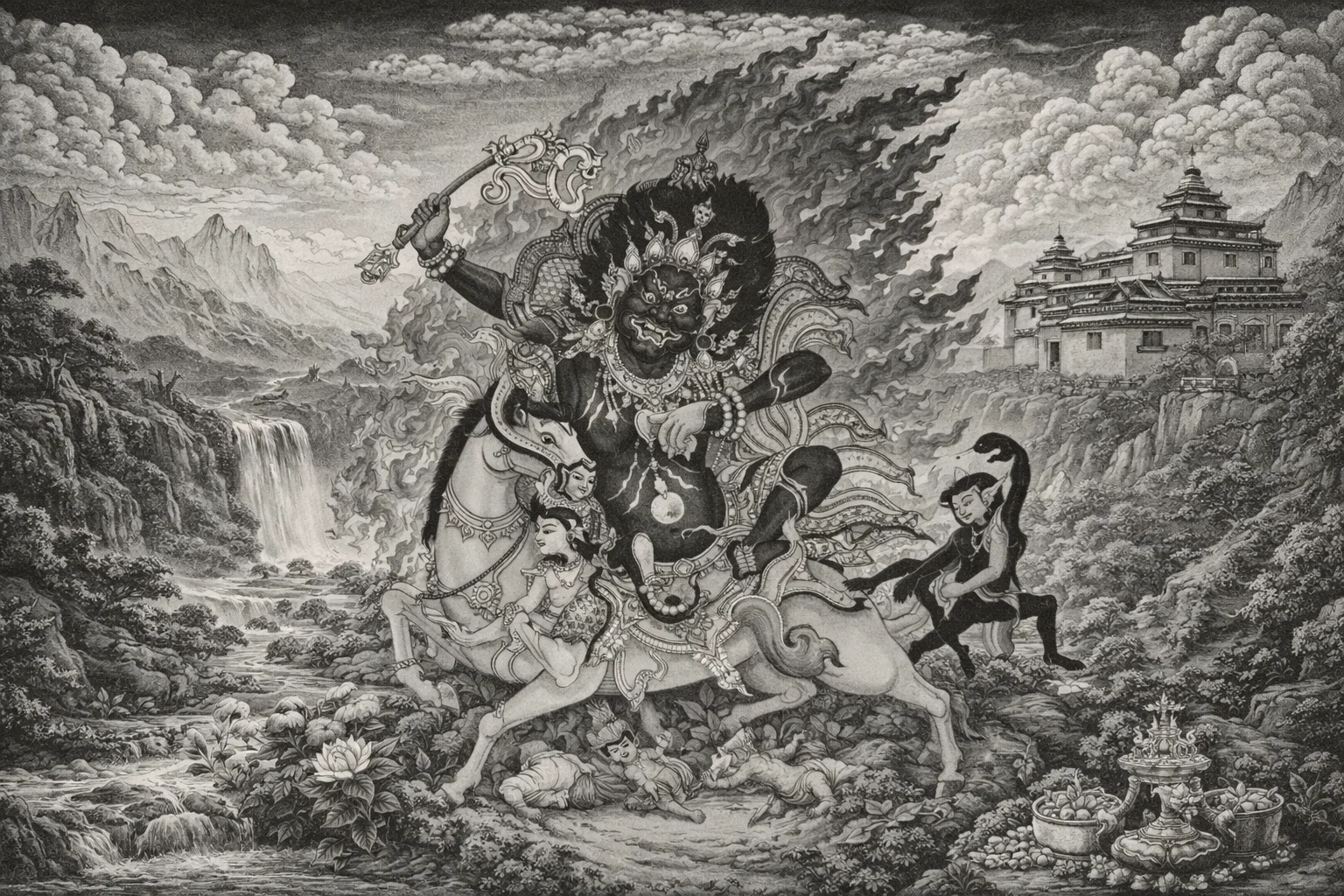
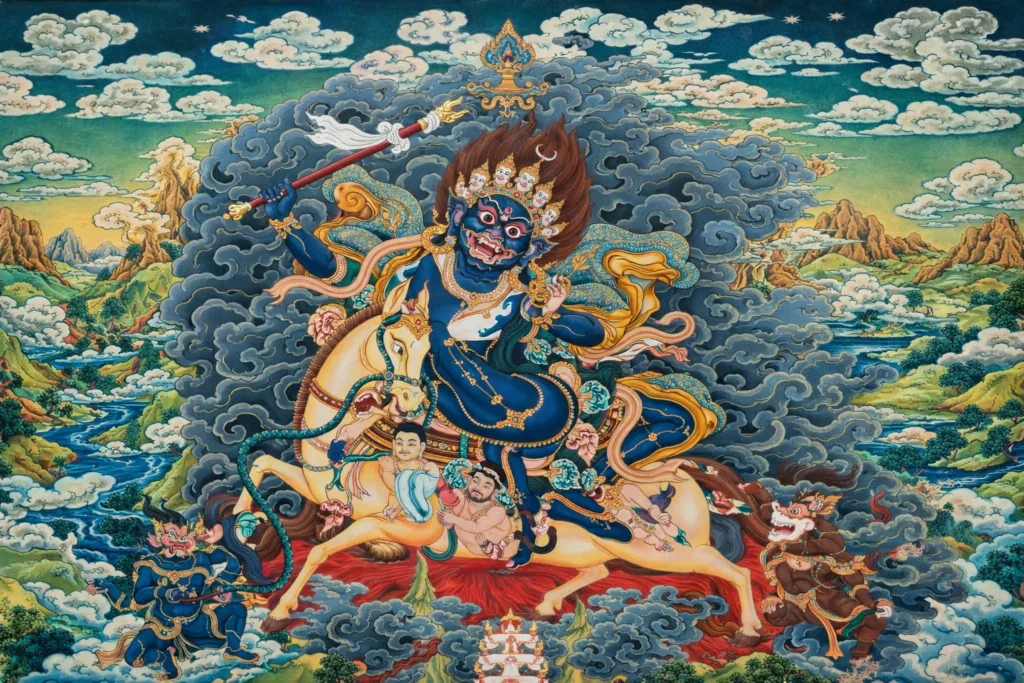
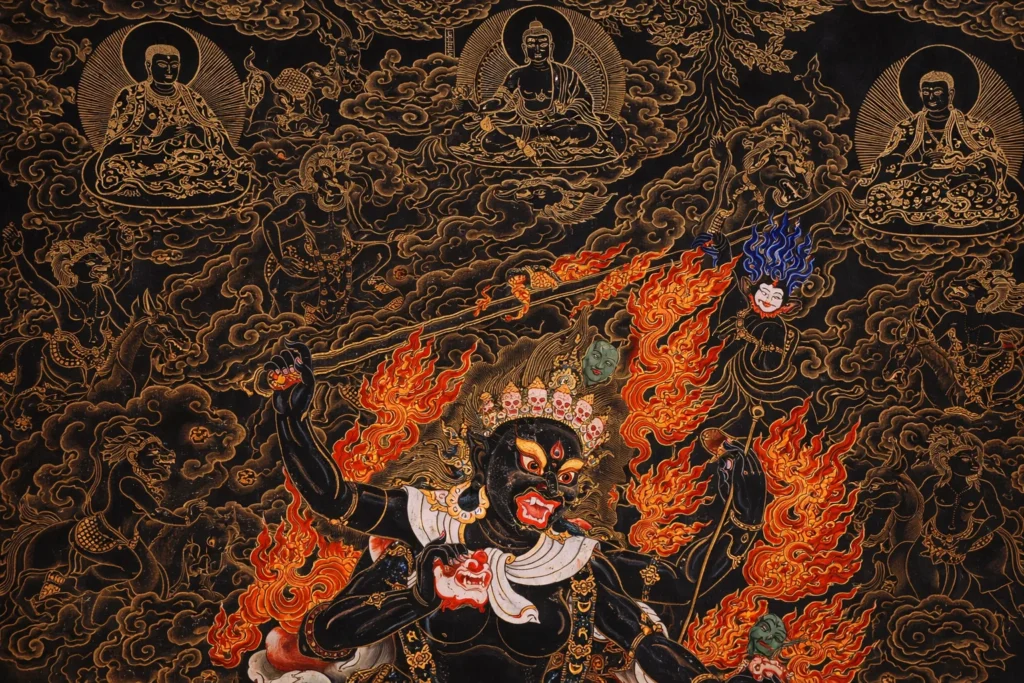
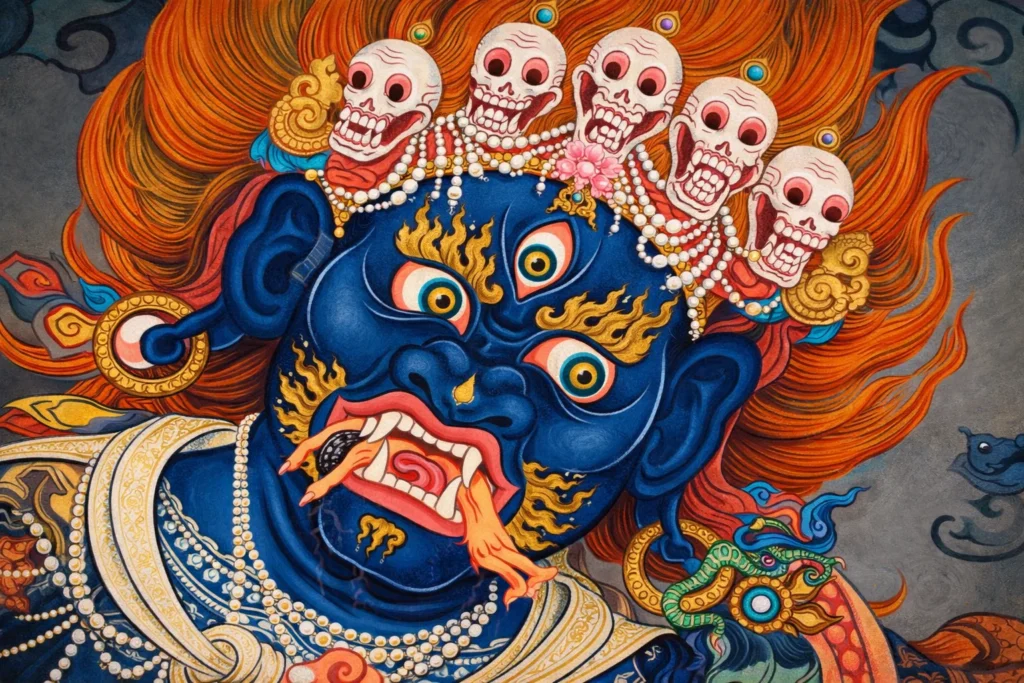
Palden Lhamo is usually shown with dark blue or black skin, which stands for her fierce nature and her power to take on the world’s suffering. She has a large body and rides a white mule over a sea of blood. Her face looks angry, with three bulging eyes and sharp fangs. She wears a crown made of five human skulls, symbolizing the transformation of the five poisons into the five wisdoms.
Her clothing is composed of ritualistic and frightening items. She wears a cloak made from human skin and a tiger skin loincloth. Around her neck is a necklace of fifty severed human heads. In her right hand, she usually has a sandalwood club with a skull on top, and in her left, a skull cup filled with blood or brains.
A unique feature of Palden Lhamo’s mule is an eye on its left side, which appeared when her husband, a demon king, shot an arrow at her as she escaped his kingdom. The mule also carries special items: dice to decide people’s fates, a bag of diseases to use against enemies, and a red tally stick to keep track of people’s wrongdoings.
Origins
The first records of Palden Lhamo appear in Indian Tantric texts, where she was called Shri Devi. Over time, her story mixed Indian Buddhist ideas with local Tibetan spirit beliefs. The Kanjur, a collection of Buddhist teachings, says she started as a fierce spirit but was brought over to protect Buddhism by Vajradhara or Padmasambhava.
Historical sources like The Blue Annals explain that her worship became important in Tibet in the 11th century. The Kadampa school, and later the Gelug school, chose her as their special protector. People believed she had promised to protect the Tibetan people, which helped her become a national guardian instead of just a local spirit.
Her story also connects with Hindu mythology, especially the Yaksha traditions. In some old stories, she was the wife of a demon king in the kingdom of Lanka.
Palden Lhamo turned away from his violent actions and fled north, changing from a demon entity into a Buddhist protector. This journey is similar to how Buddhism itself spread from the south up into the Himalayas.
Relevant Sources
“From the center of a great ocean of blood… she arises with a dark blue body, one face, and two arms. Her right hand holds a sandalwood club marked with a skull, and her left a skull-cup filled with the blood of the enemies of the teachings. She is adorned with a crown of five dry human skulls and a necklace of fifty freshly severed heads. She rides a mule with a white patch on its forehead, traveling through the three worlds in a single instant.” [The Hevajra Tantra (Śrī Hevajra-ḍākinī-jāla-samvara), Circa 8th–9th Century]
This early Vajrayana text establishes the basic appearance of the protector deity. Unlike earlier, gentler female figures in Mahayana Buddhism, this description focuses on her fierce side, which is needed to “subdue the intractable.”
The move from the Indian Dakini to a special Dharmapala is clear in her tools: the sandalwood club and skull cup, which stand for destroying ego and holding back negative karma.
At that time, these deities were shown as fierce guardians to reflect the tough spiritual challenges faced as Buddhism spread. Her dark blue skin connects her to the idea of the void and taking in all opposites. This color also links her to Mahakala, showing her role as his main partner or female counterpart in the highest yoga tantras.
“When Atiśa arrived at the border of Tibet, he had a vision of the Goddess. She appeared to him and said: ‘I shall be your protector and the protector of your teachings in this land of snows.’ Through her power, the local spirits were subdued and the Kadampa tradition was established firmly, shielded from the obstacles of the degenerate age.” [The Blue Annals (Deb-ther sngon-po), 1476 (Compiled by Go lo-tsa-ba Gzhon-nu-dpal)]
This 15th-century record shows how the deity transitioned from a general tantric figure to a national guardian. By linking her to Atiśa, a key entity in Tibetan history, the text provides a strong rationale for her worship. The reason for this portrayal is both political and social.
As Buddhism replaced local shamanic practices, it needed a protector who seemed even more powerful and fearsome than the old mountain gods.
The key point here is her rise in status. In older tantras, she was just one of many Dharmapalas. Still, in The Blue Annals, she starts to stand out as the top spiritual protector in Tibet. This change aligns with the shift to more organized schools, such as Kadampa and Gelug, which needed a main protector to bring different groups together.
“The Queen of the Weapon Army, Magzor Gyalmo, is the chief protectress of our lineage. Her mule carries the bag of diseases to be cast upon those who break their vows and the red tally stick to count the misdeeds of the enemies of the Potala. In her wrath, she is the very embodiment of the activity of the enlightened mind, appearing in dreams to guide the decisions of the state.” [The Autobiography of the Fifth Dalai Lama (Dukula’i Gos-bzang), 17th Century]
When the Fifth Dalai Lama ruled, she became more powerful than ever in the Tibetan government. The text calls her Magzor Gyalmo, meaning “The Queen who Repels Armies.” This shows how she changed from a spiritual protector to a creature with military and political power. The red tally stick and bag of diseases are clear warnings to both rebels and outsiders, showing the strict laws of the Tibetan state.
During this time of civil and regional conflict, her image was used to help keep Tibet stable. The Fifth Dalai Lama used her symbols to strengthen the Gelug school’s rule, turning her into a “State Oracle.” Stories of her appearing in dreams to guide leaders show how religion and government became closely linked in 17th-century Lhasa.
“She fled the kingdom of Lanka, for her husband the demon king was a hater of the Dharma. To prove her resolve and to end the line of those who destroy the teachings, she killed her own son and used his skin to fashion a saddle for her mule. As she rode away, her husband shot a poisoned arrow that struck the mule’s haunch; she turned the wound into an eye, that she might see the enemies of the faith in all directions.” [Oracles and Demons of Tibet (Recording of Oral Liturgy), 1956 (Documented by René de Nebesky-Wojkowitz)]
This story, recorded in the mid-1900s but based on older oral traditions, shows the deity’s local folklore side. The “Infanticide in Lanka” tale is unusual in Buddhism because it uses a shocking act to make a spiritual point. The saddle made from human skin stands for giving up all worldly ties, even the bond between mother and child, for a higher religious purpose.
The eye on the mule is an important symbol. It stands for all-seeing wisdom that comes from pain and betrayal. This story probably helped bring people together by showing that the protector’s loyalty to Buddhism is total, even above normal human morals. It also ties her to Lanka, linking Tibetan myths to Indian epics like the Ramayana, but with a Buddhist twist.
You may also enjoy:
Marid: The Ocean Jinn That Defies Heaven and Earth
September 30, 2025
Aamon: The Infernal Marquis of Lust, Feuds, and False Prophecies
September 29, 2025
Hitotsume kozō: One-Eyed Yōkai of Japanese Folklore
February 4, 2026
What Is a Bhuta? The Backward-Footed Ghosts of Hindu Horror
February 5, 2026
Ancient Demons: The Real Origins of the Setcheh Myth
November 11, 2025
Who Is Andromalius, and Why Is He the Last Demon of the Goetia?
January 20, 2026
Powers and Abilities
She is seen as much more powerful than local spirits or gods because she is an enlightened protector. While a local spirit might rule over only one mountain or valley, she is believed to control all of Tibet and even the region’s weather.
- Weather Manipulation: She is credited with the ability to summon storms, hail, and lightning to destroy the physical structures of those who oppose the Buddhist teachings.
- Divination: Through the use of her dice, she provides insight into the future. The Lhamo La-tso lake is specifically dedicated to her, where monks seek visions regarding the reincarnation of high lamas.
- Disease Control: She carries a bag of contagious diseases, which she can use as a weapon. On the other hand, she has the power to heal these same diseases for the faithful.
- State Protection: She is tasked with safeguarding Tibet’s political integrity, often appearing in legends to thwart invading armies.
- Flight: Riding her mule, she can cross the ocean of blood and traverse different realms of existence instantaneously.
Palden Lhamo Myths, Legends, and Stories
Stories about this goddess often involve violence and sacrifice, showing that her dedication to Buddhism is stronger than any personal relationship.
The Sacrifice of the Prince in the Kingdom of Lanka
One of her most famous stories takes place in the kingdom of Lanka. In this tale, she was married to a demon king who hated Buddhism. He was a cannibal and told his people to destroy temples and harm followers. The goddess, who had promised to protect Buddhism, spent years trying to get her husband to stop these attacks.
She finally saw that her husband would never change and that their son was growing up to be even worse. To protect Buddhism’s future, she decided to end her family line. She killed her son, skinned him, and used his skin as a saddle blanket for her mule.
As she escaped the palace, the demon king found out and shot a poisoned arrow at her. It hit her mule’s side. Instead of healing it, she turned the wound into an eye, saying she could now watch over the whole world. This story shows the main conflict in her character: doing something terrible for a higher spiritual purpose.
The Crossing of the Sea of Blood
After leaving Lanka, Palden Lhamo traveled north to the cold plateaus of Tibet. She had to cross a huge sea of blood, which stood for all the bad karma and violence in the world. As she crossed, demons and spirits sent by her old husband attacked her.
She fought off the waves and attacking spirits with her sandalwood club. On this journey, she collected ritual items that became part of her image, like the tally stick and the bag of diseases. When she arrived in Tibet, Padmasambhava welcomed her and made her an official guardian of the land.
The Vision of the Oracle Lake
Lhamo La-tso, or the “Oracle Lake,” is at the heart of a legend about the search for the Dalai Lama. The goddess is said to have promised the first Dalai Lama, Gendun Drup, that she would protect his line. To keep this promise, she is believed to live in the waters of this high mountain lake.
Tradition says that when a Dalai Lama dies, the Regent of Tibet and top monks go to this lake to look for signs. By meditating by the water, they see visions—like letters, houses, or landscapes—that help them find the next Dalai Lama. The legend claims the goddess creates these images to keep the leadership going.
The Protection of the Potala Palace
During invasions of Lhasa, people told stories of a giant woman riding a white mule through the streets at night.
In one story, when an enemy army reached the Potala Palace, a sudden, deadly plague struck them. Soldiers said they saw a blue figure in the sky scattering dust from a bag. People believed this was the goddess using her bag of diseases to protect the city’s spiritual center.
Palden Lhamo vs Other Similar Entities
| Demon Name | Associated Obstacle/Role | Origin/Source | Key Traits/Powers |
| Mahakala | Obstacles to practice | Indian Tantra | Wrathful, 75 forms |
| Yamantaka | Conqueror of Death | Mahayana Sutras | Bull-headed, fierce |
| Ekajati | Protector of Secret Mantra | Nyingma Terma | Single eye, single breast |
| Trakshad | General of the army | Tibetan folklore | Rides a black horse |
| Begtse Chen | War protector | Mongolian tradition | Chainmail, coral mask |
| Yama | Judgment of the dead | Pali Canon | Holds the wheel of life |
| Mara | Temptation/Desire | Samyutta Nikaya | Illusion, distraction |
| Rahu | Eclipses/Seizures | Tibetan Astrology | Serpent body, many eyes |
| Hayagriva | Curing disease | Indian Buddhism | Horse head in hair |
| Kubera | Greed/Wealth | Vedic roots | Holds a mongoose |
| Hariti | Protection of children | Vinaya texts | Formerly ate children |
| Pehar | State protection | Hor region | Five forms, bird head |
Mystical Correspondences
| Attribute | Details |
| Planet | Saturn |
| Zodiac Sign | Scorpio |
| Element | Water (Blood) |
| Direction | South |
| Color | Deep Blue/Black |
| Number | 21 (Associated with her retinue) |
| Crystal/Mineral | Lapis Lazuli |
| Metal | Iron |
| Herb/Plant | Black Aconite |
| Animal | Mule |
| Trait/Role | Wrathful Protection |
The mystical side of this goddess is all about transformation. Her dark blue color stands for the endless sky and deep ocean, showing the mind’s ability to hold both calm and anger. Palden Lhamo is linked to the planet Saturn, so her power is seen as strict and focused on removing ego and enforcing spiritual rules.
Iron and black minerals are used in her rituals to show the strength needed to defeat the “marapi” or inner demons. People who call on her often use black aconite, a poisonous plant, to show that poison can be used to fight poison. She is linked to the South, which in tradition is connected to the dead and to both growth and destruction.
Her link to the number twenty-one comes from her group of goddesses, which includes the Twelve Tenma and the goddesses of the four seasons. These connections put her at the center of a complex spiritual system that shapes the yearly cycles and spiritual life in Tibet.
You may also enjoy:
Agubanba: The Blind Yōkai That Preys on Young Women
October 23, 2025
Who Was Hiranyaksha, the Golden-Eyed Asura?
October 7, 2025
Who Is Abalam in Demonology? The Demon King That Serves Paimon
September 30, 2025
Akateko: The Bloody Hand Yōkai That Guards a Cursed Temple Tree
November 14, 2025
What Is the Akkorokamui, Japan’s Colossal Sea Monster?
November 14, 2025
Mahakala: The Dark Guardian Who Consumes Evil
October 16, 2025
Bibliography
Author’s Note: While working on this article, I balanced the official texts of the Kanjur with the vivid details recorded by De Nebesky-Wojkowitz. Markel’s work on meditational art gave a formal visual background. At the same time, Gazizova’s research on Kalmykian military use added a modern perspective. By looking at these sources through Plakun’s ideas about national psychology, I aimed to show the deity as an active force that moves between violent protection and spiritual healing.
- Buswell, Robert E., Jr., and Donald S. Lopez, Jr. The Princeton Dictionary of Buddhism. Princeton University Press, 2014. Internet Archive.
- Tauscher, Helmut. Kanjur. Brill’s Encyclopedia of Buddhism, Vol. 1, Brill, 2015.
- Based on the digital record and title page from the link provided, here is the MLA citation for this edition:
- De Nebesky-Wojkowitz, René. Oracles and Demons of Tibet: The Cult and Iconography of the Tibetan Protective Deities. Mouton & Co., 1956. Internet Archive.
- Markel, Stephen. The Circle of Bliss: Buddhist Meditational Art. Orientations 34:8 (2003): 26-31, 2003. Academia.edu.
- Valeria Gazizova. Military might and healing power. Appropriation and representations of the goddess Palden Lhamo in Kalmykia. Études mongoles et sibériennes, centrasiatiques et tibétaines, 53 | 2022, published on December 23, 2022; DOI : https://doi.org/10.4000/emscat.5684.
- Plakun, Eric M. Psychiatry in Tibetan Buddhism: Madness and Its Cure Seen Through the Lens of Religious and National History. Journal of the American Academy of Psychoanalysis and Dynamic Psychiatry, vol. 36, no. 3, 2008, pp. 415-30. ResearchGate.
- Karmay, Samten Gyaltsen. Secret Visions of the Fifth Dalai Lama: The Gold Manuscript in the Fournier Collection. Serindia Publications, 1988. Internet Archive.