The Rokurokubi is an important yōkai in Japanese folklore because it blurs the line between the safe, familiar home and the frightening unknown. Unlike most supernatural beings in Japanese stories, which appear in remote or abandoned places, the Rokurokubi lives within ordinary households. This creates a tension between living a normal life and the hidden, uncontrollable side that appears at night.
Most yōkai are known for their constant physical oddities, but Rokurokubi are different. They look human during the day but become something impossible at night. This change reflects social anxiety and the fear that someone close might be hiding a secret.
My research is based on comparing the snake-like images in Katsushika Hokusai’s Hokusai Manga with the early stories of “flying heads” found in the Konjaku Monogatarishū. [View Full Bibliography ↓]
Summary
Key Takeaways
| Attribute | Details |
| Names | Rokurokubi, Nukekubi (often conflated or used for the detached-head variant), Whirling Neck. |
| Translation | The name is derived from “rokuro,” referring to a “potter’s wheel” or a “pulley/well-crank,” and “kubi,” meaning “neck.” |
| Title | The Elongating-Neck Woman; The Pulley-Neck Spirit. |
| Type | Obake (Shapeshifter) / Yōkai. |
| Spirit Classification | Generally viewed as an “Ara-mitama” (rough spirit) when predatory, though often they are unaware humans afflicted by a “ketsugeki” (spiritual defect). |
| Origin | Historically attributed to “abnormalities in the spirit” or “karmic retribution” for the sins of the individual or their parents. |
| Gender | Predominantly female, though male variants appear in early literature. |
| Appearance | Indistinguishable from a human female during the day; at night, the neck stretches to several meters in length while the body remains stationary. |
| Kehai (Aura/Presence) | A faint blue light (hitodama) may be seen; a faint scratching sound; the smell of lamp oil; an atmospheric “heaviness” in the sleeping chamber. |
| Powers/Abilities | Extreme cervical elongation, independent movement of the head, oil consumption, and occasionally the ability to drain life force. |
| Methods of Pacification | Moving the sleeping body so the head cannot find its way back; writing sacred characters on the chest; seeking Buddhist intervention for karmic healing. |
| Habitat | Human houses, urban Edo households, and occasionally brothels or inns. |
| Diet/Prey | Lamp oil (refined from fish or vegetables), small insects, and occasionally the vital energy of sleeping humans. |
| Symbolic Item | The Andon (paper-covered oil lamp). |
| Symbolism | Representing hidden desires, the duality of the feminine role, and the “leakage” of the internal self into the physical world. |
| Associated Kami | Sometimes linked to minor “Yakubyogami” (pestilence deities) or fallen spirits of “Ubusunagami” (local tutelary deities) if the condition is a curse. |
| Sources | Konjaku Monogatari Shū, Kasshi Yawa, Shokusanjin Gadan, Hokusai Manga. |
The Fundamental Identity of Rokurokubi
The Rokurokubi is a well-known entity in Japanese yōkai stories. It is usually a human who transforms into something frightening at night. Unlike yūrei, ghosts, or oni, demons, the Rokurokubi remains human and often lives a normal life in the community.
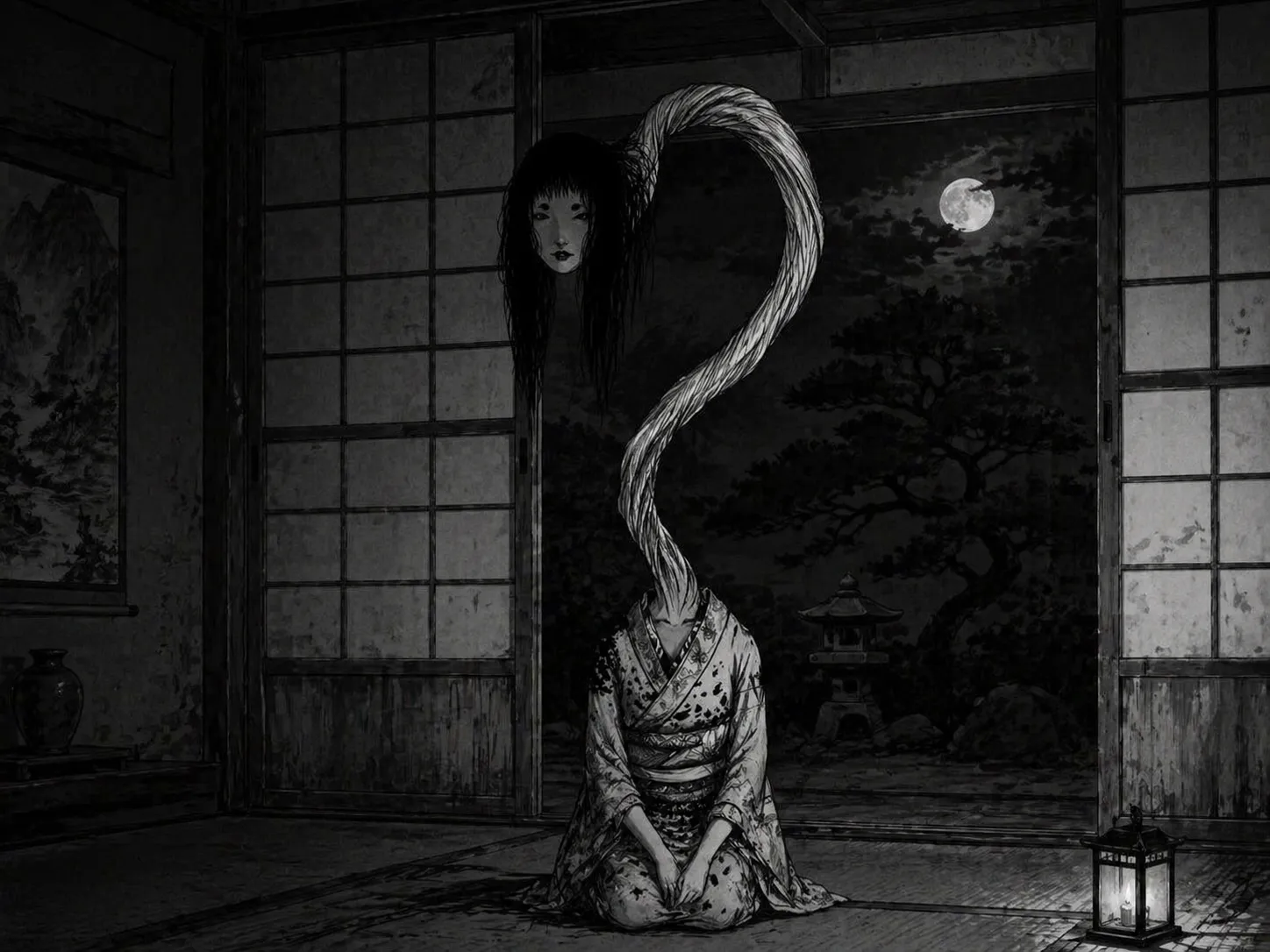
During the day, they look like ordinary women, often wives, daughters, or servants. But when they fall into a deep sleep, their necks stretch to great lengths, letting their heads move around the house or even outside.
Although there are rare male examples from the Edo period, the Rokurokubi is usually female. She represents the worry that people close to us might have hidden sides. The transformation is often seen not as a choice, but as a sickness or a sign of a wandering soul (shiryō).
In many stories, the woman does not know about her condition. She only wakes up with a sore neck or odd dreams of seeing the room from strange angles. Because she has no control over her transformation, she is seen as a tragic creature caught between being human and being a monster.
Semantic Origins
The name Rokurokubi gives clues about what the transformation looks like. ‘Rokuro’ means pulley, well-crank, or potter’s wheel, and ‘kubi’ means neck. This shows how the neck seems to crank or wind as it stretches and shrinks. In Edo-period writings, the name sometimes used characters that stressed the spinning or turning motion of the head.
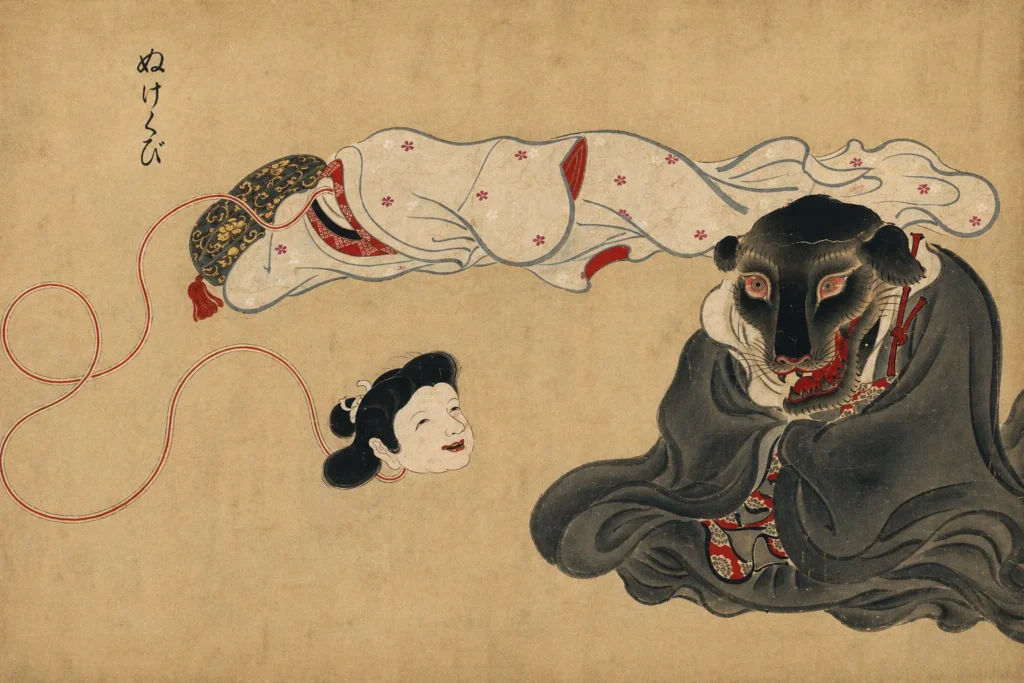
Over time, the language shows a difference between Rokurokubi and Nukekubi. In older stories from the Muromachi period, Nukekubi were common, with heads that left the body and flew around. But as cities grew during the Edo period, the version featuring a stretched neck became more popular in art and literature.
Others think the name came from ‘pulley-neck’ because the stretching neck looks like a well bucket’s rope being lowered. By the late 1700s, the term was used for any creature with an unusual neck, whether the head detached or just stretched.
How to Pronounce “Rokurokubi” in English
To say ‘Rokurokubi’ in English, break it into four parts: ro-ku-ro-ku-bi. The ‘ro’ is like ‘row’ but with a quick, soft ‘r.’ ‘Ku’ sounds like ‘koo’ in ‘cook.’ ‘Bi’ is like ‘bee.’ Each part gets about the same stress: roh-koo-roh-koo-bee.
What Does Rokurokubi Look Like?
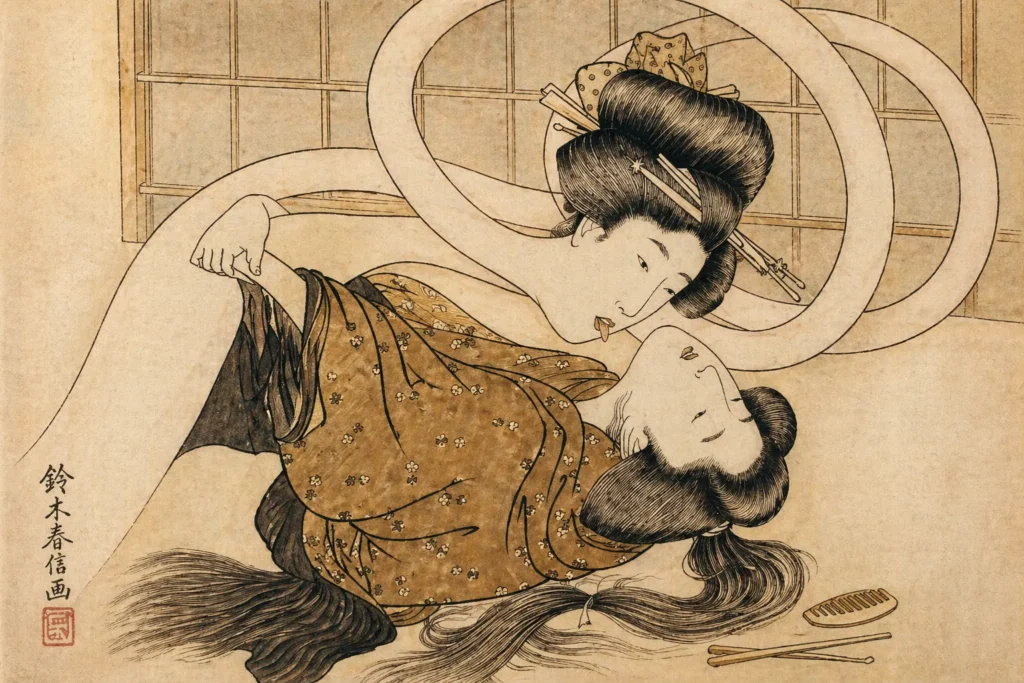
The Rokurokubi looks completely normal during the day. Edo-period stories usually depict her as a woman of marriageable age, wearing a traditional kimono and a formal hairstyle. She has no claws, glowing eyes, or strange features when awake. Some stories mention a faint ring or shadow around her neck, but it is usually too subtle for most people to see.
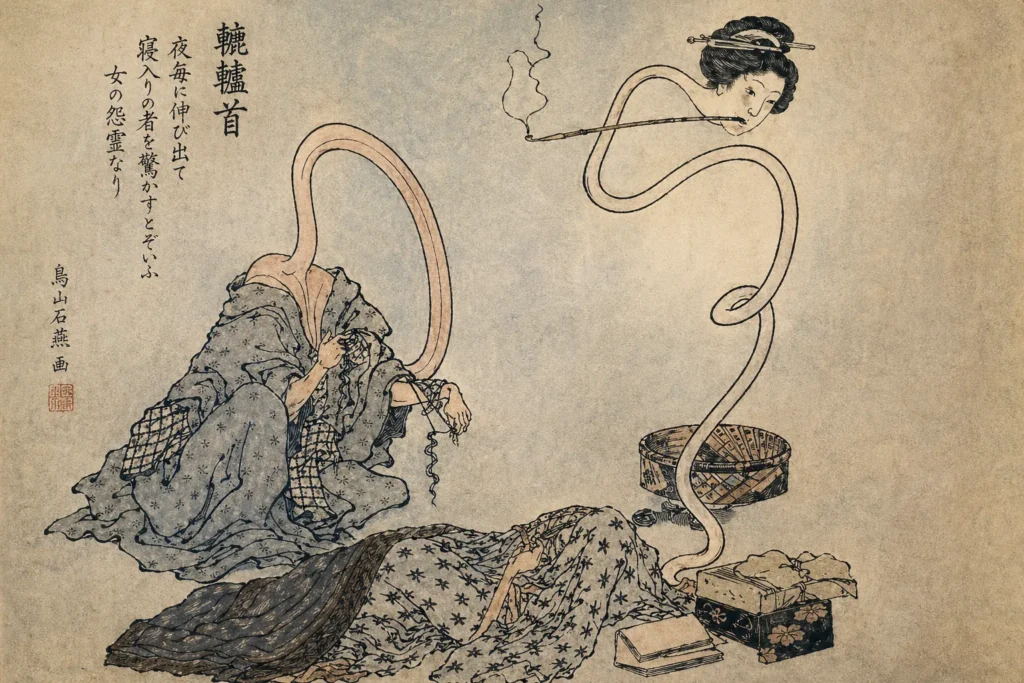
The transformation happens only when she is asleep. As her breathing slows, her neck starts to grow longer. It can stretch for several meters and often becomes thin and flexible, like a cord or a snake.
While her neck is stretched, her head stays awake and alert, with open eyes and a tongue that sometimes licks lamp oil from paper lamps. Her face might look a bit more mischievous or predatory, but it is still clearly hers.
Some artists, like Katsushika Hokusai, show the Rokurokubi long neck winding around rafters or coiling like a snake, making it look almost liquid and impossible for a normal human body.
You may also enjoy:
Who Is the Infernal King Balam? Origins, Powers, and Occult History
February 26, 2026
Allocer: Great Duke of Hell and the 52nd Spirit of the Ars Goetia
November 17, 2025
Apophis: The Great Serpent of Egyptian Chaos
November 11, 2025
Andrealphus: The Peacock Demon Who Twists Minds and Bodies
January 19, 2026
What Is the Akkorokamui, Japan’s Colossal Sea Monster?
November 14, 2025
Origins and History
The Rokurokubi became popular during the Edo Period (1603–1868), a time when cities grew quickly, and society became more divided. Earlier stories about flying heads appeared in medieval texts like the Konjaku Monogatari Shū. Still, the version with the stretching neck became especially well-known during this peaceful and literate era.
During this time, people loved ‘strange tales’ (kaidan), and supernatural stories became popular in woodblock prints and on the stage. The growth of pleasure districts and strict rules for women at home made it easy for stories to develop about people with hidden, uncontrollable sides.
I think the Rokurokubi reflects the strong social pressure women faced during the Tokugawa shogunate. Strict Neo-Confucian rules required women to be calm and obedient at home. The stretched neck is a good symbol for hidden thoughts or desires that could not be shown during the day.
Interestingly, the first reports of Rokurokubi appeared around the same time as ‘Misemono’ (freak shows) became popular in Edo. People’s interest in unusual bodies may have shifted the story from a spiritual possession to a biological oddity, turning the Rokurokubi into a common part of city entertainment rather than just a rural legend.
In the past, people often described the condition as ekki, meaning ‘overflowing spirit.’ They believed that if someone had strong resentment or longing, their soul would try to leave the body, pulling the neck with it.
This evolution from calling it a case of demon possession to a case of soul sickness shows how people in the Edo period tried to explain the supernatural in more scientific terms.
Habitat
The Rokurokubi prefers to live in city homes. Unlike the Kappa, which needs water, or the Yama-uba, which lives in the mountains, this yōkai stays inside houses. It is usually found in bedrooms of homes, inns, and brothels. The Rokurokubi is closely tied to the design of traditional Japanese houses, using rafters, sliding doors, and tall rooms to fit its long neck.
Rokurokubi choose their homes based on their need for lamp oil. In the Edo period, lamps used fish or rapeseed oil, which attracted these beings. They are often found near standing lamps in dark or quiet rooms. Since their bodies must stay still and safe while the neck stretches, they prefer enclosed spaces where they will not be disturbed.
Rokurokubi as a Manifestation of Urban Claustrophobia
The transition from the medieval Nukekubi (with a detached head) to the Edo-period Rokurokubi (with a stretching neck) shows a big shift in how Japanese people thought about privacy and being watched.
Stories from the Heian period about flying heads usually took place in the wild or involved outside spirits. But in the Edo period, the Rokurokubi became tied to city homes. My research shows that this happened as Edo (now Tokyo) became crowded, with thin walls that made privacy hard to find.
Interestingly, the stretched neck acts like a perfect tool for spying at home. The Rokurokubi comes from the fear of being watched in private moments, or the secret wish to see what others are doing.
I believe the Rokurokubi’s habit of licking lamp oil is more than just a strange detail. In the Edo period, oil was valuable, and lighting a lamp showed someone was active and present.
By taking the oil, the Rokurokubi’ steals the light,’ leaving the house in darkness like in old times. This act represents the hidden self, or straying soul, which cannot be free in a strict society and instead comes out as a physical transformation during sleep.
Also, the name’s link to ‘rokuro’ (potter’s wheel or well-pulley) shows how people in that era were interested in machines. I think calling the creature by this name shows how the supernatural was explained using simple machines as Japan became more curious about technology.
The neck does not just get longer; it moves like a pulley, showing that people in Edo thought of the supernatural as following its own strange rules. This was a key moment when vague old fears became specific, mechanical creatures that could be described and studied.
Famous Rokurokubi Legends and Stories
The Maid of the Echigoya Inn
In Kasshi Yawa by Matsura Seizan, there is a story about a traveler who stayed at a well-known inn. Late at night, he woke up to a strange noise from the next room, where a young maid was sleeping. Looking through a crack in the sliding door, he saw her neck stretch upward as her head moved toward the lamp to lick the oil.
The traveler was frozen with fear as he watched the head move around the room, gliding like a bird looking for insects. The next morning, he told the innkeeper what he had seen.
The innkeeper admitted that other guests had seen the same thing. The maid was let go, not because she was thought to be “evil,” but because her “unfortunate condition” was bad for business.
The Monk and the Detached Head
A famous story from the Buso Kan’yō-ki tells of a wandering monk who found shelter in a remote mountain hut with a group of woodcutters. During the night, the monk noticed that the woodcutters’ bodies were in their beds, but their heads were gone. He remembered a piece of folklore and realized they were the “Nukekubi” type.
He moved one of the bodies to another spot. When the heads came back from their nightly hunt, one could not find its “connection point.” The detached head began to wail and eventually died because it could not reattach to its body. This story warns about how vulnerable the creature is during its transformation.
You may also enjoy:
Who Is the Infernal King Balam? Origins, Powers, and Occult History
February 26, 2026
Si’la: The Seductive Jinn Who Lures Travelers to Their Doom
October 9, 2025
Mara: The Buddhist Demon King of Desire and Death
October 13, 2025
Kuchisake-onna: Folklore, Origins, and Urban Legend History
February 10, 2026
Who Is Agaliarept, the General of Hell Under Lucifer?
October 8, 2025
Edimmu: The Mesopotamian Wind Demon That Steals Life
November 6, 2025
The Cursed Daughter of the Merchant
In a sad story from the Shokusanjin Gadan, a rich merchant’s daughter could not find a husband because she always had a “shadowy ring” around her neck. Her father later found out that at night, her neck would stretch and her head would go to the local temple to eat the offerings left for the dead.
The merchant asked a local priest for help. The priest said the girl was suffering from a “karmic debt” because her father had once killed a snake out of anger. The girl’s transformation was a sign of the snake’s lasting curse, showing that this condition was often seen as a spiritual burden passed down in families.
Rokurokubi Powers and Abilities
The main power of this creature is its stretchy neck, which can extend much farther than a normal human’s without causing injury. While the body stays in a trance-like state, the head has sharper senses, especially in the dark.
Their strength is not about physical power. Instead, they are dangerous because they can reach places others cannot and move without making a sound.
- Extreme Elongation: The ability to stretch the neck up to several meters to scout surroundings or reach food.
- Independent Head Consciousness: The head can see, hear, and speak even when the body is in deep sleep.
- Oil Consumption: A specialized ability to digest large quantities of lamp oil, which is often toxic or unpalatable to humans.
- Stealth and Invisibility: By day, the entity is perfectly camouflaged as a human, making it impossible to detect without prior knowledge.
- Spiritual Projection: In some accounts, the elongation is actually a projection of the ichiryō (one’s soul), making the neck semi-incorporeal.
Traditional Defenses Against Rokurokubi
The best way to defend against this creature is to interrupt its transformation. Since the head must return to the body before dawn, moving the body while it is asleep can be fatal to the entity.
If the head comes back and cannot find the body or finds it moved, it may not be able to reattach, which can kill the human host. In stories, people often drag the body into a closet or cover it with a heavy blanket to confuse the returning head.
Another traditional defense is spiritual marking. People write the Siddham script or certain Buddhist sutras on the neck or chest of the person they suspect is guilty. This can stop the spirit from leaving the body. Placing ofuda, or Shinto charms, over doors and windows can also block the head from leaving the room to look for oil.
People also saw this condition as a kind of mental illness. Traditional medicine used moxibustion or herbal teas to “anchor the soul” to the liver, which was thought to be where the spirit lived. Finally, simple steps like keeping lamps empty of oil at night could keep the creature away from certain rooms.
Rokurokubi vs Similar Spirits
| Name | Category | Origin | Threat Level | Escape Difficulty |
| Nukekubi | Obake | Detached head variant; often cursed humans. | High | Hard; the flying head can bite and attack. |
| Ohaguro-Bettari | Yōkai | The ghost of a woman who failed to marry. | Low | Easy; she only seeks to startle with her faceless grin. |
| Futakuchi-onna | Obake | Cursed woman with a second mouth in her skull. | Medium | Moderate; requires constant food to pacify. |
| Yuki-onna | Yūrei-like | Spirit of the snow; personification of winter. | Lethal | Very Hard; her breath freezes victims instantly. |
| Kerakera-onna | Obake | A giant laughing woman was found in the pleasure districts. | Low | Easy; she only causes psychological distress via laughter. |
| Taka-onna | Obake | A woman who can stretch her lower body. | Medium | Moderate; she peeps into second-story windows. |
| Nure-onna | Onna-mushi | Serpent-bodied woman found near water. | Lethal | Hard; she uses a heavy “child” to trap victims. |
| Hone-onna | Yūrei | Skeletal ghost of a woman seeking her lover. | High | Hard; her touch drains the life from the living. |
| Kurote | Yōkai | A hairy black hand that emerges from toilets. | Medium | Easy; physical struggle usually suffices. |
| Ubume | Yūrei | Spirit of a woman who died in childbirth. | Medium | Moderate; she forces people to hold her heavy baby. |
| Hannya | Oni | A woman transformed by extreme jealousy. | Lethal | Very Hard; requires high-level exorcism. |
Symbolism
| Attribute | Details |
| Element | Air/Ether (due to the stretching and hovering nature of the head). |
| Animal | Snake (referencing the snake-like movement of the neck). |
| Cardinal Direction | North-East (Kimon/Demon Gate), associated with spiritual leaks. |
| Color | Pale White (skin) and Faint Blue (aura). |
| Plant | Willow (symbolizing flexibility and the drooping of the neck). |
| Season | Summer (the peak season for “kaidan” or ghost story gatherings). |
| Symbolic Item | Andon (the traditional oil lamp). |
In Japanese culture, this creature represents the unstable nature of the human body and the fragile balance of social harmony. She shows the difference between a person’s hidden side, or “Ura,” and their public side, or “Omote.” The stretched neck is a symbol of crossing boundaries, such as looking or reaching where one should not.
This creature is also important in Japanese art, showing up in many ukiyo-e prints as a “playful terror.” It helped shape yōkai stories by creating the idea of the “domestic monster.” These tales teach that the scariest things are not always in the wild, but sometimes right in the same room as the victim.
Today, the image of the stretching neck is still used to show something strange or unsettling. It appears in modern horror movies and manga as a reminder that our bodies are fragile and can hide a deeper, spiritual chaos.
You may also enjoy:
Who Is the Demon Andras, The Great Marquis of Discord?
January 15, 2026
Who Is Asmodeus in Demonology and the Bible?
February 18, 2026
Agubanba: The Blind Yōkai That Preys on Young Women
October 23, 2025
The Ghul: The Flesh-Eating Demon of Arabian Folklore
October 1, 2025
Arāti: The Beautiful Demon of Aversion in Buddhist Mythology
October 15, 2025
What Is a Rakshasa? Meaning, Origins, and Dark Powers
January 23, 2026
Bibliography
Author’s Note: The stories in the Konjaku Monogatari Shū and Kasshi Yawa show an evolution from seeing the creature as a “spiritual anomaly” to an “urban legend.” Earlier texts focus on the soul leaving the body as a spiritual phenomenon. Yet, later Edo-period stories talk more about the neck stretch in a physical way. By focusing on the Shokusanjin Gadan, I was able to connect these different eras and show how the creature switched from a vague omen to a clear entity in city life. This transition is the most important finding of my research, showing how the growth of Japanese cities altered people’s perceptions of the supernatural.
- Kelsey, W. Michael. Konjaku Monogatarishū. Twayne Publishers, 1982. Twayne’s World Authors Series 621. Internet Archive.
- Bradt, Aaron. The Role of Yōkai in Japanese Myth. 2016. Academia.edu.
- Foster, Michael Dylan. The Book of Yōkai: Mysterious Creatures of Japanese Folklore. University of California Press, 2015. Internet Archive.
- Night Parade of a Hundred Demons. Yōkai Senjafuda, Mellon Projects, University of Oregon, glam.uoregon.edu.
- Johnson, Adam J. The Evolution of Yōkai in Relationship to the Japanese Horror Genre. 2021. University of Massachusetts Amherst, Capstone Project. ScholarWorks@UMass Amherst.
- Brecher, W. Puck. Being a Brat: The Ethics of Child Disobedience in the Edo Period. Academia.edu.
- Aston, W. G., translator. Nihongi: Chronicles of Japan from the Earliest Times to A.D. 697. Kegan Paul, Trench, Trübner & Co., 1896. Internet Archive.
- Boss, Joyce. (2026). Yōkai and “Old Japan” in Lore, Art, and Film: Studying Japan through Studying Yōkai. Education About Asia. 29. 10.65959/eaa.1848. ResearchGate.