Unlike most aquatic spirits in Japanese folklore, which are known for their connection to the water’s surface, Akashita stands guard at the sluice gate. It reflects the worries and responsibilities of managing farmland, rather than the unpredictable nature of the open sea.
Looking at its evolution from the mid-Edo period to today, we can see how it changed from a direct warning about stealing water to a symbol of hidden fears tied to human-made structures.
To trace this entity’s history, I compared the first visual examples in Toriyama Sekien’s Gazu Hyakki Yagyō with earlier, more mysterious images from the Bakemono no e scroll. This helped me ensure the details matched accurately. [View Full Bibliography ↓]
Summary
Key Takeaways
| Attribute | Details |
| Names | Akashita (赤舌), Akaguchi (赤口) |
| Translation | Red Tongue |
| Title | Gatekeeper of the Sluice; The Crimson Maw |
| Type | Yōkai; Kichō (strange bird or omen-spirit) |
| Spirit Classification | Ara-mitama (violent spirit); often categorized as a malevolent omen linked to the Onmyōdō calendar. |
| Origin | Edo-period pictorial records; likely derived from the ‘Shakukō-jin’ or ‘Akaguchi-gami’ deity of the unlucky ‘Akaguchi-gami’ days. |
| Gender | Commonly depicted as male or gender-ambiguous, with masculine facial features. |
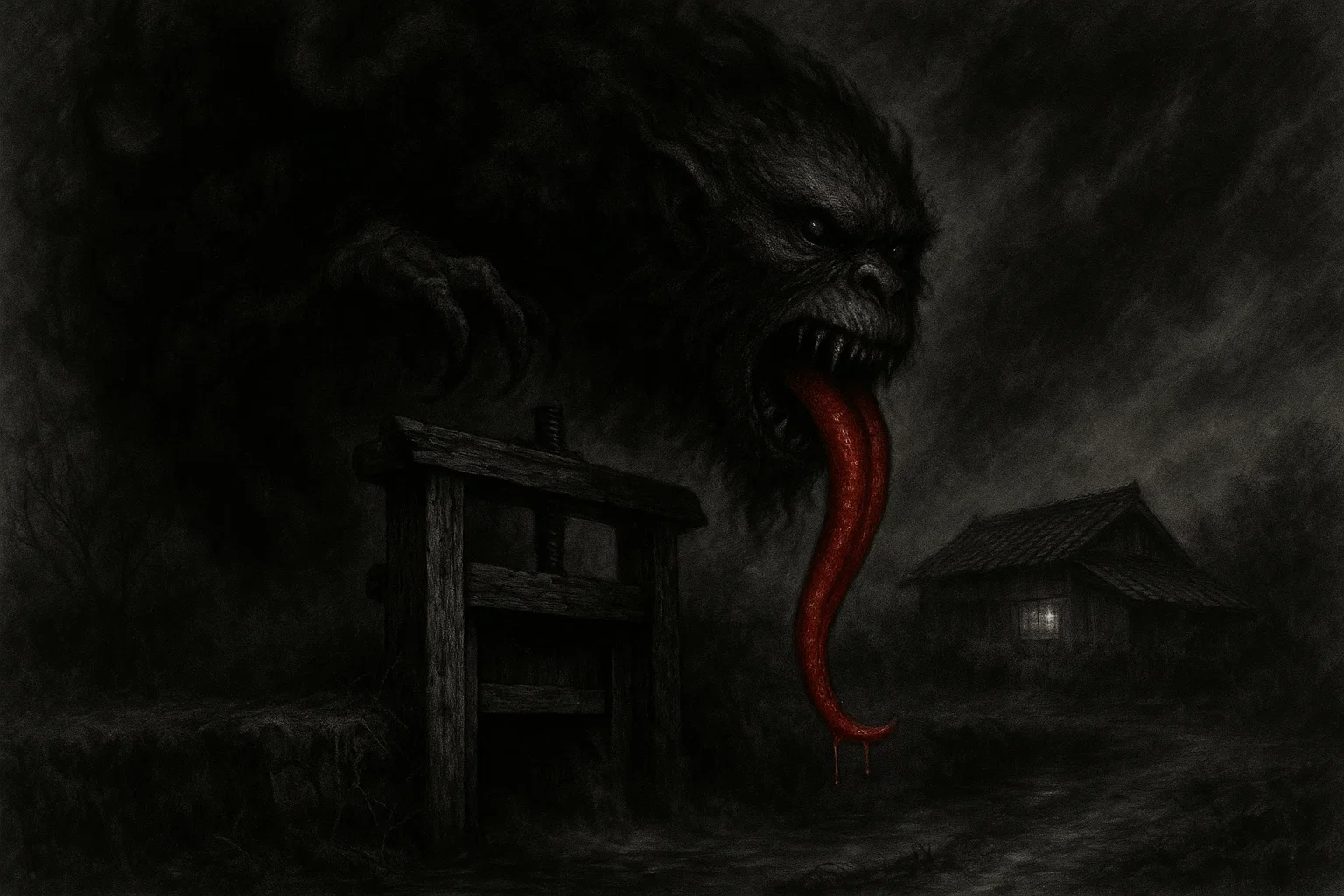
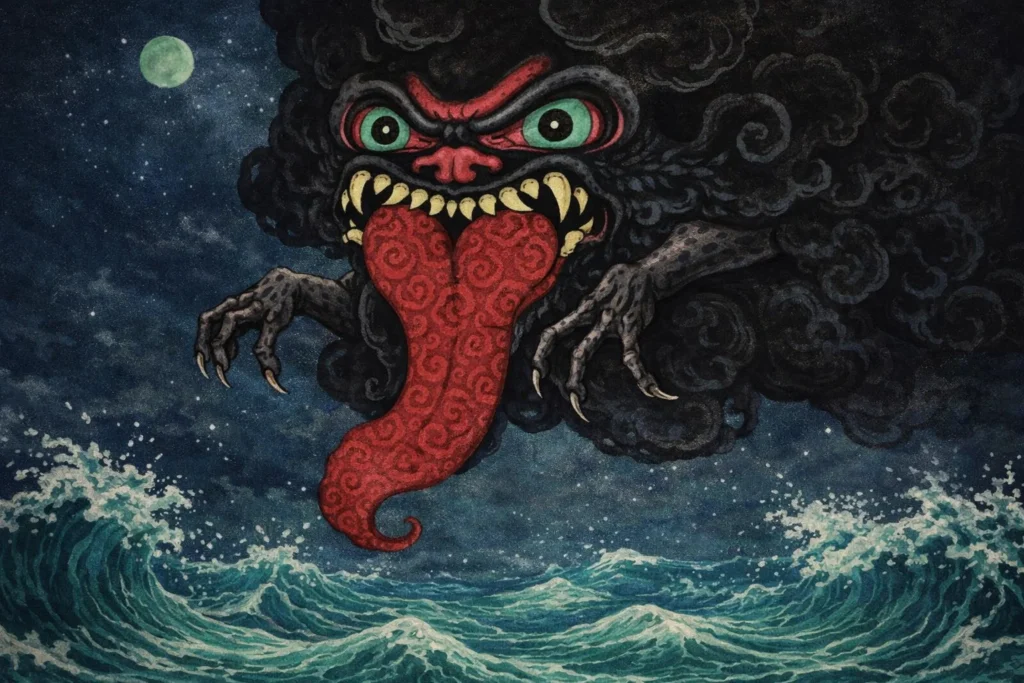
| Appearance | A hairy, clawed beast with a massive face, often obscured by dark clouds, featuring a prominent, long red tongue. |
| Kehai (Aura/Presence) | The sound of rushing water through a closed gate; a damp, oppressive atmospheric shift; the visual manifestation of dark, looming cumulus clouds. |
| Powers/Abilities | Manipulation of water flow; bringing bad luck to those who misuse resources; swallowing the unlucky. |
| Methods of Pacification | Strict adherence to water-sharing laws; avoidance of critical tasks on ‘Akaguchi’ days; Shinto purification of irrigation channels. |
| Habitat | Sluice gates; irrigation canals; drainage pipes; dark rain clouds over farmland. |
| Diet/Prey | Human luck and prosperity; occasionally said to swallow those who engage in water disputes. |
| Symbolic Item | Sluice gate (Suimon) |
| Symbolism | The consequences of greed; the fragility of communal resource management; calendrical superstition. |
| Associated Kami | Akaguchi-gami (a god of the Onmyōdō tradition residing at the East gate). |
| Sources | Gazu Hyakki Yagyō (Toriyama Sekien); Bakemono no e (Edo-period scroll). |
The Fundamental Identity of Akashita
Akashita represents the fear and stress that come with managing shared resources. It is often shown as a monstrous head watching over the tools people use to survive.
Profoundly connected to farming life in the Edo period, it represents the consequences of betraying the community, especially when it comes to sharing water. Unlike wandering forest spirits, it stays at the sluice gate, quietly judging how water is used.
This monster usually appears surrounded by black mist and goes after those who are greedy. In feudal Japan, if one farmer took more than their share of water, it could mean disaster for the whole village.
So, Akashita acted as a warning. Its huge, sticking-out tongue is more than just a scary feature—it’s a symbol for both stealing water and spreading harmful words, turning the sluice gate into a place of judgment.
Semantic Origins
The name of this spirit comes from the Onmyōdō system, an old Japanese way of keeping time. It combines the kanji aka (赤), which means “red,” and shita (舌), which means “tongue.” Many believe this name evolved from Akaguchi (赤口), meaning “Red Mouth” or “Crimson Tongue” day, one of the six unlucky days in the traditional calendar.
In the classical calendar, the Akaguchi-gami was a deity of ill-fortune believed to guard the eastern gate of the divine palace. On these days, it was said that the god’s “tongue” was particularly sharp, leading to bloody conflicts or accidents.
Old scrolls like the Bakemono no e show this spirit coming out of a gate, which links the opening of a dam to the mouth of the creature. When Toriyama Sekien described it in the 18th century, the name had come to mean both the red tongue itself and the arguments that happened during fights over land and water.
How to Pronounce “Akashita” in English
To say this name in English, break it into four parts: Ah-kah-shee-tah. The first two parts, Ah and kah, use the short “a” sound like in “father.” The third, shee, rhymes with “see,” and the last, tah, also uses the short “a.” Try to keep the stress even on each part.
You may also enjoy:
Who Is Ariton (Egyn), the Infernal King of the Eastern Gate?
February 17, 2026
Empusa: The Blood-Drinking Wraith of Greek Mythology
November 20, 2025
Andrealphus: The Peacock Demon Who Twists Minds and Bodies
January 19, 2026
Aim (Aym): The Great Duke of Hell in the Ars Goetia
November 11, 2025
Banasura: The Thousand-Armed Demon King
October 10, 2025
Who Are the Yaksha, and Why Did Buddhists Fear Their Wrath?
October 20, 2025
What Does Akashita Look Like?
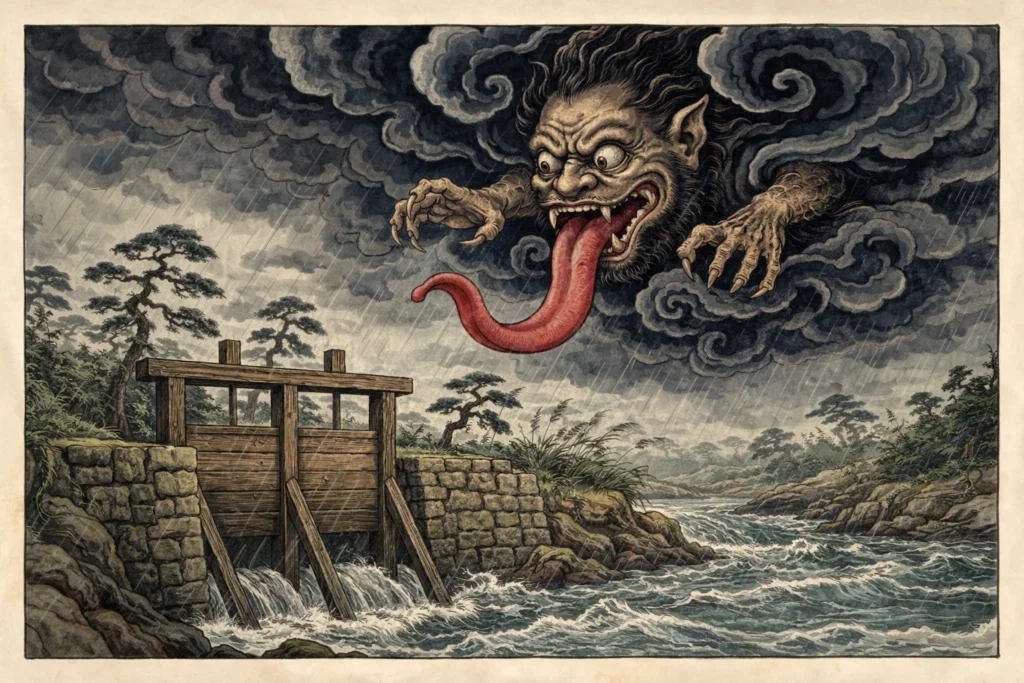
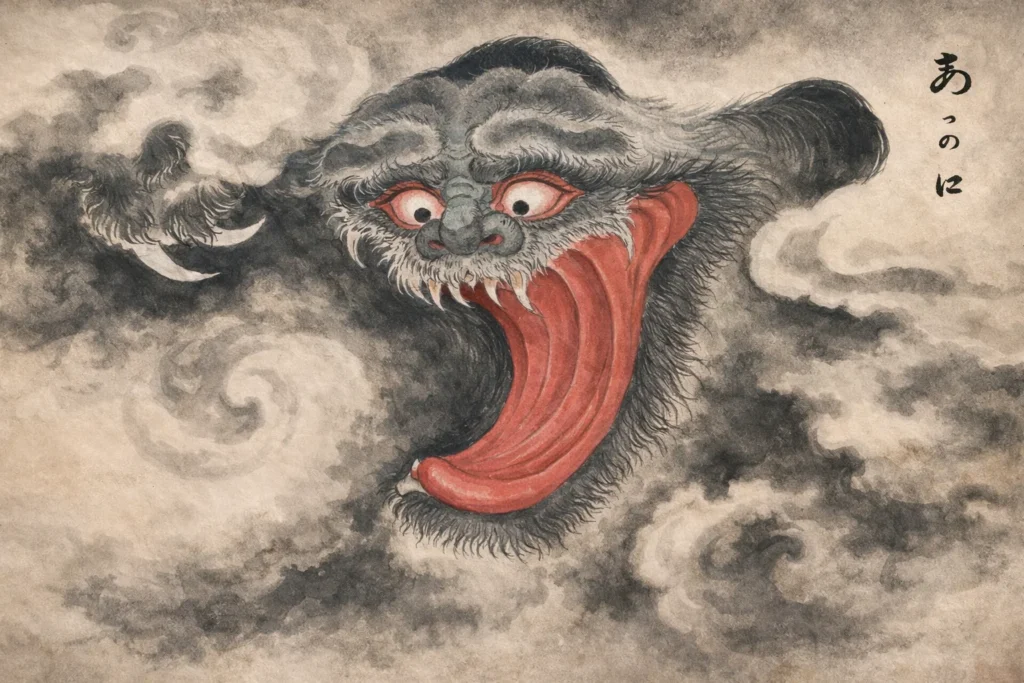
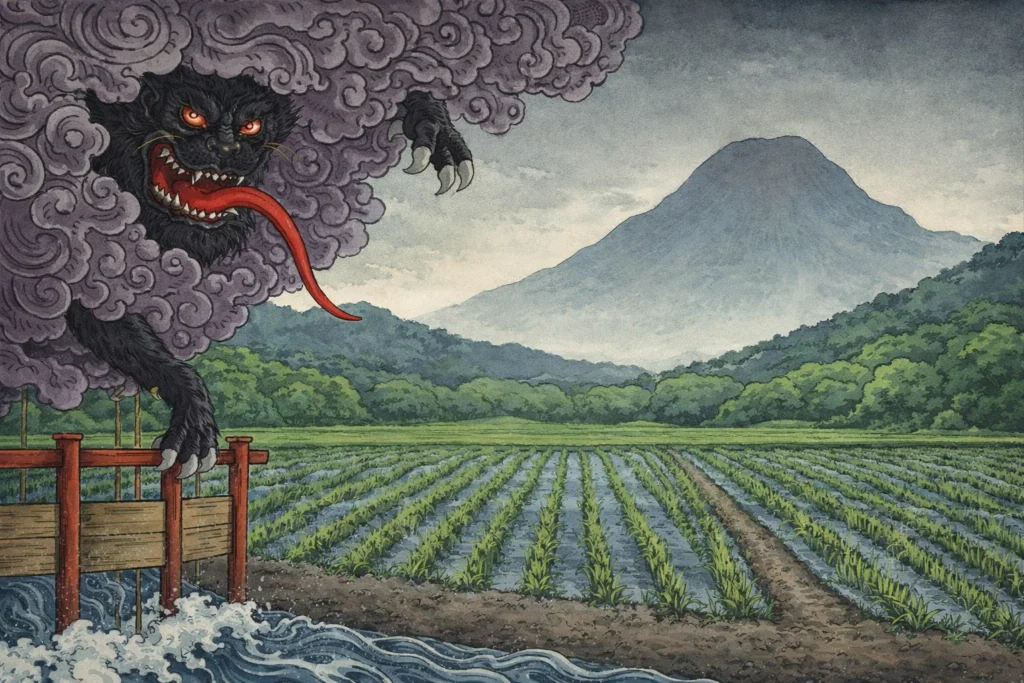
Akashita is usually shown as a huge, hairy creature, sometimes looking like a mountain ape or a twisted human. In the best-known drawings, like those in the Gazu Hyakki Yagyō, it has giant, clawed hands gripping the sides of a sluice gate or a dark cloud, hinting at a large body hidden behind the mist.
Its skin is usually shown as dark or shadowy, which makes its long, bright red tongue stand out even more. The eyes are wide and intense, always watching over the water channels. It almost always appears coming out of black smoke or storm clouds, showing its link to the weather and sudden summer storms.
The gate where Akashita appears is usually a wooden suimon, which controls water between rice fields. The mix of the gate’s straight lines and the creature’s wild fur creates a strong contrast, showing how it disrupts human order.
Origins and History
This spirit appeared as rice farming became more important and society grew stricter during the Edo period (1603–1868). At that time, water was the most valuable resource in rural Japan. Rules about water were weak, so fights over water between villages were common and could turn violent or lead to long legal battles.
From what I’ve found, this spirit seems to be a way for people to deal with the guilt of watching over shared resources. It’s interesting that the first pictures of it appeared in the 1770s, around the same time as more frequent droughts in the Kanto region. You don’t see it in older texts because irrigation systems weren’t complicated enough yet to need such a warning creature. This creature only exists where people have tried to control nature.
I also think that turning the Akaguchi-gami, once a distant god of time, into this yōkai happened because city life and country worries started to mix. When Edo artists began recording local beliefs, they gave a scary, physical shape to what used to be just a sense of bad luck from the calendar.
By putting the “crimson tongue” at the sluice gate, people used this superstition to keep peace in the rice fields. This spirit didn’t come from a natural disaster, but from the fear that someone might steal their neighbor’s water and ruin their life.
A Social History of Resource Anxiety
In my research, I noticed that Akashita transitioned from a calendar omen to a monster at the sluice gate is a great example of how city growth in the Edo period changed old fears into something new.
The Gazu Hyakki Yagyō from 1776 made the beast’s wild, cloud-covered look famous. Still, its roots go back to the Onmyōdō tradition and the Akaguchi-gami.
What’s interesting is that the original god was not a monster, but a symbol of bad timing. I think the spirit we know now is a “demoted” god, whose “red tongue” changed from a symbol of harsh words to a real, greedy feature that guards the gate.
The most important new insight about this spirit is its used during the Mid-Edo period’s farming crisis. As rice became the mainstay of the economy, water disputes became the biggest problem in rural areas like Aomori.
I’ve noticed that the image of the sluice gate only became a regular part of this spirit’s story in the late 1700s. This means that people started using the yōkai as a way to keep everyone honest. At a time when stealing water could mean life or death, the fear of seeing a “Red Tongue” at the gate helped keep people in line. This spirit isn’t just about nature—it’s about breaking the trust between neighbors.
Another notable point is the wordplay that researchers such as Atsunobu Inada have found. The “red” (aka) in the name can also mean dirty water, and “tongue” (shita) can mean “down” or the depths of the mind. This clever double meaning would have been clear to educated people in the 1700s: the creature is not just a monster in the sky, but also the “dirt at the bottom of the soul.”
Akashita symbolizes the farmer’s secret anger: he appears friendly by day but secretly harms his neighbor’s water at night. This makes the creature more than just a scary story—it becomes a symbol of how, during the shift from the Sengoku to Edo periods, open fighting was replaced by quiet, careful acts of greed.
Today, this spirit is often shown as just a “tongue monster,” with its farming background forgotten. But if we look back at its calendar origins, we see its real strength: its ability to control unlucky moments. I see it as a guardian of cause and effect.
It reminds us that there is a “Red Gate” for all our actions, and if we act out of greed, the very thing we rely on can turn against us. This spirit is a necessary evil that keeps the village in balance, showing that in Japanese folklore, the scariest monsters are often the ones that help us behave well.
Habitat
Akashita mainly lives in the in-between spaces of irrigation systems. You won’t find it in wild rivers; it prefers man-made places like sluice gates, canals, and pipes. It stays where mountain water is controlled for farming.
It’s also linked to the sky during the rainy season, said to live in the black clouds before a storm. Living both in the clouds and at the sluice gate shows its control over the water cycle. It is most active where people are stressed, especially during planting and harvest, when water gates are used every day.
Famous Akashita Legends and Stories
Although this yōkai is mostly known from pictures, it also appears in stories that warn about stealing water.
The Thief of the Shigenobu Sluice
In a village located in what is now the Tohoku region, a drought once threatened to destroy the entire year’s crop. A wealthy landowner, fearing for his own surplus, secretly went to the main sluice gate at midnight to divert the communal water into his private paddies. As he turned the wooden crank, the air became thick with a smell like stagnant pond water.
From the dark mist above the gate, two hairy, blue-black arms reached down. The landowner looked up to see a massive face with a long, red tongue that moved like a snake. The entity did not strike him; it simply swallowed the water he was trying to steal.
The next morning, the landowner’s paddies were found parched and cracked, as if they had not seen rain in a century, while the communal fields remained damp.
You may also enjoy:
Who Is Ariton (Egyn), the Infernal King of the Eastern Gate?
February 17, 2026
Akateko: The Bloody Hand Yōkai That Guards a Cursed Temple Tree
November 14, 2025
Chort: The Sinister Slavic Demon of Chaos and Bad Luck
March 10, 2026
Who Is Hariti, the Mother of Ogres in Buddhist Mythology?
December 8, 2025
Agubanba: The Blind Yōkai That Preys on Young Women
October 23, 2025
Marid: The Ocean Jinn That Defies Heaven and Earth
September 30, 2025
The Omen of the Akaguchi Day
A legend persists from the late Edo period regarding a construction project on a new canal. The foreman, a man who scoffed at Onmyōdō superstitions, insisted on breaking ground on an Akaguchi day.
As the first spade hit the earth, a localized black cloud descended on the site, despite the clear sky elsewhere. Witnesses reported seeing a crimson light within the cloud—the glint of a massive tongue.
Within an hour, a freak flash flood destroyed the canal’s foundations. The workers claimed they saw the entity perched atop the debris, its tongue licking the mud where the foreman had been standing. The project was abandoned, and the site was eventually dedicated to a local deity to pacify the spirit of the water gate.
Akashita Powers and Abilities
Akashita’s power comes from its control over the environment. Unlike Oni, it doesn’t fight with force but changes luck and resources. Just being nearby can bring bad luck, turning a healthy field into a wasteland by taking away water in a supernatural way.
- Hydrological Manipulation: The ability to stop, divert, or dry up water flows within irrigation systems regardless of gravity or mechanics.
- Cloud Shrouding: The entity can manifest a dense, unnatural black fog or smoke that acts as both a physical barrier and a sensory depressant for humans.
- Fortune Consumption: According to lore, Akashita can “eat” the good luck associated with communal projects, leading to accidents, equipment failure, and social discord.
- Dimensional Anchoring: The entity is tethered to the sluice gate; it can vanish into the woodwork or the gate’s shadow, making it nearly impossible to strike with physical weapons.
Traditional Defenses Against Akashita
To protect yourself from this spirit, you need to act honestly, not use force. Since it is tied to the Akaguchi (Red Mouth) days, the best defense is to follow the calendar. Farmers were told not to alter water flow or land borders on these unlucky days.
If an encounter occurs, the use of ofuda (holy talismans) from a Shinto shrine dedicated to water deities (Suijin) is said to provide protection. Placing these charms directly onto the wooden beams of the sluice gate acts as a seal that prevents the entity from manifesting.
Another way to defend yourself is to confess. If someone tries to steal water, then returns it and says a prayer of apology, the spirit is said to return to its cloud. People also use salt to purify the water, but it must be added directly to the water to block the spirit’s path.
Akashita vs Similar Spirits
| Name | Category | Origin | Threat Level | Escape Difficulty |
| Kappa | Suijin-servant | Drowned humans or water gods | High | Moderate; can be outsmarted with manners. |
| Amanojaku | Oni-kin | Ancient myths of subversion | Low | Easy; they are more annoying than deadly. |
| Nure-onna | Obake | Sea-serpent evolution | Extreme | Very Hard; they are fast and predatory. |
| Hyōsube | Kappa-variant | Deceased laborers | Moderate | Moderate; they cause illness through sight. |
| Umi-bōzu | Ayakashi | Drowned monks | Extreme | Extreme; they capsize entire ships. |
| Suiko | Water Spirit | Ancient Chinese lore | High | Hard; more aggressive than a standard Kappa. |
| Kitsune-bi | Yōkai-fire | Fox-spirit breath | Low | Easy; primarily a visual distraction. |
| Tsuchigumo | Oni | Subjugated clans | High | Hard; possess immense physical strength. |
| Noppera-bō | Obake | Faceless spirits | Very Low | Easy; they only seek to startle. |
| Wanyūdō | Tsukumogami | Cursed ox-cart wheel | High | Hard; they steal the souls of onlookers. |
Symbolism
| Attribute | Details |
| Element | Water and Air (Storm-based) |
| Animal | Ape or Beast (Sarugami-influence) |
| Cardinal Direction | East (Associated with the Akaguchi-gami of the East Gate) |
| Color | Crimson (Tongue) and Black (Cloud) |
| Plant | Rice (The crop it protects/threatens) |
| Season | Summer (The season of droughts and storms) |
| Symbolic Item | Sluice Gate (Suimon) |
In Japanese culture, Akashita represents the “Tongue of Conflict.” It brings the saying, “The mouth is the source of misfortune,” to life. When it appears at the sluice gate, it links disputes over water to the real fight for survival. It is a reminder that a community relies on fair sharing of resources.
It also represents the fear of being judged by others. In the isolated villages of the Edo period, being cast out from society could mean death. With its large eyes and long tongue, the spirit symbolizes the community’s watchful gaze and the supernatural risks of greed.
It is a lasting creature in yōkai stories because it shows the struggle between human efforts and the unpredictable forces of nature, reminding us that even the best-built gate can still be dangerous.
One question remains: when the rains do not come, and the gates stay dry, is it the spirit that has taken the water, or is it the greed of the person with the key?
You may also enjoy:
Who Is Baal in Christian Demonology?
February 25, 2026
Who Is Aka Manto, Japan’s Terrifying Red-Cloaked Yōkai?
October 24, 2025
Bakeneko: A Supernatural Cat Yōkai in Japanese Folklore
January 27, 2026
What Is a Pishacha, the Flesh-Eating Demon of the Dead?
February 11, 2026
Agubanba: The Blind Yōkai That Preys on Young Women
October 23, 2025
Erinyes: The Chthonic Goddesses Who Enforced Blood-Guilt
November 20, 2025
Bibliography
Author’s Note: While writing this article, I realized it was important to connect the abstract omens from the Onmyōdō tradition with the vivid monster shown in Toriyama Sekien’s Gazu Hyakki Yagyō. I focused on the Bakemono no e scroll’s strong images to place the creature in the real world of Edo-period irrigation, instead of seeing it as just a ghost in the sky. By linking old superstitions with real worries about farming, I could show the spirit as a thoughtful guardian of community values, not just a simple evil being.
- Cucinelli, Diego. Windows Onto The Supernatural In The Second Half Of The Edo Period: From The Gazu Hyakki Yagyō (1776) By Toriyama Sekien To The E-Hon Hyaku Monogatari (1841) By Takehara Shunsen. Ming Qing Studies 2015, 2015. Academia.edu.
- Johnson, Adam J. The Evolution of Yōkai in Relationship to the Japanese Horror Genre. 2021. University of Massachusetts Amherst, Capstone Project. ScholarWorks@UMass Amherst.
- Night Parade of a Hundred Demons. Yōkai Senjafuda, Mellon Projects, University of Oregon, glam.uoregon.edu.
- Kelsey, W. Michael. Konjaku Monogatarishū. Twayne Publishers, 1982. Twayne’s World Authors Series 621. Internet Archive.
- Kuroishi, I. (2020). Archaic Water: The Role of a Legend in Constructing the Water Management Heritage of Sanbonkihara, Japan. In: Hein, C. (eds) Adaptive Strategies for Water Heritage. Springer.
- Foster, Michael Dylan. The Book of Yokai: Mysterious Creatures of Japanese Folklore. University of California Press, 2015. Internet Archive.
- Reider, Noriko T. Japanese Demon Lore: Oni from Ancient Times to the Present. University Press of Colorado, 2010. JSTOR.
- Alaszewska, J., & Alaszewski, A. (2015). Purity and danger: shamans, diviners and the control of danger in premodern Japan as evidenced by the healing rites of the Aogashima islanders. Health, Risk & Society, 17(3–4), 302–325. https://doi.org/10.1080/13698575.2015.1078877.
- Davisson, Zack. (2026). The Persistence of Yōkai. Education About Asia. 29. 10.65959/eaa.1847. ResearchGate.
- Bradt, Aaron. The Role of Yokai in Japanese Myth. 2016. Academia.edu.