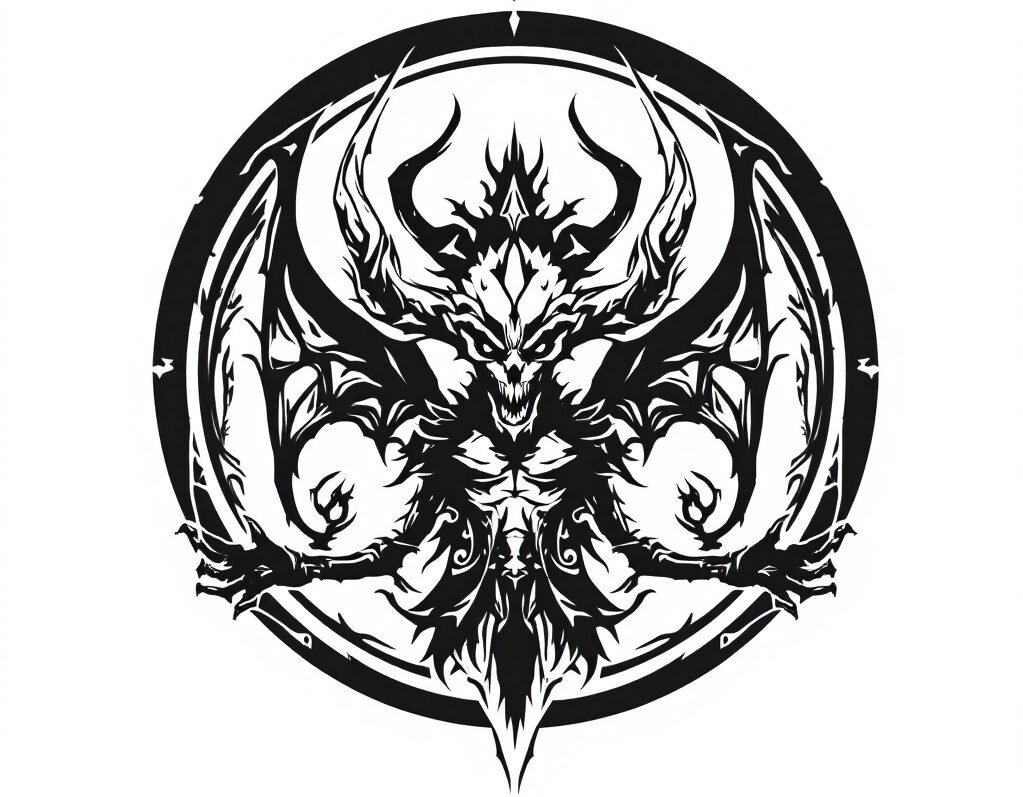
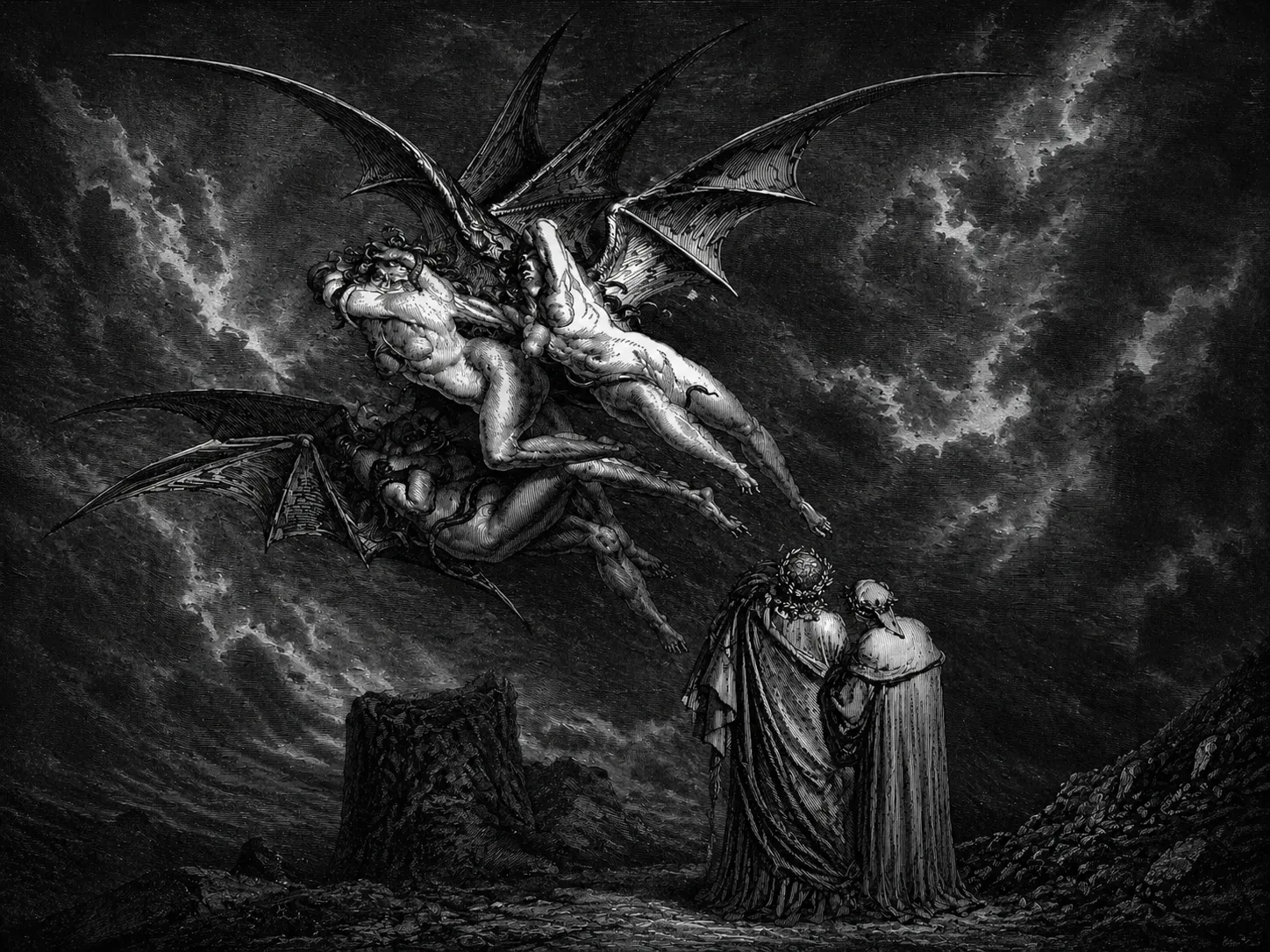
The Erinyes are seen as the force of moral accountability in Greek mythology. Unlike other gods who oversee laws, the Erinyes work outside the usual Olympian justice system. They do more than punish crime. The Erinyes enforce the ancient rules of family loyalty, becoming the living symbols of unavenged suffering until justice is done.
By comparing early stories from Pseudo-Apollodorus’s Bibliotheca and Sophocles’ Antigone, my research shows that the Erinyes were initially seen as unchangeable laws of nature rather than just characters in stories. [View Full Bibliography ↓]
Summary
Key Takeaways
| Attribute | Details |
| Names | Erinyes, Eumenides (The Kindly Ones), Semnai Theai (Venerable Goddesses) |
| Title | Chthonic Goddesses of Vengeance |
| Origin | Ancient Greece, Pre-Classical to Classical period |
| Gender | Female |
| Genealogy | Born from the blood of Uranus after Gaia, or the daughters of Nyx |
| Role | Enforcers of blood-oaths and punishers of crimes against kin |
| Associated Deity | Hades and Persephone (as subjects), Apollo (as antagonist) |
| Brings | Madness, famine, social instability, and physical torment |
| Weaknesses | Divine intervention, ritual purification, and the verdict of a jury |
| Realm/Domain | The Underworld (Erebus) and the mortal world |
| Weapon/Item | Bronze-studded whips and torches |
| Symbolism | The inescapable nature of conscience and retributive justice |
| Sources | The Iliad, The Odyssey, The Theogony, The Oresteia |
Who or What are the Erinyes?
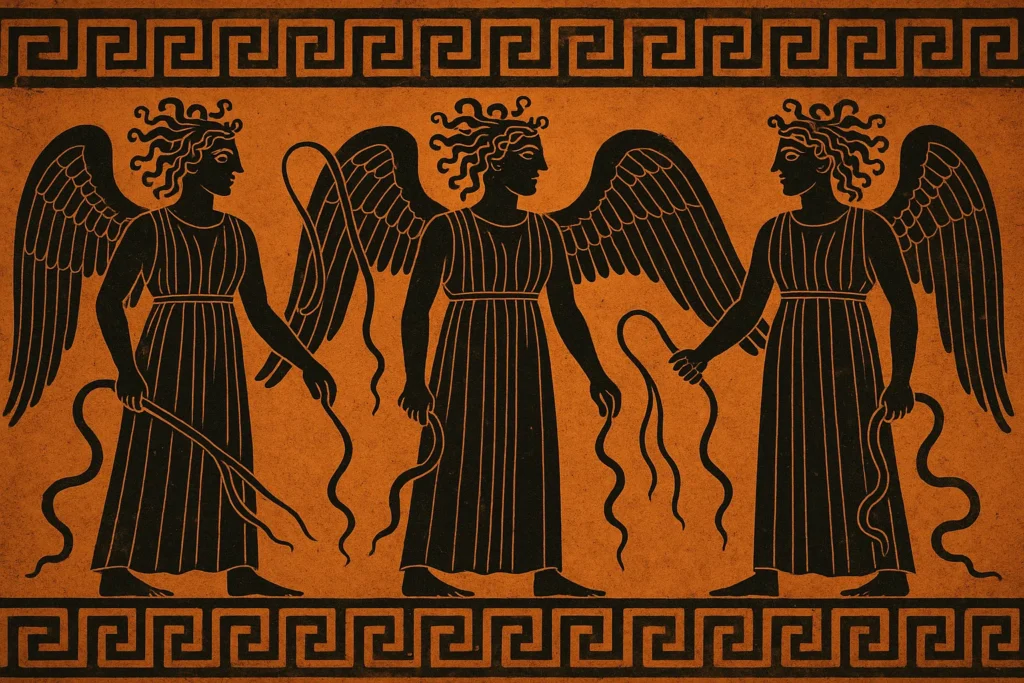
The Erinyes are a collective of chthonic deities tasked with prosecuting those who violate the sacred laws of blood kinship. While initially described in early epic tradition as a nameless, amorphous swarm of vengeful spirits, they were later individualized in classical mythology as a triad: Alecto (the unceasing), Tisiphone (the avenger of murder), and Megaera (the grudging).
In Greek religious thought, these entities ensure that a murder within a family does not go unpunished. They do not accept bribes or pleas for mercy; they are driven solely by the requirement of moral balance.
Their presence is often identified not by immediate physical violence, but by the gradual onset of madness and social ostracization that plagues the perpetrator until the debt of blood is repaid.
“Erinyes” Meaning
Researchers still debate where the name ‘Erinyes’ comes from. Many think it is linked to the Arcadian word erinúein, which means ‘to be angry,’ showing their connection to divine anger. Other theories connect the name to older Mycenaean roots, but there is no clear answer.
Later, people called them the Eumenides or ‘Kindly Ones’ as a way to calm them and avoid their anger. This transition in name shows how the Greeks tried to see these figures not just as destroyers, but as bringers of justice.
How to Pronounce “Erinyes” in English
In English, ‘Erinyes’ is usually pronounced as ‘eh-RIN-ee-eez.’ The stress is on the second syllable, and the ending is spoken as two clear syllables. Some experts use a version closer to ancient Greek, but this English form is most common.
Origins
The Erinyes first appeared in the earliest Greek myths, marking the shift from chaos to the start of social laws. Their story begins during the Titanomachy, when Cronus castrated his father Uranus.
According to Hesiod’s Theogony, the Erinyes were born when drops of Uranus’s blood fell onto the earth (Gaia) after he was castrated. This event shows that they represent punishment for crimes against the father in a family.
Other stories, such as those in the Iliad, say the Erinyes were the children of Nyx (Night) or of Hades and Persephone in later traditions. These different origins show that the Erinyes are separate from the main Olympian gods. While the Olympians lived on Mount Olympus, the Erinyes stayed deep in Erebus, the dark part of the Underworld.
The Erinyes first appear in literature in the Homeric epics from the 8th century BCE. In The Iliad, they are called ‘those who beneath the earth punish men, whosoever has sworn a false oath.’ This shows that by this time, they were seen not just as avengers of family murder, but also as enforcers of oaths and truth.
The Erinyes were closely tied to the idea of a ‘curse’ (arā), acting as the force that made the curse real when someone broke a rule. Their presence helped keep society stable, since fear of their punishment stopped people from breaking important family and community bonds.
The Erinyes became part of the Athenian legal system, as shown in Aeschylus’s Oresteia. This change marks the shift from personal, violent revenge to organized, state-run trials in the classical Athenian court (the Areopagus).
You may also enjoy:
Abura-sumashi: The Potato-Headed Yōkai That Punishes Greed
October 23, 2025
Who Was Hiranyakashipu, the Demon King of Hindu Mythology?
October 6, 2025
Aeshma: The Zoroastrian Demon of Wrath and Fury
January 13, 2026
Who Is Abaddon, the Demon of the Abyss, in the Bible?
September 29, 2025
Amdusias in the Ars Goetia: The Demon of Dark Music
December 2, 2025
Vaisravana: The Golden Guardian King Who Rules the North
October 16, 2025
Genealogy
| Relationship | Details |
| Parents | Uranus (blood) and Gaia (earth) or Nyx |
| Siblings | The Giants and Meliae (if born from Uranus) |
Historical & Folkloric Sources
Original:
“καὶ ἔτικτε δὲ τρεῖς Ἐρινῦας, Ἀληκτώ τε καὶ Τισιφόνην καὶ Μέγαιραν, αἳ τὸ μὲν πρῶτον ἀνεφάνησαν ἐκ τοῦ αἵματος τοῦ Οὐρανοῦ, ὕστερον δὲ ἀπὸ τῆς Νυκτός, αἳ τοῖς ἀσεβέσιν ἐκδικοῦσιν.” [Pseudo-Apollodorus, Bibliotheca, 1st or 2nd Century CE]
Translation:
“And she [Gaia] brought forth the three Erinyes, Alecto, Tisiphone, and Megaera, who first appeared from the blood of Uranus, and later from Nyx, who take vengeance upon the impious.”
This passage from the Bibliotheca brings together various accounts of the Erinyes’ origins. By naming Alecto, Tisiphone, and Megaera, the author shows how the Erinyes evolved from a nameless group of ‘vengeance-spirits’ (as in Homer) to individual figures with distinct roles.
Their two possible origins—from Uranus’s blood and from Nyx—show that the Erinyes are ancient beings connected to both violent beginnings and endless darkness.
Giving the Erinyes specific names came later, when myths became more organized. Naming them helped the Greeks turn their fear of revenge into something more understandable. By then, the Erinyes were seen as real figures who punished both gods and humans for their crimes.
Original:
“οὐ γάρ τι νῦν γε κἀχθές, ἀλλ’ ἀεί ποτε ζῇ ταῦτα, κοὐδεὶς οἶδεν ἐξ ὅτου ‘φάνη.” [Sophocles, Antigone, 5th Century BCE]
Translation:
“For these are not of today or yesterday, but they live forever, and no one knows from whence they appeared.”
This quote from Sophocles shows that the Erinyes are timeless. By saying they ‘live forever,’ Sophocles makes them different from the Olympian gods, who have beginnings and ends. The Erinyes are shown as eternal laws of nature, not gods who can be persuaded.
In the play, this idea adds to the tragedy. Since the Erinyes are eternal, their duty to punish family crimes cannot be stopped by human laws. Sophocles shows them as the highest authority, a force that works whether people recognize them or not.
This source helps explain why the Erinyes were so profoundly respected and feared. They are not shown as monsters to fight, but as the unseen, lasting foundation of moral order.
Original:
“ἐπὶ δὲ τοῖς ὀστράκοις, αἷς ἐπεγράφοντο τὰ τῶν Ἐρινύων ὀνόματα, οὐκ ἦν ὀργή, ἀλλὰ θεία δίκη.” [Pausanias, Description of Greece, 2nd Century CE]
Translation:
“And upon the potsherds, upon which the names of the Erinyes were inscribed, there was not rage, but divine justice.”
Pausanias’s account shows how the Erinyes were seen in different regions during Roman times. By linking them to names written on potsherds, which were used in courts or curses, he presents them not as wild spirits but as real agents of justice.
By the 2nd century CE, people saw the Erinyes more as ‘The Kindly Ones’ (Eumenides). The focus on ‘divine justice’ instead of ‘rage’ shows they had become part of the city’s legal system.
This shift shows a belief that naming the Erinyes and giving them a role in law could tame their power. It marks the move from fearing wild revenge to valuing a fair and orderly society.
What do the Erinyes look like?
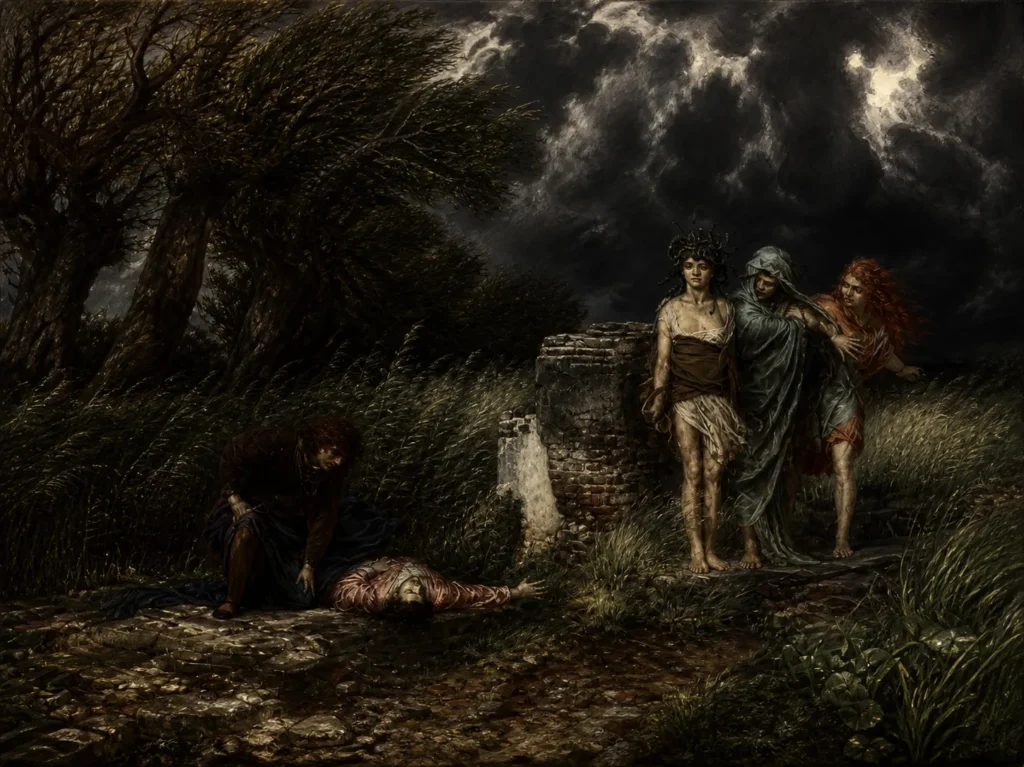
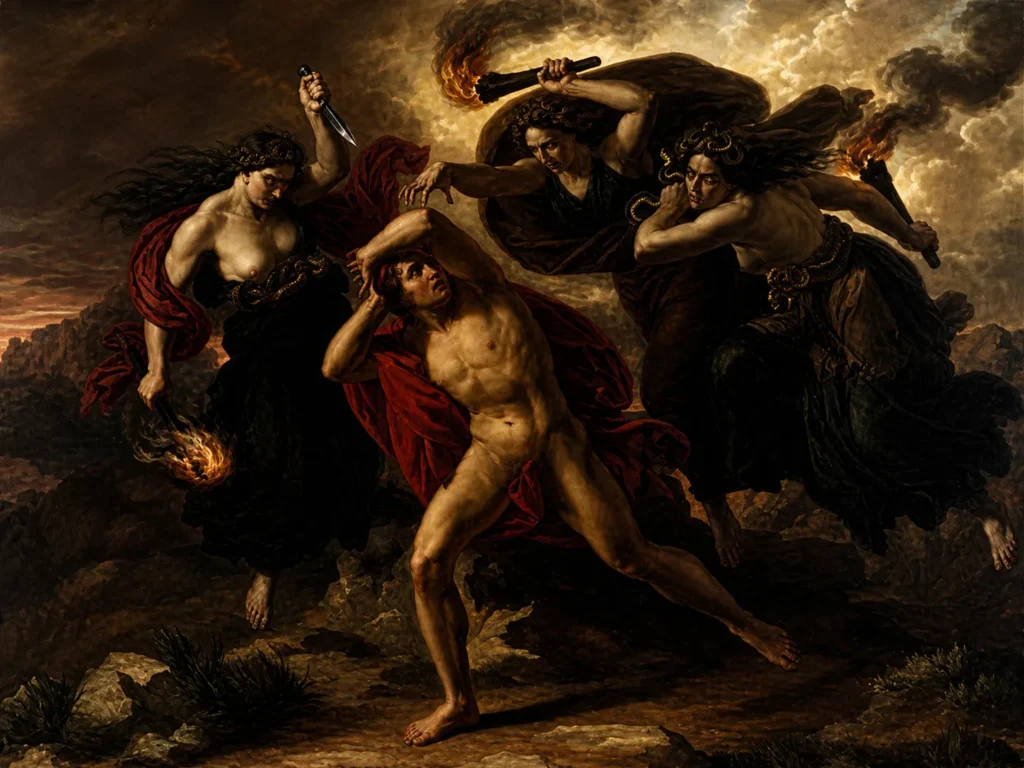
Ancient writers described the Erinyes as frightening and not human. They often had snakes for hair, eyes that dripped blood, and wings to chase wrongdoers. These features were symbols: the snakes showed how guilt creeps in, and the wings meant no one could escape their punishment.
Interestingly, the Erinyes look similar to the Gorgons. In early Greek thought, seeing either one meant facing absolute guilt, and both were seen as paralyzing.
You may also enjoy:
Pazuzu: The Ancient Demon Who Fought Evil with Evil
November 4, 2025
Who Is Shiva, the Destroyer and the Lord of the Universe?
November 12, 2025
Ifrit: Demon of Fire Who Serves Iblis in Islamic Tradition
September 30, 2025
Ambri: The Imperial Duchess of Caspiel’s Empire
December 1, 2025
Amaymon: The Infernal King Who Commands Death and Decay
November 17, 2025
Connections to Other Ancient Demons
| Name | Folklore | Type | Appearance |
| Apep | Egyptian | Chaos Serpent | Giant serpent |
| Lamashtu | Akkadian | Disease/Child-stealer | Lion-headed, bird-footed woman |
| Pazuzu | Babylonian | Wind demon | Hybrid with wings and a scorpion tail |
| Humbaba | Sumerian | Guardian monster | Face made of coiled intestines |
| Sekhmet | Egyptian | Goddess of Vengeance | Lioness-headed woman |
| Lilith | Mesopotamian | Night demon | Winged woman with bird feet |
| Gugalanna | Sumerian | Bull of Heaven | Gigantic, cosmic bull |
| Tiamat | Babylonian | Primordial chaos | Dragon or sea creature |
| Vetala | Hindu | Spirit of the dead | Vampiric, hanging upside down |
| Keres | Greek | Death spirits | Black-winged spirits |
Erinyes Myths, Legends, and Stories
The Trial of Orestes
After Agamemnon came back from the Trojan War, his wife Clytemnestra and her lover Aegisthus killed him while he was bathing. Apollo told their son Orestes to avenge his father. Following Apollo’s command, Orestes killed both his mother and her lover. As soon as he did, the Erinyes appeared to pursue him.
The Erinyes rushed at him, their eyes bleeding and their hair made of twisting snakes. Orestes ran to Delphi and took refuge at the omphalos. The Erinyes surrounded the temple and sang:
“The song of the Erinyes brings madness, it is the weaver of the mind’s destruction, it does not require a lyre, it withers the mortal soul with grief.”
Orestes begged Apollo to protect him. Although Apollo had ordered the killing, he could not stop the Erinyes. He told Orestes to go to Athens and face trial before Athena.
The trial began on the Hill of Ares, known as the Areopagus. The Erinyes served as prosecutors, accusing Orestes of breaking the sacred bond of blood. “He has shed the blood of the mother who bore him,” they said, “and therefore he is a stain on the earth that must be drained of his own life-force.”
Apollo spoke in defense, saying the father’s rights came first and that the mother was only a vessel. The Athenian jury voted, and the result was a tie. Athena cast the deciding vote to acquit Orestes, saying the law of the state was now more important than the old law of blood revenge.
Angry about the verdict, the Erinyes threatened to curse Attica with sterility and famine. Athena calmed them by offering a new role as the Eumenides, or “Kindly Ones.” She promised them a sacred grove in Athens and ongoing honors. The Erinyes accepted, changing from wandering punishers to guardians of the city’s moral order.
The Pursuit of Alcmaeon
Alcmaeon was the son of the seer Amphiaraus. Before leaving for the expedition against Thebes, Amphiaraus told Alcmaeon to kill his mother, Eriphyle, because she had betrayed him. Alcmaeon obeyed and killed his mother.
As soon as she died, the Erinyes took hold of Alcmaeon. They did not appear as warriors, but as a constant, inner torment. Alcmaeon was driven mad and lost his reason. He wandered through Arcadia, his mind breaking under the pressure of the spirits that followed him everywhere.
He asked many kings to purify him, but none would help while the Erinyes chased him. He finally found a new land, a delta made by the Achelous River’s silt, which did not exist when he committed the crime. There, he performed purification rites, and for a while, the Erinyes left him alone, unable to reach him in this new place.
Still, the consequences of his crime remained. The vengeance he carried was tied to the act of killing his own family, and the cycle only ended after more trials and acts of repayment.
Erinyes Powers and Abilities
The Erinyes had powers meant to destroy a person’s mind. Their main power was causing ‘blood-guilt’ madness, making the guilty lose their place in society and their sanity. They could go anywhere to find their target, even into homes. They did not need weapons, since the despair they caused could be deadly.
- Psychological Torment: The ability to induce irreversible insanity in those guilty of kin-slaying.
- Tracking: An unerring ability to track a perpetrator across the earth regardless of distance or disguise.
- Corruption: The capacity to cause famine or sterility in the lands of those they pursued.
- Metamorphosis: Instances suggest they could alter their presence to become invisible or manifest in terrifying forms.
Rituals, Amulets, and Protective Practices
Dealing with the Erinyes focused on catharsis, or purification. Since they enforced divine rules about blood-guilt, they could not be fought or destroyed—only satisfied. The main aim was to cleanse the guilty person through legal and ritual means, removing the ‘pollution’ (miasma) from kin-slaying so the Erinyes would stop chasing them.
Incantations and Ceremonies
The best-known ritual to calm the Erinyes used a suckling pig. In stories about Orestes, a priest would kill the pig and let its blood flow over the hands of the guilty person. The pig’s blood stood in for human blood, symbolically washing away the miasma that attracted the Erinyes.
This process was often accompanied by prayers that acknowledged the entities’ domain. While no standardized, rhythmic “spell” exists in the same way one might find for a disease-demon, the Oresteia preserves the formal, binding language used during their transition.
Another important part was making ‘sober’ sacrifices, called nephalia. People offered water, honey, and olive oil—never wine—by pouring them into the ground to calm the goddesses. The goal was to transform the Erinyes from angry spirits to peaceful protectors of the community.
Amulets and Talismans
There is no evidence that Greeks used amulets or charms to keep away the Erinyes. Unlike the demon Lamashtu, whose image was worn for protection, the Erinyes were seen as enforcers of a basic cosmic law.
Carrying a charm against the Erinyes would be seen as trying to escape justice, which could make things worse. The only real protection was to stay in good legal and religious standing in the community.
Professional Practitioners
The kathartes, or purifier, was the main expert in these cases. This person was usually a priest or religious leader who knew how to perform the special rituals needed for purification.
The kathartes acted as a go-between because the pollution from killing a parent was thought to be contagious. The purifier had to be immune to this to help the guilty person through atonement. They led the ritual, ensured the proper animals were sacrificed, and honored the gods—especially Apollo, the god of purification.
You may also enjoy:
What Is a Bhuta? The Backward-Footed Ghosts of Hindu Horror
February 5, 2026
Who Is Abalam in Demonology? The Demon King That Serves Paimon
September 30, 2025
Who Is Ariton (Egyn), the Infernal King of the Eastern Gate?
February 17, 2026
Palis: The Foot-Licking Desert Jinn That Drinks Your Blood
December 3, 2025
What Is a Rakshasa? Meaning, Origins, and Dark Powers
January 23, 2026
Bibliography
Author’s Note: In this article, I explored how the ancient Greek goddesses transformed in their roles over time. In the early stories by Hesiod and Homer, these spirits were seen as frightening beings who punished wrongdoers. However, later writers like Aeschylus and Pausanias portrayed them differently, showing them as protectors of the city and important figures in Athenian law. By focusing on key texts, I illustrated how these changes in the Erinyes’ image reflect broader moral and legal transformations in the culture.
- Heumann, Michael (trans.). Hesiod’s Theogony. 2011. Internet Archive.
- Homer. The Iliad. Translated into English prose with index by A. S. Kline, 2009. Published by Poetry in Translation.
- Homer. The Odyssey of Homer: Done into English Prose. Translated by S. H. Butcher and A. Lang. Macmillan and Co., Limited, 1927. Internet Archive.
- Apollodorus. The Library. Translated by Sir James George Frazer. William Heinemann (London) / G. P. Putnam’s Sons (New York), 1921. Internet Archive.
- Sophocles. Antigone. Translated by Robert Whitelaw, introduction and notes by J. Churton Collins, Clarendon Press, 1924. Internet Archive.
- Aeschylus. The Oresteian Trilogy: Agamemnon, Choëphoroe, Eumenides. Translated by Lewis Campbell, Methuen and Co., 1893. Internet Archive.
- Pausanias. Description of Greece. Translated by W. H. S. Jones and H. A. Ormerod, Loeb Classical Library, Harvard University Press / William Heinemann, 1918. Internet Archive.