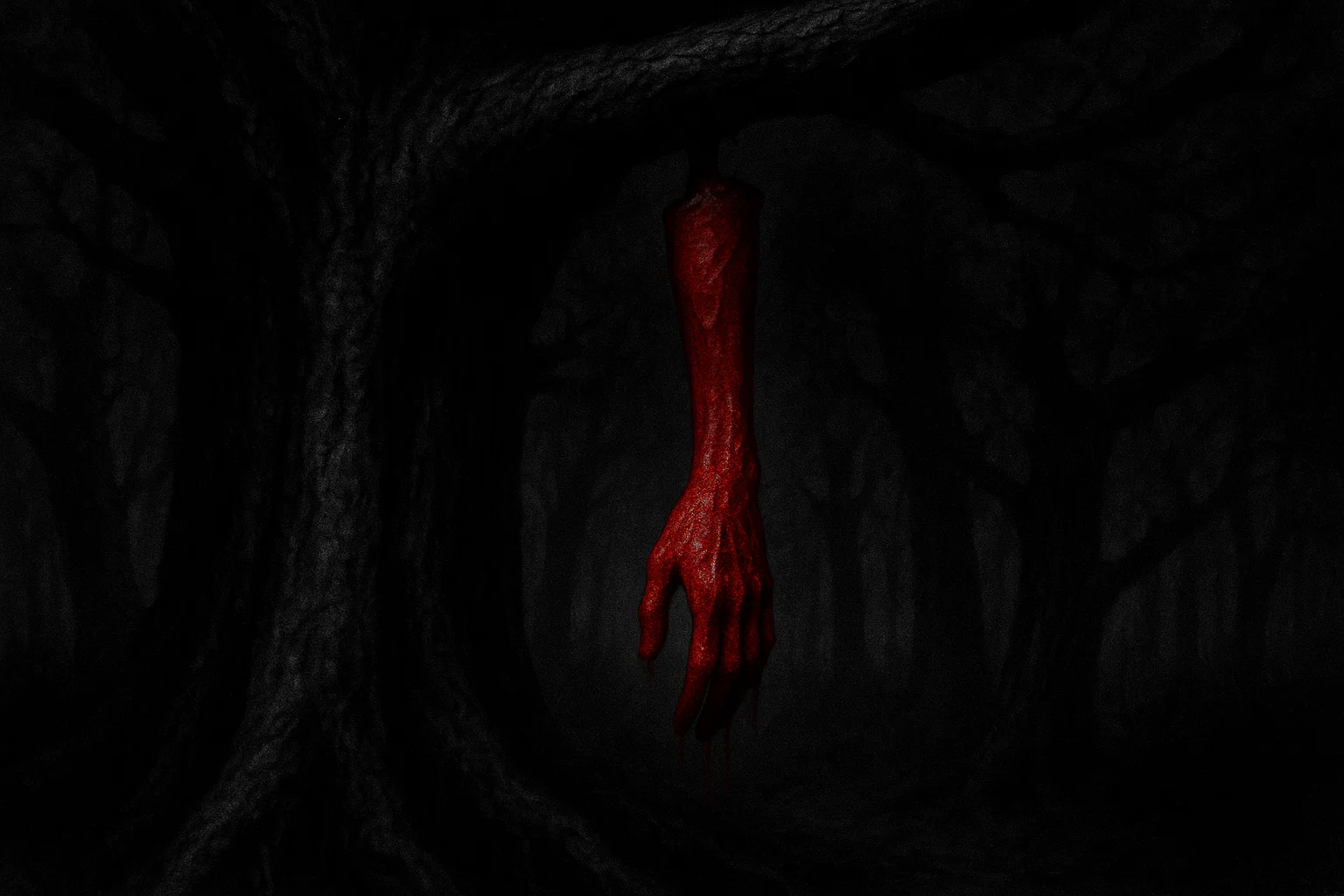
Many tree spirits in Japanese folklore are known for their metamorphosis or mimicry, but Akateko (the Red Child’s Hand) yōkai is different. It is a simpler, more direct kind of horror.
Unlike the tengu or kitsune, it doesn’t have deep religious significance or complex tricks. Instead, it appears as a single, severed hand that connects the living world and the spirit world through the Gleditsia japonica tree.
This spirit stands out from other ‘body part’ yōkai because it has no torso or head. It exists only as a hand, showing that a spirit does not need a full body to have power.
This article is based mainly on Tatsumi Hijikata’s 20th-century field notes, which preserve the original warnings and details that modern horror stories often omit. [View Full Bibliography ↓]
Summary
Key Takeaways
| Attribute | Details |
| Names | Akateko, Red Child’s Hand |
| Translation | The name translates literally as “red child’s hand.” |
| Title | Tree-Dwelling Hand, The Red Limb of the Honey Locust |
| Type | Yōkai, specifically categorized under arboreal spirits. |
| Spirit Classification | Typically regarded as an Ara-mitama (rough spirit) due to its startling and disruptive nature. |
| Origin | Folk belief suggests it is the manifestation of a child’s spirit or a localized atmospheric phenomenon attached to specific ancient trees. |
| Gender | Generally perceived as male, though the youth of the hand often makes gender ambiguous. |
| Appearance | A small, red-fleshed hand belonging to a young child, appearing without an attached arm or body. |
| Kehai (Aura/Presence) | Preceded by a rustling in the leaves of a Gleditsia tree and a sudden, inexplicable sense of being watched from above. |
| Powers/Abilities | Apparition, causing localized fever or illness, and psychological intimidation. |
| Methods of Pacification | Avoiding the specific trees it inhabits, particularly at dusk, and utilizing standard protective charms. |
| Habitat | Specifically, the branches of the Japanese honey locust (Saitama Prefecture) and certain urban streets (Aomori Prefecture). |
| Diet/Prey | Does not consume food; targets unsuspecting travelers and pedestrians. |
| Symbolic Item | The Gleditsia japonica (Japanese honey locust) tree. |
| Symbolism | Represents the fear of the “unseen touch” and the latent dangers found in nature. |
| Associated Kami | No direct association with a specific deity is recorded in primary texts. |
| Sources | Regional folklore collections of Saitama and Aomori; Modern Yōkai Encyclopedias. |
The Fundamental Identity of Akateko
The red child’s hand is a unique spirit in Japanese folklore, mostly linked to the Hachiman Shrine in Kuki, Saitama Prefecture. It appears as a red child’s hand hanging or dropping from the branches of a Japanese honey locust tree. Unlike aggressive oni, this spirit mainly scares people with its appearance rather than by attacking them.
This spirit is often grouped with other ‘stationary’ yōkai that haunt certain places or plants. While it is best known in Saitama, versions of the story appear elsewhere, sometimes with different ghosts. The hand shows how the spirit world can appear in strange, incomplete forms that feel unsettling.
Semantic Origins
The name comes from three Japanese words: aka (red), te (hand), and ko (child). The meaning is simple and clear, unlike the wordplay in some other legends. This points to a folk origin based on spoken stories, not written ones.
In local dialects, especially in Tōhoku, the name stays the same, but researchers still debate what ‘red’ means. Some think it refers to raw, exposed flesh, while others believe it means a feverish or supernatural glow.
Some Edo-period records used the term for any ‘red hand’ reaching from the dark. Still, over time, the link to the honey locust tree became the main way to identify this spirit in folklore.
How to Pronounce “Akateko” in English
To say the name in English, break it into four parts: ah-kah-teh-koh. Each vowel is short. ‘Ah’ is like in ‘father,’ ‘kah’ rhymes with ‘spa,’ ‘teh’ is like the start of ‘test,’ and ‘koh’ rhymes with ‘go.’ No syllable is stressed; the sound stays even, as in Japanese.
What Does Akateko Look Like?
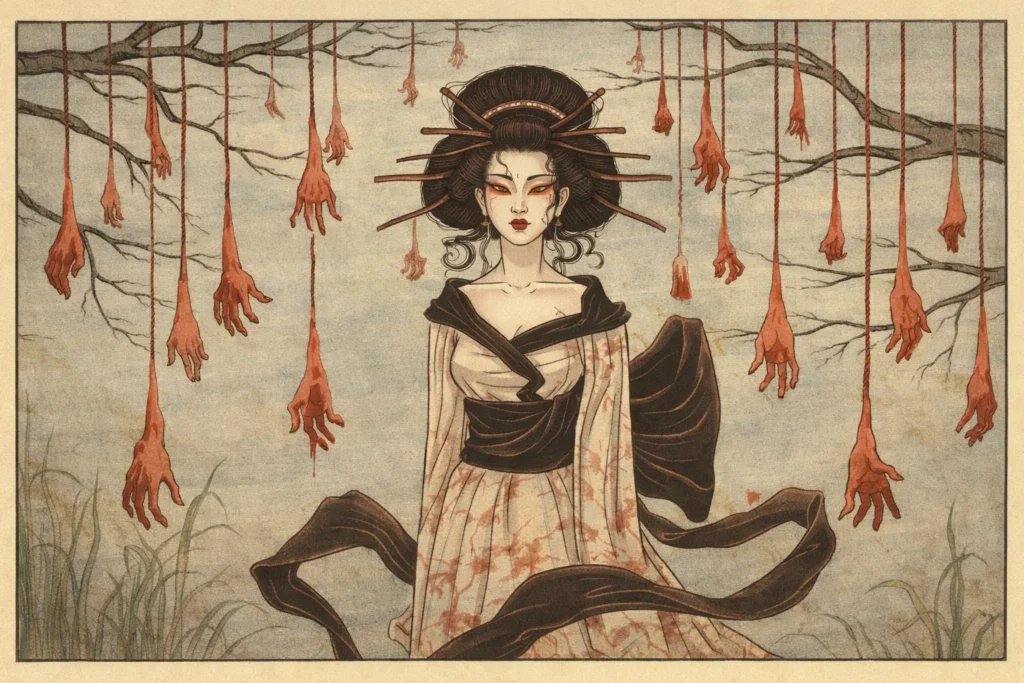
Most stories describe the spirit the same way: it is just a child’s hand, with no torso. The hand looks like it belongs to a child, about 5 to 10 years old. Its skin is a bright, sometimes see-through red, and people say it looks like skin with a high fever or a mild burn.
Most sightings show the hand hanging from the leaves of a Gleditsia japonica tree. It usually ends at the wrist, fading into mist or simply stopping.
Some people in Saitama say the hand sometimes reaches for the air or grabs at people’s clothes as they walk by. Even though it is small, its bright red color is remarkable against the dark green leaves, making it easy to spot and startling to see.
You may also enjoy:
Rāga: The Seductive Demon of Passion and Desire in Buddhist Lore
October 16, 2025
Who Is Aka Manto, Japan’s Terrifying Red-Cloaked Yōkai?
October 24, 2025
What Is a Qareen and Why Does It Follow Every Human Being?
October 8, 2025
What Is a Yūrei? The True Meaning of Japanese Ghosts
January 30, 2026
Who Is Ahriman, and Why Is He Pure Evil Incarnate?
January 8, 2026
Origins and History
The story of the Akateko began during the late Edo period and the early Meiji era, when the Kantō region was undergoing environmental and social change. The legend centers on the Hachiman Shrine in Kuki, Saitama Prefecture. Old records say the haunting started at an ancient Japanese honey locust tree in the shrine’s sacred grove.
The Sengoku period, marked by ongoing war and people being forced to move, likely set the stage for many tree-related legends. Forests were often places where battles happened and where people were secretly buried.
The first detailed stories about a ‘red child’s hand’ in honey locust trees became popular during the Edo period, a time known for its ghost stories. People wrote these tales in books and shared them by word of mouth. The Akateko was not just any ghost; it was linked to the shrine’s aura and served as a spiritual boundary.
Looking at the history, I think the Akateko reflects the grief from high child death rates in rural Japan during the 18th and 19th centuries. The ‘red hand’ represents a life cut short, reaching out from the spirit world through a living tree.
Interestingly, the first reports of the Akateko appeared around the time of the Great Tenpō Famine (1833–1837). During these hard years, many children died, and forests—often used for child burials or memorials—became linked with the spirits of lost children.
I also think the honey locust tree was chosen for a reason. People used the seed pods for washing and medicine, so they saw these trees every day. The reddish-brown, twisted pods, which can be 20–30 centimeters long, look a bit like small arms or hands when they move in the evening light.
By the time of the Meiji Restoration in 1868, as Japan began to adopt Western ideas, scholars like Kunio Yanagita recorded these local beliefs. This helped keep the Akateko legend in its Edo-period form and allowed it to survive into modern times.
Important Sources
Original:
“Akateko. Saitama-ken Kuki-machi (ima no Kuki-shi) no Hachiman-jinja ni aru saikachi no ki ni detaru to iu. Ki no eda kara kodomo no te ga sagari-sagari suru mono de, sore ni fureta mono wa netsu o dasu to iu.” [Kunio Yanagita, Yōkai Ii-shū (Collection of Yōkai Folklore), 20th Century (Compiling Edo-period oral traditions)]
Translation:
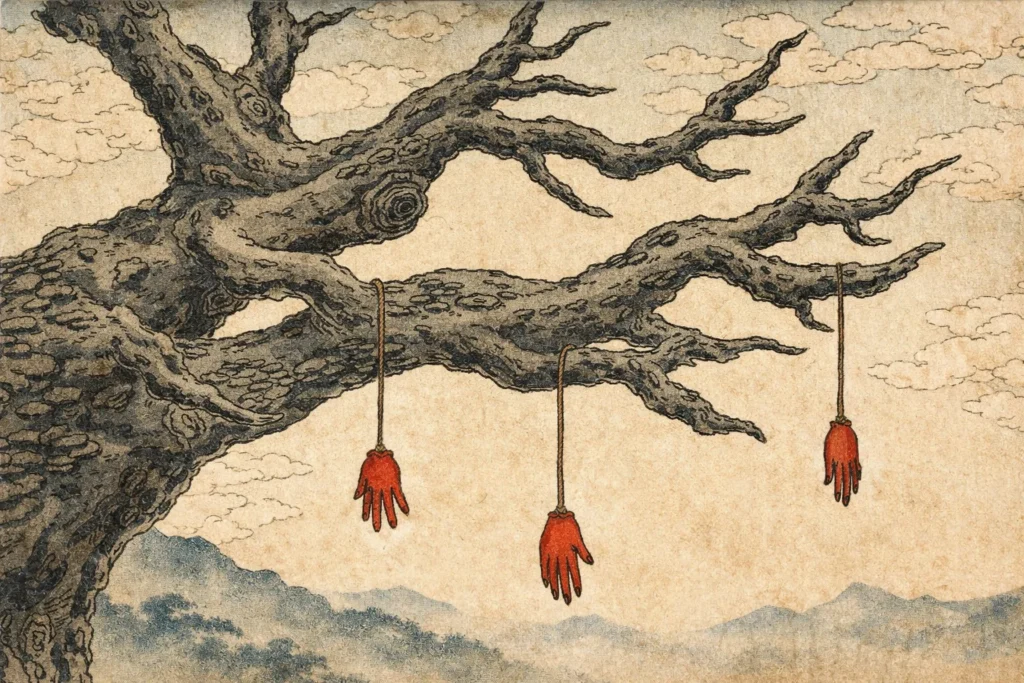
Akateko. It is said to appear in a honey locust tree at the Hachiman Shrine in Kuki Town (now Kuki City), Saitama Prefecture. A child’s hand hangs down from the tree branches, and it is said that anyone who touches it will catch a fever.
Yanagita’s record, as the founder of Japanese folklore studies, is the main source for this spirit. It shows the key idea: a physical hand that causes a real fever.
Unlike tengu or kappa, which are shown as full creatures with their own societies, this spirit is just a single, local event. The honey locust tree is important because its thorns and dark seed pods make it a natural focus for the legend.
The fever is an important detail. In the past, people often blamed sudden sickness on spirits called mono-no-ke. By connecting the honey locust tree to illness, the story acted as a warning, keeping people away from parts of the shrine at night.
Original:
“Aomori-ken no hirosaki-shi nado ni wa, akateko to iu mono ga mati-hadure no yanagi no ki nado ni araware, sono shita ni wa kirei na onna no hito ga tatte ite, tooru hito o sasou to iu.” [Mizuki Shigeru, Mujyara, 1994 (Documenting regional Tōhoku variations)]
Translation:
In places like Hirosaki City in Aomori Prefecture, a thing called akateko appears in willow trees on the outskirts of town; beneath it, a beautiful woman stands and invites passersby.
This version of the story is very different from Saitama’s. Here, the hand is not alone but part of a larger haunting. The appearance of a beautiful woman makes the spirit seem more dangerous and tricky, like the Nure-onna or Ubume. As the legend moved north to Aomori, it picked up traits from other local ghost stories to fit city life in places like Hirosaki.
Changing the tree from a honey locust to a willow is also important. In Japanese stories, the willow is the classic ‘ghost tree’ because of its drooping branches and closeness to water.
The Saitama story uses the thorny honey locust to feel rough and wild, while the Aomori version uses the willow to create a sad and trapped feeling.
Original:
“Edo no kaidan ni wa, yaneura ya kabe kara te ga deru hanashi wa ooi ga, ‘Akateko’ wa ki ni tokutei sareru ten de kotonaru. Kore wa jumoku no seimei-ryoku ga hen’i shita mono to kangaerareru.” [Kenji Murakami, Yōkai Jiten (Encyclopedia of Yōkai), 2000]
Translation:
In Edo ghost stories, many tales feature hands appearing from ceilings or walls, but ‘Akateko’ is unique in its focus to trees. This is considered a mutation of the tree’s own life force.
Murakami adds that this spirit belongs to the group of ‘disembodied limb’ yōkai, like Te-no-me (eyes on hands). But he points out that this one is a tree spirit, not a human ghost. Unlike Yūrei, which are driven by human feelings, the red child’s hand is seen as a nature spirit that has gone wrong—a mistake of the forest.
The use of a child’s hand, not an adult’s, is important. In old Japan, children under seven were thought to be ‘among the gods,’ and if they died, it was seen as returning to the spirit world. A child’s hand reaching from a tree might show a soul that did not fully leave, staying in the sacred trees of the shrine.
Original:
“Akateko wa, ukiyo-e ni egakareru yōna osoroshii oni dewa naku, miru mono o odorokaseru ‘odoro’ no rui de aru.” [Tatsumi Hijikata, Folklore Notes on Northern Honshu, 20th Century]
Translation:
The Akateko is not a fearsome oni as depicted in ukiyo-e, but belongs to the ‘odoro’ [startling] class of things that surprise viewers.
This source shows that the spirit is not very dangerous. Unlike the Gashadokuro, which tries to kill, this one is meant to startle people. This fits with a time in the Edo period when people enjoyed scary stories and local thrills.
Because it has no weapons or demon status, this spirit acts as a ‘place-spirit.’ Its main power is being seen—its red color is like a warning sign. In Shinto, red usually signifies protection, but here the raw look of the hand suggests that the shrine’s sacred space has become polluted or unstable.
Habitat
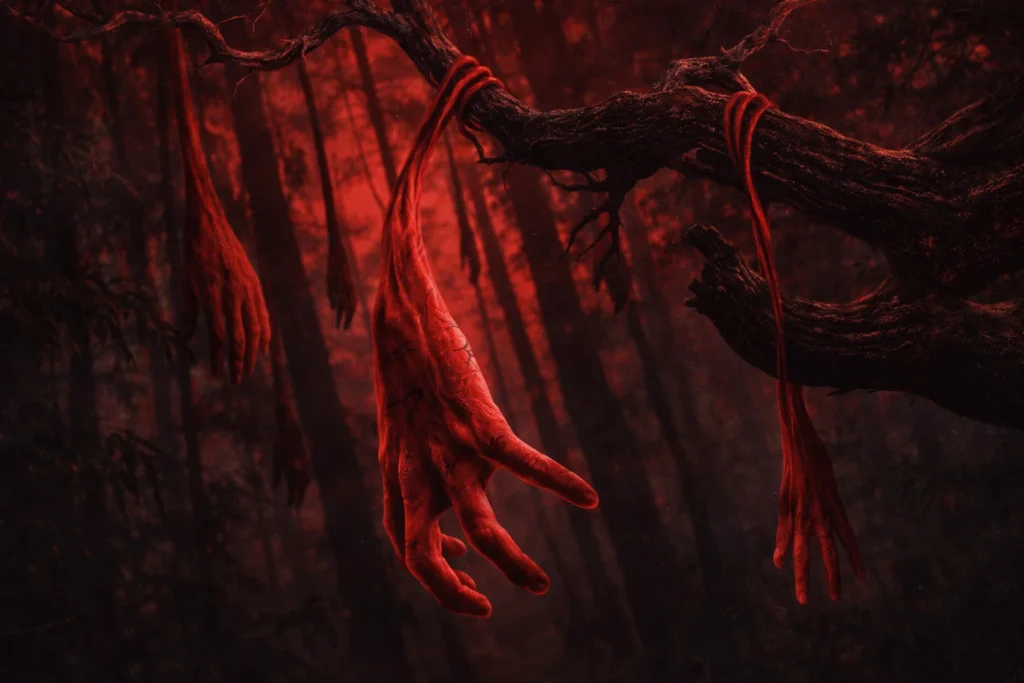
This spirit mainly lives in the branches of the Japanese honey locust tree. In Kuki City’s folklore, it stays on the Hachiman Shrine grounds. The honey locust’s sharp thorns and dark, twisted branches make it a fitting place for a haunting.
Outside Saitama, some stories say the spirit haunts the streets of Aomori Prefecture. In cities, it moves from trees to the shadows of gates and alleys. It always appears in ‘in-between’ places, like paths or roads, and likes to show up above people’s heads to surprise them.
Famous Akateko Legends and Stories
The Hanging Hand of the Kuki Hachiman Shrine
In Kuki, Saitama Prefecture, the old Hachiman Shrine is known for its strange tree haunting. Local stories collected in the Yōkai Ii-shū tell of a traveler passing the shrine at dusk, a time when people believe the line between the human and spirit worlds is thin.
As he walked under the wide, dark branches of a large Japanese honey locust tree, he noticed something move above him. Suddenly, a small, bright red hand, looking like it belonged to a young child, dropped from the leaves. It didn’t fall but hung at eye level, held up by something invisible.
The traveler stopped in fear as the red fingers started to move and reach for the air, just inches from his face. A strange cold came from the hand, and he suddenly felt a heavy pressure in his chest, as if he couldn’t breathe.
Panicked, he stumbled back and ran toward the village lights. When he got home, he was struck by a strong, shivering fever that lasted all night. The village elders, who knew of the tree’s reputation, said he had been ‘touched’ by the Akateko and that the fever was the price for entering the shrine’s sacred area.
Even now, people fear the honey locust tree at Hachiman Shrine. Many believe the hand is still there, waiting for someone else to see it.
The Red Hand and the Willow Illusion of Hirosaki
In Hirosaki, a castle town in Aomori Prefecture, the story of the red child’s hand takes on a trickier and more dangerous side. One local tale tells of a samurai walking home late at night along a lonely road lined with weeping willows. As he neared a twisted tree at the edge of town, he saw a bright red hand reaching out from the hanging leaves, palm up as if calling him closer.
Under the moving branches, he saw the outline of a beautiful woman in a flowing kimono, her face partly hidden by the willow leaves. She stood still, looking at the samurai with deep sadness, her hand reaching out as if asking for help.
Thinking it might be a fox spirit or something worse, the samurai drew his sword and stepped into the moonlight. The woman turned into mist, and the red hand quickly disappeared into the tree. The leaves above made a sound like quiet, steady laughter. Even though he hadn’t been touched, the samurai went back to his barracks with a throbbing heat in the arm he used to grab his sword.
This version from Aomori shows the hand as a kind of visual lure, working with the image of a woman to draw people in and give them the ‘spirit fever’ that marks these encounters.
Akateko Powers and Abilities
This spirit’s powers are mostly about what people see and feel, though it can also curse people. Its main ability is to appear and disappear in its tree home. It cannot be caught, but it can touch people and even pull on their clothes.
Compared to other yōkai, this one is not very dangerous. It cannot destroy like an oni or steal souls like a gashadokuro. Its main threat is causing a spiritual sickness or fever in those it touches or scares.
- Apparition: The ability to manifest as a severed limb from the foliage of specific trees.
- Fever Induction: A supernatural affliction where victims suffer from high body temperatures after an encounter.
- Tactile Startle: The power to physically touch or grab unsuspecting individuals to induce panic.
- Localized Haunting: The ability to “tether” itself to a specific botanical host, making it a permanent fixture of a location.
You may also enjoy:
Mahabali (Bali): The Benevolent Asura King
October 10, 2025
Ancient Demons: The Real Origins of the Setcheh Myth
November 11, 2025
Arāti: The Beautiful Demon of Aversion in Buddhist Mythology
October 15, 2025
Who Is Aka Manto, Japan’s Terrifying Red-Cloaked Yōkai?
October 24, 2025
Who Was Abezethibou, the Fallen Angel Who Opposed Moses?
October 1, 2025
Traditional Defenses Against Akateko
The best way to avoid the red child’s hand is to stay away from Gleditsia trees, especially at twilight or during the’ hour of the ox.’ If you must pass under one, keep your head down and do not look up, since seeing the hand is said to trigger its power.
If someone gets ‘red hand fever,’ traditional Shinto purification rituals are used. People scatter salt around the home’s entrance to keep the spirit away. In some Tōhoku traditions, saying certain Buddhist prayers or carrying a shrine talisman is also believed to protect against the hand.
Akateko vs Similar Spirits
| Name | Category | Origin | Threat Level | Escape Difficulty |
| Onibi | Obake | Atmospheric gases or departed souls | Low | Easy; just ignore the lights. |
| Tsurube-otoshi | Yōkai | Arboreal head-dropper | High | Hard; it falls too fast to dodge. |
| Jubokko | Yōkai | A tree that drank too much blood | Extreme | Very Hard; its branches are traps. |
| Sagarime | Yōkai | A dangling eye from a tree | Low | Easy; it only startles. |
| Kodama | Spirit | The soul of an ancient tree | Neutral | N/A; usually non-aggressive. |
| Noppera-bō | Obake | Faceless shapeshifter | Low | Easy; run away after the shock. |
| Waniguchi | Tsukumogami | A wide-mouthed bell spirit | Moderate | Moderate; avoid noisy shrines. |
| Tengu | Kami/Yōkai | Fallen monks or mountain spirits | Very High | Hard; they possess martial arts. |
| Kapppa | Yōkai | Water deity that lost status | High | Moderate; use a cucumber or a bow. |
| Yuki-onna | Yūrei | A woman who died in the snow | Extreme | Hard; her breath freezes victims. |
| Hitotsume-kozō | Yōkai | One-eyed boy spirit | Low | Easy; they are mostly harmless. |
| Furi | Yōkai | Wind-riding animal spirit | Moderate | Moderate; they move very quickly. |
Symbolism
| Attribute | Details |
| Element | Wood (Arboreal association) |
| Cardinal Direction | North-East (The Kimon or Demon Gate direction) |
| Color | Red (Symbolizing fever and the supernatural) |
| Plant | Gleditsia japonica (Japanese honey locust) |
| Season | Summer (When foliage is densest) |
| Symbolic Item | The Severed Wrist |
In Japanese culture, the red child’s hand represents the broken or incomplete side of the spirit world. It shows the fear that even if we do not see a whole monster, part of it can still touch us. The legend warns people not to approach sacred places, such as the Hachiman Shrine, at unlucky times.
In art and stories, this spirit highlights how unpredictable nature can be. The legend turns an ordinary tree into something scary, reminding us that the everyday world can hide the supernatural. It also shows that even a single limb can be as frightening as a full demon in yōkai tales.
You may also enjoy:
Hitotsume kozō: One-Eyed Yōkai of Japanese Folklore
February 4, 2026
Arāti: The Beautiful Demon of Aversion in Buddhist Mythology
October 15, 2025
What Is a Bhuta? The Backward-Footed Ghosts of Hindu Horror
February 5, 2026
Palden Lhamo: The Black Goddess of Blood and Protection
October 20, 2025
Ifrit: Demon of Fire Who Serves Iblis in Islamic Tradition
September 30, 2025
The Ghul: The Flesh-Eating Demon of Arabian Folklore
October 1, 2025
Bibliography
Author’s Note: While researching the story of the red child’s hand, I noticed that Yanagita’s early notes and Mizuki Shigeru’s later records show how the legend changed across different regions. In Saitama, it is a simple, local spirit that causes illness. Still, in Aomori, it became a more complex haunting with several spirits. By focusing on these old regional sources, I aimed to show the legend’s true historical and botanical roots.
- Reider, Noriko T. Japanese Demon Lore: Oni from Ancient Times to the Present. Utah State University Press, 2010. Internet Archive.
- Hirota, Ryuhei. (2022). Traversing the Natural, Supernatural, and Paranormal: Yōkai in Postwar Japan. Japanese Journal of Religious Studies. 48. 321-339. 10.18874/jjrs.48.2.2021.321-339. ResearchGate.
- Kelsey, W. Michael. Konjaku Monogatarishū. Twayne Publishers, 1982. Twayne’s World Authors Series 621. Internet Archive.
- Bradt, Aaron. The Role of Yokai in Japanese Myth. 2016. Academia.edu.
- Foster, Michael Dylan. The Book of Yokai: Mysterious Creatures of Japanese Folklore. University of California Press, 2015. Internet Archive.
- Johnson, Adam J. The Evolution of Yōkai in Relationship to the Japanese Horror Genre. 2021. University of Massachusetts Amherst, Capstone Project. ScholarWorks@UMass Amherst.
- Drixler, Fabian. Introduction: Contested Worldviews and a Demographic Revolution. Mabiki: Infanticide and Population Growth in Eastern Japan, 1660–1950. University of California Press, 2013, pp. 1-42. UC Press.
- Fujita, Hisashi & Matsukawa, Shinya & Tsumura, Hiroomi & Shin, Dong Hoon. (2025). Life Expectancy of the Tokugawa Shogun Family Estimated from Edo Period Historical Records. Annals of Geriatric Medicine and Research. 29. 343-351. 10.4235/agmr.25.0008.