Many creatures in the Puranic tradition are seen as external threats to the cosmic order. However, Andhaka stands out for representing the inner conflict between ignorance and desire. The story centers on the irony of a being born from darkness who searches for the ultimate light, only to be destroyed by that search.
Unlike other Daitya leaders who mainly seek power or territory, this entity is unique because of his unusual birth. He is a direct result of a divine shadow, connecting both the auspicious and the demonic.
In this article, I used translations of the Vamana Purana and Shiva Purana to trace how Andhaka’s language and theology have changed over time. It also uses the Matsya Purana and Kurma Purana to offer a historical perspective on modern interpretations. [View Full Bibliography ↓]
Summary
Key Takeaways
| Attribute | Details |
| Names | Andhaka, Andhakasura |
| Title | King of the Daityas, The Blind One |
| Gender | Male |
| Role | Asura King, antagonist to Shiva, symbol of spiritual blindness |
| Clan | Daitya (by adoption), progeny of Shiva and Parvati (by birth) |
| Followers | Legions of Asuras and Daityas |
| Powers | Invincibility boons, regeneration from blood droplets (in some versions), immense physical strength |
| Appearance | Commonly depicted as multi-armed, multi-headed, and blind, or with a dark and terrifying countenance |
| Etymology | Derived from the Sanskrit “Andha,” meaning “blind” or “darkness” |
| Associated Figures | Shiva, Parvati, Hiranyaksha, Vishnu, Matrikas |
| Weaknesses | Arrogance, lust for his own mother, vulnerability to Shiva’s trident (Pashupata) |
| Opposing Deva/Avatar | Lord Shiva (in the form of Andhakasuravadha-murti) |
| Pantheon | Hindu (Puranic) |
| Primary Sources | Shiva Purana, Vamana Purana, Matsya Purana, Kurma Purana, Harivamsa |
Who or What is Andhaka?
Andhakasura is a powerful Asura king whose story is central to the Shaivite tradition. Although he grew up as the son of Hiranyaksha among the Daityas, his real origin is divine. Andhaka was created from Shiva’s sweat when Parvati, in play, covered his eyes, causing a brief darkness in the universe. This led to the birth of a child who was both physically blind and spiritually lost.
Even though he was blind, he carried out intense penance to gain invincibility and sight, and eventually became king of the Asuras. He led a huge military campaign against the Devas. He later wanted to possess Parvati, not knowing she was his mother.
This forbidden desire led to a cosmic battle with Shiva, ending with the Asura being impaled on a trident and later becoming a devotee.
Andhaka Meaning
The name comes from the Sanskrit word andha, meaning “blind.” In Vedic and Puranic texts, this word refers not just to physical blindness but also to spiritual darkness or a lack of knowledge (vidya). The name fits the story, since he was born during a time when the sun and moon—the universe’s eyes—were hidden.
The name also suggests being blocked or obstructed. In many Puranic texts, it symbolizes the veil of maya (illusion) that keeps a soul from recognizing its divine origin. The name is mostly the same across regions. Still, some South Indian traditions focus on his change into the sage Bhringi or his role as a chief attendant of Shiva after his defeat.
Over time, the term has shifted from describing physical blindness to symbolizing the ego, which must be overcome through divine help.
You may also enjoy:
Abadir: The Demon Servant of Chaos and Dispersion
September 30, 2025
Who Is the Demon Andras, The Great Marquis of Discord?
January 15, 2026
Ancient Demons: The Real Origins of the Setcheh Myth
November 11, 2025
Who Is Ambolin, the Demon of Nighttime Dread
December 1, 2025
Who Is Shiva, the Destroyer and the Lord of the Universe?
November 12, 2025
How to Pronounce Andhaka in English
In English, the name is usually pronounced as un-DHUH-kuh. The first part sounds like “un” in “under,” followed by a soft “dh” sound. The final “a” is a short sound, like the “a” in “sofa.”
What Does Andhaka Look Like?
Descriptions of Andhaka change depending on whether the story is about his birth or his time as a conqueror.
At birth, he is a frightening, dark-skinned baby with a deformed or blind stare, often shown with matted hair and a wild presence. He remained blind until he performed penance to Brahma, who then restored his sight and granted him a more typical, though still powerful, Asura form.
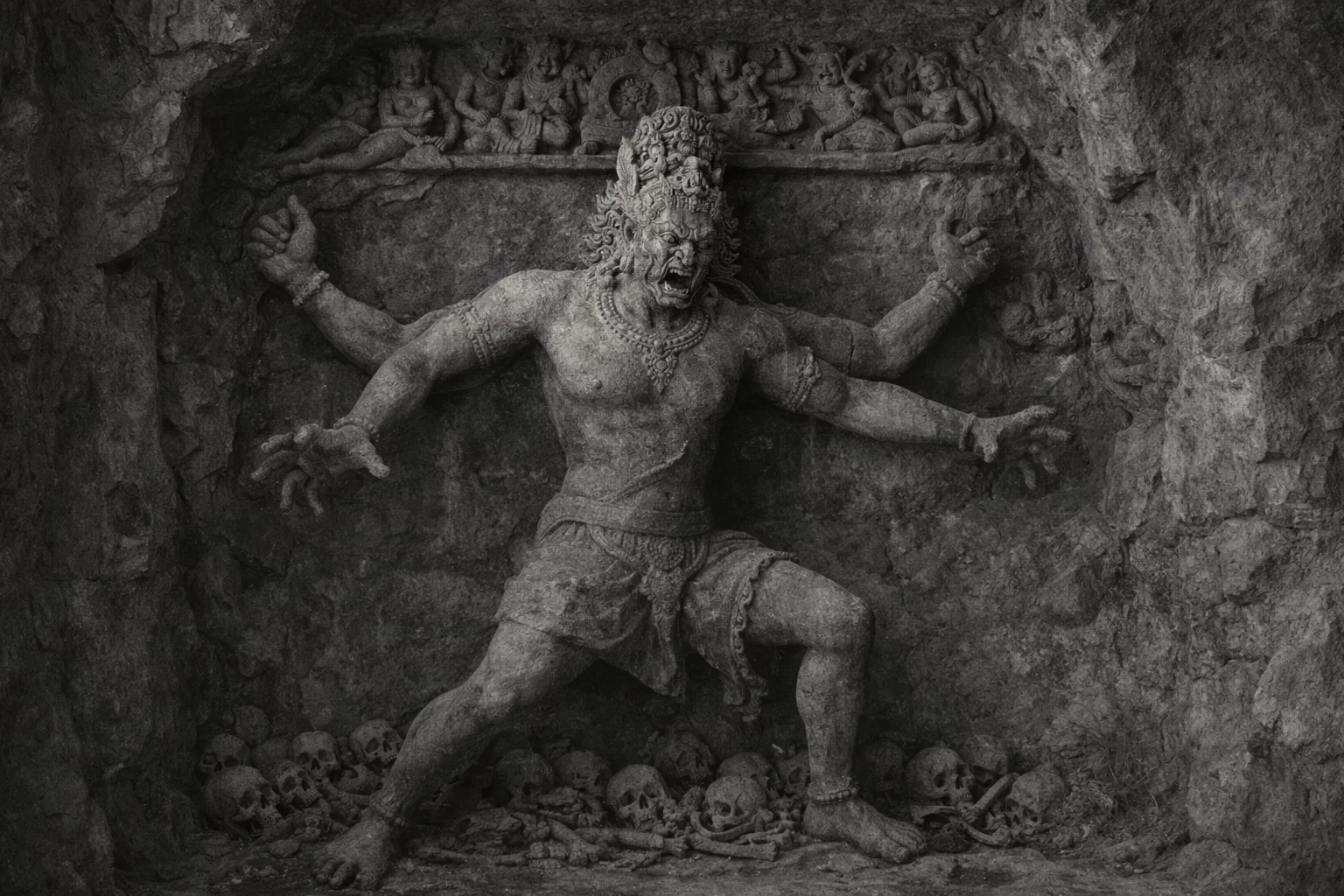
As a king, he is sometimes described as having a thousand arms and heads, though most images show him as a large, muscular warrior with a club or sword. He is usually shown with dark blue or black skin, which stands out against the white or gold skin of the Devas.
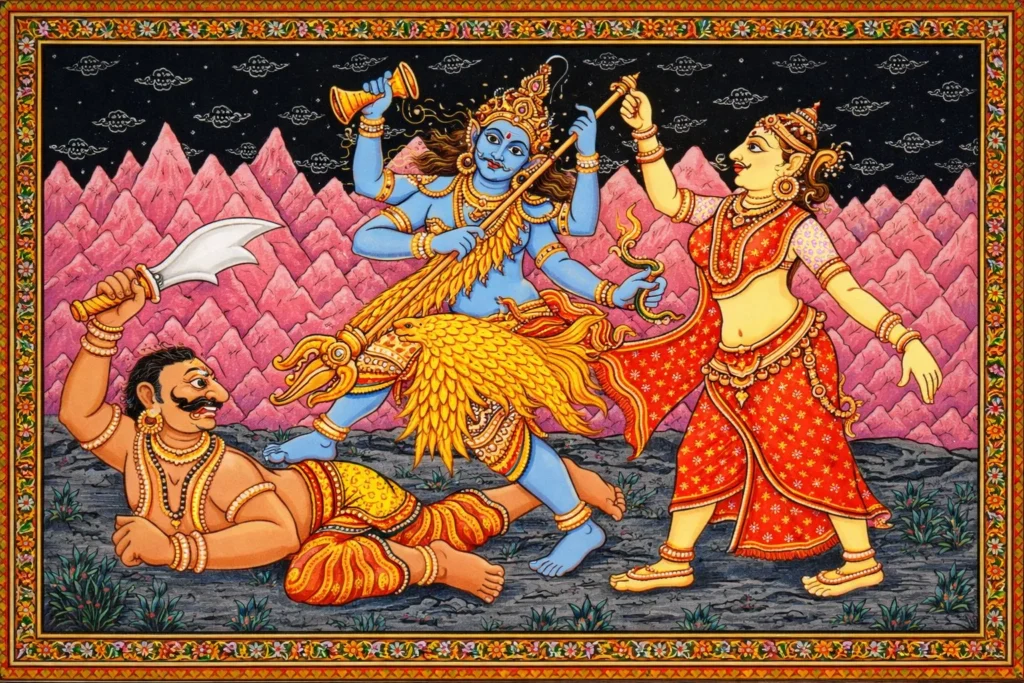
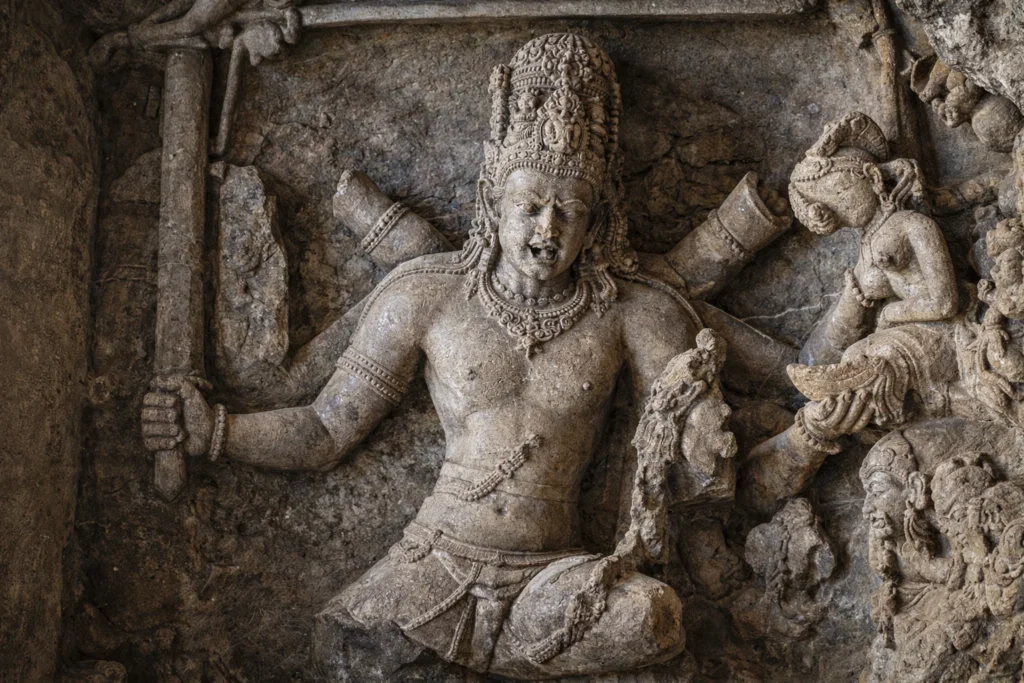
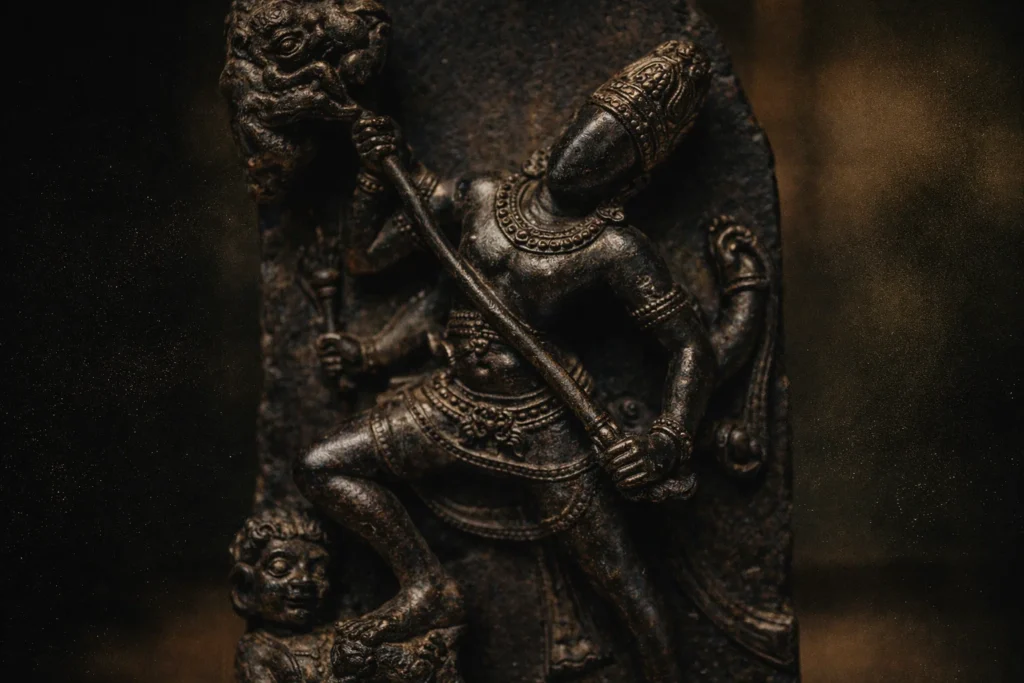
In well-known Andhakasuravadha-murti reliefs in Indian temples, he is shown being lifted by Shiva’s trident. His body is twisted in pain, and his face changes from rage to realization.
Origins
Andhaka’s story is unusual in the Puranas because he is actually the biological son of his main enemy. He first appears in the Mahabharata and later in the major Puranas, where his story grows into a tale of adoption and cosmic rebellion.
After he was born from the darkness caused by Shiva and Parvati, he was given to the Daitya king Hiranyaksha, who wanted a child. Through divine intervention, the blind child became his heir. This adoption made him part of the Daitya clan and set up his later conflict with the gods.
Birth
The birth took place in the forests of the Himalayas. According to the Vamana Purana, Parvati approached Shiva from behind and covered his eyes with her hands.
Because Shiva’s eyes represent the Sun and Moon, the entire world was immediately shrouded in a pitch-black void. From the heat generated by Shiva’s third eye and the moisture of Parvati’s hands, a drop of sweat fell to the Earth. This sweat transformed into a dreadful, blind child who began to wail and scream.
Shiva explained to Parvati that the child was their offspring, a manifestation of the tamasic (dark) energy produced by their interaction. Shortly thereafter, the Asura Hiranyaksha was performing penance to obtain a son. Shiva appeared and granted the blind infant to Hiranyaksha, decreeing that the boy would grow to be a mighty ruler but would meet his end if he ever desired that which was unattainable or unholy.
Family
Andhaka’s family includes both his divine parents and his adoptive Asura relatives. He grew up among the Daityas and was taught by Sukracharya, the Asura priest. He was very loyal to his adoptive father, Hiranyaksha. He wanted to avenge the deaths of both Hiranyaksha and his uncle Hiranyakasipu, who were killed by Vishnu’s avatars.
Historical & Scriptural Records
“From the sweat of her hands, O great king, which were placed on the eyes of the Lord of the universe, was born a boy, blind and of a dark and terrible appearance. Seeing him, the Lord said to Parvati: ‘O goddess, since this boy was born when my eyes were covered by you, he shall be called by the name of the Blind One.'” [Vamana Purana, Chapter 63, approximately 4th–10th Century CE]
This main source gives the basic biological and spiritual background for Andhaka. It clearly connects his blindness to a cosmic event—the brief loss of universal light—rather than to a genetic issue. This sets up the main tension: he is the child of ultimate light (Shiva), but is born from the ignorance (tamas) that comes when that light is hidden.
Unlike most Asuras who are born in the usual way, this entity’s origin is accidental and full of contradictions. His story warns about what can happen when divine play (Lila) affects the material world.
“Andhaka then performed a penance for a thousand years, standing on one leg and eating nothing but air. Brahma, being pleased, appeared and granted him his desire. The Asura asked for divine vision and that he might not be killed by any being who was not his equal in strength, or by any who did not have the same blood as his own.” [Matsya Purana, Chapter 179, approximately 250–500 CE]
This source shows how Andhaka changes from a pitied, deformed child to a real political and cosmic threat. It’s important to notice the “Loophole Motif” in Puranic stories. By asking for invincibility except from his own blood, he unknowingly makes it possible for his biological father to defeat him.
Here, the meaning of the name shifts from describing a disability to serving as a title for a conqueror. This reflects the medieval Indian view of the Asura as a symbol of the outsider or the ego that tries to break natural laws through intense but misguided spiritual practice.
“When the blood of the Asura fell upon the Earth, thousands of other Asuras like him arose from it. Seeing this, the Lord created the Divine Mothers, the Matrikas, to drink the blood of the demon before it could touch the ground. Thus deprived of his power of multiplication, the Great God pierced him with his trident and held him aloft.” [Shiva Purana, Rudra-Samhita, Section 5, approximately 10th–11th Century CE]
This later source adds a complex folkloric and tantric idea: blood that multiplies. This connects the story to Raktabija, another creature from the Devi Mahatmyam.
The Matrikas (Divine Mothers) play an important role in this story. Their presence shows that the entity is so chaotic that even the highest male god needs help from fierce female deities to control him. This reflects the rise of Tantric Shaktism, where goddesses became key to overcoming the “blind” male ego.
“The Asura, being thus suspended on the tip of the trident for a long time, was purified of his sins by the sight of the Lord. He abandoned his demonic nature and began to praise the Lord of the Moon-crest. Shiva, the merciful, then made him the chief of his Ganas and gave him the name of Bhringi.” [Kurma Purana, Chapter 16, approximately 700–1100 CE]
This last source gives the story a redemption arc, which is unusual for demonic figures. The change into Bhringi is a unique local tradition that tries to connect his divine origins with his actions. Being impaled on the trident stands for breaking through ignorance.
At this point in the story, Andhaka is not just a villain but becomes a model devotee who finds understanding through suffering. This fits with the Bhakti movement’s idea that even the most lost soul can find light through divine grace.
Role in Hindu Cosmology
In the cycle of Dharma, Andhaka stands for uncontrolled desire and spiritual ignorance. He is more than a villain; he reflects the soul’s struggle with its own beginnings. In Hindu cosmology, his story warns about the risks of ego-driven gifts—he gained physical sight from Brahma. Still, he stayed blind to his true origins and the sacredness of the divine feminine.
His defeat by Shiva is important in the Puranas because it shows the idea of redemptive destruction. Unlike other Asuras who are just killed and reborn, he is shown hanging on the trident for centuries.
The heat of the trident burns away his sins and demonic side, and he eventually apologizes and becomes a Gana (attendant) of Shiva. This change stands for turning the darkest human urges into devotion.
Myths, Legends, and Stories
The Birth of Andhaka in the Shiva Purana
In the secluded vales of the Himalayas, Lord Shiva sat in profound meditation. Parvati, his consort, approached him from behind in a spirit of playfulness. She placed her hands over his eyes, which represent the Sun and the Moon.
Instantly, the entire universe was plunged into a terrifying, impenetrable darkness. The warmth of Shiva’s third eye, reacting to the touch, caused Parvati’s palms to perspire. As the sweat mingled with the divine energy of the darkness, a drop fell to the Earth.
From this moisture appeared a child of horrific appearance—dark, distorted, and completely blind. He began to wail with a voice that shook the mountains. Shiva, comforting the startled Parvati, declared, “This child is born of our union in the dark; he shall be known as the ‘Blind One’.”
At that time, the Daitya Hiranyaksha was performing a great penance to obtain a son. Shiva appeared before him and said, “I give you this child of mine to be your heir. He shall be a mighty king of the Daityas, but warn him: his end shall come if he ever seeks the unattainable.”
You may also enjoy:
Who Is Asmodeus in Demonology and the Bible?
February 18, 2026
Who Is Azazel, the Demon Blamed for Human Corruption?
February 24, 2026
Abadir: The Demon Servant of Chaos and Dispersion
September 30, 2025
What Is a Qareen and Why Does It Follow Every Human Being?
October 8, 2025
The Ghul: The Flesh-Eating Demon of Arabian Folklore
October 1, 2025
The Tapasya and the Boons of Brahma
Following the death of his adoptive father Hiranyaksha, the young king faced the derision of his kinsmen, who mocked his blindness and his right to the throne. Driven by a desire for absolute power, he retreated to the forest to perform an arduous penance to Brahma.
For many thousands of years, he remained motionless, fixing his mind on the Creator. He eventually began to slice pieces of his own flesh, offering them into the sacrificial fire as a sign of total surrender.
Brahma, moved by such extreme devotion, appeared and said, “Ask for any boon, and it shall be yours.” The king replied, “Lord, grant me the gift of sight so that I may behold the world I rule. Furthermore, grant that I may never be slain by any god, demon, or man, save for one who is as a father to me and in a circumstance where I seek to possess my own mother—an act I deem impossible.”
Brahma granted these boons, and the king’s eyes were opened, revealing a world he immediately set out to conquer.
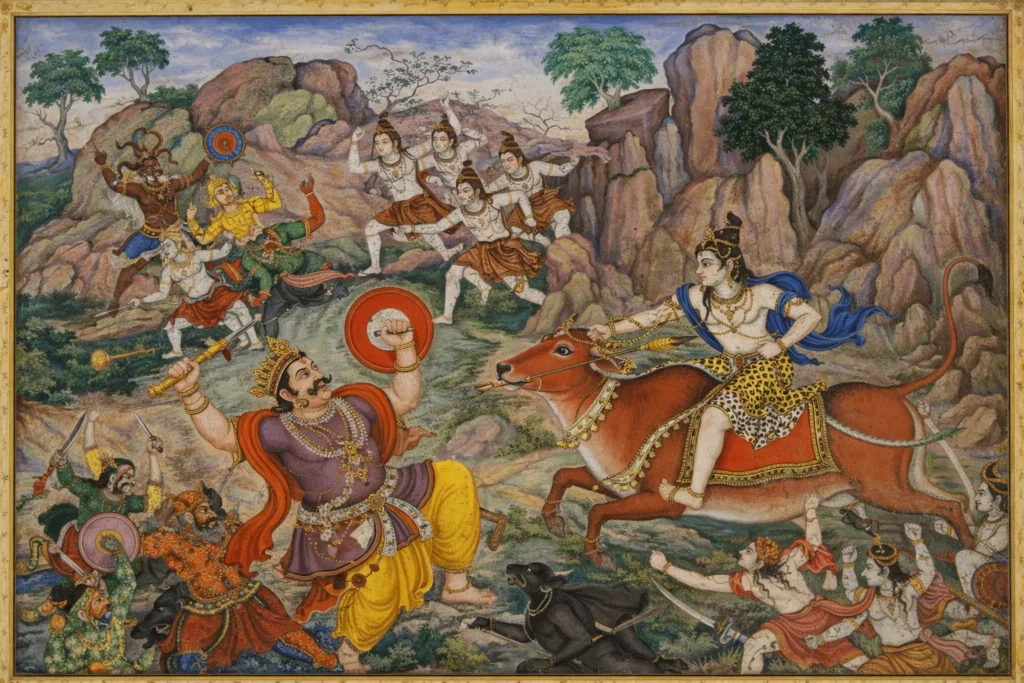
The Invasion of the Three Worlds and the Siege of Kailash
With his new sight and invincibility, the king led a huge army of Asuras against the gods. He defeated Indra and the Vasus, making the gods flee and hide in caves. His pride grew, and he ruled with terror for a long time.
One day, his generals, Shumbha and Nishumbha, returned from scouting and told him about a woman of unmatched beauty living on Mount Kailash. “She is the jewel of the universe,” they said. Driven by desire, which was another kind of darkness for him, the king led his army to the mountain. He did not realize the woman was Parvati, his own mother.
When he reached the gates, Nandi, Shiva’s guardian, warned him to leave. The king laughed and ordered his army to attack, saying he would take the goddess by force as his queen.
The Battle and the Multiplication of Blood
As Andhaka’s army climbed the slopes of Kailash, a fierce battle broke out between them and Shiva’s Ganas. Lord Vishnu and the other gods came to help Shiva, but the king was too strong. The Matsya Purana says that when Shiva hit the king, every drop of his blood that touched the ground became a new, fully armed copy of the Asura.
Soon, the battlefield was filled with thousands of identical demons. To stop this, Shiva used his power to create the Matrikas, the seven divine mothers. These goddesses, like Brahmani, Vaishnavi, and Chamunda, spread out and caught every drop of blood before it hit the ground. Without new reinforcements, the king was left alone to face Shiva’s anger.
The Impalement and Final Redemption
Lord Shiva took on his most fearsome form as the Destroyer and raised his trident, the Pashupata. With a roar, he struck and pierced the Asura king’s chest, lifting him into the air on the trident’s three points. The king could not die because of his boons, but the weapon’s divine heat began to burn away his ego and sins.
Andhaka stayed impaled for centuries, exposed to the sun and Shiva’s presence. Over time, his spiritual ignorance faded. He saw Parvati as the mother of the world and his own mother, and he recognized Shiva as his father. His hatred changed to deep regret, and he began to praise Mahadeva.
Shiva, pleased with his change, took him down from the trident, removed his demonic side, and said, “You are purified. Henceforth, you shall remain by my side as a leader among my Ganas.”
Andhaka vs Other Similar Entities
| Asura Name | Associated Trait/Role | Clan/Origin | Key Traits/Powers |
| Ravana | Conquest and Ego | Rakshasa | Ten heads, celestial weapons |
| Bali | Sacrifice and Piety | Daitya | Ruler of three worlds |
| Bhasmasura | Self-Destruction | Asura | Ash-turning touch |
| Madhu | Primordial Chaos | Asura (Earwax) | Immense strength |
| Kaitabha | Primordial Chaos | Asura (Earwax) | Immense strength |
| Tarakasura | Anti-Deva Warfare | Daitya | Boon of child-killer |
| Vritra | Drought and Obstruction | Asura | Dragon-like form |
| Mahishasura | Shifting Deception | Asura | Shape-shifting (Buffalo) |
| Narakasura | Tyranny | Bhauma | Control over earth |
| Hiranyaksha | Earth-Thief | Daitya | Invulnerability to animals |
Rank Among Asuras
As Hiranyaksha’s successor, Andhaka held the top rank among the Daityas. He was more than a local leader; he was a “Chakravartin” of the Asuras, ruling both the underworld (Patala) and the heavens. He had full authority over other Asuras, though his blindness at first caused problems with relatives, such as the sons of Hiranyakasipu.
He united the different Asura clans against the Devas. Although Ravana is better known, Andhaka came before him and represents a more basic, elemental darkness. His rivalry with Indra was so fierce that Indra had to hide in caves, showing how much of a threat he was to the gods.
Mystical Correspondences
| Attribute | Details |
| Planet | Saturn (Sani) |
| Zodiac Sign | Capricorn (Makara) |
| Element | Earth (Prithvi) and Darkness |
| Direction | South-West (Nirriti) |
| Color | Black or Deep Indigo |
| Number | 0 (Representing the Void/Darkness) |
| Crystal/Mineral | Black Onyx or Iron Ore |
| Metal | Lead |
| Herb/Plant | Dhatura (Thorn Apple) |
| Animal | Bat or Dark Serpent |
| Trait/Role | Ignorance, Desire, Redemption |
The Asura is linked to Saturn, the planet of limits, shadows, and heavy karma. This connection explains the slow, difficult nature of his penance and the lessons he learns through suffering.
Saturn’s influence shows in his blindness and his link to the South-West, the direction of ancestors and Asuras. His zodiac sign, Capricorn, gives him strong ambition and a wish to build a kingdom to rival the heavens, even if it is based on spiritual blindness.
He is also closely connected to the Earth element, which fits his adoption by Hiranyaksha, who stole the Earth. This grounding makes him hard to defeat in battle, but it also stands for the heavy material world that has the soul back. His color, black, matches the darkness of his birth and the void he caused when he blocked the sun.
In rituals, plants like Dhatura, which are sacred to Shiva but poisonous to people, show his double nature: a danger that can be changed into an offering through divine intervention.
You may also enjoy:
Edimmu: The Mesopotamian Wind Demon That Steals Life
November 6, 2025
Alû: The Mesopotamian Demon of Malevolence and Pestilence
November 10, 2025
Kuchisake-onna: Folklore, Origins, and Urban Legend History
February 10, 2026
Bibliography
Author’s Note: While writing this article, I caught a strong contrast between the Matsya Purana’s focus on multiplying blood and the Shiva Purana’s focus on divine parentage. The Mahabharata gives a more direct, battle-centered story. Still, by comparing it with the Varaha Purana, we can see the shift from blind pride to spiritual understanding. My study of these texts shows that Andhaka is not merely a villain but a complex symbol of the soul’s hard journey from darkness (tamas) to knowledge (vidya).
- Basu, B. D., editor. The Matsya Puranam. Translated by A Taluqdar of Oudh, vol. 17, part 1, Panini Office, 1916. Sacred Books of the Hindus. Internet Archive.
- Shastri, J. L., editor. The Siva Purana, Part 4. Translated by a Board of Scholars, Motilal Banarsidass, 1970. Internet Archive.
- Shastri, J. L., editor. The Siva Purana, Part 1. Translated by a Board of Scholars, Motilal Banarsidass, 1970. Internet Archive.
- Ganguli, Kisari Mohan, translator. The Mahabharata of Krishna-Dwaipayana Vyasa. Edited and published by Pratap Chandra Roy, Bharata Press, 1883-1896. Internet Archive.
- Shastri, J. L., editor. The Varāha-Purāṇa: Part I. Translated by S. Venkitasubramonia Iyer, vol. 31, Motilal Banarsidass, 1985. Ancient Indian Tradition and Mythology. Scribd.
- George M. Williams (27 March 2008). Handbook of Hindu Mythology. Oxford University Press. pp. 54–. ISBN 978-0-19-533261-2.
- Ganga Ram Garg (1992). Encyclopedia of the Hindu World Vol. 3. Concept Publishing Company. p. 449. ISBN 978-81-7022-376-4.