The Ifrit is known for its fierce, focused anger in the desert, but the Marid stands for the vast and uncaring power of the deep ocean. In Islamic theology, Marids are called the “Rebellious Ones” not just because of their fiery nature, but because they refuse to obey any authority, whether divine or human.
Looking at their journey from ancient sea monsters to the chained giants in the stories of Solomon, we see a lasting fear in culture about the wildness of nature and the dangers of trying to control it.
This article uses the main translations of the Shams al-Ma’arif and Sīrat Sayf ibn Dhi-Yazan to make sure the Marid’s classification is true to its cultural roots. I also checked modern sources against works such as Lisan al-Arab and Sahih Muslim to provide a reliable historical overview. [View Full Bibliography ↓]
Summary
Key Takeaways
| Attribute | Details |
|---|---|
| Names | Marid, Mārid, Blue Jinn; variations include rebellious giant or water devil in folklore. |
| Type | Powerful sea-dwellers, classified as chthonic demons among jinn, stronger than most but akin to ʿifrīt in might. |
| Title | Rebellious One, Giant of the Depths; sometimes called King of Water Spirits in tales. |
| Gender | Typically male, though folklore shows ambiguous or female forms in shape-shifting. |
| Servitors | Lesser water jinn or bound ʿifrīt; commands schools of weaker sea entities in legends. |
| Superior Jinn | Iblis (as overlord of rebellious shayṭān); some texts place them under no direct lord due to defiance. |
| Powers | Stirs storms and floods to drown foes; eavesdrops on angels for forbidden knowledge; twists wishes to curse granters; moves massive objects like ships or thrones. |
| Appearance | Towering figures with ocean-blue skin, eyes like storm lightning, and forms shifting from misty vapors to raging waves or humanoid giants. |
| Etymology | From Arabic root m-r-d, meaning “rebellious” or “recalcitrant”; echoes Hebrew terms for rebel, tied to defiance against order. |
| Associated Figures | King Solomon (who bound them); Iblis (their tempter); prophets like Ali in narrations of confinement. |
| Weaknesses | Bound by seals like Sulayman’s ring; repelled by Ayat al-Kursi or iron tools; outwitted by reverse commands due to literal pride. |
| Opposing Holy Figure | Archangel Jibril (guardian against eavesdroppers); Prophet Muhammad (who subdued ifrits); King Solomon via divine ring. |
| Social Structure or Tribe | Leaders of water tribes, ruling hidden ocean clans with strict hierarchies of lesser jinn. |
| Followers/Tribe Size | Commands vast tribes of sea jinn, numbering in legions as per folklore epics like Sirat Sayf. |
| Element | Water (primary); ties to air through storm-summoning. |
| Planet/Zodiac | Neptune (for oceanic depths); Pisces (water sign of illusion and rebellion). |
| Color(s) | Deep blue (storm seas); black (abyssal voids). |
| Number(s) | 7 (tides and waves in rituals). |
| Crystal(s)/Mineral(s) | Aquamarine (sea control); obsidian (binding rebellious forces). |
| Primary Sources | Quran (Surah As-Saffat 37:1); Hadith narrations by Ali ibn Ibrahim al-Qummi; One Thousand and One Nights (Fisherman tale); Shams al-Ma’arif (binding rituals); Sirat Sayf ibn Dhi-Yazan (pre-Islamic epic). |
“Marid” Meaning
The meaning of the name “Marid” centers on a deep sense of defiance found in old Arabic words. The name likely derives from the Semitic root “m-r-d,” meaning “rebellion” or “stubborn resistance.” It paints an image of a force that fights against rules, like a strong current pulling against the shore.
This characterization fits well with how this Jinn is portrayed in old tales: he ignores commands, breaks agreements, and struggles against chains with fierce determination. Ibn Manzur, in his book Lisan al-Arab, points out this as a mark of the wild, linking it to huge spirits that defy the heavens.
However, over time, the definition expanded to encompass more than just any singular fighter Jinn—it became a label for some of the strongest kinds of evil Jinn. A class of malevolent Jinn, if you like. Hans Wehr’s word list refers to them as “demons” or “giants,” illustrating the shift from a broad term for the defiant to a distinct group of unseen powers.
The entire meaning of the name also changed across lands. For instance, before Islam, Arabs viewed them as spirits of the rough seas, free and fierce. With Islam’s rise, it fit into Jinn groups, which the Quran refers to as “shayṭān mārid” (rebels).
How to Pronounce the Jinn’s Name in English
Say Marid as “MAH-reed.” The first syllable rhymes with “car,” stressed hard, and the second like “reed” in a plant. Roll the “r” lightly, if possible, like in Spanish, to match the Arabic flow. Avoid “muh-RID”—keep it smooth, two beats.
What Does the Marid Look Like?
Depictions of this powerful Jinn draw from old sources, portraying him as an awe-inspiring force of nature rather than a fixed shape.
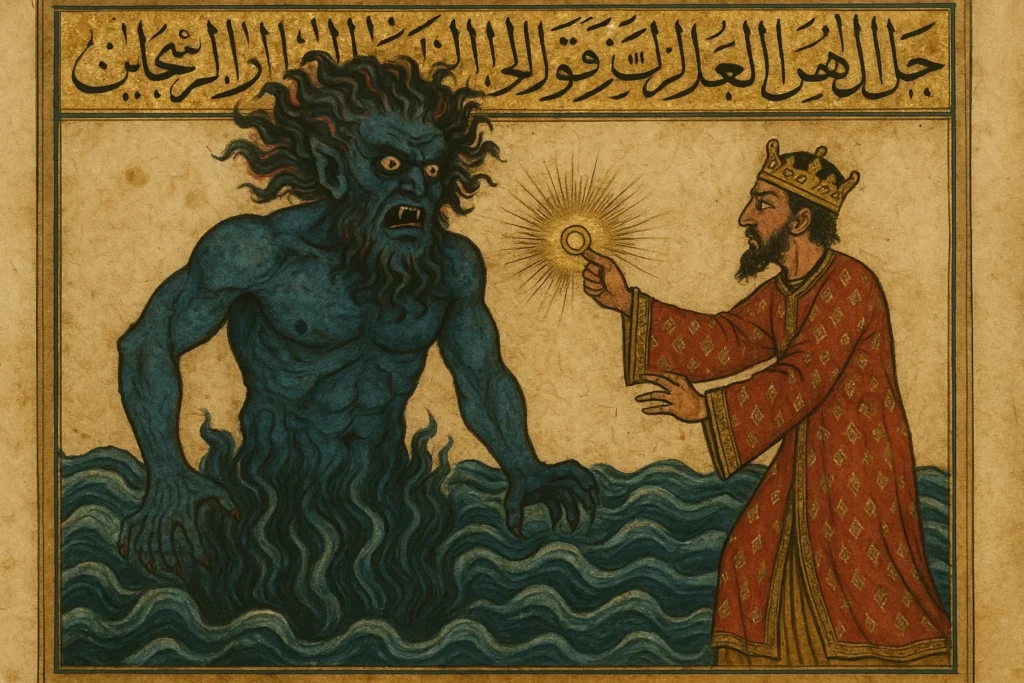
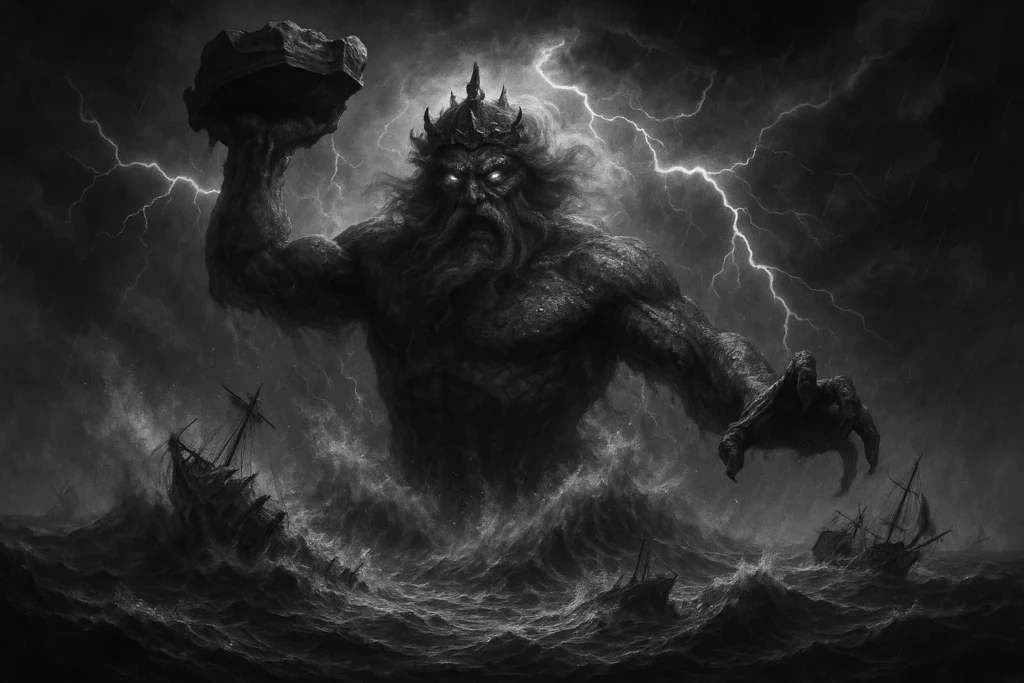
In One Thousand and One Nights, he rises from a jar as a swirling mist of blue vapor, coiling like sea fog before snapping into a giant form. His body gleams with wet scales or deep azure skin, eyes flashing like lightning over waves. Arms stretch long to grasp ships, and his voice booms like thunder, shaking the air.
During summons, he often manifests in stages: first, a chill wind off the water, then ripples in the air that turn solid. According to Sīrat Sayf ibn Dhi-Yazan, the Marid is a tall man with storm clouds for hair, feet covered in foam. He can shift easily—into a large whale to drag sailors down or eagles to scout from heights. Invisible most of the time, he can strike when seen: a hand from the mist yanking victims to depths.
You may also enjoy:
Who Is Abaddon, the Demon of the Abyss, in the Bible?
September 29, 2025
The Ghul: The Flesh-Eating Demon of Arabian Folklore
October 1, 2025
Iblis, the Jinn King of Darkness and Deception
September 29, 2025
Who Is Ahriman, and Why Is He Pure Evil Incarnate?
January 8, 2026
Jikininki: The Japanese Ghost That Feeds on Human Corpses
February 9, 2026
Vritra: The Dragon Who Swallowed the Sky in Hindu Mythology
October 7, 2025
Origins
The Marid is an ancient Jinn. Early nomads spoke of the terrifying “māridah” born from fire but tied to the fury of the waves. Stories of wise yet fierce giants—like the Mesopotamian apkallu—slipped in through caravans and quickly spread in the nearby lands.
Before written words fixed them, oral tales painted the creature as an ocean lord, guarding hidden pearls or drowning the bold. Tribal songs from Jahiliyyah times warned of his pride, how he twisted oaths, and of his sinking boats for fun.
Along Yemen’s coasts, he ruled the dives; in the Hijaz hills, he haunted wells. These beliefs grew from nature’s might—floods as wrath, calm seas as rare grace.
As Islam dawned in the 7th century, this demonic spirit found new frames. The Quran “bound” the Jinn, calling him a fire-born peer to man, answerable to God.
By the Abbasid era, he had become a prominent entity in books and courts. The famous Solomon’s ring was said to have chained the Jinn to build the temple, mixing Jewish tales with Arab style. In Persia, the Jinn fought heroes like divs; in India, he mixed with local ghosts.
Marid as the Archetype of Post-Colonial and Fluid Resistance
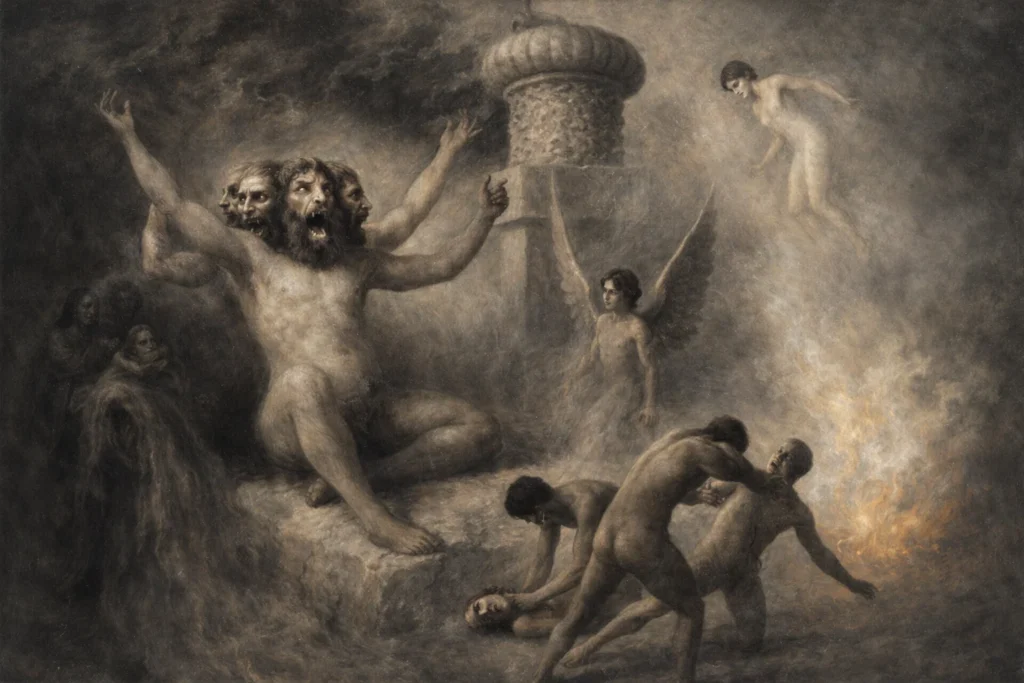
The way Marid is described in Lisan al-Arab and Shams al-Ma’arif goes beyond basic ideas of elemental spirits. Instead, Marid becomes a main example of the idea of refusing to submit.
Other types of Jinn, like the Ifrit, are known for what they do, such as seeking revenge or causing destruction with heat. The Marid, however, is defined by the word m-r-d, meaning rebellion. This means he is more than just a water spirit; it stands for something that cannot be controlled.
During the Abbasid Caliphate, when these stories were written down, the Marid symbolized the wild and uncontrolled parts of the sea. These areas were like the rebellious tribes and pirates who resisted the empire’s control.
The change in how the entity is described—from a sea monster before Islam to a chained giant in Solomon’s stories—reflects how people deal with fears. By linking the idea of rebellion to the ocean, old storytellers showed people’s worries about things that cannot be shaped or controlled.
The Ghul is known for having a set, physical form, even if it is decaying. In contrast, the Marid is linked to water and mist, making it always changing. This fits with the idea of a powerful, destructive force that cannot be controlled or named, like the deep ocean. The Marid does more than just sink ships; it challenges the very idea of human limits at sea.
What stands out here is the Marid’s special link to the Qarin, a personal Jinn companion. Old texts say that while an Ifrit attacks from the outside using magic, a Marid puts pressure on the Qarin, making a person’s pride grow until it matches the Jinn’s own arrogance.
Historical & Folkloric Records
While the Marid is a foundation of Jinn classification, remember that the term “Marid” appears in the Quran primarily as an adjective for “rebellion” rather than as a distinct aquatic giant species. Its evolution into a specific “Ocean Jinn” is a result of later linguistic codification and the sprawling oral traditions of the Islamic Golden Age.
“And [We glassed the heaven] as a protection against every rebellious devil [Shayṭānin mārid]. They cannot listen to the High Council, for they are pelted from every side.” [Quran, Surah As-Saffat (37:7-8), 7th Century CE]
In this earliest foundational layer, mārid functions as a descriptive participle derived from the root m-r-d, meaning “one who is stripped of hair or leaves”—metaphorically, one who has stripped away all obedience.
Here, the Marid is not yet the blue-skinned giant of the sea; it is a “Satanic” entity defined by its proximity to the heavens. Its primary “power” in this era is the act of celestial eavesdropping (istiraq al-sam’), attempting to steal divine decrees before being struck down by “piercing stars” (meteors).
Theologically, this establishes the Marid as the ultimate transgressor of boundaries. They represent the intellectual arrogance of the created being trying to bypass the Creator’s information hierarchy.
At this stage, the Marid is a “Shayṭān” (adversary) first and a “Jinn” second, emphasizing a moral status of absolute recalcitrance over a specific elemental phenotype.
“The Mārid is the most evil and most powerful of the Jinn. It is said: a man is mārid if he is rebellious; and a Jinn is mārid if he surpasses his kind in stature and pride. Ibn Manzur states: The mārid is the one who remains proud and refuses to submit, and from this comes the giants of the Jinn.” [Ibn Manzur, Lisan al-Arab, 13th Century CE]
By the 13th century, the Lisan al-Arab, a key Arabic dictionary, changed Marid from just a word for rebellion into a category for a type of giant. This marked a shift from seeing Marid as only a spiritual rebel to seeing it as a physical giant.
The focus shifts to scale and social hierarchy; the Marid is now defined by “surpassing his kind.” This reflects a medieval transition in which the unseen world was organized as a mirror of human feudal systems, with Marids serving as the unruly, high-ranking lords of the Jinn wilderness.
Linguistically, the connection to “stature” (giantism) begins to supersede the purely “rebellious” aspect. The Marid is no longer just a tempter; it is a physical threat of massive proportions. This era of codification provided the scaffolding for later storytellers to personify these entities as the colossal figures found in jars and hidden palaces.
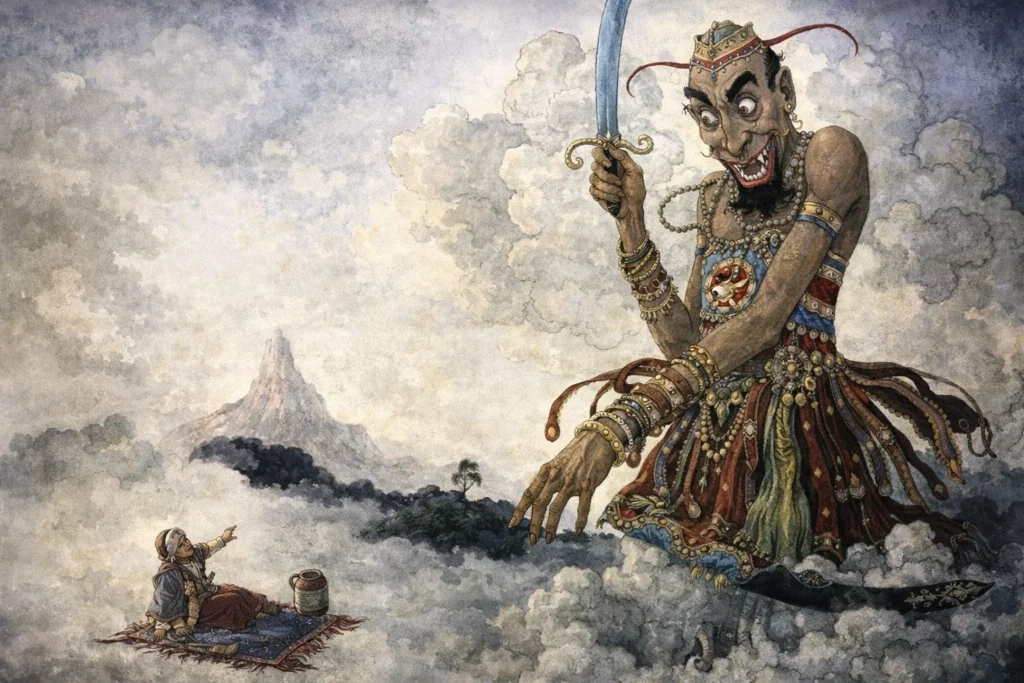
“Thereupon the Jinni shook and became a column of smoke, which grew skyward till it issued from the jar’s mouth… and then became a fume that took the semblance of a man huge of stature, his head in the clouds and his feet on the sand. His head was like a dome, his hands like pitchforks, and his legs like masts, and his mouth like a cavern.” [The Fisherman and the Jinni, One Thousand and One Nights (Breslau/Galland Manuscripts), 14th–18th Century]
This story gives us the most famous image of the Marid, showing how it changes from smoke into a giant. Unlike the Marid in scripture who listens in on the heavens, this one is trapped by human tools, like a copper jar sealed with Solomon’s ring. The way its body is compared to things like domes and masts shows the Marid as a mix of human creations, making it seem even more frightening.
The important point here is the creature’s stubbornness and hurt pride. In this story, the Marid wants to kill the person who freed him because he was trapped for so long. This shows a change from seeing the Jinn as pure evil to seeing it as a being shaped by long-term suffering. At this point, the Marid is clearly linked to the ocean, since the fisherman finds the jar underwater.
“Know that the Marid of the Water is the most difficult to bind. You must use the blue seal and the names of the depth, for they respond to the crashing of the waves. They are the governors of the tides and the guardians of the treasures that the earth has swallowed.” [Al-Buni (Attributed), Shams al-Ma’arif (The Sun of Gnosis), 13th–17th Century (Standardized)]
In the magical texts of Shams al-Ma’arif, the Marid is finally linked to the element of water. Earlier sources saw them as fire-born rebels, but the occult tradition needed to sort Jinn by the four elements for rituals. So, the Marid became a spirit of the deep sea, changing from a sky-climber to a sea-dweller. This was a big change from the Marid as a rebel in the Quran to a ruler of water.
The mention of blue seals and control over tides shows how ideas from Greek and Hermetic philosophy influenced Islamic beliefs about spirits. The Marid is now seen not just as a monster, but as a force of nature that can be used. This source also links the Marid to the zodiac and certain minerals, turning a warning about pride into a part of medieval magic.
Powers and Abilities
This powerful entity wields forces that dwarf lesser Jinn. His powers typically invoke the chaos and the forces of nature:
- Storm Summoning: Calls gales and floods to swallow fleets.
- Master Spy: He can climb to the heavens to spy on angels, stealing prophecies.
- Wish Twisting: Grants boons from jars but warps them—riches turn to lead, love to obsession.
- Shapeshifter: Morphs to beasts or waves for ambushes.
- Superhuman Strength: Lifts thrones or boulders like foam.
- Master of Illusions: Crafts false seas or drowned kin to lure prey.
- Floods: Drowns minds in greed or rage visions.
Influence on Humans and Possession
According to Islamic tradition, Marid latch onto humans through gaps in faith or moments of weakness, holding a tidal force unmatched by that of lesser Jinn. His malevolent influence, known as sihr (sorcery), twists thoughts toward dark desires, planting sudden urges to curse enemies, hoard forbidden knowledge, or seek power through hidden means.
Unlike common Jinn, he is overwhelmed with a flood-like grip, drowning resolve in waves of obsession.
Signs of his touch include victims feeling cold shivers as if plunged into icy seas, dreaming of endless black waters, or suffering fits of rage that surge like storms.
The qarin, a personal Jinn shadow tied to each human from birth, becomes a dangerous tool for Marid. When he binds to a qarin, it amplifies personal flaws—envy turns to paranoia, making friends seem foes; pride swells into reckless gambles.
Protection and Exorcism Methods
Sahih Muslim recommends placing salt circles around homes, mimicking natural sea barriers to ward off the advance of this evil Jinn. Iron nails in doorframes can allegedly pin the Jinn’s fluid form (a practice tied to Bedouin wards against storm spirits). Reciting Ayat al-Kursi three times at twilight weaves a divine veil, shielding against rebellious Jinn who roam at night.
For active hauntings, burning rue over hot coals releases smoke that chokes the Jinn. What’s more, black threads dyed in squid ink, tied at wrists, are said to knot their influence.
Some texts (like Shams al-Ma’arif) suggest sprinkling seawater mixed with saffron at thresholds. Its golden color resembles divine light and can repel demonic entities. Hadith also mentions blowing breath over water after reciting Surah Al-Ikhlas, then sprinkling it on the afflicted to cool Marid’s fiery roots.
You may also enjoy:
Who Is Andromalius, and Why Is He the Last Demon of the Goetia?
January 20, 2026
Rokurokubi: The Yōkai That Looks Human Until Midnight
February 3, 2026
What Is Jorōgumo? The Deadly Spider Woman of Japanese Myth
February 2, 2026
Who Is Aka Manto, Japan’s Terrifying Red-Cloaked Yōkai?
October 24, 2025
Hitotsume kozō: One-Eyed Yōkai of Japanese Folklore
February 4, 2026
Marid Myths, Legends, and Stories
The Fisherman and the Vengeful Marid
In days of old, a simple fisher cast his net into the rolling waves four times daily, hauling just enough to keep his family from want. One clear morning, a great pull strained his line; not schools of silver fish, but a heavy brass vessel, capped with lead marked in forgotten signs.
Drawn by wonder, he broke the seal. Thick smoke poured out, climbing to touch the clouds, then fell back as a vast form—hide like dark tides, stare sharp as reef edges, bulk taller than date trees.
“I stand as the Marid of the abysses,” it growled. “Locked away long ago by Solomon’s heirs for felling a lord who loosed me. In thanks, I pledged to end my freer. You snapped the tie—now face doom!”
The fisher dropped to his knees, pulse racing. “Mighty one, hold back! I set you loose; allow a gift first—share your account true, as rulers learn before rulings.”
Vanity rose in the Marid; it cherished its own words. “Listen close: I held sway over swells beneath lights, sinking armadas for play. A wizard snared me in this pot amid gale chants, swearing my duty. I toiled bitterly, raising towers from bubbles, till fury surged. I crushed his keep, swamped his rooms—yet he shut me firm, damning my title. Eras spun; waters climbed and dropped. Now unbound, my vow calls for your close.”
The man dipped his head wise. “Grand account, but consider: if I shut you again, would my line not free you once more? Better show your strength—send me secure, and let ages judge the rash.”
To mock the lock, the Jinn shrank to the size of a bird and rested on his arm. “Seek three favors, speck, but curse if they offend.”
The fisher asked plain gifts: fresh years for his boys, webs full of catch, calm in his home. Each given straight, for the ego hid the plain snares from the colossus.
The Marid couldn’t twist the fisherman’s words. No loopholes. No way to turn wishes into nightmares. He was defeated.
The Trickery in Sayf’s Quest
In a distant past, Prince Sayf, the son of Dhi Yazan, yearned for honor after rivals had usurped his rightful throne. Prophetic seers informed him of the ancient treasure of Solomon, a wealth that could help his reclamation of the kingdom.
They also guided him to secret caves where Sayf found a sage who advised him: “Summon a Marid, but refrain from directly talking to him, for his perception distorts the truth akin to the way seaweed shifts in water.”
At midnight, Sayf drew rings in the sand and invoked rituals from ancient texts. The winds howled, and salt stung his eyes. A colossal creature then appeared, formidable as a cliff, possessing arms resembling gnarled roots and exhaling clouds of starlight. “Mortal, what compels you to disrupt my slumber?” the demon growled, with waves accumulating at its feet.
“O great sovereign of the tides, guide me to Solomon’s wealth,” Sayf confidently proclaimed, maintaining his composure. The Marid responded with a chuckle, mist dispersing from its form. “Fool! I heed no one—yet your words amuse me. I shall guide you, albeit with the intent to mock your deceptions.”
They navigated through the mist, with the giant parting hills as though they were crashing waves. Paths twisted, and illusions disintegrated—pools formed only to vanish into voids.
After reaching the entrance to the treasure, concealed behind jewels and intricate markings, the Marid swept aside the stone barricades. “This hoard scorns kings; seize it, and you shall vanquish your adversaries.” Sayf took hold of the radiant treasure, dazzling in its brilliance.
Yet, while admiring the wealth, the colossal being stated, “Now, you must render a fee—your life in exchange for my service.” Sayf raised a sealing band, reminiscent of Solomon. “With this, you have contributed—now descend into obscurity, bound in servitude.”
Fury surged within the Marid, which expanded into a tempest, but the band radiated light, ensnaring its form. It fell, lamenting and cursing into the winds.
Sayf reclaimed his sovereignty; however, storms besieged his reign, serving as a reminder that deception can ensnare even the strong.
Marid vs Other Jinn
| Jinn Name | Associated Traits/Influence | Rank/Origin | Key Traits/Powers |
|---|---|---|---|
| Ifrit | Vengeance and destruction; incites fiery wrath in hearts. | Underworld king; Quran (Surah An-Naml). | Commands flames to burn foes; shape-shifts to beasts; hard to bind without holy fire. |
| Ghul | Grave-haunting gluttony; lures wanderers to devour flesh. | Desert scavenger; Hadith warnings. | Mimics lost kin to trap prey; regenerates from wounds; tied to night sands. |
| Qareen | Personal temptation; whispers sins tailored to one’s flaws. | Birth companion; Islamic theology. | Knows all secrets from cradle; sows doubt invisibly; convertible by faith. |
| Shaitan | Broad evil seduction; leads tribes to polytheism. | Devil’s aides; Quran multiple verses. | Casts illusions of gain; multiplies whispers; chained in holy months. |
| Hinn | Animalistic cunning; preys on the weak like packs. | Primitive predecessor; folklore sightings. | Appears as dogs for hunts; weak alone but swarms; tied to wild howls. |
| Nasnas | Monstrous half-form terror; offspring of forbidden unions. | Hybrid curse; Arabian tales. | Hops on one leg to strike; drains strength on touch; born of shiqq sins. |
| Jann | Desert mirage mischief; hides oases from the lost. | Ancestral shifters; pre-Islamic lore. | Forms whirlwinds to mislead; reveals water for pacts; open to human aid. |
| Shiqq | Split deformity horror; breeds abominations in shadows. | Lower half-beast; Hadith fragments. | Crawls as torso fiend; mates to spawn nasnas; weak light scatters it. |
| Si’lat | Shape-shift seduction; mimics beloveds for betrayal. | Master impersonator; Persian-Arab blends. | Copies voices perfectly; drains life in embraces; dawn reveals true slime. |
| Palis | Vampiric thirst; licks feet in sleep for blood drain. | Desert foot-fiend; Somali-Arab myths. | Low wit, outsmarted by soles crossed; leaves husks; tied to barren nights. |
| Sila | Night shade allure; haunts lovers with false passions. | Ghul kin shifter; medieval grimoires. | Blends beauty and bat-form; induces lust fevers; repelled by pure salt. |
| Tawaghit | Tyrant possession; claims idols for false worship. | Statue demons; occult warnings. | Infests carvings to speak lies; crumbles under faith strikes; hoard cursed gold. |
| Ghilan | Grave whisperer; stirs unrest in burial grounds. | Night shade haunter; folklore graves. | Changes to dust swirls; echoes regrets to madden; full moon swells power. |
| Zuzula | Underworld chaos; winged claws rend the bold. | Horned clan fiends; horror yarns. | Flies in packs to tear; brews underworld fogs; iron horns as weapons. |
Associations
The Marid can be linked to cosmic forces that amplify his stormy spite, turning water from a life-giver to a grave-maker.
Zodiac and Astrological Links
Marid aligns tightly with Neptune, the planet of deep mysteries and deceptive currents, which fuels their ability to weave misty veils that cloud judgment. His power peaks under Pisces, the water sign of illusion and rebellion, where his fluid nature thrives—summoning at equinox tides, when stars align low.
Shams al-Ma’arif ties this Jinn to the lunar phases: the full moon swells his waves to drown prayers, while the new moon cloaks his whispers in shadow.
Elemental Associations
Water rules Marid’s essence, shaping his form as crashing waves or illusory pools that drag victims under. This tie allows the Jinn to command seas, summon floods, and craft mists to trap their foes.
Air plays a secondary role, fueling the births of his storms and carrying their whispers across the skies.
West, where suns sink into seas, aligns with their gales, blending the weight of water with the speed of wind to blind and disorient.
Colors, Numbers, and Crystals
Deep blue evokes stormy seas and dark skies, and is used in rites to summon the Jinn or to stain auras with their chilling influence.
Black mirrors the abyssal void, hiding their true forms and marking their pull toward despair.
The number 7 binds to Marid, tied to sea cycles—seven waves in tales, seven seals in bindings, or seven tides in curses. It marks his ritual flaws, as pride often fails in this regard.
Crystals like aquamarine channel their tide control, used in talismans to bind or repel their flow, its blue gleam a mirror of their seas.
Other Correspondences
Metals like iron chain Marid’s might, used in nails or rings to pin their fluid forms, ingrained Bedouin wards. Brass has their essence in jars, its sheen a trap for their pride, while lead seals their curses in urns, heavy as their grudges.
Herbs tied to their chaos: nightshade brews fogs to blind, its poison mirroring their deceit; rue repels with sharp scent, burning their watery breath; mandrake calls them in dark rites, its roots echoing their deep ties.
Animals reflect their nature: whales for vast size, dragging ships to depths; serpents for sly shifts, coiling through waves; eagles for air ties, scouting from storm heights.
You may also enjoy:
Andrealphus: The Peacock Demon Who Twists Minds and Bodies
January 19, 2026
Akateko: The Bloody Hand Yōkai That Guards a Cursed Temple Tree
November 14, 2025
Tarakasura: The Dark Demon Who Ruled Hell on Earth
December 4, 2025
Rāga: The Seductive Demon of Passion and Desire in Buddhist Lore
October 16, 2025
Who Is Baal in Christian Demonology?
February 25, 2026
Bibliography
Author’s Note: Researching this entity was both interesting and challenging. The differences between modern journals (like Volkan) and the rich, changing ideas in stories like Sīrat Sayf Ibn Dhī Yazan are quite puzzling. Sahih Muslim and Abdel Haleem give the basic religious background for the Marid. Still, it is the mix of the Testament of Solomon and old folk tales that shows how the Marid changed from a heavenly rebel to a chained sea giant. Not to mention the Marid’s oceanic side—often left out of strict religious texts—that comes to life in stories from One Thousand and One Nights and local traditions. This research shows how hard, yet important, it is to bring together the views of scholars and storytellers to fully understand this entity.
- Meri, Josef W. (editor). Medieval Islamic Civilization: An Encyclopedia. Routledge, 2006. Internet Archive.
- M. A. S. Abdel Haleem (translator). The Qur’an: English Translation and Parallel Arabic Text. Oxford University Press, 2004. Quran Project Edition.
- Al-Shaykh, Hanan. One Thousand and One Nights: A Retelling. Pantheon Books, 2013. Internet Archive.
- Abdul Hamid Siddiqui (translator). al-Hajjaj, Muslim ibn. Sahih Muslim. Islamic Book Service, 2004. Internet Archive.
- Volkan, Kevin. The Jinn: Islam, Exorcism, and Psychology. Journal of Social and Political Sciences, 2023. 6. 1-14. 10.31014/aior.1991.06.03.425.
- Khalifa, Najat, and Tim Hardie. Possession and Jinn. Journal of the Royal Society of Medicine vol. 98,8 (2005): 351-3. doi:10.1177/014107680509800805.
- Blatherwick, Helen. Prophets, Gods and Kings in Sīrat Sayf Ibn Dhī Yazan: An Intertextual Reading of an Egyptian Popular Epic. 2016. Academia.edu.
- Jayyusi, Lena (translator and editor). The Adventures of Sayf ben Dhi Yazan: An Arab Folk Epic. Indiana University Press, 1996. Internet Archive.
- McCown, Chester Charlton, editor. The Testament of Solomon. J. C. Hinrichs’sche Buchhandlung, 1922. Internet Archive. Edited from manuscripts at Mount Athos, Bologna, Holkham Hall, Jerusalem, London, Milan, Paris, and Vienna.
- García Martínez, Florentino. The Dead Sea Scrolls Translated: The Qumran Texts in English. Translated by Wilfred G. E. Watson, E. J. Brill, 1994. Internet Archive.