Al-Ahmar stands at the crossroads of astronomy and occult beliefs in Islamic grimoires. Unlike many spirits found only in folklore, Al-Ahmar is closely linked to the planet Mars. This connection makes him a bridge between the stars and the hidden world beneath the earth.
Rather than being a mischievous entity, he is known for his organized, martial influence on human conflict and physical strength.
My research used direct translations from Shams al-Ma’arif and Kitab al-Bulhan to ensure the description of Al-Ahmar fits its cultural context. [View Full Bibliography ↓]
Summary
Key Takeaways
| Attribute | Details |
| Names | Al-Ahmar, Abu Ya’qub, Abu Mihriz, The Red King |
| Type | Jinn King (Subterranean and Planetary) |
| Title | Malik (King), Ruler of Tuesday, Servant of Mars |
| Gender | Male |
| Servitors | Kamashtam, Haba’iq, and various red-hued marid and ifrit |
| Powers | Induces hemorrhage, fuels violent rage, governs iron, causes fevers |
| Appearance | A tall, red-skinned warrior is often depicted holding a spear or sword |
| Etymology | Arabic for “The Red One” |
| Associated Figures | The Angel Samsama’il (planetary overseer) |
| Weaknesses | Ayat al-Kursi, the color green, and the recitation of specific Surahs |
| Opposing Holy Figure | The Archangel Samsama’il (who binds him to his duties) |
| Social Structure | Monarch of the Red Tribe; one of the Seven Great Jinn Kings |
| Followers/Tribe Size | Commands a vast legion of the Red Tribe (Banu al-Ahmar) |
| Primary Sources | Shams al-Ma’arif (The Sun of Gnosis), Kitab al-Bulhan, various occult manuals |
Who or What is Al-Ahmar?
Al-Ahmar is known as one of the seven main Jinn kings who rule over the days of the week in Arabic occult thought. He is the ruler of Tuesday and leads the “Red Tribe” of spirits. Unlike the shayatin, who are always evil, he is seen as a strong earthly king who serves higher powers in the heavens.
He is not a lone spirit but a key official in the hidden world’s hierarchy, carrying out the powers of Mars on earth. His main duties involved leadership, war, and control over blood, making him an important entity in medieval and early modern Middle Eastern studies of spirits.
Al-Ahmar Meaning
The name comes from the Arabic root h-m-r, meaning “the red” or “the red one.” In Semitic languages and Islamic occultism, names like this are usually practical, not just for looks. The color red directly connects to the planet Mars (al-Mirrikh), which many cultures have linked to this color because of how it appears in the night sky.
Over time, the name became more of a title or nickname. In books like the Shams al-Ma’arif, he is also called Abu Ya’qub or Abu Mihriz, which are honorifics used for formal or ritual purposes. Changing from a simple color description to a formal name shows how Al-Ahmar went from being seen as a vague spirit of heat to a more defined, god-like entity among the Jinn.
In some North African traditions, the name also means the intense heat of the desert. This strengthens the link between the color red, fire, and the feeling of burning.
How to Pronounce Al-Ahmar in English
The name is pronounced al-AH-mar. The “al” sounds like in “pal,” the “ah” is a deep sound from the back of the throat (like the Arabic letter Ha), and “mar” rhymes with “car.” The stress is on the second syllable.
What Does Al-Ahmar Look Like?
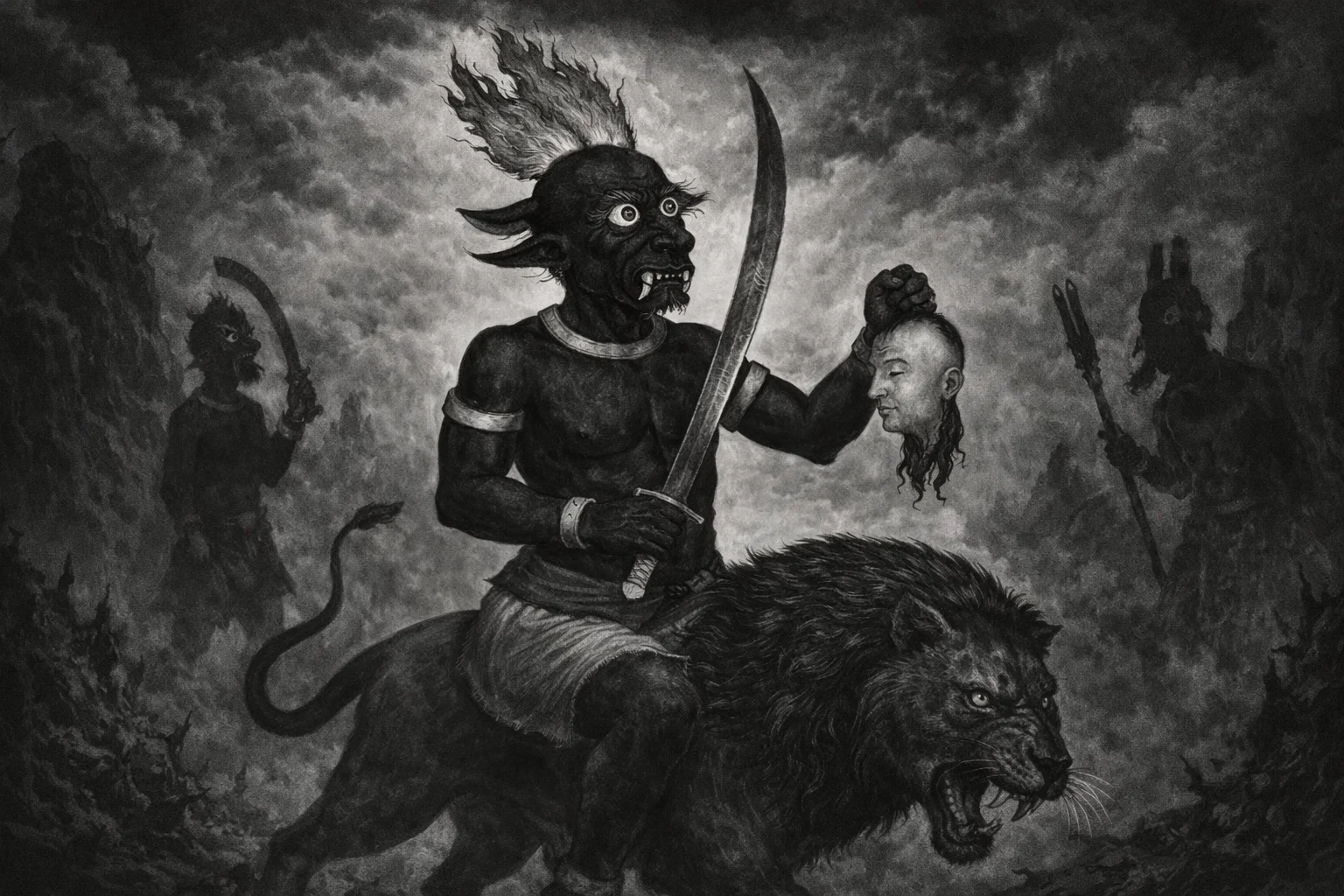
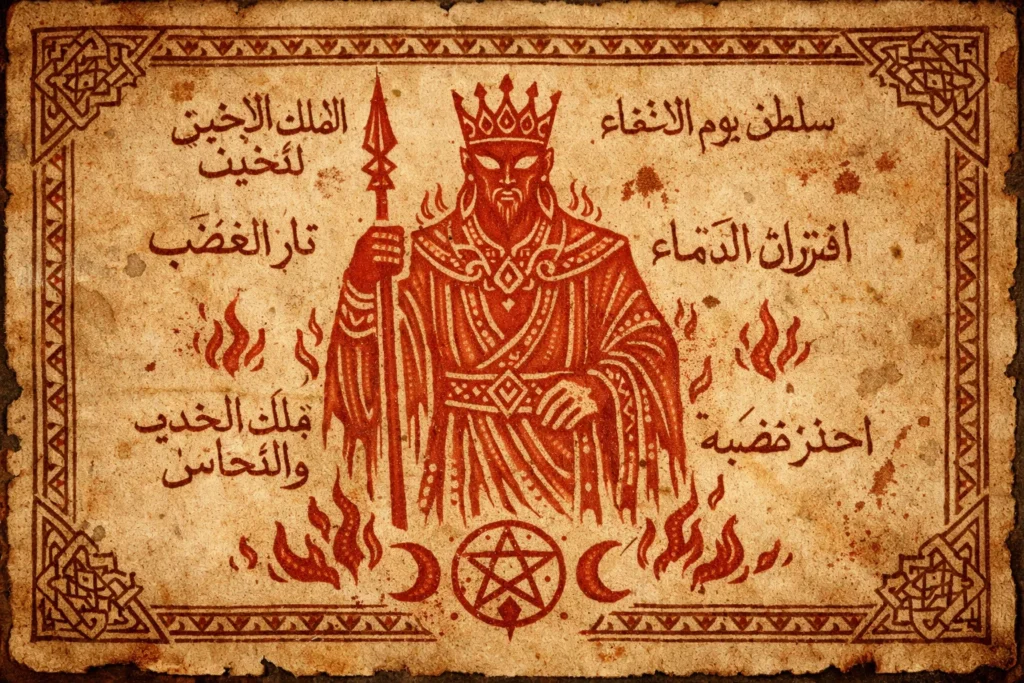
Books such as the Kitab al-Bulhan (Book of Surprises) also describe Al-Ahmar. He is usually shown as a tall, powerful warrior-king. His skin is a bright, deep red, like scorched earth or blood. He often wears red clothes or armor made of shiny copper and iron.
In many old stories, he rides a lion or a red horse, showing his warrior side and control over wild animals. He is almost always shown with weapons like a long spear, a scimitar, or a double-edged sword. His eyes are often said to glow like embers, and some stories even give him extra heads or limbs to show his great power. Still, he looks human, unlike the more monstrous ghul or the shapeless si’lat.
You may also enjoy:
Ancient Demons: The Real Origins of the Setcheh Myth
November 11, 2025
Who Was Abezethibou, the Fallen Angel Who Opposed Moses?
October 1, 2025
Edimmu: The Mesopotamian Wind Demon That Steals Life
November 6, 2025
Mahabali (Bali): The Benevolent Asura King
October 10, 2025
What Is Akaname, The Filth-Licking Yōkai?
October 28, 2025
Who Is Futakuchi-onna, the Two-Mouthed Woman?
March 9, 2026
Origins
Al-Ahmar’s story begins with pre-Islamic Arabian ideas about Jinn, which medieval Islamic scholars later organized. He is not named in the Quran, but comes from a mix of Hellenistic astrology and Arabian spirit stories. During the Islamic Golden Age, researchers matched the seven ancient planets with local Jinn beliefs, creating the Seven Jinn Kings.
He came to represent the powers of Mars. Jinn were thought to be made from “smokeless fire” long before Adam, but the idea of the “Red King” became clear in the works of writers like Ahmad al-Buni.
According to tradition, he was given control over Tuesday and the earth’s metals at the start of the current world cycle. His family line is often linked to the Banu al-Amir, a strong tribe of Jinn known for their independence and fierce nature.
Blood, Iron, and the Institutionalization of Violence
The shift from viewing Al-Ahmar as a vague desert spirit to a formal “King of Tuesday” reflects medieval thinkers’ efforts to connect Greek science with Semitic beliefs about spirits. By linking the Red King to Mars, 13th and 14th-century occultists were building a system to explain the rightful use of force.
In al-Buni’s writings, Al-Ahmar acts as a heavenly ruler who turns potential energy into action, especially through iron. This means the Red King symbolizes the state’s control over violence, ruling over weapons such as swords and armor that defined the borders of both Islamic and Crusader empires.
Historically, the Red King became more important during the Mamluk period, a military group shaped by life in the barracks and by working with metal. Al-Ahmar stands for the “Taming of the Flame,” where the wild fire of the Jinn is controlled by the cold iron of Mars.
This shows a change in medieval Arabic thinking: the desert came to be seen not just as a place of wild spirits, but as a battlefield with rules and set times. The Red King became the model of a professional soldier, different from the wild ghul because he follows the “Great Name” and works within a strict court system.
The focus on the “Red Tribe” (Banu al-Ahmar) also connects to the medical ideas of the time. In Galenic medicine, which influenced Islamic scholars, the sanguine type was linked to heat, moisture, and the color red. By calling Al-Ahmar the cause of “uncontrollable bleeding,” writers were giving a spiritual reason for certain illnesses.
The Red King is seen as the “Sovereign of Excess.” He does more than cause pain; he makes the body’s boundaries, like skin and veins, break down, just as war can make a nation’s borders bleed. This makes him a symbol of self-control, showing how inner energy can turn from life-giving to destructive.
Historical & Folkloric Records of Al-Ahmar
Al-Ahmar is not mentioned in the Quran, but his story begins in medieval Arabic grimoires and books on the cosmos.
“The third is the King of Tuesday, and his name is Al-Ahmar. He is the servant of Mars (Al-Mirrikh). His color is red, and his metal is iron. He is the one who causes bleeding and fevers, and he is a mighty king among the Jinn of the earth.” [Ahmad al-Buni, Shams al-Ma’arif al-Kubra (The Sun of Great Gnosis), 13th Century]
Al-Buni’s 13th-century work marks a key step in the study of planetary Jinn. In his writings, Al-Ahmar is clearly linked to Neoplatonic and Hermetic ideas that became popular in Islamic occultism. By connecting him to Mars, the text changes the view of Jinn from wild desert spirits to organized cosmic beings.
At that time, scholars tried to organize the spirit world into a system like the heavens. Al-Buni’s focus on iron and blood both explains illnesses like bleeding. It gives a “scientific” reason for the spirit’s power through Mars.
“The King of Tuesday: Al-Ahmar. He is depicted as a red man, riding a lion, holding a sword in his hand, and he is the one who rules over the day of Tuesday and its hours.” [Abd al-Hasan al-Isfahani, Kitab al-Bulhan (Book of Surprises), late 14th Century]
The Kitab al-Bulhan marks an important change, moving from al-Buni’s practical descriptions to a more vivid, warrior-like image. Showing Al-Ahmar with a lion and a sword fits the “King” image of the time and reflects the Mamluk military society. Here, he is not just a cause of fever but a true ruler.
The main difference here is in how he is pictured. Earlier texts describe the “Red One” as a vague spirit of heat, but by the 14th century, he has a clear form that could be shown in talismans. Giving him a human shape let people treat him as a leader or peer, not just a force of nature.
“They say that Al-Ahmar is the master of the Red Jinn, and they are the most rebellious of the tribes. They dwell in the high mountains and the scorching deserts, and they do not submit easily to the conjurations of the sages unless the Great Name is used.” [Traditional Levantine Folklore recorded in Kitab Qissat al-Jinn (Tales of the Jinn), 17th-18th Century manuscripts]
This later source shows the rebellious side of the “Red Tribe” (Banu al-Ahmar). Unlike earlier books that show the King as a predictable servant of the planets, Ottoman-era folklore focuses on his independence and unpredictability. He is seen as the leader of a special tribe of Jinn, reflecting the tribal politics of the Middle East.
The change to calling him “Master of the Red Jinn” (Sahib al-Jinn al-Ahmar) moves away from the formal titles like “President” or “King” and gives him a more clan-based identity. This shows how, over time, Al-Ahmar became part of everyday stories, moving from scholarly books to popular folklore, where people both feared and respected him.
Powers and Abilities
In the spirit world, Al-Ahmar ranks much higher than ordinary Jinn or shaitan. He is like a regent, with power akin to that of a general or a minor god. While regular spirits might cause small illnesses or bad luck, Al-Ahmar can affect armies and the health of whole communities.
- Hematological Control: He can manipulate blood, often cited as the cause of uncontrollable nosebleeds, hemorrhages, and menstrual disorders.
- Thermal Manipulation: He can raise humans’ body temperature, inducing localized inflammation or high fevers that are resistant to traditional medicine.
- Martial Influence: He governs the impulse toward violence and can incite “bloodlust” or sudden, irrational anger in individuals.
- Geological Authority: As a lord of the subterranean, he controls the “red metals,” specifically iron and copper, and can reveal or hide veins of these ores.
- Legion Command: He has the power to dispatch thousands of lesser red Jinn to carry out specific tasks across the globe simultaneously.
Influence on Humans and Possession
The Red King’s presence is usually obvious. When he or his followers influence someone, it often causes intense heat and red skin. People affected may become very aggressive, shout, or want to hit others.
Unlike other Jinn who might make someone feel sad and weak, Al-Ahmar’s influence is sudden and physical. People may notice a metallic taste in their mouth or red rashes shaped like symbols. In communities, his presence is often blamed for sudden fights and the loss of peace.
Protection and Exorcism Methods
Traditional ways to protect against Al-Ahmar focus on using colors and elements that oppose him. Because he is the “Red King,” the color green, which stands for nature, life, and the Prophet, is thought to keep him away.
- Botanical Deterrents: Herbs that are “cool” in nature, such as coriander or sandalwood, were historically used in fumigations to drive away the heat of his presence.
- Metals: While he governs iron, he is said to be repelled by pure silver, which is associated with the Moon, a cooling celestial body.
- Talismans: Practitioners would often engrave a heptagram on a lead or silver plate to specifically invoke the name of the Archangel Samsama’il, who is believed to be the only celestial authority capable of restraining him.
- Spiritual Recitation: The use of Ayat al-Kursi (The Throne Verse) is the most common Islamic remedy, believed to create an impenetrable barrier against any Jinn king.
You may also enjoy:
Who Is Agares, the Demon of Earthquakes and Deception?
October 13, 2025
Who Is Al-Abyad? The White King Jinn Who Rules Love and Chaos
January 26, 2026
Jikininki: The Japanese Ghost That Feeds on Human Corpses
February 9, 2026
Abura-akago: The Bizarre Oil-Licking Yōkai
October 22, 2025
Al-Ahmar Myths, Legends, and Stories
The Submission of the Red King to Solomon
In the cycle of legends surrounding Prophet Sulayman (Solomon), it is recounted that the King of the Red Jinn was among the most difficult spirits to bring under the royal seal.
According to these accounts, when Solomon summoned the kings of the seven days to pledge their loyalty to the divine cause, the Red King initially resisted, citing his allegiance to the fiery stars. He appeared before Solomon’s throne riding a lion, surrounded by a whirlwind of sand and fire.
Solomon, empowered by the Great Name of God, commanded the wind to be still and the lion to kneel. Seeing that the Prophet’s authority was backed by the Creator of the Heavens, the Red King dismounted and offered his service.
He was then tasked with overseeing the mining of copper and iron for the construction of the Temple in Jerusalem. He provided laborers from his tribe who could withstand the intense heat of the forges, marking a period in which his destructive power was channeled into holy architecture.
The Duel of the Red and White Kings
A common theme in Middle Eastern folklore involves the perpetual struggle between Al-Ahmar and Al-Abyad (The White King, ruler of Friday). This myth functions as a cosmological explanation for the balance of the world. While the Red King represents war, heat, and destruction, the White King represents peace, coolness, and devotion.
In one legend, the two kings met at the “edge of the world” to decide who would rule the hearts of men. The Red King struck the earth with his spear, causing volcanoes to erupt and blood to flow. The White King responded by chanting prayers that turned the lava into stone and the blood into water.
The battle lasted for a thousand years until it was decreed by the heavens that they must share the week, ensuring that humanity experiences both the trials of conflict and the blessings of rest.
Al-Ahmar vs Other Jinn
| Jinn Name | Associated Traits/Influence | Rank/Origin | Key Traits/Powers |
| Al-Mudhib | Greed and Solar power | King of Sunday | Commands gold and light |
| Murrah | Sorrow and Lunar cycles | King of Monday | Governs secrets and the tides |
| Barqan | Intellect and Speed | King of Wednesday | Associated with Mercury and magic |
| Shamhurush | Justice and Law | King of Thursday | Great judge of the jinn; Jupiter |
| Al-Abyad | Devotion and Beauty | King of Friday | Ruler of the White Tribe; Venus |
| Maymun | Endurance and Time | King of Saturday | Associated with Saturn and lead |
| Zoba’ah | Storms and Chaos | Egyptian Folklore | Creates whirlwinds and dust storms |
| Dasim | Domestic Strife | Son of Iblis | Causes arguments between spouses |
| Awar | Lust and Blindness | Son of Iblis | Incites sexual misconduct |
| Haffaf | Alcohol and Intoxication | Shaytan | Found in taverns and places of vice |
| Zalambur | Dishonesty in Trade | Market Demon | Influences fraudulent business |
| Ifrit | Pride and Strength | Class of Jinn | Immense physical power; fire-based |
| Marid | Arrogance and Water | Class of Jinn | Most powerful class; sea dwellers |
Position Among Jinn
Within the complex social strata of the unseen world, this entity has a position of high aristocracy. He is one of the Seven Kings of the Earth, a group that forms a council governing the terrestrial affairs of the Jinn.
His relationship with other kings is one of competitive equilibrium. He is frequently associated with Shamhurush, the judge, as the two represent the “Sword” and the “Scale” of Jinn society. While Shamhurush provides the law, the Red King is the one who enforces the “sentence” through physical force.
He is the undisputed leader of the Banu al-Ahmar (The Sons of the Red). This tribe is unique because it is composed of spirits that are not necessarily demonic (shayatin) but are often neutral or “heavy” spirits. They do not follow Iblis in his rebellion against God; instead, they serve as a martial caste that adheres to the laws of the universe, albeit with a tendency toward severity.
His palace is said to be located in a region where the earth itself is red, possibly a metaphorical reference to the iron-rich deserts or the subterranean depths near volcanic vents.
Mystical Correspondences
| Attribute | Details |
| Planet | Mars (Al-Mirrikh) |
| Zodiac Sign | Aries and Scorpio |
| Element | Fire (and occasionally dry Earth) |
| Direction | South or West (depending on the rite) |
| Color | Scarlet, Crimson, Deep Red |
| Number | 3 (or occasionally 9) |
| Crystal/Mineral | Ruby, Garnet, Red Agate |
| Metal | Iron and Copper |
| Herb/Plant | Garlic, Mustard, Nettles |
| Animal | Lion, Horse, Falcon |
The Red King’s mystical links show his warlike and unpredictable side. He is connected to Mars and the zodiac signs Aries and Scorpio, which highlight his strong energy and hidden power.
Aries stands for his open aggression, while Scorpio shows his deeper, secret influence over blood and the mind. In medieval occultism, these connections helped people decide when his power was strongest on Tuesdays, usually in the first and eighth hours.
His link to fire is not like a small candle flame, but more like the intense heat of a forge. That’s why iron is his main metal—it comes from fire and is used in war, just like his role as an enforcer. Rubies are used in talismans to channel his energy, and the number 3 shows his place as the third king in the weekly cycle.
You may also enjoy:
Who Was Ravana in Hindu Mythology and Why Was He Feared?
October 3, 2025
Who Is Arioch, the Demon of War and Vengeance?
January 21, 2026
Palis: The Foot-Licking Desert Jinn That Drinks Your Blood
December 3, 2025
Mahabali (Bali): The Benevolent Asura King
October 10, 2025
Who Is Al-Abyad? The White King Jinn Who Rules Love and Chaos
January 26, 2026
Bibliography
Author’s Note: While putting together this article, I noticed a puzzling difference between the organized planetary system in the Kitab al-Bulhan and the more unpredictable psychological traits found in modern studies, such as those by Volkan. It was interesting to see how medieval writers focused on outward signs, such as bleeding. At the same time, modern research examines inner feelings such as bloodlust and aggression. To keep Al-Ahmar’s image as the “Sovereign of Excess” accurate, I relied mainly on primary Arabic sources, balancing old art with oral traditions.
- Abu Ma’shar al-Balkhi. Kitab al-Bulhan (Book of Wonders). Bodleian Library, MS. Bodl. Or. 133, late 14th century. Internet Archive.
- al-Mas‘ūdī, ‘Alī ibn al-Ḥusayn. Historical Encyclopaedia: Entitled “Meadows of Gold and Mines of Gems”. Translated by Aloys Sprenger, Oriental Translation Fund of Great Britain and Ireland, 1841. Internet Archive.
- al-Ṭabarī, Abū Jaʿfar Muḥammad ibn Jarīr. The History of al-Ṭabarī, Vol. 39: Biographies of the Prophet’s Companions and Their Successors. Translated by Ella Landau-Tasseron, State University of New York Press, 1998. Internet Archive.
- M. A. S. Abdel Haleem (translator). The Qur’an: English Translation and Parallel Arabic Text. Oxford University Press, 2004. Quran Project Edition.
- Meri, Josef W. (editor). Medieval Islamic Civilization: An Encyclopedia. Routledge, 2006. Internet Archive.
- Volkan, Prof. Kevin. The Jinn: Islam, Exorcism, and Psychology. Journal of Social and Political Sciences, vol. 6, no. 3, Asian Institute of Research, 2023, pp. 1–14. Academia.edu.
- Saif, Liana. Amulets, Magic, and Talismans. Blackwell’s Companion to Islamic Art and Architecture, Wiley, 2017.