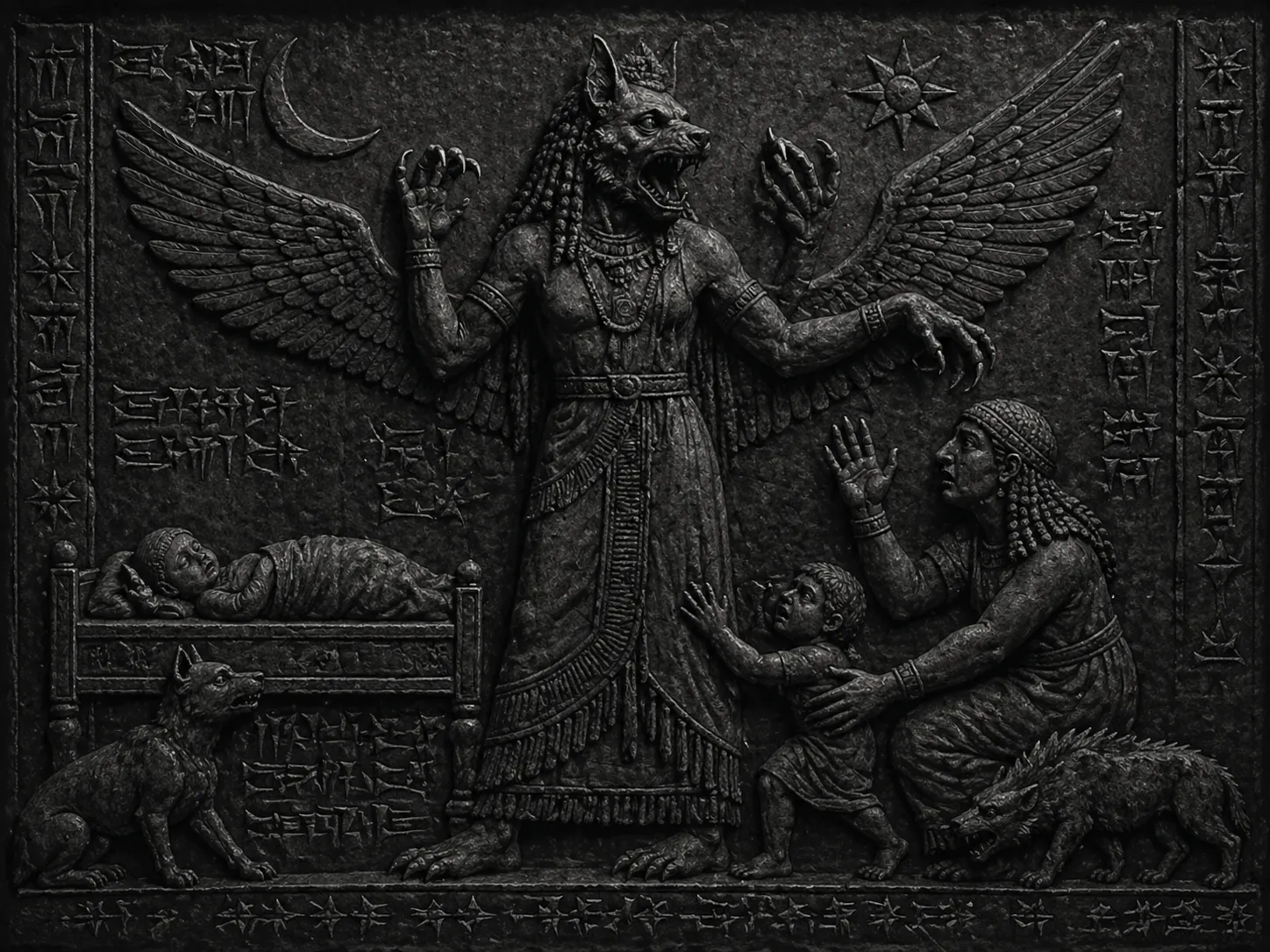
Most Mesopotamian spirits were seen as agents of divine punishment or chaotic natural forces. However, Lamashtu embodied the particular fear of reproductive failure.
Unlike Pazuzu, who represented the destructive south wind, this entity was seen as a direct threat to family lines. She is remarkable in demonology because she was not just a servant of the gods, but a rebellious celestial daughter. Her exile to the human world made her the household’s main enemy.
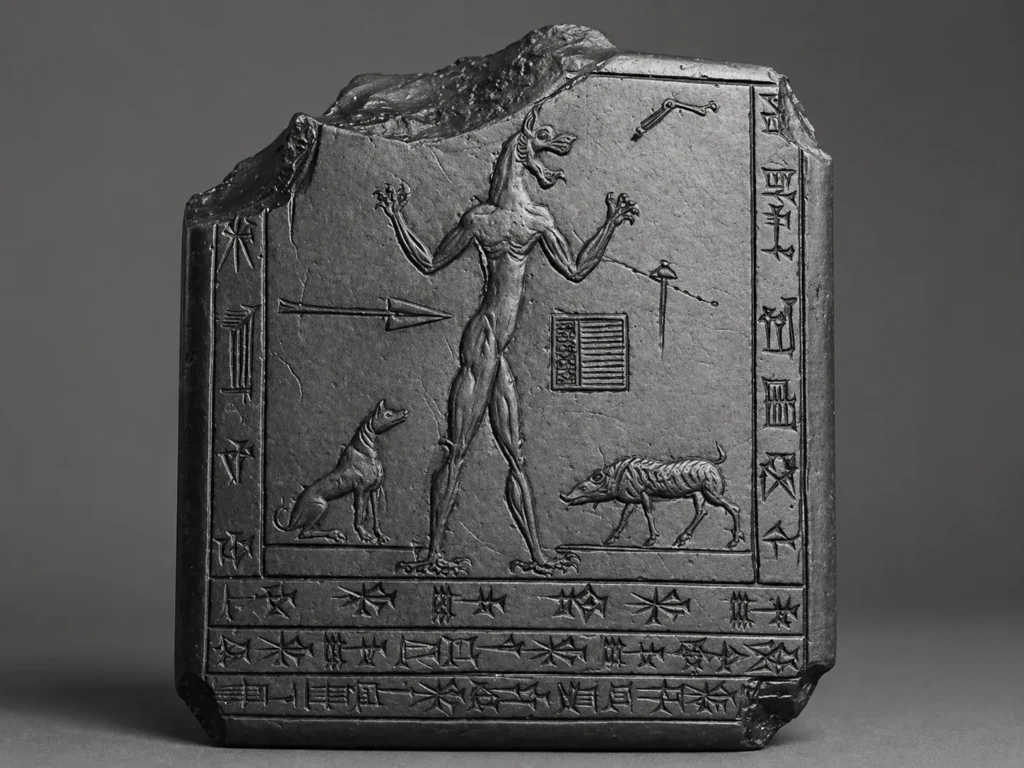
For accuracy, my research focuses on the Old Babylonian Tablet AO 6472 instead of modern occult sources. This approach helps preserve the original Mesopotamian concerns that shaped the story of this entity. [View Full Bibliography ↓]
Summary
Key Takeaways
| Attribute | Details |
| Names | Lamashtu, Dimme, Labartu |
| Title | Daughter of Anu, The One Who Seizes, Seven-Named One |
| Origin | Sumerian and Akkadian Mesopotamia, c. 3rd Millennium BCE |
| Gender | Female |
| Genealogy | Daughter of the sky god Anu; lacks a husband or traditional offspring |
| Role | Slayer of infants, bringer of puerperal fever, and consumer of flesh |
| Associated Deity | Anu (father/exiler), Enlil (witness), Pazuzu (rival and protector against her) |
| Brings | Infant mortality, miscarriage, postpartum infection, and nightmares |
| Weaknesses | Amulets depicting her rival Pazuzu, specific incantations, and black dog sacrifices |
| Realm/Domain | The mountains, the reed-thicket, and the underworld |
| Weapon/Item | Double-headed serpents, a spindle, and a comb |
| Symbolism | The fragility of life, the danger of childbirth, and the ‘unnatural’ mother |
| Sources | The Lamashtu Series (standard Babylonian incantations), various Sumerian tablets |
Who or What is Lamashtu?
Lamashtu is a powerful demon in the Mesopotamian pantheon and is known as the daughter of Anu, the sky god. Unlike the Utukku or Edimmu, who were usually ghosts, she was a divine being cast out of Heaven for demanding human flesh. Her story gave ancient people a way to explain high infant mortality and childbirth complications.
In ancient Babylon and Assyria, she was seen as the opposite of a nurturing mother. People believed she did not just cause illness by being nearby, but actually entered the rooms of pregnant women to touch their bellies or take newborns from their nurses.
Sudden fevers and unexplained sickness in children were signs of her presence, making her the most feared threat to families in the region for over two thousand years.
“Lamashtu” Meaning
Her name comes from the Akkadian language, but earlier Sumerians called her Dimme.
Researchers are not sure of the exact origin, but it is often connected to words meaning “that which erases” or “she who seizes.” The transition from Dimme to her Akkadian name shows how she became a more defined entity with her own story.
In cuneiform texts, she is often called the “Daughter of Anu.” This title highlights her high status and explains why she had powers that lesser spirits did not.
Some late Babylonian texts link Lamashtu’s name to the number seven, calling her “Seven-Names.” This probably refers to her appearing in seven forms or causing seven types of harm. Her name became so closely tied to reproductive problems that it was used to describe certain medical conditions in ancient texts.
How to Pronounce “Lamashtu” in English
In English, her name is usually pronounced lah-MAH-sh-too, with the stress on the second syllable. The “sh” sound matches the Akkadian “š,” and the last “u” is long, like in “blue.” Academics often use a short “a” in the first syllable, as in “father.”
You may also enjoy:
Aim (Aym): The Great Duke of Hell in the Ars Goetia
November 11, 2025
Who Is Baal in Christian Demonology?
February 25, 2026
Who Is the Jann in Islamic Mythology and Why Is He Feared?
October 2, 2025
Who Is Adrammelech in Demonology and the Bible?
October 1, 2025
Bakeneko: A Supernatural Cat Yōkai in Japanese Folklore
January 27, 2026
What Were Lamashtu’s Seven Names?
The focus on the number seven is central to her identity. Lamashtu is often called the “Seven-named Daughter of Anu,” is title that goes beyond mere poetic convention. I think these seven names acted as a ritual tool to cover all the ways she could cause harm.
By listing all seven names, the Āšipu, or exorcist, ensured that every aspect of her power was addressed and nothing was left out of the banishing ritual.
The names, as reconstructed from cuneiform tablets, are as follows:
- Lamashtu: The primary name, likely functioning as the “proper” identifier for her celestial origin.
- Barbarat: Translated as “The Female Wolf.” In my research, I’ve noted that this name highlight her role as a scavenger who waits at the edge of the camp (or the home) to pick off the most vulnerable members of the “flock.”
- Pašittu: Meaning “The Eraser” or “The Annihilator.” This is perhaps the most chilling epithet; it suggests a power that does not just kill, but removes the child from the record of existence, effectively “erasing” the family’s future.
- Mutaššila: Often associated with “The One Who Paralyzes” or causes wasting. My analysis suggests this refers to the physical state of infants suffering from dehydration or severe lethargy due to infection.
- Kušu: A name linked to crabs or aquatic creatures. This likely refers to her “seizing” or “pinching” grip, a physical metaphor for the sharp pains of labor or the sudden onset of internal cramps.
- Sursurbu: An obscure name often interpreted as “The Greatly Foul One.” It reflects the ancient view of disease as a form of spiritual and physical filth that “infects” the ritual purity of the home.
- Saggas: Meaning “The Murderess” or “The Smiter.” This final name strips away all euphemism, identifying her as a direct agent of lethal violence.
I find it interesting that these names move from animal (Wolf) to action (Eraser) to crime (Murderess). This pattern may have helped ancient healers diagnose the kind of harm at hand. By saying the names in order, the healer could focus on the specific problem the patient faced.
Origins of the Daughter of Anu
Lamashtu first appeared in the third millennium BCE and is clearly mentioned in Old Babylonian records from around 1894 to 1595 BCE. Unlike many lesser spirits that came from local stories, she was described early on as a complete and powerful enemy.
Her story is closely linked to the Mesopotamian gods, as she is the daughter of Anu, the sky god. She ended up on Earth because of a crisis among the gods.
In the Lamashtu Series (a standardized collection of incantations), it is documented that because of her “evil heart” and her demand to consume the “flesh and blood” of newborns, Anu cast her down from the heavens. This “fall” was not an act of demonic rebellion in the modern sense, but a divine eviction to protect the sanctity of the upper realms from her unsanctioned hunger.
In the Middle and Neo-Assyrian periods (about 1365–609 BCE), her story grew as she became part of the detailed demonology that explained the mysterious dangers found at home.
Texts show she was known first as Dimme in the Sumerian tradition, already linked to breaking family lines. By the time of the Library of Ashurbanipal, her story was a key part of Mesopotamian beliefs. People said she came to the human world from the eastern mountains, which were seen as a wild area between cities and chaos.
Lamashtu first appeared in art and literature during a period when cities like Babylon and Ur were growing rapidly. Crowded living conditions likely caused more infant deaths from disease, so people needed a religious explanation for these losses.
Genealogy
Lamashtu’s family background is marked by isolation. Even though she is the daughter of the chief god, she is an outcast among her own kind. She has no partner, and her motherly instincts are twisted; she is often shown nursing animals like dogs and pigs, while she harms human children.
| Relationship | Details |
| Parents | Anu (Sky God) |
| Siblings | The Anunnaki (Inanna/Ishtar, Enki, etc.), though she is estranged from them |
What Does Lamashtu Look Like?
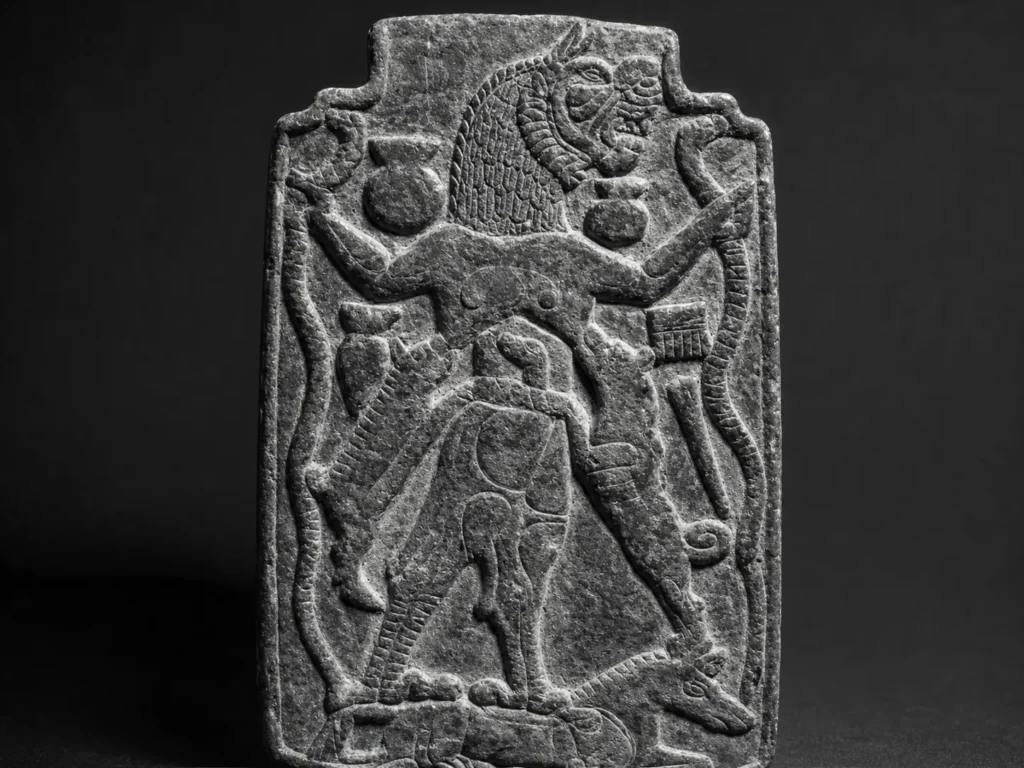
Descriptions and amulets show Lamashtu as a mix of different animals, meant to represent a break from the natural order. She usually has a lion’s head for strength and fierceness, a donkey’s body for wildness and endurance, eagle talons for grabbing prey, and long, sharp teeth.
Art often shows her kneeling on a donkey and holding snakes. For ancient people, the donkey was the animal Lamashtu rode into the human world, and the snakes showed her link to the underworld and deadly poison.
Quick note: Many reliefs highlight her hanging breasts, not as a sexual feature, but as a disturbing twist on motherhood. She is often shown nursing a pig and a dog, which suggests she favors street animals over human children.
Connections to Other Ancient Demons
| Name | Genealogy | Type | Appearance |
| Pazuzu | Babylonian | Wind Demon | Humanoid, lion/dog face, four wings, bird talons, scorpion tail. |
| Lilitu | Sumerian | Storm Spirit | Winged female with owl feet. |
| Alû | Akkadian | Nightmare Demon | Often faceless, limbless, or dog-like spirit. |
| Gallu | Sumerian | Underworld Constable | Humanoid bull-like spirits. |
| Abyzou | Byzantine/Near East | Infant Slayer | Often depicted with snake-like lower body or long hair. |
| Keres | Greek | Death Fates | Dark-winged creatures with gnashing teeth and sharp claws. |
| Gello | Greek | Child-stealing Ghost | Pale, female specter. |
| Lamia | Greek | Child-devouring Monster | Woman with a serpentine lower body. |
| Asag | Sumerian | Disease Demon | Hideous creature that causes rivers to boil. |
| Empusa | Greek | Shape-shifting Spirit | One leg of bronze, one of a donkey. |
| Mormo | Greek | Nursery Bogeyman | Varies, often a female spirit of the night. |
Lamashtu Myths, Legends, and Stories
The Descent and the Forbidden Petition
At first, Lamashtu lived high in the heavens as Anu’s favored daughter. But she developed a forbidden desire. She went to her father’s throne and made a request that shocked the gods. Instead of asking for a city or a temple, she wanted permission to eat the flesh of the black-headed people. She saw humans not as worshippers, but as prey.
“Grant me the children of the cities,” she demanded. “Let me touch the bellies of those in labor; let me snatch the fruit from the womb.”
Anu, recoiling at the perversion of her divine nature, issued a decree of permanent banishment. “Because your heart is wicked,” the sky god thundered, “you shall have no place among your brothers. You shall have no husband to comfort you, and no child of your own to nurse. You are cast down to the waste-places, the reed-thickets, and the mountains.”
He cast her out of the heavens, and she fell to Earth as an outcast. Denied a family of her own, she swore to bring ruin to the families of humans.
The Infiltration of the Bedchamber
The story of Lamashtu’s arrival in the city is one of stealth and crossing boundaries. In the dead of night, she comes down from the eastern mountains and heads for the city walls. She does not use the gates like a visitor. Instead, she moves like a shadow, slipping through cracks in doors and windows, until she reaches the bed of a woman in labor.
She offers no comfort, only whispers of fever. She reaches out her “yellowed, long-nailed hands” and touches the woman’s belly seven times, each touch bringing a new curse.
The story describes her actions: “She pulls out the child of the pregnant woman; she snatches the infant from the arms of the nurse.” Lamashtu then escapes to the marshes, taking her prize to her “unclean” home. There, she nurses wild animals instead of human children, leaving the family in deep mourning.
The Conflict with the Lord of the South Wind
While she was the main threat to children, another story tells of her conflict with Pazuzu, Hanbi’s son. In this tale, the two chaotic forces meet at the entrance of a house. Pazuzu, who represents the hot and destructive south wind, finds her trying to enter a home guarded by his image.
Their exchange shows they recognize each other as old rivals. “Why do you come to this house?” the wind-demon shouts, his four wings stirring up desert heat. “The daughter of Anu has no rights here.” She replies with a snarl, “I am the one who seizes; I am the one who erases.”
The story ends in a standoff: although Pazuzu brings drought and disease, Lamashtu fiercely resists him. He grabs her by her lion’s mane and throws her back toward the underworld, making her flee to the “mountains of stone.”
This legend explains why people used one demon to drive out another; only something as frightening as the south wind could stop the “Seven-Named Murderess.”
You may also enjoy:
Who Is Asmodeus in Demonology and the Bible?
February 18, 2026
Iblis, the Jinn King of Darkness and Deception
September 29, 2025
Agubanba: The Blind Yōkai That Preys on Young Women
October 23, 2025
What Is a Dīv? The Terrifying Giant Demon of Persian Myth
January 22, 2026
Who Is Abaddon, the Demon of the Abyss, in the Bible?
September 29, 2025
Powers and Abilities
She is seen as one of the most powerful beings in Mesopotamian folklore because even the gods cannot easily control her. Her power is mostly biological and environmental.
She can slip through cracks in doors and windows, getting past barriers that would stop a person. Her touch alone can cause wasting diseases with her “yellowed” fingers.
- Infant Seizure: The ability to spiritually or physically “snatch” the life force of a newborn, leading to sudden death.
- Contagion: She can induce lethal fevers in women during or after labor.
- Nightmares: She haunts the sleep of pregnant women, causing psychological distress that was believed to harm the fetus.
- Blight: Her presence can dry up water sources and cause vegetation to wither in the immediate vicinity of her target.
- Animal Command: Often associated with controlling “unclean” animals like dogs and pigs to act as her scouts.
The “Unnatural” Mother
In my research into cuneiform texts, I found something unusual about how the Mesopotamians saw this being. Most demons were seen as “mechanical” agents of the gods, harming people only when a god was offended. But this creature was treated as an independent goddess.
When I looked at the cuneiform sign dingir (d) that appears before her name in texts like the Lamashtu Series, it showed she was not just a monster but a divine being with her own will. This independence made her especially frightening to ancient people. Lamashtu did not punish the guilty, but acted out of pure malice, becoming a predator who had “gone rogue” from the gods.
I find the images on her protective plaques especially interesting, particularly how she is shown with domestic animals. Most descriptions mention her lion’s head and donkey’s teeth. Still, I think the most important detail is how Lamashtu is shown nursing a piglet and a puppy at her breasts.
In the ancient Near East, these animals were seen as “unclean” and lived on the edges of towns. By nursing them, she was not just acting monstrous; she was turning motherhood upside down.
Lamashtu turns away from human babies—the “black-headed” children she was supposed to protect as Anu’s daughter—and instead feeds the scavenger animals of the streets. This completely reverses the Mesopotamian idea that the family was the center of society.
Also, my study of her “seven names” shows that the ancients had a complex understanding of what we now call different diseases. Old medical texts often connected her to clear symptoms, like “touching the belly” seven times to cause miscarriage, or bringing a “cold fever” to the nursery.
I think her seven names—including rare titles like Barbarat (“The Female Wolf”) and Pašittu (“The Eraser”)—were probably a way for ancient healers to remember and classify different stages of newborn illness or fever. By naming and picturing the fear of infant death, the Mesopotamians could deal with it through rituals instead of leaving it to chance.
This is why they put Lamashtu’s image on amulets. Following the idea that “like cures like,” they believed that capturing her likeness in stone or bronze would keep her away and protect their children from the “Eraser.”
Rituals, Amulets, and Protective Practices
Ancient Mesopotamians did not worship her; they tried to drive her away. Their rituals aimed to force her out of the home or offer her gifts so she would leave for the underworld or far-off mountains. These practices were formal and needed special materials to connect the physical and spiritual worlds.
Incantations and Ceremonies
The most well-known ritual used a clay figurine of the demon. The priest dressed it in tiny clothes and gave it supplies for a journey, like a leather bag, a comb, a spindle, and sandals. This act of sympathetic magic was meant to give her what she lacked as a childless, homeless being, hoping she would leave the city.
The ceremony often involved sacrificing a piglet. The piglet’s heart was put in the figurine’s mouth, symbolizing that the animal’s life was given instead of a child’s. The figurine was then sent down a river in a boat or buried near a wall to show that she was gone for good.
Akkadian Incantation An-nu-tum šip-tu: At-ti mar-at a-nim
“Great is the daughter of Heaven who tortures babies
Her hand is a net, her embrace is death
She is cruel, raging, angry, predatory
A runner, a thief, is the daughter of Heaven
She touches the bellies of women in labor
She pulls out the pregnant women’s baby
The daughter of Heaven is one of the Gods, her brothers
With no child of her own.
Her head is a lion’s head
Her body is a donkey’s body
She roars like a lion
She constantly howls like a demon-dog.”
Amulets and Talismans
To protect their families, people used amulets made of stone or bronze. One common method was the use of the Pazuzu amulet. Pazuzu, a wind demon, was her rival in myth. Even though he was also dangerous, people believed only he could send her back to the underworld. Pregnant women would wear bronze Pazuzu heads or hang plaques showing him driving her away.
These amulets were often made from hematite or steatite. Hematite, with its dark, blood-like color, was thought to protect the mother’s blood. People placed these objects at doorways and windows because they believed Lamashtu entered through the shadows. By putting her image or her rival’s at these spots, families created a spiritual barrier to show the home was protected.
Professional Practitioners
The Āšipu, an expert in exorcism and magic, carried out the rituals. The Āšipu was not an ordinary priest, but a kind of “magical doctor” who could tell if a fever was natural or caused by the “Hand of the Daughter of Anu.”
He worked with the Asû, the physician. While the Asû gave herbs, the Āšipu offered spiritual protection to keep the demon from coming back. His job was to act as a go-between, using his knowledge of the gods’ secret names to order the demon to stop.
You may also enjoy:
Who Is Shiva, the Destroyer and the Lord of the Universe?
November 12, 2025
Abura-akago: The Bizarre Oil-Licking Yōkai
October 22, 2025
Hitotsume kozō: One-Eyed Yōkai of Japanese Folklore
February 4, 2026
Who Is Andromalius, and Why Is He the Last Demon of the Goetia?
January 20, 2026
Who Was Abezethibou, the Fallen Angel Who Opposed Moses?
October 1, 2025
Bibliography
Author’s Note: I found it important to focus on the Lamashtu Series rather than on later Western occult ideas. This helped keep her original role as an independent goddess rather than just a spirit of evil. By comparing Neo-Assyrian bronze amulets with the “Seven Names” from the Library of Ashurbanipal, I could connect her mixed appearance to the medical notes of ancient doctors. This link between ritual art and cuneiform texts shows a complex belief system where the “Eraser” was more than a monster—she was a way to explain why babies were so vulnerable in ancient Mesopotamia.
- Wiggermann, F. A. M. Lamashtu, Daughter of Anu: A New Profile of the Mesopotamian Demon. 2000. Internet Archive.
- Farber, Walter. Lamaštu: An Edition of the Canonical Series of Lamaštu Incantations and Rituals and Related Texts from the Second and First Millennia B.C. Penn State University Press, 2014.
- Mark, Joshua J. Enuma Elish – The Babylonian Epic of Creation – Full Text. World History Encyclopedia, 2018.
- McGrath, William. The Diagnostic Series SA.GIG: Ancient Innovations and Adaptations. University of Toronto, 2016.
- Zulaski, Jeremie. (2022). Demon Tech Magic: Considering Lamaštu Amulets as Technical Systems. 10.13140/RG.2.2.22801.92002. ResearchGate.
- Algmati, Hamida. Women in Antiquity. Routledge, 2016. Academia.edu.
- Coulon, Jean-Charles and Korshi Dosoo, éditeurs. Magikon zōon. Institut de recherche et d’histoire des textes, 2022, https://doi.org/10.4000/books.irht.537.
- Ulanowski, Krzysztof. (2016). Ulanowski K. (2017). War Sacrifices in Mesopotamia, “ARAM” 29, 1&2, 105-117. ResearchGate.