Many demons in later Puranic stories appear as human-like kings with complicated morals. In contrast, the main enemy in the Rigveda is a more basic, elemental force. Vritra symbolizes cosmic resistance, serving as both a real and symbolic barrier that prevents the waters of life from reaching the world.
Unlike later Asuras who tried to take Indra’s throne through politics or war, this being represents a deeper struggle between chaos and the creative order of the Devas. This conflict is a core myth in Vedic creation stories, not just a fight between personalities.
This article examines the Rigveda with a focus on “Dharma,” exploring how Vritra is both a destructive force and a necessary cosmic trigger. It also compares the Mahabharata to show the differences between early Vedic myths and later Puranic beliefs. [View Full Bibliography ↓]
Summary
Key Takeaways
| Attribute | Details |
| Names | Vritra, Ahi, Encompassor, The Restrainer, Vritrasura |
| Title | First-born of Serpents, The Coverer, Lord of the Danavas |
| Gender | Male |
| Role | Cosmic obstructor, withholder of rain and rivers, personification of drought |
| Clan | Danava (Descendants of Danu) |
| Followers | Ahi-serpents, Danavas, and forces of darkness/inertia |
| Powers | Atmospheric manipulation, massive physical scale, concealment of light/water |
| Appearance | Giant serpentine or dragon-like form without feet or shoulders |
| Etymology | Derived from the Sanskrit root vṛ (to cover, to encompass, to restrain) |
| Associated Figures | Indra (arch-nemesis), Tvashtar (creator/father), Trisiras (brother) |
| Weaknesses | The Vajra (thunderbolt), foam of the sea (in later myths), Soma juice |
| Opposing Deva/Avatar | Indra |
| Pantheon | Vedic / Hindu |
| Primary Sources | Rigveda, Shatapatha Brahmana, Mahabharata, Bhagavata Purana |
Who or What is Vritra?
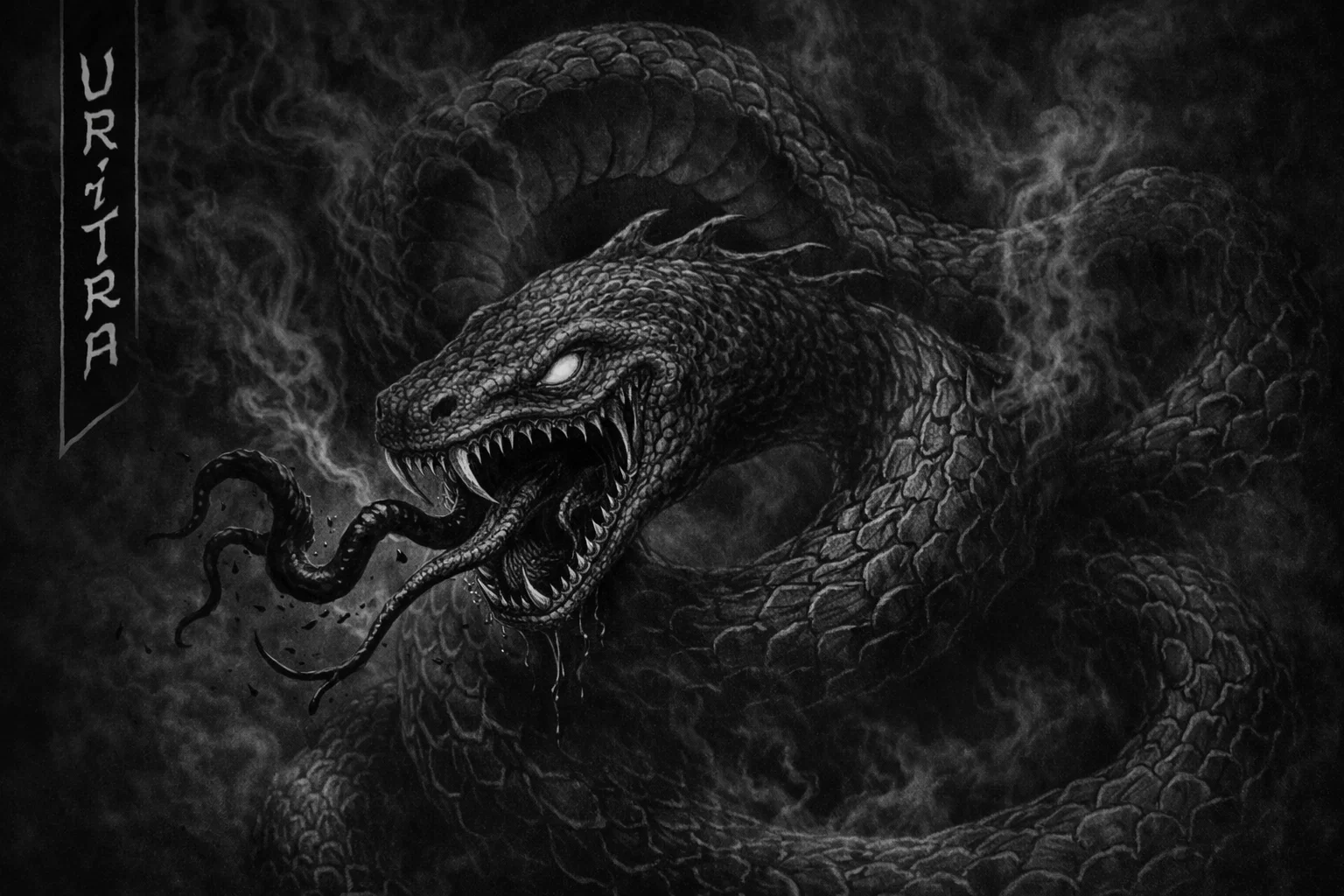
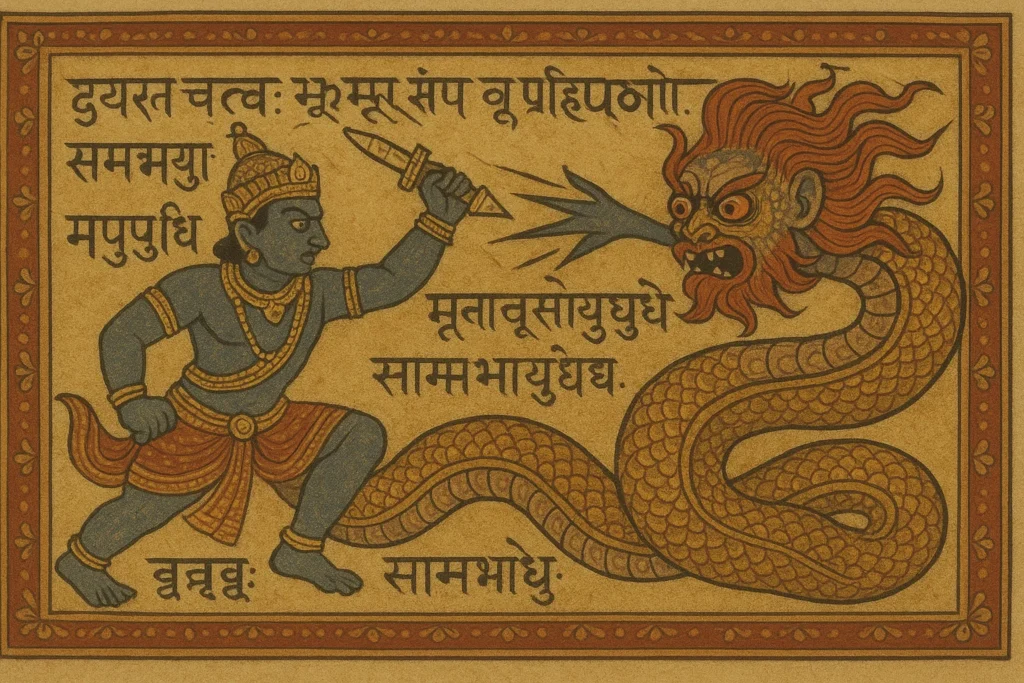
In the oldest Indo-Aryan myths, this being is called the supreme Danava, a type of creature linked to the first waters. He is usually described as a giant serpent or dragon lying across the mountains, trapping the “seven rivers.” By blocking these waters, he causes famine and darkness, stopping the natural flow of the world.
He is not just a physical danger but a symbol of deeper problems. In Vedic thought, killing the serpent lets the sun rise, rain fall, and the earth grow crops. So, this being stands for resistance and chaos that Indra must defeat to bring order to the world (Dharma).
Vritra Meaning
The name comes from the Sanskrit root vṛ, meaning “to cover,” “to surround,” or “to hold back.” This fits the being’s role in myths as the “Enveloper” who wraps around the world’s resources. In the Rigveda, the word vṛtra first meant “obstacle” or “enemy” before it became the name of this dragon-demon.
Over time, the word shifted from simply meaning “obstruction” to describing a god of drought. Language experts see links to other Indo-European ideas about still water. Some also say the name refers to covering up light, since this being’s presence is tied to hiding the sun.
In the Brahmanas and Puranas, the name stays the same, but the focus changes. The being becomes less of a weather demon and more of a symbol for the sin of killing a Brahmin (brahmahatya). Still, “The Coverer” is the main way to describe him.
How to Pronounce “Vritra” in English
The name is pronounced VRI-truh. The first part sounds like “wrist” but with a rolled ‘r’ as in Sanskrit (vṛ). The second part is a short “truh,” like at the end of “ultra.” In English phonetics, it is written as /ˈvrɪtrə/.
What Does Vritra Look Like?
The way this being looks changes a lot from early Vedic hymns to later Puranas. In the Rigveda, he is called Ahi, the serpent, and has no feet or shoulders, showing he is like a snake.
Vritra is huge, filling the space between heaven and earth and blocking the river valleys. He is often hidden in mist, darkness, and thunder, so his true form is hard to see, fitting his role as the “Enveloper.”
In later stories and art, he gains more human-like Asura features but still keeps his snake-like traits. He is shown as a huge, dark-skinned giant with fierce eyes and flaming hair.
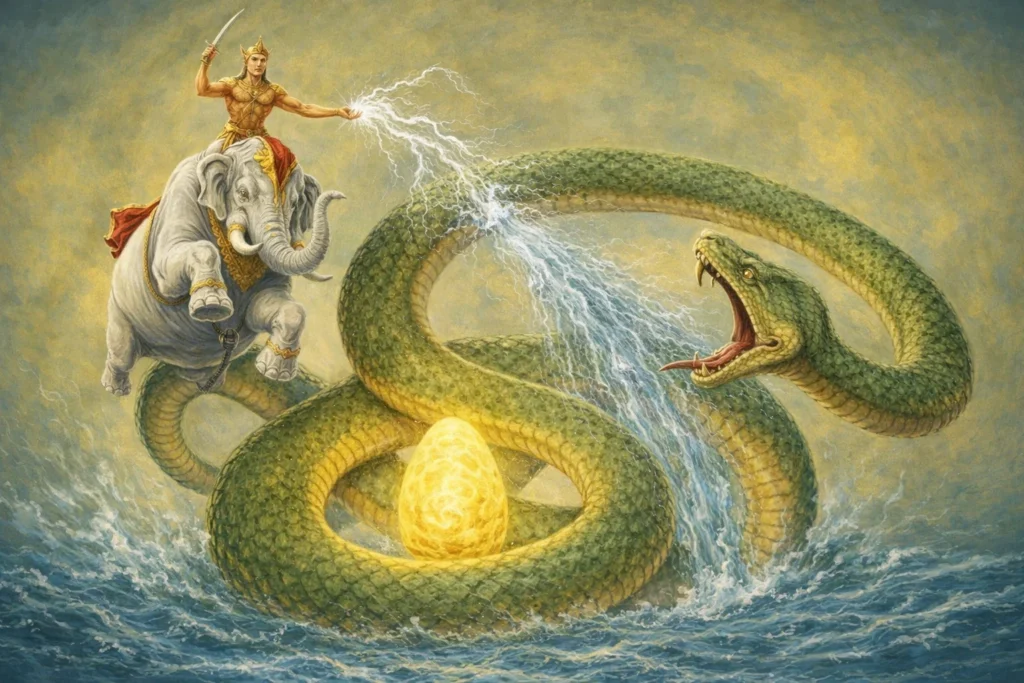
His mouth is said to be so big it could swallow the whole world, even Indra and his elephant, Airavata. Even with these human features, his main trait is his size—he is so large that his breath causes storms and his body casts a shadow over the earth.
Origins
Vritra’s story is closely tied to Tvashtar, the divine builder. After Indra killed Tvashtar’s son, Trisiras, who had three heads, Tvashtar wanted revenge. He carried out a special ritual to create a being strong enough to defeat Indra, the king of the gods.
As Hindu literature developed, this being changed from a simple force of nature in the Rigveda to a more complex and tragic figure in the Mahabharata and Puranas. In these later stories, he is often shown as a devoted follower of Vishnu, trapped in a demon’s body because of past karma. Still, he must be defeated to keep the universe going.
Birth
The Shatapatha Brahmana and the Bhagavata Purana say that this being was created through a ritual. Tvashtar, angry over his son’s death, poured offerings into the fire and said, “O enemy of Indra, flourish!” But because he put the stress on the wrong part of the word Indrashatru, the meaning changed from “one who will kill Indra” to “one who will be killed by Indra.”
A huge and frightening creature came out of the fire, growing very quickly. He was made from the fire’s power and his father’s anger. As soon as he appeared, he started to consume everything around him, growing until he reached the sun. This fast growth made him a “created” Asura, meant to destroy the order of the gods, not a naturally born one.
Family
This being’s family comes from the sun and artisan lines in Vedic myths. His father, Tvashtar, is the gods’ divine smith, which creates an odd situation where the maker of holy tools also created a great demon. His brother, Trisiras (or Vishvarupa), was a scholar whose death started the cosmic war.
| Lineage | Members |
| Parents | Tvashtar (Father); Mother is often unspecified or cited as the sacrificial fire. |
| Siblings | Trisiras (Vishvarupa) |
| Spouse | Danu (sometimes cited as mother or consort in varying traditions) |
You may also enjoy:
Edimmu: The Mesopotamian Wind Demon That Steals Life
November 6, 2025
Mahakala: The Dark Guardian Who Consumes Evil
October 16, 2025
Who Is the Demon Andras, The Great Marquis of Discord?
January 15, 2026
Gandharva: God, Spirit, or Demon?
November 13, 2025
Banasura: The Thousand-Armed Demon King
October 10, 2025
Tarakasura: The Dark Demon Who Ruled Hell on Earth
December 4, 2025
Historical & Scriptural Records
The story of the “Encompassor” shows a major change in Indo-European myths, as he goes from being a basic force of nature to a complex entity tied to tragedy and devotion in Brahmin traditions.
“I will declare the manly deeds of Indra, the first that he achieved, the Thunder-wielder. He slew the Dragon, then disclosed the waters, and cleft the channels of the mountain torrents. He slew the Dragon lying on the mountain: Tvaṣṭar fashioned for him his heavenly thunderbolt. Like lowing kine in rapid flow descending the waters glided lower to the ocean.” [Rigveda, Mandala 1, Hymn 32 (Griffith Translation), c. 1500–1200 BCE]
In these oldest Sanskrit texts, the being is simply Ahi (the serpent) or a limbless dragon. Researchers see this as a natural and practical view of the world.
At this point, he is not a “demon” in a moral way, but a symbol of drought and stillness in nature. Researchers often say the “mountain” means heavy, dry clouds that trap water.
The use of “lowing cows” to describe the rushing waters shows how important farming was to the Vedic people. Indra’s win is seen as an act of creation—breaking the “Enveloper” sets the world’s flow in motion. At this stage, the being is just a frightening barrier, without a soul or family, and the hero must overcome it for the tribe to survive.
“Then Tvaṣṭar was furious: ‘Has he indeed slain my son?’ he said. He brought Soma juice from which Indra was excluded… He said, ‘Grow thou, having Indra for thy foe.’ Thence Vritra was produced. As many steps as he (the demon) took, so far did he extend; he encompassed the whole of this (earth).” [Shatapatha Brahmana, 1.6.3.1–17 (Eggeling Translation), c. 8th–6th Century BCE]
This text shows Vritra’s change from a simple dragon to a being created by ritual. The Shatapatha Brahmana explains why the creature exists, turning the story from a natural event into a planned act of revenge by a father. The “accent error” in the mantra is important, showing a time when words and chants were seen as more powerful than physical force.
In this story, the being is a warning for priests. His rapid growth, filling the space between earth and sky, symbolizes uncontrolled taking. Unlike the Rigvedic serpent, which just sits on a mountain, this version spreads out and threatens the whole system of sacrifice (Yajna).
“Then Vritra said, ‘I cannot be slain by anything dry or wet, nor by wood, stone, or iron, nor in the day or in the night.’ … Seeing a large mass of foam in the sea, Indra thought, ‘This is neither wet nor dry, nor is it a weapon of wood or stone.’ At the hour of twilight, which was neither day nor night, he smote the head of Vritra with that foam containing the thunderbolt.” [Mahabharata, Udyoga Parva, Section X (Ganguli Translation), c. 4th Century BCE – 4th Century CE]
In the Mahabharata, this being is now equal to the gods and can only be defeated through clever rules. This story brings in the idea of the “Boon of Immunity,” which later appears with other Asuras like Ravana. The move from a simple fight to breaking a treaty shows a more complex and sometimes cynical view of divine politics and strict rules.
The “Foam” symbol is important because it stands for the “in-between” or things that don’t fit clear categories. Using twilight and sea-foam shows a mythic interest in breaking down opposites. This story highlights the time’s focus on Dharma (duty) and the tricky ethics of war, where even the king of the gods must use loopholes to win.
“O my Lord, O Supreme Personality of Godhead, will I again be able to be a servant of Your eternal servants… My mind always thinks of Your auspicious attributes, my words always chant the glories of Your activities, and my body is always engaged in Your service.” [Bhagavata Purana, Canto 6, Chapter 11, Verse 24 (Prabhupada Translation), c. 8th–10th Century CE]
In this last stage, the being’s role is completely changed. He is not just a mindless dragon or a legal problem, but a Mahabhagavata (Great Devotee). The Bhagavata Purana shows him as a wise sage stuck in a demon’s body, wishing for Indra to kill him so he can be freed (Moksha).
This story aligns with the rise of the Bhakti Movement, which valued inner devotion over outward appearance. Vritra’s scary outside is just a “mask” hiding a soul that is even more spiritual than the god who defeats him.
This is ironic: the “Encompassor” who once kept back the waters of life now has the “waters of devotion” in his heart, turning the cosmic fight into a journey back to spiritual truth.
Role in Hindu Cosmology
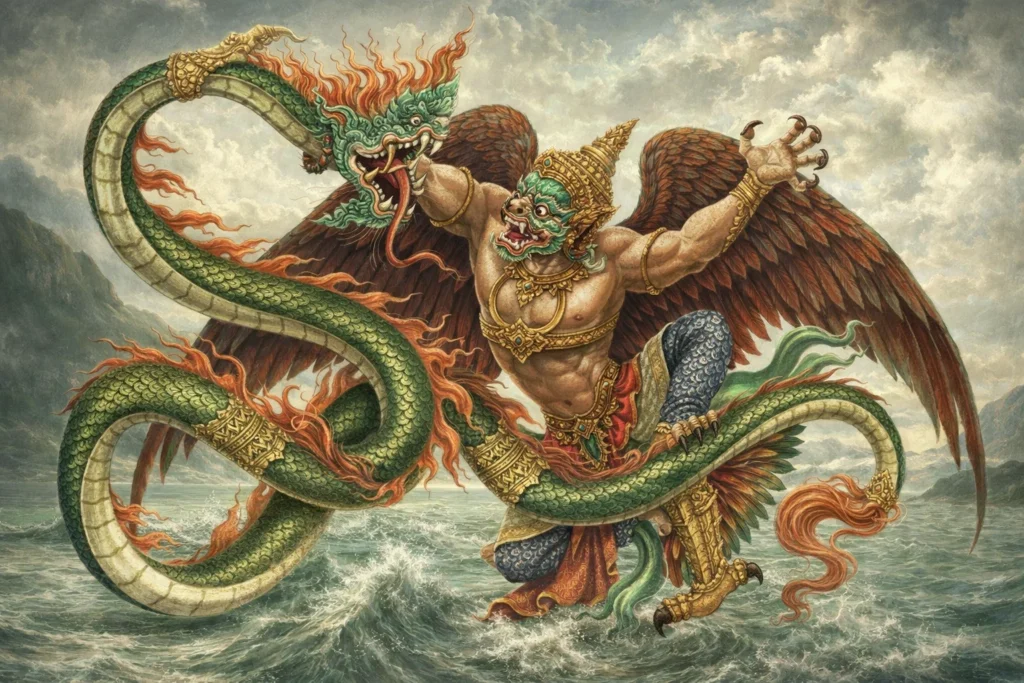
In the cycle of Dharma, Vritra stands for Pralaya (dissolution) or Stagnation. By holding back the waters, he stops time and life from moving forward. He is the “Great Obstacle” that forces the gods to step in. Without him, Indra’s role as the hero who brings order from chaos would not exist.
In the Bhagavata Purana, his role becomes more about devotion (Bhakti). Even though he looks frightening, he is shown as a wise soul who knows that being killed by Indra will set him free (Moksha).
Vritra is a “villain” because the universe needs him to be, but inside, he is focused on the Supreme Being. This shows that even the gods’ greatest enemies can become great devotees, highlighting the complex nature of karma and divine play (Lila).
The Myth of Primordial Entropy
The battle with the “Enveloper” is a Vedic metaphor for moving from stillness in nature to active life. For the Indo-Aryans, the monsoon was more than just weather—it was seen as a divine rescue.
Vritra stands for the “mountain” of winter or the “drought-serpent” before the monsoon—a real and symbolic dam. Looking at the Rigveda with modern science, killing the serpent is like breaking a climate deadlock. He is the symbol of “potential energy” that never moves, a state where all resources are stuck in one place.
In psychological terms, this being is the classic hoarder. Unlike later Asuras who want to rule, the Vedic serpent just wants to keep and hold things. He does not use the waters; he only lies on top of them.
This reflects the “Shadow” side of creativity—the part of us that collects knowledge, wealth, or feelings but does not share them. In Vedic thought, wealth and grace must flow like water to stay pure. The serpent is the “Enclosure” that causes stagnation, and breaking him with the thunderbolt is the shock that makes both people and the world open up and grow.
The link between the Sanskrit root vṛ (to cover) and European words like “Wraith” or “Covert” shows a shared worry about things that are hidden. This being is the “Great Shroud” of the world. When Indra “uncovered” the cows (waters) hidden in the cave or beneath the serpent, he revealed the world in a cosmic way.
This shows that ancient writers saw the world as a series of layers to be uncovered. The demon is not just an outside enemy, but the very “skin” of the early universe that must be broken for life to begin.
Myths, Legends, and Stories
The Imprisonment of the Seven Rivers in the Rigveda
The oldest story about this being is in the Rigveda (Mandala 1, Hymn 32). Here, the serpent wraps itself around the mountains, blocking the heavenly waters. The world is dry, and the gods cannot help. Indra, after drinking lots of Soma, picks up the thunderbolt made for him by Tvashtar.
The battle is shown as a fight between forces of nature. Indra hits the “first-born of serpents” on the back, breaking his body. As he falls, the barriers he made are destroyed.
The waters, like lowing cows, rush to the ocean. This act is said to create the sun, sky, and dawn, making Indra king of the gods. The serpent’s broken body lies under the waters he once tried to hold back, always covered by the flowing rivers.
You may also enjoy:
Who Is Arioch, the Demon of War and Vengeance?
January 21, 2026
Rāga: The Seductive Demon of Passion and Desire in Buddhist Lore
October 16, 2025
Who Was Hiranyakashipu, the Demon King of Hindu Mythology?
October 6, 2025
Who Is Aka Manto, Japan’s Terrifying Red-Cloaked Yōkai?
October 24, 2025
Who Is the Infernal King Balam? Origins, Powers, and Occult History
February 26, 2026
The Treaty and the Foam of the Sea in the Mahabharata
In the Udyoga Parva of the Mahabharata, the story becomes more complicated. After a long, unresolved war, the gods and Vritra make a truce. The treaty says he cannot be killed by any weapon made of wood, stone, or iron, or during the day or night, or by anything dry or wet.
Indra finds a loophole at twilight, which is neither day nor night. On the ocean shore, he sees sea foam. Foam is neither fully wet nor dry, and not made of wood, stone, or metal. Indra gives the foam the power of Vishnu and his thunderbolt, then throws it at the being, killing him while following the rules of the boon.
The Sin of Brahmahatya
A common theme in later myths, such as those in the Bhagavata Purana, is the spiritual outcome of this being’s death. Since he was the son of Tvashtar (a creator god like a Brahmin), killing him was seen as Brahmahatya (the murder of a Brahmin).
After the being’s death, a frightening form of this sin chased Indra all over the universe. Indra had to hide inside a lotus stalk in Lake Manasarovar for years to do penance. During this time, a mortal king named Nahusha ruled Heaven.
This story shifts the focus from a mere victory to a moral problem, showing that even the king of the gods must follow the rules of purity and behavior.
Vritra vs Other Similar Entities
| Asura Name | Associated Trait/Role | Clan/Origin | Key Traits/Powers |
| Ravana | Ego/Conquest | Rakshasa | Ten heads, invincibility boon |
| Bali | Generosity/Sacrifice | Daitya | Rule over three worlds |
| Hiranyakashipu | Tyranny/Hatred | Daitya | Immunity to gods/beasts |
| Mahishasura | Delusion/Chaos | Asura | Shape-shifting (Buffalo) |
| Tarakasura | Oppression | Daitya | Only killed by Shiva’s son |
| Madhu | Ignorance | Asura (Earwax) | Primordial existence |
| Kaitabha | Passion | Asura (Earwax) | Primordial existence |
| Andhaka | Blind Desire | Asura | Multiplying blood drops |
| Bhasmasura | Destructive Greed | Asura | Ash-turning touch |
| Narakasura | Hoarding | Asura | Son of Bhudevi, occult power |
| Jalandhara | Arrogance | Asura (Ocean) | Power from wife’s chastity |
| Rahu | Eclipse/Hunger | Asura | Immortal severed head |
Rank Among Asuras
In Vedic demon stories, this being is ranked highest. Vritra is often called the “most powerful” of the Danavas. Unlike later kings like Ravana, who built empires, his importance comes from being a threat to the whole universe. He does not command an army—he is the army.
He is seen as the original model for other Asuras. As the “first-born” serpent, all later snake-like or blocking demons are just weaker copies of him.
In the Puranas, even the gods respect him for his great discipline and spiritual wisdom, making him one of the top “Mahabhagavatas” (Great Devotees) among Asuras, even though he is an enemy.
Mystical Correspondences
| Attribute | Details |
| Planet | Saturn (Inertia and restriction) |
| Zodiac Sign | Capricorn (Solidification and structure) |
| Element | Water (The withheld or stagnant state) |
| Direction | North (Associated with mountains and cold) |
| Color | Dark Blue or Black |
| Number | 0 (Representing the void or the circle of containment) |
| Crystal/Mineral | Lapis Lazuli or Iron Ore |
| Metal | Lead |
| Herb/Plant | Soma (The catalyst of his defeat) |
| Animal | Serpent / Dragon |
| Trait/Role | Restraint and Obstruction |
This being is linked to Saturn, the planet of limits and boundaries. Like Saturn, he is the wall that blocks the flow of the heavens. His connection to Capricorn fits with the image of the mountain, where he blocks the rivers. The number zero also stands for his role as the “Enveloper,” making a closed circle that traps the world’s potential inside him.
In terms of elements, he is linked to Water, but only in its still, stagnant, or frozen form. He is also connected to the North, the direction of the Himalayas. His color is Dark Blue, like the deep ocean and storm clouds. Lead and Iron Ore are used to show his “heavy” nature—he is the weight that pulls things down, stopping the gods’ fire from rising.
You may also enjoy:
What Is Akaname, The Filth-Licking Yōkai?
October 28, 2025
Mahabali (Bali): The Benevolent Asura King
October 10, 2025
Who Is the Demon Andras, The Great Marquis of Discord?
January 15, 2026
Who Was Ravana in Hindu Mythology and Why Was He Feared?
October 3, 2025
Palis: The Foot-Licking Desert Jinn That Drinks Your Blood
December 3, 2025
Bibliography
Author’s Note: While working on this article, the hardest part was connecting the Rig Veda’s simple, limbless serpent with the complex, tragic devotee in the Bhagavata Purana. My research shows that the ritual mistake in the Satapatha-Brahmana is a key link, turning the being from a drought-demon into a symbol of cosmic resistance. Comparing these old Sanskrit texts with Tsumura’s modern work on Chaoskampf, it becomes clear: the “Encompassor” is not just a villain, but a needed barrier. His defeat by “foam” in the Mahabharata marks the start of a universe ruled by laws and order.
- Goyandka, C. L., editor. The Bhagavata Purana. Translated by a Board of Scholars, Gita Press, 2019. Internet Archive.
- Ganguli, Kisari Mohan, translator. The Mahabharata of Krishna-Dwaipayana Vyasa. Edited and published by Pratap Chandra Roy, Bharata Press, 1883-1896. Internet Archive.
- Griffith, Ralph T. H., and Arthur Berriedale Keith, translators. Complete Rig Veda in English (Sakala Shakha). Edited by Rigvedacomplete, Internet Archive ed., 2018. Internet Archive.
- Eggeling, Julius, translator. The Satapatha-Brahmana: According to the Text of the Madhyandina School. Vol. 12, Clarendon Press, 1882. Internet Archive.
- Eggeling, Julius, translator. The Satapatha-Brahmana: Part II. Vol. 26, Clarendon Press, 1885. Sacred Books of the East. Internet Archive.
- Tsumura, David Toshio. Chaos and Chaoskampf in the Bible: Is ‘Chaos’ a Suitable Term to Describe Creation or Conflict in the Bible? Journal of the American Oriental Society, vol. 140, no. 4, 2020, pp. 963-69. JSTOR.
- Hoarding. Significance of Hoarding. WisdomLib, 16 Jan. 2026.