Most stories about the Daityas focus on their battles for control of the heavens, but Banasura’s story is more complex. He stands out for his intense asceticism and unique position in the celestial order. The main conflict in his story is that, even though he became like a “son” to Shiva, he was still bound by the karmic limits of his Asura heritage.
Instead of being shown as just a chaotic demon, Banasura marks a shift from the era of Puranic kings to the rise of Krishna’s influence. His story helps bring together the Shaivite and Vaishnavite traditions.
In this article, I examine modern devotional ideas using the historical accounts from the Bhagavata Purana and the Harivamsa. By studying these original Sanskrit texts, we can see the difference between Banasura’s early role in cosmic balance and the later stories that grew around him. [View Full Bibliography ↓]
Summary
Key Takeaways
| Attribute | Details |
| Names | Banasura, Bana, Mahabali-putra |
| Title | King of Sonitpura, Sahasrabahu (Thousand-armed), Lord of the Daityas |
| Gender | Male |
| Role | Sovereign of Sonitpura, Devotee of Shiva, Protector of the Asura lineage |
| Clan | Daitya (Descendant of Kashyapa and Diti) |
| Followers | Asuras, Ganas (by association with Shiva), and the army of Sonitpura |
| Powers | Extreme physical strength, manipulation of mystical weaponry, mastery over 1,000 arms |
| Appearance | Towering stature, possessing one thousand muscular arms, often depicted with a fierce countenance |
| Etymology | Derived from ‘Bana’ (arrow) and ‘Asura’ (divine/non-divine being) |
| Associated Figures | Mahabali (father), Shiva (protector), Usha (daughter), Aniruddha (son-in-law), Krishna (adversary) |
| Weaknesses | Arrogance (marda), reliance on the physical might of his arms, vulnerability to Sudarshana Chakra |
| Opposing Deva/Avatar | Krishna (Avatar of Vishnu) |
| Pantheon | Hindu (Puranic) |
| Primary Sources | Bhagavata Purana, Vishnu Purana, Mahabharata, Harivamsa |
Who or What is Banasura?
Banasura is a well-known Daitya king and the oldest son of Mahabali. Although he is part of the Asura group, his deep devotion to Shiva sets him apart.
Through strict penance, he won Shiva’s favor, and Shiva promised to protect his city, Sonitpura. This special protection made Banasura more powerful than most earthly kings, and even the Devas were reluctant to challenge him.
Even though Banasura came from a respected line—he was the great-grandson of Prahlada—he fell into the common Asura trap of pride. His thousand arms, which he once used to play the drum for Shiva’s dance, later showed his growing desire for battle.
His story is an important part of Krishna’s life, where different religious groups are brought together through divine action.
Banasura Meaning
The name Banasura comes from the Sanskrit word Bana, meaning “arrow.” With the suffix Asura, it refers to a powerful Daitya or Danava known for skill in archery. The name highlights his talent in battle, especially since his thousand arms let him shoot arrows faster than anyone else.
Most Puranic texts use the name Banasura, though he is sometimes simply called Bana. In the Harivamsa, his name also reflects his family background. As Bali’s son, he inherited a tradition of great sacrifice. Still, his story shows what happens when strength is not balanced by humility.
In some regional folk stories, Banasura is connected to the “Bana” dynasty of South India. However, his main story comes from the original Sanskrit epics.
How to Pronounce Banasura in English
Banasura is pronounced BAH-nah-soo-rah. The first part, “BAH,” sounds like the ‘a’ in “father.” The next part, “nah,” is soft. “Soo” rhymes with “moon,” and “rah” ends with a quick ‘r’ and a short ‘a’ sound.
What Does Banasura Look Like?
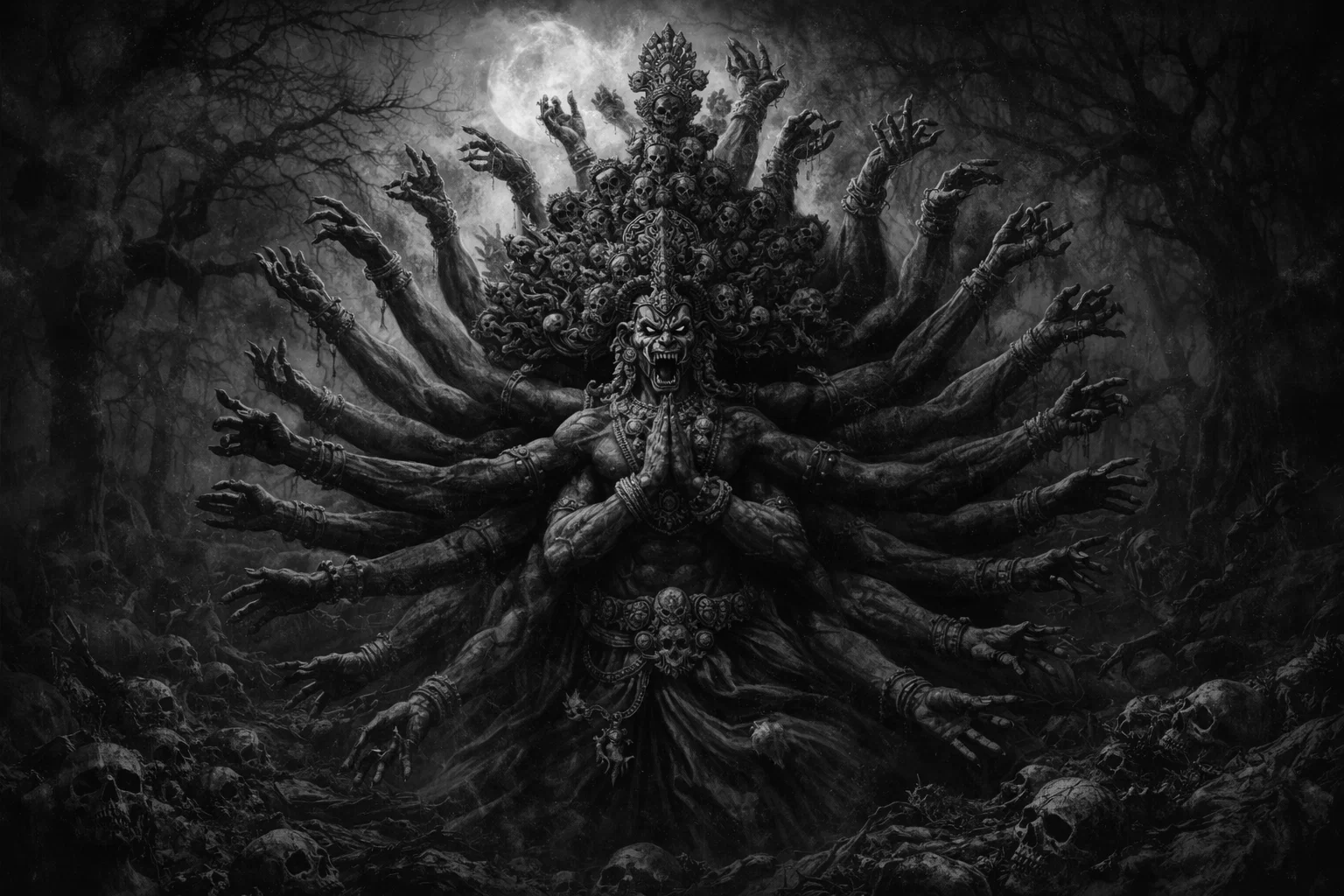
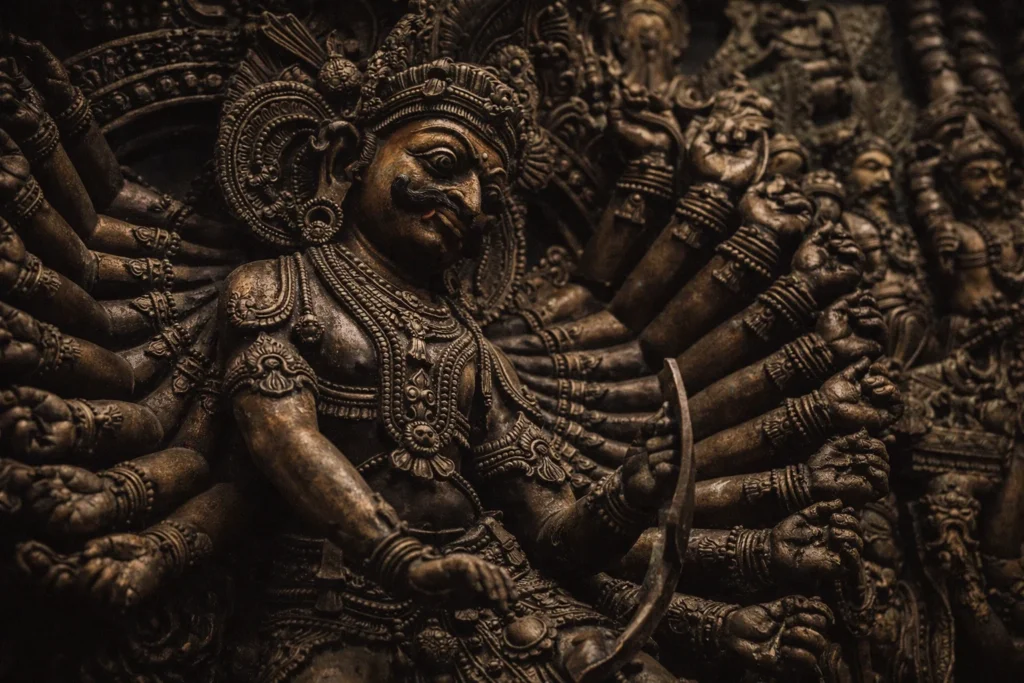
The Bhagavata Purana describes Banasura as a huge and powerful king, best known for his thousand arms. These arms were useful, not just for show, and showed his great skill in both music and battle.
When he danced for Shiva, his arms moved in perfect rhythm. In battle, they wore golden armor and held many weapons, making him look like a moving fortress.
He is often described as having the dark glow of a rain cloud, which stood out against his bright jewelry and crown. He looked both fierce and majestic, and his eyes were said to burn like embers when he was angry.
The Harivamsa adds that Banasura wore garlands of heavenly flowers given by the gods. These beautiful decorations later contrasted with his blood-stained look after the battle at Sonitpura. When he fought Krishna, most of his arms were cut off, leaving him with just two or four. This change showed his journey from pride to humility.
You may also enjoy:
What Is Jorōgumo? The Deadly Spider Woman of Japanese Myth
February 2, 2026
Andrealphus: The Peacock Demon Who Twists Minds and Bodies
January 19, 2026
Who Is Ahriman, and Why Is He Pure Evil Incarnate?
January 8, 2026
Who Were the Hinn, the First Spirits of Creation?
November 12, 2025
Who Are the Yaksha, and Why Did Buddhists Fear Their Wrath?
October 20, 2025
Who Is Ariton (Egyn), the Infernal King of the Eastern Gate?
February 17, 2026
Origins
Banasura’s story begins with the Daityas, the children of Diti and the sage Kashyapa. As Mahabali’s oldest son, he came from a family with a long and complicated history with the Vaishnava tradition, from Prahlada’s deep devotion to Bali’s wide-reaching rule.
The first stories about Banasura appear in the Puranas, where he is named as the ruler of Sonitpura, or the “City of Blood.” Over time, his story shifted from a simple tale of an Asura king to a deeper lesson about the limits of divine gifts and the importance of maintaining cosmic order, even for the most devoted followers.
Birth
Banasura was the son of Mahabali and Vindhyavali, born at a time when the Daityas were powerful in all three worlds. As Prahlada’s great-grandson, he was expected to uphold his ancestors’ traditions.
As a child, Banasura preferred worshipping Shiva over Vishnu. He went to the Himalayas and performed tough penance for centuries. Shiva was impressed and granted him a thousand arms, promising that he, Parvati, and their sons, Kartikeya and Ganesha, would protect Sonitpura.
Family
Banasura’s family life focused on his daughter Usha. Her secret love for Aniruddha, Krishna’s grandson, started the big war between the Yadavas and Shiva’s followers. Banasura respected his father, Mahabali, but he was much more hot-tempered than his father.
| Relation | Individual(s) |
| Parents | Mahabali (Father), Vindhyavali (Mother) |
| Siblings | One hundred brothers, including several unnamed Daityas |
| Spouse | Kandala (referenced in some regional traditions) |
| Children | Usha (Daughter) |
Historical & Folkloric Records
“The sons of Bali were a hundred, of whom the eldest was [Bana]; he was a devotee of Siva, and a person of great soul. He was a king of the Daityas, and lived in the city of Sonitpura. To him Siva granted a boon, and became the guardian of his city.” [Vishnu Purana, Book IV, Chapter I, Wilson Translation, 19th Century (Original Manuscript c. 400-900 CE)]
This passage from the Vishnu Purana is the main source for Banasura’s status. Unlike later, more detailed stories, it explains that his power comes from Shiva’s support. By calling him a “person of great soul” (mahatman), the text shows Banasura as a true ruler who earned his place through spiritual effort, not just as a villain.
The idea of “hundred sons” often appears in Puranic stories to show how large and powerful the Asura clans were during the Dwapara Yuga. This early source does not mention Banasura’s thousand arms, which suggests that this detail was added later to highlight his shift from a devoted follower to someone overcome by pride.
“With a thousand arms he played the drum (mrdanga) while the Lord of the Umā performed his dance. Pleased with his devotion, the Lord of the Trident said, ‘Ask for a boon.’ [Bana] then requested, ‘May you, O Lord, be the protector of my city.’ The Lord replied, ‘So be it; I shall stay at your gate to protect you.’” [Bhagavata Purana, Canto 10, Chapter 62, c. 8th-10th Century CE]
The Bhagavata Purana is the first to mention Banasura’s thousand arms. At first, these arms are not for fighting but for worship. This shows a change in how he is seen: his many arms are a sign of extreme devotion, not just a strange feature. Playing the mridangam drum connects him to the cosmic rhythm of Shiva’s dance.
Researchers believe the thousand arms stand for the restless energy of the material world. While Banasura first uses them for music, they later become a sign of his pride.
The story shows that he is so powerful that he grows bored with peace and asks Shiva for a war to satisfy his need for action. This makes him a victim of his own perfection, leading to a needed conflict with Krishna to restore balance.
“Then the mighty [Bana], the son of Bali, mounting his chariot, came out of the city to fight with Krishna. His banner, bearing the device of a peacock’s tail, shone like the sun. He was followed by his brothers and a vast army of Daityas, all armed with various weapons.” [Harivamsa, Vishnu Parva, Chapter 124, c. 1st-3rd Century CE (as an appendix to the Mahabharata)]
The Harivamsa presents Banasura as a strong warrior. His banner with a peacock tail is important because the peacock is linked to Kartikeya, Shiva’s son and leader of the gods’ armies. This shows that Banasura was closely connected to Shiva’s family and had their protection.
This story shows Banasura moving from a spiritual figure to a powerful earthly warrior. His thousand hands holding many weapons make him seem like a living war machine. In that society, a king’s worth was shown by divine support, but if he used that power to trouble Krishna’s family, it would lead to his downfall.
“King [Bana], the son of Bali, was the ruler of Sonitpur. He kept his daughter Usha in a fortress surrounded by fire, known as Agnigarh, to prevent any suitor from approaching her. This fire was maintained by his mystical powers and the grace of Mahadeva.” [Assamese Folk Narratives / Tezpur Traditions, Recorded in various regional manuscripts, 14th-18th Century]
Stories from Northeast India, especially those from Tezpur in Assam, add a new dimension to Banasura’s character. The Agnigarh, or Fortress of Fire, is a real place in local folklore. Here, Banasura is not just a cosmic rebel but also a protective, though strict, father.
This version of the story may come from local beliefs about the “Fire of the East.” By linking Banasura to a real fortress, the legend connects myth with local history.
The fire stands for the spiritual power given by Shiva, used as a barrier against the changes brought by Usha and Aniruddha’s love. This story helped people in the Brahmaputra valley see Banasura as an important ancestor rather than just a demon.
You may also enjoy:
Tarakasura: The Dark Demon Who Ruled Hell on Earth
December 4, 2025
Nasnas: The Monstrous Demon Hybrid That Haunted Pre-Human Earth
November 12, 2025
Who Is Abalam in Demonology? The Demon King That Serves Paimon
September 30, 2025
What Is a Pishacha, the Flesh-Eating Demon of the Dead?
February 11, 2026
Barbas: The Lion Demon Who Spreads Disease
March 3, 2026
Who Was Hiranyakashipu, the Demon King of Hindu Mythology?
October 6, 2025
Role in Hindu Cosmology
In the cycle of Dharma, Banasura stands for the restless energy of the Asuras.
In Hindu stories, Asuras and Devas are always shifting, like two forces in the universe. Banasura is a devoted follower but also an opponent. He is not evil for wanting to destroy the world, but his immense power and Shiva’s protection make him a threat to the earth.
Banasura’s power keeps the balance off until an Avatar steps in. By causing a clash between Krishna and Shiva, his story shows that the main Hindu gods are, in fact, united. When Banasura is defeated and humbled, it helps bring his family back into harmony, free from the pride that once caused trouble.
Banasura Myths, Legends, and Stories
The Imprisonment of Aniruddha
In the Bhagavata Purana, the story starts with Usha, Banasura’s daughter, dreaming of a handsome young man. Her friend Chitralekha, who had magical powers, helped her discover that the youth was Aniruddha, Krishna’s grandson. Chitralekha used her powers to bring Aniruddha from Dwaraka to Usha’s room in Sonitpura.
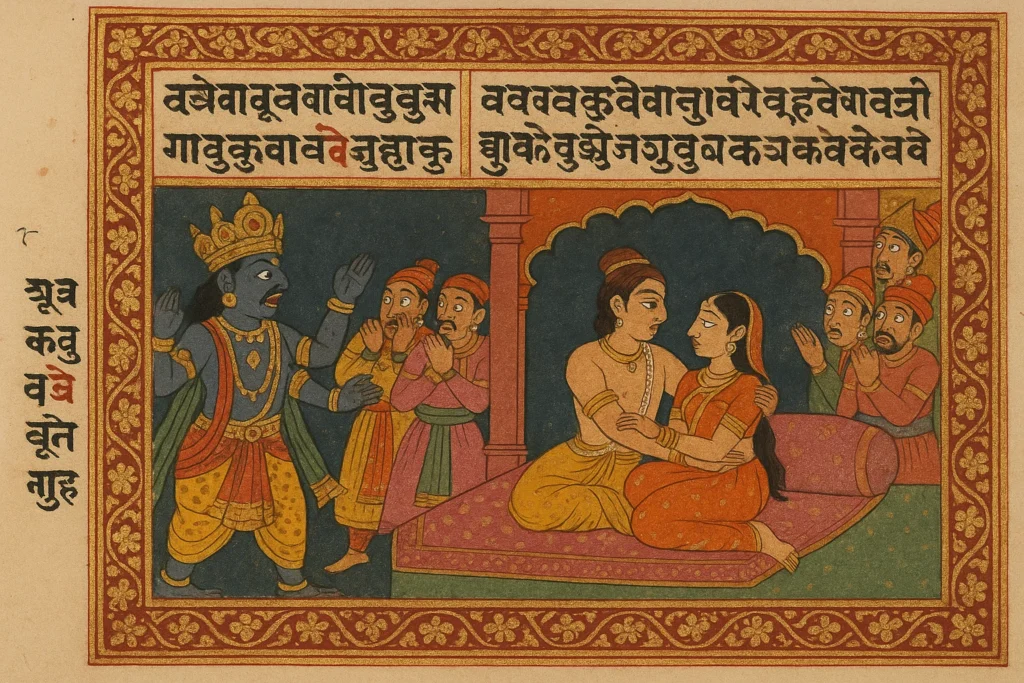
When Banasura found Aniruddha in his daughter’s room, he became furious. Even though Aniruddha fought back with a mace, Banasura used a serpent noose to capture him and threw him into a dungeon. This attack on the Yadava prince directly led to the coming battle.
The Battle of Sonitpura and the Shiva-Jwara
When Krishna, Balarama, and Pradyumna learned that Aniruddha was missing, they led the Yadava army to Sonitpura. Shiva, who had promised to protect Banasura, met them at the gates. This sparked a fierce battle known as the Hari-Hara war, in which Krishna and Shiva fought.
During the fight, Shiva sent out the Shiva-Jwara, a fever that brought heat and sickness. Krishna answered with the Vishnu-Jwara, a cooling fever. The two fevers canceled each other out. Then Krishna used a special weapon to make Shiva yawn and lose focus, allowing Krishna to get past him and reach Banasura.
The Severing of the Thousand Arms
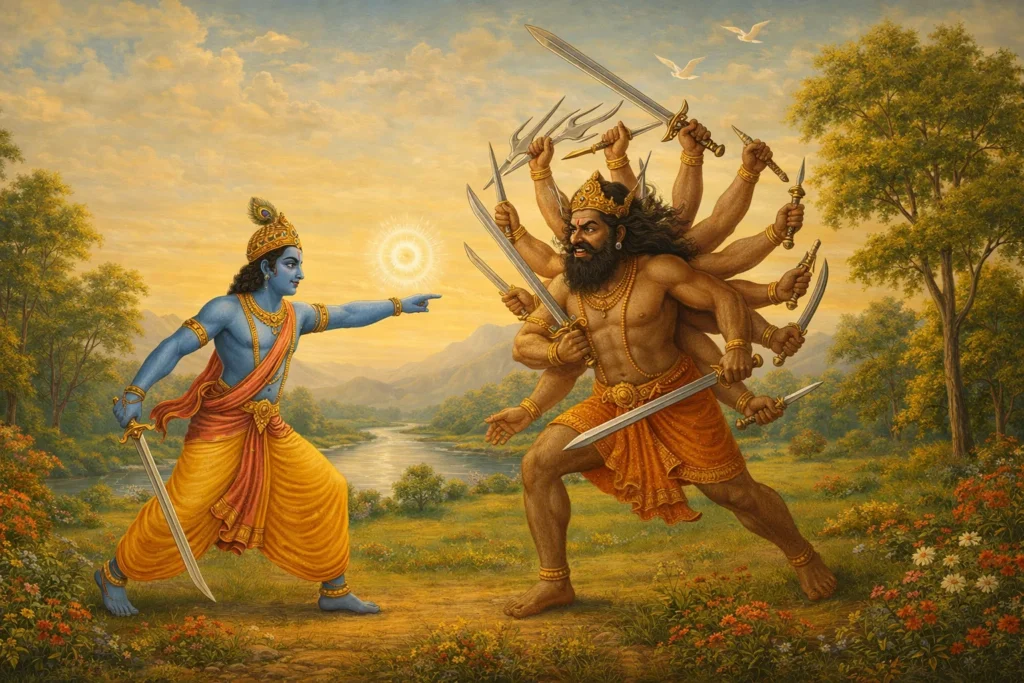
Full of pride and using his thousand arms, Banasura went out to fight Krishna alone. He attacked with a huge number of arrows and weapons, using all his arms at once. Krishna fought back with the Sudarshana Chakra, cutting off Banasura’s arms one by one, like trimming the branches of a tree.
As Banasura’s arms were cut off, Shiva recovered and stepped in, asking Krishna to spare his devotee. Krishna explained that he never meant to kill Banasura, since he was Prahlada’s grandson and Vishnu had promised not to harm his family. Krishna left Banasura with only four (or two) arms, ending his pride but letting him live.
Banasura vs Other Asuras
| Asura Name | Associated Trait | Clan/Origin | Key Traits/Powers |
| Ravana | Conquest/Ego | Rakshasa | Ten heads, celestial boons |
| Mahabali | Sacrifice/Dharma | Daitya | Universal sovereignty |
| Hiranyakashipu | Tyranny | Daitya | Invulnerability boon |
| Vritra | Drought/Obstruction | Vedic/Asura | Massive draconic form |
| Tarakasura | Ambition | Daitya | Only killed by Shiva’s son |
| Narakasura | Hoarding/Greed | Asura (Bhauma) | Possession of divine items |
| Andhaka | Lust/Blindness | Daitya | Blood-born clones |
| Madhu | Ignorance | Asura | Born from Vishnu’s ear |
| Kaitabha | Malice | Asura | Born with Madhu |
| Bhasmasura | Self-Destruction | Asura | Ash-touch ability |
| Gajashura | Physical Might | Asura | Elephantine form |
| Jalandhara | Chastity-linked power | Asura | Born of the Ocean |
Rank Among Asuras
Banasura was the top leader among the later Daityas. After his father, Bali, was sent to the netherworld, Banasura became the primary Asura ruler on earth. He did not try to defeat Indra, but instead focused on defending his own realm with Shiva’s support.
Unlike Ravana, who wanted to rule over the gods, Banasura was happy ruling his own land. However, he was so powerful that he became bored with peace and asked Shiva to give him a worthy opponent.
Banasura was the clear leader among the Asuras, commanding large armies and earning respect for his strong devotion. His main conflict was not with the Devas, but with Krishna’s family.
In Puranic stories, he is portrayed as one of the “Great Kings,” alongside Bali and Prahlada, showing that even flawed Asuras can remain connected to the divine.
Mystical Correspondences
| Attribute | Details |
| Planet | Mars (Mangala) |
| Zodiac Sign | Scorpio (Vrishchika) |
| Element | Water and Fire (Blood/Passion) |
| Direction | North-East (Ishana) |
| Color | Deep Crimson |
| Number | 1,000 |
| Crystal/Mineral | Bloodstone |
| Metal | Iron |
| Herb/Plant | Dhatura (sacred to Shiva) |
| Animal | Serpent (Naga) |
| Trait/Role | Restless Strength / Devotion |
Banasura is closely linked to the planet Mars, which matches his warlike nature and strong reactions to insults. This influence is clear in how he ruled Sonitpura, where the spirit of battle was always present.
His zodiac sign, Scorpio, shows his intense passion—both in his devotion to Shiva and his strong desire to protect his daughter. This sign also points to his toughness, as seen in the stories when he survived losing his arms.
Banasura is linked to fire because of his ambition and to water because he ruled the “City of Blood.” This mix shows his changeable nature as both a fighter and a musician.
He is also connected to the North-East, which is Shiva’s direction and shows where he found spiritual safety. The number 1,000 is his main symbol, standing for great strength that must eventually be given up to the divine.
Worship and Boons
Banasura is a classic example of gaining power through ascetic practice. He mainly worshipped Shiva by playing music during Shiva’s dance. Using his thousand arms, he created a complex rhythm that pleased Shiva so much that he was granted any wish. Banasura chose Shiva’s protection, making his city safe from any enemy not approved by Shiva.
But the gifts Banasura received also led to his downfall. When he said his thousand arms were a burden because he had no one strong enough to fight, Shiva predicted that his pride would be broken when his banner fell.
This promise of future defeat was actually a blessing, meant to free Banasura from his own pride. Today, in Assam and parts of North India, he is sometimes seen not as a demon but as a tragic devotee, and his city is still considered important both historically and spiritually.
You may also enjoy:
Who Is Agaliarept, the General of Hell Under Lucifer?
October 8, 2025
Mara: The Buddhist Demon King of Desire and Death
October 13, 2025
Bakeneko: A Supernatural Cat Yōkai in Japanese Folklore
January 27, 2026
Erinyes: The Chthonic Goddesses Who Enforced Blood-Guilt
November 20, 2025
Who Is the Jann in Islamic Mythology and Why Is He Feared?
October 2, 2025
Bibliography
Author’s Note: While putting together this profile, I noticed a strong contrast between the simple family records in the Vishnu Purana and the dramatic stories of Banasura’s many arms in the Harivamsa and Bhagavata Purana. It was interesting to see how his thousand arms changed from a sign of devotion to a symbol of pride. Comparing Assamese stories of Agnigarh with the main Sanskrit texts was challenging. Still, it showed how big myths become part of real places and history.
- Goyandka, C. L., editor. The Bhagavata Purana. Translated by a Board of Scholars, Gita Press, 2019. Internet Archive.
- Wilson, H. H., translator. The Vishnu Purana: A System of Hindu Mythology and Tradition. Edited by Fitzedward Hall, vol. 6 (Works by the Late Horace Hayman Wilson, vol. 1), Trübner & Co., 1864. Wikimedia Commons.
- Dutt, Manmatha Nath, translator. A Prose English Translation of Harivamsha. Edited by Manmatha Nath Dutt, Elysium Press, 1897. Internet Archive.
- Ganguli, Kisari Mohan, translator. The Mahabharata of Krishna-Dwaipayana Vyasa. Edited and published by Pratap Chandra Roy, Bharata Press, 1883-1896. Internet Archive.
- Griffith, Ralph T. H., and Arthur Berriedale Keith, translators. Complete Rig Veda in English (Sakala Shakha). Edited by Rigvedacomplete, Internet Archive ed., 2018. Internet Archive.
- Naunidhirâma. The Garuda Purâna (Sâroddhâra). Translated by Ernest Wood and S. V. Subrahmanyam, edited by Major B. D. Basu, AMS Press, 1974. Internet Archive.
- Witzel, Michael. Brahmanas. Academia.edu.
- Besant, Annie, and Bhagavan Das, compilers. The Vedas and Brahmanas. Theosophical Publishing House, 1912. Internet Archive.