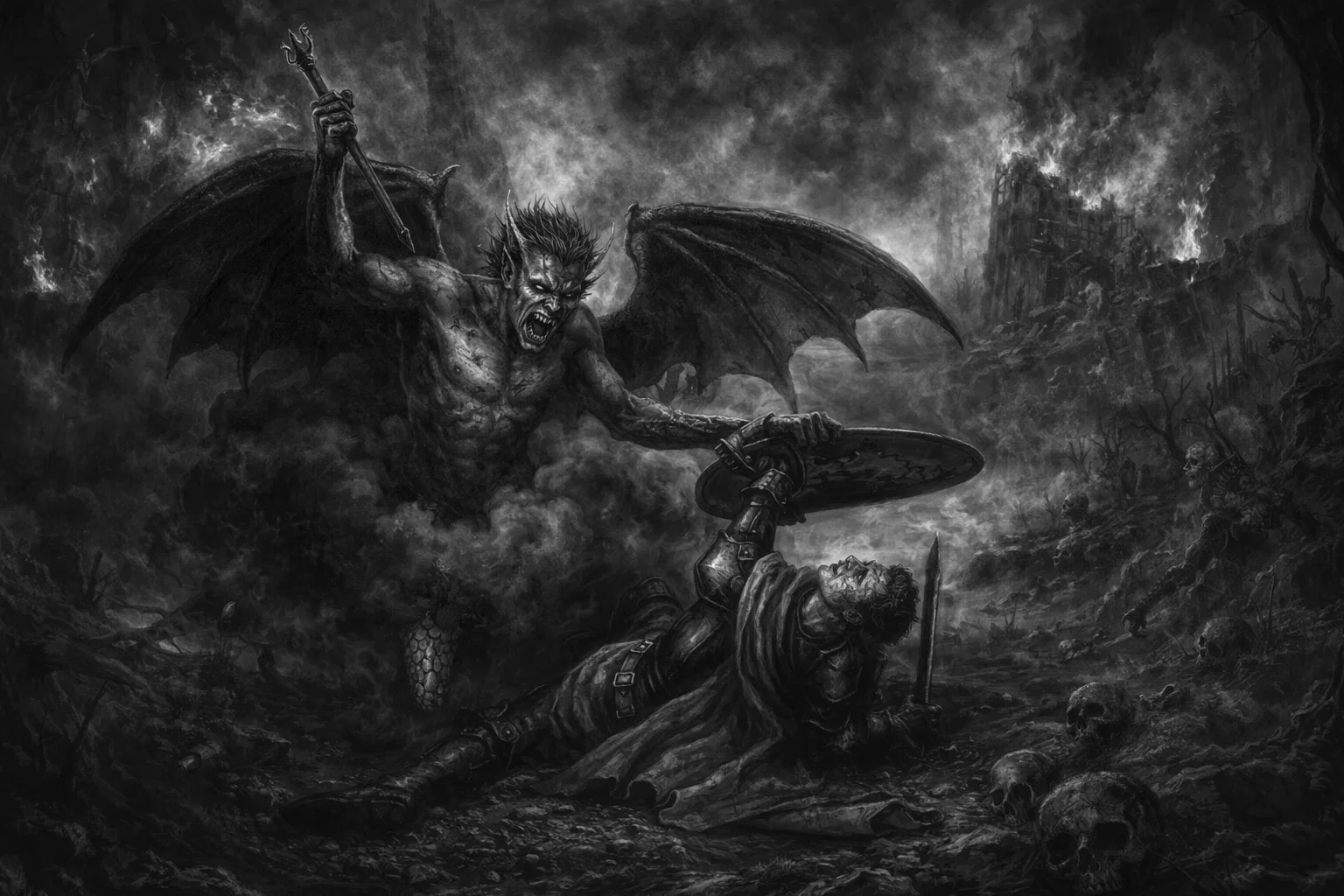
Abaddon is an important example of how language transitions in Judeo-Christian history, showing the shift from a place to a person. The word first meant the “realm of the dead” in Hebrew, but in the Book of Revelation, the demon appears as a king of locusts with his own will. This change connects the idea of a destructive pit to a powerful agent carrying out divine punishment. By moving from a passive place to an active destroyer, the demon stands out as a unique entity who carries out God’s apocalyptic plan from the depths.
[In this article, I want to take a closer look at the modern digital stories by comparing them with the Book of Revelation and the Dead Sea Scrolls. It aims to give a clear, evidence-based history of how an abstract void became a sentient being and one of the best-known demons in demonology.] [View Full Bibliography ↓]
Summary
Key Takeaways
| Attribute | Details |
|---|---|
| Names | Abaddon, Apollyon, The Destroyer, Angel of the Bottomless Pit |
| Title | King of the Bottomless Pit, Angel of Death |
| Gender | Male |
| Role | Destroyer, bringer of chaos, overseer of torment in the abyss |
| Hierarchy | High-ranking demon, often considered a prince or king in hell |
| Servitors | Locusts of the abyss, unnamed demonic spirits |
| Superior Demon | Satan or Lucifer (varies by text) |
| Powers | Commands destructive locusts, spreads ruin, torments souls, and induces despair |
| Appearance | Winged figure, often with locust-like or monstrous features |
| Etymology | Hebrew “Abaddon” meaning “destruction” or “place of destruction” |
| Associated Figures | Satan, locust demons, biblical figures like John of Patmos |
| Weaknesses | Bound by divine names, repelled by holy symbols like the cross |
| Opposing Angel/Saint | Archangel Michael, Saint John the Evangelist |
| Pantheon | Christian, with Jewish roots |
| Legions | Commands locust armies (number unspecified in texts) |
| Element | Earth (linked to the abyss) |
| Planet/Zodiac | Pluto, Scorpio |
| Color(s) | Black, dark green |
| Number(s) | 9 (symbolizing finality and destruction) |
| Crystal(s)/Mineral(s) | Obsidian, black tourmaline |
| Primary Sources | Book of Revelation, Book of Job, Pseudomonarchia Daemonum, Dictionnaire Infernal |
“Abaddon” Meaning
The name derives from the Hebrew term ‘abaddon, rooted in the verb abad, meaning “to perish” or “to destroy.” The concept of Abaddon encapsulates both a place of destruction and a personified entity, reflecting its dual role in ancient texts.
In Jewish tradition, ‘Abaddon appears in the Old Testament as a realm synonymous with Sheol, the underworld where souls face ruin. The Abaddon definition evolves in Christian texts, particularly in the New Testament, where it becomes Apollyon, a Greek term meaning “destroyer.” This shift highlights a linguistic adaptation that blends Hebrew and Hellenistic influences to emphasize an active, malevolent force.
The etymology reveals deep symbolic layers. The Hebrew root ‘abad‘ connects to concepts of loss, desolation, and annihilation, suggesting that Abaddon embodies not just physical ruin but also spiritual and moral decay. In the Book of Job and the Psalms, Abaddon signifies divine judgment as a place of despair, a void in which hope is lost.
By the time of Revelation, the name has come to personify a demonic king, reflecting Christian apocalyptic theology. Variations include The Destroyer and Angel of the Bottomless Pit, with Apollyon appearing in Greek translations, such as the Septuagint.
These alternate names across texts—Hebrew, Greek, and later Latin—show cultural adaptations, with Apollyon emphasizing a warrior-like destroyer in Christian lore.
Pronunciation
English pronunciation is typically “AB-uh-don” for the Hebrew form and “uh-POL-yun” for the Greek Apollyon. Some medieval texts, such as the Dictionnaire Infernal, use both names interchangeably, reinforcing the demon’s identity as a force of chaos that spans both Jewish and Christian traditions.
This evolution clearly shows how the demon’s name embodies its role as a symbol of divine wrath and infernal power, adapting to various cultural contexts while retaining its core meaning of destruction.
What Does Abaddon Look Like?
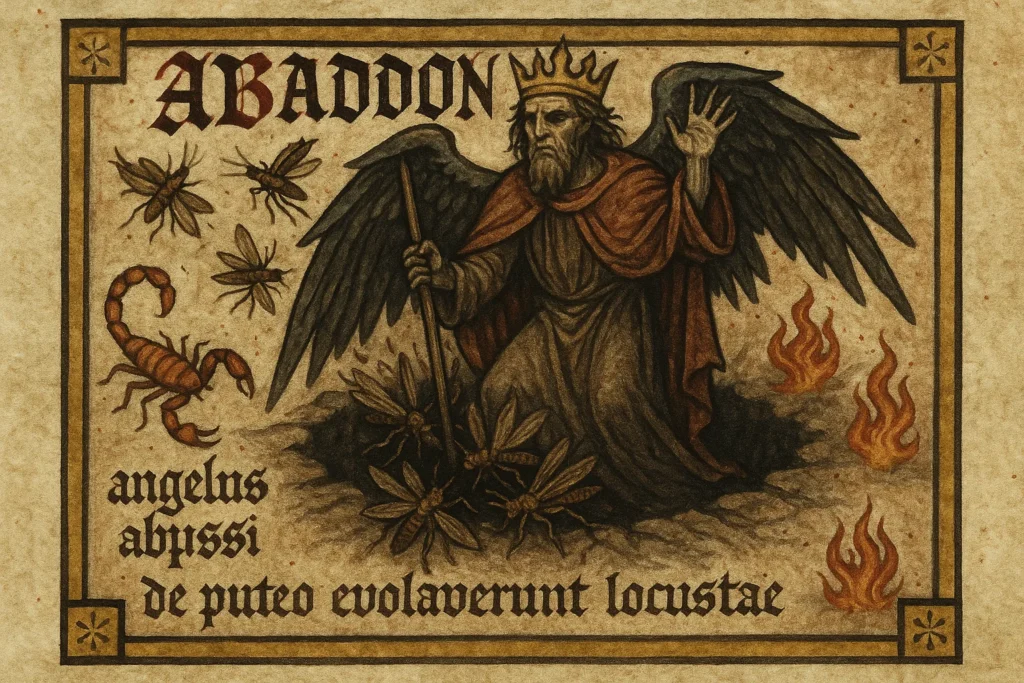
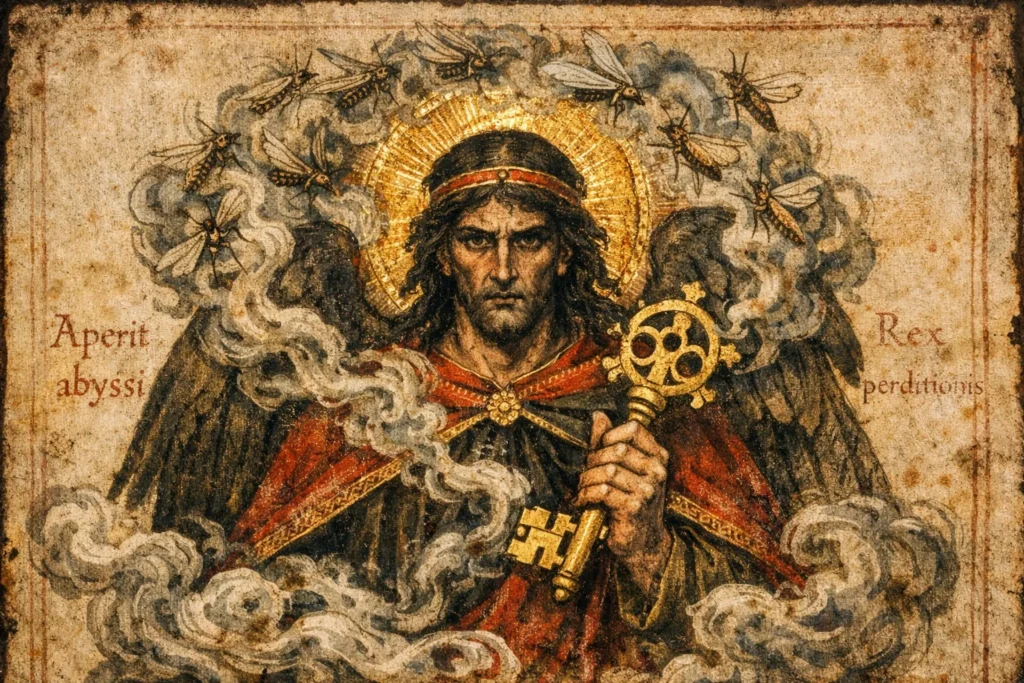
In most sources, The Destroyer is described as frightening and is often tied to apocalyptic imagery. The Book of Revelation describes the demon as the “Angel of the Bottomless Pit,” commanding locusts with scorpion-like tails and human-like faces.
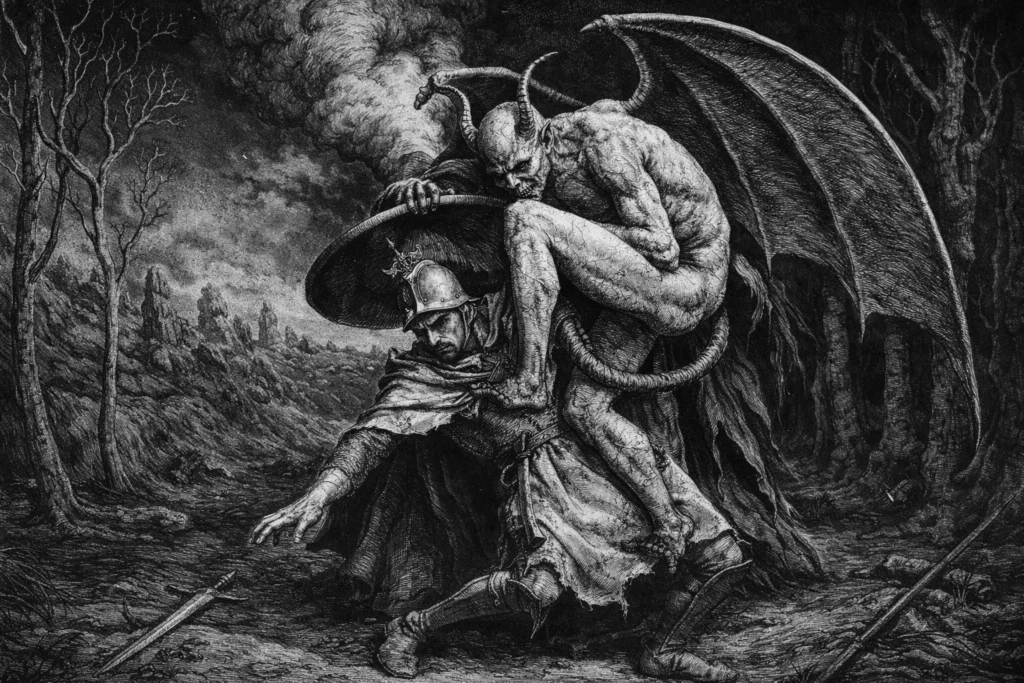
These locusts, under his rule, have wings and armor—a clear symbol of relentless destruction. Some medieval texts (including the Dictionnaire Infernal) depict Abaddon as a tall, winged figure with monstrous features, blending human and insect-like traits. The locust imagery suggests a swarm-like, unstoppable force. At the same time, the dark, shadowy form in art reflects chaos and dread.
Grimoires sometimes depict him as a cloaked or skeletal figure, accentuating death and decay, with symbolic elements such as a crown to denote kingship over the abyss.
Origins
The demon’s origins can be traced back to ancient Jewish theology, where it first appears as a concept of destruction before evolving into a formidable demonic entity in Christian demonology. In fact, the term “Abaddon” appears in the Old Testament (circa 6th–4th century BCE) as a poetic synonym for Sheol, the underworld, symbolizing a place of desolation, ruin, and divine judgment.
This early portrayal (found in texts like the Book of Job and Psalms) depicts Abaddon as a realm where hope and life perish, reflecting Jewish views of the afterlife as a shadowy, desolate void. The concept likely draws from pre-Christian influences—particularly Mesopotamian and Canaanite mythologies—which featured deities and spirits associated with death and chaos.
For example, the Mesopotamian god Nergal, ruler of the underworld and bringer of plagues, shares thematic parallels with Abaddon’s destructive nature. This could suggest a cultural borrowing as Jewish scribes demonized pagan entities during the Babylonian Exile (6th century BCE). Similarly, Canaanite myths of Mot, the God of death, may have influenced Abaddon’s association with annihilation, as Jewish theology reframed such figures as forces of divine retribution.
By the Hellenistic period (3rd–1st century BCE), the concept of Abaddon began to shift, likely influenced by Greek ideas. The Greek translation of the Old Testament, the Septuagint, renders ‘abaddon as Apollyon, meaning “destroyer,” a term possibly linked to the Greek god Apollo, known for sending plagues and destruction.
This linguistic transition—evident in texts like the Book of Enoch (circa 2nd century BCE)—marks the transition from a place to a personified entity, setting the stage for the demon’s role in Christian texts.
In the New Testament, particularly the Book of Revelation (circa 90 CE), Abaddon appears as the “Angel of the Bottomless Pit,” a demonic king commanding locust-like creatures in an apocalyptic vision. It’s clear evidence of how Christian apocalyptic theology amplified Abaddon’s role as an active agent of divine wrath, distinct from but aligned with Satan.
Medieval Christian demonology further developed the demon’s identity, integrating it into the infernal hierarchy. Texts such as Pseudomonarchia Daemonum (1577) by Johann Weyer and the Dictionnaire Infernal (1863) by Collin de Plancy depict Abaddon as a high-ranking demon, often a king or prince, who rules the abyss and commands destructive forces.
The Zohar (13th century), a key Kabbalistic text, bridges Jewish and Christian traditions by describing Abaddon as both a realm and a spiritual force, influencing its depiction in later grimoires.
This evolution reflects a synthesis of Jewish mysticism, Hellenistic philosophy, and Christian eschatology, transforming Abaddon from an abstract concept into a fearsome demon. Its development also mirrors broader trends in demonology, in which pre-Christian deities were recast as infernal beings, a process seen with demons such as Baal and Asmodeus.
The Toponymic Shift
As mentioned, the name Abaddon comes from the Hebrew ’ăbaddōn and shows a key change in Western ideas about the end times: turning an empty space into a person-like figure. In the wisdom books of the Masoretic Text, especially Job and Proverbs, Abaddon is used as another word for Sheol, which is seen as a lifeless, empty place of destruction.
By the time we reach Revelation 9:11, Abaddon is described as the “Angel of the Abyss.” The meaning of the name changes from a place where the dead go to an active force in the end times. Abaddon is not just a guardian of the pit; he becomes the pit itself, now acting with purpose. This shows that people in the ancient Mediterranean world believed that the forces of decay could eventually act on their own.
In the Dead Sea Scrolls, especially the Thanksgiving Hymns, Abaddon is called a “torrent” that breaks into the world’s structures. This image aligns with the main idea of entropy, which is the transition from order to complete emptiness.
Unlike the chaos linked to figures like Belial or Mastema, Abaddon’s role in the Bible is more orderly and mechanical. He does not tempt people to do wrong; instead, he brings about physical destruction.
This makes Abaddon a link between the Greek idea of Apollyon, the Destroyer, and older Near Eastern spirits known as Exterminators. He combines the Greek idea of cosmic forces with the Hebrew fear of an unnamed, consuming grave.
From a psychological point of view, making Abaddon into a person helps people picture the idea of an “irreversible process.” While other evil figures stand for breaking social or moral rules, Abaddon reflects the fear of being completely erased—the worry that death is not just a state, but a force that hunts the living.
The “locusts” that Abaddon leads, which are described as having human faces and lion’s teeth, are a symbol for an unstoppable ending. In this way, Abaddon stands for Finality, showing the point when the idea of “nothingness” stops being just a thought and becomes a real, powerful ruler.
You may also enjoy:
What Is a Dīv? The Terrifying Giant Demon of Persian Myth
January 22, 2026
Arāti: The Beautiful Demon of Aversion in Buddhist Mythology
October 15, 2025
Ammit: Devourer of the Dead in Ancient Egyptian Mythology
November 10, 2025
Who Was Hiranyakashipu, the Demon King of Hindu Mythology?
October 6, 2025
Apophis: The Great Serpent of Egyptian Chaos
November 11, 2025
Was Abaddon Ever Mentioned in the Bible?
The demon is explicitly mentioned in the Bible. The demon appears in both the Old and New Testaments, with distinct roles.
In the Old Testament, the demon is primarily a symbol of destruction, often equated with the underworld or Sheol. In the New Testament, it is personified as a demonic entity, particularly in the apocalyptic visions of the Book of Revelation.
| Source | Quote |
|---|---|
| Job 26:6 | “The underworld is naked before God, and Abaddon has no covering.” |
| Job 28:22 | “Abaddon and Death say, ‘We have heard a rumor of it with our ears.’” |
| Job 31:12 | “For that would be a fire that consumes as far as Abaddon, and it would burn to the root all my increase.” |
| Psalm 88:11 | “Is your steadfast love declared in the grave, or your faithfulness in Abaddon?” |
| Proverbs 15:11 | “Sheol and Abaddon lie open before the Lord; how much more the hearts of the children of man!” |
| Proverbs 27:20 | “Sheol and Abaddon are never satisfied, and never satisfied are the eyes of man.” |
| Revelation 9:11 | “They have as king over them the angel of the bottomless pit. His name in Hebrew is Abaddon, and in Greek he is called Apollyon.” |
As we can see from the quotes above, the demon represents a realm of destruction, often paired with Sheol to signify the desolation of the underworld. In Job 26:6, it is a place exposed to God’s omniscience, underlining divine power over death. Job 28:22 personifies Abaddon alongside Death, suggesting a quasi-entity aware of divine wisdom.
Psalm 88:11 uses Abaddon to highlight the absence of God’s love in the grave. At the same time, Proverbs portrays it as an insatiable force of ruin. The King James Version (KJV) retains these references, while modern translations, such as the New International Version (NIV), clarify Abaddon as “Destruction” to distinguish it from Sheol.
In Revelation 9:11, Abaddon is referred to as the “Angel of the Bottomless Pit,” ruling the locusts that torment humanity. This shift reflects Christian theology’s personification of Abaddon as a demon enacting divine judgment. The Apollyon translation in Greek is connected to Hellenistic ideas of destruction, possibly influenced by Apollo’s role as a plague bearer.
Abaddon in Grimoires and Other Texts
The Destroyer appears in several occult texts, reinforcing its biblical role as a destroyer:
| Source | Quote |
|---|---|
| Pseudomonarchia Daemonum | “Abaddon, also called Apollyon, a great king, appearing as a mighty warrior.” |
| Dictionnaire Infernal | “Abaddon, the angel of the abyss, who commands the locusts of destruction.” |
| The Book of Enoch | “And the angels who did not keep their own position… he has kept in eternal chains under gloomy darkness until the judgment of the great day, as Abaddon.” |
| Zohar | “Abaddon is the place of destruction, where the wicked are cast down.” |
In Pseudomonarchia Daemonum (1577) by Johann Weyer, Abaddon is a high-ranking demon, depicted as a warrior-like figure commanding respect in hell’s hierarchy.
The Dictionnaire Infernal (1863) by Collin de Plancy highlights Abaddon’s role in Revelation, describing it as a monstrous entity leading locusts from the abyss.
The Book of Enoch, an apocryphal text (circa 2nd century BCE), indirectly refers to the demon not as an evil entity but as a place of punishment for fallen angels, linking it to the abyss.
Similarly, the Zohar treats the demon as a metaphysical realm of ruin, likely influencing later Christian demonology. Unlike the Ars Goetia demons, which require detailed summoning rituals, Abaddon’s appearances are more abstract, focusing on its apocalyptic role rather than on practical evocation.
Powers and Abilities
Abaddon’s powers, pulled from biblical and occult sources, focus on destruction and torment:
- Commanding Locusts: Rules an army of locust-like demons that torment humanity with scorpion-like stings (Revelation 9:3-11). These locusts target those without divine protection, causing prolonged suffering.
- Spreading Despair: Induces hopelessness and spiritual decay, tied to its role in destroying faith and morale.
- Ruling the Abyss: Oversees the “bottomless pit,” a realm of chaos and punishment, controlling its inhabitants.
- Bringing Chaos: Causes widespread ruin, disrupting order through natural or spiritual calamities.
But his powers are not absolute. Limitations include the demon’s subordination to divine will, as its actions in Revelation manifest God’s judgment. It is also vulnerable to holy names and symbols, such as the cross or prayers invoking Archangel Michael.
Abaddon Myths, Legends, and Stories
Abaddon in the Book of Revelation
In the Book of Revelation (circa 90 CE), attributed to John of Patmos, the Angel of the Bottomless Pit is a major figure during the fifth trumpet judgment, a pivotal moment in the apocalyptic narrative. A star falls from heaven, entrusted with the key to the bottomless pit. Upon unlocking it, thick smoke billows forth, darkening the sun and sky, and from this darkness, a swarm of locusts arises.
These strange creatures, unlike natural locusts, have human-like faces, women’s hair, lion’s teeth, iron breastplates, and scorpion-like tails. Their wings produce a thunderous sound, likened to chariots rushing into battle. Under Abaddon’s command, these locusts are tasked with tormenting those who lack God’s seal on their foreheads for five months. Their stings inflict excruciating pain, so unbearable that people seek death but cannot find it.
Abaddon rules this army with absolute authority, directing their mission of divine retribution. The locusts spare vegetation, focusing solely on humanity.
Abaddon in the Book of Job
In the Book of Job (circa 6th century BCE), the Destroyer appears as a place of destruction, woven into the poetic dialogues exploring suffering and divine power. Job, enduring immense loss, reflects on the underworld’s vulnerability before God. In one passage, he declares that Sheol and Abaddon lie naked before God, stripped of any covering, emphasizing divine omniscience over the realms of death.
In another verse, Abaddon and Death are personified, responding that they have only heard rumors of divine wisdom, thereby underscoring their limited understanding in comparison to God’s. A third reference warns that sin ignites a fire that consumes as far as Abaddon, destroying all prosperity and hope.
This depiction frames the demon as a desolate realm, synonymous with Sheol, where life and joy perish under divine judgment. Unlike its later demonic role, Abaddon here is an abstract force, symbolizing the ultimate end of mortal endeavors.
You may also enjoy:
Abadir: The Demon Servant of Chaos and Dispersion
September 30, 2025
Barbas: The Lion Demon Who Spreads Disease
March 3, 2026
Al-Ahmar: The Tuesday King of the Seven Jinn
February 13, 2026
Who Is the Jann in Islamic Mythology and Why Is He Feared?
October 2, 2025
Abaddon in the Zohar
In the Zohar (13th century), a foundational text of Jewish mysticism, Abaddon is depicted as a metaphysical realm within the spiritual hierarchy, closely tied to divine justice. The text describes a cosmic order in which the wicked are judged and cast into Abaddon, a realm of eternal destruction where impurities are purged.
Unlike the Bible’s poetic references, the Zohar elaborates on Abaddon as a spiritual force, overseen by angelic or demonic entities under God’s command. Souls descending into this unholy land face annihilation, their sins consumed in its depths. The narrative portrays Abaddon as a crucible of divine wrath, where the unrighteous are stripped of existence.
Abaddon in the Testament of Solomon
In the Testament of Solomon (circa 1st–5th century CE), an apocryphal text, Abaddon appears as a powerful entity bound by King Solomon’s divine authority.
The narrative recounts Solomon, endowed with a ring from God, commanding demons to build the Temple. Abaddon, described as the ruler of the abyss, is summoned and compelled to reveal its nature. It declares its power to bring torment to the wicked, commanding spirits of destruction. Solomon, using divine names and seals, binds Abaddon to prevent its chaos from disrupting his work.
Abaddon vs Other Demons
| Demon Name | Associated Sin/Temptation | Rank/Origin | Key Traits/Powers |
|---|---|---|---|
| Asmodeus | Lust | Prince, Ars Goetia | Incites lust, grants knowledge of secrets |
| Belial | Lawlessness | King, Ars Goetia | Promotes rebellion, grants honors |
| Beelzebub | Gluttony | Prince, Binsfeld’s classification | Rules flies, spreads disease |
| Lucifer | Pride | Supreme ruler, Christian lore | Leads rebellion, tempts with power |
| Mammon | Greed | Prince, Binsfeld’s classification | Inspires materialism, wealth obsession |
| Leviathan | Envy | Prince, Binsfeld’s classification | Causes jealousy, rules seas |
| Satan | Wrath | Adversary, Christian lore | Opposes God, incites anger |
| Astaroth | Sloth | Duke, Ars Goetia | Promotes laziness, reveals secrets |
| Pazuzu | Winds and Plague | Mesopotamian demon | Spreads disease, controls storms |
| Baphomet | Heresy | Occult figure, medieval lore | Symbolizes blasphemy, occult knowledge |
| Moloch | Sacrifice | Canaanite demon, biblical references | Demands child sacrifice, inspires cruelty |
| Lilith | Seduction | Demoness, Jewish folklore | Tempts men, harms infants |
| Baal | Idolatry | Canaanite demon, biblical references | Promotes false worship, commands storms |
| Amon | Discord | Marquis, Ars Goetia | Sows conflict, grants foresight |
| Demogorgon | Chaos and Terror | Medieval demon, literary references | Inspires fear, disrupts order |
Rank in the Hierarchy of Hell
The Angel of the Bottomless Pit holds a prominent position in the infernal hierarchy, often described as a king or prince ruling the “bottomless pit.” In Revelation 9:11, Abaddon commands an army of locust-like demons, suggesting significant authority over lesser spirits.
Unlike Ars Goetia demons, which specify legion counts (e.g., Bael’s 66 legions or Astaroth’s 40), Abaddon’s forces are described as vast but unnumbered, emphasizing their apocalyptic role. Pseudomonarchia Daemonum portrays Abaddon as a “great king,” placing it on par with figures like Beelzebub or Asmodeus, though subordinate to Satan or Lucifer, depending on the text.
In fact, its role as the “Angel of the Bottomless Pit” suggests a specialized function, overseeing a realm of torment distinct from hell’s broader structure. Abaddon’s power aligns with divine judgment in Revelation, creating potential tension with demons like Belial, whose lawlessness contrasts with his structured and destructive nature.
Medieval texts, such as those by Wierus, suggest that Abaddon collaborates with Satan in apocalyptic schemes but may rival Leviathan or Mammon for influence over specific domains.
Its unique position as both a divine enforcer and infernal king sets him apart, wielding immense destructive power while bound to a higher authority.
Associations
Abaddon’s associations reflect its destructive essence, linking to symbols, elements, and celestial forces that underscore its role as a bringer of ruin. These connections can provide insight into the demon’s malevolent nature, aiding in rituals or theological study.
Astrological, elemental, and symbolic ties highlight its connection to chaos, death, and the abyss, reinforcing its identity as a high-ranking demon.
Zodiac and Astrological Links
Abaddon is associated with Pluto, the planet of transformation, death, and rebirth, reflecting its role as a destroyer. Pluto’s influence, as noted in occult texts such as the Lesser Key of Solomon, to associated with profound change and annihilation, amplifying his power during astrological transits.
The zodiac sign Scorpio, ruled by Pluto, aligns with the demon’s intense, secretive, and destructive nature. Scorpio’s season (October 23–November 21) is considered optimal for rituals invoking Abaddon, as its energy peaks under this sign’s influence.
Some grimoires also link The Destroyer to Mars, the planet of war, due to its warrior-like depiction in Pseudomonarchia Daemonum, suggesting a secondary influence over conflict and aggression.
Elemental Associations
Abaddon is strongly tied to Earth, specifically the underworld or abyss, as depicted in Revelation’s bottomless pit. This primordial element manifests in its locust army, which emerges from the ground to unleash torment, symbolizing decay and subterranean chaos.
The Dictionnaire Infernal describes Abaddon’s connection to caverns and desolate landscapes, reinforcing its earthy domain.
Additionally, Abaddon has a secondary link to Air, represented by the smoke rising from the abyss and the winged locusts under its command.
Colors, Numbers, and Crystals
Abaddon is associated with black, signifying death, the void, and the darkness of the abyss, as well as dark green, representing decay, pestilence, and the locusts’ swarming nature. These colors evoke his role as a harbinger of ruin.
The number 9 is associated, signifying finality, completion, and destruction in numerology, aligning with Abaddon’s apocalyptic purpose.
Crystals like obsidian, a black volcanic glass, symbolize protection and the absorption of negative energy, mirroring Abaddon’s ability to consume hope.
Black tourmaline, used in occult rituals for banishing, connects to Abaddon’s power to repel or overwhelm.
Other Correspondences
Abaddon is also associated with iron, a metal signifying strength, war, and unyielding destruction, often used in ritual tools to invoke its power. Nightshade, a poisonous plant, aligns with Abaddon’s deadly nature, used in medieval grimoires for baneful magic.
Locusts, as animals, are central, representing swarming devastation and plague, as seen in Revelation. Some texts, such as the Zohar, mention scorpions as secondary animals, reinforcing Abaddon’s power to torment.
Abaddon loosely corresponds to wrath in Binsfeld’s classification, though its primary sin is destruction itself, encompassing chaos and loss.
Sensory associations include a foul, smoky odor, evoking the abyss’s stench, and a droning sound linked to its locust army.
Abaddon’s Sigil and Symbols
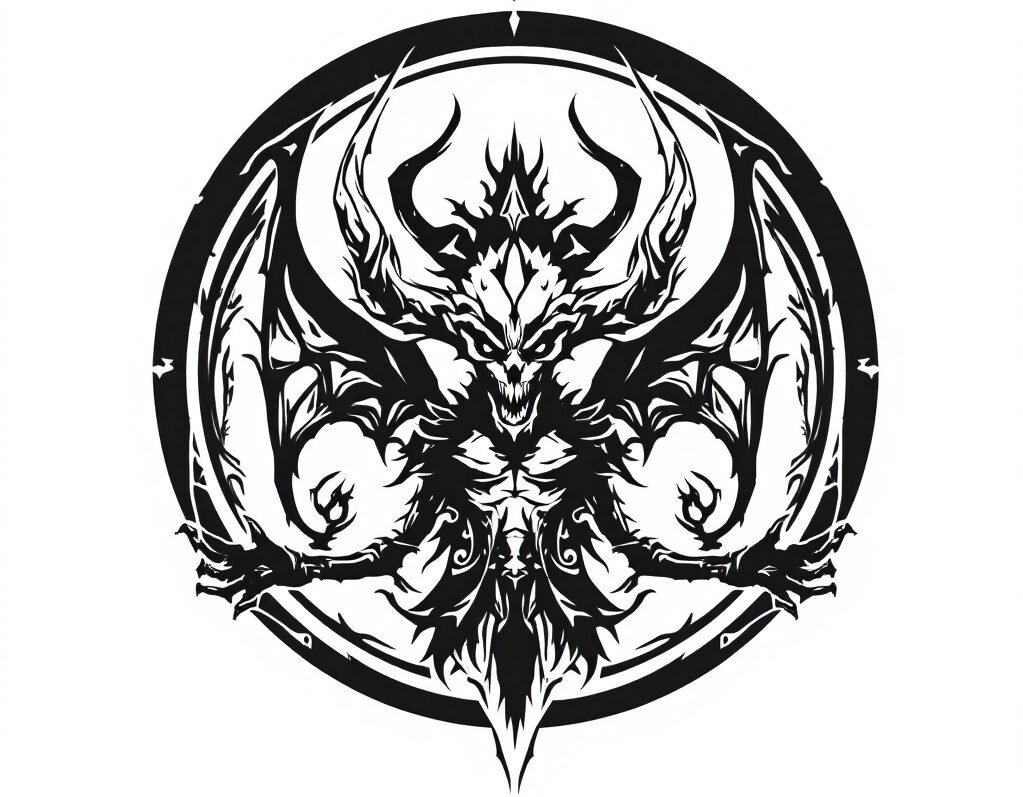
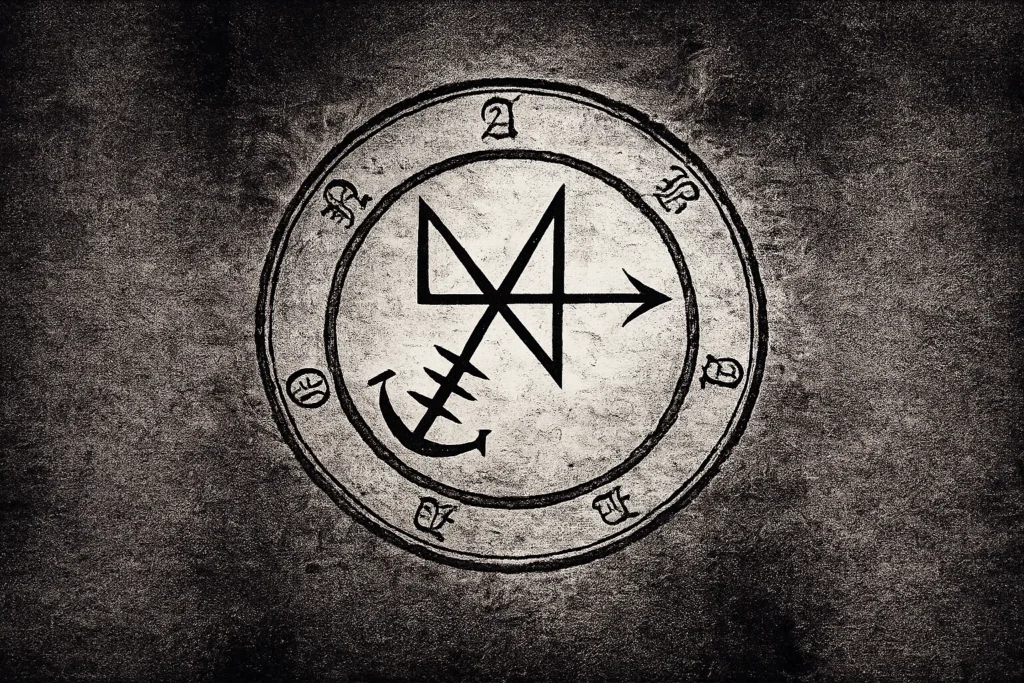
Abaddon’s sigil, although not explicitly detailed in Ars Goetia, is described in lesser-known occult texts as a circle enclosing a locust emblem, surrounded by jagged, radiating lines that symbolize chaos and destruction. The locust, central to Abaddon’s identity in Revelation, represents its swarming, relentless power.
The jagged lines evoke the disorder of the abyss, used in ritual circles to channel Abaddon’s energy. The Dictionnaire Infernal mentions a crown-like symbol.
Scorpions and smoke clouds are additional symbols, reflecting the tormenting locusts and the darkness of the abyss.
Variations in sigils exist, with some texts adding a pentagram to denote infernal authority. Still, the locust and crown remain consistent, tying directly to the demon’s destructive and regal nature.
Summoning and Rituals
Rituals typically involve a consecrated circle, inscribed with divine names and symbols to bind Abaddon and prevent its wrath from overwhelming the summoner. The Testament of Solomon (circa 1st–5th century CE) suggests using a divine seal (such as Solomon’s ring) inscribed with the Tetragrammaton (YHWH) to restrain the demon’s power. This ring, believed to grant authority over demons, is central to rituals, ensuring the demon remains subservient to the summoner’s will.
The ritual process—as outlined in medieval grimoires—begins with the creation of a protective circle, often drawn with chalk or etched into the ground with an iron blade, symbolizing his association with Earth and strength. The circle is adorned with holy names, such as Elohim or Adonai, and symbols, such as the cross or pentagram, to ward off malevolent forces.
Offerings (such as nightshade or mandrake, both tied to death and poison) are placed within the circle to appease the demon’s destructive nature. Some texts recommend burning incense with a foul, smoky odor, mirroring the abyss’s stench in Revelation.
The summoner invokes Abaddon by chanting its names—Abaddon in Hebrew or Apollyon in Greek—often in a sequence of nine repetitions. These invocations, drawn from texts like the Sefer Raziel HaMalakh, call upon Abaddon to manifest within the circle. Here, the demon may appear as a darkened, winged entity or a swarm of locusts.
Grimoires stress the importance of binding The Destroyer with divine commands to prevent its locust-like forces from causing chaos beyond the ritual’s intended purpose.
The Lesser Key of Solomon suggests using a consecrated wand, made of iron or hazel, to direct Abaddon’s energy, ensuring it remains focused on the summoner’s purpose, such as inflicting torment or revealing secrets of the abyss. Rituals also require specific timing, often during Scorpio’s season (October 23–November 21) or under Pluto’s influence, to align with Abaddon’s astrological associations.
Protective amulets (particularly those embedded with obsidian or black tourmaline) are worn to shield against Abaddon’s despair-inducing power. The Zohar mentions reciting psalms—particularly Psalm 91—to invoke divine protection, as Abaddon is vulnerable to holy names and symbols (such as the cross).
The Grand Grimoire (circa 1520) warns that summoning the Angel of the Bottomless Pit without divine authority risks unleashing its locust army, causing widespread ruin.
Some texts, such as Sefer Raziel HaMalakh, describe offerings of iron objects, symbolizing strength, to placate Abaddon, while others recommend inscribing its sigil—a circle with a locust emblem and jagged lines—on parchment to channel its energy.
Overall, unlike demons in the Ars Goetia, which provide detailed evocation steps, Abaddon’s rituals are less prescriptive.
Bibliography
Author’s Note: While putting together this article, I noticed a strong contrast between the plain, geographic descriptions of the “Abaddon” abyss in the Book of Job and the lively, militarized figure that appears in 19th-century works like Collin de Plancy’s Dictionnaire Infernal. It was especially interesting to see how the “Angel of the Abyss” changed from a divine executioner in early manuscripts to a key monster in Victorian occult traditions. This shift required a close comparison of the Testament of Solomon with modern deliverance theology. Overall, the research shows a clear pattern: Abaddon stands out among the infernal elite because he is one of the few entities in which the biblical canon and grimoire tradition not only overlap but also compete to define what ultimate destruction means.
- The Church of Jesus Christ of Latter-day Saints – The Old Testament. Intellectual Reserve, Inc, 1979, 2013.
- The Library of the University of California – The Book of Job. The Morland Press Ltd, London.
- Chester Charlton Mc – The Testament of Solomon. Edited from manuscripts at Mount Athos, Bologna, Holkham Hall, Jerusalem, London, Milan, Paris, and Vienna. Leipzig J. C. Hinrichs’ Sche Buchhandlung, 1922.
- Collin de Plancy – Dictionnaire infernal; répertoire universel des êtres, des personnages, des livres, des faits et des choses qui tiennent aux esprits. 1863
- Johann Weyer – Pseudomonarchia Daemonum. Digital edition by Joseph H. Peterson, 2000.
- L. W. De Laurence – The Lesser Key of Solomon, Goetia. Original publication: Chicago: de Laurence, Scott & Co, 1916.
- Bradley Sliedrecht – The Defeated Foes: Demons, Deliverance, and the Authority of Christ, 2025.
- Russell Gasdia – Frightful Demons and Faithful Prayer: Possession, Exorcism, and Religious Sentiments in Johann Weyer’s De Praestigiis Daemonum and Reginald Scot’s The Discoverie of Witchcraft.
- Dr. Jay Winter – The Complete Book of Enoch (standard English version). Winter Publications, 2015.
You may also enjoy:
Who Is Ariton (Egyn), the Infernal King of the Eastern Gate?
February 17, 2026
Andrealphus: The Peacock Demon Who Twists Minds and Bodies
January 19, 2026
Gandharva: God, Spirit, or Demon?
November 13, 2025
Who Is Abalam in Demonology? The Demon King That Serves Paimon
September 30, 2025
Who Is Ambolin, the Demon of Nighttime Dread
December 1, 2025