Many supernatural beings in Japanese folklore are seen as dangerous or as signs of disaster. However, Abura-sumashi is remarkable because it represents the unexpected. Instead of using violence, it unsettles people by breaking the feeling of being alone in the wilderness, making them question whether they are truly by themselves.
When we compare this spirit to more dangerous mountain hags or beasts, we see that it highlights the importance of oral tradition. It also brings out the surprising idea that the land itself might be listening to and confirming what people say.
In this article, I compared Hamada Zenji’s regional field studies in Amakusa-jima Minzoku-shi with the visual examples from Gazu Hyakki Yagyō. This approach helps keep my analysis focused on traditional sources, avoiding the influence of modern movies. [View Full Bibliography ↓]
Summary
Key Takeaways
| Attribute | Details |
| Names | Abura-sumashi |
| Translation | Oil-presser; one who presses oil |
| Title | Mountain Spirit; Ghost of the Oil-Thief |
| Type | Yōkai; Obake |
| Spirit Classification | Generally classified as a Nigi-mitama (gentle/pacified spirit), though its origin suggests a connection to the Goryō (vengeful ghost) tradition regarding those who died in disgrace. |
| Origin | The spirit of an individual who stole oil from the lamps of temples or shrines and died before atonement. |
| Gender | Commonly depicted as male, though occasionally gender-neutral. |
| Appearance | A humanoid figure with a disproportionately large, stone-like head resembling a potato or a smooth river rock, wearing a straw rain cape (mino). |
| Kehai (Aura/Presence) | The sound of rustling straw or the subtle scent of rancid vegetable oil precedes a sighting. |
| Powers/Abilities | Bi-location, sudden manifestation, and the ability to respond to its own name when spoken aloud. |
| Methods of Pacification | Avoidance of mountain passes at twilight; acknowledging the spirit with respect rather than fear. |
| Habitat | The Kusazumi-goe mountain pass in Amakusa, Kumamoto Prefecture. |
| Diet/Prey | Does not consume humans; it targets travelers’ complacency. |
| Symbolic Item | Mino (straw rain cape) |
| Symbolism | The permanence of guilt; the surveillance of nature; the consequences of petty theft. |
| Associated Kami | Potentially a fallen servant of localized mountain deities (Yama-no-Kami). |
| Sources | Amakusa-jima Minzoku-shi (Folklore of Amakusa Island) by Hamada Zenji. |
The Fundamental Identity of the Abura-sumashi
This spirit is unique to the folklore of Kumamoto Prefecture, especially the Amakusa Islands. Unlike other spirits found throughout Japan, it is tied to a single place: the Kusazumi-goe pass. It stays in this spot not to harm people, but because of an old story about someone stealing oil.
Abura-sumashi is not aggressive. Instead, it acts as a link between people and the supernatural. Travelers usually encounter it when they talk about past legends. The spirit does not hunt; it shows up only when mentioned, confirming its own story and making the local legends feel real.
Semantic Origins
The name comes from the old work of making oil. ‘Abura’ (油) means ‘oil,’ especially the kind made from seeds like tea or rapeseed, which was used for lamps. ‘Sumashi’ comes from ‘sumasu’ (澄ます), which means ‘to clear’ or ‘to refine.’ In the past, an oil-presser was someone who clarified oil.
For this yōkai, the name also has a social and moral meaning. In the Edo period, oil was very valuable. It was often taxed or offered at Buddhist temples. Stealing oil was seen as a serious crime against religion.
The way the name changed over time suggests that the spirit is the ghost of someone whose life was marked by the work he did or the oil he stole. There are a few regional differences in the story because the spirit is so closely tied to Amakusa. This kept the name and legend connected to the Kusazumi-goe pass.
How to Pronounce “Abura-sumashi” in English
The name is pronounced ah-boo-rah soo-mah-shee. Each part has three short syllables with even stress. In English, it sounds smooth, without sharp stops or long vowels. It is similar to combining ‘umbrella’ and ‘smashy’.
You may also enjoy:
Jikininki: The Japanese Ghost That Feeds on Human Corpses
February 9, 2026
What Is a Tengu? Origins, Powers, and Dark Folklore
January 29, 2026
Who Is Al-Abyad? The White King Jinn Who Rules Love and Chaos
January 26, 2026
Who Is the Infernal King Balam? Origins, Powers, and Occult History
February 26, 2026
Vritra: The Dragon Who Swallowed the Sky in Hindu Mythology
October 7, 2025
Aži Dahāka: The Three-Headed Dragon of Zoroastrian Mythology
January 14, 2026
What Does the Abura-sumashi Look Like?
Mizuki Shigeru helped make the spirit’s appearance more consistent, but the idea originated in older stories from Kumamoto.
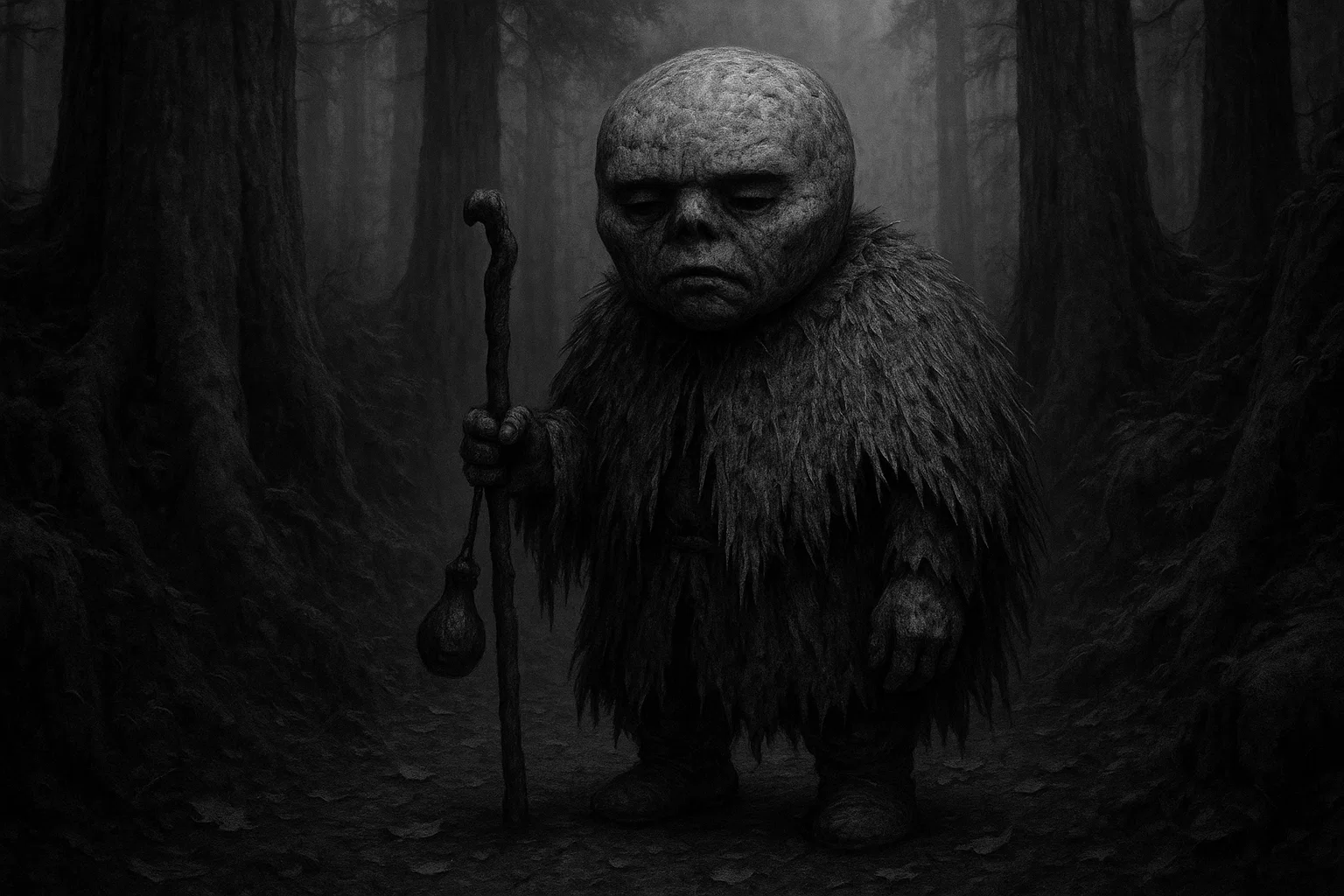
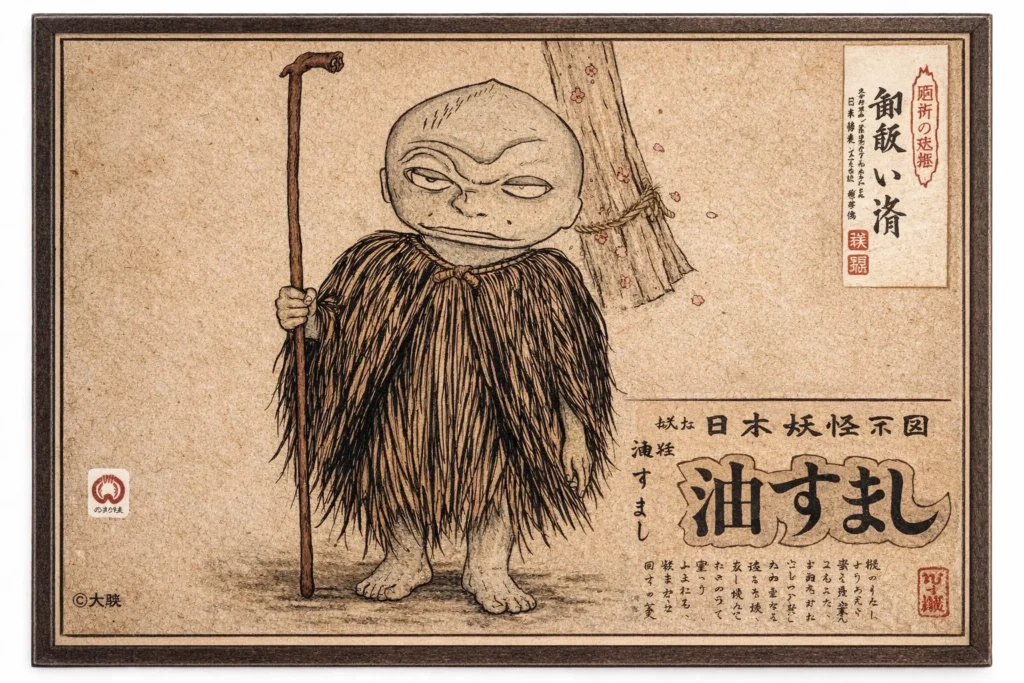
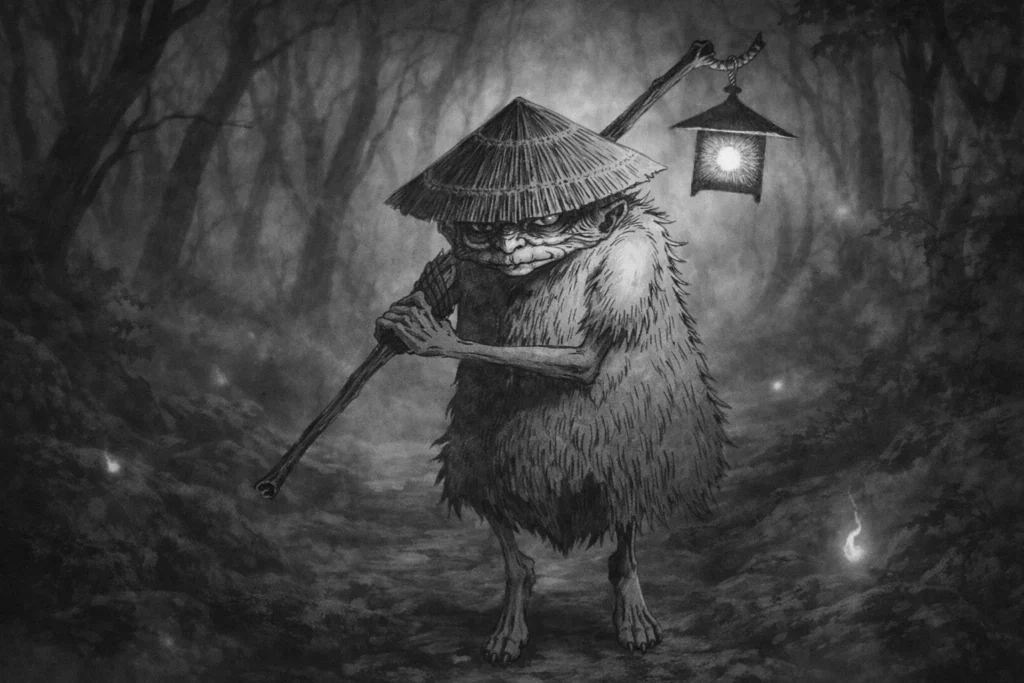
Abura-sumashi is usually shown as a small, stout human-like figure. Its head looks like a big, worn stone or a peeled potato. The skin is gray or earthy, with few facial features. The eyes are small, and the mouth is hard to see, giving it a calm, blank look.
The spirit is almost always shown wearing a mino, a traditional Japanese rain cape made of straw. This type of clothing was common for peasants and travelers in the mountains, helping the spirit blend into the misty pass.
Under the cape, Abura-sumashi has thin, human-like arms and legs. It does not carry weapons or tools; just being there is what makes it special. Its lack of hair or fancy clothes shows that it is a simple, earthbound supernatural being.
Origins and History
This spirit’s story began during the Edo period (1603–1868), when oil was very important. In Amakusa, oil for lamps was a luxury rather than a basic need. Temples were the center of community life, and the oil given to them was considered sacred. The legend of the oil-presser ghost likely started as a warning against stealing from temples.
Based on my research, I think this spirit served as a way for mountain villages to watch over one another. Interestingly, the earliest accounts of the spirit appeared during the mid-Edo period, when religious taxes increased in Kyushu.
If someone died while suspected of a crime like stealing oil, their story was kept alive as a warning to others. I believe the spirit’s stone-like head symbolizes a soul hardened by guilt, showing how a heart can grow cold and heavy from unconfessed wrongdoing.
The Amakusa region also has a history of religious conflict, including groups known as ‘Hidden Christians.’ Creating a yōkai to punish those who steal temple oil may have helped religious leaders maintain control over the area. By placing a ghost in a busy mountain pass, the community set up a lasting supernatural reminder for travelers to behave morally.
Habitat
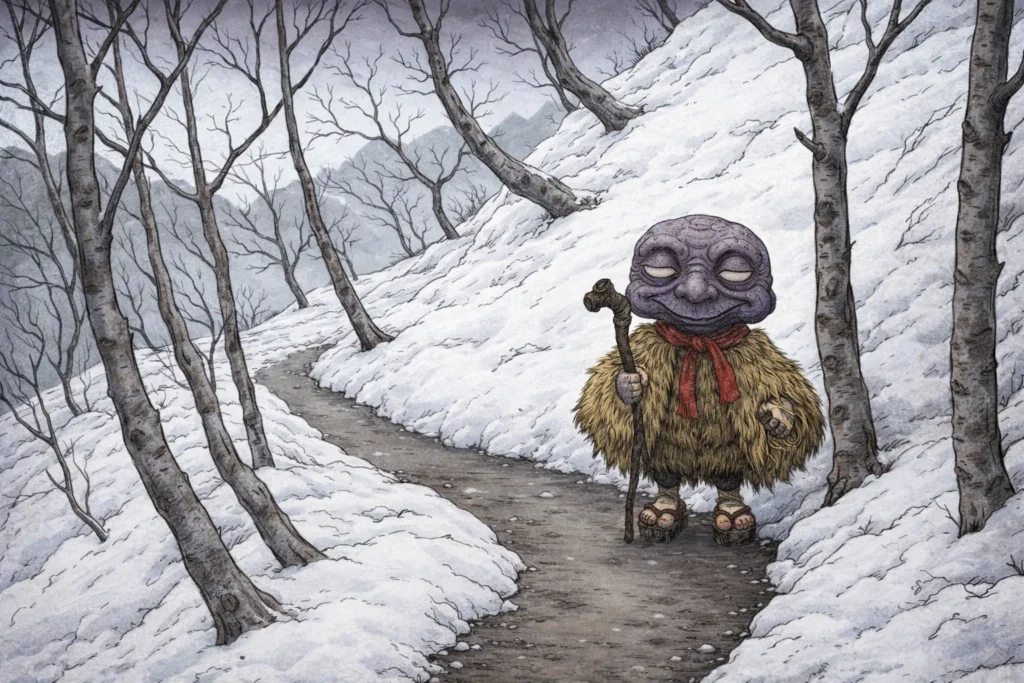
The spirit mainly lives in the Kusazumi-goe, a mountain pass on Amakusa Kamishima in Kumamoto Prefecture. In Japanese folklore, mountain passes are seen as ‘liminal spaces,’ where the line between the human and spirit worlds is very thin.
The spirit likes this spot because it is a place of change. Travelers passing through are often tired and alert, which makes them more likely to notice something supernatural.
The thick plants, regular mist, and isolation of the Amakusa mountains create the perfect setting for a spirit that appears suddenly. It does not live in homes or villages. Instead, it stays in the wild areas, quietly watching over the path between towns.
How the Abura-sumashi Personifies the Anxiety of Environmental Surveillance
Based on my research, I think the most interesting thing about Abura-sumashi is not how it looks, but how it reacts to stories. Many Edo-period spirits were given set forms by artists like Toriyama Sekien. Still, this mountain spirit keeps some of the old Heian-era idea of mononoke, which were formless and more like a feeling than a clear shape.
I find it especially interesting that this spirit never starts an encounter. It stays hidden until someone tells its story. I believe it acts like a mirror for the traveler, showing that the land is not just a silent background, but is actually listening and taking part.
People often miss the link between the spirit’s stone-like head and the real rocks in the Kusazumi-goe pass. When I looked at the area, I saw that the thick mist and volcanic rocks could easily look like a crouching figure.
There is also a link to the history of resource shortages. Oil was more than just fuel; it showed civilization and religious faith. By appearing as proof of its own story, the spirit acts like an unseen watcher.
The main fear is being watched without knowing it. In a quiet mountain pass, travelers might think they are alone, but when the spirit suddenly says, ‘I still do!’, it reminds them they are not truly private.
I also think this spirit shows a shift from shared guilt to personal haunting. Unlike Goryō, which brought trouble to whole cities, this spirit focuses on one traveler at a time. It stands for a hidden secret of the mountain. Stealing oil from a temple was like taking away the community’s light.
The spirit’s heavy, potato-like head and straw body stand for the burden of theft that has not been forgiven. It is a ‘heavy’ spirit that ties the moral lesson to a real place.
I believe this spirit helps keep culture stable, guaranteeing that, even far from towns, the ‘light’ of social rules is protected by a being that reminds us our actions are always noticed by the land.
Famous Abura-sumashi Legends and Stories
The Manifestation at Kusazumi-goe
The best-known story about Abura-sumashi comes from Amakusa’s oral traditions and was later written down in folklore studies.
In the story, a grandmother and her grandchild are walking through the Kusazumi-goe pass. As they go along the narrow, twisting path, the grandmother tells the child a local legend, maybe to entertain or warn them.
She says, “Long ago, a yōkai called the Abura-sumashi used to appear in this very spot.” Right after she speaks, a voice from the bushes answers, “I still do!”
A figure in a straw rain cape comes out, surprising them both. This is the main legend about the spirit, which shows that it reacts when mentioned. It does not chase people; it just appears when its name is spoken, as if to make sure its story is told correctly.
You may also enjoy:
Who Was Hiranyaksha, the Golden-Eyed Asura?
October 7, 2025
Mara: The Buddhist Demon King of Desire and Death
October 13, 2025
What Is a Rakshasa? Meaning, Origins, and Dark Powers
January 23, 2026
What Is a Dīv? The Terrifying Giant Demon of Persian Myth
January 22, 2026
Al-Ahmar: The Tuesday King of the Seven Jinn
February 13, 2026
Abura-sumashi Powers and Abilities
Abura-sumashi’s power is subtle, not destructive. It does not have the strength of an Oni or the tricks of a Kitsune. Instead, it is very good at hiding and responding to people. It can stay invisible and silent until someone says its name, making it a master of surprise.
- Spontaneous Manifestation: The ability to appear instantly in response to its name being spoken.
- Vocal Mimicry: The spirit can speak human language clearly, often using a dry or rasping tone to startle travelers.
- Presence Concealment: It can remain undetected in sparse cover, seemingly blending into the rocks and trees until it chooses to reveal itself.
- Moral Weight: While not a physical power, the entity exerts a psychological pressure on those who harbor guilt, particularly regarding theft.
Traditional Defenses Against the Abura-sumashi
Since Abura-sumashi is not inherently dangerous, defending against it is more about good manners and staying calm than fighting. The best way to avoid trouble is to walk through the Kusazumi-goe pass quietly and respectfully. Because the spirit appears when people talk about it, travelers are told not to say its name out loud while in the area.
In Shinto tradition, if you feel a sudden chill or smell oil, it is common to say a short prayer or show respect to the Yama-no-Kami, the Mountain God, since the oil-presser spirit is thought to live under this god’s care.
People sometimes use salt to keep away yōkai, but for Abura-sumashi, just respecting the mountain and moving quickly through the pass is enough. The spirit cannot be destroyed or sent away forever, as it is part of the land’s history. The best way to deal with it is to stay quiet and keep moving.
Abura-sumashi vs Similar Spirits
| Name | Category | Origin | Threat Level | Escape Difficulty |
| Konaki-jiji | Yōkai | Spirit of an abandoned elderly man. | Medium | High; it becomes heavy like stone when picked up. |
| Nurikabe | Yōkai | Manifestation of blocked paths. | Low | Low; one must tap the bottom with a stick. |
| Yama-uba | Obake | Transformed mountain hag. | Very High | Very High; she is a fast, predatory hunter. |
| Taka-onna | Yōkai | A woman who grew tall from jealousy. | Low | Low; she mostly peers into second-story windows. |
| Sunakake-baba | Yōkai | Sand-throwing hag of the forest. | Medium | Medium; she causes temporary blindness with sand. |
| Tsuchigumo | Yōkai | Ancient earth spider spirits. | Very High | Extreme; they use webs and illusions to trap prey. |
| Kappa | Suijin | Fallen water deity. | High | Medium; one must bow to spill its head-water. |
| Noppera-bō | Obake | Faceless ghost. | Low | Low; it only seeks to frighten, not harm. |
| Wanyūdō | Tsukumogami | A suffering soul bound to a burning wheel. | High | High; it steals the souls of those who look at it. |
| Kodama | Spirit | The soul of an ancient tree. | Neutral | N/A; they are generally harmless and stationary. |
Symbolism
| Attribute | Details |
| Element | Earth (Stone/Mountain) |
| Animal | None (Though sometimes associated with the stoic nature of a toad) |
| Cardinal Direction | West (Associated with the direction of Amakusa from the mainland) |
| Color | Grey (The color of stone and weathered straw) |
| Plant | Tea Plant (Source of the seeds for lamp oil) |
| Season | Autumn (The time of harvest and the pressing of oil) |
| Symbolic Item | Mino (Straw rain cape) |
In Japanese culture, Abura-sumashi means that people are always responsible for their actions. It shows the fear that even small wrongs, like stealing oil, will stay with us and appear in the places we visit. The spirit reminds us that the wild is not empty, but full of the community’s memories, acting as a living record of what people have done.
This spirit is also important in the ‘Metatextual Yōkai’ tradition, as it is one of the few that seems to know about its own legend. This helps connect the story to the people who hear it.
Today, it is a symbol of Kumamoto’s regional identity, changing from a scary figure to a well-loved mascot of Japanese folklore. Its role in festivals and books helps keep the history of oil-pressers and temple offerings alive.
You may also enjoy:
Pazuzu: The Ancient Demon Who Fought Evil with Evil
November 4, 2025
Who Is the Jann in Islamic Mythology and Why Is He Feared?
October 2, 2025
Rāga: The Seductive Demon of Passion and Desire in Buddhist Lore
October 16, 2025
Aeshma: The Zoroastrian Demon of Wrath and Fury
January 13, 2026
Who Are the Yaksha, and Why Did Buddhists Fear Their Wrath?
October 20, 2025
Marid: The Ocean Jinn That Defies Heaven and Earth
September 30, 2025
Bibliography
Author’s Note: In this article, I focused on Hamada Zenji’s local stories rather than Sekien’s later artwork to preserve the original spirit’s link to the worries of the Amakusa region. By looking at how oil’s sacred role in Edo-period temples connects with the special nature of mountain passes, I found that this spirit is more than just a monster. It acts as a cultural stabilizer, supporting oral traditions that help maintain strong community morals, even in the wild.
- Kelsey, W. Michael. Konjaku Monogatari-shū. Twayne Publishers, 1982. Twayne’s World Authors Series 621. Internet Archive.
- Meyer, Matthew. The Night Parade of One Hundred Demons: A Field Guide to Japanese Yokai. 2nd ed., Matthew Meyer, 2015. Dokumen.pub.
- Morse, Ronald A. Yanagita Kunio and the Japanese Folklore Movement: The Search for Japan’s National Character and Distinctive Culture. Edited and revised by Robert Goehlert, CrossAsia-eBooks, 2015. CrossAsia Repository, repository.crossasia.org.
- Cucinelli, Diego. Windows Onto The Supernatural In The Second Half Of The Edo Period: From The Gazu Hyakki Yagyō (1776) By Toriyama Sekien To The E-Hon Hyaku Monogatari (1841) By Takehara Shunsen. Ming Qing Studies 2015, 2015. Academia.edu.
- Bradt, Aaron. The Role of Yokai in Japanese Myth. 2016. Academia.edu.
- Hirota, Ryuhei. (2022). Traversing the Natural, Supernatural, and Paranormal: Yōkai in Postwar Japan. Japanese Journal of Religious Studies. 48. 321-339. 10.18874/jjrs.48.2.2021.321-339. ResearchGate.
- Foster, Michael Dylan. The Book of Yokai: Mysterious Creatures of Japanese Folklore. University of California Press, 2015. Internet Archive.