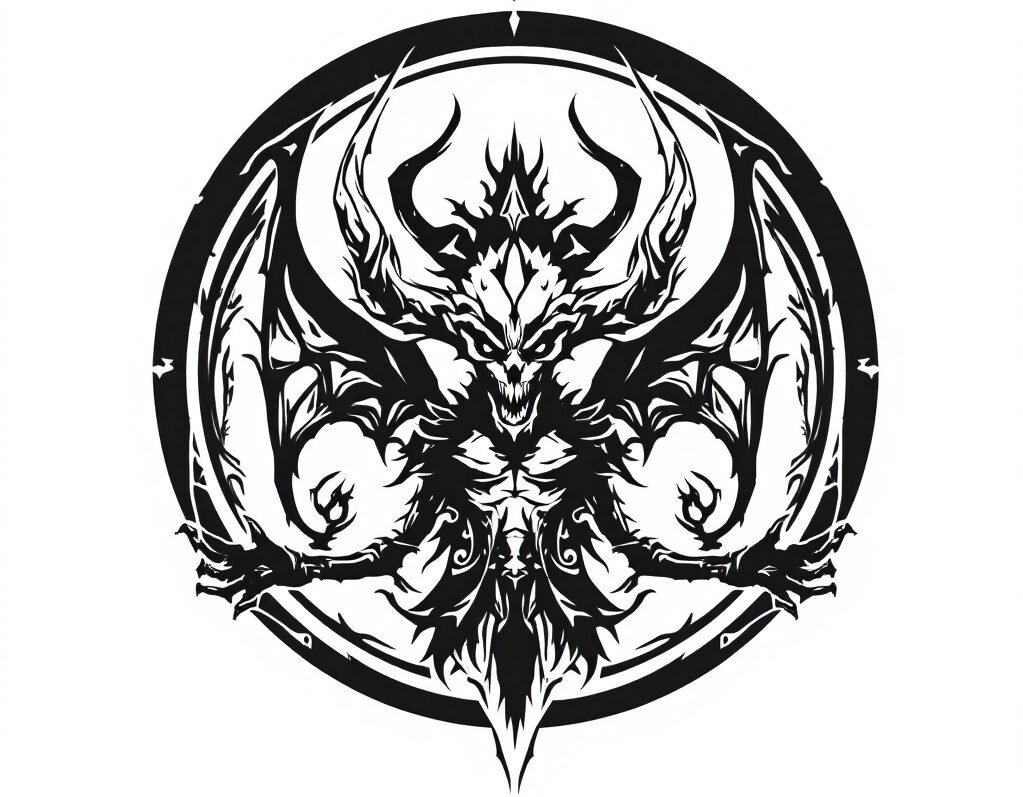
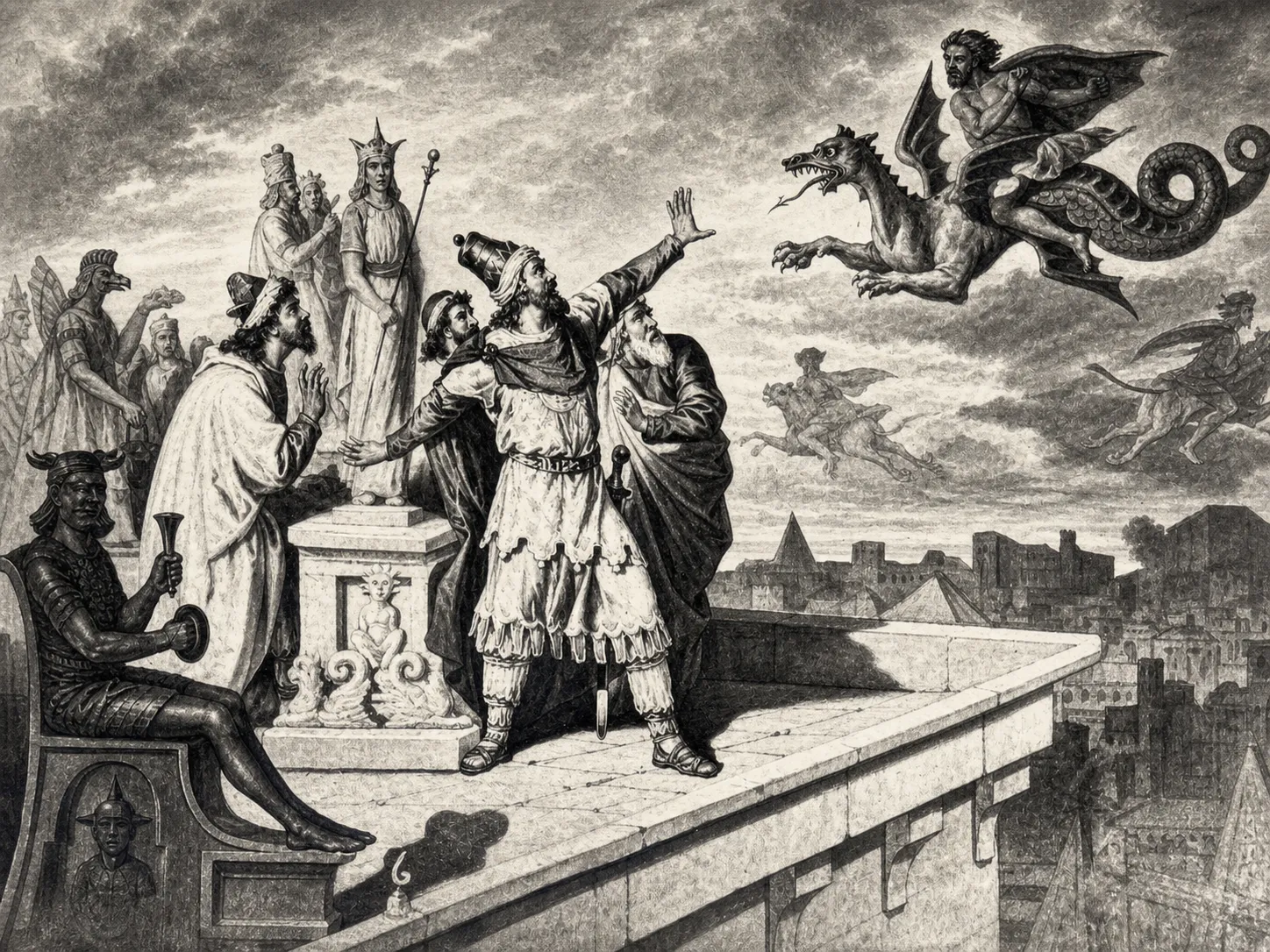
Aži Dahāka symbolizes the threat of chaos in Zoroastrian beliefs. Unlike most mythologies, which portray enemies as outside monsters, this monster is different because it shows how power can become corrupt. It connects the idea of a chaotic serpent with that of a real-life tyrant, showing how greed and moral decline can turn a ruler into a force of destruction that threatens the world’s order.
By comparing the creation stories in Yasht 19 of the Avesta with the historical tales in the Shāhnāmeh, I traced how Aži Dahāka transitioned from a symbol of chaos into a model of tyranny. [View Full Bibliography ↓]
Summary
Key Takeaways
| Attribute | Details |
| Names | Aži Dahāka, Zahhāk, Dahāk, Bivar Asp, Azhdahak |
| Title | Chaos Serpent, Three-Headed Dragon, The Tyrant of Damāvand |
| Origin | Ancient Iranian/Zoroastrian (Avestan period) |
| Gender | Male |
| Genealogy | Son of Angra Mainyu (or Merdās in later accounts) |
| Role | Cosmic adversary, chaos bringer, symbol of tyrannical rule |
| Associated Deity | Ahura Mazda (supreme opponent), Thraētaona/Fereydun (hero who binds him) |
| Brings | Drought, illness, social decay, and tyrannical oppression |
| Weaknesses | Bound by divine decree, susceptible to the mace of Thraētaona |
| Realm/Domain | Mount Damāvand (prison), Airyanem Vaejah (mythological kingdom) |
| Weapon/Item | Three-headed form, venomous serpents growing from the shoulders |
| Symbolism | Moral corruption, destructive power, the perversion of justice |
| Sources | The Avesta, Dēnkard, Bundahishn, Shāhnāmeh |
Who or What is Aži Dahāka?
Aži Dahāka is a key entity in Iranian mythology, seen as a powerful monster made by the evil spirit Angra Mainyu. In the Avesta, it is described as a many-headed serpent with great strength and cleverness, posing a constant and serious threat to the world.
Over time, Aži Dahāka transforms from a serpent monster to a human-like tyrant with snakes growing from his shoulders. This transformation shows that he is both a symbol of chaos and a warning about the corruption that absolute power can cause.
“Aži Dahāka” Meaning
The name comes from the Avestan language, combining Aži (meaning “serpent” or “dragon”) with Dahāka. The meaning of Dahāka is still debated by researchers, who suggest it could mean “stinging,” “burning,” or something like “man-like” or “huge.”
The name transformed over time. In later Pahlavi texts and the Shāhnāmeh, it became Zahhāk, sometimes linked to foreign or Arabian roots (Zahhāk-e Tāzī). Despite these differences, the creature always stood for dangerous or corrupt authority, showing how political and cultural views shifted in the region.
How to Pronounce “Aži Dahāka” in English
In English, the name is usually pronounced to match Persian sounds. “Aži” is said as “Ah-zhee,” where the “zh” sounds like the “s” in “pleasure.” “Dahāka” is pronounced “Dah-hah-kah,” with a long “a” in the middle. Pronunciations may differ, but the best way is to use a soft “zh” sound and say each syllable clearly.
You may also enjoy:
Ifrit: Demon of Fire Who Serves Iblis in Islamic Tradition
September 30, 2025
Who Is the Demon Andras, The Great Marquis of Discord?
January 15, 2026
Who Is Azazel, the Demon Blamed for Human Corruption?
February 24, 2026
Al-Ahmar: The Tuesday King of the Seven Jinn
February 13, 2026
What Is a Pishacha, the Flesh-Eating Demon of the Dead?
February 11, 2026
Who Are the Yaksha, and Why Did Buddhists Fear Their Wrath?
October 20, 2025
Origins
Aži Dahāka’s roots go back to the Proto-Indo-Iranian period, around the 2nd millennium BCE. I believe this creature grew out of the common “Dragon of Chaos” idea found in early herding societies, rather than appearing suddenly.
The first clear record of Aži Dahāka is in the Avesta, especially Yasht 19 (Zamyad Yasht), which has hymns to khvarenah (divine fortune). Here, he already appears as a three-headed, three-jawed monster, showing that his story was well developed before Zoroastrian texts were written down.
Genealogy
| Relationship | Details |
| Parents | Angra Mainyu (creator/evil spirit) or Merdās (human king in later versions) |
| Siblings | Spitiyura (in select later narratives) |
What Does Aži Dahāka Look Like?
Aži Dahāka is always described as having a strange and frightening appearance. Old texts say he has three heads, three jaws, and six eyes. These features are not just for show—they stand for his power to see, destroy, and control. The three heads mean he can cause harm in many ways, and the six eyes show he is always watching over his victims.
Later stories highlight his serpent side even more, showing poisonous snakes emerging from his shoulders on a human-like body. This image is a strong reminder that he survives by feeding on human life.
I notice that these descriptions often correspond to periods of disease or social problems. The “serpents” can be seen as old symbols for tyrants who drain the strength of their people to keep their power.
Connections to Other Ancient Demons
| Name | Genealogy | Type | Appearance |
| Apep | Egyptian | Chaos Serpent | Giant serpent |
| Lamashtu | Babylonian | Disease Demon | Lion-headed female |
| Tiamat | Babylonian | Chaos Monster | Primordial dragon/serpent |
| Jörmungandr | Norse | Chaos Serpent | Midgard-spanning serpent |
| Pazuzu | Assyrian | Wind Demon | Winged, hybrid monster |
| Typhon | Greek | Chaos Monster | Multi-headed, serpentine |
| Humbaba | Sumerian | Guardian Demon | Face of coiled intestines |
| Mot | Canaanite | Death/Sterility | God of death |
| Iblis | Islamic | Tempter | Fallen spirit |
| Vritra | Vedic | Chaos Serpent | Drought dragon |
You may also enjoy:
Alû: The Mesopotamian Demon of Malevolence and Pestilence
November 10, 2025
Barbas: The Lion Demon Who Spreads Disease
March 3, 2026
Who Is Al-Abyad? The White King Jinn Who Rules Love and Chaos
January 26, 2026
What Is the Akkorokamui, Japan’s Colossal Sea Monster?
November 14, 2025
Aži Dahāka: The Three-Headed Dragon of Zoroastrian Mythology
January 14, 2026
Mahakala: The Dark Guardian Who Consumes Evil
October 16, 2025
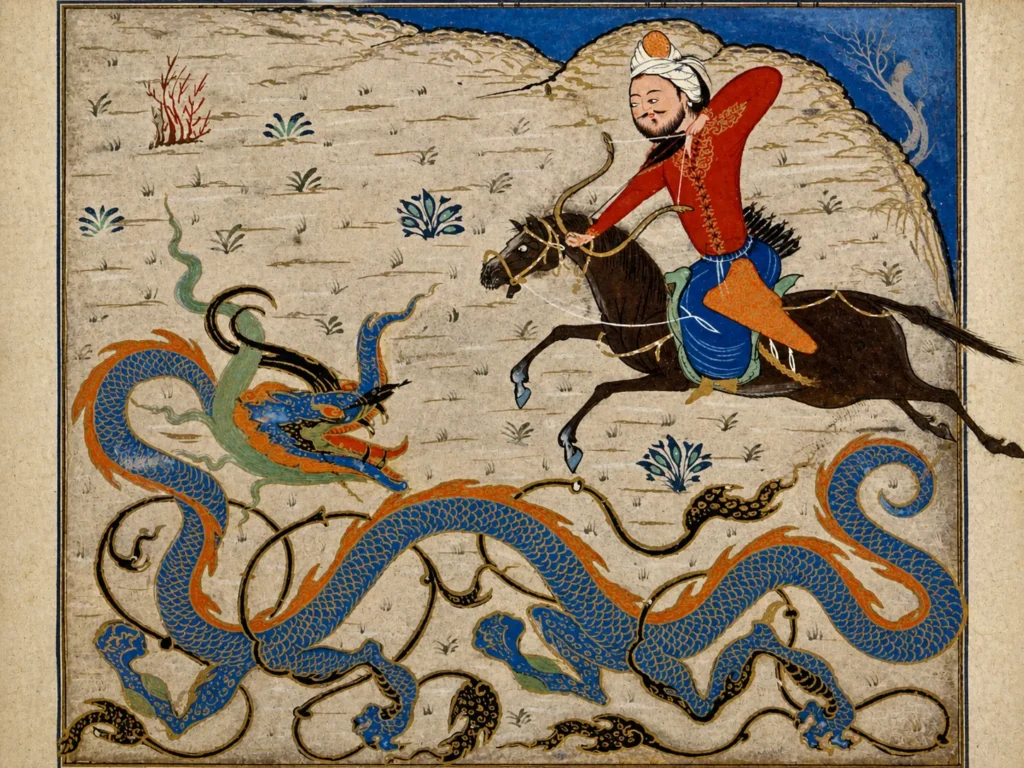
Aži Dahāka Myths, Legends, and Stories
Aži Dahāka plays a key role in the Shāhnāmeh and Zoroastrian end-times stories, where his story shapes the idea of the tyrant-serpent.
The Tyrant of Airyanem Vaejah
The legend of the fall of the righteous king Jamshid and the rise of the usurper follows a definitive sequence in the Shāhnāmeh.
Jamshid, having reigned for seven hundred years in peace, grew arrogant and claimed divinity, causing his khvarenah—the divine glory—to depart from him. It was then that the stranger from the Arabian lands, the son of Merdās, appeared, seduced by the dark counsel of the evil spirit.
The usurper arrived at the court of the disgraced king, who had been hiding from his own people. Aži Dahāka confronted the former monarch on the shores of the China Sea.
He did not speak with diplomacy but with the voice of a conqueror, declaring, “The crown of the world belongs no longer to the one who has turned his face from the light.” With a golden saw, the usurper severed the body of Jamshid in two, seizing his throne and establishing a reign of terror that plunged the world into shadow.
In the heart of this tyranny, the usurper dreamed of his own destruction at the hands of a young man named Fereydun. Driven by the fear that would define his rule, he searched for the child, destroying all who stood in his path.
During this time, the devil, disguised as a royal cook, kissed the shoulders of the tyrant. From those kisses, two black serpents sprouted, demanding to be fed with the brains of human youth. The tyrant, bound by the hunger of his own body, decreed that two young men be sacrificed each day to sate the creatures.
The narrative reaches its climax when Fereydun, having grown to manhood, marched against the capital with a great host. He wielded a mace carved with the head of an ox, the weapon of divine justice. As he reached the palace, the tyrant attempted to defend his throne, but his powers faltered before the hero’s purity.
Fereydun raised his mace to strike, yet a voice from the heavens, that of the angel Srosh, descended to command, “Do not strike him yet, for his time is not come. Bind him in chains and carry him to the peaks of Mount Damāvand, where the sun does not touch the stone.”
Bound in iron, the tyrant was cast into the mountain’s abyss, destined to remain until the final renovation of the world.
From Serpent to State-Crusher
In my research, I found that Aži Dahāka’s transitioned from a reptilian monster to a human-like tyrant marks an important shift in Iranian ideas about power and leadership.
Most histories focus on Aži Dahāka as a “dragon of chaos,” but I find it interesting that his later form, with snakes growing from his shoulders, acts as a symbol for corrupt power. He is no longer just an outside threat; he becomes the state itself, which survives by harming its own young people.
I believe that making Aži Dahāka into a demon helped protect Zoroastrian society. By showing the “Tyrant” as a three-headed, six-eyed monster, priests drew a clear line between good kings, who have divine glory, and selfish rulers.
The evolution from the Avestan dragon to Zahhāk in the Shāhnāmeh was a deliberate choice. It turned the pain of foreign invasions into the story of a monster who cannot be killed, only trapped.
I think Mount Damāvand was chosen as Aži Dahāka’s prison for a reason. The mountain is a volcano, and its sulfuric gases were seen as the monster’s foul breath.
The shift in Aži Dahāka’s identity also shows how outsiders were demonized. Sometimes his name was linked to the Dahae tribes or mistaken for an Arabic word. In this way, he became a symbol of the fears of settled people facing threats from outside.
He is the ultimate enemy both inside and outside: he talks like a ruler and wears a crown, but inside, he is made up of the same chaos that the religion wanted to destroy.
Aži Dahāka Powers and Abilities
Aži Dahāka is shown as having superhuman strength and strong magical powers over nature. His abilities are destructive, allowing him to alter the weather and cause societies to fall apart.
- Transformation: The ability to alter his external form to deceive or evade opponents.
- Weather Control: Manipulation of storms, droughts, and lightning to devastate agricultural production.
- Corruption: The capacity to spread sickness and metaphysical “stains” through his touch or presence.
- Necromancy: Influence over the dead and the ability to command other chaotic entities.
- Divine Resilience: An unnatural endurance that requires supernatural intervention to contain.
Rituals, Amulets, and Protective Practices
People needed protective rituals because the Bundahishn said Aži Dahāka was like a hidden disaster waiting to happen in Iran. These rituals were not meant to please him, but to keep his influence away from homes and to stop his evil from affecting the household spirit.
Incantations and Ceremonies
Main ceremonies focused on yazashne (worship) to keep Asha (Truth) as a protective force. To fight off demons, rituals often lasted three days and included a purification process. Priests used the Barsom, a bundle of metal or wooden rods, to help direct their ritual energy.
The incantations were heavily embedded in the Avestan language, emphasizing the containment of the “Serpent-Dahāka.” A core segment of these protective recitations, designed to banish the Druj (the Lie/Corruption), follows this structure:
Druj be gone, away from this house!
By the power of the Ahura-created light,
May the Three-Jawed One be bound to the cold stone.
Let the boundary of the threshold be sealed in iron,
Let the fire in this hearth burn against the shadow of the dragon.
This ritual worked by using the idea of “sympathetic exclusion.” By picturing Aži Dahāka trapped in the mountain, people hoped to keep him away from their own homes, too.
Amulets and Talismans
Protection focused on the entryway of the home. People made talismans from iron or lapis lazuli. Iron was chosen not just for its strength, but because it was seen as a metal that keeps the world stable against chaos. Lapis lazuli, with its deep blue and gold, looked like the night sky and stood for the order of Ahura Mazda, which Aži Dahāka tried to destroy.
These objects were not worn as decoration. Instead, people put them into the mortar above doors or buried them under the threshold. By placing iron under the floor, the homeowner made the entrance a “locked” area, tying the home to cosmic order and keeping the serpent-demon out.
Professional Practitioners
The Āšōzā (pure-handed ones) or special Magi performed these rituals. They worked to actively push back the demon, believing that demons never bargain—they only leave when faced with a stronger, more orderly power.
Their job was to do “astral mapping,” deciding if a family’s bad luck was just normal or caused by the demon. If it were the demon, they would bury iron tokens to “stake” the home and keep it safe from Aži Dahāka’s influence.
You may also enjoy:
Who Was Abezethibou, the Fallen Angel Who Opposed Moses?
October 1, 2025
What Is a Yūrei? The True Meaning of Japanese Ghosts
January 30, 2026
Who Is Al-Abyad? The White King Jinn Who Rules Love and Chaos
January 26, 2026
Who Is the Demon Andras, The Great Marquis of Discord?
January 15, 2026
Ammit: Devourer of the Dead in Ancient Egyptian Mythology
November 10, 2025
Bibliography
Author’s Note: I found that sources from the Avesta to the Shāhnāmeh show how Aži Dahāka switched from a symbol of chaos to a way of expressing political fears. By focusing on the older Zoroastrian texts, I could see the difference between the demon as a cosmic enemy and as a human tyrant. I let these sources disagree because the tension between myth and history is what makes Aži Dahāka so important.
- Baca-Winters, Keenan. The Last Battle: The Dēnkard and the Post-Zoroastrian World. Academia.edu.
- Geldner, Karl F., editor. Avesta: The Sacred Books of the Parsis. Stuttgart, 1896. Internet Archive.
- Dēnkard, the Acts of Religion, Book 3. Edited by Dastur Peshotanji Behramji Sanjana, 1876. English translation by Ratanshah E. Kohiyar, electronic edition prepared by Joseph H. Peterson, 1999. Avesta.org.
- Dēnkard, the Acts of Religion, Book 5. Edited by Dastur Peshotanji Behramji Sanjana, 1907. English translation, electronic edition prepared by Joseph H. Peterson, 1998. Avesta.org.
- Bundahishn: Zoroastrian Cosmogony and Cosmology. Translated by Edward William West, 1897. Electronic edition prepared by Joseph H. Peterson, 1997. Avesta.org.
- Ferdowsi. The Shahnama of Firdausi. Translated by Arthur George Warner and Edmond Warner, vol. 1, Kegan Paul, Trench, Trübner & Co., 1905. Internet Archive.
- Hourcade, Bernard & Tafażżolī, Aḥmad. DAMĀVAND. Encyclopedia Iranica. Published December 15, 1993. https://doi.org/10.1163/2330-4804_EIRO_COM_7990.