Many figures in demonology stand for a single vice, but Ravana is different. He combines great intelligence with an overwhelming ego. Rather than being a chaotic force, he is a disciplined ruler whose downfall comes from a loophole in a divine contract.
Unlike most spirits who oppose the divine by nature, he is actually a devoted follower of Shiva. This makes the conflict in the Ramayana a complicated mix of devotion and moral failure.
This article looks at translations of the Ramayana and the Shiva Purana to trace how this entity’s language and theology changed from ancient times to the Puranic era. [View Full Bibliography ↓]
Summary
Key Takeaways
| Attribute | Details |
| Names | Ravana, Dashanana, Dashagriva, Lankeshwar, Paulastya |
| Title | King of Lanka, Emperor of the Three Worlds, Lord of Rakshasas |
| Gender | Male |
| Role | Conqueror, Scholar, Devotee, Antagonist, Musician |
| Clan | Rakshasa (maternal) and Brahmin (paternal) |
| Followers | Rakshasas, Asuras, and the army of Lanka |
| Powers | Invincibility against gods/demons, shape-shifting, mastery of Maya, Vedic scholarship |
| Appearance | Commonly depicted with ten heads and twenty arms, towering stature, dark complexion |
| Etymology | Derived from the Sanskrit root ‘ru’, meaning “one of terrifying roar” |
| Associated Figures | Shiva, Brahma, Rama, Sita, Vibhishana, Mandodari, Kumbhakarna |
| Weaknesses | Vulnerability to humans and monkeys, the nectar of immortality in his navel |
| Opposing Deva/Avatar | Vishnu (in the form of the avatar Rama) |
| Pantheon | Hindu (Vedic and Puranic) |
| Primary Sources | Ramayana, Mahabharata, Bhagavata Purana, Shiva Purana |
Who or What is Ravana?
Ravana is a Rakshasa king who ruled the golden city of Lanka. Unlike lesser evil spirits, he was highly educated and respected, born to a high-caste sage and a Rakshasa princess. His ten heads stand for his deep knowledge of the four Vedas and six Shastras, showing that his intellect could match even the gods’ architects.
In Hindu cosmology, he is sometimes seen as Jaya, a gatekeeper of Vishnu’s home, who was cursed to be born on Earth as an enemy of the gods. This view means he is not just a villain, but a key entity needed for the Avatar to appear and restore cosmic order.
“Ravana” Meaning
The name comes from a myth about Mount Kailash. At first, he had other names, but the Uttara Kanda says Shiva himself gave him the name. In Sanskrit, “Ravana” means “he of the terrifying roar” or “one who causes others to cry.”
This change happened when the King of Lanka tried to lift Mount Kailash. Shiva pressed the mountain down with his toe, trapping the King’s arms. The King’s cry of pain and strength echoed through the three worlds for a thousand years.
Impressed by his endurance and the hymns he composed, especially the Shiva Tandava Stotram, Shiva gave him a name that showed his power to shake the universe with his voice. Over time, this name marked his shift from an ordinary Rakshasa leader to a famous creature known around the world.
How to Pronounce “Ravana” in English
In English, the name is usually said as RAH-vuh-nuh. The first part is stressed and sounds like “ah” in “father.” The other syllables are short and neutral. In many modern Indian languages, the last “a” is often silent, so it sounds like RAH-vun.
What Does Ravana Look Like?
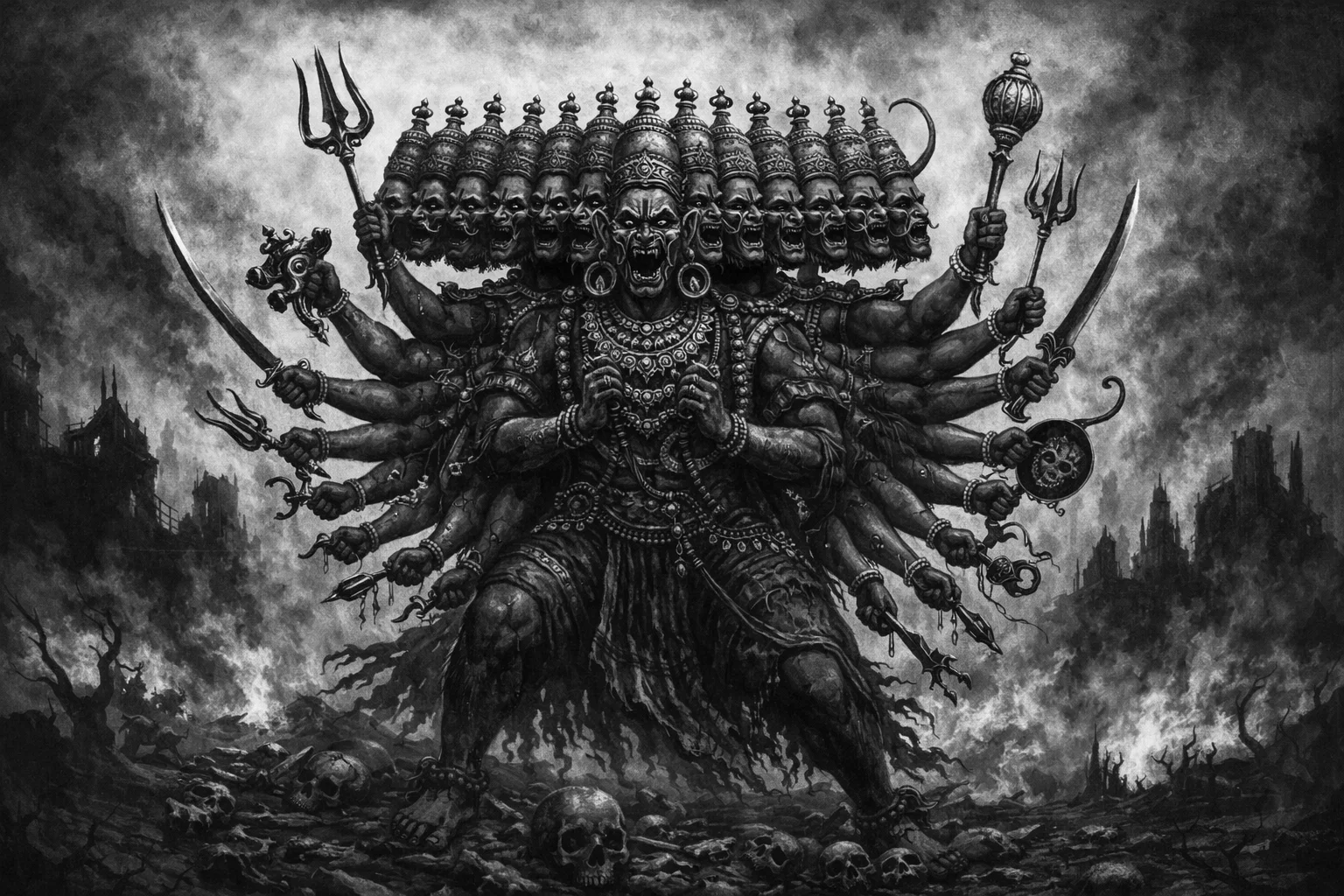
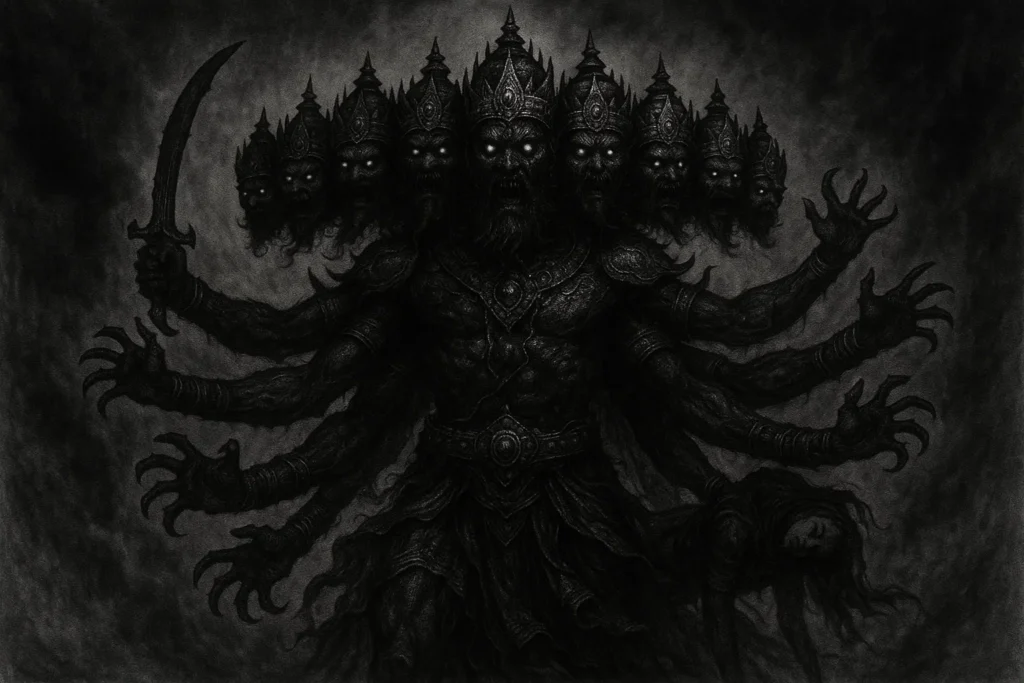
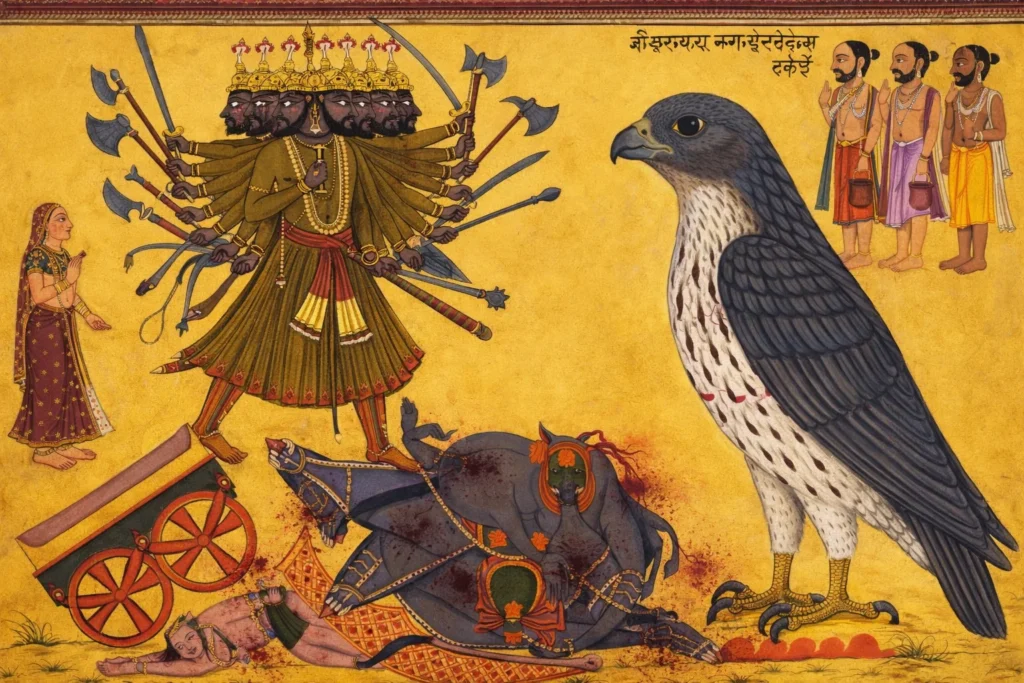
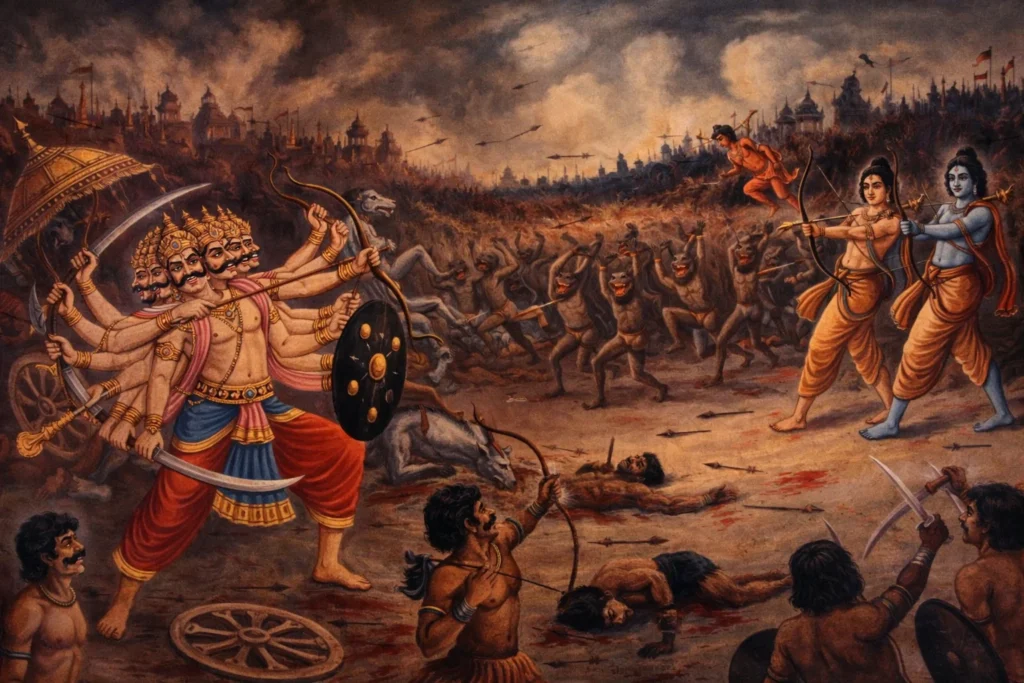
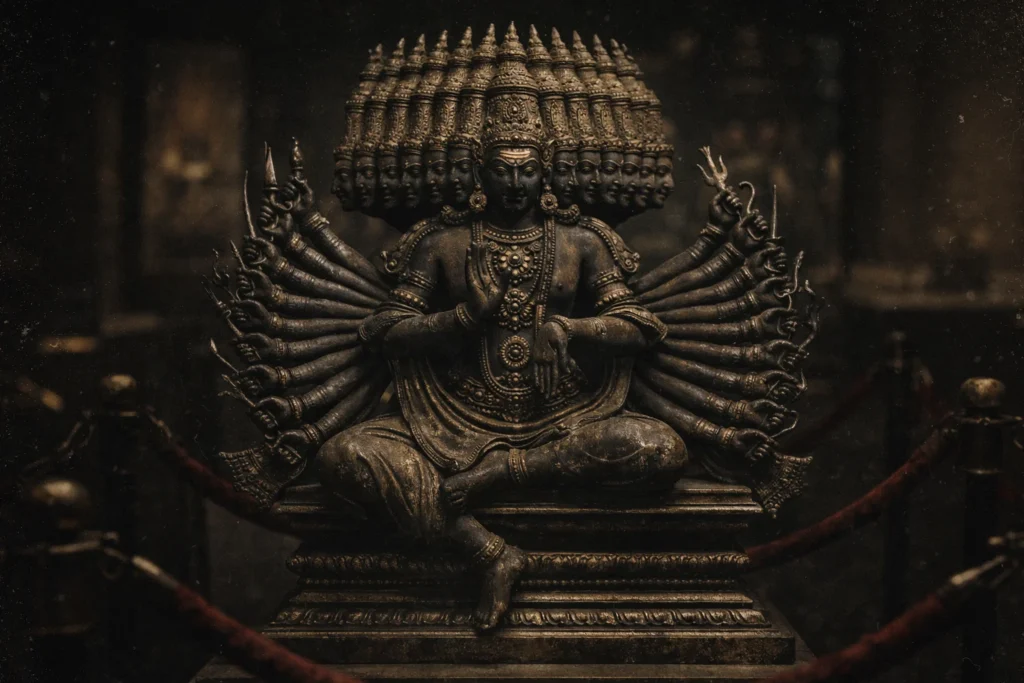
Ravana is best known for having many heads and arms. The Ramayana and other texts say he has ten heads and twenty arms. These heads are not just unusual features—they stand for his great knowledge and his ability to see in all directions. His skin is often described as dark, like charcoal or a storm cloud, which stands out against his bright gold jewelry and silks.
He is described as huge, like a mountain. His eyes are compared to red-hot coals, showing his fiery and unpredictable nature. In battle, he wears divine armor and uses many magical weapons, including the Chandrahas sword from Shiva. Even though he looks frightening, he is also said to be majestic. He can take on handsome human forms thanks to his metamorphosis powers.
Origins
The King of Lanka’s story starts with his unusual background. He comes from both a priestly family and the warrior-like Rakshasa race. This mix explains why he can be both deeply spiritual and fiercely ambitious.
He did not inherit his power; he earned it through intense penance and clever warfare. By gaining special boons from Brahma, he escaped the usual cycle of life and death and took the throne from his half-brother Kubera.
You may also enjoy:
Ambri: The Imperial Duchess of Caspiel’s Empire
December 1, 2025
Who Is Adrammelech in Demonology and the Bible?
October 1, 2025
Barbas: The Lion Demon Who Spreads Disease
March 3, 2026
Who Was Hiranyakashipu, the Demon King of Hindu Mythology?
October 6, 2025
Who Are the Yaksha, and Why Did Buddhists Fear Their Wrath?
October 20, 2025
What Is a Dīv? The Terrifying Giant Demon of Persian Myth
January 22, 2026
Birth
He was born during the Treta Yuga to the Brahmin sage Vishrava and the Rakshasa princess Kaikasi. His great-grandfather, Pulastya, was one of Brahma’s mind-born sons, placing him high in the Vedic hierarchy. His maternal grandfather, Sumali, was a Rakshasa king who sought to restore his people’s lost glory.
Sumali urged Kaikasi to marry Vishrava so their children would have both a sage’s wisdom and a demon’s strength.
When he was born, he was called Dashagriva, meaning “the ten-necked one.” With his brothers Kumbhakarna and Vibhishana, he learned both warfare and scripture from his father, becoming a top scholar of his time.
Family
His family played a key role in how he ruled Lanka. By marrying Mandodari, daughter of the divine architect Mayasura, he gained access to advanced technology and building skills. His relationships with his brothers showed the three Gunas: his own passion and ego (Rajas), Kumbhakarna’s laziness (Tamas), and Vibhishana’s purity (Sattva).
| Relation | Name(s) |
| Parents | Sage Vishrava and Princess Kaikasi |
| Siblings | Kumbhakarna, Vibhishana, Shurpanakha, Ahiravan, Khara, Dushana |
| Spouse | Mandodari (Chief Queen) |
| Children | Meghanada (Indrajit), Atikaya, Akshayakumara, Narantaka, Devantaka, Trishira |
Role in Hindu Cosmology
In the cycle of Dharma, the King of Lanka is the main opponent who makes it necessary for the divine to appear. His story shows that knowledge and devotion alone are not enough for freedom when mixed with ego. Ravana is not a “fallen” being like in Western stories, but a cosmic force whose actions restore the universe’s balance.
His story is also linked to Bhakti, or devotion, through opposition. Some traditions say that being killed by an Avatar of Vishnu gave him a kind of liberation that would have taken many lifetimes of peaceful worship.
In this way, he represents “Virodha-Bhakti,” or devotion through conflict, acting as the shadow that helps define Rama’s light.
The Shadow of the Polymath
Usually, the ten heads are seen as symbols for the four Vedas and six Shastras. But a closer look suggests they also represent a complex mind that eventually became too heavy and collapsed under its own weight.
In ancient Sanskrit psychology, he represents the ‘Vijñānamaya Kosha’ or wisdom layer, distinct from the ‘Anandamaya Kosha’ or bliss layer. This makes him a ruler of logic who can solve any problem but cannot see the moral impact of his actions. Ravana is not a mad demon, but someone whose extreme logic and ego lead him to believe he can defy the basic laws of the universe.
The change from calling him ‘Dashagriva’ (ten-necked) in early texts to ‘Lankeshwar’ (Lord of Lanka) in later stories shows how Vedic society’s view of outsiders changed over time. Lanka became a symbol for early warnings about the risks of a society ruled only by technology and without limits.
While the Devas can seem emotional or unpredictable, the King of Lanka is cold and efficient. His golden city is not just a sign of wealth, but a symbol of a place where nature has been completely controlled by intellect. This is similar to the Prometheus story in the West, but with a Dharmic twist: he knows the divine order and still tries to challenge it by using loopholes in his boons.
This inner struggle connects old demon stories to modern ideas about systems. Ravana stands for the idea of a system—like an empire or a mind—that becomes so complex and confident that it ignores small, simple things, which eventually cause its downfall.
When he asked for invincibility, he ignored humans and monkeys, showing the blind spots of the powerful. Looking at this choice, we see a criticism of how intellectuals sometimes overlook basic, real-world facts in favor of abstract or higher ideas.
Historical & Folkloric Records
The ten-headed king is a key entity in Hindu stories, but his character changes a lot over time. Ravana goes from being a mysterious, shadowy monster to a complex and tragic ruler in different Sanskrit and regional texts.
Original:
“tataḥ sa dadṛśe tatra rākṣasendraṃ mahābalam
daśagrīvaṃ mahāvīryaṃ rākṣasaiḥ parivāritam
daśagrīvaṃ viṃśatibhujaṃ darpād uccārayantam
rakta-nayana-saṃyuktaṃ dīpta-pāvaka-saṃnibham” [Valmiki Ramayana, Aranya Kanda, c. 5th–4th Century BCE]
Translation:
“Then he saw there the mighty Lord of the Rakshasas, the ten-necked one of great prowess, surrounded by Rakshasas. He had ten necks and twenty arms, shouting aloud in his pride, with blood-red eyes, resembling a blazing fire.”
This important epic text has set the central image of him that has lasted for over two thousand years. The focus on his ‘ten necks’ (Dashagriva) is a symbol for his huge senses and intellect.
Early on, Ravana is shown to have great power, but also arrogance. The ‘blazing fire’ comparison is important in Vedic culture, where fire is usually sacred. Still, here it is twisted into something that destroys instead of purifies.
The change from Vedic Asura (which once meant a powerful being or god) to epic rakshasa (a demon or night-stalker) shows how morals changed in ancient India.
Earlier, these beings were like natural forces. Still, now he is shown with human traits like pride, loyalty to family, and a desire for power. The Aranya Kanda describes him at his most intimidating, just before his fall.
Original:
“yo vai śiva-bhakti-rataḥ sadā sa puruṣaḥ śubhaḥ
tasyāpi rāvaṇasyāpi śiva-bhaktiḥ sudurlabhā
tataḥ śivaḥ suprasanno dattva tasmai varān bahūn
candrahāsam iti khyātaṃ khaḍgaṃ tasyai dadau prabhuḥ” [Shiva Purana, Kotirudra Samhita, c. 10th–11th Century CE]
Translation:
“That man who is ever devoted to Shiva is auspicious; even for that Ravana, devotion to Shiva was most difficult to attain. Then Shiva, being well-pleased, granted him many boons; the Lord gave him the sword famous as Chandrahas.”
This medieval Puranic text shows him as a supreme devotee, or Mahabhakta. This is a big change from earlier stories. In the Shiva Purana, he is not just a monster to be defeated, but a complex religious entity whose devotion is so great that Shiva grants him divine weapons.
The Chandrahas sword, or Moon-blade, stands for the cool, mystical power given to a fiery and unpredictable king. This mix—a destructive ruler with a divine gift—shows the main tension in his story: Ravana has divine tools but not the moral restraint to use them for good. This era’s writing shows a shift toward Bhakti, in which even villains can attain divinity through devotion and ritual.
“The Lord of Lanka is not a demon to be burned, but a King to be remembered. He was the greatest of the Vaidyas (physicians), the master of the Veena, and the one who knew the movements of the stars before they moved. We do not celebrate his fall, but honor the wisdom that was lost when the ten heads ceased to speak.” [Oral Folklore Tradition of the Bisrakh Region / Southern Sri Lankan Apocrypha, Collected 19th–20th Century]
This local view is a folkloric source that runs counter to the usual demon story found in religious texts. Here, Ravana is seen as a symbol of lost greatness. The focus is not on his twenty arms for war, but on his music skills with the Veena and his role as a doctor.
These local stories suggest he may have been based on real tribal or non-Vedic kings who were later turned into ‘Rakshasas’ by Vedic culture. In this view, his ten heads mean mastery over the ten directions or ten sciences, not a real physical trait. This version tells a different story, showing him as a tragic hero or fallen sage, not just a symbol of evil.
Myths, Legends, and Stories
The Penance for Invincibility
Wanting to rule the three worlds, he did a long and difficult penance to Brahma on Mount Gokarna. For thousands of years, Ravana practiced strict self-denial, burning one of his heads in the fire at the end of each thousand years. When he was about to burn his last head, Brahma appeared, impressed by his determination.
Brahma gave him back his heads and granted him near-invincibility. The King asked not to be killed by gods, Gandharvas, Asuras, or spirits. In his pride, he thought humans and animals were too unimportant to mention, which became the weakness that Rama and his monkey allies would later use against him.
You may also enjoy:
What Is a Tengu? Origins, Powers, and Dark Folklore
January 29, 2026
Who Are the Yaksha, and Why Did Buddhists Fear Their Wrath?
October 20, 2025
Apophis: The Great Serpent of Egyptian Chaos
November 11, 2025
Who Was Hiranyakashipu, the Demon King of Hindu Mythology?
October 6, 2025
The Abduction of Sita in the Ramayana
The most important story is about the kidnapping of Sita, Rama’s wife. After Lakshmana injured his sister Shurpanakha, the King wanted revenge. He used the Rakshasa Maricha, who turned into a golden deer to distract Rama and Lakshmana, then went to Sita’s hut disguised as a wandering monk.
When Sita stepped outside the protective circle Lakshmana had drawn to give alms, he showed his true form and took her by force to Lanka in his flying chariot, the Pushpaka Vimana. This act of wrongdoing sparked the Great War, which would end with his defeat.
The Lifting of Mount Kailash
Pushed by his pride, the King once tried to move Mount Kailash, Shiva’s home, because it blocked his chariot. As he tried to lift the mountain, the earth shook and Parvati, Shiva’s wife, became afraid.
To teach him a lesson, Shiva pressed the mountain down with his toe, trapping the King’s arms. Realizing his mistake and Shiva’s power, the King began to praise Shiva. Ravana stayed like this for a thousand years, composing the Shiva Tandava Stotram. Shiva, touched by his devotion and song, freed him and gave him the divine sword Chandrahas.
Ravana vs Other Asuras
| Asura Name | Associated Trait/Role | Clan/Origin | Key Traits/Powers |
| Bali | Sacrifice/Kingship | Daitya | Immense merit, ruled three worlds |
| Hiranyakashipu | Hatred of Vishnu | Daitya | Boon of conditional immortality |
| Vritra | Drought/Resistance | Vedic | Formidable dragon/serpent |
| Mahishasura | Shapeshifting/Fury | Buffalo Asura | Change forms, defeated gods |
| Bhasmasura | Self-Destruction | Puranic | Ash-turning touch |
| Tarakasura | Oppression | Daitya | Could only be killed by Shiva’s son |
| Rahu | Eclipse/Chaos | Asura | Immortal head, swallows the sun |
| Narakasura | Tyranny | Bhauma | Son of Bhudevi, hoarded treasures |
| Madhu | Primordial Ego | From Vishnu’s ear | Ancient strength |
| Kaitabha | Primordial Ego | From Vishnu’s ear | Ancient strength |
| Andhaka | Blind Desire | Shiva’s offspring | Multiplied from blood drops |
| Jalandhara | Purity-linked Power | Born of Ocean/Fire | Invincible while wife was chaste |
Rank Among Asuras
The King of Lanka is regarded as the epitome of Rakshasa culture. While other Asuras like Bali are known for their devotion or violence, he stands out as a skilled leader and scholar. He turned Lanka from a wild land into a golden city, showing greater skill in ruling and building than others of his time.
He was respected not only for his military power but also for his intellect. Many say he was equal to the Devas in understanding the universe. He did not want to destroy the world, but to take Indra’s place as king of the heavens, believing he deserved it more than the gods.
Mystical Correspondences
| Attribute | Details |
| Planet | Mars (Mangala) |
| Zodiac Sign | Aries (Mesha) |
| Element | Fire (Agni) |
| Direction | South (associated with Yama and Lanka) |
| Color | Black and Deep Red |
| Number | 10 (for the ten heads) |
| Crystal/Mineral | Ruby and Blue Sapphire |
| Metal | Gold and Iron |
| Herb/Plant | Bael (associated with Shiva worship) |
| Animal | Donkey or Elephant |
| Trait/Role | Sovereignty and Intellectual Ego |
The King of Lanka’s power is linked to the heavens, especially to Mars, which stands for war and aggression. Mars drives his battles, making him a strong and unstoppable fighter against the Devas. Ravana’s connection to Aries shows his fiery ambition and constant drive for power. These cosmic links make him a skilled general who can lead both earthly and heavenly armies.
Ravana is also linked to the fire element, showing both his strong ambition and the fires used in his penance. In the Ramayana, his anger is like a fire that could destroy the world. This fire also relates to his ten heads, which symbolize his many forms of intelligence.
In some stories, a donkey on his chariot stands for his stubbornness, while the elephant shows his royal power. These symbols show that he is both refined and dangerously unpredictable.
Worship and Boons
The King’s power mainly came from Tapasya, or deep penance. He and his brothers did penance for 10,000 years to please Brahma. His strong devotion earned him near-invincibility. He also mastered the Sama Veda and used music to worship Shiva.
In some regions of India and Sri Lanka, people do not burn his effigy but honor him as a great scholar and Shiva devotee. Their rituals focus on his roles as a protector and an expert in medicine and astrology, recognizing that, even though he made mistakes in the Ramayana, his impact on the arts and sciences was extraordinary.
You may also enjoy:
Who Is Futakuchi-onna, the Two-Mouthed Woman?
March 9, 2026
Who Was Hiranyakashipu, the Demon King of Hindu Mythology?
October 6, 2025
Who Was Abezethibou, the Fallen Angel Who Opposed Moses?
October 1, 2025
Arāti: The Beautiful Demon of Aversion in Buddhist Mythology
October 15, 2025
Edimmu: The Mesopotamian Wind Demon That Steals Life
November 6, 2025
What Is the Akkorokamui, Japan’s Colossal Sea Monster?
November 14, 2025
Bibliography
Author’s Note: While putting together this profile, I noticed a strong tension between the precise rules governing the boons in the Bhagavata Purana and the emotional, almost tragic devotion shown in the Siva Purana. The Uttara Kanda stands out as the key link, turning a typical villain into a story about generations of ambition and intelligence. I made sure to keep his identity as a top Vedic scholar at the center, since this is often lost in Western summaries that focus only on his role as a ‘Rakshasa.’
- Dutt, Romesh C., translator. The Ramayana: The Epic of Rama, Prince of India. Condensed into English Verse, 1899. Ancient Buddhist Texts, edited by Ānandajoti Bhikkhu, 2018.
- Shastri, J. L., editor. The Siva-Purana, Part 1. Translated by a Board of Scholars, Motilal Banarsidass, 1970. Internet Archive.
- Shastri, J. L., editor. The Siva-Purana, Part 4. Translated by a Board of Scholars, Motilal Banarsidass, 1970. Internet Archive.
- Ganguli, Kisari Mohan, translator. The Mahabharata of Krishna-Dwaipayana Vyasa. Edited and published by Pratap Chandra Roy, Bharata Press, 1883-1896. Internet Archive.
- Goyandka, C. L., editor. The Bhagavata Purana. Translated by a Board of Scholars, Gita Press, 2019. Internet Archive.
- Dutt, Manmatha Nath, editor and translator. The Rāmāyana, Volume 4: Uttara Kānda. Edited by James Simmons, Project Gutenberg, 2020. Project Gutenberg. Originally published in Calcutta, 1894.
- Study.com. Ravana: The Demon King in Hindu Mythology. Edited by Study.com, 2023.