Most adversaries in Vedic literature are external threats to the cosmos, but Hiranyakashipu, the Daitya king, stands out. He represents the struggle between human laws and divine presence. Instead of just fighting the gods, he tries to make them powerless by asking for a boon that gives him ‘legal immunity’ from death.
Unlike most Asuras who use brute strength, Hiranyakashipu’s rebellion is clever and bureaucratic. His actions force the Supreme Deity to appear in a form that slips through the loopholes of his own rules.
In this article, I use translations of the Bhagavata Purana and Vishnu Purana to trace how the story and meaning of Hiranyakashipu changed from ancient times to the Puranic era. [View Full Bibliography ↓]
Summary
Key Takeaways
| Attribute | Details |
| Names | Hiranyakashipu, Hiranyakasipu, Kaśipu |
| Title | King of the Daityas, Emperor of the Three Worlds, Lord of the Asuras |
| Gender | Male |
| Role | Universal Tyrant, Persecutor of Devotees, Rival of the Devas |
| Clan | Daitya |
| Followers | Asuras, Rakshasas, and the Daitya army |
| Powers | Invulnerability to standard mortality, Mystical Tapasya, Reality-warping through boons |
| Appearance | Towering stature, golden radiance, fierce eyes, and bejeweled armor |
| Etymology | Sanskrit for “Clothed in Gold” or “One on a Soft Bed” |
| Associated Figures | Hiranyaksha (Brother), Prahlada (Son), Brahma (Boon-giver), Holika (Sister) |
| Weaknesses | Legal loopholes in his boon, the threshold of a building, twilight hours |
| Opposing Deva/Avatar | Narasimha (The Half-Man, Half-Lion incarnation of Vishnu) |
| Pantheon | Hindu (Puranic and Vedic) |
| Primary Sources | Bhagavata Purana, Vishnu Purana, Mahabharata, Harivamsa |
Who or What is Hiranyakashipu?
Hiranyakashipu is a Daitya king and a key entity in ancient Indian Puranic traditions. As the older of two brothers, he shows the height of Asuric power through strict discipline and asceticism. He is not a mindless monster, but a smart strategist and expert in Vedic law, using his knowledge to ask for a boon that nearly makes him immortal.
During his rule, he turns the cosmic order upside down by making everyone worship him instead of the traditional Devas. This leads to a personal conflict with his son, Prahlada, which becomes a key story about faith and the return of Dharma.
“Hiranyakashipu” Meaning
The name comes from two Sanskrit words: ‘hiranya’ means ‘gold,’ and ‘kashipu’ means ‘cushion,’ ‘soft bed,’ or ‘clothing.’ Together, the name means ‘one who is clothed in gold’ or ‘one who rests on a soft bed.’ Researchers see this as a symbol of his focus on wealth, comfort, and pleasure.
Over time, the name came to stand for a materialistic ego that ignores the spiritual. In the Bhagavata Purana, it also refers to someone who cares only about wealth and sensual pleasure, which are the main things Hiranyakashipu tried to make last forever during his rule.
Different regional texts spell his name variously, such as Hiranyakasipu in South Indian records, but the main meaning remains the same. It always points to his golden appearance and the luxury of his court.
How to Pronounce “Hiranyakashipu” in English
In English, the name is pronounced hi-RUN-ya-ka-SHEE-poo. Stress the second syllable, ‘RUN,’ and the fourth, ‘SHEE.’ The ‘h’ is soft, like in ‘history.’ The ‘a’ sounds are short, as in ‘cup,’ and the final ‘u’ is long, like in ‘too.’
What Does Hiranyakashipu Look Like?
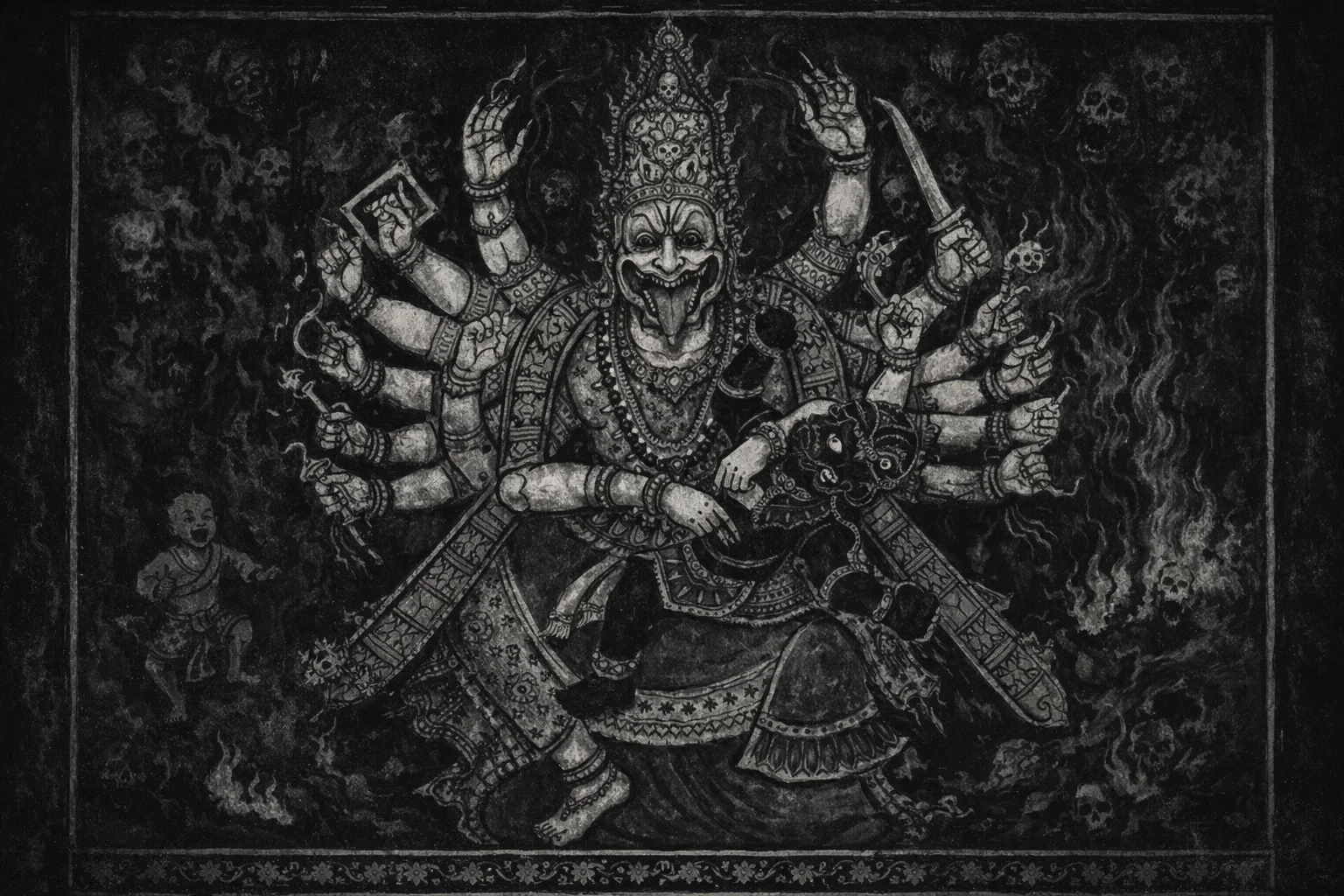
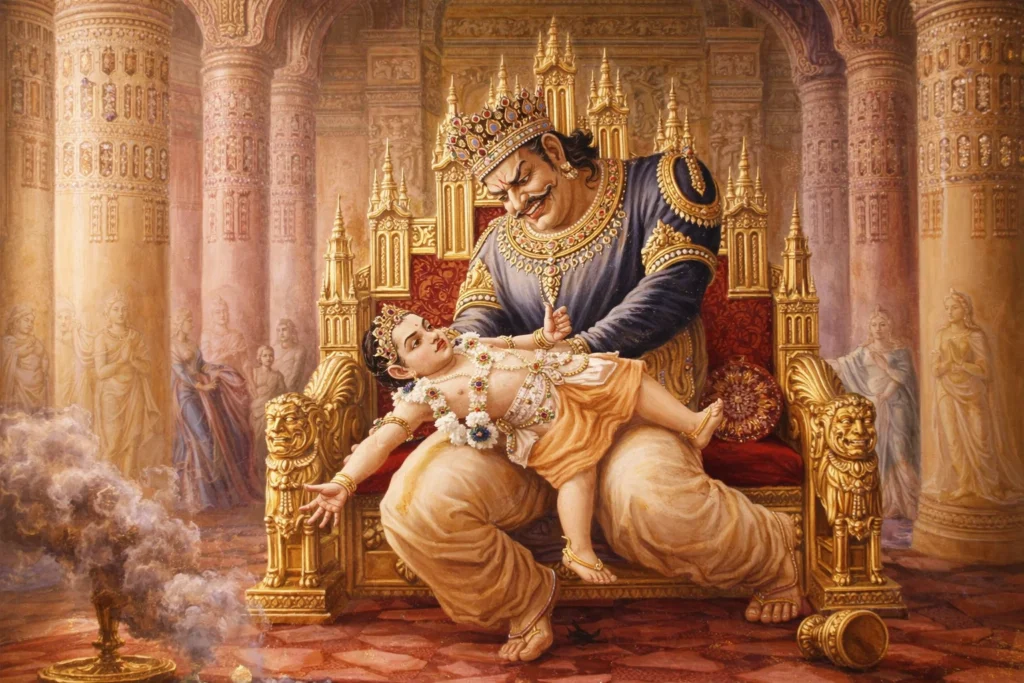
Classical texts describe the Asura as a huge and impressive entity. His body glows golden, fitting the meaning of his name. In the Srimad-Bhagavatam, his presence is so strong that his angry gaze is said to make the sky smoky. He has fierce, fiery eyes and eyebrows that are always drawn together in a proud frown.
He is usually shown wearing golden armor covered in jewels and a large crown, showing his rule over the three worlds. In battle, he uses a powerful trident or mace, and he is so strong that he can break stone pillars with a single blow.
His teeth are sharp and frightening, and he is often pictured biting his lips in anger. Even after his death, stories say his face kept its lotus-like beauty, though it was covered in dust from his last fight with the divine.
Historical & Scriptural Records
“Diti’s son, the King of the Daityas, became very powerful. He conquered the three worlds and took up residence in the heavenly planets. He lived in the palace of King Indra, which had been constructed by the celestial architect Viśvakarmā. The palace was so opulent that it surpassed all others in the universe. There, he controlled everyone, including the administrative demigods, and forced them to bow down to his feet.” [Bhagavata Purana (Srimad-Bhagavatam), Canto 7, Chapter 3, Approx. 8th–10th Century CE]
This scripture shows that he is not just a ‘demon’ in the Western sense, but a cosmic usurper who takes over the universe’s main seat of power.
The fact that Viśvakarmā, the divine architect, built his palace highlights a key point: he does not create his own world of darkness; instead, he takes over the world of light. This fits the Puranic idea that Adharma, or unrighteousness, is a twist of the existing order rather than something separate.
The text highlights his political and bureaucratic control over the Devas. In this period of Sanskrit literature, his story shows that even the greatest material success and ‘celestial’ life mean little without spiritual devotion.
Making the demigods ‘bow down’ to him stands for the ego’s short-lived victory over natural laws through Tapasya, or ascetic effort.
“The Great Asura, having obtained the boon from Brahma, became invincible. He could not be slain by any created being, nor by any weapon, nor during the day or the night. He then brought the three worlds under his subjection, and prohibited the performance of all religious rites, declaring himself to be the only object of worship. He took the sun, the moon, the wind, and the fire under his own command.” [Vishnu Purana, Book I, Chapter XVII, Approx. 1st–4th Century CE]
The Vishnu Purana gives a clear, legal-like outline of his power. The main focus is the Boon of Brahma, an ancient thought experiment on the limits of logic. He tries to use words to make himself ‘deathless’ by ruling out every way he could die—by time, place, species, or weapon. This shows a shift from the simple battles of the Vedas to the more complex, philosophical struggles of the Puranic era.
His control over the elements like the sun, moon, and wind shows that he stands for total control over the material world. By making himself the ‘only object of worship,’ he shows the ego at its highest, where a person sees themselves as the Creator. This story likely influenced later ideas of the ‘God-King’ in Southeast Asia, where rulers tried to copy this kind of Asuric power.
“Hiranyakasipu’s sister Holika had a boon that she would not be burnt by fire. Taking the child Prahlada on her lap, she entered a bonfire to consume him. But by the grace of the Lord, the fire did not touch the boy, while the demoness was reduced to ashes. Since that day, the festival of the pyre has been celebrated to mark the victory of the devotee over the tyrant.” [Regional Oral Tradition / Folkloric Recitation of the Holika Dahan, Recorded in various Medieval Vernacular Commentaries, Approx. 12th–14th Century CE]
This folk story brings in Holika, a character who is not often mentioned in the main Sanskrit debates. It shows how the story moves from a palace-centered conflict to a community ritual. The ‘Child-to-Fire’ theme is a symbol of the ‘Ordeal by Fire,’ a common way in many cultures to prove someone’s divine favor.
Focusing on the sister’s ‘protective shawl’ or her fire immunity adds a sense of family betrayal to his story. It shows that he even used his own family against his son.
The lasting belief that burning an effigy cleanses the community of bad luck shows how his story changed from that of a real king to a symbol of the ‘internal enemy’ or ‘evil eye’ that people try to get rid of each year.
Origins
His story starts with a cosmic mistake. The Bhagavata Purana says he and his brother were once Jaya and Vijaya, gatekeepers of Vaikuntha.
When they blocked the four Kumaras, who looked like children, they were cursed to be born on earth. To return to their lord sooner, they chose to be born as enemies and became part of the Daitya clan.
Early in his life, his younger brother Hiranyaksha was killed by the Varaha avatar. This loss made him hate Vishnu deeply and pushed him to seek power so that nothing like this could happen to him.
You may also enjoy:
Who Is Aka Manto, Japan’s Terrifying Red-Cloaked Yōkai?
October 24, 2025
Ancient Demons: The Real Origins of the Setcheh Myth
November 11, 2025
Ammit: Devourer of the Dead in Ancient Egyptian Mythology
November 10, 2025
Ifrit: Demon of Fire Who Serves Iblis in Islamic Tradition
September 30, 2025
Who Is Arioch, the Demon of War and Vengeance?
January 21, 2026
Vaisravana: The Golden Guardian King Who Rules the North
October 16, 2025
Birth
He was born to the sage Kashyapa and the goddess Diti. His birth happened at twilight, a time seen as unlucky for having children in Vedic culture. Diti insisted on having children at this time, against her husband’s advice, so their children were destined to be powerful but dark-hearted.
As the child of a great sage, he was born with natural knowledge and the chance for holiness. But his Daitya heritage led him to want to conquer the physical world. His birth is often seen as the start of a dark age for the Three Worlds, when the Asuras began to take over.
Family
The Daitya king’s family is key to his story, especially the difference between him and his good-hearted wife, Kayadhu. He stands for ego, while she stands for grace. Their most famous child, Prahlada, became his main rival because the boy stayed loyal to the king’s enemy.
| Relation | Name(s) |
| Parents | Sage Kashyapa (Father) and Diti (Mother) |
| Siblings | Hiranyaksha (Brother) and Holika (Sister) |
| Spouse | Kayadhu |
| Children | Prahlada, Anuhrada, Hrada, and Samhrada |
Role in Hindu Cosmology
In the cycle of Dharma, he is the ultimate ‘test’ of the cosmic order. He is the biggest challenge to Vishnu’s protection in the Krita Yuga. By getting a boon that blocked almost every way he could die, he forced the universe to create a new form, Narasimha, to stop him.
During his rule, Adharma, or unrighteousness, reaches its highest point, making a cosmic ‘reset’ necessary. He is not just a villain, but someone who tries to show that human or Asuric intelligence can beat divine law. His defeat is more than just his death—it proves that Dharma cannot be avoided by clever tricks.
The Boon as a Constitutional Crisis
The Daitya king’s importance goes beyond myth. He also plays a part in ancient political philosophy and legal theory. His talk with Brahma is like a ‘Constitutional Crisis’ in the Vedic world. By asking for a boon that lists what cannot kill him, instead of what can, he tries to create a special legal exception for himself.
In political theory, this is like Carl Schmitt’s idea of the Sovereign—the one who decides on exceptions. The Daitya king did not just want power; he wanted to live outside the laws of nature set by the Creator.
This story is a deep critique of human or Asuric legalism and the limits of language. Hiranyakashipu thought that by covering every possible category—inside or outside, man or beast, day or night—he could make himself immortal. In the end, his defeat is really an intellectual loss.
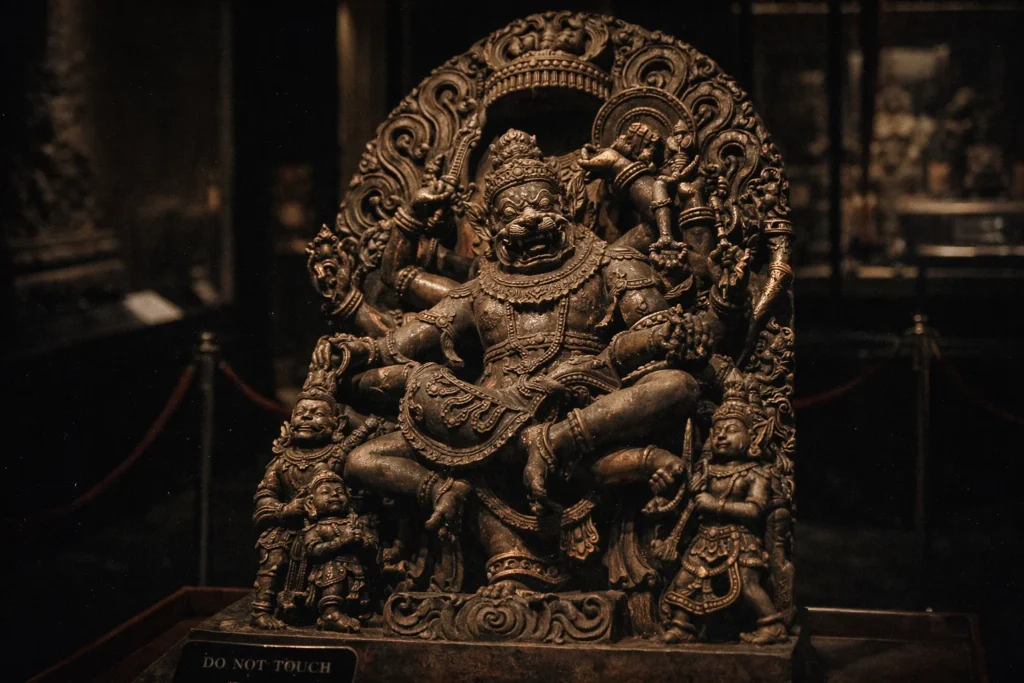
When the Supreme Deity appears as Narasimha, the ‘Half-Man, Half-Lion,’ it is a kind of loophole that gets around the king’s strict rules. Narasimha is not a ‘created being’ in the usual sense or any species the king listed in his boon. This shows that the highest power in the universe follows the ‘spirit of the law’ rather than the exact words and can create new forms to fix problems.
From a psychological perspective, this struggle is akin to the ‘Inflation of the Ego’ in Jung’s ideas. The king stands for the part of us that tries to control everything through willpower and cleverness, eventually seeing itself as the center of reality. By refusing to accept any power greater than his own ‘golden’ self, his world falls apart—shown by his own son turning against him.
This family conflict reflects his own divided mind. His ‘Material Self,’ or body, is finally destroyed by his ‘Spiritual Shadow,’ Narasimha, right at the doorway of his house—the line between his private ego and the outside world.
Myths, Legends, and Stories
The Great Penance of Hiranyakashipu
To get revenge for his brother’s death, the king went to Mount Mandara and did a great act of tapasya, or ascetic penance. He stood on his toes with his arms raised to the sky and stayed still for centuries.
His penance was so intense that the heat from his body started to burn the heavens, making the gods run away. Ants built a mound over him, and grass grew through his skin, but his life force stayed strong in his bones. Lord Brahma, both impressed and worried, appeared to grant him a boon.
The king asked for immortality, but since that was not allowed, he asked for a set of conditions instead: he could not be killed by any being created by Brahma, not inside or outside, not during the day or night, not on the ground or in the sky, and not by any weapon, human, or animal.
You may also enjoy:
What Is a Pishacha, the Flesh-Eating Demon of the Dead?
February 11, 2026
Who Is Barqan, The Powerful Jinn King?
March 12, 2026
Mahabali (Bali): The Benevolent Asura King
October 10, 2025
Who Is Ariton (Egyn), the Infernal King of the Eastern Gate?
February 17, 2026
Amaymon: The Infernal King Who Commands Death and Decay
November 17, 2025
Mahakala: The Dark Guardian Who Consumes Evil
October 16, 2025
The Persecution of Prahlada
While the king was away doing penance, his wife Kayadhu stayed with the sage Narada. Their son Prahlada, still in the womb, heard Narada’s teachings and became a follower of Vishnu. When the king returned and learned of his son’s faith, he saw it as a betrayal.
Hiranyakashipu tried to change Prahlada through education, but when that did not work, he ordered his execution. Prahlada was thrown off cliffs, trampled by elephants, and bitten by snakes, but he was always protected by the divine.
The Legend of Holika Dahan
As a last effort to kill his son, the king asked his sister Holika, who had a magical shawl that protected her from fire, to help. She sat in a bonfire with Prahlada on her lap, planning for him to burn while she stayed safe.
But because of Prahlada’s purity and Holika’s bad intentions, the shawl flew off her and covered Prahlada. Holika was burned to ashes, but Prahlada came out unharmed. This story is the origin of the Holi festival, which celebrates the defeat of evil.
The Manifestation of Narasimha
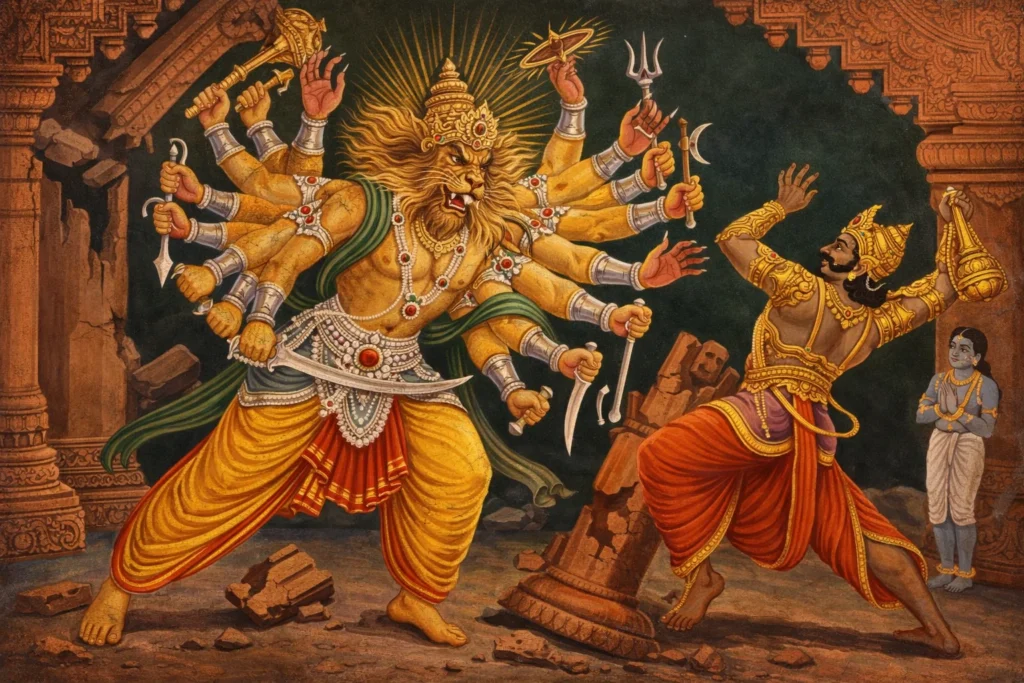
The story reaches its peak when the king, angry that his son survived, tells Prahlada to prove that Vishnu is real. He points to a stone pillar in the palace and asks if the god is inside.
When Prahlada says yes, the king hits the pillar with his mace. The pillar breaks open, and Narasimha, a being with a man’s body and a lion’s head, comes out.
Narasimha pulled the king to the palace doorway, which is neither inside nor outside, at twilight, which is neither day nor night. He put the king on his lap, which is neither earth nor sky, and used his claws—not a man-made weapon—to kill him. In this way, Narasimha met every condition of the boon and still ended the king’s life.
Comparison with Other Similar Entities
| Asura Name | Associated Trait/Role | Clan/Origin | Key Traits/Powers |
| Ravana | Ego and Conquest | Rakshasa | Ten heads, celestial weapons |
| Mahishasura | Deception and Shape-shifting | Asura | Buffalo form, immunity to men |
| Bali | Sacrifice and Piety | Daitya | Universal charity, immense power |
| Vritra | Drought and Obstruction | Asura | Dragon-like form, anti-Indra |
| Bhasmasura | Destructive Greed | Asura | Touch that turns to ash |
| Tarakasura | Terrorizing Devas | Daitya | Boon of death only by Shiva’s son |
| Andhaka | Blindness and Desire | Asura | Each blood drop creates a clone |
| Narakasura | Tyranny and Filth | Asura | Son of Earth, kidnapped 16,000 women |
| Madhu | Ignorance | Asura | Born from Vishnu’s earwax |
| Kaitabha | Arrogance | Asura | Born with Madhu, chaos entity |
| Kamsa | Fear and Usurpation | Asura (reincarnated) | Great physical strength |
| Bana | Warlike Pride | Asura | Thousand arms, devotee of Shiva |
Rank Among Asuras
In demonology, he ranks as high as figures like Ravana. As Emperor of the Daityas, he is more than a local ruler—he is a cosmic king who defeated Indra and made the planetary gods serve in his kitchens and courts. His rule marks the highest point of Asuric power in the Satyayuga.
He had complete authority over other Asuras. He led the Rakshasas and Danavas, bringing together the various underworld clans under a common anti-theist cause. His fight with the Devas was not just about land, but about challenging the universe’s order of sacrifice.
Mystical Correspondences
| Attribute | Details |
| Planet | Saturn (Constraint and Law) |
| Zodiac Sign | Capricorn (Ambition and Structure) |
| Element | Earth (Materialism) |
| Direction | South (Direction of Yama/Death) |
| Color | Gold and Deep Purple |
| Number | 8 (The number of boundaries) |
| Crystal/Mineral | Pyrite (Fool’s Gold) |
| Metal | Gold |
| Herb/Plant | Mustard Seeds (Used in protective/destructive rites) |
| Animal | Lion (as his nemesis) or Elephant |
| Trait/Role | Material Ego, Intellectual Arrogance |
His cosmic connections are to Saturn, which represents the cold, strict, and limiting side of law. Saturn drives his focus on the exact wording of his boon, showing a life ruled by strict rules.
His zodiac sign, Capricorn, gives him a steady ambition to build an everlasting earthly empire, matching the sign’s link to material power and the endurance he showed in his penance.
He is connected to the earth element, showing his complete rejection of the spiritual for the physical world. This is seen in his stone palace and golden armor, which stand for a heart closed off from divine grace.
In Vedic cosmology, he is linked to the South, the direction of the dead, showing that his golden path leads to destruction. His connection to the number 8 highlights his aim to rule all eight directions of the world.
You may also enjoy:
Hitotsume kozō: One-Eyed Yōkai of Japanese Folklore
February 4, 2026
Ancient Demons: The Real Origins of the Setcheh Myth
November 11, 2025
Who Is Futakuchi-onna, the Two-Mouthed Woman?
March 9, 2026
Bibliography
Author’s Note: While putting this research together, I caught a contrast between the simple, ritual-based descriptions in the Brahmanas and the dramatic stories in the Bhagavata Purana. The Vishnu Purana stands out as a key link, clearly showing the legal side of the boon, which earlier Vedic texts only suggest through ideas of cosmic chaos. To bring these different sources together, I focused on the deep psychological motives of the Daitya king in the Matsya Puranam, which offers the fullest picture of a ruler trapped by his pride in his intellect.
- Goyandka, C. L., editor. The Bhagavata Purana. Translated by a Board of Scholars, Gita Press, 2019. Internet Archive.
- Ganguli, Kisari Mohan, translator. The Mahabharata of Krishna-Dwaipayana Vyasa. Edited and published by Pratap Chandra Roy, Bharata Press, 1883-1896. Internet Archive.
- Naunidhirâma. The Garuda Purâna (Sâroddhâra). Translated by Ernest Wood and S. V. Subrahmanyam, edited by Major B. D. Basu, AMS Press, 1974. Internet Archive.
- Witzel, Michael. Brahmanas. Academia.edu.
- Wilson, H. H., translator. The Vishnu Purana: A System of Hindu Mythology and Tradition. Edited by Fitzedward Hall, vol. 6 (Works by the Late Horace Hayman Wilson, vol. 1), Trübner & Co., 1864. Wikimedia Commons.
- Besant, Annie, and Bhagavan Das, compilers. The Vedas and Brahmanas. Theosophical Publishing House, 1912. Internet Archive.
- Basu, B. D., editor. The Matsya Puranam. Translated by A Taluqdar of Oudh, vol. 17, part 1, Panini Office, 1916. Sacred Books of the Hindus. Internet Archive.