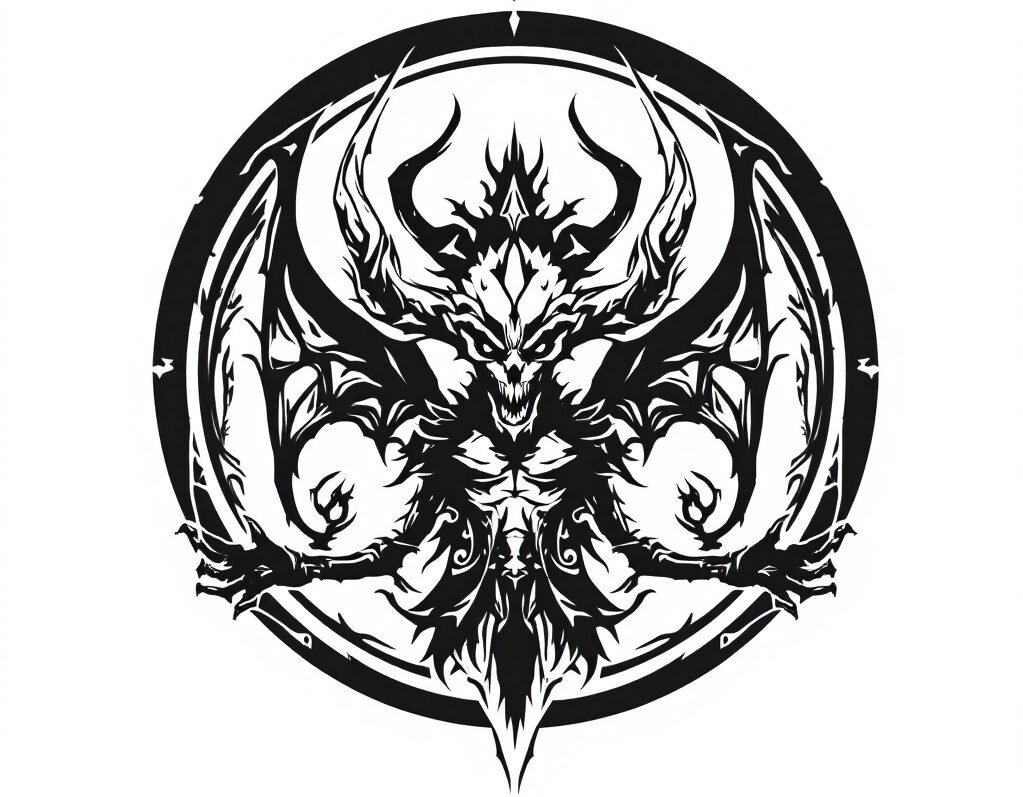
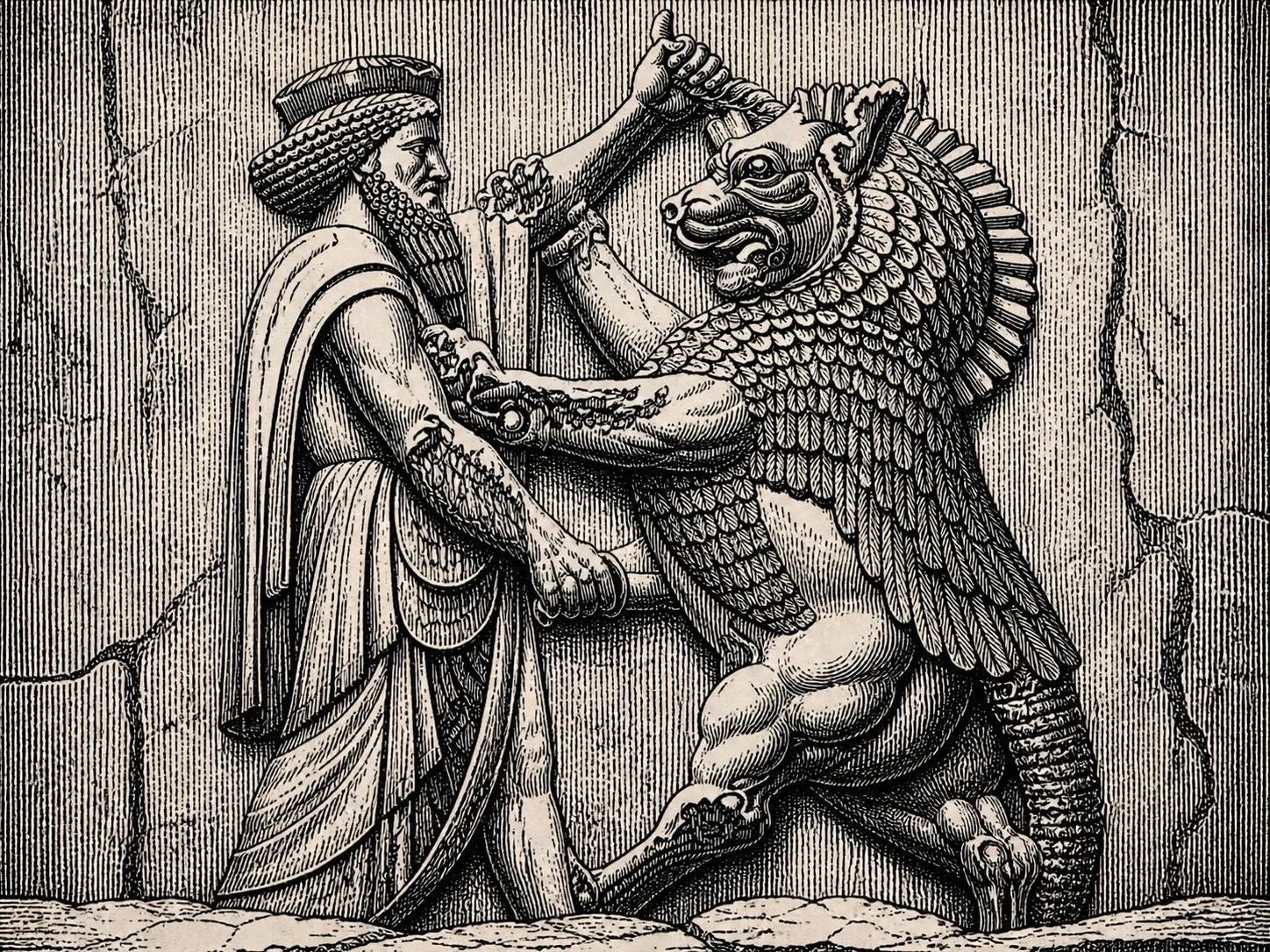
Ahriman represents the ultimate force of destruction and decay in the universe. Unlike other mythological figures who represent certain vices or disasters, this ancient demon is seen as the source of all negativity, sickness, and death.
Many religions view chaos as an accidental result of creation, but Ahriman is different. He is a conscious force, intentionally working to break down the order of the universe.
I base my article below on a close reading of the Avesta, especially the Gathas and Vendidad. This approach keeps the demon’s role ingrained in its original Zoroastrian context, rather than later mixed interpretations. [View Full Bibliography ↓]
Summary
Key Takeaways
| Attribute | Details |
| Names | Ahriman, Angra Mainyu, Mainyu |
| Title | Spirit of Destruction, The Hostile Spirit |
| Origin | Ancient Persia, Zoroastrianism (Late 2nd millennium BCE to Sassanid period) |
| Gender | Male |
| Genealogy | Twin brother to Spenta Mainyu, both emanations of Zurvan (in Zurvanite tradition) |
| Role | Cosmic adversary, bringer of chaos, creator of death and suffering |
| Associated Deity | Ahura Mazda (the supreme creator who opposes and will eventually defeat him) |
| Brings | Disease, darkness, drought, lies, and physical death |
| Weaknesses | Truth (Asha), divine light, and the ultimate victory of Ahura Mazda |
| Realm/Domain | The Darkness, the North (often associated with cold and decay) |
| Weapon/Item | The Lie (Druj), negative influence, corruption |
| Symbolism | Evil, entropy, spiritual corruption, and the antithesis of creation |
| Sources | The Avesta (Gathas, Vendidad, Yasht), Bundahishn, Denkard |
Who or What is Ahriman?
Ahriman is the main antagonist in Zoroastrian beliefs, representing everything that opposes the cosmic order called Asha. He is not a creator god, but a force that brings decay into a perfect world. He lives in total darkness and tries to ruin the good creations of Ahura Mazda, the supreme god.
In Zoroastrianism, the universe is seen as a battleground. Every bad event, like earthquakes, plagues, or human wrongdoing, is linked to Ahriman’s influence. He is a necessary but harmful part of the religion’s dualistic view, acting as the darkness that challenges and defines the light of goodness.
“Ahriman” Meaning
The name Ahriman comes from the Middle Persian version of the Avestan name Angra Mainyu. ‘Angra’ means ‘hostile’ or ‘destructive,’ and ‘Mainyu’ means ‘spirit’ or ‘mind.’ So, the name can be understood as ‘The Hostile Spirit’ or ‘The Destructive Mentality.’
This name shows that Ahriman’s nature is based on his intentions, not his physical form. He represents the destructive power of thought itself. Throughout history, including in the Pahlavi books from the Sassanid era, this name has stayed the main way to refer to the principle of evil.
The spelling of Ahriman’s name varied as the language shifted from ancient Avestan to Middle Persian. Still, the basic meaning—the spirit of aggression and destruction—remained the same in Zoroastrian writings.
How to Pronounce “Ahriman” in English
In English, Ahriman is usually pronounced as “AH-ri-man.” The first syllable is stressed and sounds like “ah.” The second syllable is unstressed, like the “ri” in “river,” and the last syllable rhymes with “pan” or “can.”
Some researchers may stress the “ah” sound more to match Persian roots, but the standard English pronunciation uses these three clear syllables.
You may also enjoy:
Banasura: The Thousand-Armed Demon King
October 10, 2025
What Is Baku? The Bizarre Yōkai That Eats Nightmares
January 28, 2026
Ifrit: Demon of Fire Who Serves Iblis in Islamic Tradition
September 30, 2025
Abura-akago: The Bizarre Oil-Licking Yōkai
October 22, 2025
Who Is the Jann in Islamic Mythology and Why Is He Feared?
October 2, 2025
Who Is Ariton (Egyn), the Infernal King of the Eastern Gate?
February 17, 2026
Origins
Ahriman’s origins are closely tied to the religious transitions brought by Zoroaster, who lived around the late 2nd or early 1st millennium BCE. Unlike other Near Eastern religions, where chaos monsters like Tiamat or Lotan were defeated to create the world, Ahriman was introduced as a unique idea: the ‘Hostile Spirit.’
Historically, Ahriman marks a shift from a group of nature spirits, called Daevas, to a clear dualistic system. In older Vedic beliefs, Daevas were gods, but Zoroastrianism redefined them as evil demons led by Ahriman. This shift was not sudden, but a gradual move away from earlier, more varied beliefs.
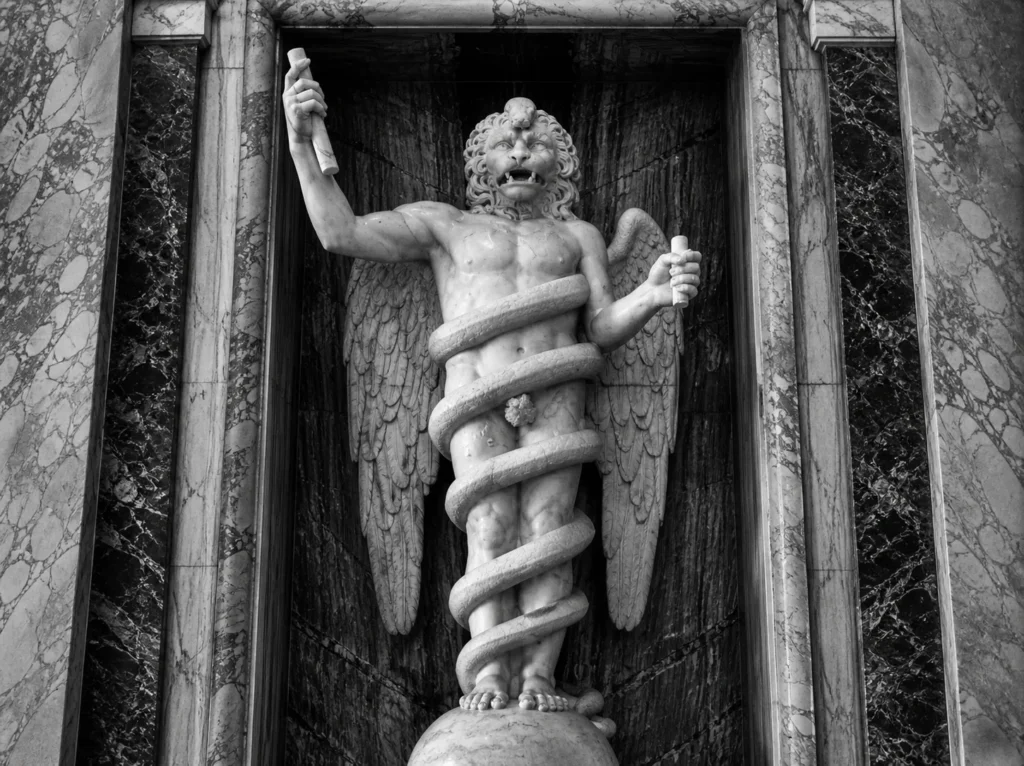
Ahriman’s character became more defined during the late Achaemenid and Sassanid periods. At this time, scholars founded the Zurvanite school, which sought to explain evil by asserting that Zurvan, or Infinite Time, was the parent of both Ahura Mazda and Ahriman, making them brothers naturally opposed to each other.
Earlier influences on Ahriman’s story may come from the darker aspects of Proto-Indo-Iranian religion, where the struggle between order (Ṛta in Vedic and Asha in Avestan) and chaos was already a key idea.
Ahriman was not tied to a specific place like many city gods. Instead, he became the symbol of the disorder found in the world’s order. By the time the Bundahishn was written, he was seen as a clear anti-creator, which marked a shift in the ancient Near East from fearing random disasters to fearing a purposeful, intelligent force working against life.
Genealogy
The demon’s origins are typically explained through the idea of duality. In the main dualistic tradition, he exists on his own, but in the Zurvanite school, he is connected to the idea of time.
| Relationship | Details |
| Parents | Zurvan (in Zurvanite theology) or uncreated (in dualistic theology) |
| Siblings | Spenta Mainyu (the Holy Spirit) |
| Spouse | None (often associated with the demoness Az/Jahi) |
| Children | A host of Daevas (demons), including Aka Manah and Druj |
What Does Ahriman Look Like?
Zoroastrian texts rarely show this entity as a person or animal. Instead, they describe him by what he does. He is linked to darkness and sometimes imagined as a serpent or lizard, showing his sneaky and corrupting nature. These animal images suggest he has no fixed form and ignores natural laws.
From these descriptions, I believe Ahriman is not meant to have a fixed, physical body. Instead, he has a changing form, which lets him spread chaos in whatever way is most effective. The use of reptile or shadow images shows that he exists on the edge of reality and does not follow the usual rules of the physical world.
Connections to Other Ancient Demons
| Name | Genealogy | Type | Appearance |
| Tiamat | Babylonian | Chaos Monster | Dragon/Serpent |
| Apep | Egyptian | Chaos Serpent | Giant serpent |
| Pazuzu | Assyrian | Wind Demon | Hybrid (human/lion/eagle) |
| Lamashtu | Mesopotamian | Disease Demon | Lion-headed female |
| Set | Egyptian | Storm God/Demon | Animal-headed unknown |
| Mot | Canaanite | Death Deity | Anthropomorphic |
| Loki | Norse | Chaos Spirit | Shapeshifter |
| Mara | Buddhist | Tempter/Demon | Various, often monstrous |
| Iblis | Islamic | Jinn/Adversary | Invisible (usually) |
| Humbaba | Sumerian | Chaos Guardian | Monstrous, grotesque face |
You may also enjoy:
What Is a Dīv? The Terrifying Giant Demon of Persian Myth
January 22, 2026
Who Is the Jann in Islamic Mythology and Why Is He Feared?
October 2, 2025
Who Is Agaliarept, the General of Hell Under Lucifer?
October 8, 2025
Who Is Abalam in Demonology? The Demon King That Serves Paimon
September 30, 2025
Who Is Azazel, the Demon Blamed for Human Corruption?
February 24, 2026
Ahriman Myths, Legends, and Stories
The Assault on Creation
At first, the world was in a perfect spiritual state called Menog, free from decay. Ahura Mazda, the Lord of Wisdom, looked over his creation and saw that it was completely good. But then, darkness began to move in the North. Ahriman, the Hostile Spirit, looked into the bright world of the Creator.
He did not just hate the light; he was filled with deep envy. Ahriman went into the darkness, gathered his council of Daevas, the demons of lies, malice, and death, and announced that he would destroy the order of the universe.
He leaped across the sky, casting a shadow against the bright sun, and entered the physical world. He did not come to rule, but to destroy. Ahriman first attacked the clear, pure waters of the earth, making them salty and bitter.
Next, he attacked the sacred fire, filling it with thick smoke that hid the flame. He crossed the green plains, and wherever he walked, the grass died, and the soil became poisoned dust.
When he saw the first creation, the Primordial Bull called Gaw i Ewdad, Ahriman released all his destructive power. He killed the creature, bringing pain and death into a world that had never known them. Then he turned to the first man, Gayomard, and brought disease, grief, and suffering to him. Ahriman shouted in triumph, thinking he had put out the light.
He hid in the darkness of the world he had ruined, but in his pride, he did not see that by entering the world, he had trapped himself in time. He was no longer just a spirit of pure evil; he was now part of a struggle that would end in his own defeat.
Ahriman as the Primordial Evil
In my research, I noticed that many ancient myths see chaos as a wild force or a beast to be defeated. But in the Pahlavi books, Ahriman is seen differently—as a symbol of deep, structural corruption. I find it interesting that Ahriman is not just an enemy but also acts as the ‘system administrator’ of decay.
After reading the Bundahishn, I think Ahriman is best understood not as a single monster, but as the personification of a ‘glitch’ in the universe. He represents the force that ensures every act of creation (from plants growing to humans being born) is subject to aging and decay.
I believe that Zoroastrians feared Ahriman because he represented forces that could not be undone. Unlike Tiamat in the Mesopotamian myth, whose chaos could be shaped into the world, Ahriman represents the unavoidable breakdown of order. In this view, the world is fragile, always losing its strength to this hostile spirit.
This idea shifts the human role from passive to active, keeping the universe in order. By choosing truth (Asha) and doing good deeds, people are constantly helping to fix the universe and repair the damage caused by Ahriman.
I also think the later Zurvanite view of Ahriman—as a being born from doubt—gives an interesting psychological view of evil. If Ahriman comes from hesitation, he represents the moment when a creator loses confidence in their own work.
This idea makes Ahriman the symbol of doubt and second-guessing, the voice that says effort is pointless because everything ends. In this way, Ahriman is not just an external demon, but also the feeling of losing purpose within. He represents the realization that time is limited, which was a frightening thought for ancient people.
Ahriman Powers and Abilities
Ahriman doesn’t have the creative power of Ahura Mazda. Instead, his strength is in manipulation, corruption, and breaking down what already exists.
He can create ‘The Lie’ (Druj), a force that blinds people to the truth and leads them to harm themselves. He also commands many lesser demons that can affect both the world and people’s minds.
- Entropy: The ability to accelerate the breakdown of organic and inorganic matter.
- Corruption: The power to twist the moral judgment of humans, leading them to abandon Asha (truth/order).
- Metamorphosis: His essence is fluid, allowing him to take on various terrifying or deceptive forms to influence the world.
- Disease: The capacity to introduce plagues, sickness, and physiological decay into living beings.
- Environmental Manipulation: Creating disasters such as drought, floods, and earthquakes to disrupt human harmony.
Rituals, Amulets, and Protective Practices
Practices related to Ahriman were mainly about keeping him away. The aim was to protect Asha and clean the home or body from his pollution. Zoroastrians did not worship Ahriman; they saw him as a constant danger that needed to be watched. Their rituals used light, purity, and sacred words to push away darkness.
Incantations and Ceremonies
Ceremonies focused on fire rituals, since fire represents divine truth and clarity. Priests would recite the Ahuna Vairya prayer, considered the strongest defense against Ahriman. Praying was not just about words; it was a way to reject the physical chaos Ahriman brought.
An ancient protection against his influence often involved the Avestan phrase:
“Ahura Mazda is the one who created all good, and Ahriman is the one who created all evil.”
By saying these prayers, people showed their loyalty to light and created a spiritual barrier that Ahriman could not cross. These rituals often required purity, which meant washing with water or bull’s urine (gomez) to avoid contact with the demon’s negative forces.
Amulets and Talismans
For physical protection, people often used objects made of iron or steel, since these metals were linked to the heavens and seen as strong against chaos.
Metal pieces were placed at doorways or buried at the corners of buildings to keep out demons. People also wore pendants with the Faravahar symbol, which represents the human spirit.
These pendants were usually made from lapis lazuli or bronze, chosen for their strength and purity. They reminded people of their bond with Ahura Mazda and helped strengthen their will, so that chaos could not take hold in their minds.
Professional Practitioners
The Āšipu and similar priests in Zoroastrianism, called Mobad or Zōtar, were primarily responsible for confronting the threat of Ahriman. Their job was to perform the Yasna, an important religious ceremony that maintains cosmic order.
These priests did not try to talk to Ahriman like they might with lesser spirits. Instead, they served as channels for divine energy, performing purification rituals to ward off darkness.
Their training took years, as they learned the Avesta by heart and perfected fire rituals to keep the sacred space pure. They were the first line of defense in the ongoing struggle against chaos.
You may also enjoy:
Hitotsume kozō: One-Eyed Yōkai of Japanese Folklore
February 4, 2026
Lamia: The Queen Cursed to Devour the Children of Others
January 7, 2026
Who Is the Infernal King Balam? Origins, Powers, and Occult History
February 26, 2026
Banasura: The Thousand-Armed Demon King
October 10, 2025
Who Is Hariti, the Mother of Ogres in Buddhist Mythology?
December 8, 2025
Allocer: Great Duke of Hell and the 52nd Spirit of the Ars Goetia
November 17, 2025
Bibliography
Author’s Note: For this article, I explored some of the early philosophical ideas found in the Gathas, along with the more detailed stories from the Bundahishn. By looking closely at these two sources, I was able to distinguish the original concepts of good and evil from later interpretations that focused more on demons, which helps us understand how the demon’s character evolved. Instead of just being seen as a typical demon, he appears as a significant force of chaos. This careful examination was important to reveal Ahriman’s true role as a primordial opponent.
- Geldner, Karl F., editor. Avesta: The Sacred Books of the Parsis. Stuttgart, 1896. Internet Archive.
- Ara, Mitra. (2022). Genesis According to the Zoroastrian Book of Primal Creation, Bundahishn. American Journals Publishing Center. ResearchGate.
- Baca-Winters, Keenan. The Last Battle: The Dēnkard and the Post-Zoroastrian World. Academia.edu.
- Dēnkard, the Acts of Religion, Book 3. Edited by Dastur Peshotanji Behramji Sanjana, 1876. English translation by Ratanshah E. Kohiyar, electronic edition prepared by Joseph H. Peterson, 1999. Avesta.org.
- Dēnkard, the Acts of Religion, Book 5. Edited by Dastur Peshotanji Behramji Sanjana, 1907. English translation, electronic edition prepared by Joseph H. Peterson, 1998. Avesta.org.
- KRONEN, JOHN D., and SANDRA MENSSEN. The Defensibility of Zoroastrian Dualism. Religious Studies, vol. 46, no. 2, 2010, pp. 185–205. JSTOR, http://www.jstor.org/stable/25676936. Accessed 4 May 2026.
- Shah, Bipin. (2016). Early Vedic Schism-Indo-Iranian Split and Rise of Zoroastrianism. ResearchGate.