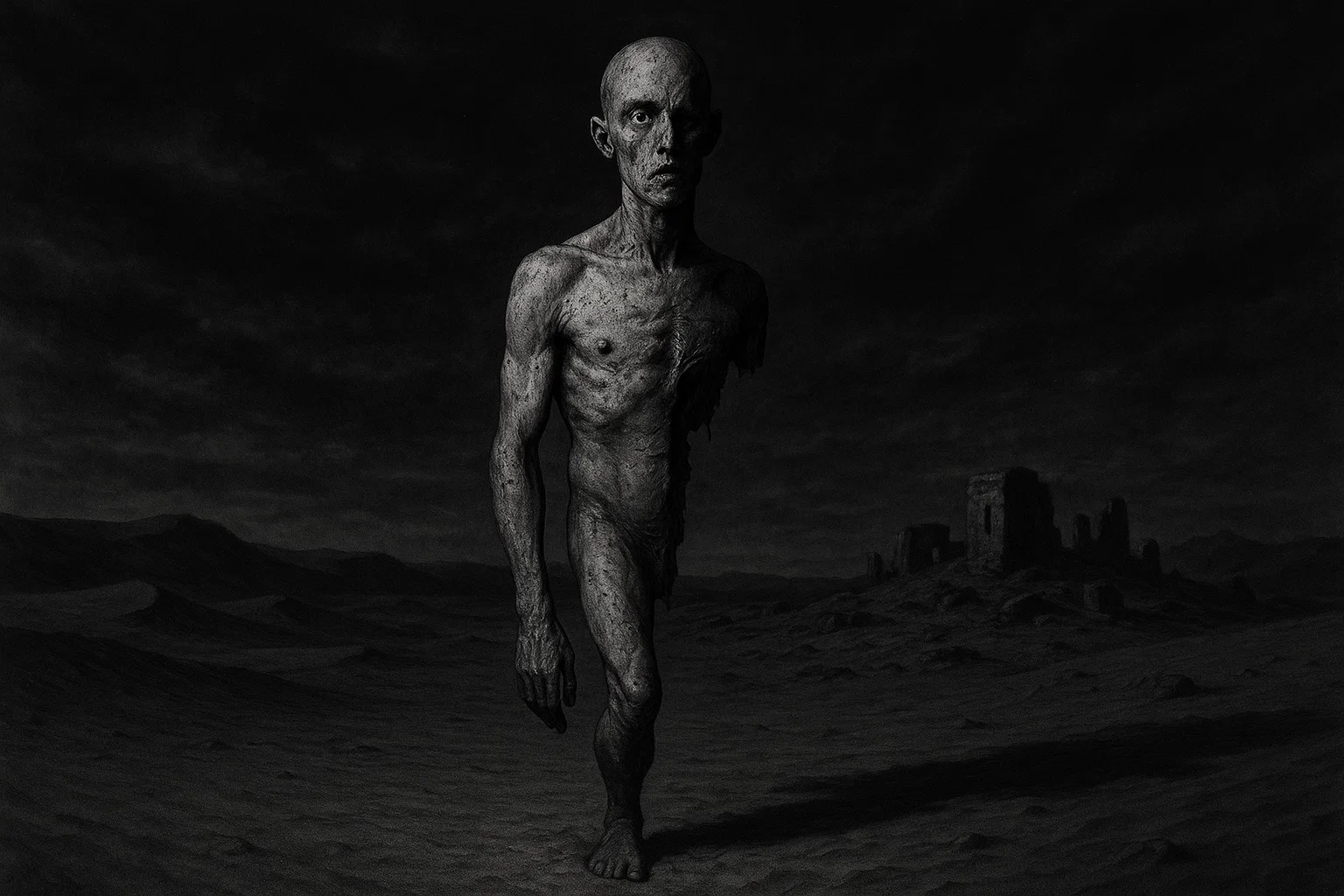
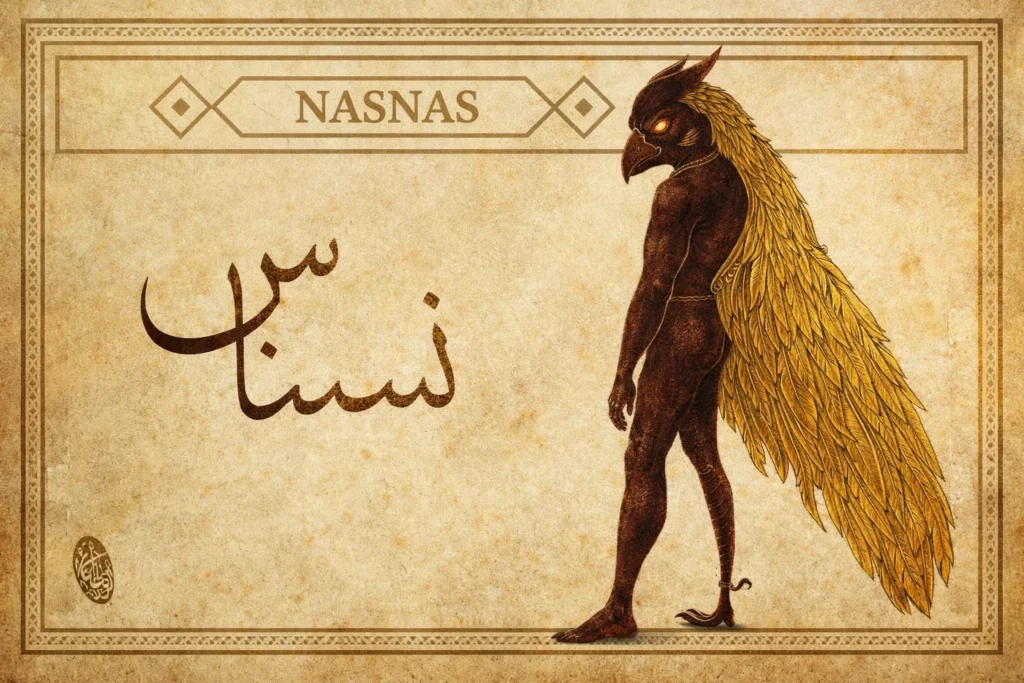
The Nasnas is a creature that stands out because its body is asymmetrical, unlike most creatures in nature or mythology.
Most monsters in folklore are known for having extra features, like many heads, wings, or eyes. These creatures are different because they is defined by what they don’t have, and they is split in half. In Arabian stories, it is not a complete spirit but a leftover from an ancient race, making people question what it means to be a whole human.
This article uses the main translations of Al-Jahiz’s Kitāb al-Hayawan and Al-Qazwini’s works to make sure the descriptions of these entities fit their cultural backgrounds. Looking at these old texts helps separate the original legends from later attempts to explain the creature in scientific terms. [View Full Bibliography ↓]
Summary
Key Takeaways
| Attribute | Details |
| Names | Nasnas, Nesnas, Al-Nasnas |
| Type | Hybrid/Monstrous Jinn (Often categorized as a sub-species of Shiqq) |
| Title | The Bisected One, The Half-Human |
| Gender | Male and Female variants exist |
| Servitors | None specified in traditional lore |
| Superior Jinn | Shiqq (as the progenitor race) |
| Powers | Incredible agility through hopping, lethal speed, ability to kill with a touch, and deceptive vocal mimicry |
| Appearance | Half of a human body vertically divided: one leg, one arm, half a torso, and half a face appearing on the chest or head |
| Etymology | Derived from the Arabic root ‘n-s’, often linked to ‘nas’ (mankind), implying a diminished or frail version of humanity |
| Associated Figures | Shiqq, the people of Ad, and the legendary hunters of Yemen |
| Weaknesses | Vulnerable to being caught if its predictable hopping rhythm is exploited; susceptible to iron weapons |
| Opposing Holy Figure | Prophet Hud (associated with the destruction of the related Adites) |
| Social Structure or Tribe | Inhabits the wilderness of Hadramaut and Yemen; lives in isolated groups |
| Followers/Tribe Size | Varies; described as a dwindling race found in the sands of the Al-Ahqaf |
| Primary Sources | One Thousand and One Nights, Al-Jahiz’s Kitab al-Hayawan, Mukhtasar al-Aja’ib, and the writings of Al-Qazwini |
Who or What is a Nasnas?
The entity is usually described as a monster that has only half the body parts of a human. It is not a ghost or spirit, but a strange, flesh-and-blood creature that lives in the empty areas of the Arabian Peninsula, especially in Yemen and the Rub’ al Khali.
In Middle Eastern demon stories, the Nasnas is often seen as the child of a Shiqq and a human, or as a weakened descendant of an ancient race. Unlike the Ifrit or Marid, which are known for their magical powers, these entities are known for their physical limits and the surprising speed and agility they uses to overcome them.
Nasnas Meaning
The name Nasnas comes from the Arabic root n-s-n-s, which is linked to ideas of weakness or fading away. Many scholars think it is a smaller or repeated form of Nas, the Arabic word for “people” or “mankind.” So, the name means a “lesser man” or a “fragment of a human.”
Over time, the word Nasnas has been used in different regions and, at times, even described as a type of ape in later scientific texts, as people tried to explain the myth. But in old myths, the name was an insult, meaning something that is “not quite” human.
In some Yemeni stories, the name also comes from the sound the creature’s one foot makes when it hits the ground. Over time, the word changed from meaning a monster to describing a mysterious animal, and later became a way to talk about someone who is not whole in body or character.
How to Pronounce Nasnas in English
The name is pronounced nas-NAHS. The first part sounds like “gas,” and the second part is stressed, with a long “a” like in “father,” ending with a soft “s.”
What Do a Nasnas Look Like?
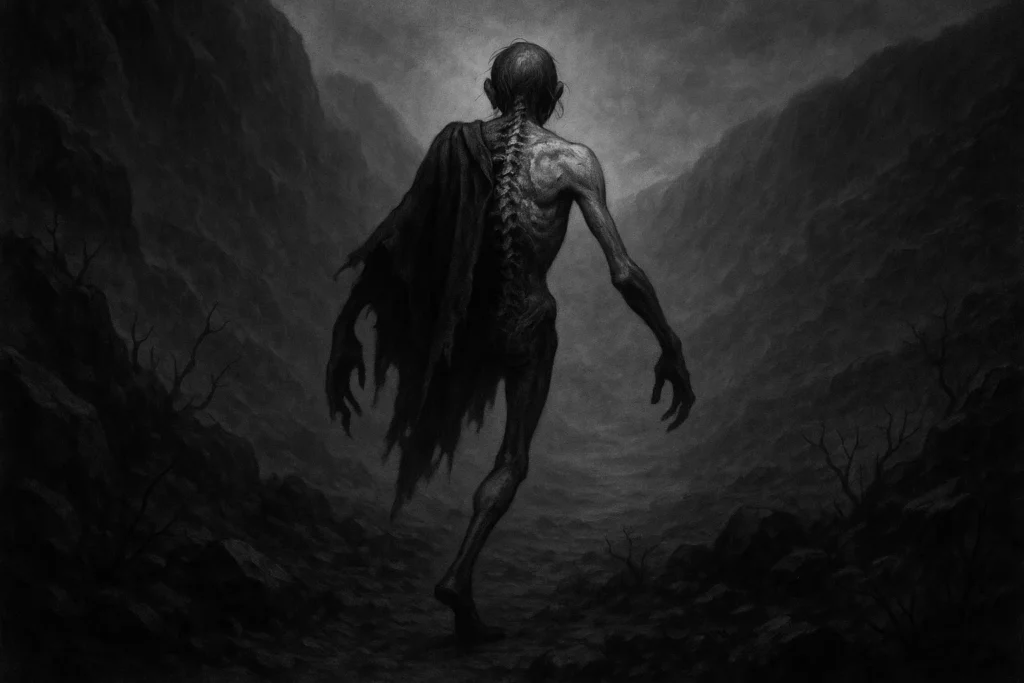
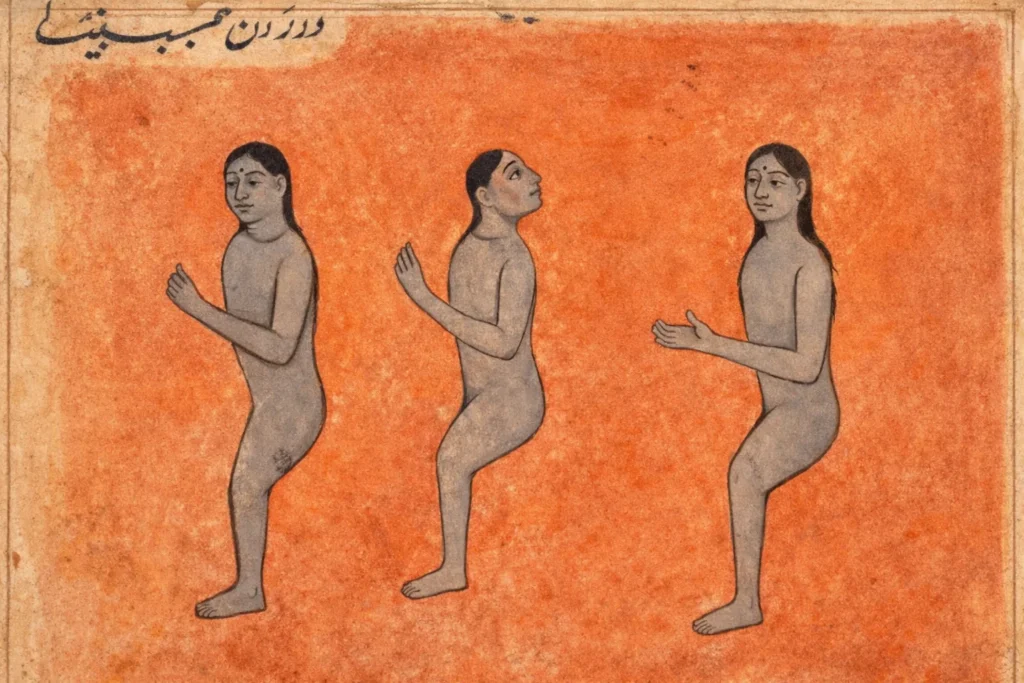
The most noticeable thing is its body shape, which is always described the same way in old texts. It is split down the middle, with only one eye, one ear, one arm, and one leg. Its face is often said to be on its chest, or just half a face on half a head.
Even though it has only one leg, the creature is famous for its speed and agility. It does not crawl or limp, but hops so quickly that it can outrun a running horse. Its one arm is usually on its chest, and it uses its skillfully to climb or catch prey.
Some stories from the One Thousand and One Nights say that some tribes value the Nasnas’s meat, even though the creature is dangerous. Its skin is often described as tough or like a plucked bird, which adds to its strange and unfinished appearance.
You may also enjoy:
Who Is Abalam in Demonology? The Demon King That Serves Paimon
September 30, 2025
Abura-akago: The Bizarre Oil-Licking Yōkai
October 22, 2025
Agubanba: The Blind Yōkai That Preys on Young Women
October 23, 2025
What Is a Rakshasa? Meaning, Origins, and Dark Powers
January 23, 2026
What Is the Abumi-guchi Yōkai and Why Does It Wait Forever?
October 22, 2025
What Is a Bhuta? The Backward-Footed Ghosts of Hindu Horror
February 5, 2026
Origins
The Nasnas is believed to come from stories before Islam, especially from the wild areas of Southern Arabia. Myths say it is descended from the Shiqq, a type of lower Jinn that is also split in half. The Shiqq is said to have interbred with humans, giving rise to the Nasnas.
Another story links these strange monsters to the Adites, a race of giants from the Quran. After the people of Ad were destroyed by a powerful wind, some survivors were turned into these half-beings as a sign of their spiritual weakness and rebellion.
These beings were sent to live in the forests and deserts of Yemen, where local tribes hunted them to the brink of extinction. Their story is about losing strength and becoming both physically and symbolically broken.
The Ontological Terror of the Bisection
The fear inspired by these entities comes from how they challenge the idea of a complete human form. In Middle Eastern stories, most monsters, like the many-headed Kamlian or the winged Ifrit, have extra body parts, showing an overflow of energy.
The Nasnas is different because they is scary for what they lack. Being only half a person makes people feel uneasy, a feeling now called the “uncanny valley.” In old Yemeni society, it was seen as a sign of both social and physical breakdown, standing between spiritual perfection and the weakness of the physical world.
This idea of being split in half reflects concerns about the tribe’s strength. In ancient South Arabia, being whole meant being part of the group. Someone alone was seen as weak and incomplete, just like a body cut in half.
Other such stories became popular during times of war and hardship in the Al-Ahqaf desert. The creature was a symbol for a society being “cut in half” by hunger and conflict. When writers like Al-Mas’ūdī wrote about seeing these beings, they were also recording the lasting pain from the fall of the Adites, warning that going against order leads to lasting division.
The Nasnas’s amazing speed, being able to outrun a horse on one leg, goes against the rules of physics studied by Islamic scholars in the Abbasid Era. The creature seems impossible, showing that the laws of nature can be broken by the power of the unseen.
Humans need balance and symmetry to move quickly, but these entities, even though they is not balanced, is even faster. This makes it a symbol of how something broken can still be powerful, and sometimes even more focused and dangerous than something whole.
Historical & Folkloric Mentions
The Nasnas is not mentioned in the Quran. Still, it first appears in early medieval writings by natural historians and explorers who tried to describe strange creatures from Southern Arabia.
“Among the wonders of the land of Yemen is the Nasnas; it is a creature that has half a head, half a body, one arm, and one leg, and it hops with great speed. It is said that they are a people from the remnants of ‘Ad who were transformed.” [Zakariya al-Qazwini, ‘Aja’ib al-Makhluqat wa Ghara’ib al-Mawjudat (The Wonders of Creation), 13th Century]
Al-Qazwini’s 13th-century work is among the earliest to describe the creature scientifically. Unlike later stories, his text treats the creature as a real animal living in Yemen.
This text shows an important change in how people saw the entity. By connecting it to the “remnants of ‘Ad,” Al-Qazwini turned it from just a desert monster into a symbol of divine punishment. This links the creature to the Islamic concept of Maskh, in which being physically different is a lasting sign of spiritual rebellion.
“The Nasnas are found in the woods of Yemen… when one of them is caught by a hunter, it speaks in the Arabic tongue and says, ‘I am a man like you, do not kill me.’ But the hunters of the Mahra tribe do not heed its words and slaughter it for its meat, which they find sweet.” [Al-Jahiz, Kitāb al-Hayawan (The Book of Animals), 9th Century]
Al-Jahiz gives us the oldest known naturalist view of the Nasnas, which came before Al-Qazwini’s more mystical ideas. His account is important because it points out that the creature could speak Arabic.
This shows that in the 9th century, people did not see the Nasnas as a hidden spirit, but as a kind of failed human. The fact that its meat was said to taste sweet made it seem more like a strange animal than a demon.
“I saw a creature that was the half of a human being… It had one eye, one arm, and one leg, and it leaped about like a bird. Its face was in its chest, and it spoke with a voice that was human yet shrill.” [One Thousand and One Nights (The Tale of the Sage and the Scholar), Compiled approx. 14th–15th Century]
This story shows the Nasnas as they appears in folklore. Here, its face is moved from the head to the chest, a common theme in old stories about strange races. This change shows how the creature became a symbol for fears about outsiders.
In these stories, the Nasnas shows the breakdown of the human form. The change from Al-Jahiz’s human-like creature to one with a face on its chest shows how stories made its features more extreme over time to make it seem less human.
Looking at these three sources, we can see how the Nasnas changed over time. In the 9th century, Al-Jahiz described it as a strange animal that spoke Arabic and was hunted. By the 13th century, Al-Qazwini connected it to the religious story of the giants of ‘Ad, giving a reason for its split form.
By the time of the One Thousand and One Nights, the Nasnas had become a strange, chest-faced monster of the desert. This shows how a local legend about a wild man became part of wider Islamic demon stories and world folklore.
Powers and Abilities
The Nasnas is not as strong as a Marid or an Ifrit. However, it is still more powerful than a normal human because of its supernatural body. It is called a “physical” demon because its danger comes from its speed and hunting skills, not from magic.
- Supernatural Agility: The ability to leap vast distances and maintain speeds that baffle human observers.
- Vocal Mimicry: According to lore, they can speak human tongues and can use this to lure unsuspecting travelers into the brush.
- Lethal Touch: In some traditions, the creature can kill a human simply by touching them, causing the victim’s body to wither or “halve” in a sympathetic reaction.
- Predatory Stealth: Despite its hopping gait, it can move silently through the dense “Nasnas-woods” to ambush prey.
Influence on Humans and Possession
Unlike the Shayatin, the Nasnas do not usually possess people’s minds. Instead, it is a predator that controls its territory. Meeting one is seen as a sign of bad luck or the breaking apart of a family or business. It is a demon linked to disunity.
Protection and Exorcism Methods
In the past, people protected themselves from the Nasnas with physical barriers and special charms. Since it is seen as a type of Jinn-hybrid, it is affected by the usual rules for dealing with unseen beings.
- Iron Weapons: Like many Jinn-adjacent creatures, the touch of cold iron is believed to be lethal to them.
- Amulets of Solomon: Carrying seals that invoke King Solomon’s authority is a primary historical defense.
- Salt Barriers: Creating a perimeter of salt around a campsite is a traditional remedy to prevent them from entering human areas.
- Specific Herbs: The use of Asafoetida (Hing) and Black Seed oil is mentioned in medieval texts as a way to repel the foul odor often associated with these creatures’ habitats.
You may also enjoy:
Who Are the Yaksha, and Why Did Buddhists Fear Their Wrath?
October 20, 2025
What Is the Akkorokamui, Japan’s Colossal Sea Monster?
November 14, 2025
Who Is Adrammelech in Demonology and the Bible?
October 1, 2025
Who Is Agares, the Demon of Earthquakes and Deception?
October 13, 2025
Mara: The Buddhist Demon King of Desire and Death
October 13, 2025
Aži Dahāka: The Three-Headed Dragon of Zoroastrian Mythology
January 14, 2026
Myths, Legends, and Stories
The Hunting of the Nasnas in Yemen
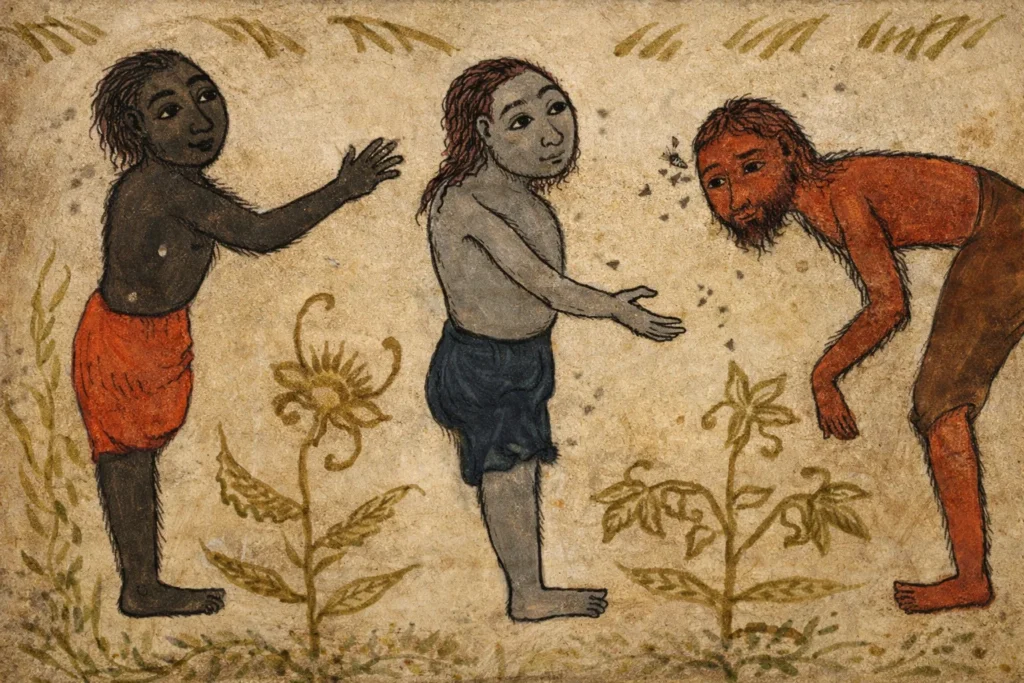
Al-Jahiz’s Book of Animals says that tribes in Southern Arabia, especially in Mahra, used to hunt the Nasnas. Hunters would go into the bushes where these half-beings hid. The creatures would try to save themselves by speaking the local language, begging for mercy, and claiming to be human.
But the hunters could tell by the single footprints in the sand and were not fooled. They thought the creature’s meat was a delicacy. This story shows that people in medieval Arabia saw the Nasnas as a real animal, not just a spirit.
The Encounter in the One Thousand and One Nights
In the story of The Sage and the Scholar, travelers in the southern desert see what appears to be a man hiding behind a tree. When they get closer, the being jumps out, showing it is split in half. It hops around their group so fast that the guards cannot shoot it.
The creature asks for food as payment, eating it with its one hand while staring at them with its single eye. This story shows the Nasnas as a kind of toll-keeper in the desert, a part of the land that wants to be noticed by the humans who travel through.
Nasnas vs Other Jinn
| Jinn Name | Associated Traits/Influence | Rank/Origin | Key Traits/Powers |
| Ifrit | Wrath and vengeance | High Rank / Smokeless Fire | Extreme strength, pyrokinesis |
| Ghul | Gluttony and grave-robbing | Low Rank / Arabian Folklore | Shape-shifting, devouring flesh |
| Marid | Arrogance and rebellion | Highest Rank / Sea & Air | Control over elements, immense size |
| Si’lat | Seduction and deception | Mid Rank / Woods & Forests | Expert shape-shifting into women |
| Shiqq | Terror and fragmentation | Lower Jinn / Progenitor of Nasnas | Half-man form, father of monsters |
| Hatif | Auditory hallucination | Invisible Jinn / Folklore | Disembodied voices, mimicry |
| Qareen | Spiritual sabotage | Personal Jinn / Quranic | Constant whispering, inciting sin |
| Palis | Exhaustion and theft | Low Rank / Desert Dweller | Licks the soles of feet to drain blood |
| Zoba’ah | Chaos and storms | Tribe Leader / Whirlwinds | Commands dust devils and cyclones |
| Dall | Leading travelers astray | Low Rank / Deserts | Creates false paths and mirages |
Position Among Jinn
The Nasnas is seen as outcasts among the Jinn. They are not leaders and do not control other spirits. Instead, they are often bullied by stronger beings like the Ifrits, who see them as clever animals rather than equals.
They mainly connect with the Shiqq, which they see as their ancestor. In the hidden world, they live alone or in small groups and act as scavengers. They do not take part in the big politics of the Jinn courts, like those of the Seven Jinn Kings.
Instead, they shows the wild, broken side of the Jinn. They have lost their magical nature and are now stuck in a strange, half-physical form.
Mystical Correspondences
| Attribute | Details |
| Planet | Saturn (Representing limitation and leaden weight) |
| Zodiac Sign | Capricorn (The sign of isolation and the wilderness) |
| Element | Earth (Specifically dry, barren sand) |
| Direction | South (Toward the deserts of Yemen) |
| Color | Ocher or Pale Yellow (The color of withered skin) |
| Number | 1/2 (Representing the incomplete or broken unit) |
| Crystal/Mineral | Obsidian (Broken glass-like fragments) |
| Metal | Lead (Symbolizing the heavy, hopping movement) |
| Herb/Plant | Colocynth (Bitter apple of the desert) |
| Animal | The Ostrich (A bird that runs but cannot fly) |
The Nasnas is linked to Saturn and Capricorn, which symbolize limits and hardship. While other Jinn are connected to planets like Jupiter or Mars, the Nasnas is tied to Saturn, which stands for boundaries and the physical body. Its existence shows a “stopped” or “broken” cosmic process.
Earth is very important to the Nasnas, since it is one of the few Jinn that is truly physical and lives on land. The number one-half is its symbol, showing it goes against the usual balance in nature. Its “evil” is about the fear of being incomplete—a reminder that without spiritual wholeness, the body can become a strange and dangerous thing.
You may also enjoy:
What Is the Abumi-guchi Yōkai and Why Does It Wait Forever?
October 22, 2025
Who Is Aka Manto, Japan’s Terrifying Red-Cloaked Yōkai?
October 24, 2025
Who Is the Jann in Islamic Mythology and Why Is He Feared?
October 2, 2025
Abadir: The Demon Servant of Chaos and Dispersion
September 30, 2025
Amdusias in the Ars Goetia: The Demon of Dark Music
December 2, 2025
Bibliography
Author’s Note: While putting together this profile, I noticed an interesting contrast between the realistic, almost food-like descriptions in al-Jāḥiẓ’s Kitāb al-Ḥayawān and the more legendary family histories in al-Ṭabarī’s works. Al-Mas’ūdī’s writing gives important geographical context in Yemen. Still, it is the storytelling style of the One Thousand and One Nights that best shows how the creature’s split body changed from a physical oddity to a symbol of social isolation. Balancing these different perspectives—from the creature as “sweet meat” to the “transformed remnant” of a fallen giant—required careful editing to maintain its role as both a real predator and a sign with religious meaning.
- al-Jāḥiẓ, ʻAmr ibn Baḥr. Hādhā Kitāb al-Ḥayawān [The Book of Animals]. Vol. 5–7, al-Maṭbaʻah al-Ḥamīdīyyah al-Miṣrīyyah, 1905. Internet Archive.
- Al-Shaykh, Hanan. One Thousand and One Nights: A Retelling. Pantheon Books, 2013. Internet Archive.
- al-Mas‘ūdī, ‘Alī ibn al-Ḥusayn. Historical Encyclopaedia: Entitled “Meadows of Gold and Mines of Gems”. Translated by Aloys Sprenger, Oriental Translation Fund of Great Britain and Ireland, 1841. Internet Archive.
- al-Ṭabarī, Abū Jaʿfar Muḥammad ibn Jarīr. The History of al-Ṭabarī, Vol. 5: The Sasanids, the Byzantines, the Lakhmids, and Yemen. Translated by C. E. Bosworth, State University of New York Press, 1999. Internet Archive.
- al-Ṭabarī, Abū Jaʿfar Muḥammad ibn Jarīr. The History of al-Ṭabarī, Vol. 1: General Introduction and From the Creation to the Flood. Translated by Franz Rosenthal, State University of New York Press, 1989. Internet Archive.