Most mythological systems divide beings into either celestial or infernal categories, but the Rakshasa stands out as a unique paradox. Known as “night-walkers,” their power comes from turning sacred order upside down. They are not just ghosts or demons; they are a distinct race caught between physical predation and the illusions of Maya.
Unlike the Asuras, who fight for control of the cosmos, Rakshasas are often defined by their constant hunger and their role as guardians of chaos in both the earthly and underground worlds.
In this article, I used translations of the Rigveda and the Vishnu Purana to trace how the language and religious ideas about Rakshasas changed from ancient times to the Puranic era.[View Full Bibliography ↓]
Note: Since Rakshasas also appear in Buddhist stories as planetary or guardian spirits, readers interested in a full cross-cultural view should look at the Buddhist Demons category as well.
Summary
Key Takeaways
| Attribute | Details |
| Names | Rakshasa, Yatudhana, Nairrita, Rajanichara (night-walker) |
| Title | Lord of the Night, Guardians of the Southwest, Cannibals |
| Gender | Predominantly Male (Rakshasas) and Female (Rakshasis) |
| Role | Man-eaters, shape-shifters, disturbers of sacrifices, guardians |
| Clan | Descendants of Pulastya or Khasa; associated with the Nairrita direction |
| Followers | Pisachas, Bhutas, and lesser flesh-eating spirits |
| Powers | Kamarupa (shape-shifting), Maya (illusion), extreme physical strength |
| Appearance | Varies; often depicted with fangs, claws, red eyes, and protruding bellies |
| Etymology | Derived from ‘Raksh’ (to guard/protect) or ‘Rakshas’ (harm/injury) |
| Associated Figures | Ravana, Kubera, Vibhishana, Hidimbi, Ghatotkacha, Agni |
| Weaknesses | Sunlight (weakens magic), sacred mantras, iron, divine weapons (Astras) |
| Opposing Deva/Avatar | Vishnu (as Rama), Indra, Agni |
| Pantheon | Hindu (Vedic and Puranic), Buddhist, and Jain |
| Primary Sources | Rigveda, Ramayana, Mahabharata, Bhagavata Purana |
Who or What is the Rakshasa?
Rakshasas are a supernatural race in Hindu mythology with many sides. They can be vicious, man-eating demons or even divine guardians. In the Vedic period, people mostly saw them as evil spirits who sought to disrupt the holy sacrifices of sages. Later, in the epics, they developed a complex civilization with their own kingdoms, social structures, and religious customs.
Although they are often seen as villains, Rakshasas are not entirely evil. They can perform great penance (tapas) and receive blessings from gods like Brahma or Shiva.
Their main trait is Kamarupa, the power to change shape at will, which they use to trick both humans and gods. In Buddhist stories, they sometimes protect the Dharma, but they remain fierce and unpredictable.
DEMONS ARE REAL — AND THE BIBLE PROVES IT Limited-Time: Up to 20% OFF!
No myths. No exaggeration. Just Scripture. Clinton Arnold’s landmark biblical theology of the powers of darkness. What the Old & New Testaments actually teach about Satan, demons, and spiritual warfare. Essential reading for every pastor, counselor, and believer facing the unseen battle. The book seminaries and deliverance ministries swear by.
Demons are real • Scripture is clear • Victory is yours • Clinton Arnold’s definitive biblical study.
“Rakshasa” Meaning
Scholars still debate where the word ‘Rakshasa’ comes from, which matches the dual nature of these beings. The most common root is the Sanskrit verb ‘raksh,’ meaning ‘to protect’ or ‘to guard.’
Some creation myths say that when Brahma made the waters of the world, he created two groups to guard them. One group shouted, ‘We shall protect!’ (Rakshama), and became the Rakshasas. The other group said, ‘We shall worship!’ (Yakshama), and became the Yakshas.
Another theory connects the name to ideas of harm or injury. In the Rigveda, ‘Rakshasa’ is often used like ‘Yatudhana,’ meaning sorcerers or beings who cause suffering through black magic and the consumption of raw flesh.
Over time, the word shifted from describing any harmful spirit to referring to a specific mythological group. Different sources highlight their role as night-walkers (Rajanichara), showing their power at night and their position as the opposite of sun gods.
How to Pronounce “Rakshasa” in English
The word is pronounced RAHK-shuh-suh. The first syllable is stressed and has a long ‘a’ sound, like in ‘father.’ The ‘k’ and ‘sh’ sounds are blended quickly, and the last ‘a’ is short and almost silent in modern Indian speech, so it sometimes sounds like ‘Rakshas.’
You may also enjoy:
Chort: The Sinister Slavic Demon of Chaos and Bad Luck
March 10, 2026
Who Is Abalam in Demonology? The Demon King That Serves Paimon
September 30, 2025
Alû: The Mesopotamian Demon of Malevolence and Pestilence
November 10, 2025
Who Is Ahriman, and Why Is He Pure Evil Incarnate?
January 8, 2026
What Is the Abumi-guchi Yōkai and Why Does It Wait Forever?
October 22, 2025
What Is Akaname, The Filth-Licking Yōkai?
October 28, 2025
What Does a Rakshasa Look Like?
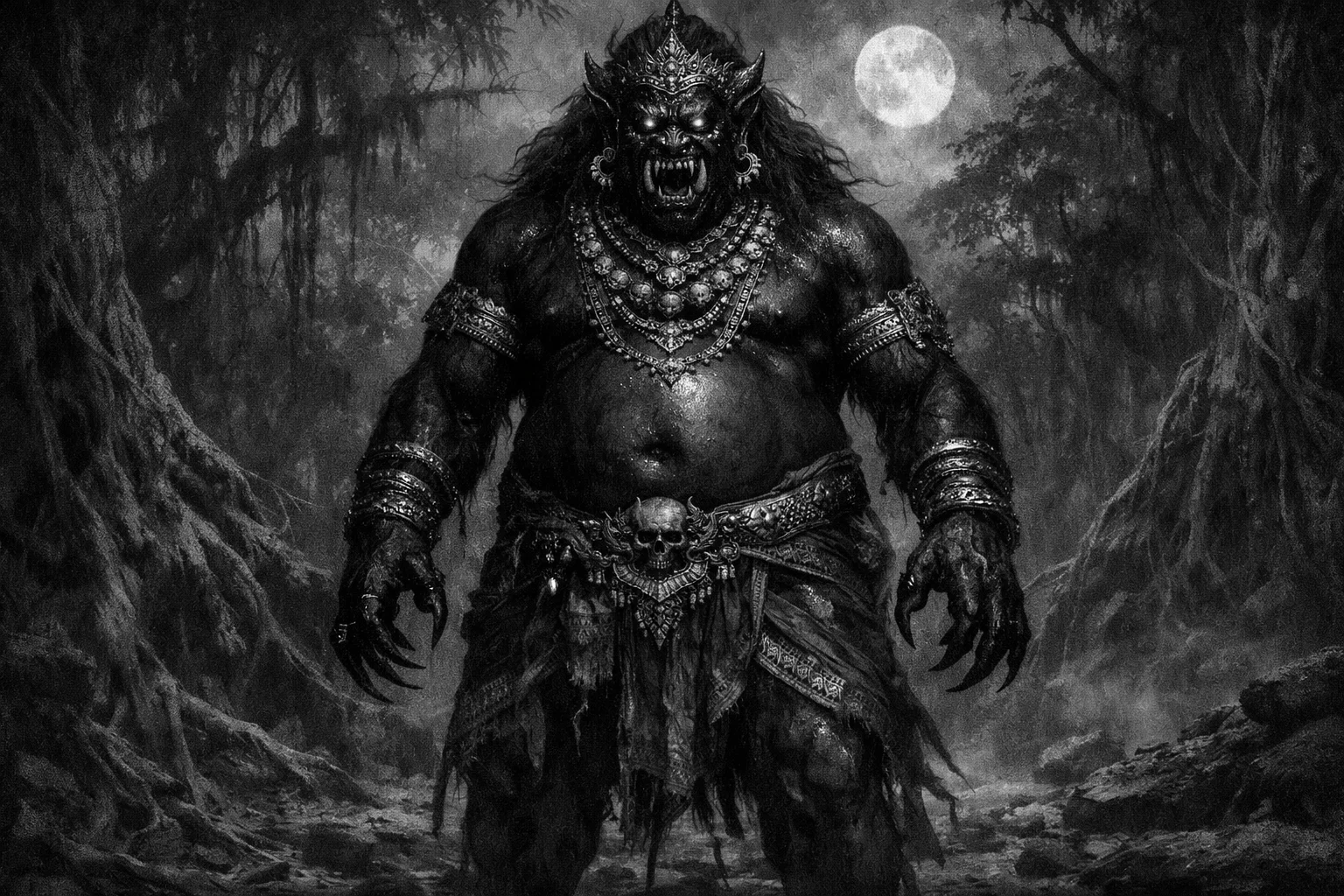
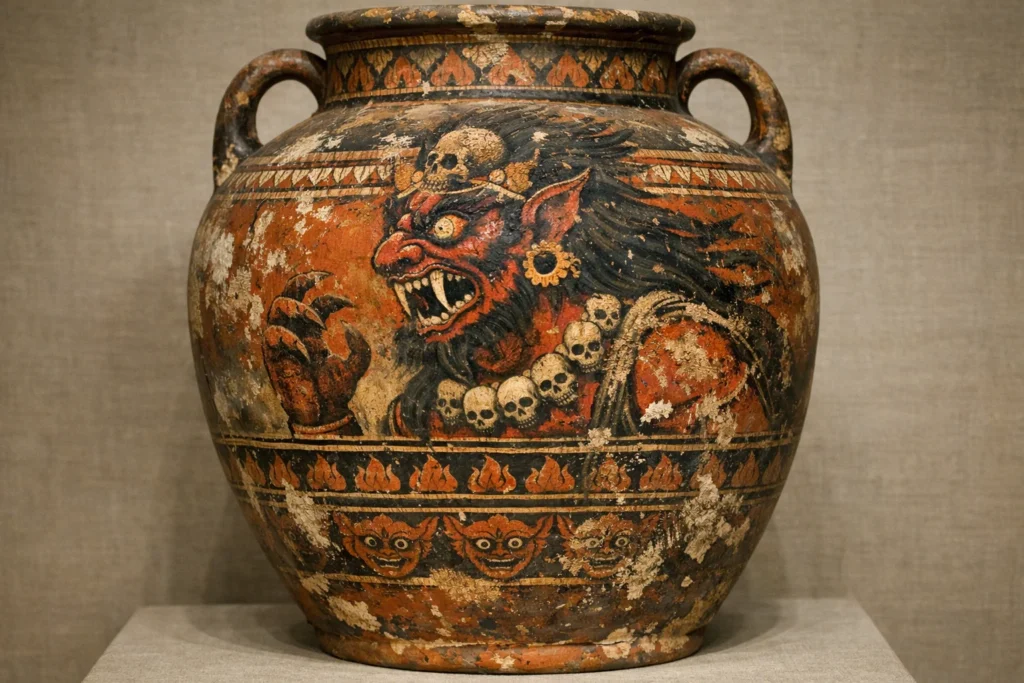
Because Rakshasas can change shape, their appearance is unstable, but their ‘true’ form is always fierce. They are usually shown as huge beings with skin as dark as soot or storm clouds. Their eyes glowed or were yellow, like embers in the night. They have fangs protruding from their mouths, designed for eating raw meat and human flesh.
In the Mahabharata and Ramayana, Rakshasas are described as having wild, flame-colored hair, big bellies, and long, claw-like nails. Some have many heads or arms—Ravana, for example, had ten heads and twenty arms, showing his great intelligence and strength.
Even with these monstrous features, they can turn into handsome men or beautiful women to trick people. A female Rakshasa, or Rakshasi, might appear as a lovely maiden to lure a warrior, then change back into a predator when her victim is defenseless.
Origins
Stories about where Rakshasas come from go back to the beginning of the universe, though different Puranas tell it differently.
One main story says they were born from Brahma’s foot at night, which is why they love darkness. Another tradition says they are descended from the sage Kashyapa and his wife Khasa, making them relatives of the Devas and Asuras.
Birth
The most famous Rakshasa family traces its origins to the sage Pulastya, one of Brahma’s mind-born sons. Pulastya’s son, Vishrava, was a powerful sage with two wives. His first wife, Ilavida, gave birth to Kubera, the God of wealth.
But the Rakshasa king Sumali wanted to reclaim Lanka, so he sent his daughter, Kaikasi, to marry Vishrava. Their children were Ravana, Kumbhakarna, the good-hearted Vibhishana, and their sister Shurpanakha. This mix of Brahmin and demon heritage gave them great spiritual power and the potential for both good and evil.
Family
Rakshasa society is very family- and clan-based. They often belong to groups like the Nairritas, who are said to descend from Nirriti, the goddess of death and decay. In the epics, loyalty to family is extremely important.
For example, Kumbhakarna fought for his brother Ravana even though he knew Ravana was wrong. Marriages are often arranged for strategic reasons, such as Ravana’s marriage to Mandodari, the daughter of the architect Mayasura, who gave him access to powerful weapons and advanced buildings.
| Genealogy | Details |
| Parents | Sage Vishrava and Kaikasi; or Brahma; or Kashyapa and Khasa |
| Siblings | Ravana, Kumbhakarna, Vibhishana, Shurpanakha, Khara, Dushana |
| Spouse | Mandodari (Ravana’s wife), Hidimbi (Bhima’s wife) |
| Children | Indrajit, Atikaya, Akshayakumara, Ghatotkacha (son of Hidimbi) |
Role in Hindu Cosmology
In Hindu thought, Rakshasas are seen as obstacles that test the virtue of divine heroes, or Avatars. They stand for Tamas, which means darkness, laziness, and chaos.
While Asuras fight for control of Heaven, Rakshasas usually act on earth, frightening sages in the forest and disrupting fire sacrifices (Yagna). By eating the flesh of holy people, they destroy both the physical and spiritual order of the world.
But Rakshasas also have a role in the cycle of Karma. Many are actually cursed celestial beings or Gandharvas who must live as demons until a divine Avatar like Vishnu frees them (Moksha). So, their evil actions often help bring God to earth in a certain form to restore balance.
1,000+ SPIRITS, GODS & GODDESSES AWAITING YOUR CALL. Limited-Time: Up to 49% OFF!
The ultimate global spirit encyclopedia – 2,000+ entries from every culture on Earth. Fairies • Djinn • Demons • Loa • Angels • Deities • Ancestors Real names • True offerings • Ancient rituals that actually work. Judika Illes’ legendary masterwork – the one book every serious witch, mage, and spirit-worker owns.
The Paradox of the “Civilized Cannibal”
The historical development of the Rakshasa, from the Vedic oral tradition to the classical Puranic era, reveals a profound shift in the conceptualization of “the monster.” In the earliest layers of the Rigveda, these entities functioned as formless, nocturnal disruptions of the ritual space—essentially external threats to the structural integrity of the sacrifice.
By the time the Ramayana was written, Rakshasas had changed from wild forest monsters to city dwellers. Lanka is described as a huge, rich city of gold and crystal, showing them as smart and cultured predators. This change reflects Iron Age concerns, in which the main threat was not just wild nature but another civilization that was just as advanced but lacked the moral values of Dharma.
This change introduces the idea of the ‘Civilized Cannibal’—a being who maintains a refined and orderly society while still preying on humans. The grand buildings of Lanka reflect the Rakshasa ego: they look beautiful and organized on the outside, but beneath the surface is a deep hunger.
In modern mythology studies, this is similar to how the vampire changed in Western stories—from a mindless, bloated corpse in old Balkan tales to the elegant, cultured Count in 19th-century Gothic novels. This entity shows the fear that intelligence and culture do not always make someone good; instead, they can help someone become a more dangerous predator.
Also, the kind of illusion (Maya) used by Rakshasas is different from the gods’ cosmic illusion. Divine Maya shapes reality itself, but Rakshasa Maya is more like a trick or parasite. They do not create new worlds; instead, they twist what people already see to take advantage of human weaknesses like grief or desire.
This makes Rakshasas a key example in the study of deception. The real monster is not the one who breaks down the door, but the one who convinces you that the door never existed. They warn us about being fooled by appearances, showing how chaos can enter society through its most polished and attractive parts.
Historical & Scriptural Records
“Indra, do thou smite the Rākṣasas; may they be consumed. Let them be ground to pieces. Let the Rākṣasas who are the obstructors of our sacrifice be utterly destroyed. Do thou, O Agni, burn the Yātudhānas who follow after the Rākṣasas. May the Rākṣasa, O Indra, be shattered by thy bolt.” [Rigveda, Mandala 7, Hymn 104 (Translated by Ralph T.H. Griffith), c. 1500–1200 BCE]
This early Vedic passage shows Rakshasas in their oldest and most frightening role: as beings who block the sacred fire sacrifice (Yagna).
At this early stage, Rakshasas were not seen as kings or social beings, but as ghostly, chaotic forces that grew stronger when rituals were missing. The text puts them together with Yātudhānas (sorcerers or wrongdoers), showing that back then, Rakshasas were more like a spiritual label for anything that blocked the flow of divine light through fire.
The prayers to Agni (the fire god) and Indra (the thunder god) show a basic struggle in the universe. The Vedic writers saw the world as centered on sacrifice.
For them, Rakshasas were the darkness trying to swallow the altar’s smoke. The repeated words like ‘smite,’ ‘burn,’ and ‘shatter’ show a deep fear about keeping the Cosmic Order (Rta) safe from the coming night.
“Then the Lord of the universe, being hungry and thirsty, produced in the darkness a body of passion and foulness. From that body, he created beings emaciated with hunger, of hideous aspects and long beards. Some of them, when they were created, ran to the creator and cried, ‘Rakshama!’ (Let us protect). They were thence called Rākṣasas. Others cried, ‘Jakshama!’ (Let us eat). They became the Yakshas.” [Vishnu Purana, Book 1, Chapter 5 (Translated by Horace Hayman Wilson), c. 4th–10th Century CE]
By the time of the Puranas, Rakshasas had shifted from vague, dark spirits to clearly defined beings with a specific origin story. This text gives a practical reason for their existence, connecting them to the creator’s hunger and passion.
The split between Rakshama (protection) and Jakshama (consumption) marks an important change, showing that their identity is based on a natural urge to guard, even if it is fierce and violent.
This time marks the move from seeing demons as just scary to classifying them in detail. The descriptions—thin, ugly, long-bearded—help set them apart from other beings like Asuras or Pisachas.
This shows how medieval Indian scholars tried to organize the supernatural world as carefully as the natural one, giving each being a purpose (Dharma), even if that purpose was to show the darker side of the divine.
“But the Rakshasa, as often as Indivarasena cut off his head, grew another head again by his magic power. Then the prince, seeing that the giant was not to be slain by cutting off his heads, remembered the word of the princess, and struck him in the middle of his body.” [Kathasaritsagara (The Ocean of Story), Volume 3, Chapter 32 (Translated by C.H. Tawney), 11th Century CE]
This 11th-century story from the Kathasaritsagara (the ‘Ocean of the Streams of Story’) shows how Rakshasas became part of famous folklore and heroic tales.
Unlike the religious texts that focus on their spiritual danger, this story shows Rakshasas as ‘boss-level’ villains in adventure tales. The idea of a head that grows back is a clever folklore symbol, showing how evil can be hard to defeat and how normal weapons do not work against a master of illusion (Maya).
Here, the story shifts from seeing Rakshasas as cosmic threats to making them puzzles for heroes to solve. The prince has to strike the ‘middle of the body’ instead of the head, which shows a folk belief that a demon’s life-force is hidden somewhere unexpected.
This shows a medieval interest in ‘secret weaknesses.’ Stories from this time often say that strength alone is not enough to beat the supernatural; heroes also need special knowledge, usually given by a woman or a wise person.
You may also enjoy:
Who Was Hiranyakashipu, the Demon King of Hindu Mythology?
October 6, 2025
Who Is Agaliarept, the General of Hell Under Lucifer?
October 8, 2025
Who Is Ambolin, the Demon of Nighttime Dread
December 1, 2025
Who Is Baal in Christian Demonology?
February 25, 2026
Vritra: The Dragon Who Swallowed the Sky in Hindu Mythology
October 7, 2025
Erinyes: The Chthonic Goddesses Who Enforced Blood-Guilt
November 20, 2025
Rakshasa Myths, Legends, and Stories
The Siege of the Sages in the Aranya Kanda
The Dandakaranya forest always smelled of burnt meat and metal, showing that Khara and Dushana ruled there. The forest was supposed to be a safe place for Vedic sages, but the ‘night-walkers’ had turned it into their hunting ground.
When Rama, the exiled prince, entered the clearing, he saw the hermits terrified. The Rakshasas did not just kill—they also defiled. They waited until the sacred mantras were being chanted, then threw filth and blood into the fire, breaking the connection between earth and the divine.
The fight grew into a huge battle, with fourteen thousand Rakshasa soldiers attacking a single archer. In the Aranya Kanda, the sky turned black—not from clouds, but from the many spears and trees thrown by the monsters.
Using his skill with celestial weapons, Rama held his ground. He broke through the forest’s illusions and defeated the generals one by one, leaving the ground covered with the invaders and returning the forest to those who followed Dharma.
THE BOOK THEY BANNED FROM THE BIBLE Limited-Time: Up to 90% OFF!
Why was Enoch removed? The fallen Watchers • The birth of the Nephilim • Origin of demons • Names of the angels who became demons • Apocalyptic visions. The original source text that inspired all demonology. Read the apocalyptic visions the church didn’t want you to see.
The Penance of the Three Brothers and the Boons of Brahma
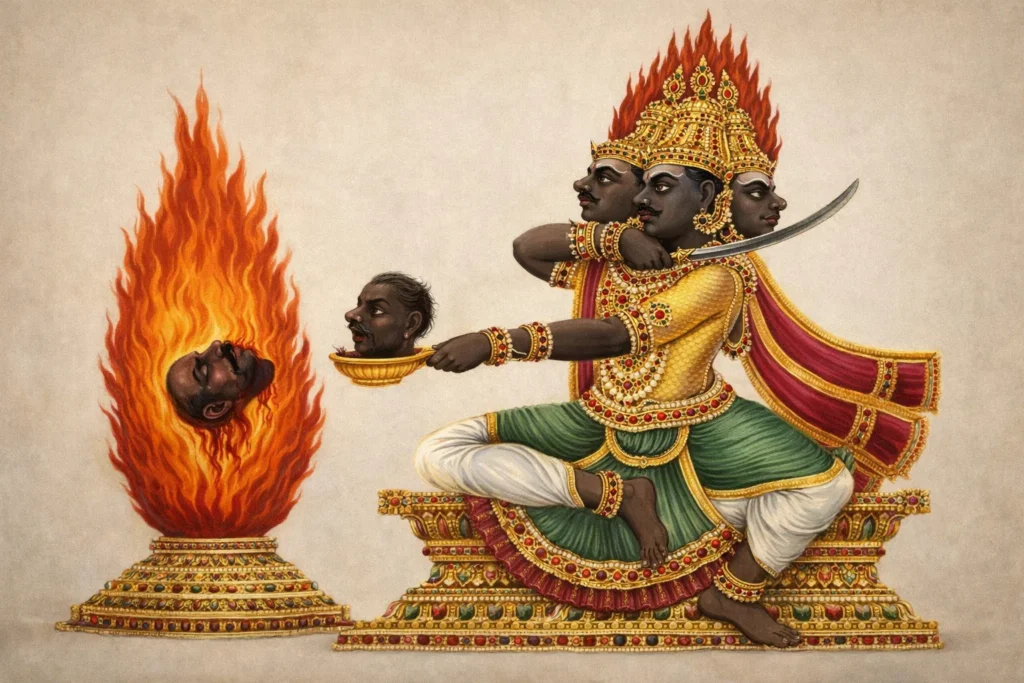
On Mount Gokarna, the brothers Ravana, Kumbhakarna, and Vibhishana performed such intense penance that even the gods were disturbed. They stood among five fires, staring at the sun, and kept up their Tapasya for thousands of years.
It was a strange sight: demons using the highest form of spiritual practice. Ravana showed his devotion by cutting off his own head. He let nine of them fall into the fire as offerings to Brahma, the Creator.
When Ravana raised the blade for his tenth and last head, Brahma appeared, moved by the brothers’ great effort. Ravana boldly asked for invincibility against gods, demons, Gandharvas, and serpents. He was so proud that he did not even ask for protection from humans or monkeys, thinking they were unimportant.
This story sets up the cosmic trap that would later cause Ravana’s downfall. At the same time, Kumbhakarna meant to ask for Indrasana (Indra’s throne). Still, because of a divine trick by the goddess Saraswati, he asked for Nidrasana (the bed of sleep) instead, so he was forced to sleep for six months at a time.
The Abduction of Sita and the Illusion of the Golden Deer
A key moment in the epic centers on a powerful illusion (Maya). Ravana, wanting revenge for his sister’s injury, asked the sorcerer Maricha for help. Maricha turned into a Golden Deer, so beautiful that its skin looked like molten gold and its antlers sparkled with jewels. Sita was enchanted by the deer and asked Rama to catch it, drawing him away from their hut.
When Maricha, pretending to be Rama, cried out in the forest, Lakshmana also left, leaving Sita alone. At that moment, the king of Lanka dropped his disguise as a wandering holy man. The story says the whole forest went silent with fear as he returned to his true form, using his twenty arms to grab Sita.
He took Sita and placed her on the Pushpaka Vimana, his flying chariot. As they flew south, the vulture-king Jatayu tried to save her, but Ravana cut off the old bird’s wings with his Chandrahasa sword. This act turned a personal conflict into a cosmic war.
The Midnight Valor of Ghatotkacha at Kurukshetra
On the fourteenth night of the Kurukshetra War, darkness covered the battlefield. Human soldiers struggled to see, but Ghatotkacha, Bhima’s half-Rakshasa son, became much stronger under the moon. He grew as big as a mountain, crushed chariots under his feet, and his roar scared the Kaurava horses to death.
Using his Rakshasa powers, Ghatotkacha rained fire, stones, and invisible weapons on the enemy. The Kaurava soldiers could not hit what they could not see. Ghatotkacha seemed to appear as a thousand giants one moment and as a single shadow the next.
To save his army, Karna had to use the Vasavi Shakti, a powerful weapon he had saved to kill Arjuna. When the dart struck Ghatotkacha’s heart, he grew even larger before dying, so his huge body crushed a whole division of the enemy as he fell.
Rank Among Asuras
Rakshasas are often seen as a branch or close allies of the Asuras, but they have a lower, more earth-focused status.
While Daityas and Danavas (types of Asuras) fight the gods for control of the three worlds, Rakshasas care more about ruling the land and satisfying their appetites. Under Ravana, they reached their peak, ruling the world and even making the gods serve in Lanka’s palace.
Rakshasa vs Other Similar Entities
| Asura Name | Associated Trait | Clan/Origin | Key Traits/Powers |
| Baly | Generosity/Sacrifice | Daitya | Immense merit, ruler of Patala |
| Hiranyakashipu | Tyranny/Ego | Daitya | Boon of near-immortality |
| Vritra | Drought/Obstruction | Danava | Dragon-like, serpent form |
| Mahishasura | Deception/Change | Asura (Buffalo) | Shape-shifting into buffalo |
| Tarakasura | Militancy | Daitya | Boon only child of Shiva could kill |
| Andhaka | Blindness/Lust | Asura | Born from Shiva’s sweat |
| Madhu | Primordial Chaos | Asura | Born from Vishnu’s earwax |
| Kaitabha | Primordial Chaos | Asura | Companion of Madhu |
| Bhasmasura | Self-Destruction | Asura | Turn anyone to ash with a touch |
| Narakasura | Filth/Dominance | Asura | Son of Bhudevi (Earth) |
| Bana | Martial Pride | Daitya | Thousand arms, devotee of Shiva |
Mystical Correspondences
| Attribute | Details |
| Planet | Saturn (Sani) or Rahu |
| Zodiac Sign | Scorpio (Vrischika) or Capricorn |
| Element | Earth (Prithvi) and Night-Air |
| Direction | Southwest (Nairrita) |
| Color | Black, Dark Blue, or Blood Red |
| Number | 9 (number of the night/witchcraft) |
| Crystal/Mineral | Black Onyx or Iron Ore |
| Metal | Iron (Loha) |
| Herb/Plant | Dhatura or Mustard Seeds (used to ward them off) |
| Animal | Vulture, Jackal, or Tiger |
| Trait/Role | Illusion (Maya) and Physical Power |
Rakshasas are linked to the planet Saturn, which stands for heaviness, slowness, and material things, and to Rahu, the shadow planet of obsession and desire.
These planets are said to control karmic debt and the darker urges that Rakshasas show. In astrology, a ‘Rakshasa Gana’ means someone has an assertive, dominant, and sometimes volatile nature, much like the Rakshasas in myths.
In the physical world, Rakshasas are linked to the Southwest, the direction of the goddess Nirriti. Their element is a heavy kind of Earth mixed with night Air, showing their solid bodies and their ability to move unseen. Iron is important to them; it is their metal, but people also use iron as a charm to protect against them, since iron can break their magic.
Worship and Boons
Even though they have a fearsome reputation, Rakshasas are important in some Tantric rituals and for gaining material power. Since they are masters of illusion (Maya), people who want worldly power sometimes call on them. The best-known example is Ravana worshipping Shiva. While trapped under a mountain, he wrote the Shiva Tandava Stotram, a famous hymn.
Rakshasas often receive boons like invincibility, magical weapons, or long life. But these gifts always have a hidden weakness that leads to their downfall if they break cosmic laws.
For example, the Rakshasa general Vibhishana asked for righteousness, so even though he was born a demon, he would always stay devoted to the Divine, making him a rare ‘saint’ among Rakshasas.
You may also enjoy:
Who Is Agares, the Demon of Earthquakes and Deception?
October 13, 2025
Who Is Futakuchi-onna, the Two-Mouthed Woman?
March 9, 2026
Who Were the Hinn, the First Spirits of Creation?
November 12, 2025
Pazuzu: The Ancient Demon Who Fought Evil with Evil
November 4, 2025
Erinyes: The Chthonic Goddesses Who Enforced Blood-Guilt
November 20, 2025
Who Is the Demon Andras, The Great Marquis of Discord?
January 15, 2026
Bibliography
Author’s Note: One interesting aspect I discovered while working on this research is how the Rigveda shows Rakshasas as formless forces that disrupt rituals. At the same time, the Ramayana describes them as part of a structured, urban civilization. My research found that their flesh-eating side gradually merged with the clever illusions (Maya) described in the Bhagavata Purana. This changed the focus from just identifying monsters to understanding a complex anti-civilization. I used the Vishnu Purana’s explanation of their name to help connect these different stories, keeping the shift from shadowy beings to the powerful rulers of Lanka at the center of this study.
- Griffith, Ralph T. H., and Arthur Berriedale Keith, translators. Complete Rigveda in English (Sakala Shakha). Edited by Rigvedacomplete, Internet Archive ed., 2018. Internet Archive.
- Dutt, Romesh C., translator. The Ramayana: The Epic of Rama, Prince of India. Condensed into English Verse, 1899. Ancient Buddhist Texts, edited by Ānandajoti Bhikkhu, 2018.
- Ganguli, Kisari Mohan, translator. The Mahabharata of Krishna-Dwaipayana Vyasa. Edited and published by Pratap Chandra Roy, Bharata Press, 1883-1896. Internet Archive.
- Wilson, H. H., translator. The Vishnu Purana: A System of Hindu Mythology and Tradition. Edited by Fitzedward Hall, vol. 6 (Works by the Late Horace Hayman Wilson, vol. 1), Trübner & Co., 1864. Wikimedia Commons.
- Goyandka, C. L., editor. The Bhagavata Purana. Translated by a Board of Scholars, Gita Press, 2019. Internet Archive.
- Pandian, Arjunan. Ancient Religion Of Indian Continent Chapter 4 Ancient Indian History Apn. Academia.edu.
- Chakravarty, Kalyan. (2018). Vedic Ramifications in the Iconology of Śiva. ResearchGate.