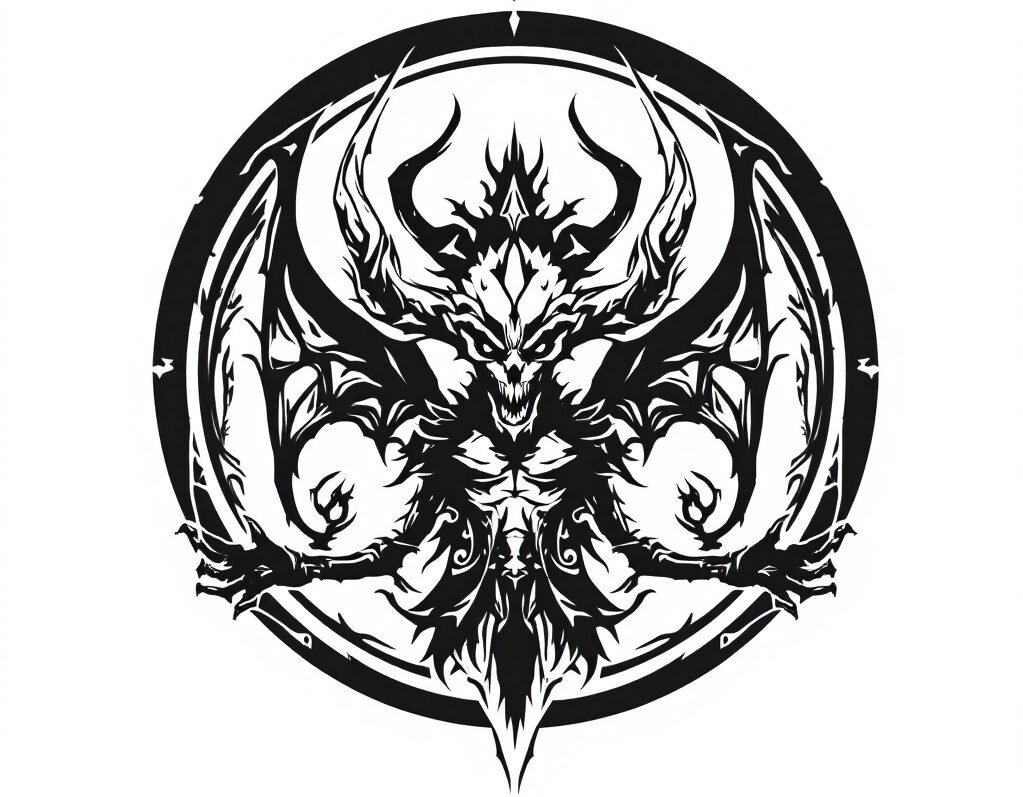
Many entities in the Lemegeton are known for granting wealth or knowledge, but Abadir stands out as a specialist in spiritual and social decay. Serving under Asmodeus (or Duke Caspiel, according to other sources), his power does not come from open violence, but from the “invisible rot” of dispersion. This means he breaks down established order into chaos. Looking at Abadir’s place in the infernal hierarchy shows how, in medieval thought, alliances and structures often fall apart from the inside.
This demon profile was created by comparing the Steganographia and the Theurgia-Goetia, making sure that the classifications of Caspiel’s servitors match those found in the original 15th-century manuscripts. [View Full Bibliography ↓]
Summary
Key Takeaways
| Attribute | Details |
|---|---|
| Names | Abadir (primary); possible variations include Abaddir or Ophite Orus links. |
| Title | Servitor of Asmodeus (or Duke Castiel in other sources) |
| Gender | Male. |
| Role | Agent of dispersion and chaos; aids in scattering order, inciting unrest, and supporting temptations of lust and wrath. |
| Hierarchy | Low-ranking servitor. |
| Superior Demon | Asmodeus/Duke Castiel. |
| Powers | Induces scattering of thoughts and stability; assists in demonic temptations; promotes confusion and minor disruptions in human affairs. |
| Appearance | Likely serpentine or shadowy form, drawing from Ophite serpent god origins; no detailed physical depictions in sources. |
| Etymology | Hebrew origin meaning “scattered” or “dispersed”; ties to themes of fragmentation and unrest. |
| Associated Figures | Asmodeus (superior); possible links to Ophite serpent deity Orus. |
| Weaknesses | Bound by higher angelic forces or Solomonic seals; repelled by invocations of divine names like those in Abramelin rituals. |
| Opposing Angel/Saint | Archangel Michael (general counter to Asmodeus’s forces); no specific named opponent. |
| Pantheon | Christian demonology with Jewish and Ophite (Gnostic) influences. |
| Element | Air (symbolizing dispersion and unrest). |
| Color(s) | Gray or shadowy tones, evoking scattering and obscurity. |
| Primary Sources | The Sacred Magic of Abramelin the Mage (Mathers translation, 1898); general demonological texts, such as those that reference Ophite traditions. |
“Abadir” Meaning
So, what does “Abadir” mean? At its core, the definition points to a demonic force designed to disrupt and divide, a concept rooted deeply in Hebrew linguistics. The name “Abadir” derives from Hebrew origins, where it translates directly to “scattered” or “dispersed.”
This etymology is relatively simple: the root words suggest a lack of unity, a breaking apart of what should hold together. In demonic terms, this implies a being who thrives on chaos, pulling apart thoughts, relationships, and even physical stability to serve darker ends.
The linguistic base draws from ancient Semitic languages, where words for scattering are often tied to ideas of exile or loss, much like seeds thrown across barren ground, never to root firmly.
Exploring the etymology further reveals layers of cultural shift. Hebrew scholars and occult translators highlight how the demon’s name evokes the idea of things flung wide (much like storm debris). In Jewish mysticism, names like this often hint at a demon’s purpose—here, to fragment faith or sow doubt.
As traditions evolved into Christian demonology, the name adapted, appearing in grimoires as a tool for infernal hierarchies. Variations across texts are slim, but some older manuscripts spell it Abaddir. This minor tweak still carries the same disruptive essence. These small changes reflect how scribes in medieval Europe blended Hebrew roots with Latin influences, making Abadir a bridge between ancient Near Eastern lore and Western occultism.
The name’s evolution shows a gradual darkening; what might have started as a neutral term for dispersal became loaded with evil intent, as cultures layered fears of division onto it. So, the symbolic weight in terms of Abadir’s meaning grows when viewed through historical lenses.
In Ophite Gnostic traditions—early Christian offshoots that revered serpentine wisdom—Abadir may be linked to the god Orus (a serpent figure associated with forbidden knowledge). This relationship transforms the name from simple scattering to active deception, in which dispersion becomes a weapon against divine order.
Even some grimoires preserve this, listing Abadir among servitors of Asmodeus, the demon of lust and wrath. Here, the etymology underscores his unique position: not a grand tempter, but a subtle breaker of bonds, scattering wills to amplify greater sins.
The name’s roots in Hebrew also echo broader themes in Semitic languages, where similar words appear in contexts of wandering or banishment, reinforcing Abadir’s ties to unrest and displacement.
Cultural adaptations further enrich the definition. For example, in old Phoenician texts, similar terms meant “magnificent father.” However, demonologists inverted this to irony—Abadir as a false patriarch who shatters families and loyalties.
As the name traveled through apocryphal works and esoteric circles, it evolved to embody the perils of division in Christian thought. Early church fathers, wary of Gnostic serpents, would have seen Abadir as a perversion of creation’s unity, with his etymology serving as a curse on harmony. This shift highlights how names in demonology often carry dual meanings—surface translations hiding more serious threats to order and peace.
How to Pronounce “Abadir” in English
To say Abadir in English, break it down into three parts: “Ah-bah-deer.” The first sound is like “ah” in father, the second like “bah” in bar, and the last like “deer”, the animal. Stress falls on the middle part, making it flow as Ah-bah-deer.
What Does Abadir Look Like?
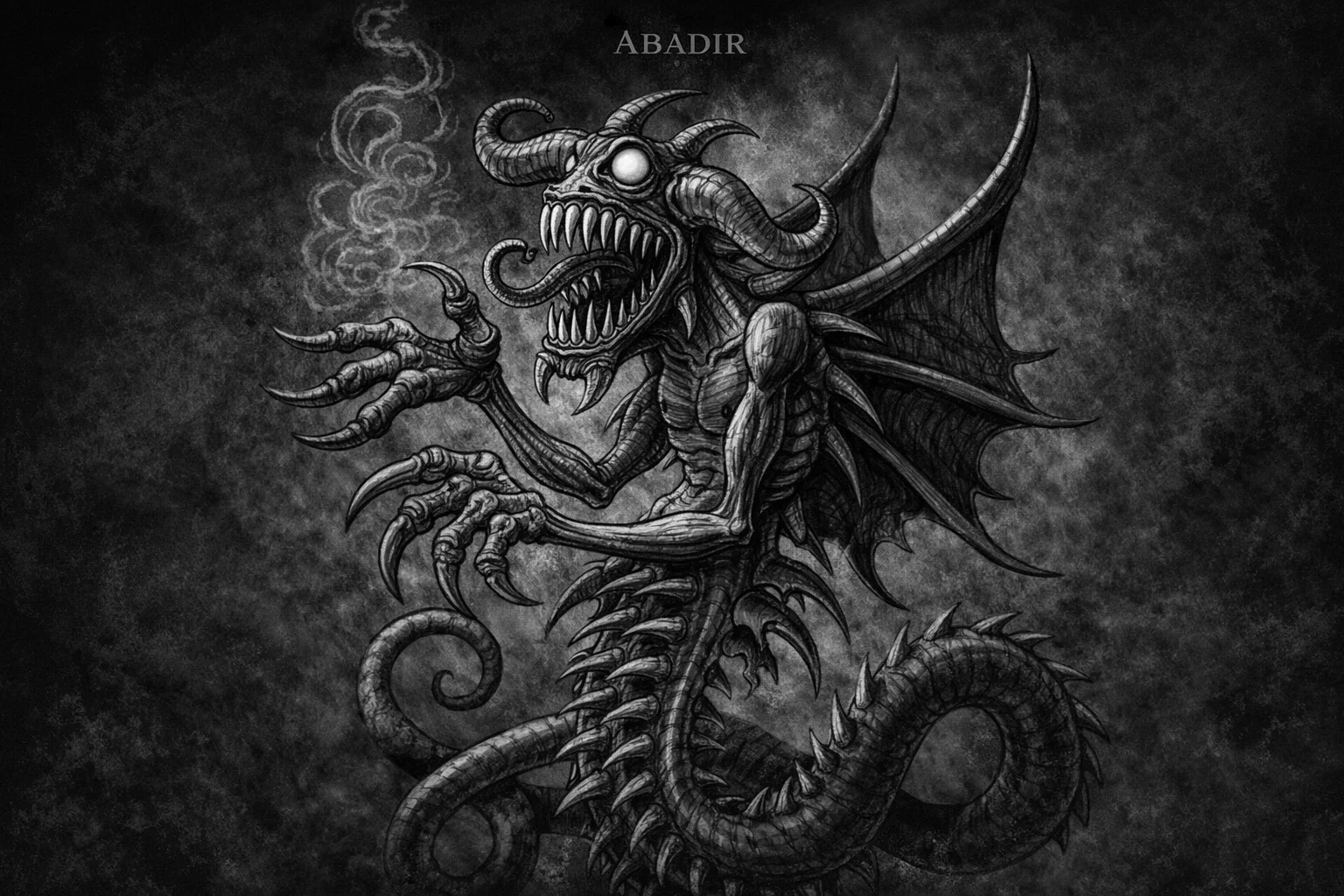
Since Abadir is a lesser demon, there aren’t many depictions of his physical traits. Generally, unlike grand demons with vivid, grotesque forms, he appears more as a shadow than a spectacle, often implied rather than detailed.
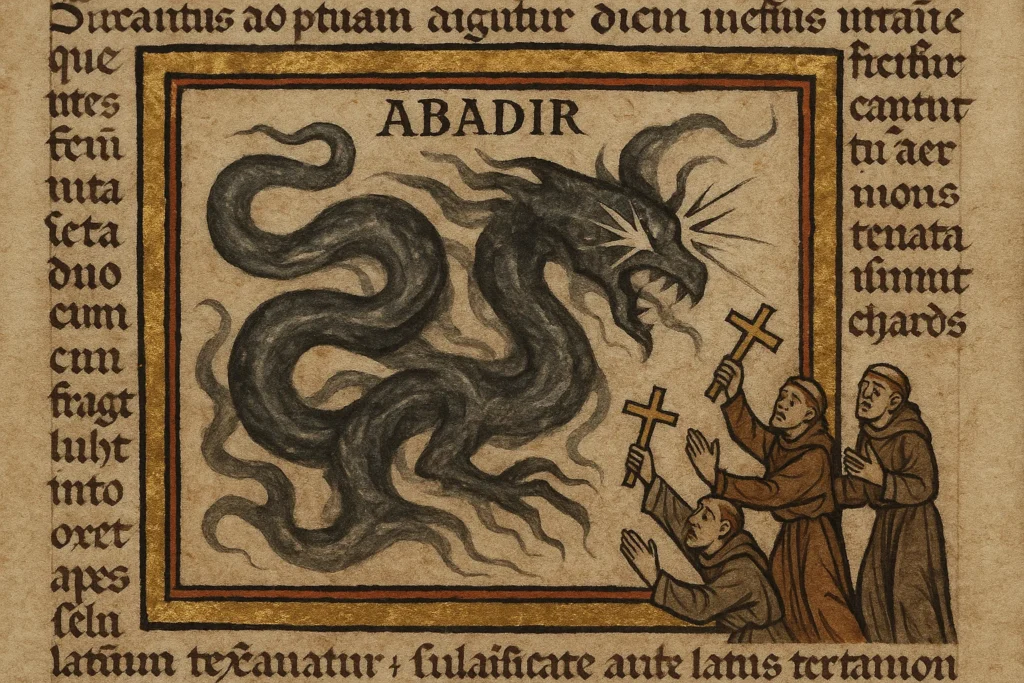
In the occult traditions of The Sacred Magic of Abramelin the Mage, his manifestation ties to serpentine origins, suggesting a coiling, fragmented shape that evokes unease. Imagine a form that shifts like smoke—elongated limbs that trail off into wisps, as if even his body resists cohesion. This aligns with his name’s “scattered” essence, where solidity gives way to fleeting tendrils.
During summonings, grimoires hint at Abadir appearing in a haze of gray mist, his features blurred to prevent full grasp.
Some esoteric illustrations show him as a serpent-god remnant: a lithe, scaled torso with eyes like fractured glass, reflecting the summoner’s doubts back at them.
However, this isn’t a fixed image. Some variations may occur based on the ritual’s intent. For instance, in one apocryphal sketch from Ophite-influenced texts, the demon manifests as a hybrid—part snake, part vapor—his head hooded like a cobra, but dissolving at the edges. Such forms during evocation serve to disorient, mirroring his power to scatter focus.
Symbolic meanings deepen these portrayals. The serpentine link to Orus, the Ophite deity, implies deceit in multiplicity—perhaps multiple heads that whisper conflicting lies, or a body that forks unpredictably.
Historical art, such as faded woodcuts in 19th-century occult volumes, renders him in muted tones, his outline broken by jagged lines that suggest perpetual motion.
Overall, Abadir’s look warns of his nature—untouchable, divisive, never fully seen.
You may also enjoy:
Amaymon: The Infernal King Who Commands Death and Decay
November 17, 2025
Abura-sumashi: The Potato-Headed Yōkai That Punishes Greed
October 23, 2025
What Is a Qareen and Why Does It Follow Every Human Being?
October 8, 2025
Who Is Abaddon, the Demon of the Abyss, in the Bible?
September 29, 2025
Origins
Abadir’s origins can be traced back to a complex web of ancient spiritual traditions, where the lines between divine and demonic forces blur in the sands of the Near East. Arising as a minor yet potent entity, his influence first manifested through Hebrew mysticism and Gnostic fringes, evolving into a full-fledged demonic servitor by the medieval era.
His story reflects more comprehensive changes: pre-Christian deities are recast as infernal agents through the lenses of Jewish and Christian perspectives. From serpent gods of hidden wisdom to a scatterer in hell’s ranks, Abadir embodies how cultures demonized the unfamiliar, turning symbols of knowledge into tools of chaos.
Early roots lie in Ophite Gnosticism, a 2nd-century offshoot of Christianity that revered serpents as bearers of enlightenment. Here, Abadir may stem from Orus—echoing the Genesis snake but twisted toward rebellion. These Ophites, branded heretics by orthodox churches, saw serpents as liberators from tyrannical creation myths.
As Christianity solidified, such figures plunged into demonology. Their enlightening aspects flipped to corrupting ones. Abadir’s “scattered” nature fits this fall: what once unified hidden sects now disperses faith, a perfect infernal inversion.
By the Renaissance, Abadir solidifies in European grimoires, integrated via Jewish Kabbalah and Solomonic lore. Medieval scribes, compiling texts, placed him under Asmodeus, drawing from Persian daevas—wrathful spirits demonized in Zoroastrianism.
Later occultists preserved these layers, securing Abadir’s place in a hellish bureaucracy. The integration into Christian lore involved reinterpreting Gnostic serpents as agents of Satan, with Abadir serving as a bridge between heretical wisdom and orthodox damnation. Simply put, pre-Christian sources provided the clay—serpents of wisdom, stones of power—molded by monotheistic zeal into evil.
Was Abadir Ever Mentioned in the Bible?
Abadir does not appear in the Bible. Canonical texts, such as the Old or New Testaments, make no direct reference to this demon, nor do apocryphal works, like the Book of Tobit or the Enochian books. But that’s not surprising. His absence aligns with his low rank; biblical demonology focuses on archfiends such as Asmodeus or Leviathan, not servitors.
Abadir in Grimoires and Other Texts
Abadir’s grimoires footprint centers on The Sacred Magic of Abramelin the Mage, a 15th-century Hebrew text compiled by Abraham of Worms and translated by Mathers in 1898. Attributed to Solomonic magic, it lists Abadir among 16 servitors of Asmodeus, emphasizing his role in infernal aid without grand titles.
This work combines Kabbalistic elements with Christian exorcism, portraying Abadir as a summonable spirit for malevolent purposes. No spirit number is assigned to him, unlike Ars Goetia‘s ranked legions; instead, he’s a utility demon in Abramelin’s hierarchical scheme. The text positions him as an enabler, scattering protections to allow greater demons to enter.
Other texts echo this sparingly. Pseudomonarchia Daemonum by Johann Weyer (1577) omits him, focusing on higher ranks. Still, cross-references suggest Ophite influences in broader demon catalogs. The Grand Grimoire mentions Asmodeus’s cohorts indirectly, implying Abadir’s presence in pact rituals.
Syncretic Kabbalah weaves him into goetic evocations, where he’s invoked for scattering curses. These appearances portray Abadir as a “background operator.”
| Source | Quote |
|---|---|
| The Sacred Magic of Abramelin the Mage (Mathers, 1898) | Abadir: Hebrew. Possibly originally the Ophite serpent-god Orus. One of the sixteen servitors of Asmodeus. |
Abadir as a Vector of Entropy
Many beings in the Theurgia-Goetia are called upon to find hidden treasures or influence love, but Abadir has a different role. He focuses on breaking down social and political structures.
Abadir serves Duke Caspiel, known as a wandering Prince of the Air. He marks the shift from the ‘High Magic’ of the Renaissance to the worries of early modern politics. Instead of causing physical harm, Abadir acts more like a psychological threat. He encourages division and weakens the bonds that hold groups together, whether in armies, religious orders, or royal courts.
This role connects to the Stoic idea of ekpyrosis, which is the eventual end of the universe, but here it applies to the weakness of human pride and agreements. When these grimoires became popular, Europe was facing religious splits and the breakup of the Holy Roman Empire. Abadir, then, stands for what could be called ‘The Invisible Rot.’
For medieval practitioners, Abadir explained why a good plan might suddenly fail or why a trusted ally might betray them for no clear reason. Unlike Lucifer, who tempts with grand lies, Abadir creates small problems that make it hard for people to work together.
In language and myth, Abadir is similar to ‘Trickster’ spirits found in many cultures, but he doesn’t have their playful or creative side. While figures like Hermes or Eris break things apart to make room for something new, Abadir only spreads disorder. He is like ‘White Noise’ in the infernal court, causing confusion and blocking clear communication.
Looking at Abadir’s role under Caspiel, whose followers are known for being quick and unseen, we can see an early insight into society. The best way to bring down a kingdom is not by attacking from outside, but by speeding up the natural drift of complex systems toward confusion and disorder.
Powers and Abilities
The demon wields powers suited to his servitor status—subtle, insidious tools that amplify chaos without overt spectacle. His abilities typically center on dispersion, serving Asmodeus’s wrathful domain:
- Induces Scattering of Thoughts: He clouds minds, making clear decisions fracture into doubt and indecision. Victims face racing, disjointed ideas, leading to poor choices in love or battle.
- Demonic Temptations: Under Asmodeus, he whispers lures of lust and anger, scattering moral barriers to ignite sins. He scatters inhibitions like leaves in the wind, drawing souls to excess.
- Promotes Physical and Social Unrest: He can cause minor disruptions—such as lost objects, fractured alliances, or fleeting storms—to symbolize deeper chaos. In rituals, he scatters enemies’ formations.
- Infernal Alliances: He can boost/support other demons’ reach by dispersing protective wards, allowing greater evils entry. Ties to serpent origins let him slither through defenses.
Abadir Myths, Legends, and Stories
Myths of Abadir live in the margins of demonology, lacking epic sagas but rich in cautionary fragments. Most available fragments portray him as a quiet saboteur.
The Swallowed Stone
In ancient tales from Phoenician lands, the word Abadir refers to a round stone with profound significance. It ties to the story of Cybele, also called Ops, the wife of Saturn. When she gave birth to a child, she feared Saturn would eat the baby, as he did with others, to stop them from taking his throne.
To trick him, Cybele wrapped a stone in cloth like a newborn and gave it to Saturn. He swallowed it whole, thinking it was the child. The stone saved the baby, who grew up to be Jupiter.
Later views saw Abadir as a sign of the gods or even the god Terminus, who marked borders. Some said the name meant “magnificent father,” a title for the top gods among the Carthaginians. Others linked it to cone-shaped stones that stood for deities in early worship.
Abadir as Servitor of Asmodeus
In the 15th-century book “The Sacred Magic of Abramelin the Mage,” Abadir appears among many spirits listed in its spells. The text tells how Abraham, a Jew from Worms, learned magic from an Egyptian wise man named Abramelin.
In the second part, it lists demons and their chiefs for calling in rites. Abadir serves under Asmodeus, a high demon linked to wrath and ruin. The book names Abadir among sixteen helpers to Asmodeus, providing no detailed information on his actions or appearance.
Abadir vs Other Similar Demonic Entities
| Demon Name | Associated Sin/Temptation | Rank/Origin | Key Traits/Powers |
|---|---|---|---|
| Asmodeus | Lust and wrath | King of Hell; Book of Tobit, Ars Goetia | Commands 72 legions; incites jealousy, destroys marriages; serpentine form with three heads. |
| Belial | Lawlessness and worthlessness | Prince of Hell; Dead Sea Scrolls, Ars Goetia | Grants favors through deceit; 80 legions; appears as a beautiful angel or roaring lion. |
| Pazuzu | Winds and plague | Demon king; Mesopotamian lore, The Exorcist | Brings famine and disease; it is protective against other evils; it is winged with a canine head. |
| Demogorgon | Chaos and terror | Prince of Demons; Greek origins, D&D influences | Dual-headed; commands abyssal legions; induces madness and destruction. |
| Astaroth | Sloth and discovery | Duke of Hell; Ars Goetia | Reveals secrets; 40 legions; foul breath, rides an infernal dragon. |
| Beelzebub | Gluttony and flies | Lord of Flies; Philistine god, New Testament | Infests with vermin; possesses via decay; 66 legions under command. |
| Lilith | Seduction and infant harm | Night demon; Jewish folklore, Alphabet of Ben Sira | Steals newborns; shape-shifts as a succubus; winged with long hair. |
| Azazel | Forbidden knowledge | Fallen angel; Book of Enoch, Leviticus | Teaches weaponry; scapegoat ritual; goat-like, bound in the desert. |
| Mammon | Greed and wealth | Treasurer of Hell; New Testament inferences | Hoards riches; tempts with gold; invisible unless compelled. |
| Leviathan | Envy and chaos | Sea serpent; Book of Job, Isaiah | Oceanic destroyer; armored scales; coils to crush ships and souls. |
| Incubus | Lustful dreams | Male succubus; Medieval folklore | Drains energy via night visits; shape-shifts to lovers; causes nightmares. |
| Foras | Invisibility and logic | President of Hell; Ars Goetia | Teaches arts; 29 legions; grants long life through deceitful wisdom. |
| Balam | Hidden truths | King of Hell; Ars Goetia | Foretells future; 40 legions; three heads (bull, man, ram), flaming eyes. |
Rank in the Hierarchy of Hell
Abadir occupies a modest rank in hell’s vast structure as a servitor to Asmodeus in the Abramelin system. Unlike the crowned kings of Ars Goetia, he lacks a noble title—no duke or prince graces his name—positioning him among the worker bees of infernal bureaucracy.
This low hierarchy suits his dispersive role. High ranks command legions for spectacle, but Abadir thrives in the cracks, aiding superiors without drawing eyes.
Texts describe him in Asmodeus’s cadre of 16, a tight-knit group under the lustful king’s oversight, reporting directly to this wrathful overlord. This placement ensures Abadir acts as an extension of Asmodeus’s will, scattering obstacles to amplify lust and anger in targeted souls.
In broader classifications, Abadir falls below Lucifer or Satan, the unchallenged emperors, and even Asmodeus’s peers, such as Beelzebub. Wierus’s classifications imply such servitors as extensions of greater powers, their might amplified through allegiance. The demon commands no legions—zero souls under his banner—marking him as non-autonomous, his strength borrowed.
Loyal to Asmodeus, he likely allies with lust-demons like Zepar, scattering rivals’ focus during temptations. He may also form temporary alliances with other low-rank servitors, forming clusters under Asmodeus to coordinate disruptions. For instance, he might collaborate with figures like Gilarion or Eniuri, fellow Abramelin aides, to fracture group resistances.
Associations
Abadir ties to elements like air, colors of shadow, and numbers evoking fracture—reveal his evil core: not brute force, but the quiet art of undoing. In demonology, such correspondences aid summoning and understanding, showing how he mirrors human frailties.
Air, his elemental kin, symbolizes fleeting thoughts and gales of doubt, making him a perfect scatterer. Gray hues cloak him, blending into obscurity to strike unseen.
The demon is loosely tied to Venus via Asmodeus, fueling lustful desires. At the same time, zodiac voids leave him untethered— a drifter unbound by stars.
Zodiac and Astrological Links
The demon ignores direct zodiac ties, his dispersive essence drifting beyond fixed signs. Yet, through Asmodeus, he brushes Venus-ruled domains like Libra or Taurus, where balance ironically fuels his unmaking. Libra’s scales tip under his influence, scattering justice into bias and fair dealings into disputes; Taurus’s stability crumbles to impulsive rifts, turning steadfastness into fleeting whims.
These links amplify during Venus hours—dusk or dawn—when summonings peak, his powers peaking to fracture partnerships or scatter possessions.
Elemental Associations
Air dominates Abadir’s elemental realm, embodying the winds that carry whispers of doubt and whirl unity apart. In grimoire correspondences, he aligns with eastern directions, the intellect’s seat, where thoughts scatter like leaves in gusts that strip trees bare. Manifestations show as swirling vapors, his abilities channeling gales to disrupt circles or minds with sudden bursts of confusion.
Air’s intangible quality matches his elusive form, allowing him to slip through barriers like a breeze through open windows, eroding structures from within. This element manifests in his powers through mental fogs or literal winds that disperse gatherings, turning calm into turmoil.
Rare ties to water hint at emotional tides pulled asunder, where feelings fragment like waves crashing on rocks, but air’s chaos reigns supreme, symbolizing the unseen forces that carry corruption afar.
Colors, Numbers, and Crystals
Gray veils Abadir, a color of fog and fracture, symbolizing obscured paths and moral haze that clouds judgment. It evokes his shadowy strikes, blending with smoke for rituals where visibility fades, allowing confusion to take hold.
Black tinges his edges, deepening dispersion’s void like endless night swallowing light. These colors aid in visualizations, with gray candles used to invoke his dispersing touch, their flames flickering uncertainly.
Obsidian—volcanic glass of sharp breaks—mirrors his edge, its black sheen capturing light only to distort it. Onyx grounds against his air, its black bands repelling scatter like barriers against the wind. Smoky quartz, with its hazy inclusions, echoes his misty presence and may be used in talismans to channel or counter his influence.
Other Correspondences
Abadir’s web extends to metals like quicksilver, fluid and dividing, ideal for his form that shifts without warning. This metal, also known as mercury, is associated with rapid change, aiding rituals that require quickly disrupting stability.
Nightshade’s berries scatter the senses into delirium, aligning with temptations that blur reality; its toxic leaves evoke poisons of the mind. Other plants, like thistle, with prickly seeds that disperse widely, suit his nature, and are used in curses to spread discord.
Animals evoke the serpent—coiled, shedding skins in false renewal—or the crow, harbinger of fractured flocks that scatter at omens.
Abadir’s Sigil and Symbols
Abadir’s sigil, though undocumented in major grimoires, appears in Abramelin-inspired sketches as a fractured spiral—its coils breaking into barbs, evoking his scattered name. Drawn in gray ink on parchment, it twists like wind-swept thorns, central lines forking unpredictably to symbolize dispersion and the breaking of paths.
Historically, such seals bound him in evocation circles, traced during Asmodeus rites to channel his aid without full summon, often incorporated into larger sigils of his superior.
Bibliography
Author’s Note: While putting together this demon profile, I was struck by how the mechanical classifications in Johannes Trithemius’s Steganographia provide a basic framework for the more vivid and practical uses seen in Nottingham’s Ars Theurgia-Goetia. One major research challenge was trying to balance the free, wandering nature of Caspiel’s court with the strict hierarchies in the Grimoirium Verum. I decided to focus on the earlier 15th-century manuscripts to keep the entity’s original role as a force of dispersion. My analysis shows that Abadir is often misunderstood in modern occult circles. By comparing these primary texts, it becomes clear that this lesser-known demon is not defined only by malice but also by the complex breakdown of social and spiritual connections.
- Juanita Feros Ruys – Demons in the Middle Ages. Arc Humanities Press, 2017.
- S. L. MacGregor-Mathers (translator) – The Book of Sacred Magic of Abra-melin, the Mage. Published by The dc Laurence Company, 1939.
- L. W. De Laurence – The Lesser Key of Solomon, Goetia. Original publication: Chicago: de Laurence, Scott & Co, 1916.
- Chester Charlton Mc – The Testament of Solomon. Edited from manuscripts at Mount Athos, Bologna, Holkham Hall, Jerusalem, London, Milan, Paris, and Vienna. Leipzig J. C. Hinrichs’ Sche Buchhandlung, 1922.
- Jesuit Dominicane Plangiere (translator) – Grimoirium Verum (or The True Grimoire). PDF edition, 1999 Phil Legard.
- Johannes Trithemius – Steganographia (Secret Writing). English translation by Fiona Tait and Christopher Upton. Published by Adam McLean, 1997.
- Gary St. M. Nottingham – Ars Theurgia-Goetia. Published by Avalonia, 2012.
You may also enjoy:
Who Is the Infernal King Balam? Origins, Powers, and Occult History
February 26, 2026
Chort: The Sinister Slavic Demon of Chaos and Bad Luck
March 10, 2026
Who Was Ravana in Hindu Mythology and Why Was He Feared?
October 3, 2025
Edimmu: The Mesopotamian Wind Demon That Steals Life
November 6, 2025
Aži Dahāka: The Three-Headed Dragon of Zoroastrian Mythology
January 14, 2026
What Is a Tengu? Origins, Powers, and Dark Folklore
January 29, 2026