Kumbhāṇḍa in the Buddhist cosmos show a clear tension between the chaos of the spirit world and the strict order of celestial rule. Rather than being just independent monsters, they are examples of how the strange and grotesque are brought under control by serving higher divine powers.
Looking at their role as attendants to the Great King of the South, we see how local nature spirits became part of a larger moral and cosmic system. They act as protectors of sacred places and also stand as symbols of physical deformity. These spirits also appear in Hindu mythology (check the Hindu Demons for more information).
My article below is based on information from the Dīgha Nikāya, which provides a clear timeline of how these spirits entered the Buddhist pantheon and came under the authority of the Four Heavenly Kings. [View Full Bibliography ↓]
Summary
Key Takeaways
| Attribute | Details |
| Names | Kumbhāṇḍa, Kumbhaṇḍa, Kubhanda |
| Title | Guardians of the Southern Quarter, Attendants of Virūḍhaka |
| Region | India, Tibet, Southeast Asia, East Asia |
| Type | Buddhist demon, nature spirit, lesser deity |
| Gender | Predominantly male, though the class includes various forms |
| Realm | Cāturmahārājika (Heaven of the Four Great Kings), Southern Quarter |
| Obstacle/Threat | Siphoning of human vitality, physical obstruction, and terror |
| Associated Figures | Virūḍhaka, Gautama Buddha, The Four Heavenly Kings |
| Weaknesses | The authority of the Four Heavenly Kings, Buddhist mantras, and the presence of the Buddha |
| Associated Deity/Figure | Virūḍhaka (The Great King of the South) |
| Pantheon | Buddhist with Vedic/Hindu influences |
| Primary Sources | Āṭānāṭiya Sutta, Mahāsamaya Sutta, Lotus Sutra, Lalitavistara Sūtra |
Who or What is the Kumbhāṇḍa?
The Kumbhāṇḍa are a type of small, misshapen spirits found at the lower levels of the Buddhist celestial order. They are considered amanusa (non-human beings). They are usually grouped with other semi-divine beings, such as the Yakshas, Nagas, and Gandharvas. In Buddhist stories, they live in the South, on the slopes of Mount Meru.
Although they are often shown as scary or harmful to humans, they do not act on their own. They follow the orders of Virūḍhaka, the Great King of the South.
Many texts describe them as having huge, distorted bodies, which is why they are known as “pot-bellied” or “jar-shaped” spirits that can trouble people who are not spiritually protected.
“Kumbhāṇḍa” Meaning
The name comes from the Sanskrit words kumbha, meaning “jar” or “pot,” and anda, meaning “egg” or “testicle.” This has led to two main ideas about their name.
Most often, it refers to their bodies, with the belief that they have very large, jar-like genitals or big, swollen bellies that look like water jars. In Pāli texts, Kumbhāṇḍa keeps this “pot-shaped” meaning, highlighting their short and swollen look.
In Chinese Buddhist texts, they are usually called Jiumantuo (鳩槃荼), which sounds like the Sanskrit name. Sometimes, they are also called “Winter Melon Spirits” or “Gourd Spirits” (Guagua) because their shape is round and bulbous like a gourd.
In Tibetan tradition, they are called Grul-bum, meaning “clumsy” or “stunted.” In all these cultures, the name always points to a spirit that is heavy and looks very different from the graceful Gandharvas or the more human-like Yakshas.
How to Pronounce “Kumbhāṇḍa” in English
To say Kumbhāṇḍa correctly, stress the second syllable: koom-BAHN-dah. The first part, Kumbh, has a short “oo” sound like in “book,” with a soft “bh” sound. The middle -āṇ- is a long “ah” sound, and the last -da is a short, plain “dah.”
For the Pāli version, Kumbhāṇḍa is pronounced almost the same: koom-BHAN-dah, but the middle vowel is a bit shorter.
In Chinese, Jiumantuo is said as JYOO-mahn-twoh, with the first part rhyming with “view.” The Tibetan name Grul-bum is pronounced DROOL-poom, with a strong “dr” sound and a soft “p” in the second part.
What Does the Kumbhāṇḍa Look Like?
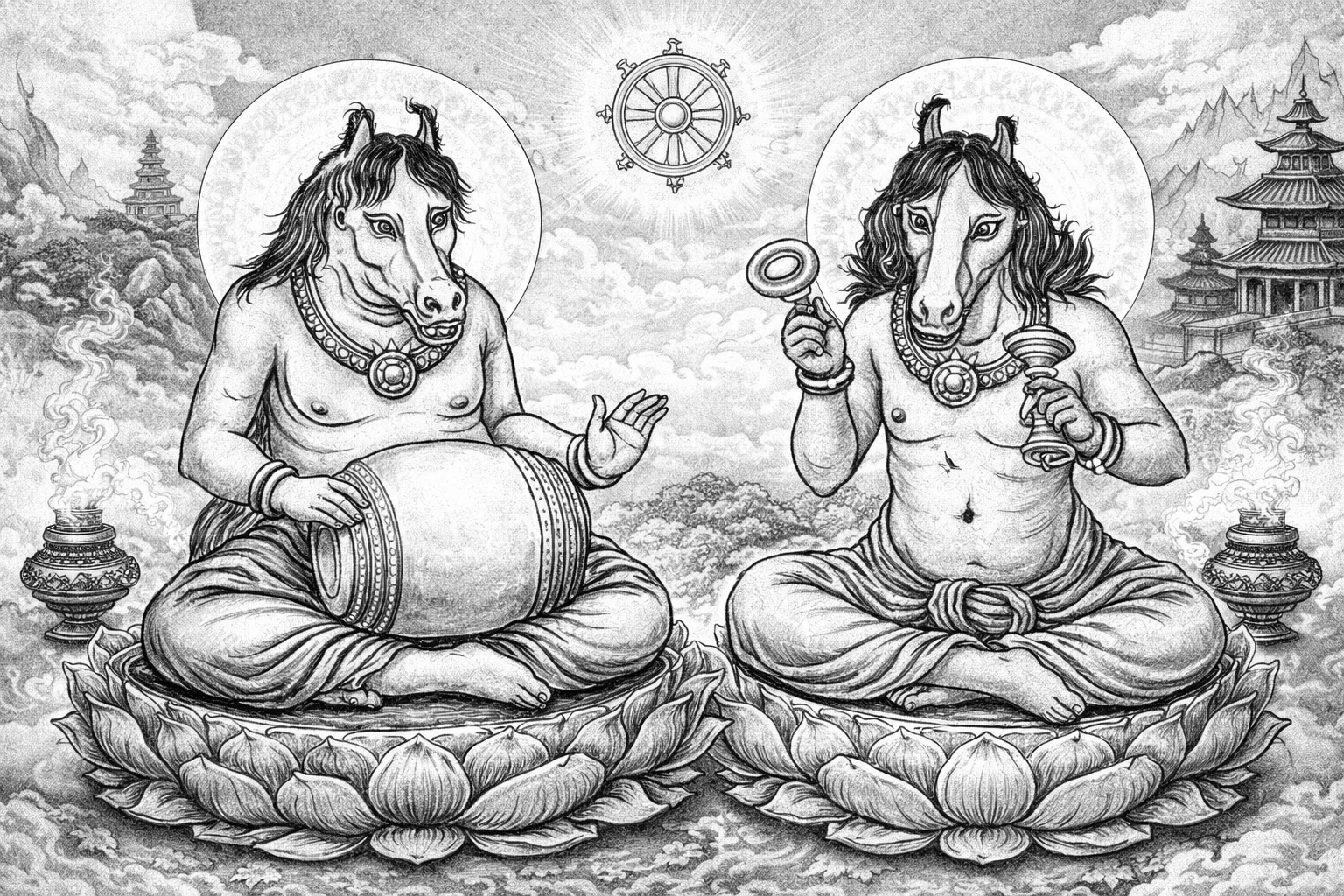
These spirits are described as short and strange-looking. They usually have very short arms and legs with large, uneven bodies. Their most noticeable feature is a swollen belly that resembles a large clay water jar (kumbha). This pot-bellied look is not a sign of wealth or health, but shows their odd, ghostly nature.
In Buddhist art, the Kumbhāṇḍa are often shown with bulging eyes and fierce faces, but they do not have the royal fierceness of higher gods. Their skin is usually painted dark, sometimes red or black, depending on the tradition.
Sometimes, they are called “spirit-parasites” and are said to change their size, but their usual form is that of an ugly dwarf. In East Asian art, they can look more like the Preta (Hungry Ghost), but with a stronger, shorter body and a more aggressive stance.
You may also enjoy:
Demon Alastor: The Grand Executioner of Hell
November 17, 2025
What Is Akaname, The Filth-Licking Yōkai?
October 28, 2025
What Is a Bhuta? The Backward-Footed Ghosts of Hindu Horror
February 5, 2026
Banasura: The Thousand-Armed Demon King
October 10, 2025
What Is a Dīv? The Terrifying Giant Demon of Persian Myth
January 22, 2026
Iblis, the Jinn King of Darkness and Deception
September 29, 2025
The Burden of Abundance
From my research in early Mahayana and Pāli sources, I found that the Kumbhāṇḍa has a much more complex role than just being a forest goblin or minor spirit.
While most stories focus on their odd, pot-bellied shape, I believe they also show a deeper social and psychological issue: the risk of uncontrolled or stagnant energy. In ancient farming societies, fertility was not always seen as a blessing. If not guided by someone like the King of the South, Virūḍhaka, it could become strange, heavy, or even harmful.
I find it interesting that the word kumbha (pot) is linked to the idea of “containment.”
In many Buddhist texts, such as the Lalitavistara, the Kumbhāṇḍa appears alongside Yakshas and Nagas. Still, it is shown as especially heavy and clumsy. This seems to symbolize the “heavy” ego—parts of human nature filled with desires and things, but lacking the “lightness” that comes from spiritual practice.
Unlike the Gandharvas, who symbolize the lightness of air and sound, these spirits symbolize the heaviness of earth and the lower body. They show the idea of “outflows” (asravas), which are energies that leak or build up when someone does not follow Buddhist teachings.
Also, when I looked at the Āṭānāṭiya Sutta, I saw that the early Buddhist community used a kind of “cosmic containment”. By making Kumbhāṇḍa, a “Great Mighty Demon King,” the leader of many spirits who promise to protect the Dharma, they turned fear of the grotesque into a useful force.
This spirit acts as a psychological mirror for the practitioner. The traits that make them seem “demonic,” like their bulging, jar-like shapes, are turned into a way to protect the scriptures.
In this way, the Kumbhāṇḍa shows how raw instincts can become guardians of what is sacred. It suggests a common idea of the “Redeemed Shadow,” where the most flawed parts of ourselves are not destroyed, but given a role in serving higher awareness.
Origins
The earliest records of these spirits are found in Vedic and Pāli texts from ancient India.
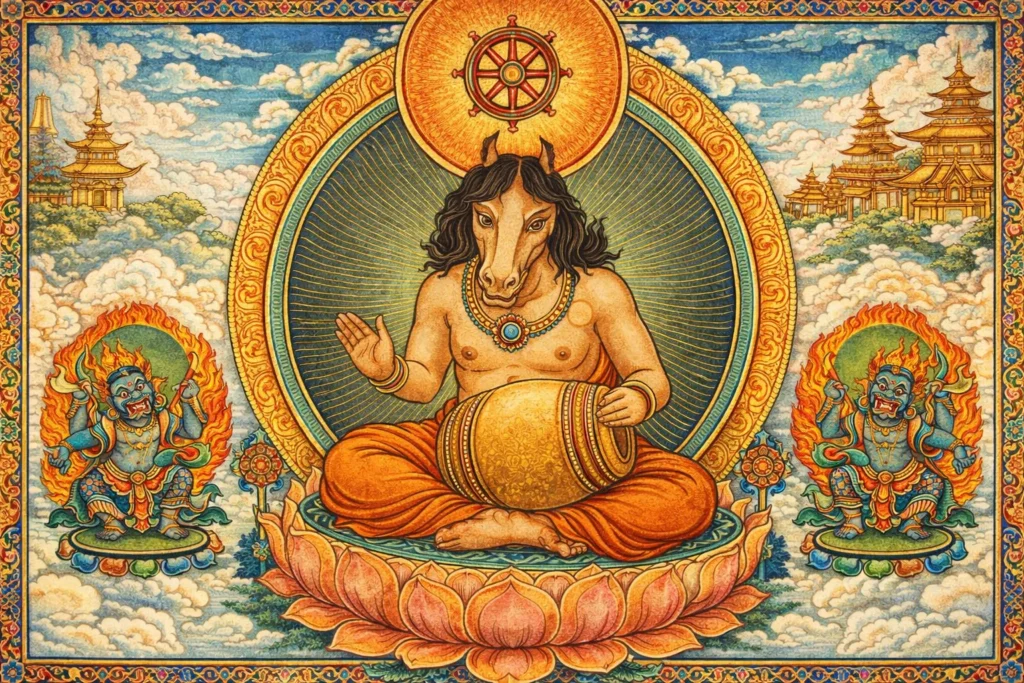
In the Vedic tradition, they were linked to the wild and chaotic parts of nature, living on the edges of human society. As Buddhism organized its view of the universe, these local spirits became part of the Cāturmahārājika, the lowest of the six heavens in the Desire Realm (Kāmadhātu).
Their story is closely tied to the legend of the Four Heavenly Kings. Buddhist texts, such as the Digha Nikaya, say that when the Buddha became enlightened, all the spirits were organized into a protective order. These spirits were put under the rule of Virūḍhaka.
This transition from wild, independent spirits to “Celestial Soldiers” or “Heavenly Attendants” marked a major turning point in their story. They went from being simple folk-demons to being accepted, though still low-ranking, as part of the cosmic defense of the Dharma.
Powers and Abilities
These spirits are stronger than humans and hungry ghosts, but much weaker than the Devas and the Great Kings. Their power is about the same as the Yakshas, but they are usually seen as less smart and more physical than the Gandharvas.
- Vitality Siphoning: They are reputed to have the ability to drain the ojas (vital energy) from humans, especially those who are spiritually weak or sleeping.
- Metamorphosis: Documented accounts suggest they can alter their appearance to deceive or terrify humans. However, they often retain a degree of their stunted stature.
- Superhuman Strength: Despite their small size, their “spirit-body” has strength far beyond that of a mortal man.
- Invisibility: As amanusa, they remain invisible to the naked human eye unless they choose to manifest or are seen by someone with the “divine eye” (dibba-cakkhu).
- Flight: They can move through the air to travel between the earthly world and the slopes of Mount Meru.
Myths, Legends, and Stories
Because these entities are often treated as a collective class rather than individual characters, they appear as background actors or “guardians of the gate” in many Buddhist narratives.
The Declaration of Protection
In the Āṭānāṭiya Sutta, the Four Great Kings, led by Vessavaṇa, come to the Buddha at Vulture’s Peak to offer protection for his followers. The text describes how the King of the South arrives:
“Then from the Southern quarter came the Great King Virūḍhaka, of the renowned fame, the lord of the Kumbhāṇḍas. He came with a vast host of Kumbhāṇḍas, who were of varied and fearsome forms. They stood respectful, bowing to the Blessed One.”
The story shows that these spirits, once seen as a threat to monks living in the forest, were brought under the Great King’s control. Vessavaṇa tells the Buddha that some of these spirits do not believe in the Blessed One, so the protective chant is needed:
“If any monk or nun, or lay-disciple, should learn this ward and repeat it, then no non-human, whether a Kumbhāṇḍa or his servant, shall gain access to that person to harm them. Should such a spirit do so, the other non-humans will punish that spirit, and he shall be driven out from the city of the spirits.”
You may also enjoy:
Who Is Agares, the Demon of Earthquakes and Deception?
October 13, 2025
Al-Ahmar: The Tuesday King of the Seven Jinn
February 13, 2026
Amdusias in the Ars Goetia: The Demon of Dark Music
December 2, 2025
Apophis: The Great Serpent of Egyptian Chaos
November 11, 2025
Allocer: Great Duke of Hell and the 52nd Spirit of the Ars Goetia
November 17, 2025
The Gathering of the Spirits
At the great assembly in the Mahāvana forest in Kapilavatthu, the Mahāsamaya Sutta tells how all kinds of non-human beings gathered to see the Buddha and his monks. The text describes the arrival of the Southern retinue:
“The King Virūḍhaka, who rules the Southern quarter, the lord of the Kumbhāṇḍas, appeared there with his many followers. These were spirits of great power, endowed with psychic strength and splendor. They came to the forest assembly to pay homage to the Sangha. Among them were many sons of the King, all bearing the name Inda, possessed of great strength and courage.”
This story shows how these spirits, once seen as misshapen and lower in rank, became part of the larger celestial community that recognizes the importance of the Dharma. It highlights that the spirits did not come to cause trouble but were drawn to the Buddha’s presence. This marked a moment of cosmic peace, when their predatory nature was calmed.
The Conversion of the Spirit Host
The Lalitavistara Sūtra gives a vivid account of the spirits present during the Buddha’s journey to enlightenment. As the Bodhisattva sat under the Bodhi tree, the text describes how different beings moved around him:
“The Kumbhāṇḍas, those with jar-shaped bodies and distorted faces, stood in the Southern direction. They held their places under the command of Virūḍhaka, watching the great struggle against the armies of Mara. When the Bodhisattva attained the supreme and perfect enlightenment, the earth shook in six ways, and the Kumbhāṇḍas, alongside the Yakshas and Gandharvas, raised a great cry of joy. They scattered celestial flowers and perfumes, and the misshapen spirits, seeing the light of the Tathāgata, were filled with a faith they had not known before. They bowed their heads and acknowledged that the one who has conquered himself is the lord of all beings, human and non-human alike.”
Kumbhāṇḍa vs Other Similar Entities
| Demon Name | Associated Obstacle/Role | Origin/Source | Key Traits/Powers |
| Mara | Temptation and Delusion | Pāli Canon | Illusion, control of desire |
| Yaksha | Protection or Harassment | Vedic/Buddhist texts | Great strength, wealth guarding |
| Naga | Control of Waters/Weather | Buddhist Sutras | Shapeshifting, venom |
| Gandharva | Celestial Music/Fragrance | Mahayana Sutras | Flight, musical mastery |
| Preta | Insatiable Hunger | Abhidharma | Invisibility, suffering |
| Asura | Wrath and War | Vedic/Buddhist texts | Martial prowess, jealousy |
| Rakshasa | Consumption of Flesh | Ramayana/Buddhist texts | Terrible appearance, strength |
| Pishacha | Eating of Waste/Flesh | Ancient Indian Lore | Possession, madness |
| Vetala | Possession of Corpses | Indian Folklore | Reanimation, occult knowledge |
| Dakini | Spiritual Energy/Wisdom | Vajrayana Buddhism | Ecstatic flight, magic |
| Garuda | Hunting Nagas | Puranas/Buddhism | Immense size, flight |
| Vinayaka | Creating Obstacles | Early Tantric texts | Hindering spiritual progress |
Mystical Correspondences
| Attribute | Details |
| Planet | Saturn (associated with boundaries and heavy forms) |
| Zodiac Sign | Capricorn (structure and earthiness) |
| Element | Earth |
| Direction | South |
| Color | Blue or Dark Green (colors of Virūḍhaka) |
| Number | 8 (associated with the directions and their guardians) |
| Crystal/Mineral | Lapis Lazuli (often associated with the Southern King) |
| Metal | Iron |
| Herb/Plant | Winter Melon or Gourd |
| Animal | Elephant (due to the association with weight and the South) |
| Trait/Role | Guardian of the South, vitality siphoner |
Most mystical ideas about these spirits come from their link to Virūḍhaka. Since they rule the South, they are connected to its elements and symbols. In Buddhist rituals, especially when protecting buildings or sacred places, people often call on their King to guard the Southern corner from these spirits.
The link to gourds or winter melons often appears in East Asian views, where the vegetable’s shape reminds people of the spirit’s odd body. Unlike Western ideas of summoning demons, these spirits are not called up but managed through Buddhist rituals that calm them and ensure they protect rather than harm.
You may also enjoy:
Who Was Hiranyakashipu, the Demon King of Hindu Mythology?
October 6, 2025
Arāti: The Beautiful Demon of Aversion in Buddhist Mythology
October 15, 2025
Kuchisake-onna: Folklore, Origins, and Urban Legend History
February 10, 2026
Who Is the Infernal King Balam? Origins, Powers, and Occult History
February 26, 2026
What Is a Pishacha, the Flesh-Eating Demon of the Dead?
February 11, 2026
Abura-sumashi: The Potato-Headed Yōkai That Punishes Greed
October 23, 2025
Bibliography
Author’s Note: Since the information on the Kumbhāṇḍa is relatively scarce, I had to look for some reliable, original sources to help me understand the mythology behind these spirits. I compared the Pāli descriptions in Walshe’s Dīgha Nikāya with the detailed images in Nebesky-Wojkowitz’s study of Tibetan protectors. I also focused on connecting the “pot-bellied” features described in the Princeton Dictionary of Buddhism with their role in the divine gatherings found in the Lalitavistara and the Samyutta-Nikāya. By using these main sutras rather than later folk stories, I highlighted how these spirits evolved from wild nature spirits to disciplined guardians of the Southern Quarter.
- Buswell, Robert E., Jr., and Donald S. Lopez, Jr. The Princeton Dictionary of Buddhism. Princeton University Press, 2014. Internet Archive.
- Mitra, Rajendralala, translator. The Lalitavistara; or, Memoirs of the Early Life of S’ākya Siñha. Fasciculus 1–2, Baptist Mission Press, 1881–1882. Bibliotheca Indica. Internet Archive.
- Walshe, Maurice, translator. The Long Discourses of the Buddha: A Translation of the Dīgha Nikāya. Wisdom Publications, 1995. The Teachings of the Buddha. Internet Archive.
- Tauscher, Helmut. Kanjur. Brill’s Encyclopedia of Buddhism, Vol. 1, Brill, 2015.
- Kern, H., translator. Saddharma-Puṇḍarīka; or, The Lotus of the True Law. Dover Publications, 1963. Internet Archive.
- De Nebesky-Wojkowitz, René. Oracles and Demons of Tibet: The Cult and Iconography of the Tibetan Protective Deities. Mouton & Co., 1956. Internet Archive.
- Feer, Léon, editor. The Saṃyutta-Nikāya of the Sutta-Piṭaka: Part I. Sagātha-Vagga. Published for the Pali Text Society, Henry Frowde / Oxford University Press, 1884. Internet Archive.