Many creatures in Japanese folklore are known for their strange looks or violent behavior. However, unlike those, Yuki Onna is remarkable for combining pure beauty with the dangers of a harsh environment.
She is more than just a ghost; she represents the quiet, dangerous calm before a snowstorm. White snow is both a sign of pure beauty and a cover for death. Unlike other yōkai, such as the Ubume, which are tied to personal tragedies, this entity acts as a force of nature, connecting mountain gods with wandering ghosts in folklore.
To trace how this spirit transformed from a deity to a ghost, I carefully compared the Muromachi-period Sōgi Shūryū Shō with later entries in the Konjaku Hyakki Yakō. This approach helps document her evolution without adding modern interpretations. [View Full Bibliography ↓]
Summary
Key Takeaways
| Attribute | Details |
| Names | Yuki-onna, Yuki-musume, Yuki-onago, Yukijoro, Yuki-anago |
| Translation | Snow Woman |
| Title | The Snow Queen; Lady of the Frost |
| Type | Yūrei / Yōkai |
| Spirit Classification | Typically regarded as an Ara-mitama (rough spirit) when causing storms, though local legends sometimes depict a Nigi-mitama (gentle spirit) aspect in domestic tales. |
| Origin | Folk traditions suggest she is the spirit of a woman who perished in the snow, or an elemental manifestation of winter. |
| Gender | Female |
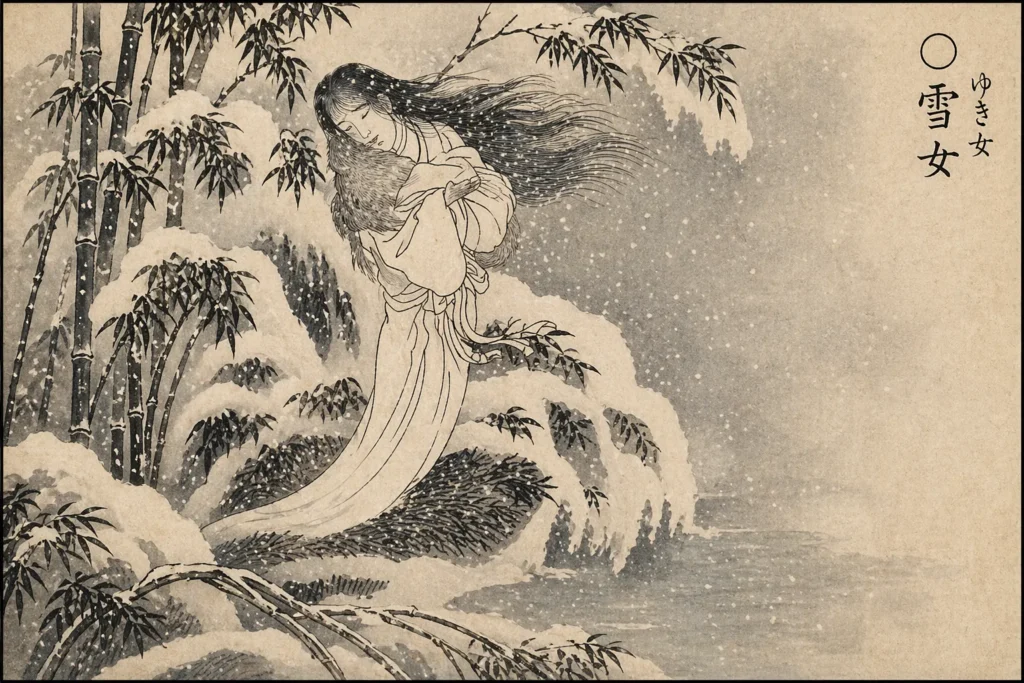
| Appearance | An exceptionally tall woman with translucent, pale skin, wearing a white kimono, and possessing long, dark hair that contrasts with the snow. |
| Kehai (Aura/Presence) | A sudden drop in temperature, the sound of whistling wind that mimics a woman’s voice, and the visual distortion of a “white-out” condition. |
| Powers/Abilities | Cryokinesis, breath that freezes humans, flight, and the ability to transform into mist or snow. |
| Methods of Pacification | Steam, boiling water, and heat sources are primary physical deterrents. Breaking a vow made to her or mentioning her true nature often triggers her departure. |
| Habitat | High mountain passes, snowy forests, and rural villages during heavy winters, particularly in the Tohoku region. |
| Diet/Prey | Human life force (seiki) or the warmth of the living. |
| Symbolism | The merciless beauty of winter, the fragility of human life against nature, and the sanctity of promises. |
| Associated Kami | Sometimes viewed as a servant of the Mountain God (Yama-no-Kami). |
| Sources | Sōgi Shūryū Shō, Kwaidan: Stories and Studies of Strange Things, Konjaku Hyakki Yakō. |
The Fundamental Identity of Yuki Onna
Yuki Onna is well-known in Japanese folklore and belongs to a group of spirits that live in the cold mountains of the north. She is known for her haunting beauty and her link to deadly winter storms. Researchers often group her with yūrei because she appears human and has a tragic story. Still, her powers also connect her to yōkai, spirits tied to natural forces.
She usually goes after people who are alone in the mountains, especially those cut off by bad weather. Her main goal is to take their seiki, or life energy, either by freezing breath or a deadly hug. Still, she is not always evil; sometimes she lets young or beautiful people go if they promise to keep the meeting a secret.
Semantic Origins
The name is simple but important. It comes from the kanji yuki (雪) for “snow” and onna (女) for “woman.” In Iwate and Miyagi, she is called Yuki-musume, or “snow daughter,” which makes her seem younger or less powerful. In Aomori, the name Yukijoro, or “snow harlot,” gives her a more dangerous and seductive image.
Over time, the name was altered. In the Muromachi period, she was often called yuki-ba, or “snow hag,” a term that described her as old and frightening. By the Edo period, artists preferred to show her as both beautiful and scary.
In Akita, people use the term Yuki-onna, where -na is a local word for something small or childlike, hinting that she can appear young before becoming her full adult self.
How to Pronounce “Yuki Onna” in English
You say the name as yoo-kee oh-nah. Yuki rhymes with “spooky” and has a long “u” sound. Onna has two parts: a short “o” like in “on,” and a short “a” like at the end of “sofa.” The double “n” means you hold the “n” sound a bit longer.
What Does Yuki Onna Look Like?
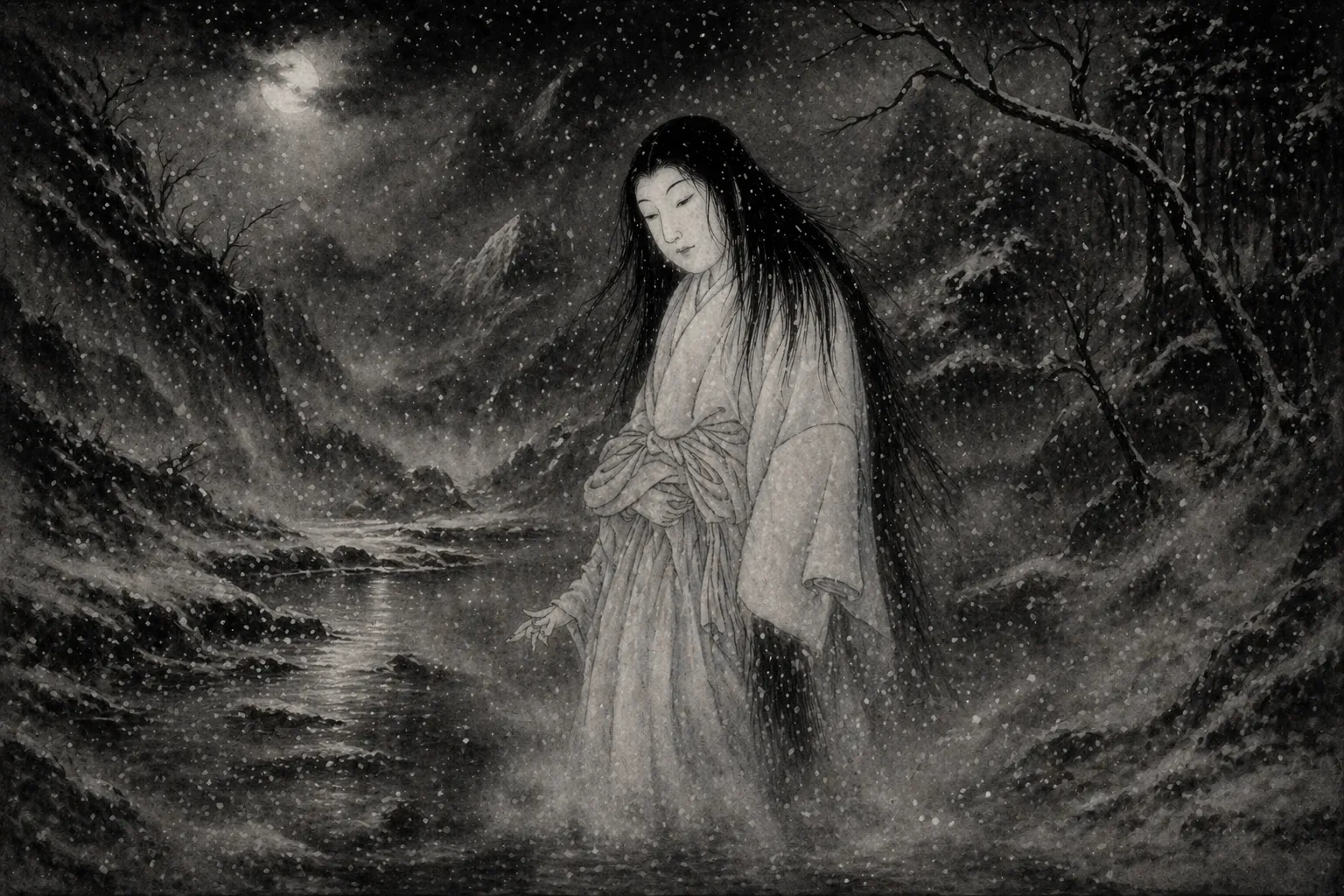
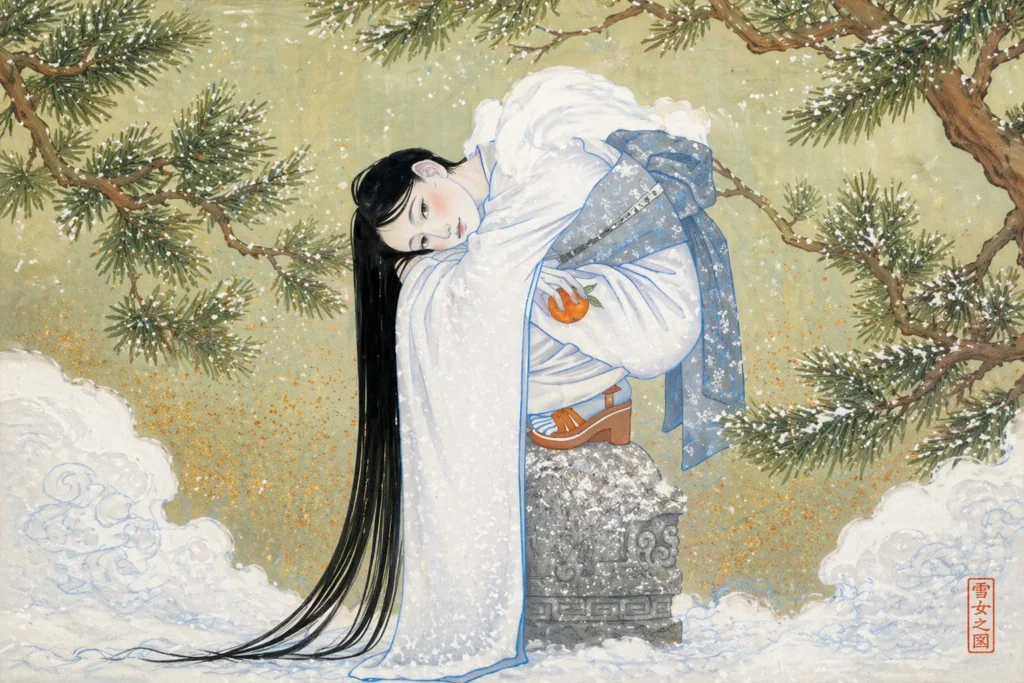
Stories and old texts describe Yuki Onna with strong contrasts. Her skin is always said to be as white as snow, sometimes so pale it looks almost see-through or not human.
Her hair is long, straight, and very black, which stands out against her white face and kimono. Often, her kimono is so light that it blends with the snow, making her seem to float or to have no feet, a common trait among Japanese ghosts.
Her eyes are especially frightening, sometimes described as icy or a sharp violet color. Even though she is scary, her face is said to be very beautiful, which attracts her victims. Some stories from Niigata say that Yuki Onna can be over two meters tall. In contrast, others say she can turn into a cloud of powder or sparkling dust if she feels threatened.
The Sōgi Shūryū Shō notes that she has no shadow, showing she is not a normal person. She also leaves no footprints in the snow and moves quietly, almost as if she is gliding.
You may also enjoy:
Amdusias in the Ars Goetia: The Demon of Dark Music
December 2, 2025
Yuki Onna: The Terrifying Bride Who Feeds on Travelers
December 9, 2025
What Is the Akkorokamui, Japan’s Colossal Sea Monster?
November 14, 2025
What Is a Yūrei? The True Meaning of Japanese Ghosts
January 30, 2026
Who Is Andromalius, and Why Is He the Last Demon of the Goetia?
January 20, 2026
Abura-sumashi: The Potato-Headed Yōkai That Punishes Greed
October 23, 2025
Origins and History
Yuki Onna became part of Japanese folklore as farming and hunting communities tried to explain why people sometimes died suddenly and quietly during harsh winters in Tohoku and Hokuriku.
The first written stories are from the Muromachi period (1336–1573), especially in the poetry of Sōgi, who wrote about a woman in a snowy garden. Still, the idea probably goes back even further, to old mountain worship and fear of mountain gods.
Looking at the history, I think this spirit may have come from people’s hallucinations caused by hypothermia. Interestingly, the first stories about her appeared during the “Little Ice Age” in the 17th century, when harsh winters led to famine and many deaths in the mountains.
The idea of a beautiful woman giving a peaceful, frozen sleep may have helped people cope with the fear of freezing to death. Instead of seeing it as something terrifying, the story turns it into a meeting with a supernatural being. I think she represents the “mercy” of the cold, offering a quiet end instead of a painful one.
During the Edo period (1603–1868), as more people moved to cities like Edo (now Tokyo), her image transformed. Yuki Onna became a common monster in ghost stories, shifting from a wild force of nature to a character with human emotions, such as love and betrayal. This transition shows how people became interested in stories where the line between humans and spirits was unclear.
The Fallen Divinity of the Mountain Pass
From my research on Japanese mountain spirits, I see the pale woman of the frost as a clear example of a former goddess who has lost her divine status. Today, she is often seen as a ghost or a simple spirit. Still, older sources from the Muromachi and early Edo periods suggest she started as a local mountain deity or a shamanic entity.
It is interesting that in the Tohoku region, she was sometimes called Yuki-ba, a name similar to Yama-uba. This hints that before becoming the “Snow Woman,” she belonged to a larger group of mountain goddesses who controlled both water and deadly blizzards.
I believe her most important role is not just to bring deadly cold, but to guard the “Threshold of Survival.” In old Japan, mountains were seen as a separate world for spirits.
When she lets someone live if they promise to stay silent, as in the famous Hearn story, she is not just being kind. She is showing her power to control what people know about the border between villages and the wild mountains. The main conflict is that the fragility of human life is when faced with nature’s harsh rules.
A major change in the 18th century was showing her without feet. Earlier stories, like those in the Sōgi Shūryū Shō from the 1500s, did not always focus on this ghostly detail.
Later ukiyo-e prints showed her without feet, part of a trend in the Edo period to give scary spirits distinct features so city people could recognize them. By taking away her feet and her link to the earth, society turned her from a mountain goddess into a wandering ghost.
I also noticed a link between Yuki Onna and the Ubuyame, or birth-hag. In some rural stories, the snow spirit has a child and asks travelers to take it, but the child becomes heavier until it crushes them. This connects her to the “Fallen Water Goddess” line, since snow is just the winter form of the Water God’s power.
This shows that her “evil” is not about morals, but about nature. She represents life stopping during winter. I see her as a symbol of the “frozen heart,” warning society not to lose kindness when survival gets tough.
Habitat
Yuki Onna is only found in places that are very cold and high up. Her main homes are the mountain passes of the Japanese Alps and the deep forests in the north. Stories say she lives in a “Palace of Ice” or in the clouds that bring snow, coming down only when the weather lets her keep her form.
She is often linked to lonely huts used by woodcutters or charcoal makers. These places are important because they show the main conflict in her story: where human warmth meets the cold, uncaring wild.
People also say she haunts bridges over frozen rivers, where moving water keeps things from freezing completely. In Gifu, some believe she lives in windy valleys, using the land to make her voice louder and confuse travelers.
Famous Yuki Onna Legends and Stories
The Legend of Minokichi and Mosaku
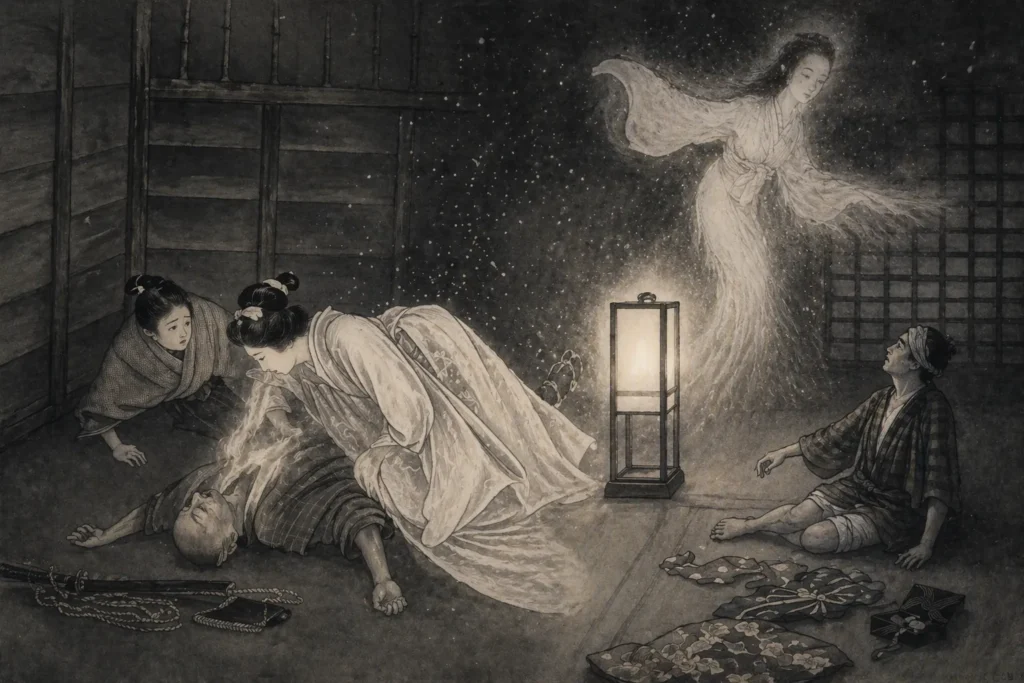
One of the most widely recognized accounts comes from the Lafcadio Hearn collection, based on a story from Musashi Province. During a severe winter storm, two woodcutters, an old man named Mosaku and his young apprentice Minokichi, were forced to take shelter in a small ferryman’s hut by a river.
In the middle of the night, Minokichi awoke to find a beautiful woman in white leaning over the elder Mosaku. She blew a breath of white mist onto the old man, killing him instantly.
When she turned toward the youth, she paused, struck by his beauty and youth. She spoke to him in a voice that sounded like the whistling wind:
“I intended to treat you like the other, but I shall spare you because of your youth. However, you must never speak of this night to anyone, not even your mother. If you ever mention me again, I will know, and I will kill you.“
Years later, Minokichi met a beautiful young woman named O-Yuki while traveling. They eventually married and had many children, living in perfect harmony. One evening, while watching his wife sew by the light of a lamp, Minokichi remarked that her beauty reminded him of a strange woman he had seen in his youth. He then recounted the story of the night in the hut.
As he spoke, O-Yuki’s face turned pale, and her form began to shimmer. She revealed herself to be the spirit from the storm, crying out:
“You have broken your promise! If not for our children, I would kill you this instant. Now I must leave you forever.“
She then dissolved into a white mist and vanished through the chimney, never to be seen again.
The Woman of the Snow Waterfall
In the highlands of the Nagano region, a tale exists of a hunter who pursued a white deer into a deep ravine during a blizzard.
As he approached a frozen waterfall, the mist cleared to reveal a woman standing atop the ice. She was holding a small child wrapped in a white cloth. She beckoned the hunter to come closer and hold the infant while she adjusted her robes.
The hunter, sensing a supernatural trap, drew his knife and held it between his teeth as he reached for the child. As the weight of the “infant” touched his arms, it became as heavy as a boulder, threatening to crush his bones and pull him into the snow.
Realizing the child was made of solid ice, the hunter recited a Buddhist prayer and struck the ground with his iron blade. The vibration caused the woman to scream and shatter into a thousand shards of ice, which the wind swept away.
The Snow Woman’s Visit to the Inn
A legend from the Niigata prefecture tells of an innkeeper who took in a beautiful traveler during a storm. The woman refused all food and would not sit near the hearth, claiming she had a delicate constitution.
Curious and concerned, the innkeeper’s wife peeked through a hole in the sliding door and saw the guest standing in the middle of the room, fanning herself.
As she fanned, the room grew so cold that the water jars cracked. The woman then began to grow taller until her head touched the ceiling, and her skin began to glow with a phosphorescent blue light. The innkeeper burst into the room with a hot iron poker, causing the woman to scream and turn into a swirling snowstorm that blew the doors open and vanished into the night.
You may also enjoy:
Abura-akago: The Bizarre Oil-Licking Yōkai
October 22, 2025
Demon Alastor: The Grand Executioner of Hell
November 17, 2025
Who Is Barqan, The Powerful Jinn King?
March 12, 2026
Who Is Azazel, the Demon Blamed for Human Corruption?
February 24, 2026
What Is the Abumi-guchi Yōkai and Why Does It Wait Forever?
October 22, 2025
Palden Lhamo: The Black Goddess of Blood and Protection
October 20, 2025
Yuki Onna Powers and Abilities
Yuki Onna is seen as a powerful yōkai, with abilities linked to cold weather. She is weak or gone in summer, but during a blizzard, she is at her strongest.
Yuki Onna is often thought to be more dangerous than spirits like the Kappa or Tanuki because her attacks usually kill and leave no signs. Hence, people think the victim just froze to death.
- Cryokinesis: The ability to generate and manipulate ice and snow at will, often used to create localized blizzards to trap prey.
- Life-Force Absorption: She can inhale a human’s seiki (vital energy), leaving them a frozen husk.
- Freezing Breath: A direct attack where her breath acts as a localized blast of sub-zero air, capable of flash-freezing organic matter.
- Intangibility/Mist Form: The capacity to transform her body into fine snow or mist to escape through small cracks in walls or chimneys.
- Illusion Generation: She can create “Fata Morgana” in the snow, making a warm village appear to a freezing traveler to lure them deeper into the cold.
Traditional Defenses Against Yuki Onna
The best way to defend against Yuki Onna is with heat and steam. Since her body is made of frozen moisture, she cannot stand high temperatures. Many stories say she is driven away or even melted by boiling water or the heat from a Japanese bath. Often, she is forced to leave when she has to enter a warm room or sit near a heated table.
Besides heat, making and keeping a sacred promise is another way to stay safe. She is bound by spiritual rules, so if someone keeps their word to her, she usually cannot hurt them.
People also use rituals to keep her away. Placing ofuda (Shinto charms) on hut doors is common. In some areas, people throw roasted soybeans, which symbolize life and growth, to drive her off. Another old trick is to ignore her if she calls out in the wind, since she often needs someone to answer before she can act.
Yuki Onna vs Similar Spirits
| Name | Category | Origin | Threat Level | Escape Difficulty |
| Yama-uba | Obake | An elderly woman who turned into a mountain demon. | High | Hard; she is a physical predator and a cannibal. |
| Ubume | Yūrei | Spirit of a woman who died during childbirth. | Moderate | Medium; she usually wants her child held, not death. |
| Hone-onna | Yūrei | A deceased woman whose love keeps her skeletal form in the world. | High | Extreme; her beauty masks her true skeletal nature. |
| Kuchisake-onna | Yōkai | Modern urban legend of a mutilated woman. | Extreme | Very Hard; requires specific verbal riddles to escape. |
| Futakuchi-onna | Yōkai | A woman cursed with a second mouth on the back of her head. | Moderate | Easy; she targets food rather than human lives. |
| Ame-onna | Yōkai | A rain-making spirit derived from Chinese water deities. | Low | Very Easy; she is gloomy but rarely malevolent. |
| Kerakera-onna | Yōkai | Giant woman who cackles in red-light districts. | Low | Easy; she causes psychological distress, not death. |
| Taka-onna | Yōkai | A woman who can stretch her body to look into second-story windows. | Low | Easy; she is primarily a voyeuristic entity. |
| Oiwa | Yūrei | Victim of a poisoning/betrayal in the Yotsuya Kaidan. | Extreme | Impossible; she is a vengeful ghost targeting a specific bloodline. |
| Okiku | Yūrei | A servant girl was thrown down a well, counting plates. | Low | Easy; her haunting is localized to a specific well. |
| Nure-onna | Yōkai | Sea serpent with the head of a woman. | Extreme | Hard; she uses her massive tail to crush victims. |
| Hannya | Oni | A woman whose jealousy transformed her into a demon. | High | Hard; represents obsessive, destructive rage. |
Symbolism
| Attribute | Details |
| Element | Water (specifically in its solid state as Ice/Snow). |
| Cardinal Direction | North (associated with the cold winds of Siberia). |
| Color | White (representing death, purity, and the void). |
| Plant | Pine tree (the only green that survives her presence). |
| Season | Winter (specifically the period of the deep freeze). |
| Symbolic Item | White Kimono (representing a funeral shroud). |
In Japanese culture, Yuki Onna represents both the beauty and danger of winter. She shows the “beauty of death,” fitting the idea of mono no aware, or the sadness of things passing. In art and stories, she reminds people that nature cares little for human feelings and that the line between life and death is very thin.
She also represents the importance of keeping secrets. In her best-known stories, the real tragedy comes from breaking a promise, not from cruelty. This shows how important trust and promises were in old Japanese society.
When the main character breaks his word, he loses not just his wife but also the protection of the spirit world, showing that honesty is the only defense against chaos.
You may also enjoy:
What Is a Pishacha, the Flesh-Eating Demon of the Dead?
February 11, 2026
Palis: The Foot-Licking Desert Jinn That Drinks Your Blood
December 3, 2025
Mara: The Buddhist Demon King of Desire and Death
October 13, 2025
Who Was Hiranyakashipu, the Demon King of Hindu Mythology?
October 6, 2025
Who Is the Infernal King Balam? Origins, Powers, and Occult History
February 26, 2026
Mahabali (Bali): The Benevolent Asura King
October 10, 2025
Bibliography
Author’s Note: In this article, I explored how a spirit transformed from a simple warning about nature into a character with emotions. This helped me look beyond common stereotypes we often see today. By comparing ancient texts to detailed drawings by Sekien, I traced the spirit’s journey from being a goddess of the mountains to a local ghost. I also examined both Hearn’s romantic tales and the more intense stories found in the Konjaku Monogatarishū. This allowed me to present her not only as a tragic creature but also as a powerful force of nature.
- Johnson, Adam J. The Evolution of Yōkai in Relationship to the Japanese Horror Genre. 2021. University of Massachusetts Amherst, Capstone Project. ScholarWorks@UMass Amherst.
- Night Parade of a Hundred Demons. Yōkai Senjafuda, Mellon Projects, University of Oregon, glam.uoregon.edu.
- Reider, Noriko T. Japanese Demon Lore: Oni from Ancient Times to the Present. Utah State University Press, 2010. Internet Archive.
- Hearn, Lafcadio. Kwaidan: Stories and Studies of Strange Things. Houghton, Mifflin and Company, 1904. Internet Archive.
- Night Parade of a Hundred Demons. Yōkai Senjafuda, Mellon Projects, University of Oregon, glam.uoregon.edu.
- Nicolae, Raluca. (2015). Shaping Darkness in hyakki yagyō emaki. Asian Studies. 3. 9-27. 10.4312/as.2015.3.1.9-27. ResearchGate.
- Kelsey, W. Michael. Konjaku Monogatarishū. Twayne Publishers, 1982. Twayne’s World Authors Series 621. Internet Archive.
- Aston, W. G., translator. Nihongi: Chronicles of Japan from the Earliest Times to A.D. 697. Kegan Paul, Trench, Trübner & Co., 1896. Internet Archive.