The Dīv are central figures in Persian and Islamic cosmology, serving as the main forces of chaos that challenge the universe’s established order.
Modern interpretations sometimes group many supernatural beings together. Still, the Dīv are unique because they physically resist divine authority instead of simply tempting people spiritually. Their physical presence sets them apart from the more ghostly spirits in other traditions, making them the original enemies in the ongoing battle between light and darkness.
This article uses the main translations of the Shahnameh and the Bundahishn to make sure the description of this fascinating entity fits the culture. By examining folklore in the Avesta and the Tarikh al-Tabari, I tried to offer a historical profile grounded on evidence. [View Full Bibliography ↓]
Summary
Key Takeaways
| Attribute | Details |
| Names | Dīv, Daeva, Deev, Dew |
| Type | Primordial monstrous entities; distinct from Jinn but often synchronized in Islamic lore |
| Title | Ahrimanic agents, Lords of Darkness |
| Gender | Predominantly male, though female counterparts (Dīvehs) exist in folklore |
| Servitors | Lesser sorcerers, predatory animals, and minor chaotic spirits |
| Superior Jinn | Ahriman (Angra Mainyu) in Zoroastrianism; Iblis in certain Islamic syncretic texts |
| Powers | Superhuman strength, weather manipulation, sorcery, shape-shifting, and stone-throwing |
| Appearance | Giant anthropomorphic figures with horns, fangs, and reversed feet; often hairy |
| Etymology | Derived from the Proto-Indo-European ‘deiwos’ (shining one/god), later inverted in Persian tradition |
| Associated Figures | Rostam, Kay Khosrow, Ahriman, Solomon, Tahmuras |
| Weaknesses | Iron, mirrors, specific divine names, and the cunning of heroes |
| Opposing Holy Figure | Ahura Mazda, Archangel Sraosha, various Prophets in Islamic tradition |
| Social Structure or Tribe | Feudal hierarchy consisting of kings and chieftains inhabiting remote mountains or pits |
| Followers/Tribe Size | Command vast legions and armies of monsters in the Mazandaran regions |
| Primary Sources | The Avesta, Shahnameh (Book of Kings), Tarikh al-Tabari, Bundahishn |
Who or What is Dīv?
The Dīv are monstrous supernatural beings from Iranian mythology and later became part of Middle Eastern folklore. Unlike the Jinn, who are seen as morally mixed and made from smokeless fire, the Dīv are almost always shown as evil, giant, and physically strong. They often represent different vices and natural disasters.
In the oldest stories, the Dīv were once ancient gods who were later turned into demons. In later epics and religious texts, they became the main enemies of heroes and kings, living in the ‘World of Darkness’ or in remote, wild places such as the mountains of Mazandaran. They exist mainly to oppose ‘Asha’ (truth and order) in the universe.
“Dīv” Meaning
The word ‘Dīv’ is a major example of how language can change meaning in religious history. It comes from the Proto-Indo-European root *deiwos, which means ‘shining’ or ‘celestial.’ This is the same root as the Latin ‘Deus’ and the Sanskrit ‘Deva.’ In Old Persian, especially after Zoroaster’s reforms, these ‘shining ones’ were rejected. The Daevas became known as false gods or beings who chose the path of ‘Druj’ (the Lie).
Over time, the Old Persian Daeva changed into the Middle Persian Dew and then the New Persian Dīv. As a result of this change, the ‘shining ones’ became ‘monsters.’ In Indian traditions, the Sanskrit word Deva still means a good god, but in Iran, it came to mean something demonic. This split in meaning shows a deep cultural and religious divide between the Indo-Aryan groups.
Today in Persian, the word can also be used as a metaphor for someone very strong or cruel, but its main meaning still refers to the horned, giant creatures from old stories.
How to Pronounce “Dīv” in English
In English, ‘Dīv’ is pronounced /diːv/, rhyming with ‘leave’ or ‘believe.’ The ‘i’ is a long vowel, and the ‘v’ at the end is clear. It should not sound like the ‘i’ in ‘dip.’
What Does a Dīv Look Like?
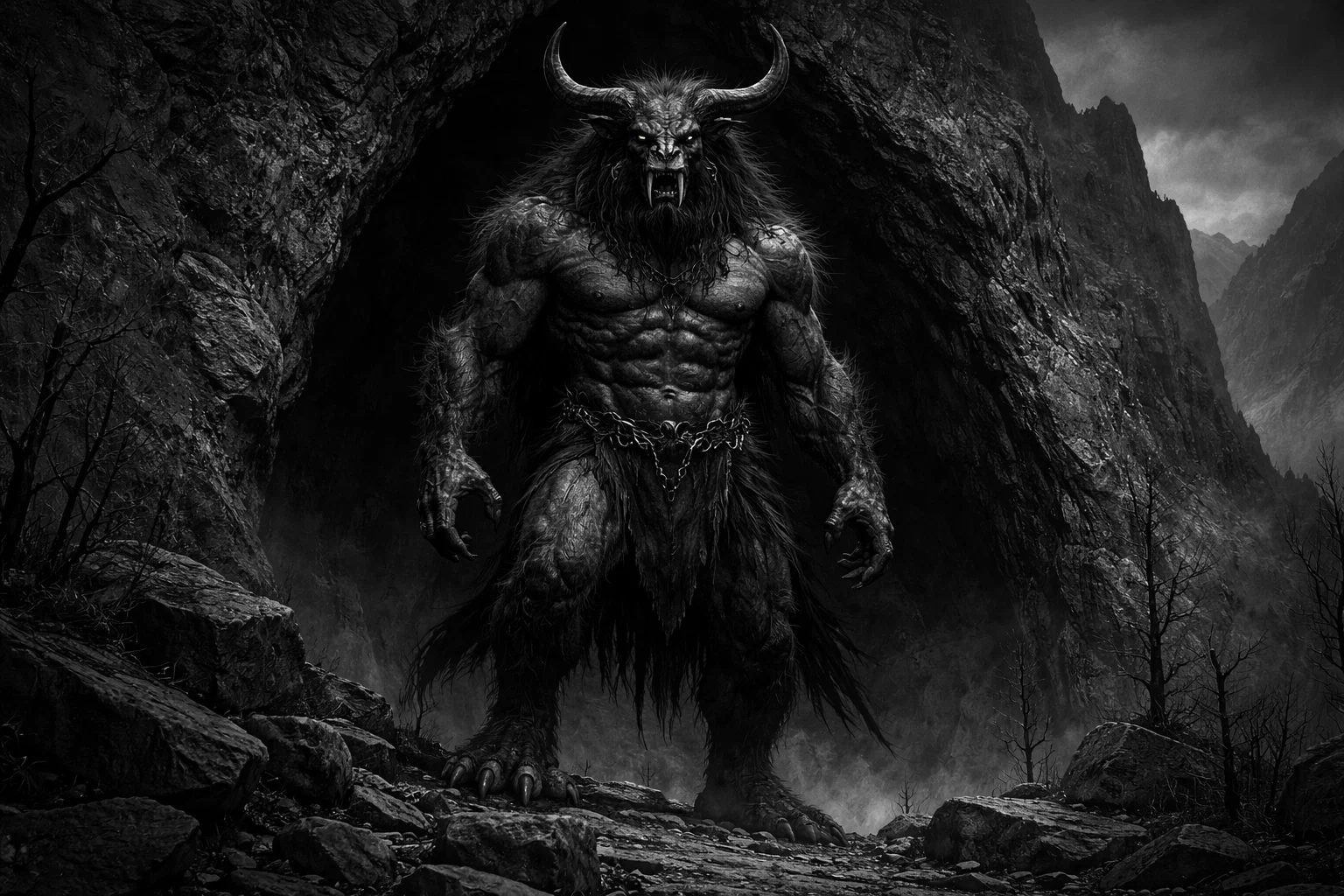
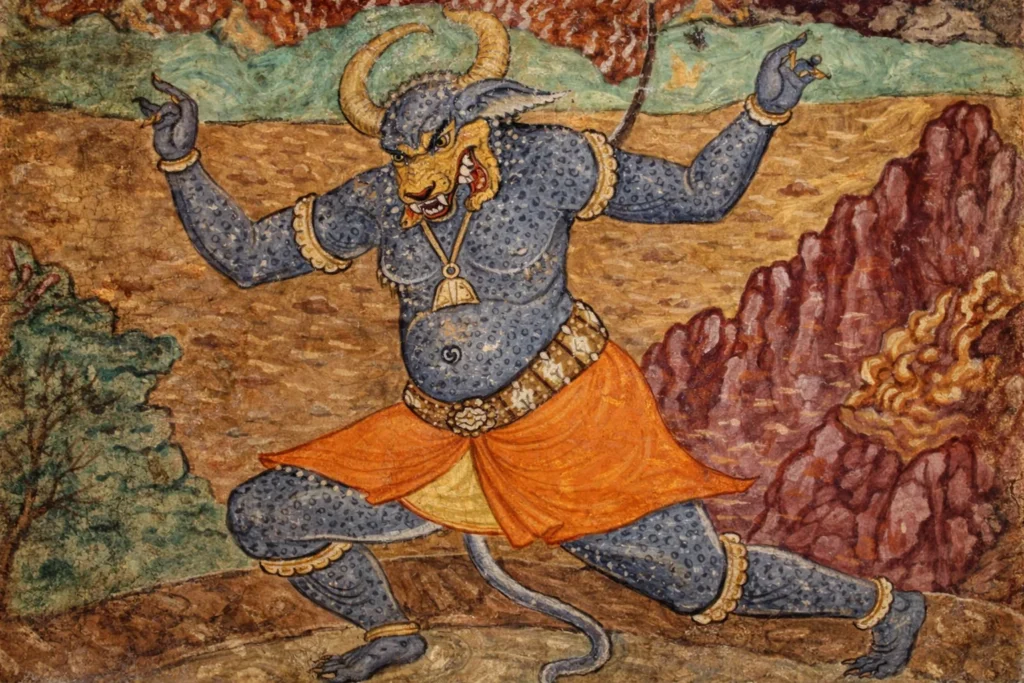
Descriptions of the Dīv’s appearance have stayed similar for centuries in Persian art and literature. They are usually shown as a mix of human and animal features. Most sources describe them as giant, strong figures with broad shoulders. Their skin is often painted in bright, unnatural colors, such as deep black, chalky white, or blood red.
A key feature of the Dīv is their horns, which can resemble those of a bull or a goat. Their faces are often described as twisted, with tusks or long fangs and big, glowing eyes. In many old illustrations, especially in the Shahnameh, they wear leopard skins or other animal pelts as clothing. Folklore also says they sometimes have feet or limbs turned backward, a common sign of the supernatural in Middle Eastern stories.
They are also often described as very hairy, with thick manes or fur all over their bodies. This wild look contrasts with the neat appearance of the Persian heroes who fight them.
Origins
The story of these beings starts with the ancient Iranian idea of two opposing forces. In Zoroastrian belief, as told in the Avesta, two spirits—Ahura Mazda (Light) and Angra Mainyu (Darkness)—chose their own paths. The Daevas were spirits who picked the wrong side and followed Angra Mainyu, becoming his soldiers against creation. They were not born evil but became that way by choice.
Over time, these beings changed from abstract ideas into the main monsters of the Persian national epic. In the Sasanian Empire, the Bundahishn (Book of Primal Creation) organized them into a ranking of ‘Great Demons,’ each one matched against a good archangel. For example, the demon of greed was set against the spirit of contentment.
After the Islamic conquest of Persia, the identity of these beings changed again. They were partly linked with the Jinn from the Quran, but still kept their unique Persian ‘monster’ qualities.
While Jinn are often shown as hidden spirits in another world, the Dīv stayed tied to real places in Iran, like old ruins, caves, and the snowy Alborz mountains. They became a way to remember the pre-Islamic past and to warn about the dangers of the wild and the risks of spiritual rebellion.
You may also enjoy:
Who Is Baal in Christian Demonology?
February 25, 2026
What Is a Rakshasa? Meaning, Origins, and Dark Powers
January 23, 2026
Who Is the Jann in Islamic Mythology and Why Is He Feared?
October 2, 2025
Mahabali (Bali): The Benevolent Asura King
October 10, 2025
Palden Lhamo: The Black Goddess of Blood and Protection
October 20, 2025
The Inversion of Light
The change of the Dīv from ‘shining ones’ in Proto-Indo-European belief to monsters in Persian tradition is one of the biggest shifts in religious history. This change in language and belief shows the split between Vedic and Avestan cultures. In the Rigveda, the Devas remained good gods, while the Asuras became their enemies.
In contrast, the Iranian Gathas tell how the Prophet Zoroaster led a spiritual revolution that turned the Daevas from gods into demons, calling them agents of ‘the Lie.’ This was more than just a change in words; it was a planned effort to support a new monotheistic order by making the old gods seem dangerous and harmful.
From a social point of view, the Dīv’s horns, fangs, and animal skins acted as a quick way to show fear of the non-Zoroastrian nomadic tribes that threatened the Iranian plateau. The mountains of Mazandaran, named in the Shahnameh as their main home, were both a real and symbolic border.
By giving the people of these wild areas demonic traits, Persian leaders could justify expanding their territory as a holy mission for ‘Asha’ (Cosmic Order) against the chaos of ‘Druj’ (Falsehood) shown by the mountain people. In this way, the monster becomes a symbol of the fear that settled societies have of the wild and untamed lands.
This change also shows an early understanding of the ‘repressed shadow.’ By turning old gods into demons, the culture did not get rid of their power but instead pushed them into the subconscious, or in myths, into the earth’s caves and pits.
The Dīv shows the ‘return of the repressed,’ in which traits once valued in warrior gods—like wild anger, great strength, and unpredictability—became the faults the new moral code sought to remove. When a hero like Rostam fights these giants, he is not just battling a monster; he is also showing self-control and trying to overcome the wild parts of his own heritage to build a more disciplined society.
Powers and Abilities
A Dīv is much stronger than a regular ghul or minor spirit. They are powerful beings who can do things that even the greatest human heroes struggle with. While a Jinn might use tricks or illusions, the Dīv rely on brute strength and powerful magic.
- Supernatural Strength: They are capable of uprooting trees, hurling massive boulders, and leveling fortifications with their bare hands.
- Weather Control: Many legends attribute the ability to summon sudden frosts, hailstorms, or blinding mists to obscure their movements or entrap travelers.
- Petrifaction: Higher-ranking entities possess the ability to turn enemies to stone or induce a state of magical paralysis.
- Transformation: They can take the forms of beautiful humans to deceive, or predatory animals like wolves and dragons to attack.
- Invisibility: Despite their size, they can vanish from sight using “magic smoke” or by blending into the shadows of caves.
- Immunity to Mundane Weapons: Most standard iron or bronze weapons fail to pierce their hides unless the weapon has been specifically blessed or forged under mystical conditions.
Influence on Humans and Possession
The way these creatures influence people is more forceful and obvious than the quiet whispers of the Waswas (satanic whispering). When they target someone, it can show up as sickness in a home or sudden ‘madness’ with violent behavior and unusual strength. Unlike the hidden possession by some Jinn, a Dīv’s presence is usually clear: the person may look different, grow coarse hair suddenly, or avoid sunlight.
On a larger scale, people believed these beings pushed humans toward anger (Aeshma) and pride. They do not just tempt people—they overpower them with strong emotions. In the past, sudden plagues or failed crops were often blamed on a demon’s breath. They were also said to kidnap beautiful young people or skilled workers, taking them to their mountain homes to become slaves or join their demonic families.
Protection and Exorcism Methods
In the past, people used both physical barriers and spiritual charms to protect themselves from these beings. Since they are linked to ‘The Lie,’ they are driven away by anything that represents Truth and Light:
- Iron and Steel: It was widely believed that these monsters feared cold iron. Placing an iron dagger under a pillow or hanging a horseshoe over a doorway served as a primary deterrent.
- Mirrors: As beings of inherent ugliness and distortion, they cannot bear to see their own reflection. Steel mirrors were often used in rituals to drive them away or to reveal their true forms when disguised.
- Fires and Lamps: Maintaining a constant flame, particularly one fueled by sacred wood, was thought to keep the dark entities at bay, as they thrive in the cold and shadow.
- Amulets and Incantations: In the Islamic period, the use of Ta’wiz (amulets containing Quranic verses) became the standard. Verses such as Ayat al-Kursi or the Mu’awwidhatayn (the two surahs of protection) were inscribed on lead or silver plates.
- Salt: Encircling a camp or a cradle with salt was a common folk remedy to prevent the creatures from crossing the threshold.
- The Name of Solomon: Due to the legend that King Solomon commanded all supernatural beings, his seal or simply the invocation of his name was considered a powerful binding force.
Key Historical & Scriptural Records
“I abjure the dominion of the Daevas, the devoid of good, erratic, manifesting evil, the most deceitful of beings, the most degenerate of beings, the most harmful of beings… and I ascribe all good to Ahura Mazda.” [Fravarane (The Zoroastrian Creed), Yasna 12.1, c. 1000–600 BCE]
This liturgical fragment represents the “Zero Hour” of the entity’s history. Here, the term refers not to a physical monster with horns, but to a category of ancient Indo-Iranian deities whose worship was being systematically dismantled.
The theological aspect of this source lies in the transition from polytheism to ethical dualism; by “abjuring” these spirits, the Zoroastrian tradition transformed them from objects of veneration into personified moral failings. Unlike later folklore, which depicts them as physical threats, this earliest record treats them as intellectual and spiritual pathogens—“erratic” forces that misdirect human choice.
The linguistic context is vital here: the word Daeva is used as a direct antonym to Asha (Truth). At this stage, there is no mention of giant stature or animalistic features; the “evil” they manifest is primarily the chaos of false worship and the social instability of the pre-Zoroastrian heroic age.
“The adversary, [Angra Mainyu], produced from the material of darkness… the demons (dewan). The first is Akoman (‘Evil Mind’), then Andar, then Sawar, then Nanhayd, then Tairich and Zairich.” [Greater Bundahishn (The Book of Primal Creation), c. 9th Century CE (based on Sasanian sources)]
The Bundahishn is the source that turned these vague spirits into a structured group of demons. This Pahlavi text sets up a ‘mirror-image’ world in which each main demon is matched with a specific archangel, such as Akoman, the opposite of Vohu Manah (Good Mind). This system from the 9th century shows how the Sasanian era valued order and hierarchy, even in the spirit world.
This change is important: the beings are now seen not just as ‘false gods’ but as made from the material of darkness. This brings in a new idea of dualism that was not clear in the earliest texts. Now, they are described as having a real, though dark, substance, which led to their later role as physical monsters in Persian stories.
“A monster rose before him, black of hue, with chest and shoulders like a mountain’s blue. His head was like a boar’s, with tusks so white, his eyes like pits of fire in the night… This was the Akvan Div, whose breath was frost, by whom the path of every man was lost.” [Shahnameh (The Book of Kings) by Ferdowsi, c. 1010 CE]
In Iran’s national epic, the Dīv becomes a full folklore creature. Ferdowsi’s description is very different from the abstract ‘Evil Mind’ in the Bundahishn. Now, the Dīv is a real giant with boar-like tusks and the size of a mountain. This change shows how, in the 11th century, people wanted a physical enemy that a hero like Rostam could defeat.
The ‘breath of frost’ and ‘mountain blue’ skin are not just poetic—they connect the demon to real places in Northern Iran. At this time, these beings served as a way to show the dangers of the Alborz Mountains and the Mazandaran jungles. The old idea of the ‘Lie’ became a real monster that could be defeated, showing the victory of Persian civilization over the wild and unknown parts of the world.
You may also enjoy:
Who Is Futakuchi-onna, the Two-Mouthed Woman?
March 9, 2026
Who Is Abalam in Demonology? The Demon King That Serves Paimon
September 30, 2025
Akateko: The Bloody Hand Yōkai That Guards a Cursed Temple Tree
November 14, 2025
The Ghul: The Flesh-Eating Demon of Arabian Folklore
October 1, 2025
Rokurokubi: The Yōkai That Looks Human Until Midnight
February 3, 2026
Myths, Legends, and Stories
The Seven Labors of Rostam and the White Dīv
In the national epic Shahnameh, the hero Rostam must undertake seven perilous labors to rescue King Kay Kavus, who has been blinded and imprisoned in Mazandaran by the demonic forces. The climax of these labors involves confronting the White Dīv (Sepid), the most formidable chieftain of the mountain demons.
Rostam enters the demon’s dark cavern while the creature is sleeping during the heat of the day. The cavern is described as a place of absolute blackness, smelling of decay. After being awakened, the giant demon looms over Rostam, its white body contrasting with the shadows. The battle is a grueling display of physical power; they wrestle until the earth shakes.
Eventually, Rostam manages to lift the demon and dash it against the ground. He then uses his dagger to cut out the demon’s liver. According to the prophecy, the blood from the White Dīv’s liver is the only substance capable of curing the King’s blindness.
Rostam returns to the King and drops the blood into his eyes, successfully restoring his sight and breaking the demonic enchantment over the land.
Tahmuras, the Binder of Demons
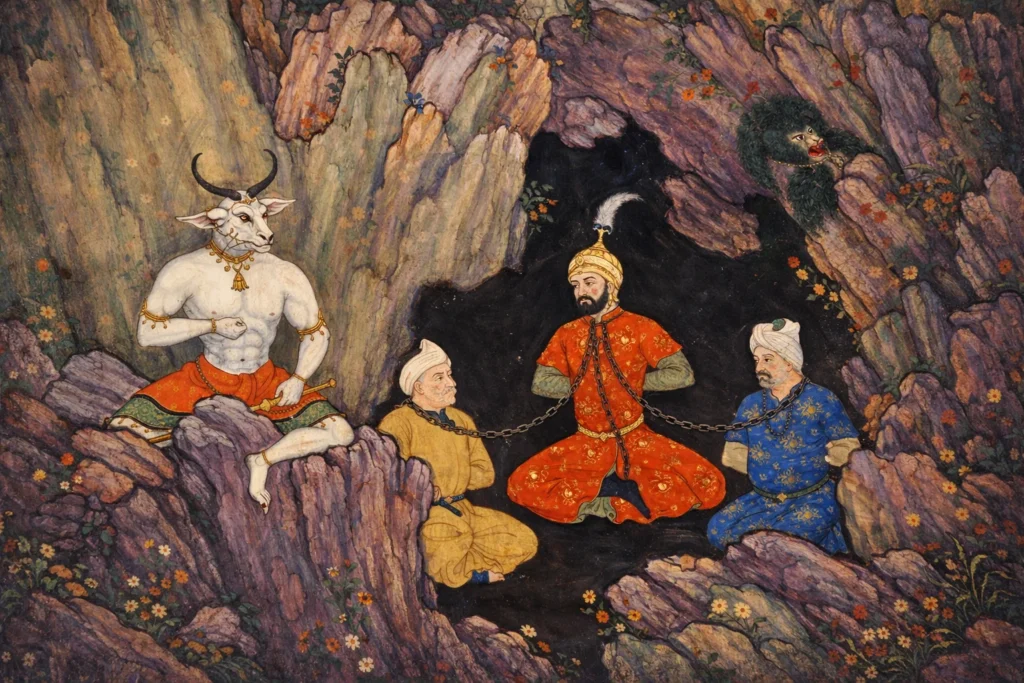
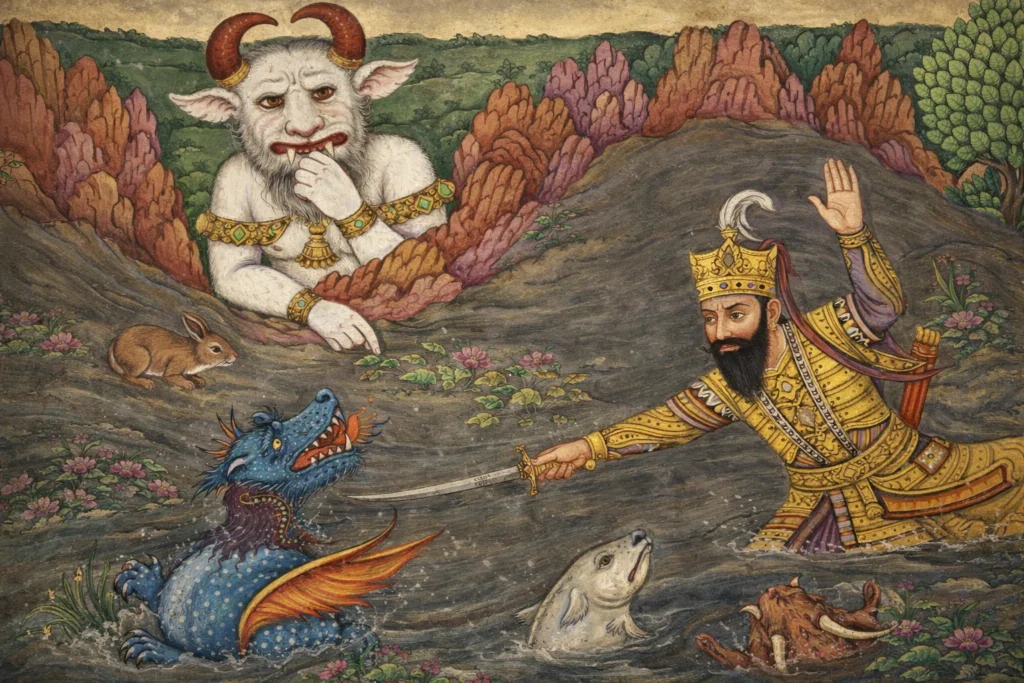
Long before the time of Rostam, the Pishdadian King Tahmuras earned the epithet Diveband (Binder of Demons). Tahmuras was a righteous ruler who sought to civilize the world. The demons, resentful of his order, gathered a vast army to overthrow him. Drawing on a mix of divine grace and physical prowess, Tahmuras defeated the demonic host. Instead of executing them, he used magical chains to bind them.
The demons pleaded for their lives and offered a trade: in exchange for their freedom, they would teach the King a secret art that they had guarded for ages. Tahmuras agreed, and the demons taught him the art of writing.
This myth is significant because it portrays these entities not just as mindless monsters, but as keepers of ancient, albeit dangerous, knowledge. It suggests that humanity’s “civilization” was partly built on the forced contributions of the chaotic world.
The Akvan Dīv and the Throw into the Sea
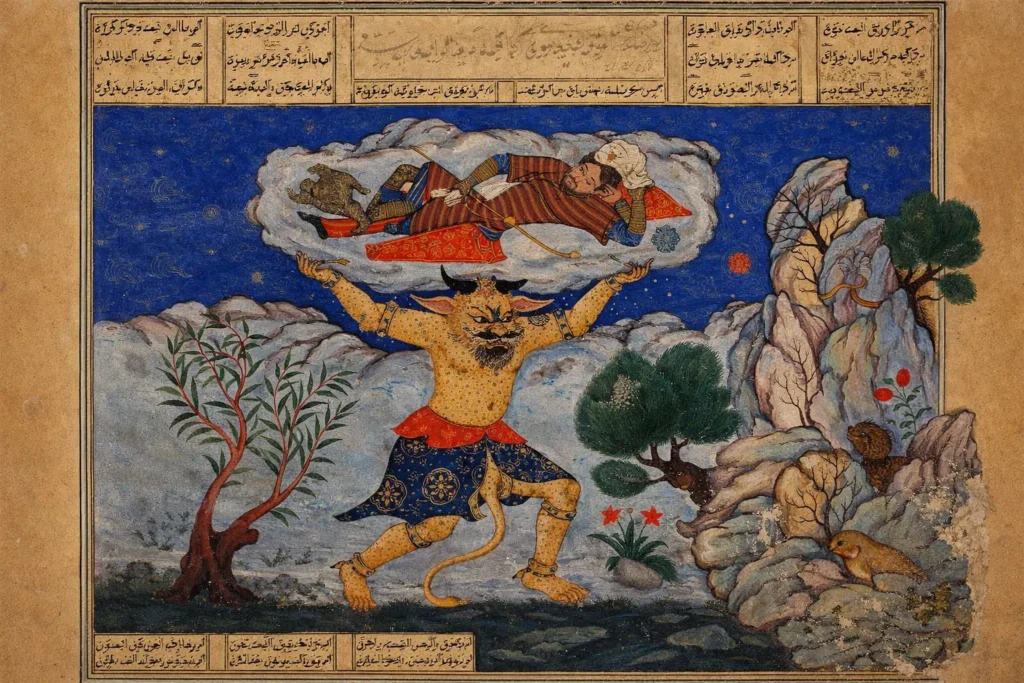
The legend of the Akvan Dīv highlights the cunning and perverse logic of these creatures. This demon appeared in the royal hunting grounds as a magnificent wild ass with a coat of gold. When Rostam tried to capture it, the creature vanished and reappeared, leading the hero on a chase for days. Eventually, while Rostam slept, the demon reverted to its true form—a monstrous giant—and scooped up the patch of earth where Rostam lay.
The demon offered Rostam a choice: “Shall I throw you onto the mountains or into the sea?” Knowing that the demon would do the opposite of what was requested, Rostam asked to be thrown onto the mountains, claiming he feared the sea’s monsters.
The Akvan Dīv, wishing to cause the most certain death, threw Rostam into the deep ocean. This allowed Rostam to swim to safety and eventually track down the demon to decapitate it, proving that human intellect could overcome demonic malice.
Dīv vs Other Jinn
| Jinn Name | Associated Traits/Influence | Rank/Origin | Key Traits/Powers |
| Ifrit | Extreme wrath and rebellion | Quranic/Arabian Folklore | High-tier fire manipulation; immense size |
| Marid | Arrogance and watery chaos | One Thousand and One Nights | Granting wishes; commanding the seas |
| Ghul | Gluttony and necrophagia | Ancient Arabian Lore | Inhabits graveyards; shapeshifts into animals |
| Si’lat | Seduction and deception | Arabian Folklore | Highly intelligent female mimics; expert mimics |
| Palis | Exhaustion and foot-licking | Persian Folklore | Drains life through the soles of feet |
| Nasnas | Fragmentation of the self | Yemeni/Arabian Lore | Half-human anatomy; hops on one leg |
| Shiqq | Incomplete or split nature | Pre-Islamic Lore | Appears as half a human body; prophetic |
| Hinn | Lowly mischief | Islamic Traditions | Weakest class; often appears as black dogs |
| Qareen | Personal temptation | Quranic/Hadith | Double/Shadow of a human; whispers doubt |
| Jann | Ancestral or desert spirits | Pre-Islamic / Quran | Earliest form of Jinn; wind-based |
| Zoba’ah | Cyclonic chaos | Arabian Occultism | One of the Seven Kings; commands whirlwinds |
| Kabus | Suffocation and nightmares | Middle Eastern Folklore | Sits on the chest of sleepers; causes paralysis |
Position Among Jinn
In the ranking of Middle Eastern spirits, the Dīv are seen as outsiders and enemies. Many Jinn tribes are said to have adopted religions or formed societies like those of humans, with their own kings and laws. But the Dīv are usually shown as leftovers from ancient times. They do not mix with Jinn society and instead act as the ‘old guard’ of chaos.
In Persian magic books, the Dīv are often ranked above regular Jinn for their toughness and physical power. They are seen as the ‘generals’ of dark forces. They usually dominate or stay apart from other spirits.
For example, while a sorcerer might control an Ifrit with the Seal of Solomon, binding a Dīv usually requires more complex rituals involving iron and ancient Persian spells. They stand for an older kind of evil that came before the usual Arabian types, so other supernatural beings both respect and fear them.
Mystical Correspondences
| Attribute | Details |
| Planet | Saturn (Keyvan) |
| Zodiac Sign | Capricorn / Scorpio |
| Element | Earth (Heavy/Corrupted) and Frost |
| Direction | North (The direction of darkness in Persian lore) |
| Color | Indigo, Black, and Ash Grey |
| Number | 7 (Representing the seven arch-demons) |
| Crystal/Mineral | Black Tourmaline and Obsidian |
| Metal | Lead (associated with weight and Saturn) |
| Herb/Plant | Aconite (Wolfsbane) and Mandrake |
| Animal | Leopard, Boar, and Serpent |
These monsters are linked to the planet Saturn, which highlights their role as bringers of decay, sadness, and the heavy passage of time. Saturn’s cold and distant nature matches the icy mountain peaks where the Dīv are said to live.
In Persian tradition, their connection to the North is important, since ancient Iranians saw the North as the direction of Hell’s gates, where the cold winds of Ahriman came from.
Their link to the number 7 comes from the ‘Seven Arch-Demons’ in Zoroastrian tradition, who were made to oppose the seven holy spirits. This number shows their organized fight against the divine order. Lead is also connected to them, showing the ‘heaviness’ of their influence, which pulls people toward greed and anger.
All these mystical connections show that the Dīv are not just randomly evil, but are a structured, cosmic force meant to test how strong the human soul is.
You may also enjoy:
Akateko: The Bloody Hand Yōkai That Guards a Cursed Temple Tree
November 14, 2025
Kuchisake-onna: Folklore, Origins, and Urban Legend History
February 10, 2026
Who Is Abalam in Demonology? The Demon King That Serves Paimon
September 30, 2025
Barbas: The Lion Demon Who Spreads Disease
March 3, 2026
Ambri: The Imperial Duchess of Caspiel’s Empire
December 1, 2025
Bibliography
Author’s Note: While I was researching this article, I noticed a strong contrast between the organized religious hierarchies in Sahih Muslim and the vivid, almost real monsters in Dick Davis’s translation of the Shahnameh. The scriptural sources view the Dīv as part of a larger story of spiritual rebellion. Still, by comparing them with al-Jāḥiẓ’s Kitāb al-Ḥayawān, I could connect their animal traits to their place in nature. It is remarkable how the ‘Dīv’ links the mountain folklore of the Alborz with formal Islamic teachings. This research involved examining local Mazandaran legends through the broader lens of Medieval Islamic Civilization. My research shows that the Dīv is not just an old demon, but a lasting symbol of the ‘uncivilized’ that still appears in Middle Eastern literature.
- Abdul Hamid Siddiqui (translator). al-Hajjaj, Muslim ibn. Sahih Muslim. Islamic Book Service, 2004. Internet Archive.
- M. A. S. Abdel Haleem (translator). The Qur’an: English Translation and Parallel Arabic Text. Oxford University Press, 2004. Quran Project Edition.
- Al-Shaykh, Hanan. One Thousand and One Nights: A Retelling. Pantheon Books, 2013. Internet Archive.
- Ali, Abdullah Yusuf (translator). The Holy Qur’an: English Translation and Commentary. 1934. Internet Archive.
- Al-Bukhari, Muhammad.The Translation of the Meanings of Sahih Al-Bukhari. Translated by Muhammad Muhsin Khan, rev. ed., vol. 1-7, Ahmadiyya Anjuman Isha’at Islam, 2004. Ahmadiyya.org.
- al-Mas‘ūdī, ‘Alī ibn al-Ḥusayn. Historical Encyclopaedia: Entitled “Meadows of Gold and Mines of Gems”. Translated by Aloys Sprenger, Oriental Translation Fund of Great Britain and Ireland, 1841. Internet Archive.
- al-Jāḥiẓ, ʻAmr ibn Baḥr. Hādhā Kitāb al-Ḥayawān [The Book of Animals]. Vol. 5–7, al-Maṭbaʻah al-Ḥamīdīyyah al-Miṣrīyyah, 1905. Internet Archive.
- Ferdowsi, Abolqasem. Shahnameh: The Persian Book of Kings. Translated by Dick Davis, Viking, 2006. Internet Archive.
- Khalifa, Najat, and Tim Hardie. Possession and Jinn. Journal of the Royal Society of Medicine vol. 98,8 (2005): 351-3. doi:10.1177/014107680509800805.
- Meri, Josef W. (editor). Medieval Islamic Civilization: An Encyclopedia. Routledge, 2006. Internet Archive.