Many adversaries in Vedic stories stand for chaos and destruction, but Tarakasura is different. He uses divine law in a calculated way to bring about cosmic stagnation. During his rule, the usual order of the universe was not just challenged but overturned by strict penance and the powerful boons he earned.
Unlike ordinary marauders, he shows the conflict between spiritual achievement and moral duty. His story proves that even strict spiritual practices can be used against the natural order of the world.
This article uses translations of the Shiva Purana and Skanda Purana to trace how Tarakasura’s story and meaning changed over time. By also examining the Matsya Purana, this article aims to clarify common misunderstandings about the Daitya King’s so-called “invincibility” in the cycle of Dharma. [View Full Bibliography ↓]
Summary
Key Takeaways
| Attribute | Details |
| Names | Tarakasura, Taraka |
| Title | King of the Daityas, Overlord of the Three Worlds |
| Gender | Male |
| Role | Cosmic conqueror, practitioner of extreme asceticism, catalyst for the birth of Kartikeya |
| Clan | Daitya |
| Followers | A vast army of Asuras, including his three sons (the Tripurasura) |
| Powers | Invulnerability against all except a child of Shiva, mastery over celestial weaponry, sovereign control over the elements |
| Appearance | Often depicted with a formidable, towering physique, regal armor, and the traditional characteristics of a powerful Daitya warrior |
| Etymology | Derived from the Sanskrit root ‘tṛ’ meaning ‘to cross’ or ‘to pass over’, often interpreted as ‘one who causes others to cross (to the other side/death)’ or ‘star-like’ |
| Associated Figures | Brahma (boon-giver), Shiva, Parvati, Kamadeva, and Kartikeya (slayer) |
| Weaknesses | Specifically limited protection; he was vulnerable only to a son born of Shiva’s seed |
| Opposing Deva/Avatar | Kartikeya (also known as Skanda or Murugan) |
| Pantheon | Hindu (primarily Puranic) |
| Primary Sources | Shiva Purana, Matsya Purana, Skanda Purana, Kumarasambhava |
Who or What is Tarakasura?
Tarakasura is a well-known Daitya king whose story is closely tied to the Puranic tales about Shiva and Parvati’s marriage. He is an Asura, a type of being often at odds with the gods. His importance comes from his near-invincibility, which he earned through intense penance to Brahma.
He was so powerful that he drove the gods out of Heaven, forcing them into exile. This created a cosmic deadlock that could only be broken by a loophole in his boon: he could only be killed by a six-day-old child. Because of this, the gods had to get involved in Shiva’s love life, which eventually led to the birth of Kartikeya, the war god.
Tarakasura Meaning
The name Tarakasura comes from the Sanskrit word Taraka. The root tṛ means to cross or rescue. In demonology, though, it often has a darker meaning.
Some scholars think the name means “star” or “shining one,” showing his great power gained through spiritual effort. Others say it refers to him as a “deliverer” of destruction or as someone who crosses the line between the mortal and the divine.
The name Tarakasura remains the same across most Puranic texts. However, his character changes slightly between the Shiva Purana and the Matsya Purana. The ending “-asura” shows that he is a descendant of Diti and Kashyapa.
His name is closely tied to the Taraka-maya war, a great battle that affected all three worlds. Over time, the meaning of his name highlights that he was a powerful being who used his light to overshadow the heavens.
How to Pronounce Tarakasura in English
The name is pronounced Tah-rah-kah-soo-rah, with stress on the first and third syllables. The ‘a’ sounds are short, like in “father,” and the ‘u’ at the end sounds like ‘oo’ in “food.”
What Does Tarakasura Look Like?
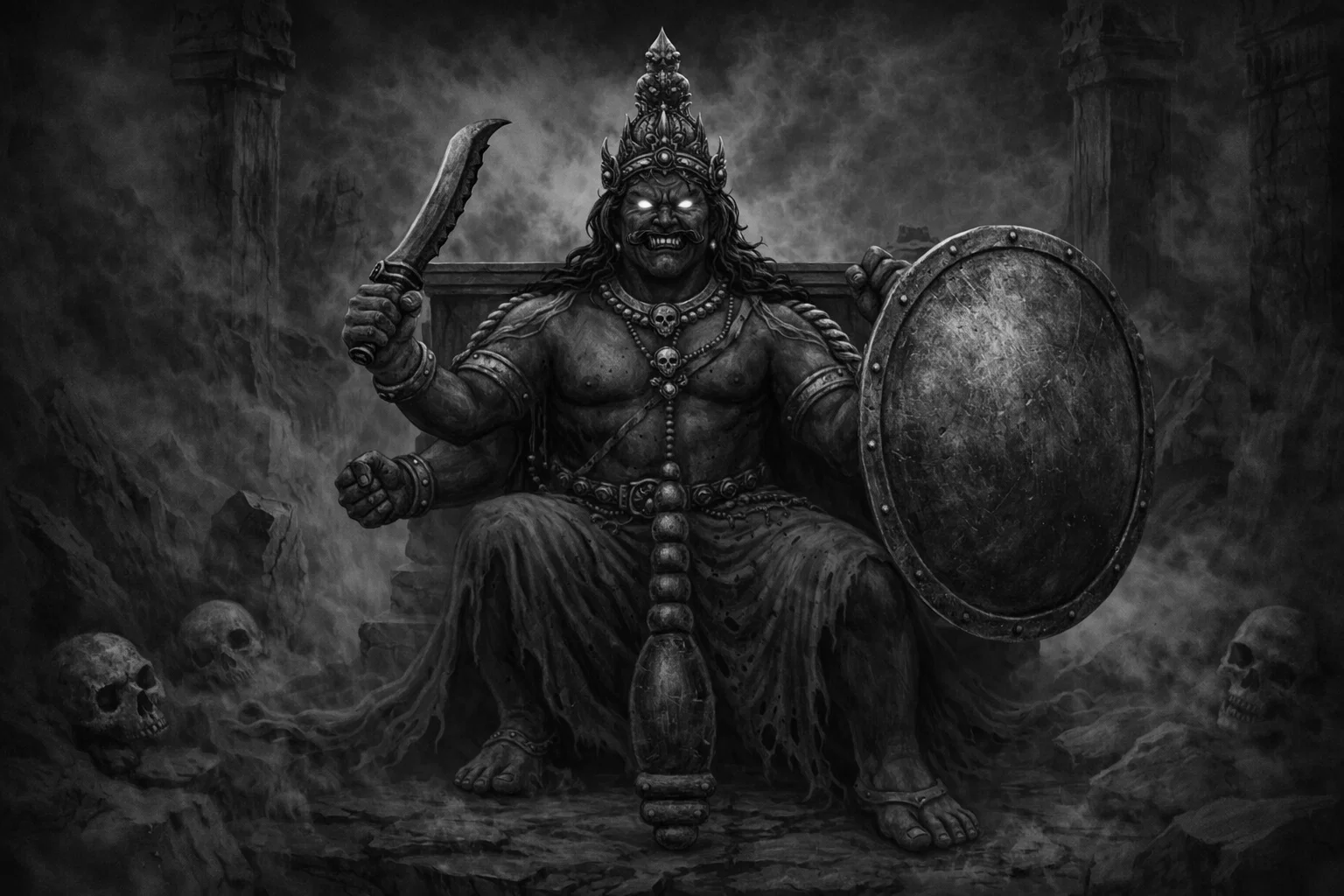
The Shiva Purana and Matsya Purana describe him as a powerful and impressive warrior. He is not shown as a monster, but as a strong Daitya king. His body is said to shine like a thousand suns, showing the energy he gained from years of penance. He is usually pictured in golden armor with gems and a crown, marking his claim to rule the three worlds.
Tarakasura is described as very tall, able to intimidate even the strongest gods. He is usually shown with two arms, holding a mace or sword, and sometimes riding a large chariot pulled by many fast horses.
His eyes are said to burn with ambition and pride, but his face still shows the calm of a practiced ascetic. He represents the ideal Asura warrior: strong, disciplined, and commanding total loyalty from his followers.
Origins
Tarakasura’s story begins after many battles between the gods and the children of Diti. After earlier Asura leaders were defeated, he became a new hope for his people, seeking to restore their lost honor. From a young age, he saw the power gap between the gods and his own kind, so he looked for a solution through divine help.
His story in literature shows a shift in Hindu mythology from simple tribal fights to deeper questions about the power of boons. He appears in the oldest Puranas as the main enemy, whose presence forces Shiva to end his time alone in meditation.
You may also enjoy:
Rāga: The Seductive Demon of Passion and Desire in Buddhist Lore
October 16, 2025
What Is Baku? The Bizarre Yōkai That Eats Nightmares
January 28, 2026
What Is a Yūrei? The True Meaning of Japanese Ghosts
January 30, 2026
Who Is the Demon Andras, The Great Marquis of Discord?
January 15, 2026
Ancient Demons: The Real Origins of the Setcheh Myth
November 11, 2025
Andhaka: The Blind Demon Born From Cosmic Darkness
February 6, 2026
Birth
Tarakasura was the son of Vajrangi and Varangi. Vajrangi, his father, was a strong Daitya created by Diti to get revenge for her sons killed by Indra. Vajrangi’s body was as hard as a diamond, which is how he got his name. But Vajrangi was not evil by nature; after capturing Indra, he let him go when Brahma asked and then chose a life of penance.
He was born into a family known for great strength and spiritual discipline. At his birth, signs in the sky worried the gods, as a prophecy said he would do what no other Asura had done—completely block the divine order. As a child, he learned about war and politics, but his main goal was to gain the ultimate weapon: a boon that could not be broken.
Family
Tarakasura’s family played a big role in his legacy, especially through his children. He was the son of Vajrangi and Varangi. While his parents gave him strength, his sons carried on his influence after he was gone.
He had three sons: Tarakaksha, Kamalaksha, and Vidyunmali. These brothers later became the famous Tripurasura, rulers of three flying cities made of gold, silver, and iron. Their story is similar to their father’s, as they also tried to protect themselves with special boons but were eventually defeated by Shiva as Tripurantaka.
| Relation | Identity |
| Parents | Vajrangi (Father) and Varangi (Mother) |
| Spouse | Variously mentioned as daughters of other prominent Asura lords |
| Children | Tarakaksha, Kamalaksha, and Vidyunmali |
Role in Hindu Cosmology
In the cycle of Dharma, he acts as a needed force for cosmic change. He is the “perfect adversary” who shows a weakness in the gods’ system. By getting a boon that made him safe from all known threats, he forced the universe to create something new: a warrior born from Shiva and Parvati.
His rule shows the Guna of Rajas—passion and activity—taken too far. He is not a villain in the usual sense, but more an agent of stagnation. By pushing out the gods, he broke the cycle of sacrifices that keeps the universe going.
When Kartikeya finally defeats him, balance is restored. More importantly, this event gives birth to the “General of the Gods,” a god who protects the good and destroys the ego. In this way, Tarakasura’s challenge was needed to bring the war-god into being.
The Weaponization of Dharma
In Puranic stories, this Daitya is important not just as a force of chaos, but as someone who cleverly uses cosmic law. Unlike other mythic enemies, such as the Greek Titans or Norse Jotunn, who represent wild natural forces, the son of Vajrangi works by skillfully using the rules of Rta, the cosmic order.
His rise shows a key issue in Vedic thought: Tapas, or spiritual effort, works like a law of nature. Once someone earns enough merit, the gods must reward them, no matter their intentions.
By putting Brahma in a tough spot, Tarakasura turned Heaven into a place ruled by strict rules, showing that the biggest danger to the gods was not breaking the law, but following it too perfectly by the wrong person.
This story is a strong criticism of merit without ethics. The Daitya’s rule shows a time when the usual order of the universe was stopped by a deal that even the Creator could not break.
This connects to ideas in legal philosophy and social history, showing a shift from rule by charisma to rule by law. His request for a very specific and unlikely death—being killed by a six-day-old child—shows he understood how to find loopholes in the rules.
He did not want to destroy the system, but to control it by finding its weakest point. This makes him a classic example of a “Systemic Saboteur”—someone who uses a society’s rules to undermine it from within.
Also, Kartikeya’s birth to solve this problem adds a new step in the growth of divine nature. Before this, the gods were mostly unchanging, stuck in their roles.
Tarakasura’s unbeatable boon forced Shiva and Parvati to unite, mixing their different energies. This means the Asura is really the reason the “War God” type exists in this tradition; without his challenge, Skanda’s warrior spirit would never have appeared.
In this way, the Daitya is like the “Necessary Antagonist” in evolution—he is the pressure that drives a species or group to change and grow stronger to survive a major challenge.
Tarakasura Myths, Legends, and Stories
The Great Penance and the Boon of Brahma
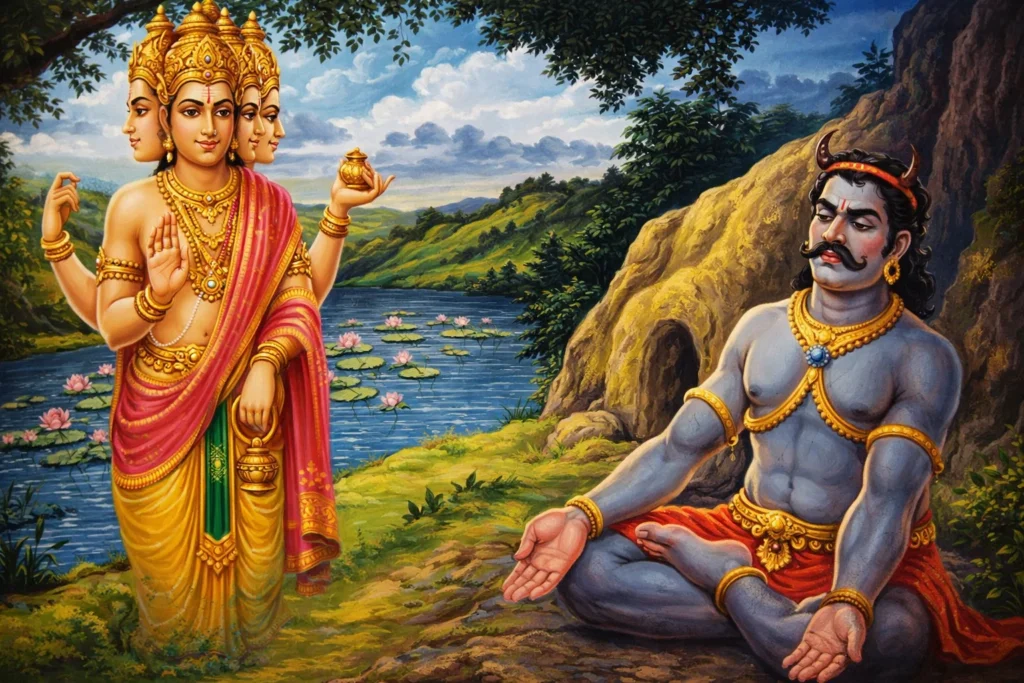
In the Shiva Purana, the narrative begins with Tarakasura retreating to the forest of Madhu to perform a penance so severe that it caused the earth to tremble.
He stood on one leg for a hundred years, followed by another century of standing on his big toe. Finally, he subsisted only on air. The heat generated by his tapas began to scorch the celestial realms, forcing Brahma to appear before him.
When offered a boon, the Daitya asked for immortality. Brahma refused, stating that all who are born must die. With strategic cunning, the Daitya then requested that he be killed only by a son of Shiva.
At this time, Shiva was a widower following Sati’s death and had entered a state of deep, eternal meditation. The Daitya believed that Shiva would never marry again and, therefore, would never father a child. Brahma granted the boon, and the Daitya returned to his capital to begin his conquest.
You may also enjoy:
Akateko: The Bloody Hand Yōkai That Guards a Cursed Temple Tree
November 14, 2025
What Is a Yūrei? The True Meaning of Japanese Ghosts
January 30, 2026
Alû: The Mesopotamian Demon of Malevolence and Pestilence
November 10, 2025
The Ghul: The Flesh-Eating Demon of Arabian Folklore
October 1, 2025
Gandharva: God, Spirit, or Demon?
November 13, 2025
Who Is Futakuchi-onna, the Two-Mouthed Woman?
March 9, 2026
The Conquest of the Three Worlds
Secure in his invincibility, the king of the Daityas launched a massive military campaign against Indra, the king of the gods. The Puranic accounts describe an epic war in which the Asura army, bolstered by its leader’s divine protection, systematically dismantled the defenses of Amravati (the celestial city).
Tarakasura’s power was so absolute that he seized the positions of the directional guardians (Dikpalas). He commanded the sun to shine without burning, the moon to remain full, and the wind to blow only as a gentle breeze for his pleasure.
The Devas were stripped of their weapons and forced to serve the Asura king or flee to the forests of the mortal world. This period of Asura hegemony lasted for centuries, marking a dark age for the celestial order, during which the Vedas’ rituals were suppressed, and the gods lived in constant fear.
The Sacrifice of Kamadeva
The desperate Devas realized that their only hope lay in the birth of a son to Shiva. However, Shiva remained absorbed in Samadhi. They enlisted the help of Kamadeva, the god of love, to disturb Shiva’s meditation and instill desire for Parvati, who was performing her own penance to win Shiva’s heart.
The myth describes how Kamadeva fired his flower-arrows at the Great Ascetic. Shiva, angered by the interruption, opened his third eye and incinerated Kamadeva to ashes. Despite this tragedy, the seeds of desire were planted.
Eventually, Shiva recognized Parvati’s devotion, and their union was consummated. The energy produced by their union was so potent that even the gods could not contain it, leading to the birth of the child who would be the Daitya’s undoing.
The Battle with Kartikeya
The final chapter of his legend is found in the Skanda Purana, detailing the birth of Kartikeya (Skanda). The child reached maturity in just six days. The Devas appointed the young boy as the commander-in-chief of their revived army.
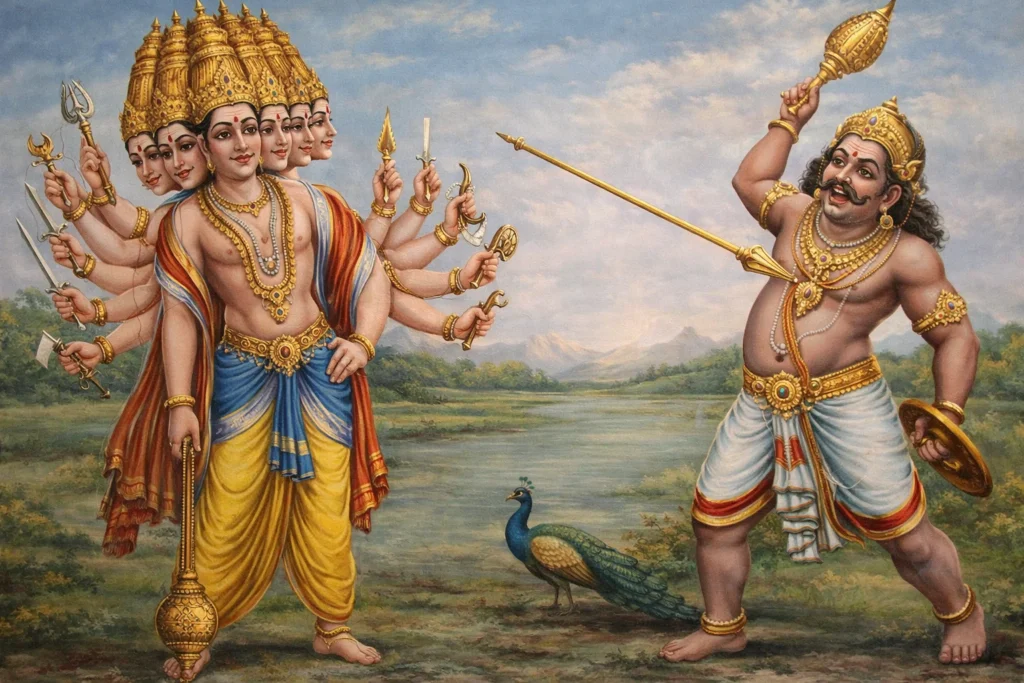
The two armies met on a vast battlefield. The Daitya, seeing a mere child leading the gods, laughed in derision. However, the battle proved fierce. The Daitya used his mastery of Maya (illusion) and celestial weapons, but Skanda countered every move.
Finally, Skanda hurled his divine spear, the Vel (or Shakti), infused with Parvati’s power. The spear pierced the chest of the Daitya, shattering his invincibility. As he fell, the Daitya was liberated from his physical form, having fulfilled his role in the divine play (Lila).
Tarakasura vs Other Similar Entities
| Asura Name | Associated Trait/Role | Clan/Origin | Key Traits/Powers |
| Ravana | Ego and Conquest | Rakshasa | Ten heads, mastery of Vedas, boon from Brahma |
| Bali | Righteousness and Sacrifice | Daitya | Grandson of Prahlada, ruler of three worlds |
| Mahishasura | Shape-shifting and Brutality | Asura | Took form of a buffalo, defeated by Durga |
| Hiranyakashipu | Hatred of Vishnu | Daitya | Boon of complex protection, killed by Narasimha |
| Bhasmasura | Impulsive Greed | Asura | Turned anything he touched to ash |
| Vritra | Drought and Obstruction | Vedic Asura | Serpentine form, slain by Indra’s Vajra |
| Madhu | Primordial Chaos | Asura | Born from the earwax of Vishnu |
| Narakasura | Tyranny | Bhauma | Son of Bhudevi, defeated by Krishna and Satyabhama |
| Andhaka | Blind Desire | Daitya | Every drop of his blood created a new Asura |
| Jalandhara | Oceanic Power | Asura | Born from Shiva’s rage and the ocean |
| Rakta-bija | Multiplication | Asura | Cloned himself from blood drops |
Rank Among Asuras
In the Daitya clan, Tarakasura has the highest leadership position. He is often mentioned with Hiranyaksha and Bali as a “Chakravartin,” or Universal Emperor, among the Asuras. Unlike lesser demons who acted chaotically, his rule was more organized and like an empire.
Tarakasura was respected by all the major Asura families, and his palace was said to be as grand as Indra’s. He kept order among the often divided Asura tribes, showing his strong leadership.
His fight with the gods was not just about land, but about who deserved to rule the universe—the gods who were born to it, or the Asuras who worked hard for their power.
Mystical Correspondences
| Attribute | Details |
| Planet | Saturn (for discipline and endurance) |
| Zodiac Sign | Capricorn (ambition and structural mastery) |
| Element | Earth (grounded power and physical invulnerability) |
| Direction | South-West (Nairṛti – the direction of the Asuras) |
| Color | Black and Gold (power emerging from darkness) |
| Number | 1 (representing his singular focus and sovereignty) |
| Crystal/Mineral | Iron or Hematite |
| Metal | Steel (representing his father Vajrangi’s diamond-like strength) |
| Herb/Plant | Dhatura (associated with the Shiva energy he tried to bypass) |
| Animal | Boar (tenacity and ferocity) |
| Trait/Role | Tapas (Asceticism) and Imperialism |
Tarakasura’s cosmic connections are linked to the discipline of Saturn, showing the endurance needed for his long penances. This influence appears in his patient and careful rise to power and his ability to survive tough times. His link to Capricorn highlights his climb from the depths to the summit of Mount Meru as he sought to secure his rule through laws and boons.
Even with his high ambitions, his nature is ingrained with the Earth element, giving him the toughness that made him almost impossible to defeat. This stability is also linked to the South-West, a direction connected with ancestors and Asura leaders.
Black and gold in his symbols show how raw ambition can be turned into the golden reality of a heavenly empire. His link to iron and steel reflects his strong will, as these metals can only be shaped or broken by great heat—the same kind of divine energy that finally appeared in Skanda, his conqueror.
You may also enjoy:
Rāga: The Seductive Demon of Passion and Desire in Buddhist Lore
October 16, 2025
Who Is Asmodeus in Demonology and the Bible?
February 18, 2026
Barbas: The Lion Demon Who Spreads Disease
March 3, 2026
What Is a Pishacha, the Flesh-Eating Demon of the Dead?
February 11, 2026
Nasnas: The Monstrous Demon Hybrid That Haunted Pre-Human Earth
November 12, 2025
What Is Jorōgumo? The Deadly Spider Woman of Japanese Myth
February 2, 2026
Bibliography
Author’s Note: While working on this article, I noticed a strong contrast between the brief mentions of the Daitya in the Rig Veda and the detailed, rule-focused story in the Shiva Purana. Kālidāsa’s Kumārasambhavam adds important psychological depth, turning a cosmic problem into a moving story of divine need. My main goal was to bring these different accounts together to show that his power came not just from strength, but from skillfully using the laws around Tapas.
- Shastri, J. L., editor. The Siva-Purana, Part 1. Translated by a Board of Scholars, Motilal Banarsidass, 1970. Internet Archive.
- Shastri, J. L., editor. The Śiva-Purāṇa: Part 2. Translated by a Board of Scholars, vol. 2, Motilal Banarsidass, 1970. Ancient Indian Tradition and Mythology. Internet Archive.
- Witzel, Michael. Brahmanas. Academia.edu.
- Shastri, J. L., editor. The Siva-Purana, Part 4. Translated by a Board of Scholars, Motilal Banarsidass, 1970. Internet Archive.
- Kālidāsa. Kumārasambhavam of Kālidāsa. Translated by M. R. Kale, 6th ed., Motilal Banarsidass, 1967. Internet Archive.
- Griffith, Ralph T. H., and Arthur Berriedale Keith, translators. Complete Rig Veda in English (Sakala Shakha). Edited by Rigvedacomplete, Internet Archive ed., 2018. Internet Archive.
- Besant, Annie, and Bhagavan Das, compilers. The Vedas and Brahmanas. Theosophical Publishing House, 1912. Internet Archive.
- Naunidhirâma. The Garuda Purâna (Sâroddhâra). Translated by Ernest Wood and S. V. Subrahmanyam, edited by Major B. D. Basu, AMS Press, 1974. Internet Archive.