The Hinn are an important part of Islamic and pre-Islamic cosmology. They act as a link between the spiritual and physical worlds. Most supernatural beings in Arabian tradition are known for their interactions with humans.
These entities are different because they existed before humans and represent a ‘lost generation’ that failed to keep order on Earth before the Jinn and humans appeared.
This article uses translations of The Epistles of the Brethren of Purity and Tarikh al-Tabari to give an accurate view of the pre-Adamite race. By studying these tenth-century texts, we can separate early stories from general Jinn traits. [View Full Bibliography ↓]
Summary
Key Takeaways
| Attribute | Details |
| Names | Hinn (singular: Hinni), al-Hinn |
| Type | Pre-Adamite sentient creatures, often categorized as the lowest or most primal form of Jinn-like entities |
| Title | The Dispossessed, The Pre-Jinn Inhabitants |
| Gender | Male and female |
| Servitors | Lesser terrestrial spirits and primal fauna |
| Powers | Shapeshifting into black dogs, invisibility, environmental manipulation, and the ability to inflict madness or physical blight |
| Appearance | Often described as vaporous, shadowy forms or manifesting as small, black, predatory animals |
| Etymology | Derived from the Arabic root h-n-n, relating to longing, yearning, or a low sound/murmur |
| Associated Figures | The Binn, the Jinn, the Archangel Jibril (as their suppressor) |
| Weaknesses | Iron, specific Quranic recitations (in later traditions), and territorial displacement |
| Opposing Holy Figure | Archangel Jibril and the celestial hosts |
| Social Structure or Tribe | Fragmented nomadic remnants; originally a global terrestrial civilization |
| Followers/Tribe Size | Varies by account, but generally considered a diminished, nearly extinct race |
| Primary Sources | The Epistles of the Brethren of Purity (Ikhwan al-Safa), Tarikh al-Tabari (History of the Prophets and Kings), Al-Masudi’s Meadows of Gold |
Who or What is Hinn?
The Hinn are a unique type of supernatural being found in Arabian demonology. They are often described as the first beings to live on Earth, long before the Jinn were created from smokeless fire.
Unlike the Jinn, who have complex social and religious roles, the creatures are usually shown as more animal-like or basic. Early scholars, such as Ibn Abbas, called them the ‘weakest’ supernatural beings.
However, it is still considered dangerous because the entity resents those who replaced it.
“Hinn” Meaning
The word ‘Hinn’ comes from the Arabic root h-n-n, which means yearning, longing, or a soft moan. This fits their image as beings who long for the world they lost. In old Arabic dictionaries, the word also suggests weakness, setting the creature apart from stronger beings like the Ifrit or Marid.
Over time, the name changed from describing a specific group to a general term for lesser spirits. Some stories group the entities with other rare beings, such as the Binn, Timm, and Rimm.
Some scholars suggest the name comes from desert sounds, like the wind or the ‘singing’ sands, which nomads believed were the voices of a fading race. Sometimes, the name is linked to Manichaean ideas of lesser demons, but its main origin is Arabic.
How to Pronounce “Hinn” in English
The name is pronounced with a short ‘i’ and a clear ‘h’, like the word ‘hint’ without the ‘t’. The double ‘n’ is a bit longer, but in English, it sounds almost like ‘hin’.
What Does a Hinn Look Like?
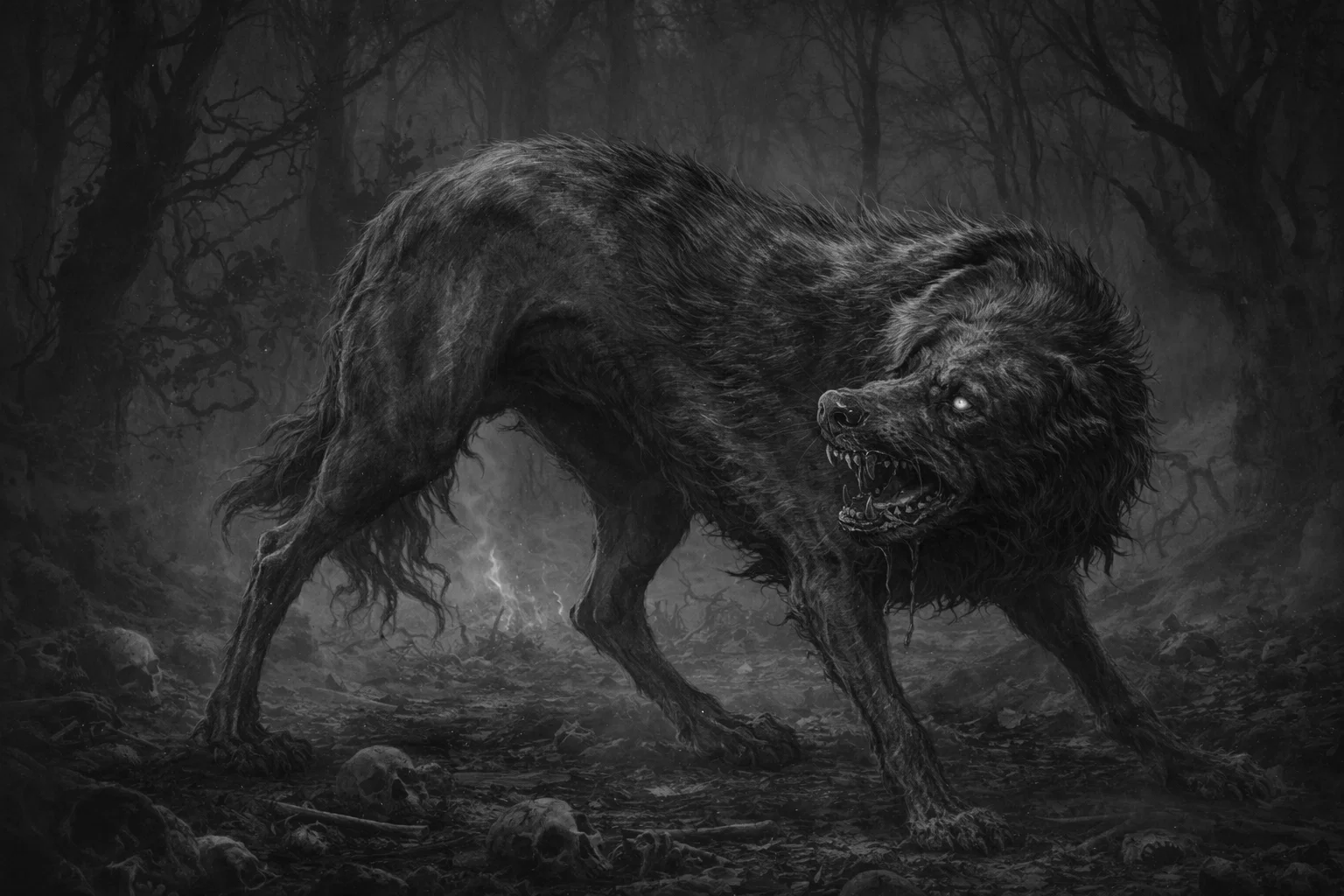
The creatures usually appear in unstable and humble forms. Al-Masudi and Tabari wrote that they rarely look majestic or human. Most often, they are seen as small black dogs. This idea is so common that some stories say any strange black dog in the wild could be a Hinn.
Besides being dogs, these entities are also described as thin or vapor-like beings. They do not have the size or presence of the Jinn and often look like shadows without a source. Some stories say the creature has small, skeletal wings or limbs, showing they are a ‘faded’ race.
The Ifrit are linked to bright fire, but this pre-Adamite monster is connected to the dim light of dusk and the gray colors of the desert. Their eyes are often described as dull, lacking the fiery glow of stronger demons.
Origins
The story of the Hinn starts in the Pre-Adamite era, a time before humans when other beings lived on Earth. Ibn Abbas said God made the entities from ‘fumes’ or the lighter parts of air. They were the first to have free will on Earth, but their rule was violent and corrupt. Without spiritual guidance, it fought wars that damaged the world.
To stop this corruption, God sent an army of angels, often led by the one who would become Iblis, to cleanse the Earth. Most of the creatures were destroyed or forced to hide in remote islands and mountain peaks. Afterward, the Jinn were created to take their place.
The pre-Adamites were pushed aside first by the Jinn, then by humans. Because of this, they became scavengers, living only in the darkest places where neither Jinn nor humans go.
You may also enjoy:
Vritra: The Dragon Who Swallowed the Sky in Hindu Mythology
October 7, 2025
What Is a Tengu? Origins, Powers, and Dark Folklore
January 29, 2026
Who Is Shiva, the Destroyer and the Lord of the Universe?
November 12, 2025
Yuki Onna: The Terrifying Bride Who Feeds on Travelers
December 9, 2025
Who Is Azazel, the Demon Blamed for Human Corruption?
February 24, 2026
Who Is Aka Manto, Japan’s Terrifying Red-Cloaked Yōkai?
October 24, 2025
Hinn as the Shadow of Ecological Succession
The Hinn are important in Islamic cosmology because they are seen as a ‘failed prototype.’ While most demon stories focus on Iblis’s rebellion, the Hinn show the fear of a whole race being replaced and forgotten.
This idea is similar to how modern science views extinction, but here it is part of a divine story. Al-Masudi wrote that the change from Hinn to Jinn was not just about who lived on Earth, but about making beings less tied to the Earth’s early, violent state.
Looking at the Hinn from a social history view, we see that scholars in the eighth and ninth centuries wrote about them as the Islamic world explored the ruins of older civilizations. The Hinn became a way to explain the ‘ghosts’ of these lost empires.
The Hinn are seen as the classic example of a displaced people. Like the ruins of Petra, which seemed to come from a lost race, the Hinn explain the mysterious history of the land before it was shaped by Abrahamic religions.
In comparative mythology, the Hinn are similar to the Fomorians in Irish myth or the Jotunn in Norse stories. All are old races that had to disappear to make way for new gods or humans.
But the Hinn are different because they do not fight their successors forever. Instead, they are always in mourning. Their appearance as black dogs, scavenging and lowly, shows how far they have fallen from their former power.
This story shows that failing to follow the divine will leads to a real loss of power. The Hinn went from ruling the world to becoming shadows hiding under the floorboards.
Powers and Abilities
The Hinn are much weaker than the Marid or Ifrit, but they are seen as more dangerous than ordinary Ghouls because they are so ancient. While an Ifrit can control matter and energy, the Hinn affect the world in more subtle, harmful ways:
- Zoomorphism: The primary ability to transform into small animals, specifically black dogs or vultures.
- Aura of Melancholy: Because of their etymological link to “longing,” they can induce deep, suicidal depression in humans who linger in their territory.
- Vulnerability Infliction: They can “thin” the veil of protection around a human, making them more susceptible to possession by more powerful Jinn.
- Invisibility: A natural state that allows them to move through human settlements undetected.
- Blight: The ability to cause the sudden wilting of crops or the souring of milk through their mere presence.
Influence on Humans and Possession
The Hinn usually do not take over humans, unlike the Shayatin. Instead, they act more like parasites. Someone haunted by a Hinn might hear sounds of ‘yearning’ or low moans.
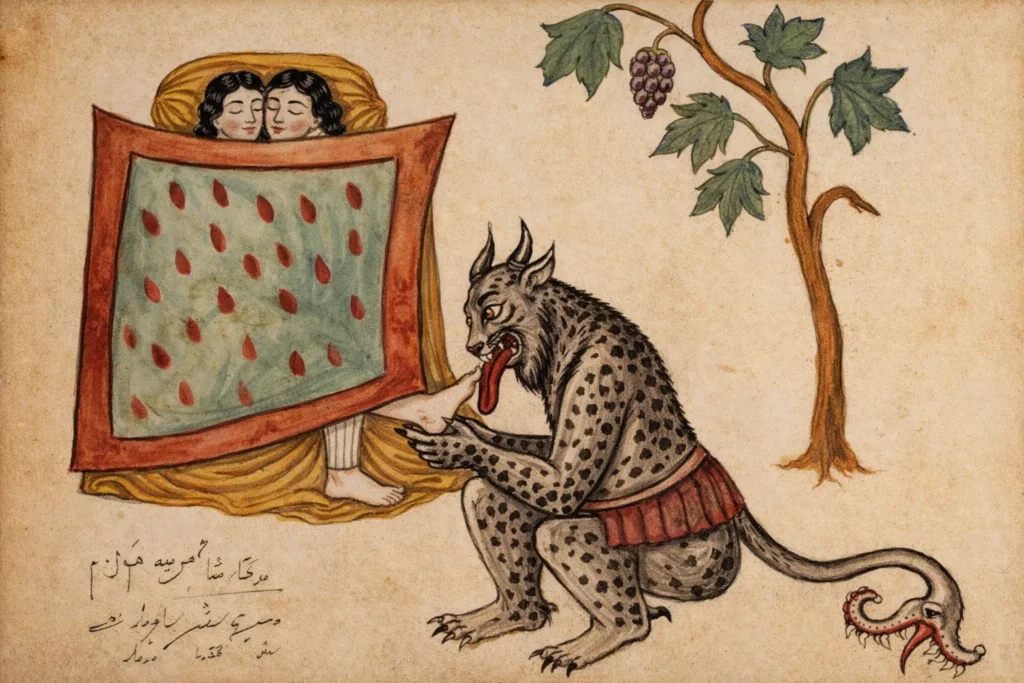
Since they lost their own homes, Hinn often hide in human houses, living in rafters or under floors. Signs they are present include a strange, stagnant-water smell and a black dog that vanishes when you get close.
Protection and Exorcism Methods
Traditionally, people protect themselves from the Hinn by using things they dislike, such as purity and iron. Since they are linked to ‘fumes,’ they cannot stand pure salt or strong steel:
- Iron Talismans: Carrying a small iron nail or wearing an iron ring is a traditional method to prevent a Hinn from attaching itself to a traveler.
- Salt Barriers: Placing salt at the four corners of a room was believed to “burn” the vaporous feet of the creature.
- Recitation of Ancient Names: In pre-Islamic lore, calling on the “Lords of the High Air” was used to banish them, while in later Islamic contexts, the Mu’awwidhatayn (the last two chapters of the Quran) are cited as effective.
- The Use of Wild Rue: Burning the seeds of Harmal (Wild Rue) is a documented historical remedy to “smoke out” these entities from a household.
Historical & Folkloric Records
While these creatures do not appear in the Quran, their historical record dates to the 7th Century CE, within the oral traditions attributed to the companions of the Prophet, later codified in early Islamic historiography.
“God created the Jinn from a smokeless flame of fire… and before that, He created the Hinn and the Binn from the surface of the earth. They shed blood and caused corruption, so God sent against them an army of angels who drove them to the islands of the seas.” [Tafsir Ibn Abbas (attributed), 7th-8th Century CE]
This early source shows that the Hinn were a race on Earth before the Jinn, made from the earth itself instead of fire. This difference is important: Jinn are seen as more spiritual, while Hinn are made from the world’s leftovers. Their story warns both Jinn and humans about the dangers of corruption and violence.
This source links the Hinn with the Binn, using rhyming names common in old Arabic stories to describe ancient, mysterious groups. At first, they were not seen as demons or dogs, but as a failed civilization that could ‘shed blood,’ which later became a reason for angels to question why Adam was created.
“The Hinn are the weakest of the Jinn, and they are the black dogs that you see. If you are eating and one of them comes to you, throw a morsel to it, for they have souls.” [Al-Jahiz, Kitab al-Hayawan (The Book of Animals), 9th Century CE]
By the 9th century, the Hinn were seen differently. Al-Jahiz, an early scientist and writer, described them not as ancient rulers but as weak, scavenging beings living among people. This is where the idea of Hinn as black dogs comes from. Instead of fierce warriors, they are shown as pitiful and in need of kindness.
This change shows a wider trend of making supernatural beings more familiar. By linking the Hinn to stray animals, the big cosmic battles of the past become part of everyday life and ethics.
The advice to ‘throw a morsel’ shows a special religious idea: even though the Hinn are outcasts and might be harmful, they still have ‘souls.’ This means people should show some kindness to these lost spirits.
“And the Hinn were of a different creation… some of them had wings and moved with the wind, while others were like the creeping things of the earth. When the Jinn overcame them, the Hinn were reduced to the shadows of the mountains and the depths of the vales.” [Al-Masudi, Muruj adh-Dhahab (The Meadows of Gold), 10th Century CE]
Al-Masudi, sometimes called the ‘Herodotus of the Arabs,’ offered a more detailed and evolving view of the Hinn.
In his account, the Hinn are not just dogs or humans but can take many forms, from winged spirits to crawling creatures. By the 10th century, the Hinn had become a general term for any strange being that did not fit as a Jinn or animal.
The main religious point here is the loss of territory. Al-Masudi describes the Hinn as living in the ‘depths’ and ‘shadows,’ making them a kind of shadow race. This matches the medieval Islamic interest in geography and the world’s wonders.
The Hinn stand for the wild, untamed parts of the world beyond the Caliphate and human civilization. They help explain strange things travelers saw at the edges of the known world.
“Know that the Hinn are the lowest of the earthly spirits, and they are used by the masters of the art to spy upon the secrets of the common folk, for they can slip through the cracks of a door as easily as the scent of musk.” [The Epistles of the Brethren of Purity (Ikhwan al-Safa), 10th-11th Century CE]
In this mystical source, the Hinn are seen as useful spirits rather than just figures from folklore. The ‘Brethren of Purity’ focus on their ability to pass through things, describing them as spies or quiet watchers because they are vapor-like.
The view of the Hinn changes from being a historical mystery to a spiritual tool. At a time when people were interested in alchemy, the Hinn were seen as simple spirits that could be easily controlled because they were weak and close to the physical world. This shows their shift from rulers of the earth to invisible helpers for those who practice magic.
Myths, Legends, and Stories
The War of the Pre-Adamites
In the chronicles of Al-Tabari, it is narrated that before the creation of the Jinn, the Earth was ruled by the Hinn and the Binn. These two races were of a physical density somewhere between light and clay. For cycles lasting thousands of years, they built cities and civilizations across the fertile plains of the primordial Earth. However, as their numbers grew, so did their pride.
They began to spill blood, a concept previously unknown to the heavens. The soil of the Earth cried out to the celestial spheres because of the corruption of the Hinn. In response, God commanded a host of angels to descend.
The angels arrived with swords of light and drove the Hinn into the sea. The few that survived were stripped of their glory and forced to take on the lowly forms of dogs and spirits of the waste, forever mourning the loss of their golden age.
The Black Dog of the Hijaz
A folk narrative from the Hijaz region tells of a merchant who found a small, shivering black dog in the middle of a barren wadi. Taking pity on the creature, he brought it into his caravan and fed it. That night, his camels refused to sleep, and his fellow travelers were struck by a profound, unexplainable grief, weeping for homes they had not yet left.
An elder in the caravan recognized the dog’s eyes—they did not reflect the campfire. He declared the creature a Hinn. He instructed the merchant to place an iron bit in the dog’s mouth.
After doing so, the dog did not yelp but instead spoke in a voice like the whistling wind, cursing the sons of Adam for stealing the sunlight before dissolving into a cloud of grey smoke.
You may also enjoy:
Aeshma: The Zoroastrian Demon of Wrath and Fury
January 13, 2026
Who Is Azazel, the Demon Blamed for Human Corruption?
February 24, 2026
Palis: The Foot-Licking Desert Jinn That Drinks Your Blood
December 3, 2025
Ambri: The Imperial Duchess of Caspiel’s Empire
December 1, 2025
Chort: The Sinister Slavic Demon of Chaos and Bad Luck
March 10, 2026
Who Is Asmodeus in Demonology and the Bible?
February 18, 2026
The Judgment of Iblis over the Hinn
In some esoteric interpretations of the Süleymanname, it is suggested that, while Iblis (then known as Azazel) was a pious servant of God, he was appointed to judge the Hinn.
He looked on them with such contempt for their weakness and their failure to uphold the Earth that his own pride began to take root. He saw the Hinn as failed prototypes.
When the Hinn pleaded for mercy, claiming they were merely following their nature, Iblis showed them none, driving them into the “hollow places” of the world.
This legend claims that the Hinn actually hate the Shayatin (demons) as much as they hate humans, for it was a demon’s pride that led to their final exile.
Hinn vs Other Jinn
| Jinn Name | Associated Traits/Influence | Rank/Origin | Key Traits/Powers |
| Ifrit | Extreme malice and destructive pride | High-ranking; Quranic/Folklore | Immense physical strength; command over fire |
| Marid | Arrogance and rebellion | Highest tier; Arabian Nights | Granting wishes with hidden costs; sea-dwelling |
| Ghul | Cannibalistic gluttony | Scavenger; Pre-Islamic lore | Shapeshifting; haunting graveyards and deserts |
| Si’lat | Seduction and deception | Forest spirit; Arabian folklore | Expert mimicry; luring men to their deaths |
| Palis | Exhaustion and vampirism | Foot-licker; Persian/Arabian lore | Drains energy by licking soles of feet |
| Qareen | Constant temptation to sin | Personal companion; Quran/Hadith | Whispering into the heart; knows all secrets |
| Shiqq | Terror and physical deformity | Lower-tier demon; Pre-Islamic | Appears as half a human; kills travelers |
| Nasnas | Fragility and confusion | Hybrid creature; Folklore | Half-bodied; hops on one leg to distract |
| Dalhan | Fear of the sea | Island dweller; Folklore | Feeds on shipwrecked sailors |
| Hafaf | General mischief | Follower of Iblis; Grimoires | Induces wine-induced stupor or madness |
| Zalanbur | Dishonesty in trade | Market demon; Grimoires | Causes arguments in marketplaces and fraud |
| Dasim | Domestic strife | Household demon; Hadith/Lore | Causes friction between husband and wife |
Position Among Jinn
They occupy the absolute lowest rung of the supernatural hierarchy. They are often not even granted the dignity of being called “Jinn” by the more powerful classes like the Ifrit, who view them as “the dust of the previous world.” In Jinn society, if they are mentioned at all, it is as pariahs.
They have a unique relationship with the Binn, who are their only peers in the Pre-Adamite timeline. According to lore, the Hinn and Binn occasionally war over the few remaining “thin places” in the world where the veil is weak.
Regarding the Shayatin (the followers of Iblis), the Hinn are often used as disposable scouts. Because they can blend into the shadows and take the form of common dogs, higher demons use them to monitor human activities without drawing the attention of guardian angels.
However, there is no loyalty; a Hinn will readily abandon a task if confronted with a threat, as their primary instinct is survival after eons of persecution.
Mystical Correspondences
| Attribute | Details |
| Planet | The Moon (in its waning/dark phase) |
| Zodiac Sign | Pisces (representing the deep, forgotten waters of the void) |
| Element | Air (specifically the “unclean” or stagnant air) |
| Direction | North-West (the direction of fading light) |
| Color | Grey and Charcoal |
| Number | 0 (representing the void and non-existence) |
| Crystal/Mineral | Anthracite or Obsidian |
| Metal | Lead (representing weight and stagnation) |
| Herb/Plant | Moss and Nightshade |
| Animal | Black Dog and Vulture |
These entities are linked to the Waning Moon and Pisces, showing they are leftovers from a forgotten past. Unlike the fiery Ifrit, the Hinn live in the gray areas between light and dark. Their tie to stagnant air comes from their origin in the ‘fumes’ of the earth, a lower form of creation without fire’s purity or the divine breath given to humans.
These links show that the Hinn’s ‘evil’ is about decay and hopelessness. Their number, 0, signifies that they are out of place—they are not meant to be here. Their connection to lead shows they cannot rise to the heavens and are stuck to the earth they once harmed.
You may also enjoy:
Who Is Agares, the Demon of Earthquakes and Deception?
October 13, 2025
Who Is Andromalius, and Why Is He the Last Demon of the Goetia?
January 20, 2026
Who Is Ambolin, the Demon of Nighttime Dread
December 1, 2025
Mahabali (Bali): The Benevolent Asura King
October 10, 2025
Nasnas: The Monstrous Demon Hybrid That Haunted Pre-Human Earth
November 12, 2025
Bibliography
Author’s Note: While researching this profile, I noticed a strong contrast between the violent stories of the Hinn in al-Tabari’s early accounts and their later image as pitiful black dogs in al-Jahiz’s writings. It was interesting to compare these old stories with the 2025 Max Planck Institute’s findings about using harmal as a real-world way to ward off such beings. By looking at both medieval texts and modern data, I saw a clear pattern: the Hinn changed from a major threat to a minor entity in folklore, showing how their role faded over time.
- al-Ṭabarī, Abū Jaʿfar Muḥammad ibn Jarīr. The History of al-Ṭabarī, Vol. 10: The Conquest of Arabia. Translated by Fred M. Donner, State University of New York Press, 1993. Internet Archive.
- al-Mas‘ūdī, ‘Alī ibn al-Ḥusayn. Historical Encyclopaedia: Entitled “Meadows of Gold and Mines of Gems”. Translated by Aloys Sprenger, Oriental Translation Fund of Great Britain and Ireland, 1841. Internet Archive.
- al-Jāḥiẓ, ʻAmr ibn Baḥr. Hādhā Kitāb al-Ḥayawān [The Book of Animals]. Vol. 5–7, al-Maṭbaʻah al-Ḥamīdīyyah al-Miṣrīyyah, 1905. Internet Archive.
- al-Fīrūzābādī, Muḥammad ibn Ya‘qūb (attributed). Tanwīr al-Miqbās min Tafsīr Ibn ‘Abbās. Translated by Mokrane Guezzane, Royal Aal al-Bayt Institute for Islamic Thought, 2007. Internet Archive.
- Al-Shaykh, Hanan. One Thousand and One Nights: A Retelling. Pantheon Books, 2013. Internet Archive.
- Solomon, King of Israel (attributed). The Key of Solomon the King (Clavicula Salomonis). Translated and edited by S. Liddell MacGregor Mathers, George Redway, 1889. Internet Archive.
- McCown, Chester Charlton, editor. The Testament of Solomon. J. C. Hinrichs’sche Buchhandlung, 1922. Internet Archive. Edited from manuscripts at Mount Athos, Bologna, Holkham Hall, Jerusalem, London, Milan, Paris, and Vienna.
- Mohamed, Yasien. The metaphor of the dog in Arabic Literature. Tydskrif vir letterkunde. 45. 10.4314/tvl.v45i1.29821. 2008.
- Max Planck Institute of Geoanthropology. Earliest use of psychoactive and medicinal plant ‘harmal’ identified in Iron Age Arabia. ScienceDaily, 23 May 2025.