The daughters of the lord of the Desire Realm symbolize how human impulses become automatic, not just external dangers. While their father uses open force to block enlightenment, these figures work within the mind, creating barriers of attachment and aversion.
Arāti stands for the obstacle of discontent or boredom, a subtle force that weakens spiritual focus by making virtue seem unappealing. In Buddhist cosmology, she personifies one of the three main poisons, showing how inner states are turned into demons to be overcome through meditation.
To understand the hierarchy of the Mara-kanyā, one must compare the Samyutta Nikaya and the Lalitavistara Sutra. This helps recover the early Buddhist idea of turning inner aversion into an external demon. [View Full Bibliography ↓]
Summary
Key Takeaways
| Attribute | Details |
| Names | Arati, Arati-Rati |
| Title | Daughter of Mara, Personification of Discontent |
| Region | Ancient India (Magadha), Southeast Asia, Tibet |
| Type | Buddhist demon (Mara-kanyā), Deva of the Desire Realm |
| Gender | Female |
| Realm | Kamadhatu (Desire Realm), specifically Paranirmitavasavartin |
| Obstacle/Threat | Spiritual discontent, boredom, aversion to meditative practice |
| Associated Figures | Mara (Father), Tanha (Sister), Raga (Sister), Gautama Buddha |
| Weapon/Item | Illusory physical forms, music, dance |
| Weaknesses | Equanimity, realization of impermanence, mindfulness |
| Associated Deity/Figure | Gautama Buddha |
| Pantheon | Buddhist (Theravada and Mahayana traditions) |
| Primary Sources | Sutta Nipata (Padhana Sutta), Samyutta Nikaya, Lalitavistara Sutra, Buddhacarita |
Who or What is Arāti?
Arāti is one of Mara’s three daughters, and Mara rules the sixth Heaven in the Desire Realm. In Buddhist demonology, she has an important role as a direct agent of Mara.
Her main purpose is to hinder spiritual progress by using sensory distractions and psychological tricks. Unlike demons that cause physical harm, she works on the mind, challenging a practitioner’s resolve and commitment to liberation.
As one of the Mara-kanyā, she is seen as a beautiful celestial being, but her role is to block progress. She and her sisters together show the range of human craving and aversion. While her sisters focus on thirst and attachment, she stands for the dissatisfaction that comes when neither worldly nor spiritual pursuits brings interest.
Arāti Meaning
The name comes from Sanskrit and Pali, where it is the opposite of rati. Rati means “delight,” “pleasure,” or “fondness,” often sexually or aesthetically. The prefix “a-“ means “not,” so the name means “non-delight,” “discontent,” or “aversion.” Buddhist texts show this name was chosen to describe the feeling of losing interest in following the Dharma.
In the Pali Canon, especially the Sutta Nipāta, the term refers to a lack of enthusiasm for the religious life. In Chinese Buddhism, she is often called one of the “Three Tempters” (Sān nǚ), but her main trait is still “discontent.” Some Tibetan commentaries connect her to ennui, showing she represents spiritual exhaustion from strict discipline.
You may also enjoy:
Tarakasura: The Dark Demon Who Ruled Hell on Earth
December 4, 2025
Si’la: The Seductive Jinn Who Lures Travelers to Their Doom
October 9, 2025
Amdusias in the Ars Goetia: The Demon of Dark Music
December 2, 2025
Who Is Agares, the Demon of Earthquakes and Deception?
October 13, 2025
Gandharva: God, Spirit, or Demon?
November 13, 2025
Who Is Futakuchi-onna, the Two-Mouthed Woman?
March 9, 2026
How to Pronounce Arāti in English
The name is pronounced AH-rah-tee. The first syllable sounds like the “a” in “father.” The “t” is clear, and the last syllable is a long “e.”
What Does Arāti Look Like?
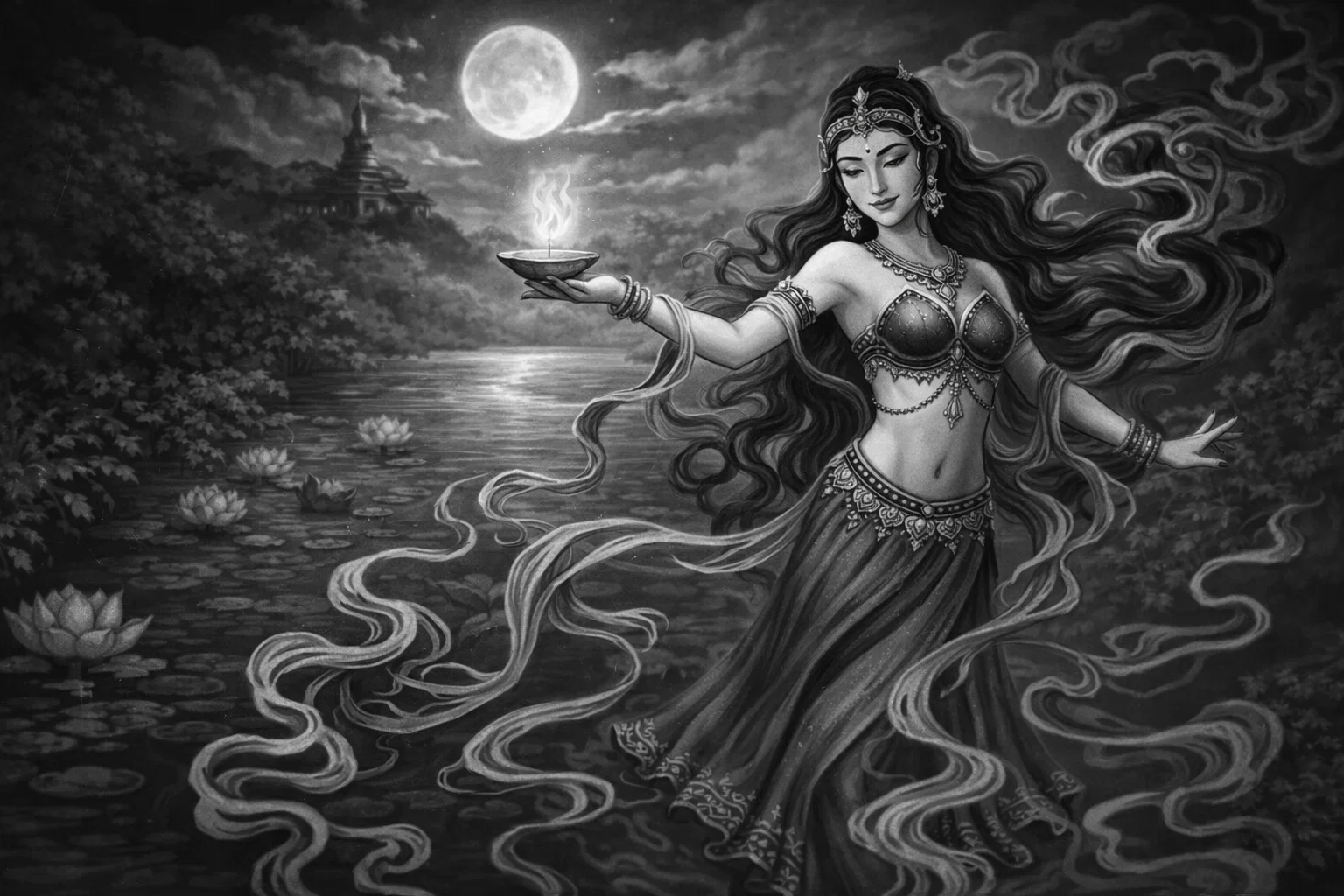
Descriptions of her appearance differ between early texts and later art. In the Sutta Nipāta and Māravijaya stories, she is a beautiful celestial maiden. She is often shown with golden skin, wearing fine silk and heavenly jewels. Her beauty is meant to tempt practitioners back into the cycle of rebirth.
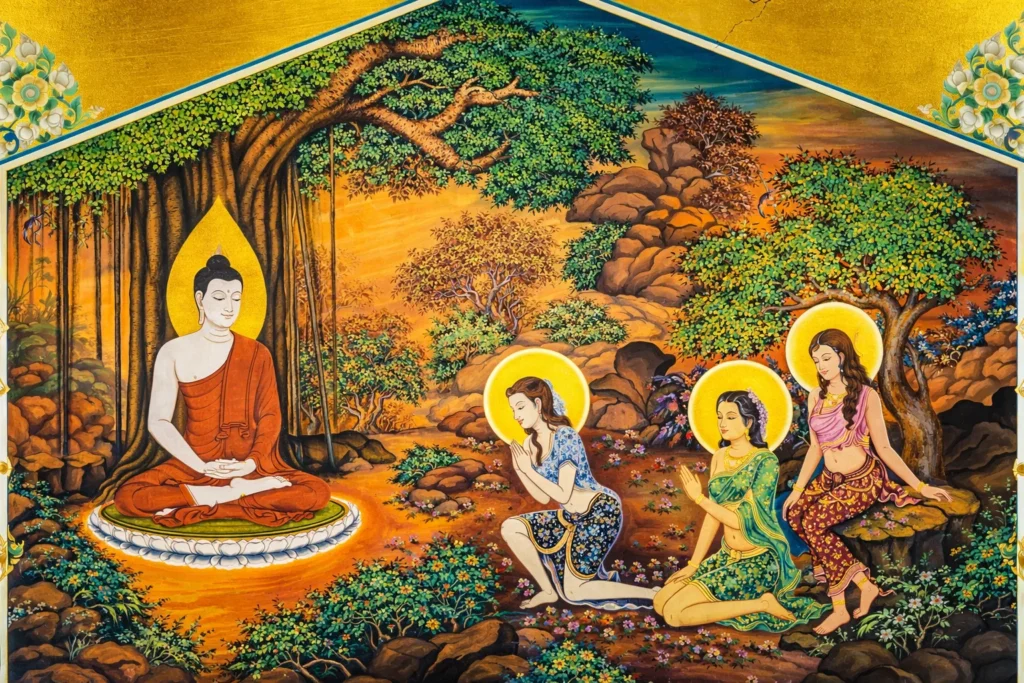
In Southeast Asian temple art, Arāti is often shown as a graceful dancer, sometimes in a pose of pleading or attraction at the feet of the meditating Buddha. After the Buddha defeats her, some traditions say she undergoes a dramatic transformation.
The Lalitavistara Sutra says that when the Buddha stayed unmoved, the daughters’ youthful looks faded at once. She changes from a beautiful maiden to an old woman with grey hair and wrinkles, showing the decay and impermanence of all physical beauty.
Origins
The first records of this entity appear in the Sutta Nipāta, one of the oldest Pali Canon texts. In the Padhana Sutta, she is part of Mara’s “ten armies.”
At first, the daughters had no separate names or roles; they represented the collective power of the Kamadhatu to trap the mind. Later, as stories about the Buddha grew, these forces became the three named daughters.
Her character developed alongside the Māravijaya, or Victory over Mara, story. Before Buddhism, similar beings appeared in Hindu mythology as Apsaras, celestial nymphs sent by Indra to distract ascetics.
In Buddhism, though, she is not just a heavenly messenger but a demon created by her father’s wish to retain control over the realm of desire. This shows how the Hindu idea of the Apsara was changed into a psychological metaphor for the “army of the mind.”
Arāti and the Mythicization of Ennui
In my research, I found that although Mara’s daughters are often seen as a group of “temptresses,” Arāti has a more complex psychological role than just sexual temptation. Her name comes from the Sanskrit root rati (delight/pleasure) with the prefix a-, so it means “non-delight.”
I believe her part in the Māravijaya, or the victory over Mara, is a mythic way to show spiritual boredom or fatigue. While her sister Tanha stands for the “thirst” for experiences, Arāti shows the harmful effects of boredom and of losing interest in the spiritual life. She represents the moment when a practitioner, worn out by discipline, finds meditation not peaceful but painfully empty.
I find it interesting that early Buddhist stories, such as the Padhana Sutta, portray her as a distinct “army” of Mara rather than a passive entity. In these texts, she is tied to the state of arati-kasaya, or “impurity of discontent.” This shows that for monks in the 1st century BCE, the main danger to enlightenment was not external sin but the loss of motivation from within.
She acts as a “psychological mirror,” showing the practitioner their own resistance to the “dryness” of the ascetic path. By turning discontent into a demon, the tradition gave practitioners a clear target to recognize and overcome by building energy (virya) and joy (priti).
Also, changing Arāti from an abstract negative state (akusala Dharma) to a personified celestial maiden shows a shift in how spiritual obstacles were handled. I think the art showing the daughters as dancers who later become hags is a kind of “visual argument.” It’s not just about resisting lust, but about how we perceive things.
When the Buddha sees her, he does not see a maiden but the automatic nature of aversion. This means she was not meant to be a “villain” like in Western stories, but a “necessary evil” in the Buddhist world—a final test for those who must go beyond both pleasure and disgust to reach liberation.
Powers and Abilities
Arāti is considered very powerful among the Devaputra-maras because she can influence even advanced meditators’ minds. She cannot cause physical harm, but her influence on the mind is strong.
- Illusion: She can assume various female forms, ranging from young girls to mature women, to match her target’s specific desires or vulnerabilities.
- Sensory Manipulation: The ability to project celestial music, fragrances, and visual spectacles that cloud the judgment of the practitioner.
- Inducement of Aversion: She can project a sense of profound boredom or dissatisfaction toward virtuous activities, making the spiritual path feel burdensome or meaningless.
- Projection of Despair: A subtle ability to highlight the difficulties of the path, leading the practitioner to feel that liberation is impossible.
Arāti Myths, Legends, and Stories
The Temptation Under the Bodhi Tree
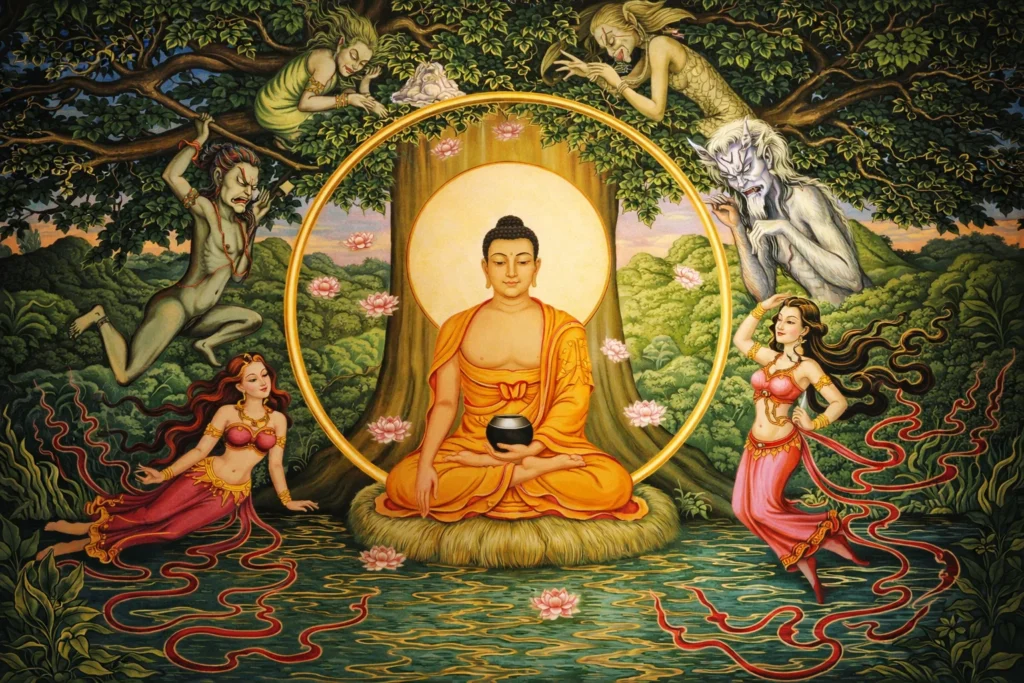
The most significant narrative involving the entity occurs in the hours leading up to Gautama Buddha’s enlightenment at Bodh Gaya. After Mara’s primary army of demons failed to move the Bodhisattva through fear and violence, Mara called upon his three daughters.
Each daughter represented a different seduction strategy. This entity’s role was to use the power of discontent to see if the Bodhisattva felt any regret or weariness regarding his long years of asceticism and his current state of isolation.
According to the Buddhacarita of Ashvagosha, she and her sisters approached the Bodhisattva with various alluring gestures and songs. They displayed thirty-two types of feminine charm. They argued that he was in the prime of his life and that it was a waste to spend it in silent meditation when the joys of the celestial realms and human kingship awaited him.
Arāti tried to evoke a sense of arāti—the lack of pleasure in his solitary goal. The Bodhisattva, however, remained as steady as Mount Meru. He recognized their bodies as mere “vessels of impurity” covered in beautiful skin. He saw through the illusory nature of the discontent they tried to project.
You may also enjoy:
Who Is the Demon Andras, The Great Marquis of Discord?
January 15, 2026
Edimmu: The Mesopotamian Wind Demon That Steals Life
November 6, 2025
What Is the Abumi-guchi Yōkai and Why Does It Wait Forever?
October 22, 2025
Yuki Onna: The Terrifying Bride Who Feeds on Travelers
December 9, 2025
What Is a Pishacha, the Flesh-Eating Demon of the Dead?
February 11, 2026
The Challenge of the Daughters in the Samyutta Nikaya
In the Māra-Samyutta of the Samyutta Nikaya, a narrative is recorded where the daughters approach the Buddha after his enlightenment.
They find him sitting under the Ajapala Banyan tree. They asked him why he sat there in the forest, wondering whether he had lost his wealth or was seeking a relationship. Arāti challenged him by suggesting that a man who has found what he was looking for should be happy and engaged with the world, rather than sitting in silence.
The Buddha replied with a verse stating that he had conquered the “army of the pleasant and the unpleasant” and that he had attained the goal of “deathlessness.”
He told the daughters that there was no “path” by which they could lead him, as he had already stepped outside the tracks of desire. This interaction serves to illustrate that once the nature of discontent is fully understood as a mental construct, the entity and the force it represents no longer have any “footing” or power over the mind.
The Transformation in the Lalitavistara Sutra
In the Mahayana Lalitavistara Sutra, the narrative adds a detail regarding the fate of the daughters. When they continued their attempts to seduce the Buddha despite his warnings, they were struck by the realization of their own filth.
The Buddha did not curse them; rather, his purity acted as a mirror. They suddenly saw themselves not as beautiful maidens but as they would appear in the future—as old, decaying corpses.
This “vision of the foul” caused the entity to lose her power instantly, as her very existence is dependent on the illusion of attractiveness and the avoidance of the unpleasant truth of aging.
Arāti vs Other Similar Entities
| Demon Name | Associated Obstacle | Origin/Source | Key Traits/Powers |
| Mara | Ego and Death | Pali Canon | Lord of Desire Realm |
| Tanha | Craving/Thirst | Sutta Nipata | Seduction through desire |
| Raga | Attachment/Lust | Buddhacarita | Sensual allure |
| Namuchi | Spiritual Death | Rig Veda/Pali | The “Hold-fast” demon |
| Matanga | Low-born temptation | Matanga Sutra | Magical charms |
| Pishacha | Flesh-eating/Madness | Various Sutras | Possession |
| Kumbhanda | Vitality theft | Lotus Sutra | Consuming life force |
| Preta | Insatiable Greed | Petavatthu | Hunger and thirst |
| Yaksha | Nature Obstacles | Atanatiya Sutta | Shape-shifting guardians |
| Asura | Pride and Wrath | Abhidharma | Waging war on Devas |
| Rakshasa | Fear and Chaos | Lankavatara Sutra | Illusion and strength |
| Dakini | Uncontrolled Energy | Tantric Texts | Fierce transformation |
Mystical Correspondences
| Attribute | Details |
| Planet | Saturn (Aversion and Restraint) |
| Zodiac Sign | Capricorn (Structure vs. Discontent) |
| Element | Earth (Heavy/Stagnant) |
| Direction | West (Setting Sun) |
| Color | Grey or Dull Yellow |
| Number | 3 (The Three Daughters) |
| Crystal/Mineral | Lead (Weight and Dullness) |
| Metal | Iron |
| Herb/Plant | Nightshade |
| Animal | Spider (Entrapment) |
| Trait/Role | Spiritual Aversion |
Arāti is mainly linked to feelings of “heaviness” and “stagnation.” While her sisters are tied to the “fire” of lust or the “water” of craving, she is connected to the “earth” at its heaviest, as a weight that has people back. Her effect is like a spiritual gravity, making progress on the path much harder.
In traditional systems, she stands for the “void” that appears when worldly pleasures no longer satisfy, but spiritual joy has not yet come. This in-between state of boredom is her main area. To counter her, one should develop energy (Virya) and joy (Priti), which directly fight the dullness and discontent she brings.
You may also enjoy:
Who Is Aka Manto, Japan’s Terrifying Red-Cloaked Yōkai?
October 24, 2025
Lamia: The Queen Cursed to Devour the Children of Others
January 7, 2026
Who Were the Hinn, the First Spirits of Creation?
November 12, 2025
Chort: The Sinister Slavic Demon of Chaos and Bad Luck
March 10, 2026
What Is a Rakshasa? Meaning, Origins, and Dark Powers
January 23, 2026
What Is a Bhuta? The Backward-Footed Ghosts of Hindu Horror
February 5, 2026
Bibliography
Author’s Note: In putting this research together, I realized that the simple language of the Sutta Nipāta helps balance the more elaborate stories in the Buddhacarita and the Lalitavistara. By focusing on the Visuddhimagga, I could connect these stories with the technical Abhidhamma view of arāti as a mental “impurity.” This let me go beyond the usual temptress image and show her as a complex symbol of spiritual aversion, as supported by the Princeton Dictionary of Buddhism.
- Ṭhānissaro Bhikkhu, translator. The Sutta Nipāta: The Discourse Group. Dhammatalks.org, 2021.
- Feer, Léon, editor. The Saṃyutta-Nikāya of the Sutta-Piṭaka: Part I. Sagātha-Vagga. Published for the Pali Text Society, Henry Frowde / Oxford University Press, 1884. Internet Archive.
- Mitra, Rajendralala, translator. The Lalitavistara; or, Memoirs of the Early Life of S’ākya Siñha. Fasciculus 1–2, Baptist Mission Press, 1881–1882. Bibliotheca Indica. Internet Archive.
- E. H. Johnston, translator. The Buddhacarita; or, Acts of the Buddha. Baptist Mission Press, 1936. Internet Archive.
- Buswell, Robert E., Jr., and Donald S. Lopez, Jr. The Princeton Dictionary of Buddhism. Princeton University Press, 2014. Internet Archive.
- Bhikkhu Ñāṇamoli (translator). Buddhaghosa, Bhadantācariya. The Path of Purification (Visuddhimagga). 4th ed., Buddhist Publication Society, 2010. Internet Archive.
- Buddhaghosa, Bhadantācariya. The Story of Thera Cakkhupala. The Dhammapada: Illustrated Edition, translated and edited by Weragoda Sarada Maha Thero, 1993. WisdomLib.