The story of Iblis is not about a lack of faith, but about too much pride. Unlike the Western idea of Satan as a cosmic rebel, Iblis is a Jinn who fell because he believed fire was better than clay.
Studying Iblis means exploring key Islamic debates about free will, obedience, and the “Great Refusal.” He connects the unpredictable spirits of pre-Islamic folklore with the clear moral teachings of monotheism.
In this article, I used the primary translations of Shams al-Ma’arif and Tafsir al-Tabari to ensure Iblis’s classification is accurate in its cultural context. By comparing modern stories with these old, respected texts, we can distinguish between official theology and broader occult traditions. [View Full Bibliography ↓]
Summary
Key Takeaways
| Attribute | Details |
|---|---|
| Names | Iblis, Al-Shaytan, The Devil, Azazil (in some pre-Islamic texts) |
| Type | Jinn (high-ranking, leader of Shayatin) |
| Title | Leader of the Shayatin, The Accursed |
| Gender | Typically male |
| Servitors | Shayatin (evil jinn under his command) |
| Superior Jinn | None specified |
| Powers | Temptation, deception, whispering evil thoughts, inciting disobedience |
| Appearance | Smokeless fire, horned figure, or invisible; varies by source |
| Etymology | From Arabic ‘Iblīs,’ meaning ‘despair’ or ‘despondent’ |
| Associated Figures | Adam, Hawwa (Eve), Jibril, Shayatin, prophets |
| Weaknesses | Repelled by Quranic recitations, Ayat al-Kursi, sincere faith |
| Opposing Holy Figure | Archangel Jibril, Prophet Muhammad, and other prophets |
| Social Structure | Leader of Shayatin, commands Jinn tribes |
| Followers/Tribe Size | Commands countless Shayatin and evil jinn |
| Element | Fire |
| Planet/Zodiac | Mars, Scorpio |
| Color(s) | Black, red |
| Number(s) | 6 |
| Crystal(s)/Mineral(s) | Onyx, obsidian |
| Primary Sources | Quran, Hadith (Sahih al-Bukhari, Sahih Muslim), Shams al-Ma’arif |
“Iblis” Meaning
The name “Iblis” is deeply ingrained in Islamic theology and has strong symbolic meaning. It comes from the Arabic root “b-l-s,” which means “despair” or “despondency.”
In English, the name is usually pronounced “IB-lees,” with the stress on the first syllable. Some Arabic dialects, especially in the Levant, say “Ib-LEES” instead. The name may be linked to pre-Islamic Arabic, and some researchers think it may be related to the Greek word “diabolos” (meaning “accuser” or “slanderer”). Still, this idea is debated because there is little proof of direct borrowing.
In Islamic tradition, Iblis is often used as another name for Shaytan (Satan). However, there is a difference: Iblis is the specific Jinn who defied God, while Shaytan can refer to any evil spirit or demon.
In older and non-canonical sources, Iblis is sometimes called Azazil, a name linked to stories of a fallen angel in Judeo-Christian traditions. But in Islamic theology, he is clearly seen as a Jinn, not an angel. This is important because, in Islam, angels do not have free will, but Jinn and humans do.
In Persian literature, Iblis is sometimes called Eblis, which is just a different way of pronouncing the name in that region. Sufi writers such as Rumi and Al-Ghazali view Iblis as a symbol of pride and ego, focusing on his refusal to bow to Adam.
What Does Iblis Look Like?
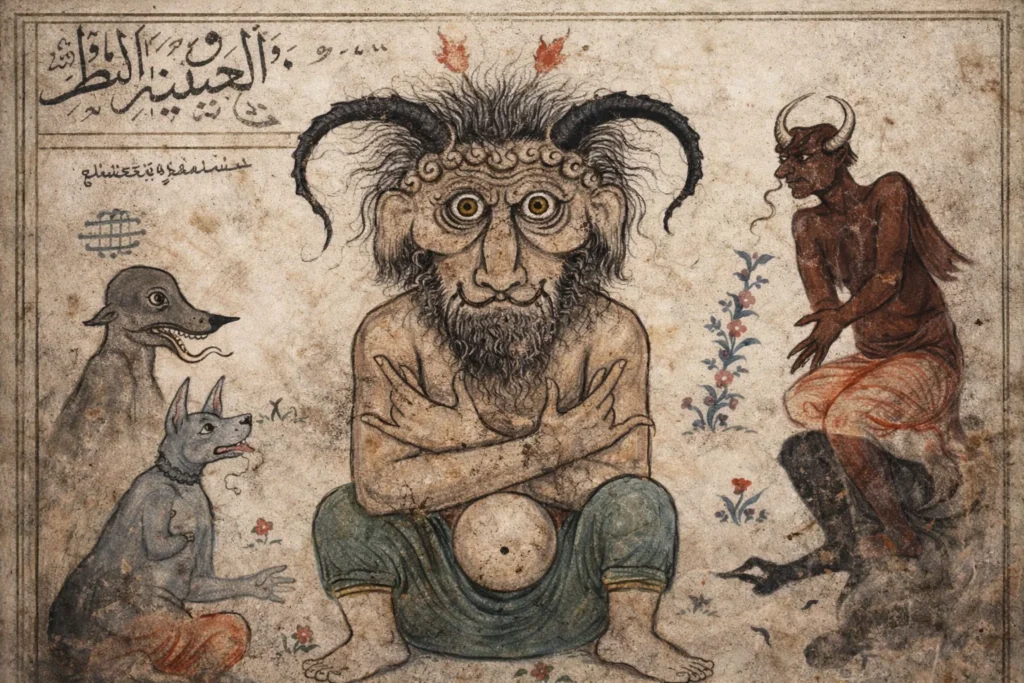
There is no fixed description of Iblis’s appearance. He is a shapeshifter Jinn. The Quran says he was created from “smokeless fire” (Quran 55:15), which suggests he has a fiery, ghostly form.
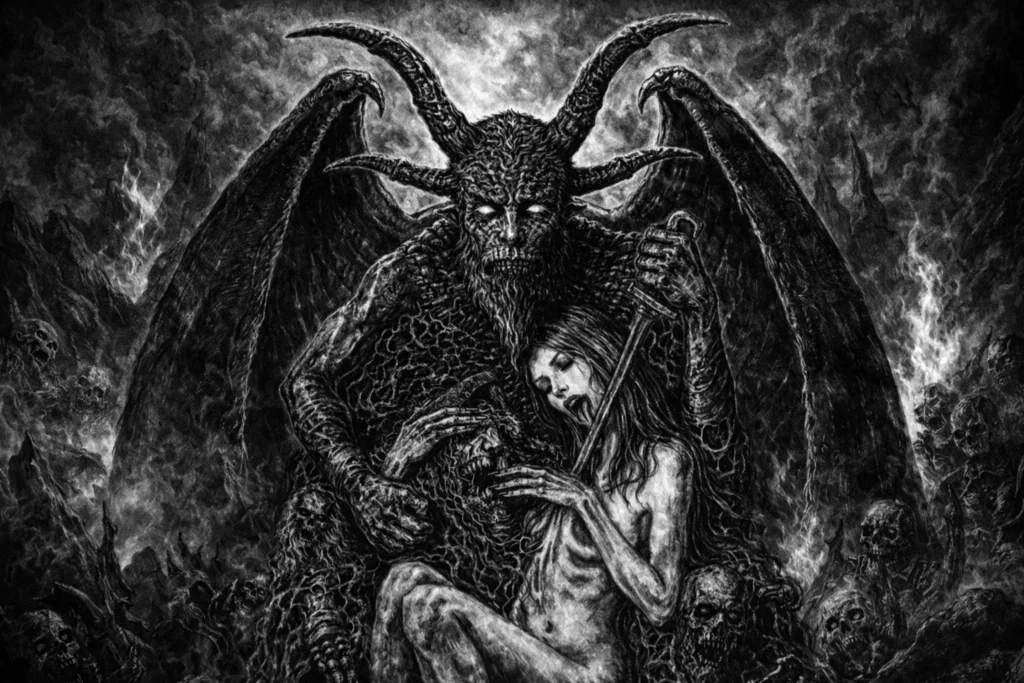
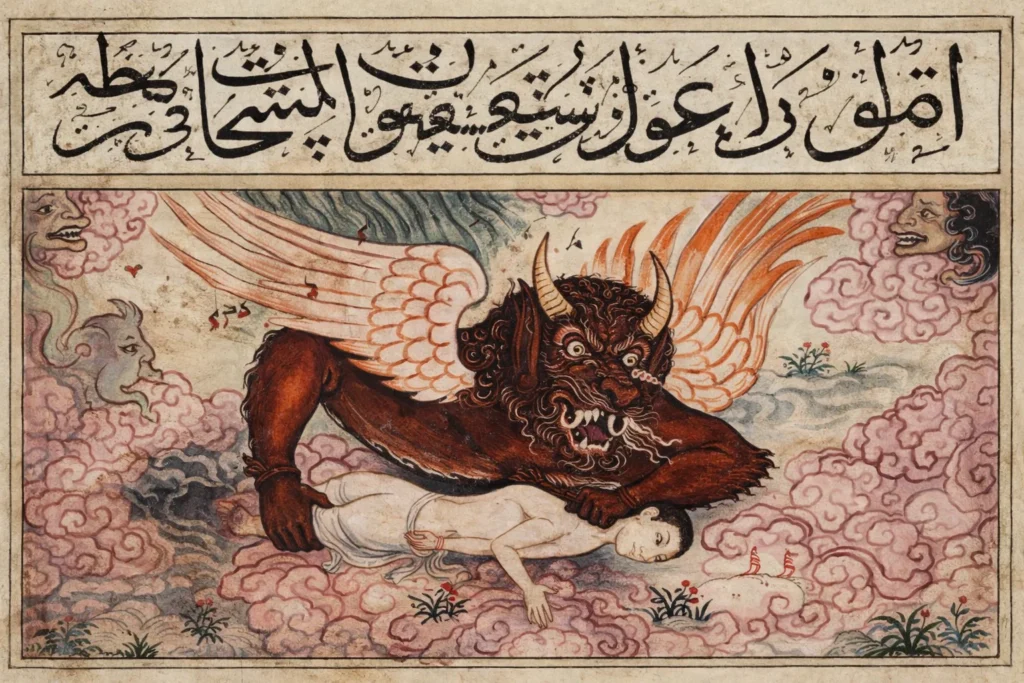
For example, in Hadith and folklore, Iblis might show up as a shadowy entity, a horned creature, or stay invisible to trick people. Some medieval Islamic art shows Iblis with dark, fiery features or as a monster with red eyes, which stands for his rebellious nature. In Shams al-Ma’arif, Iblis is linked to smoky appearances, highlighting how hard he is to pin down.
These images are more symbolic than “accurate”: fire stands for his wild passion and defiance. There are other versions too. Some stories say he appears as a snake or a human-like entity, which helps him fit in and tempt people.
Origins
Iblis’s story goes back to pre-Islamic Arabian folklore, where Jinn were both respected and feared as supernatural beings connected to nature, deserts, and tribal stories. People saw Jinn as unpredictable spirits who could help or harm, often living in lonely places or protecting certain tribes.
When Islam began in the 7th century, these ideas were adapted to fit the belief in one God. Iblis became the main example of rebelling against God. He refused to bow to Adam because he was proud of being made from fire (Quran 7:12). This act led to his eternal curse and his role as the tempter of humans.
Old Arabian poetry, such as that of Imru’ al-Qays and Antara ibn Shaddad, speaks of evil spirits akin to Iblis. These spirits were said to hide in empty places or affect people’s lives. In Islamic teachings, these beings, called shayatin or ghul, became seen as under Iblis’s command.
Persian Zoroastrian beliefs, which focus on a battle between good (Ahura Mazda) and evil (Ahriman), probably influenced how Iblis is seen as a cosmic enemy. Jewish and Christian texts outside the main scriptures, such as the Book of Enoch, also mention rebellious figures, such as Azazel. This may be why Iblis is sometimes called Azazil in certain rituals. These shared stories show how ideas about supernatural beings changed and mixed in the ancient Near East.
In Islamic stories, Iblis’s character grew through Hadith and religious writings. Scholars such as Ibn Kathir and Al-Tabari described him as a clever manipulator who exploits people’s weaknesses. Sufi mystics like Al-Ghazali saw Iblis’s rebellion as a symbol of the human ego’s resistance to submission to God.
Over time, Iblis became a common creature in Islamic poetry, stories, and occult traditions. Books like One Thousand and One Nights include stories about his influence over other Jinn.
You may also enjoy:
Allocer: Great Duke of Hell and the 52nd Spirit of the Ars Goetia
November 17, 2025
Akateko: The Bloody Hand Yōkai That Guards a Cursed Temple Tree
November 14, 2025
What Is a Qareen and Why Does It Follow Every Human Being?
October 8, 2025
Ambri: The Imperial Duchess of Caspiel’s Empire
December 1, 2025
Who Is Agares, the Demon of Earthquakes and Deception?
October 13, 2025
Who Is Adrammelech in Demonology and the Bible?
October 1, 2025
Most Relevant Historical & Scriptural Records
Iblis is a key entity in Islamic demonology. Over time, he shifted from an unnamed, rebellious spirit in pre-Islamic beliefs to a well-defined enemy in monotheistic scripture and later in medieval occult writings.
“And [mention] when We said to the angels, ‘Prostrate to Adam’; so they prostrated, except for Iblis. He was of the jinn and departed from the command of his Lord. Then will you take him and his descendants as allies other than Me while they are enemies to you? Wretched it is for the wrongdoers as an exchange.” [The Holy Qur’an, Surah Al-Kahf 18:50, Sahih International Translation]
This passage marks the clear beginning of Iblis’s story in Islamic tradition. It settles an important question by stating that he is “of the jinn” (min al-jinn). This matters because, unlike the idea of a “Fallen Angel” in other religions, Iblis in the Quran keeps his fiery nature but loses his closeness to God because of his choices. The word fasaqa (“departed” or “transgressed”) shows he strayed morally, not physically, making Iblis similar to humans in having free will.
From a religious point of view, this story introduces the idea of Kibr (arrogance) as Iblis’s main sin. By refusing to bow to a being made of “sounding clay,” Iblis is the first to show prejudice based on what something is made of. This makes him not a ruler of an underworld, but the Waswas (the Whisperer), whose power comes from manipulating human ego and doubt.
“Jabir reported: The Messenger of Allah, peace and blessings be upon him, said: ‘Verily, Iblis places his throne over the water and he sends out his troops. The closest to him in rank are those who cause the greatest fitna (tribulation). One of them comes and says: I have done this and that. Iblis says: You have done nothing. Another one comes and says: I did not leave him until I separated between a man and his wife. Iblis draws him near and says: How good you are!’” [Sahih Muslim, Book 39, Hadith 6754, 9th Century CE]
In this 9th-century version of the story, Iblis changes from a lone rebel to a skilled military leader. The image of his “Throne over the Water” is a dark mirror of the Divine Throne (Arsh), which the Quran also says is over water. This shows a “Counter-Kingdom” where Iblis copies divine order to support his own pride.
The focus here is on Fitna (discord). In the Quran, Iblis tempts individuals, but in the Hadith, he works to break apart society. The fact that he tries to separate a husband and wife shows that, in medieval Islamic thought, Iblis is seen as a psychological threat to the community. By attacking marriages, he is shown as someone who knows that breaking human relationships is the first step to destroying faith.
“Iblis is the Supreme King of the Shayatin, and he has seven deputies among the kings of the jinn, each of whom rules over a day of the week… Know that Iblis, the Accursed, does not manifest except to those whose hearts are darkened by the love of this world, and his sigil is drawn when the Moon is in detriment.” [Shams al-Ma’arif al-Kubra (The Great Sun of Gnoses), Attributed to Ahmad al-Būnī, 13th Century CE]
By the 13th century, Iblis was no longer just a warning in sermons. In Shams al-Ma’arif, he became part of a detailed system of astrology and talismans.
This text sets out rules for Iblis’s influence, connecting him to certain times and positions of the stars. This is very different from scripture, as it suggests that Iblis can be controlled or managed using the science of letters (Ilm al-Huruf) and the timing of planets.
This period shows a mix of Islamic theology with Hermetic and Neoplatonic ideas. Iblis is seen as a key entity of darkness. The idea of his “seven deputies” tries to organize the wild nature of pre-Islamic Jinn into a strict medieval system. He is described as the source of all evil magic.
“If you do not know Iblis, you do not know the true Lover. For he was the first to sacrifice his reputation for the sake of his Beloved. He was told to bow to another, and he refused out of pure devotion to the One. He chose the curse of God over the sight of anyone other than God.” [Commentary on the Sawaneh, inspired by Ahmad Ghazali/Ayn al-Quzat Hamadani, 12th-14th Century CE]
This source shows a very different view found in some Persian Sufi groups. Here, Iblis is seen through the idea of Ishq (deep love). His refusal to bow to Adam is not seen as pride, but as a form of “tragic monotheism.” For these mystics, Iblis is a martyr for Divine Unity, choosing eternal punishment rather than worshipping anyone other than God.
This view shows Iblis as the ultimate lonely figure, deeply loyal but misunderstood. It goes against the usual religious story by suggesting that Iblis’s refusal was actually a sincere act of faith.
This way of thinking shows how complex Iblis is in Islamic thought. He is both the “Accursed” and the “Great Refuser,” and mystics use his story to explore the limits of total devotion.
Iblis as the “Shadow Monotheist”
The story of Iblis shows a tension between Islamic ideas about fate and the psychology of total devotion. In some Sufi teachings, especially those of Mansur al-Hallaj and Ahmad Ghazali, Iblis is not just a villain but is seen as the ultimate, though tragic, believer in one God.
This view suggests that Iblis refused to bow to Adam not out of random evil, but because he misunderstood how to defend Tawhid (the oneness of God). In this way of thinking, Iblis faces the “Paradox of the Command”: he chose to follow what he believed was God’s eternal rule (worship only God) rather than God’s specific order to honor Adam.
Seeing Iblis as a “Muwwahid” (someone who proclaims God’s Oneness) moves his story beyond simple demonology into deeper questions about knowledge and belief. By failing to recognize the divine spark in humans, Iblis exemplifies “Literalist Blindness.” He understands the rules of holiness but misses its deeper meaning.
The angels saw the “Light of Muhammad” or the divine spirit in Adam, but Iblis only focused on what Adam was made of. This is a warning: the demon symbolizes the risk of rigid beliefs that forget human kindness in pursuit of perfect purity.
In language and stories, Iblis is seen as a unique guardian at the boundary. Unlike Ahriman in Zoroastrianism, who is an equal force to good, Iblis depends completely on God’s will. His job as Shaytan is given by God to test people’s sincerity in their choices. He acts as a filter, making sure that doing good is a real choice, not just the only option.
Looking at the “Throne upon the Water” in the Hadith (Sahih Muslim), we see that Iblis copies the Divine Throne in a reversed way. This means his main tool is not chaos but the creation of an alternative order focused on the ego. He does not want to destroy the world, but to offer a tempting, self-centered version of it.
Powers and Abilities
Iblis wields significant powers as the leader of the Shayatin, focused on corrupting humanity:
- Temptation: Iblis whispers evil thoughts (waswas), inciting sins like pride and greed (Quran 7:16-17). His influence is subtle, exploiting human weaknesses.
- Deception: He disguises himself to mislead, appearing in various forms to confuse (Hadith, Sahih Muslim 4.675).
- Command over Shayatin: He directs evil Jinn to spread mischief, though his authority is limited by divine will (Quran 15:42).
- Inducing Disobedience: He encourages defiance against God, as seen in his own rebellion (Quran 38:74-75).
However, Iblis’s powers have limits. Sincere faith and reading the Quran are said to protect against him. He cannot force anyone to act; instead, he works by suggestion, so his power is psychological rather than physical.
Influence on Humans and Possession
Iblis exerts a profound influence on humanity through his role as the leader of the Shayatin and his association with the Qarin, a Jinn companion assigned to each person, as described in Hadith (Sahih Muslim 2814).
The Qarin is his agent, whispering temptations that nudge individuals toward sinful behaviors (such as pride, envy, or anger). These whispers are subtle, often manifesting as intrusive thoughts or impulses that align with Iblis’s goal of leading humans astray from the path of righteousness.
Islamic texts say Iblis’s influence is widespread. He can affect people’s feelings, choices, and even dreams, planting doubts or fears to weaken their faith.
When it comes to Sihr (sorcery), Iblis’s influence is thought to get stronger and can even seem like possession. Signs of his presence include ongoing sinful urges, unexplained anxiety, sudden anger, or troubled relationships, as described in Islamic exorcism traditions.
For example, Hadith stories say Iblis can cause fights between spouses or communities, turning small problems into big ones. Unlike in other beliefs, Iblis mainly works on the mind, using human free will rather than taking over the body.
Ibn Taymiyyah (medieval scholar) described extreme cases in which individuals under Iblis’s sway exhibit physical symptoms, like fatigue or illness, attributed to spiritual affliction.
Protection and Exorcism Methods
Islamic tradition offers many ways to protect against Iblis. The main defense is reciting Ayat al-Kursi (Quran 2:255), which is believed to create a spiritual shield against evil Jinn, such as Iblis and his followers. The Prophet Muhammad also stressed the importance of daily prayers, especially the five required ones, as protection from Iblis’s temptations.
Specific supplications (such as those in Surah Al-Falaq and Surah An-Nas) are recommended for protection against Sihr and waswas. Hadith (Sahih al-Bukhari 4.54.496) advises seeking refuge in God from Iblis by saying, “A’udhu billahi min ash-Shaytan ir-rajim” (I seek refuge in Allah from the accursed Satan) before reciting the Quran or entering vulnerable states like sleep.
According to Shams al-Ma’arif, exorcism practices can involve structured rituals led by knowledgeable scholars or healers. These include reciting specific Quranic verses, believed to expel evil Jinn from afflicted individuals, or drinking water over which Quranic verses have been recited.
The Prophet advised people to stay away from abandoned ruins or lonely places, as Iblis might have more power there. Some old texts suggest using protective charms with God’s names on them, but these practices are debated because they are linked to black magic, or Sihr.
Iblis Myths, Legends, and Stories
The Fall From Grace
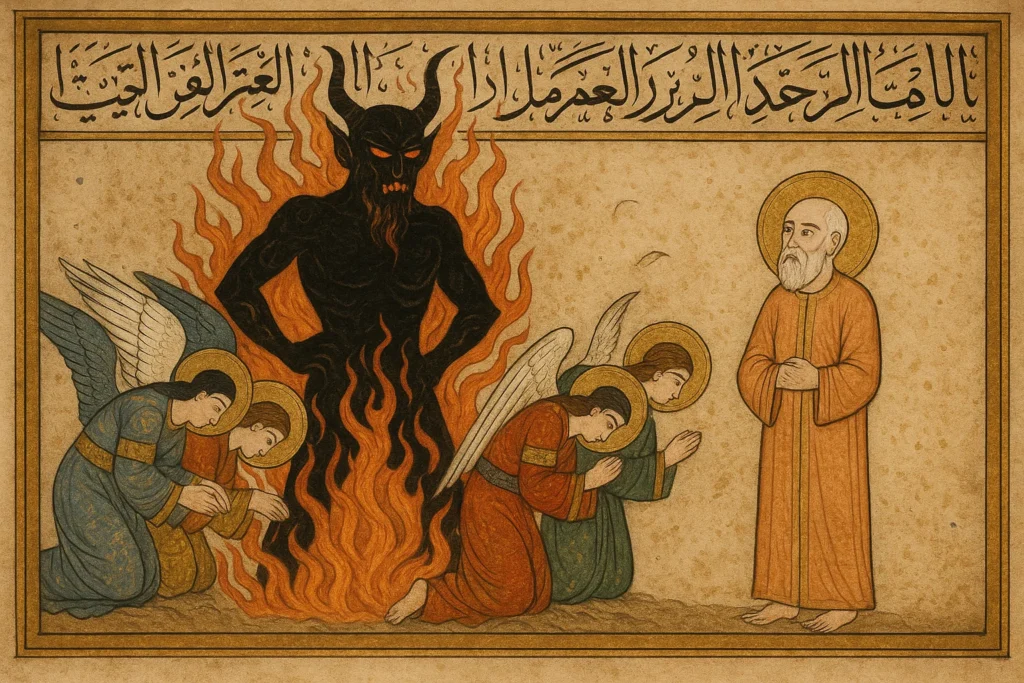
Before the world was as it is now, Iblis stood among the ranks of the most devout. Though a Jinn made of scorching, smokeless fire, his constant worship had elevated him to the company of angels.
When God gathered the heavenly host and announced, “I am going to place a vicegerent on earth,” the angels questioned the creation of a being who would shed blood. Yet, God shaped Adam from the sounding clay of the earth and breathed into him the Ruh—the divine spirit.
The command echoed through the heavens: “Prostrate before Adam!”
Every angel fell to their knees in a sea of light and submission. Only Iblis remained standing, his silhouette bizarre against the bowed forms of the celestial host.
When the Divine Voice demanded to know what prevented him from obeying, Iblis did not plead ignorance; he offered a logical defiance born of pure ego. “I am better than him,” he declared, his voice ringing with the first instance of pride the universe had ever known. “You created me from fire, and him You created from mere clay.”
For this arrogance—the belief that his origin dictated his worth—God cast him out, labeling him Rajim (Accursed). Banishment was instantaneous, but Iblis, fueled by a new, singular spite, made one final request: “Reprieve me until the Day they are raised.”
Granted this respite, Iblis did not seek repentance. Instead, he vowed to turn his exile into a war of attrition. “Because You have sent me astray,” he hissed, “I will surely sit in wait for them on Your straight path. I will come at them from before them and from behind them, from their right and from their left, and You will not find most of them grateful.”
The Temptation of Adam and Hawwa
Adam and Hawwa dwelt in the lushness of Paradise, a world where hunger and thirst were unknown. They were free to enjoy every fruit and shade, save for one: a single, restricted tree. Iblis, now the Great Deceiver, did not approach them with claws or fire; he approached them as a friend bearing “sincere” advice.
He found them near the forbidden branches and began to paint a picture of doubt. “Do you know why your Lord forbade you this tree?” he whispered, his voice smooth as silk. “It was only to prevent you from becoming angels, or from living forever as immortals.” He swore a mighty oath by the name of God that he was their true counselor.
Under the weight of his persistence, the “Waswas” (whispering) took hold. Curiosity turned to desire, and the pair tasted the fruit. In an instant, the veil of their innocence was stripped away. The celestial garments they wore vanished, leaving them exposed and ashamed, scrambling to cover themselves with the broad leaves of the Garden.
When the Divine Call reached them, asking if they had forgotten the warning, they realized the depth of the deception. While Adam and Hawwa turned to repentance, Iblis retreated into the shadows of the world, satisfied that he had proven how easily the “creature of clay” could be broken.
The Bastion of Discord
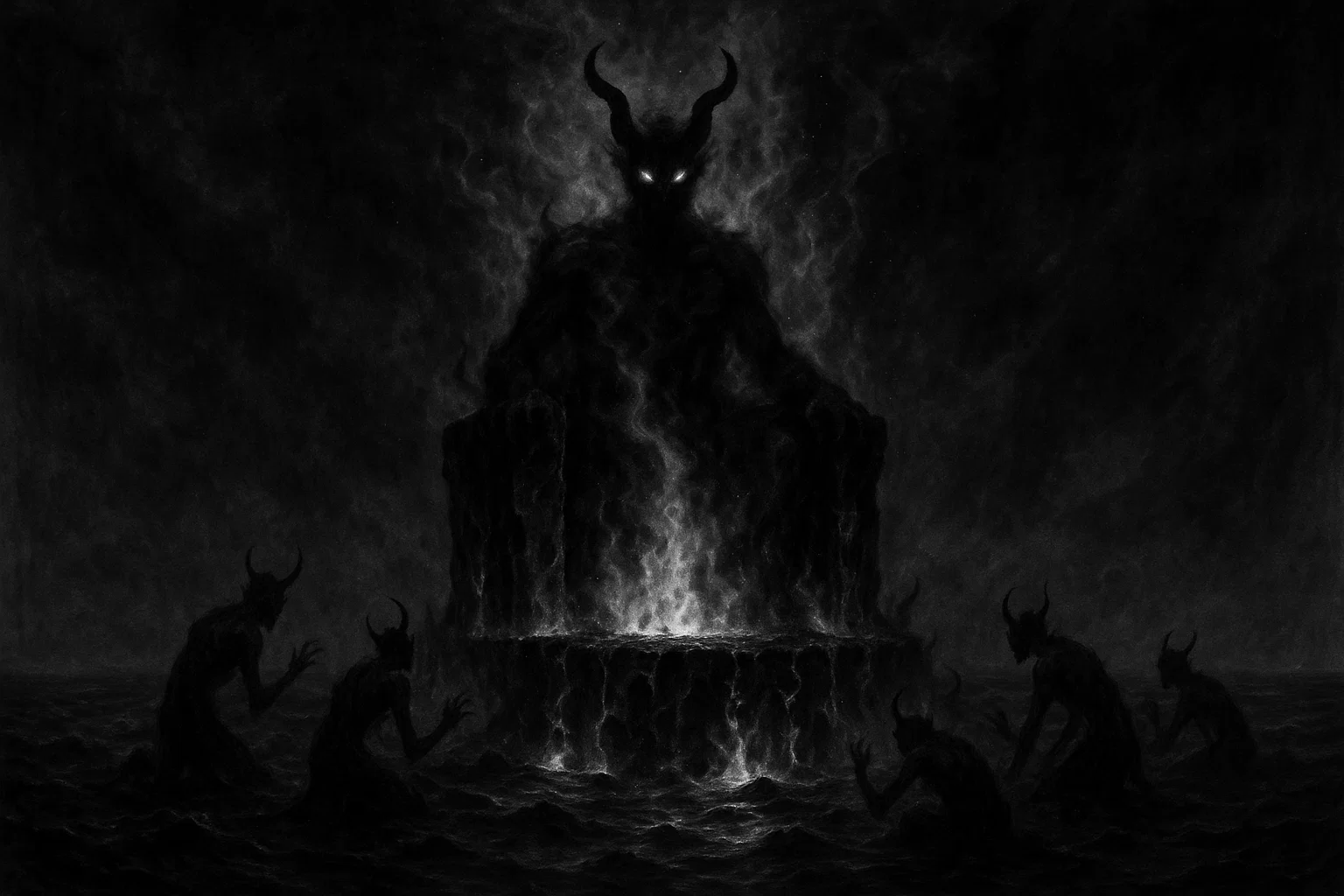
Deep within the wilderness of the world, where the vast oceans meet the horizon, Iblis established his own dark imitation of the Divine Kingdom. He placed his throne on the water, surrounded by a mist of sulfur and salt, creating a central command for his legions.
Every evening, as the sun dips below the edge of the earth, the Shayatin—the rebellious Jinn—return to the throne to report their progress. One after another, they boast of their petty victories: “I made a man steal,” or “I incited a youth to drink.” To these, Iblis remains indifferent, waving them away as mere amateurs.
Finally, a shadow approaches and whispers, “I did not leave a man until I sowed such discord between him and his wife that they tore their household asunder.” At this, Iblis rises from his watery throne. He draws the deceiver close, embracing him with a chilling pride.
“Yes,” he proclaims, “you are the one. You have truly done well.” To Iblis, the destruction of the family is the ultimate victory, for it shatters the foundation of peace and leaves the next generation vulnerable to his whims.
The Binding of the Legions
There was a time when the power of Iblis’s children met a wall of divine iron. The Prophet Sulayman (Solomon) was granted a kingship like no other, possessing a ring that gave him command over the winds, the animals, and the Jinn themselves.
Iblis watched from the darkness as his fiercest warriors—the Ifrit and the Marid—were forced into hard labor, diving into the deep seas for pearls and building magnificent palaces of glass and marble for a mortal king.
Whenever a rebellious spirit under Iblis’s influence attempted to spread mischief or eavesdrop on the heavenly councils, Sulayman’s authority was absolute. Those who remained defiant were hunted down. The folklore tells of Sulayman capturing the most cunning of Iblis’s lieutenants, binding them in copper vessels and sealing the lids with his signet ring, cast in the name of the Most High.
These vessels were hurled into the depths of the Red Sea or buried under the foundations of mountains. For a generation, the whispers of Iblis were muffled by the clink of Solomon’s chains, proving that no matter how vast the King of Deception’s reach, it is. Still, a tethered shadow compared to the light of a Prophet’s mandate.
The Stones of Ibrahim
When the Prophet Ibrahim (Abraham) set out to fulfill the ultimate test of his faith—the sacrifice of his beloved son—Iblis saw a final opportunity to fracture the lineage of the righteous. He did not appear as a monster, but as an old man, a creature of wisdom and sympathy.
He approached Ibrahim at the valley of Mina and sighed, “O Ibrahim, do you not see that this is a trick of the mind? Would a merciful God truly ask for the blood of your son? Think of the boy’s mother; think of the waste of a young life.”
Ibrahim recognized the rot beneath the sweet words. He did not argue; he took up seven pebbles and hurled them at the apparition, shouting “Allahu Akbar!” (God is Greater). Iblis vanished, only to reappear a moment later, more desperate.
“Think of the people, Ibrahim! They will call you a murderer, not a saint!” Again, Ibrahim pelted him with stones, driving him back. A third time, Iblis appeared, pleading for the life of the boy to sow a seed of doubt. A third time the stones flew, and Iblis fled into the desert, howling in frustration.
This “Stoning of the Devil” remains a ritual to this day, a physical echo of Ibrahim’s refusal to let the Master of Deception rewrite the terms of his devotion.
You may also enjoy:
Who Was Hiranyaksha, the Golden-Eyed Asura?
October 7, 2025
Arāti: The Beautiful Demon of Aversion in Buddhist Mythology
October 15, 2025
Ammit: Devourer of the Dead in Ancient Egyptian Mythology
November 10, 2025
Chort: The Sinister Slavic Demon of Chaos and Bad Luck
March 10, 2026
Vritra: The Dragon Who Swallowed the Sky in Hindu Mythology
October 7, 2025
Amaymon: The Infernal King Who Commands Death and Decay
November 17, 2025
Iblis vs Other Jinn
| Jinn Name | Associated Traits/Influence | Rank/Origin | Key Traits/Powers |
|---|---|---|---|
| Ifrit | Mischief, strength | High-ranking, Arabian folklore | Fire-based, shape-shifting, brute force |
| Marid | Arrogance, wish-granting | King of jinn, Quran | Water-based, grants boons with trickery |
| Ghul | Deception, predation | Lesser jinn, folklore | Grave-haunting, shape-shifting |
| Qarin | Personal temptation | Follower of Iblis, Hadith | Whispers to individuals |
| Jann | Neutral, seclusion | Low-ranking, Quran | Desert-dwelling, avoids humans |
| Nasnas | Chaos, confusion | Lesser jinn, folklore | Half-human form, disorients travelers |
| Shaitan | General evil | Follower of Iblis, Quran | Tempts, misleads |
| Hinn | Weakness, subservience | Low-ranking, folklore | Animal-like, minor influence |
| Palis | Lust, seduction | Lesser jinn, folklore | Drains vitality, seduces |
| Si’lat | Deception, trickery | Lesser jinn, folklore | Imitates humans, misleads |
| Vetala | Possession, necromancy | Indian-influenced jinn | Inhabits corpses, manipulates |
| Djinn | Varied, neutral to evil | General jinn, Quran | Shape-shifting, varied powers |
| Khadim | Service, obedience | Servant jinn, folklore | Serves summoners, limited autonomy |
| Sila | Illusion, seduction | Lesser jinn, folklore | Female form, deceives travelers |
Position Among Jinn
Iblis has the highest rank among evil Jinn, serving as the supreme leader of the Shayatin, as established in the Quran (7:11-18) and Hadith. His authority is unmatched, with no superior Jinn above him, as his rebellion directly challenges divine order.
Shams al-Ma’arif describes him as commanding vast tribes of Shayatin, numbering in the thousands, who operate as his agents to spread mischief globally.
Unlike other high-ranking Jinn (such as Ifrit or Marid kings), who rule specific tribes or domains, Iblis’s influence is universal, deriving from divine permission to tempt humanity until the Day of Judgment (Quran 15:36-42).
His followers include diverse lesser Jinn types, from deceptive Si’lat to predatory Ghul, all unified under his command to sow discord.
Iblis’s role is distinct from that of neutral or faithful Jinn—such as those mentioned in Quran 72:1-15, who submit to God. His rivalry with these obedient tribes highlights his isolation, as he leads only those who share his rebellious nature.
Theological works by Al-Tabari and Ibn Kathir suggest Iblis organizes his Shayatin into disciplined ranks, each assigned specific tasks, such as tempting individuals or disrupting communities. His conflicts with figures like Sulayman, who subdued rebellious Jinn, highlight his vulnerability to divine authority.
In terms of alliances, Islamic texts limit them to evil Jinn, with no mention of cooperation with other supernatural entities.
Associations
His primary element, fire, reflects his creative nature and fiery temperament. At the same time, his connection to Mars and Scorpio suggests a propensity for aggression and secrecy. Colors like black and red evoke darkness and danger, and the number 6 symbolizes imperfection in Islamic numerology. Crystals such as onyx and obsidian align with his shadowy, deceptive essence.
Zodiac and Astrological Links
The Jinn is strongly associated with Mars, the planet of war, conflict, and aggression, and Scorpio, a zodiac sign tied to intensity, secrecy, and betrayal, according to Shams al-Ma’arif.
Mars amplifies Iblis’s ability to incite discord and rebellion, as its influence is believed to heighten aggressive impulses and defiance. In medieval Islamic astrology, Mars governs ambition and destruction, traits mirrored in Iblis’s prideful refusal to bow to Adam.
Scorpio’s connection to transformation and hidden motives aligns with Iblis’s metamorphosis and deceptive nature, making periods under Scorpio’s influence particularly potent for his temptations.
Some occult texts suggest that Iblis’s power peaks during Mars’s retrograde or when Scorpio is dominant in the night sky. However, Islamic theology warns against engaging in such astrological practices due to their association with Sihr.
Elementals
Iblis’s primary element is fire, as stated in the Quran (55:15), symbolizing his creation from smokeless fire and his passionate, destructive nature. Fire manifests in his appearances, whether as a blazing monster, a smoky entity, or a horned being with fiery eyes, as described in folklore. This element reflects his ability to inflame human desires, such as pride, anger, and envy, driving them toward sin.
Unlike water-based Jinn (Marid), who manipulate emotions, or earth-based Jann, who embody stability, fire highlights Iblis’s chaotic and untamed essence. In Islamic folklore, his fiery nature is associated with desolate, heat-scorched places, such as deserts, where he whispers to travelers or lures them into danger. Fire also contrasts with the divine light of angels, emphasizing Iblis’s opposition to holiness and his role as a force of spiritual destruction.
Colors, Numbers, and Crystals
Iblis is associated with black and red, colors symbolizing darkness, evil, and bloodshed. Black reflects his hidden, shadowy influence, concealing his true intentions as he manipulates humans. Red evokes his fiery origins, the passion of his rebellion, and the danger he poses.
The number 6 is associated with Iblis in Islamic numerology, representing imperfection and chaos, in contrast to 7, which signifies divine completeness.
Crystals such as onyx and obsidian are associated with Iblis in occult texts, including Shams al-Ma’arif. Onyx, with its dark, glossy surface, is believed to enhance deception and spiritual protection, aligning with Iblis’s mysterious nature. Obsidian, a volcanic glass formed from cooled lava, resonates with his fiery creation and is used in talismans to counter his influence.
Other Correspondences
Iblis is sometimes associated with iron, a metal symbolizing strength, unyielding will, and resilience, which is often used in rituals to bind or repel Jinn.
Nightshade, a poisonous plant, reflects his toxic influence, associated with deception and spiritual harm. Animals like serpents and scorpions are tied to the Jinn, representing cunning and danger, respectively. The snake’s form is prominent in the temptation of Adam and Hawwa, while scorpions evoke its stinging, betraying nature.
Iblis’s primary sin is pride, the root of his rebellion. However, he is also linked to envy, wrath, and deceit, which drive humans to sin. Some texts describe a foul, sulfurous odor accompanying his presence, enhancing his fearsome reputation.
In occult traditions, Iblis is associated with desolate landscapes, such as barren deserts or ruined structures, reinforcing his connection to chaos and isolation.
You may also enjoy:
Who Is Arioch, the Demon of War and Vengeance?
January 21, 2026
Chort: The Sinister Slavic Demon of Chaos and Bad Luck
March 10, 2026
What Is a Qareen and Why Does It Follow Every Human Being?
October 8, 2025
Agubanba: The Blind Yōkai That Preys on Young Women
October 23, 2025
Who Is Agares, the Demon of Earthquakes and Deception?
October 13, 2025
Who Were the Hinn, the First Spirits of Creation?
November 12, 2025
Bibliography
Author’s Note: While putting together this research, I noticed a strong contrast between the strict rules in Sahih Al-Bukhari and the more sympathetic “Monotheist” view of Iblis in Ghorban Elmi’s analysis of Ahmad Ghazali. It was interesting to see how the idea of “smokeless fire” in the Quran later became a strict rule in Ahmad al-Būnī’s medieval writings, changing Iblis from a moral failure to a cosmic creature. Balancing these different views—from the literal whispers of old texts to the clever stories in One Thousand and One Nights—meant being careful not to oversimplify the complex nature of the Jinn King.
- Ali, Abdullah Yusuf, translator. The Holy Qur’an: English Translation and Commentary. 1934. Internet Archive.
- Al-Bukhari, Muhammad. The Translation of the Meanings of Sahih Al-Bukhari. Translated by Muhammad Muhsin Khan, rev. ed., vol. 1-7, Ahmadiyya Anjuman Isha’at Islam, 2004. Ahmadiyya.org.
- Alfianto, M. Ahmad Al-Buni and His Esoteric Model. Academia.edu.
- Gardiner, Noah. Esotericism in a Manuscript Culture: Ahmad al-Būnī and His Readers through the Mamluk Period. University of Michigan, 2014. Internet Archive.
- Al-Shaykh, Hanan. One Thousand and One Nights: A Retelling. Pantheon Books, 2013. Internet Archive.
- Elmi, Ghorban. Ahmad Ghazali’s Satan. HTS Teologiese Studies, 2019. Academia.edu.
- Youvan, Douglas C. Demons of the Talmud: Tracing the Origins and Functions of Rabbinic Demonology. ResearchGate, Aug. 2025.