
The Si’la is an important entity in Arabian folklore, standing between the elemental Jinn and the predatory ghoul. Most Jinn are defined by their physical makeup, like the Ifrit’s smokeless fire. Still, she is known for her unstable nature and her rare ability to mimic humans almost perfectly. This talent blurs the line between the supernatural and the human.
She has a special place in the world of demons because she uses social skills and mimicry, rather than raw power, to achieve her goals.
In this article, I used the primary translations of Kitāb al-Hayawan and The Meadows of Gold to make sure the description of this entity fits its cultural background. [View Full Bibliography ↓]
Summary
Key Takeaways
| Attribute | Details |
| Names | Si’la, as-Si’lat (singular), Sa’ali (plural) |
| Type | A specialized, female-only class of Jinn often grouped with or considered a subspecies of Ghul |
| Title | The Deceiver, The Shape-shifter of the Wilderness |
| Gender | Exclusively Female |
| Superior Jinn | Independent; occasionally associated with the court of Iblis in later theological texts |
| Powers | Extreme shape-shifting, mimicking human speech, inducing fatal disorientation, and biological mimicry to sire hybrid offspring |
| Appearance | Often appears as a beautiful woman to lure travelers, but her true form is described as having lanky limbs, hair like palm fibers, and feline or canine facial features |
| Etymology | Derived from the Arabic root s-‘-l, associated with “snatching,” “seizing,” or “shaking” |
| Associated Figures | The Ghul, the ‘Inas, and in some traditions, the offspring of Adam (as a rival lineage) |
| Weaknesses | Iron, the recitation of the Mu’awwidhatayn (Suras Al-Falaq and An-Nas), and physical combat with wolves |
| Opposing Holy Figure | Prophet Muhammad (through the revelation of protective prayers), Archangel Jibril |
| Social Structure or Tribe | Solitary; she does not belong to the organized Jinn kingdoms of the Marid or Ifrit |
| Primary Sources | The Thousand and One Nights, Kitab al-Hayawan (Al-Jahiz), The Meadows of Gold (Al-Mas’udi), and various pre-Islamic Bedouin oral traditions |
Who or What is Si’la?
The Si’la is a unique type of female Jinn, known for her sharp intelligence and predatory instincts. While most Jinn stay away from people and live in ruins or empty places, this creature looks for humans, either to prey on them or to have children.
In Middle Eastern demon stories, she is seen as the most dangerous of the ghoul-like beings. This is because she does not have the obvious monster traits of other ghouls, so she can blend in with people without being noticed.
Historically, she is seen as a spirit that lives on the edge between the known world and the wild. She stands for the dangers of the desert and how easily people can be fooled.
“Si’la” Meaning
The name Si’la (plural Sa’ali) comes from the Arabic root s-‘-l. Today, similar sounds in Arabic often mean “asking” or “begging,” but in older times, the word in demon stories meant to grab or snatch by force. This matches her main behavior: suddenly and violently taking her victims.
Over time, the meaning of the word changed. In old Bedouin poetry, the name was used as a metaphor for a thin, quick, and dangerous woman or for risky land. Later, as Islamic beliefs about spirits became more organized, the word came to mean a female Jinn with the greatest power to change her shape.
Unlike the Ghul, who is usually shown as a scavenger of the dead, the Si’la’s name points to her being a living hunter. Some language experts think there might be a link to the Hebrew Lilith, since both are female predators at night who target men. Still, she is a well-known entity in Arabian stories.
How to Pronounce “Si’la” in English
The name is pronounced SEE-lah. The first part uses a long “e” sound, then a slight pause for the apostrophe, and ends with a short “a.” In English, it is often spelled Sila or Si’lat.
What Does Si’la Look Like?
Her appearance is meant to trick people. She usually looks like a very beautiful woman, wearing local clothes to fit in with a village or to seem like a lost traveler in the desert. Her disguise is so good that even close contact or conversation won’t reveal her true nature.
But older sources, such as Al-Jahiz in his Kitāb al-Hayawan (Book of Animals), say that her true or half-changed form is ugly and very different from a human. In this form, she has long, thin limbs and skin that looks like tree bark or rough leather.
Stories often mention her hair, which is described to rough, tangled, and dry, like palm tree fibers. Her eyes are usually described as having vertical slits, like a cat’s, and she might have small claws even when she looks human. Some tales say she can’t completely hide her feet, which may look like those of a donkey or goat—a common detail in Jinn legends.
Origins
Her story goes back to before Islam, ingrained in the old beliefs of the Arabian Peninsula. For Bedouin tribes, the desert was seen as alive and often dangerous, filled with beings called Sa’ali. These spirits were thought to be the first to live in the empty deserts, always hungry and hostile to humans who crossed their land.
When Islam arrived, the Si’la became part of the larger Jinn stories. According to religious scholars, this mysterious entity originated from Smokeless Fire (marjin min nar), as do other Jinn. Still, they were seen as a cursed group that refused to follow the rules of the Jinn world.
Another story says the Si’la came from a fallen angel and a spirit of the earth. This is used to explain why they are so smart and why they focus so much on humans.
Unlike the Ifrit, who are usually linked to old ruins or the underworld, her story is closely connected to human travel routes. She follows people as they move, always looking for new victims.
You may also enjoy:
Jikininki: The Japanese Ghost That Feeds on Human Corpses
February 9, 2026
What Is a Bhuta? The Backward-Footed Ghosts of Hindu Horror
February 5, 2026
Aži Dahāka: The Three-Headed Dragon of Zoroastrian Mythology
January 14, 2026
Who Was Ravana in Hindu Mythology and Why Was He Feared?
October 3, 2025
The “Cold-Blooded” Lineage
Her primary importance is not just her hunting, but her role as the first to mix with humans in myths. Most Jinn are kept apart from people, but the Si’la is seen as breaking that barrier.
Stories like Al-Mas’ūdī’s The Meadows of Gold often tell of the Si’la marrying into human tribes, such as the Banu Amr. These tales comment on ideas of family purity and outsiders. She is shown as an infiltrator, not destroying a group from outside, but changing it from within.
What’s more, her children (called Al-Khuluk, or the “Cold-Blooded Ones”) are interesting for how they connect to early ideas about appearance in Arabia. These hybrids were said to be very smart, emotionally distant, and physically thin, matching the meaning of their mother’s name.
Looking at the Si’la from a social history perspective, her stories appear during periods of significant tribal growth. The myth of the Si’la as a wife may have helped explain unusual traits among rival groups, turning her from a demon into a way to discuss social differences.
She is also similar to figures like the Greek Lamia or the Melusine from European stories. Still, she is tied to the dry desert. While the Melusine changes with water, her transformation is linked to the fire of her own kind.
This creates a special idea: the Si’la is seen as stealing warmth. She copies human emotions and social behavior, but when faced with the true fire of the Jinn, her real, cold nature shows. She represents someone who can act as if they care, but is actually emotionally distant.
Historical & Folkloric Records
While the Si’la does not appear in the Quran, its historical record begins in the Pre-Islamic era within oral Bedouin poetry and was later codified in the 8th and 9th centuries within early Arabic natural histories and literary anthologies.
The Si’lat is the most treacherous of the ghouls (al-ghilan); and the ghoul is a kind of Shaytan. She is a female Jinn who appears to men and plays with them, then kills them. She is mostly found in forests and thickets. When a wolf sees her, he eats her. [Abu ‘Uthman ‘Amr ibn Bahr al-Jahiz, Kitāb al-Hayawan (The Book of Animals), 9th Century CE]
In this important 9th-century book, Al-Jahiz gives the main classification for the Si’la. He sets her apart from other ghouls because she is known for toying with her victims before killing them.
This shows that the Si’la is more intelligent and cruel than other, more animal-like ghouls. The story also points out her weakness: the wolf. In these tales, the wolf acts as a protector for people against the Jinn.
At this time, religious scholars focused on fitting desert spirits into Islamic beliefs. By calling the Si’la a “kind of Shaytan,” they made her part of a clear religious system, where she stood for wild, rebellious forces that would not follow divine rules.
I saw a Si’lat who was like a palm tree in height, with hair like the fibers of a palm tree (lif), and eyes that split her face vertically. She was leaning against a rock in the desert of al-Samawa. I said to her: ‘Who art thou?’ She replied: ‘I am the Si’lat of the desert.’ [Abu al-Hasan ‘Ali al-Mas’udi, Muruj al-Dhahab (The Meadows of Gold), 10th Century CE]
Al-Mas’ūdī’s 10th-century story offers a rare description of the Jinn that is not human-like, unlike later tales that portray her as a beautiful woman. He describes her eyes as split vertically and her hair as palm fibers, mixing plant and animal traits from the Arabian desert. This shows she is not just a spirit, but a being made from the harshest parts of the desert.
The way she calls herself the “Si’lat of the desert” is important. It shows she claims the desert as her own. In the 10th century, when the Abbasid Caliphate was breaking apart, these stories reflected the fears of travelers who had to cross wild, lawless lands.
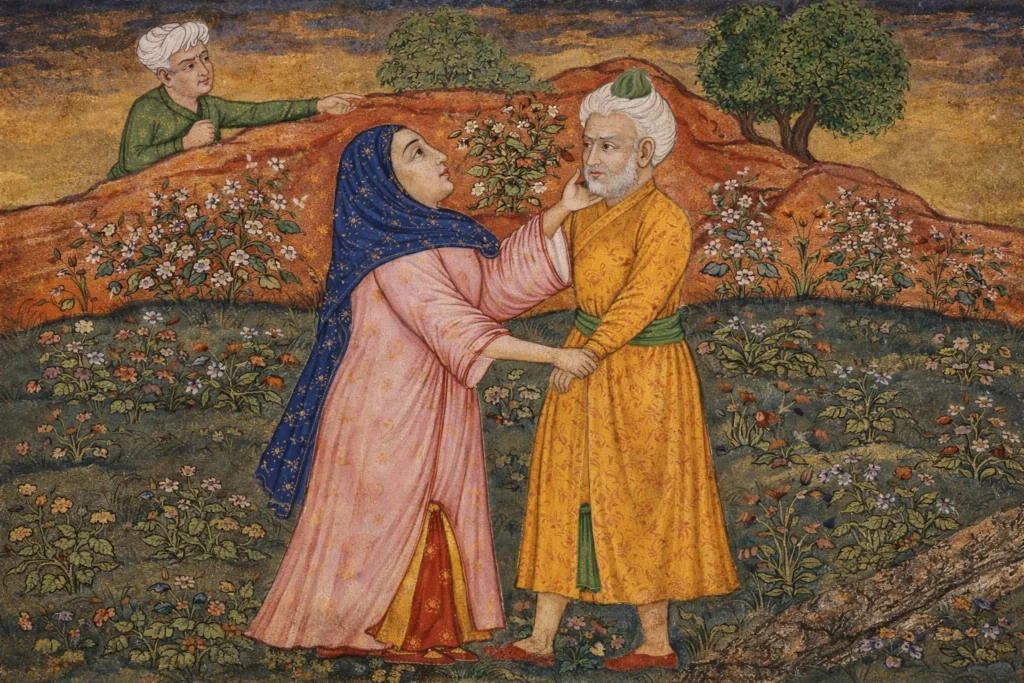
A certain man of the Banu Amr b. Yarbu’ caught a Si’lah, and stayed with her for a long time, and she bore him children. One night, she saw a fire in the distance and said: A fire of my people!’ and she flew away to it and never returned. [Ibn al-Kalbi (as cited in later commentaries), Kitāb al-Asnam (The Book of Idols) / General Folklore Traditions, 8th-12th Century CE]
This story keeps the “Marriage Motif,” showing the Si’la not just as a lone predator, but as someone who becomes part of human families. Here, she is not just a danger to avoid, but a hidden ancestor.
This story also brings up Al-Khuluk, the hybrid children, and the idea of mixing different kinds of beings. When the Si’la leaves after seeing her people’s fire, it shows she still feels a strong connection to her own kind, even after living with humans.
In medieval times, this story helped explain why some families were seen as especially clever, thin, or cold. By saying these traits came from a Si’la ancestor, people could make sense of differences in rival groups. It shows how important tribal identity was, and how the idea of the “Other” was explained through supernatural stories.
The Silat are female demons of the woods… They are the most deceptive of all the Jinn, and they have the power to transform themselves into any shape they desire, save for their feet, which remain those of an ass. [Edward William Lane (citing traditional Egyptian/Arabian commentaries), The Thousand and One Nights (Notes on Arabian Society), 19th Century CE]
Although this version comes from the 19th century, Lane uses old Egyptian and Arabian sources to describe the classic look of the Si’la. The detail about her having donkey’s feet is a later addition, and it’s a common sign of demons in many cultures. This flaw in her disguise shows that she believes lies can never be perfect—there is always a small clue for good people to spot the truth.
In the 19th century, the Si’la became more of a symbol for hidden dangers in cities, not just the desert. She was now seen as a beautiful stranger who hides her true, dangerous nature. The use of the plural “Sa’ali” shows that people started to think of them as a group living secretly among humans, not just rare monsters.
Powers and Abilities
The Si’la is considered one of the most intelligent Jinn. While an Ifrit might have more raw power, the Si’la’s strength comes from her ability to control minds and change biology.
She can trick even the most religious people because she understands human behavior so well:
- Metamorphosis: The ability to alter her physical structure, voice, and scent to perfectly mimic a specific human or a generic traveler.
- Vocal Mimicry: She can imitate the voices of a victim’s loved ones to lure them into deep forests or mountain passes.
- Enhanced Senses: A passive ability to make the desert appear as a lush oasis or a safe camp to those under her influence.
- Hybridization: The unique ability among Jinn to mate with human men and produce viable, though often “cold-blooded” or intellectually detached, offspring.
- Supernatural Agility: Despite her lanky appearance, she can outrun a horse in the rough terrain of the mountains.
Influence on Humans and Possession
The Si’la usually does not take over people’s bodies like other spirits. Instead, she manipulates from the outside. Her main aim is to lure someone away from their group. Once alone, the person can no longer see things as they really are.
Signs that someone is under the Si’la’s influence include suddenly feeling drawn to a stranger in a lonely place, getting lost, and feeling strangely sleepy. Unlike victims of other spirits, who might act wild or speak strangely, the Si’la’s victims usually seem calm as they head toward danger.
Protection and Exorcism Methods
In the past, people protected themselves from the Si’la by using special objects and saying prayers. Since she is a master of trickery, these methods are meant to reveal her true nature.
- Iron (Hadid): Like most Jinn, the Si’la has an extreme aversion to iron. Carrying an iron dagger or wearing an iron ring was believed to prevent her from maintaining her human disguise in one’s presence.
- The Wolf (Al-Sirhan): In Arabian lore, the wolf is the natural enemy of the Si’la. It was believed that a wolf could see the Si’la in her true form and would hunt and kill her. As a result, carrying a wolf’s tooth or hide was considered a potent charm.
- Salt: Encircling a campsite with salt was thought to create a barrier that a Si’la could not cross, as her “fire-based” essence reacted poorly to the mineral’s purity.
- Recitation: The Ayat al-Kursi (The Throne Verse) is cited as the primary spiritual defense, believed to compel the entity to return to the wilderness.
You may also enjoy:
Who Was Ravana in Hindu Mythology and Why Was He Feared?
October 3, 2025
Abura-akago: The Bizarre Oil-Licking Yōkai
October 22, 2025
Demon Alastor: The Grand Executioner of Hell
November 17, 2025
Bakeneko: A Supernatural Cat Yōkai in Japanese Folklore
January 27, 2026
Who Is Asmodeus in Demonology and the Bible?
February 18, 2026
Who Is Abaddon, the Demon of the Abyss, in the Bible?
September 29, 2025
Si’la Myths, Legends, and Stories
The Si’la of the Desert and the Traveler
In many Bedouin accounts, there is a frequent narrative regarding a lone traveler who encounters a beautiful woman weeping by the side of a road. In one specific traditional tale, a merchant named Hassan was traveling toward Damascus when he found a woman who claimed to have been abandoned by her caravan.
Her beauty was so profound that Hassan immediately offered her a place on his camel. As they traveled into the night, Hassan noticed that his camel was sweating profusely and acting in a state of extreme terror, despite there being no predators nearby.
When they stopped to rest, Hassan watched the woman from the corner of his eye and saw her reach into the fire with her bare hand to move the coals without being burned. Realizing he was in the company of a Si’la, Hassan waited until she went to the edge of the camp to “wash.” He quickly mounted his camel and fled.
The story concludes with the woman letting out a piercing, non-human shriek that echoes through the dunes, confirming her demonic nature.
The Marriage of the Si’la
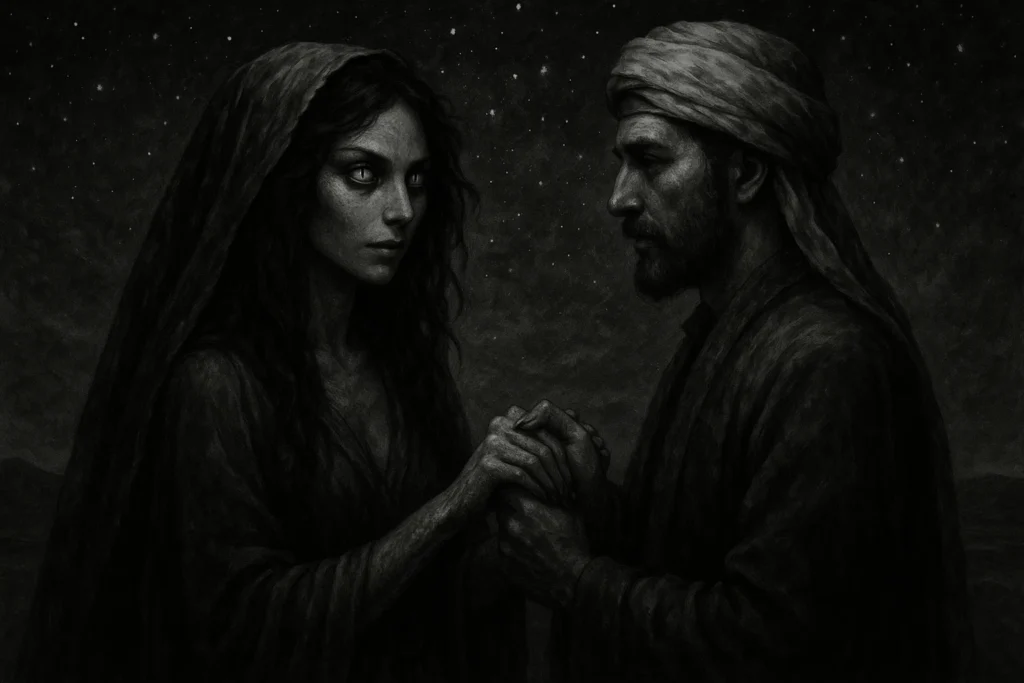
One of the most famous legends involves a Si’la who successfully integrated into human society. According to the folklore recorded by Al-Mas’ūdī, a man once encountered a woman in the wild and, unaware of her nature, took her as his wife. They lived together for many years and had several children. The children were noted for being incredibly intelligent but lacking in emotion or empathy.
One night, a flash of lightning illuminated the sky, and the woman saw a fire in the distance. She suddenly transformed into her true, spindly form and cried out, “The fire of my people!” She flew toward the flame and never returned.
This legend is often used to explain the existence of certain “cold” or “strange” bloodlines within human tribes, suggesting that the Si’la’s influence can persist through generations via supernatural hybridization.
Si’la vs Other Jinn
| Jinn Name | Associated Traits/Influence | Rank/Origin | Key Traits/Powers |
| Ifrit | Malice and immense strength | Underworld / Quranic | Control over fire and smoke |
| Marid | Arrogance and rebellion | Sea-dwellers / Folklore | Immense size and water manipulation |
| Ghul | Gluttony and corpse-desecration | Graveyards / Folklore | Shape-shifting into animals |
| Palis | Vampirism (foot-licking) | Deserts / Persian-Arabian | Drains blood from sleepers’ feet |
| Hinn | Weakness and submission | Low-rank / Animalistic | Often appear as black dogs |
| Shiqq | Incompleteness and chaos | Half-formed / Folklore | Appears as half a human body |
| Nasnas | Terror and destruction | Offspring of Shiqq | Hopping on one leg; deadly touch |
| Qareen | Temptation and whispering | Personal companion / Quranic | Knowledge of the victim’s secrets |
| Zoba’ah | Confusion and storms | Whirlwind / Folklore | Commands dust storms and cyclones |
| Jann | Neutrality or desert protection | Original Jinn race | Invisibility and longevity |
| Shaytan | Sin and disobedience | Followers of Iblis | Corrupting the heart (Waswasa) |
| Div | Sorcery and war | Persian influence | Constructing giant structures |
| Umm al-Subyan | Infant mortality and envy | Female demon / Folklore | Afflicting pregnant women |
| Hatif | Auditory deception | Invisible / Folklore | Disembodied voices leading to doom |
Position Among Jinn
The Si’la occupies a paradoxical position. She is not a member of the royal courts of the seven Jinn Kings (such as Al-Ahmar or Shamhurash), nor does she typically lead legions of followers.
Instead, she is a social pariah among the Jinn themselves. Her obsession with the human world and her habit of siring hybrid children make her an outsider to both human and Jinn societies.
However, her intelligence is respected and feared by other entities. In many grimoires, she is described as a mediator for those who wish to learn the secrets of transformation. While she does not report to Iblis in a formal military sense, her actions align with his goals of leading humanity astray through desire and the distortion of reality.
She is most frequently found in the company of Ghuls. However, the Si’la considers herself superior to them due to her ability to exist within human civilization. In contrast, the Ghul is confined to the outskirts.
Mystical Correspondences
The Si’la’s magical links show her as the top deceiver. She is connected to the Moon, especially its darkest phase, because she needs darkness to keep her tricks up her sleeve. While other Jinn, like the Ifrit, are linked to the sun’s heat, the Si’la does best in dim light, where it’s easy to fool people. Her link to Gemini points to her two sides: the lovely woman and the thin monster.
These connections help explain her “evil” side, which is more about twisting the truth than causing destruction. Quicksilver is her metal because it can’t be held or pinned down, just like her. Nightshade, her plant, shows how she attacks the mind, making the world seem dangerously unreal.
Because she is so changeable and hard to pin down, the Si’la is harder to get rid of than other, more solid demons. She can easily get past a person’s defenses.
You may also enjoy:
Abura-akago: The Bizarre Oil-Licking Yōkai
October 22, 2025
Tarakasura: The Dark Demon Who Ruled Hell on Earth
December 4, 2025
Iblis, the Jinn King of Darkness and Deception
September 29, 2025
Al-Ahmar: The Tuesday King of the Seven Jinn
February 13, 2026
Akateko: The Bloody Hand Yōkai That Guards a Cursed Temple Tree
November 14, 2025
Bibliography
Author’s Note: Looking at all these stories, I noticed a big difference between the detailed, almost scientific notes in al-Jāḥiẓ’s Kitāb al-Ḥayawān and the family-based legends in al-Mas’ūdī’s Meadows of Gold. It was interesting to see how the Si’la changed from a real desert threat in early tales to a mysterious ancestor in later histories, where the line between Jinn and humans is blurred. By comparing these old texts with Quranic interpretations, I sought to uncover Si’la’s true nature, distinct from later, simpler stories. This research shows how hard it is to describe a being that is meant to copy and confuse those who study her.
- al-Jāḥiẓ, ʻAmr ibn Baḥr. Hādhā Kitāb al-Ḥayawān [The Book of Animals]. Vol. 5–7, al-Maṭbaʻah al-Ḥamīdīyyah al-Miṣrīyyah, 1905. Internet Archive.
- al-Mas‘ūdī, ‘Alī ibn al-Ḥusayn. Historical Encyclopaedia: Entitled “Meadows of Gold and Mines of Gems”. Translated by Aloys Sprenger, Oriental Translation Fund of Great Britain and Ireland, 1841. Internet Archive.
- Ibn al-Kalbī, Hishām. The Book of Idols (Kitāb al-Aṣnām). Translated by Nabih Amin Faris, Princeton University Press, 1952. Internet Archive.
- Al-Shaykh, Hanan. One Thousand and One Nights: A Retelling. Pantheon Books, 2013. Internet Archive.
- M. A. S. Abdel Haleem (translator). The Qur’an: English Translation and Parallel Arabic Text. Oxford University Press, 2004. Quran Project Edition.
- Ali, Abdullah Yusuf (translator). The Holy Qur’an: English Translation and Commentary. 1934. Internet Archive.
- al-Ṭabarī, Abū Jaʿfar Muḥammad ibn Jarīr. The History of al-Ṭabarī, Vol. 1: General Introduction and From the Creation to the Flood. Translated by Franz Rosenthal, State University of New York Press, 1989. Internet Archive.
- al-Ṭabarī, Abū Jaʿfar Muḥammad ibn Jarīr. The History of al-Ṭabarī, Vol. 39: Biographies of the Prophet’s Companions and Their Successors. Translated by Ella Landau-Tasseron, State University of New York Press, 1998. Internet Archive.
- al-Ṭabarī, Abū Jaʿfar Muḥammad ibn Jarīr. The History of al-Ṭabarī, Vol. 10: The Conquest of Arabia. Translated by Fred M. Donner, State University of New York Press, 1993. Internet Archive.