Empusa is a unique type of wraith in ancient Greek belief, serving as a link between the physical world and the supernatural. Unlike powerful chthonic gods, Empusa is a local, predatory presence.
While Greek myths often focus on the grand actions of Olympian gods, this entity is fascinating for posing a personal, immediate threat to lone travelers, embodying sudden and formless fear.
By comparing how Empusa appears in The Frogs and in the Life of Apollonius of Tyana, I have created a historical framework that helps separate the main myths from later folklore. [View Full Bibliography ↓]
Summary
Key Takeaways
| Attribute | Details |
| Names | Empusa, Onoskelis |
| Title | Shadow-shifter, Phantasm of Hecate |
| Origin | Classical Greece (approx. 5th century BCE) |
| Gender | Female |
| Genealogy | Associated with the train of Hecate |
| Role | Terrorizer of travelers, illusionist |
| Associated Deity | Hecate (often serves in her retinue) |
| Brings | Sudden fear, paralysis, disorientation |
| Weaknesses | Insults, shouting, copper objects |
| Realm/Domain | Limbic spaces, lonely roads, crossroads |
| Weapon/Item | Copper leg (often described as one bronze leg) |
| Symbolism | The instability of perception and nocturnal fear |
| Sources | Aristophanes (The Frogs), Philostratus (Life of Apollonius of Tyana) |
Who or What is Empusa?
Empusa is a type of ghost from Greek folklore who often appears with Hecate, the goddess of witchcraft and crossroads. Known as a phantom, Empusa can quickly alter shape in frightening ways to scare or attack travelers.
Empusa exists in a space between being a goddess and a ghost. She is usually seen in lonely, empty places. By changing her shape—sometimes appearing as a beautiful woman, a dog, or even objects—she creates a strong sense of fear, meant to paralyze her victim with terror before disappearing into the night.
“Empusa” Meaning
The name Empusa comes from the Greek word empousa, which is usually understood as “the one who forces her way in” or “the one who appears.” Researchers often connect the name to the roots en- (in) and pous (foot), but there is debate about whether this refers to her single leg or her habit of suddenly appearing in a traveler’s path.
Over time, Empusa’s name came to refer to a group of metamorphic demons. Other names, like Onoskelis, meaning “donkey-leg,” were used to describe the strange animal features she sometimes took on.
This transition shows how Empusa evolved from a vague source of fear into a clear mythic creature, appearing in both Athenian plays and later stories as a regular symbol of nighttime danger.
How to Pronounce “Empusa” in English
Empusa is usually pronounced as em-PYOO-suh, with the stress on the second syllable. The “u” sounds like “you,” and the last syllable is soft. In formal settings, the “s” is pronounced with a gentle hissing sound, keeping the rhythm found in Greek names when used in English.
Origins
Empusa first appears in the literature of 5th-century BCE Athens, especially in Aristophanes’ play The Frogs (405 BCE). In these stories, she is not shown as a separate goddess with her own origin, but as a temporary, ghostly follower of Hecate. Researchers call her a phasma, meaning a shifting ghost or illusion, rather than a mythological monster with her own background.
Empusa fits into a wider Greek tradition of “liminal terrors”—creatures that haunted the dangerous areas between cities. She is related to figures like the Mormolyke, a biting monster, and the Lamia, who was said to eat children. All these beings served as frightening, formless threats on the edges of society.
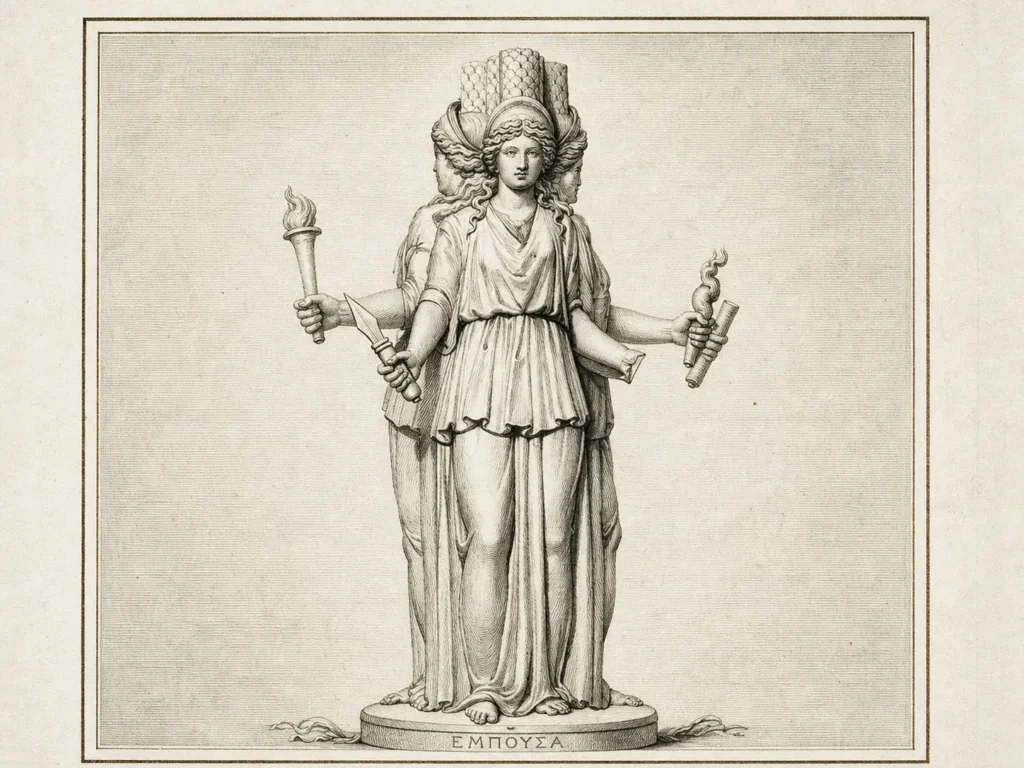
Empusa is closely connected to Hecate, the goddess of crossroads, who was thought to lead a group of wandering night spirits. Because of this, Empusa acts as a moving symbol of Hecate’s power over the dark and uncertain places in the world.
Beliefs about Empusa became more defined during the Hellenistic and Roman times. In the 3rd century CE, Philostratus’s Life of Apollonius of Tyana describes her as a clever illusionist who could copy human beauty to attract victims.
This transition shows how Empusa went from a general comedic entity in Athens to a clear symbol of supernatural danger in Mediterranean folklore. The idea is ingrained in Greek beliefs about evolution and transformation, especially the fear that reality becomes unstable and threatening at the edges of the known world.
You may also enjoy:
Aži Dahāka: The Three-Headed Dragon of Zoroastrian Mythology
January 14, 2026
The Kumbhāṇḍa: Grotesque Demons of Buddhist Hell
November 13, 2025
Who Is Arioch, the Demon of War and Vengeance?
January 21, 2026
Marid: The Ocean Jinn That Defies Heaven and Earth
September 30, 2025
What Is a Pishacha, the Flesh-Eating Demon of the Dead?
February 11, 2026
What Does Empusa Look Like?
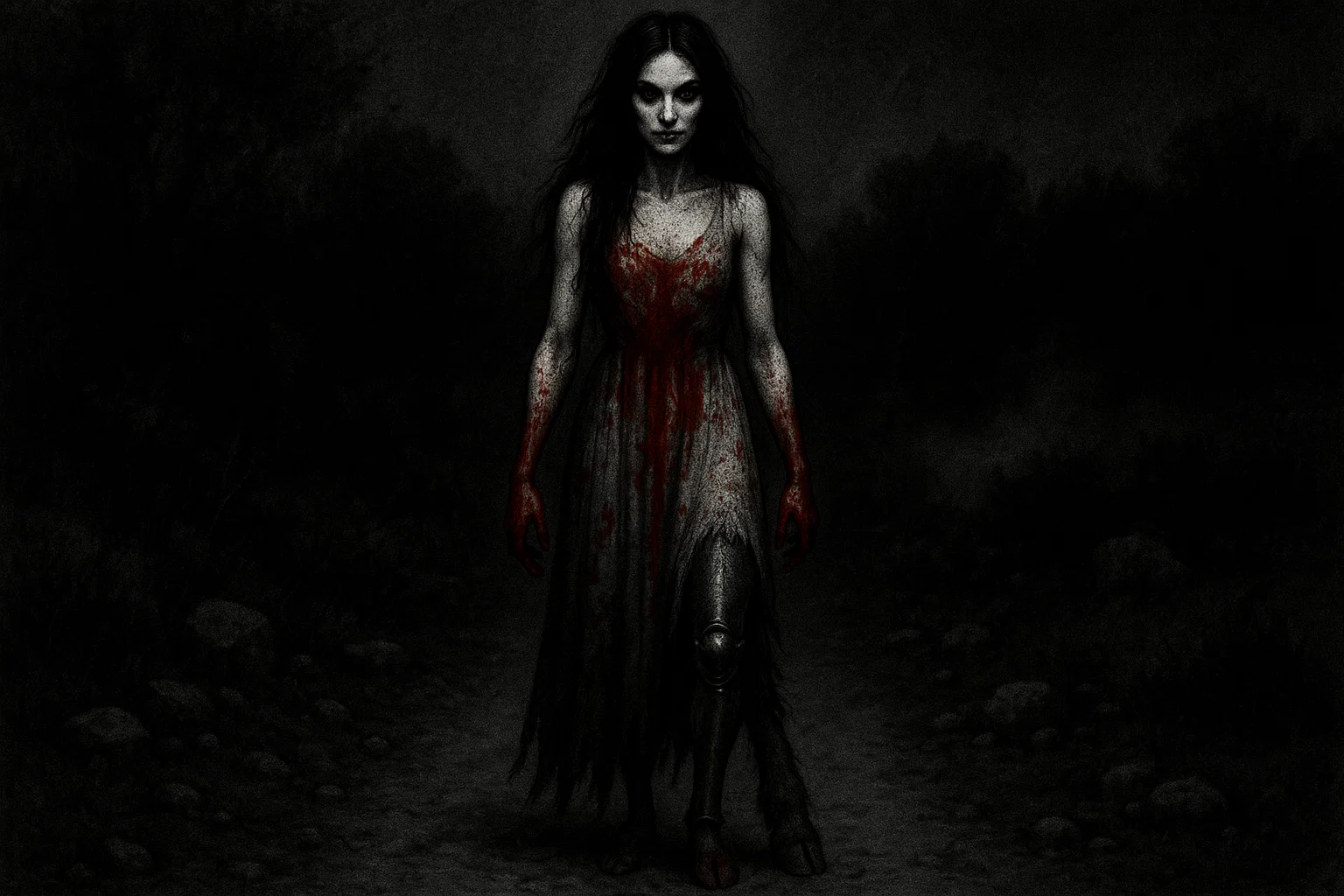
Empusa’s appearance is hard to pin down because she constantly switches shape. Still, many stories say she has one leg made of bronze or copper, and the other is a donkey’s leg. The metal leg represents something cold and artificial, while the donkey leg is more natural and lowly.
I think the donkey’s leg is important because, to the ancient Greeks, donkeys symbolized stubbornness and low desires. By mixing a beautiful human appearance with a donkey’s leg and a metal leg, Empusa shows the idea of “unnatural order.”
She is more than just a monster—she represents a broken and twisted reality that goes against the balanced forms valued in classical art.
The Bronze Leg as an Ontological Breach
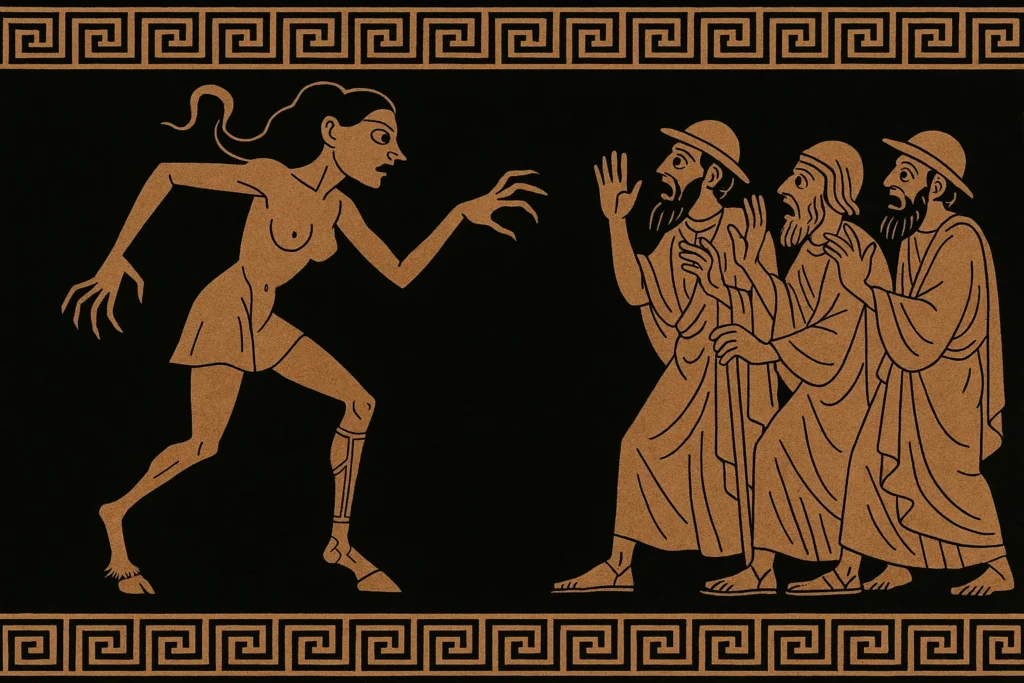
From my research, I’ve noticed that Empusa is rarely seen as a single character like a Titan or Olympian. Instead, she acts as a sign of what happens when reality breaks down. I find the bronze or copper leg especially interesting. In Greek thought, metal—especially bronze—stood for things that were artificial, unbreakable, and orderly.
On the other hand, the donkey’s leg stood for wildness, stubbornness, and chaos. For ancient Greeks, this strange mix was more than just odd—it created a deep sense of unease. Empusa seemed to be human, animal, and lifeless all at once.
I believe Empusa acted as a kind of mental boundary for the Greeks. In the Life of Apollonius of Tyana, she is driven away not by weapons, but by insults. This shows her real purpose: she represented the social fears people felt while traveling.
Travelers in ancient times faced real dangers like bandits, harsh weather, and wild animals. By imagining these threats as a metamorphosis ghost that could be scared off with words, the Greeks found a way to manage their fears. Empusa was a spirit that could be “talked down,” giving travelers some control in a wild and unpredictable world.
I also find it interesting that, while official religion focused on the order of the Olympian gods, Empusa remained part of the common people’s stories. She was part of a “shadow religion” in which Hecate’s power was expressed through the need to survive.
Priests used rituals and sacrifices to deal with the gods, but ordinary people tried to handle Empusa with cleverness and loud voices while traveling.
This difference shows something important: official religion aimed to keep the state stable, while folk demons like Empusa helped people deal with personal fears. She isn’t from the deep underworld, but from the spaces in between, always reminding travelers that they are never really alone and that danger can appear from the shadows at any time.
Connections to Other Ancient Demons
| Name | Genealogy | Type | Appearance |
| Lamashtu | Babylonian | Disease/Child-stealer | Lion-headed, donkey-bodied |
| Pazuzu | Babylonian | Wind demon | Lion/dog hybrid with wings |
| Succubus | Medieval/Classical | Seducer | Beautiful human female |
| Mormo | Greek | Terror-spirit | Ghastly, biting visage |
| Lamia | Greek | Child-devourer | Woman-serpent hybrid |
| Lilith | Mesopotamian | Night-demon | Winged woman with animal traits |
| Striges | Roman | Bird-demon | Predatory, nocturnal bird |
| Gallu | Sumerian | Underworld demon | Formless or human-like |
| Akhkhazu | Babylonian | Disease spirit | Seizer of victims |
| Vetala | Hindu | Corpse-demon | Vampire-like scavenger |
Empusa Powers and Abilities
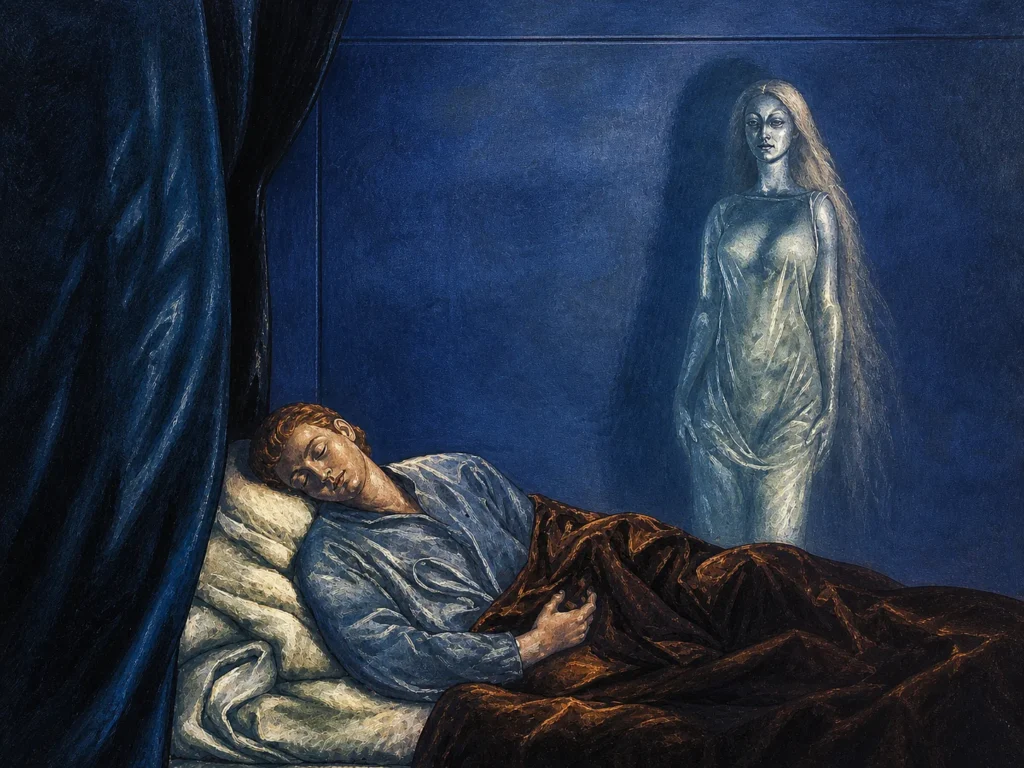
Empusa’s power comes from causing fear and confusion, not from physical strength. She triggers panic by making it hard for her victims to know what is really threatening them. By creating illusions, she uses the traveler’s own fears and surroundings to unsettle them.
- Transformation: The ability to rapidly alter physical appearance to mimic humans or animals.
- Illusion: Creating visual distortions to confuse the perception of travelers.
- Inducement of Terror: A supernatural aura that causes immediate, paralyzing fear.
- Metamorphic Instability: The capacity to transition between states of existence to evade detection.
Rituals, Amulets, and Protective Practices
Ancient ways of dealing with Empusa focused on driving her away and protecting oneself. Since she was thought to be a coward who ran when challenged, people mainly used shouting or insults to break her hold. These actions show that Empusa believed she had power only over those who let themselves be scared by her changing form.
Incantations and Ceremonies
Ceremonies for Empusa were usually informal because she was seen as a minor demon, not a major one. Travelers, especially those going through dangerous or lonely places, were told to keep making noise as they walked.
Old texts say that simply shouting or using harsh words was enough to make Empusa leave, since she was believed to run from a strong human voice. There were no formal ceremonies because she couldn’t be controlled or bargained with like other spirits.
Amulets and Talismans
People often used metal objects, especially copper or bronze, to protect themselves from Empusa, since these metals were believed to keep her at bay.
Bronze was used to make small charms or to carry for protection. People believed Empusa couldn’t get past these metals, which were seen as strong and grounding, helping to keep travelers safe from her shifting, ghostly nature.
Professional Practitioners
Most people used shouting or simple metal charms for protection, but if an area were thought to be haunted by Empusa, they would ask magoi or wandering ritualists—experts in Hecate’s mysteries—for help.
These experts didn’t do complicated exorcisms for Empusa. Instead, they advised on how to clean crossroads and where to leave offerings for Hecate, hoping she would call back her spirits and keep travelers safe.
You may also enjoy:
Apophis: The Great Serpent of Egyptian Chaos
November 11, 2025
Who Is Shiva, the Destroyer and the Lord of the Universe?
November 12, 2025
Andhaka: The Blind Demon Born From Cosmic Darkness
February 6, 2026
What Is Jorōgumo? The Deadly Spider Woman of Japanese Myth
February 2, 2026
Who Is Adrammelech in Demonology and the Bible?
October 1, 2025
The Ghul: The Flesh-Eating Demon of Arabian Folklore
October 1, 2025
Bibliography
Author’s Note: For this article, I focused on the specific and dramatic stories from Aristophanes and Philostratus, instead of later, more general supernatural tales. These main sources show how Empusa transformed from a comic, shapeless ghost in 5th-century Athens to a more realistic, seductive entity in 3rd-century Rome. By looking at both, I could highlight Empusa’s main role as a sign of reality breaking down, rather than just listing her as another monster. This approach helped me avoid adding modern folklore details.
- Aristophanes. The Frogs of Aristophanes. Translated by Gilbert Murray, George Allen & Sons, 1908. Internet Archive.
- Philostratus. The Life of Apollonius of Tyana. Translated by F. C. Conybeare, William Heinemann, 1912. Internet Archive.
- Borthwick, E. K. Seeing Weasels: The Superstitious Background of the Empusa Scene in the Frogs. The Classical Quarterly, vol. 18, no. 2, 1968, pp. 200–06. JSTOR, http://www.jstor.org/stable/638065. Accessed 1 May 2026.
- Bough, Jill. The Mirror Has Two Faces: Contradictory Reflections of Donkeys in Western Literature from Lucius to Balthazar. Animals: an open access journal from MDPI vol. 1,1 56-68. 14 Dec. 2010, doi:10.3390/ani1010056.
- Nixon, Shelly. (2013). Hekate: Bringer of Light. ResearchGate.