Most studies of Middle Eastern supernatural beings focus on the Ifrit or the Marid. However, the Jann are the original ancestors of the spirit world. They show what happens when a once-powerful species fades into the background, becoming hidden and less influential.
Unlike the Shayatin, who are known for their malice, these entities stand out because they represent the shift from the ancient world of fire to the present world of clay.
This article uses direct translations from Al-Tabari’s History and The Meadows of Gold by Al-Masudi to make sure the description of the Jann is accurate to their cultural origins. [View Full Bibliography ↓]
Summary
Key Takeaways
| Attribute | Details |
| Names | Jann, Jan, Al-Jann |
| Type | Ancestral or “Lesser” Jinn; often considered the commoners or the original form of the species |
| Title | Father of Jinn (in the context of the first Jann), Earth-Dwellers |
| Gender | Male and Female |
| Servitors | Animal-shaped spirits, lesser household spirits (Ammar) |
| Superior Jinn | Iblis (for those who fell), or independent tribal leaders |
| Powers | Shapeshifting (predominantly into snakes), invisibility, inducing illness, causing localized whirlwinds (Zoba’ah) |
| Appearance | Commonly seen as black serpents or scorpions; in anthropomorphic form, they appear as whirlwind-like shadows or nomadic travelers |
| Etymology | From the Arabic root j-n-n, meaning “to hide,” “to cover,” or “to conceal” |
| Associated Figures | Adam (as the human counterpart), Iblis, Azazel, Prophet Sulayman |
| Weaknesses | Iron (Hadid), salt, recitation of the Mu’awwidhatayn (Suras Al-Falaq and Al-Nas) |
| Opposing Holy Figure | Archangel Jibril, Prophet Muhammad, the Army of Angels |
| Social Structure or Tribe | Nomadic tribal structures mimicking Bedouin societies; divided into believers and non-believers |
| Followers/Tribe Size | Vast legions inhabiting deserts, ruins, and “unclean” places |
| Primary Sources | The Quran, Al-Tabari’s History, The Meadows of Gold (Al-Masudi), One Thousand and One Nights |
Who or What is Jann?
The Jann are a type of supernatural being in Islamic and Arabian beliefs. They are often seen as the ancestors of all Jinn or as the most common kind that lives on earth. Unlike the powerful Ifrit, who control fire, or the Marid, who live in the sea, they are closely connected to the desert and wild places.
In creation stories, the Jann are known as the beings who lived on Earth before Adam. They had their own civilization before humans, but it eventually became corrupt and violent. Because of this, angels were sent to drive them away.
“Jann” Meaning
The word Jann comes from the Arabic root j-n-n, which mainly means something hidden or concealed from people. This root also appears in words like Jannah (Paradise or Hidden Garden) and Majnun (Possessed or someone whose mind is covered).
In old texts, the word Jann is used in two main ways. Sometimes it means all Jinn collectively, especially in early interpretations of the Quran. Other times, it refers to Al-Jann, the first of the Jinn, who is like the Adam of their kind.
Iblis is usually seen as the father of the Shayatin (demons). Still, Al-Jann is considered the ancestor of the neutral or ‘natural’ Jinn. In some languages, the word Jann also refers to the smaller, snake-like forms of these spirits, setting them apart from the larger and more frightening types.
How to Pronounce “Jann” in English
The name is pronounced ‘Jan,’ which rhymes with ‘Dan’ or ‘Tan.’ In Arabic, the double ‘n’ means the ‘n’ sound is held a bit longer. Still, in English, it’s usually said as a quick, single syllable.
What Does a Jann Look Like?
The Jann are known for their ability to change shape and blend in. Old sources like Al-Jahiz say their true form is made of ‘smokeless fire,’ making them invisible to people. When they do appear, they usually take the shape of animals that live near humans but not among them.
The Jann most often appear as serpents, especially long, thin black snakes. Many Hadiths say that the Prophet Muhammad warned people not to kill snakes found in homes right away, since they could be Jann who have accepted Islam. Instead, people should warn them to leave three times.
Besides snakes, Jann are also said to appear as scorpions, black dogs, or camels. When they look human, they usually seem like normal travelers but may have minor oddities, such as vertical pupils or extra hair. In the desert, people believe they show up as whirlwinds or columns of dust.
You may also enjoy:
Who Is Futakuchi-onna, the Two-Mouthed Woman?
March 9, 2026
Iblis, the Jinn King of Darkness and Deception
September 29, 2025
Who Is Aka Manto, Japan’s Terrifying Red-Cloaked Yōkai?
October 24, 2025
Demon Alastor: The Grand Executioner of Hell
November 17, 2025
Who Was Hiranyaksha, the Golden-Eyed Asura?
October 7, 2025
Origins
The story of this entity starts long before humans existed. Al-Tabari writes that the Jann lived on Earth for thousands of years before Adam. They were made from scorching fire and, in that time, built their own kingdoms, cities, and even had their own prophets.
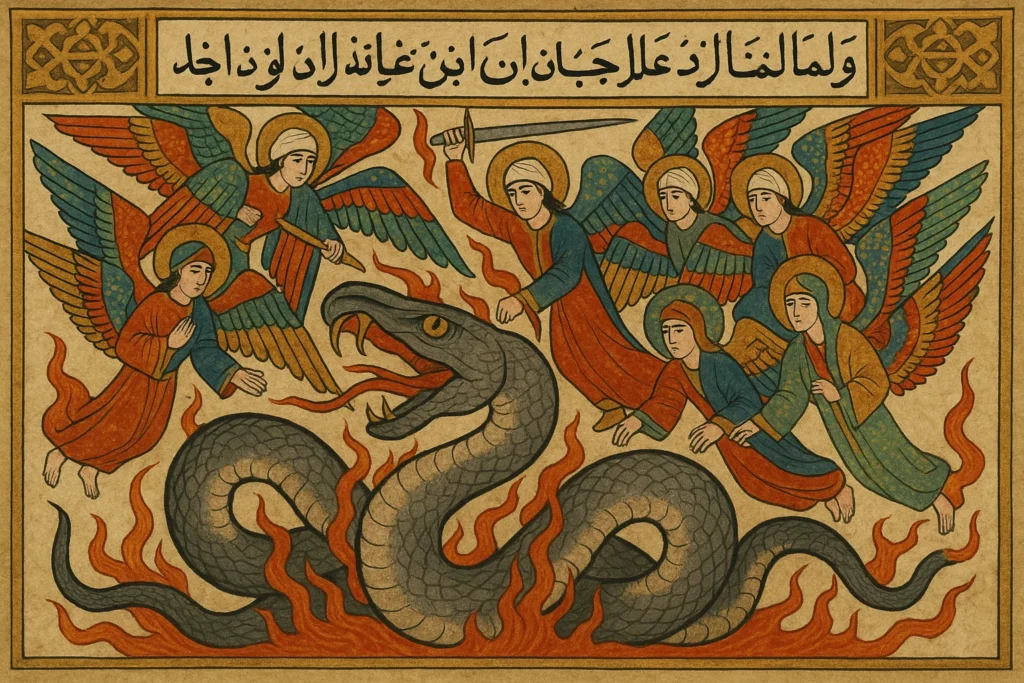
But over time, the Jann became proud and violent. The world was filled with war and destruction. Because of this, God sent an army of angels, led by Azazel (who would later become Iblis), to cleanse the Earth.
The Jann were defeated and forced to flee to far-off islands, mountain tops, and deep deserts. This event, called the ‘Great Displacement,’ changed them from rulers of the world to hidden beings living on the edges of human society. Many stories say they still feel resentment toward humans, who took their place.
The Pre-Adamite Shadow
The story of the Jann being replaced by humans offers a unique way to think about changes in nature and culture. As society moved from the Pre-Islamic period to the Islamic era, the Jann went from being rulers of the earth to a marginalized and ‘haunted’ group.
This change is similar to how nomadic tribes were pushed aside by growing cities and settled people. In this way, they are not just spirits, but reminders of a land that once belonged to others before humans arrived.
This tension is really about who owns the land. In Arabian stories, they are often portrayed as the true owners, and people have certain customs, such as saying the basmala before pouring water, to avoid upsetting them. These customs act like spiritual rules for sharing space.
This idea shows that these entities can be seen as symbols of guilt about taking over the land. They stand for the hidden beings whose resources humans have taken, making old ruins and desert wells places where humans and Jann might come into conflict.
The way the word Jann has changed over time also links them to the idea of the ‘Collective Unconscious.’ Since their name comes from a root meaning ‘hidden,’ the Jann can be seen as holding all the things that people try to keep out of their conscious minds.
While the Shayatin stand for obvious, outward evil, the Jann are more like the hidden shadows of the world. They are the spirits that might live in your home or appear as travelers in the distance, making familiar places feel strange because they have been pushed aside.
Historical & Scriptural Records
While Jann appears as a collective term in the Quran, its specific characterization as a distinct progenitor or a serpent-like class of entity is developed through the following chronological records.
“And the Jinn We created before from scorching fire [min nari al-samumi].” (Quran 15:27, 7th Century CE)
This important Arabic text shows that the Jann existed before Adam. The word al-samum, which means a deadly, scorching wind, is important because it tells us the Jann are made from a special kind of fire—one that is hot and suffocating, but without light or smoke.
In these early scriptures, the Jann are presented as the first example of unseen beings, created long before humans, who were made from clay.
From a religious point of view, this verse explains why there is tension between Jann and humans. By saying the Jann came ‘before’ (min qablu), it sets up a conflict between being older and being chosen by God. Unlike later stories that group them by planets, this early source focuses on what they are made of to show how different they are.
“The Jann were the dwellers of the earth before Adam. They caused corruption in it and shed blood, so God sent against them an army of angels who beat them and drove them to the islands of the seas.” [History of the Prophets and Kings (Tarikh al-Rusul wa al-Muluk) by Al-Tabari, 9th-10th Century CE]
Al-Tabari’s writings from the 10th century shift the view of the Jann from mere created beings to a civilization of their own. This is where the idea of their corruption (Fasad) comes in. It explains why the Jann are now hidden—they were once a powerful group that fell. This story also helps explain why humans are seen as the new caretakers of the Earth, showing the Jann as a failed attempt at free will.
Al-Tabari also makes it clear that the Jann are different from the Shayatin (demons). The Shayatin are linked to Iblis and to tempting people, but the Jann are connected to the Earth and to its failure to keep order. This is like a social history of supernatural beings, similar to how human kingdoms rise and fall.
“The Jann is a small, slender snake, usually found in houses. It is said: ‘I saw a jann in the house,’ meaning a resident spirit that has taken the form of a serpent.” [Lisan al-Arab (The Tongue of the Arabs) by Ibn Manzur, 13th Century CE]
By the 13th century, the big myths about the Jann had become more like everyday stories. Ibn Manzur’s dictionary shows that people started to think of the Jann less as cosmic rebels and more as spirits living in their homes. This change helps us understand how the supernatural became part of daily life in medieval Arab society.
The important point here is the ‘Law of Warning.’ Since a snake could be a Jann who believes in Islam, religious law at the time said not to kill them right away. This shows a rare kind of agreement between people and spirits, in which the Jann are given respect because they may be pious.
“If thou wouldst call the Jann, thou must go to a place where the wind whistles through the ruins at noon… for they are the kings of the dust and the masters of the scorching gale.” [The Sun of Gnosis (Shams al-Ma’arif al-Kubra), Attributed to Ahmad al-Buni, 13th-17th Century Compilations]
This mystical source gives us new information about rituals that earlier histories do not. In the Shams al-Ma’arif, the Jann are part of a complex magical system. They are seen not just as snakes or fallen rulers, but as important parts of a magical network.
The fact that Jann rituals take place at noon is important. Most spirits are linked to the night, but the Jann, who come from the scorching wind, are strongest when the sun is highest, and the heat is intense.
This source comes from a time when magical books tried to organize spirits using numbers, scents, and directions. In these texts, the Jann are seen as masters of the desert. Travelers often thought that sudden dust storms, called Zoba’ah, were actually the Jann showing their power.
Powers and Abilities
The Jann are not as powerful as the Ifrit when it comes to destruction, but they are more common and tend to stick around. While an Ifrit might destroy a building, a Jann is more likely to haunt a home for many generations.
- Invisibility: The ability to remain completely undetected while moving through human spaces.
- Transformation: Transforming into animals (snakes, dogs) or specific humans to deceive or observe.
- Localized Telekinesis: Moving objects within a home, often interpreted as “poltergeist” activity.
- Environmental Manipulation: Creating sandstorms or “dust devils” to lead travelers astray in the desert.
- Disease Infliction: The ability to strike humans with “the evil eye” or sudden physical ailments through spiritual “stinging.”
- Linguistic Mimicry: Impersonating the voices of loved ones to lure victims into dangerous areas.
Influence on Humans and Possession
The Jann usually affect people when their territory is disturbed, not because they want to tempt them. Unlike the Shayatin, who try to lead people into sin, the Jann react when someone enters their space. If a person is possessed by a Jann, they might suddenly shake, faint, or start speaking a language they never learned.
People often notice a ‘heavy’ feeling in a room, or a lack of items, when the Jann are around. They are said to live in ruins, graveyards, and bathrooms, and might get angry if someone pours hot water or throws a stone without first saying a blessing (basmala) to warn them.
You may also enjoy:
Who Is the Jann in Islamic Mythology and Why Is He Feared?
October 2, 2025
Hitotsume kozō: One-Eyed Yōkai of Japanese Folklore
February 4, 2026
What Is a Rakshasa? Meaning, Origins, and Dark Powers
January 23, 2026
Agubanba: The Blind Yōkai That Preys on Young Women
October 23, 2025
Who Is Agaliarept, the General of Hell Under Lucifer?
October 8, 2025
Protection and Exorcism Methods
Traditionally, people protect themselves from the Jann by setting boundaries. The most common way is to use iron, since it is believed that the Jann dislike this metal. For example, putting an iron knife or nail under a pillow is a well-known folk method to keep them away.
People also use salt to make protective circles around where they sleep. Spiritually, the main way to drive away the spirit is by reciting certain verses from the Quran. Some people wear talismans (Ta’wiz) with these verses for protection.
People also burn herbs like black seed (Nigella sativa) and incense such as frankincense or oud to clear out the Jann. It is believed that these scents drive the Jann away, while bad smells attract them.
Myths, Legends, and Stories
The Conflict of the Pre-Adamite Tribes and the Angelic Purge
Before humans built their first cities, the Jann ruled the Earth. Al-Tabari and Ibn Abbas wrote that the Jann were divided into 70 tribes, each led by a king who claimed descent from the original smokeless fire.
The Jann thrived for thousands of years, building civilizations as complex as those in Heaven. But as they became more powerful, they also became arrogant. They ignored the rules given by their prophets, and a time of chaos and lawlessness, called fasad, began.
The Jann fought each other with iron weapons, filling the valleys with noise and bloodshed. They destroyed forests and burned the land to gain more territory. Seeing this, the angels asked God if the world would be left to such violence. In answer, God sent a large group of angels down to Earth.
The angels were led by Azazel, who was then the most faithful of his kind. They attacked quickly, and a huge battle happened on the open plains. Even though the Jann were fierce and made of fire, they could not match the angels, who were made of pure light.
The angels chased the Jann tribes across the world, forcing the survivors to hide on distant islands, on high mountains like Mount Qaf, and deep in the seas. After this, the Earth was quiet and empty, ready for the creation of Adam, the first human.
The Conversion of the Jann of Nasibin
Early in the Prophet Muhammad’s mission, something important happened in the valley of Nakhlah, between Mecca and Ta’if. According to Hadith and Quranic interpretation, the Prophet was praying before dawn, reciting the Quran so that his voice filled the quiet valley.
He did not know that a group of seven (or nine, in some stories) Jann from Nasibin in the north were passing through. These Jann were scouts and scholars, traveling to learn about the spiritual state of the world.
When the Jann heard the Prophet’s recitation, they stopped and told each other, ‘Listen quietly!’ They stood still, amazed by the power and beauty of the words. They knew right away that this was not ordinary poetry or the sayings of soothsayers. To them, it sounded like the ancient scriptures they remembered, but even better.
After the Prophet finished praying, the Jann did not run away or hide. Instead, they felt a strong sense of purpose. They went to the Prophet, declared their belief in one God, and promised to follow the new faith.
These Jann quickly returned to their hidden tribes in the desert to spread the news. They told their people, “O our people! We have heard a Book revealed after Moses, confirming what came before it, guiding to the truth and to a Straight Path.”
Jann vs Other Jinn
| Jinn Name | Associated Traits/Influence | Rank/Origin | Key Traits/Powers |
| Ifrit | Malice, strength, and revenge | High-ranking; Quranic lore | Pyrokinesis and immense physical power |
| Marid | Arrogance and rebellion | Sea-dwelling royalty; Folklore | Granting wishes (often with a price) |
| Ghul | Gluttony and cannibalism | Wasteland scavengers; Arabian myth | Feasting on the dead; shapeshifting |
| Si’lat | Deception and seduction | Lesser female spirits; Folklore | Expert mimicry; alluring travelers |
| Hinn | Weakness and submission | Lowest tier; appear as black dogs | Passive presence; often animalistic |
| Palis | Exhaustion and theft | Foot-licker; Persian/Arabian lore | Draining energy from sleeping travelers |
| Nasnas | Fragmentation and chaos | Half-human hybrids; Folklore | Possessing only half a body; great speed |
| Shiqq | Terror and madness | Lower-tier demon; Pre-Islamic | Haunting travelers; distorted form |
| Zoba’ah | Confusion and disorientation | King of the Whirlwinds; Occult | Commanding dust storms and winds |
| Ammar | Domestic disturbance | Household dwellers; Hadith | Living alongside humans in walls |
| Qareen | Internal temptation | Personal double; Quranic | Whispering into the human heart |
Position Among Jinn
Among the unseen beings, the Jann are like the common people. If the Ifrit are generals and the Marid are kings, then the Jann are the citizens, soldiers, and wanderers. They are the type of Jinn people are most likely to meet in everyday life.
The Jann usually serve the more powerful types of Jinn. In the stories about Prophet Sulayman, the Jann worked as builders and divers. In their own communities, they are well-organized, with their own marriages, funerals, and laws. They often clash with the Shayatin, since some Jann are believers who follow divine law, whereas the Shayatin follow only Iblis.
Mystical Correspondences
| Attribute | Details |
| Planet | The Moon (due to its association with the night and cycles) |
| Zodiac Sign | Cancer (reflecting domesticity and hidden depths) |
| Element | Air/Fire (specifically the “Scorching Wind” or Samum) |
| Direction | North (the direction of darkness and the unknown) |
| Color | Yellow and Grey (the color of sulfur and desert dust) |
| Number | 7 (reflecting the seven layers of the earth they inhabit) |
| Crystal/Mineral | Desert Rose or Agate |
| Metal | Copper (for their creation) / Iron (for their suppression) |
| Herb/Plant | Acacia or Rue |
| Animal | The Viper and the Black Dog |
The Jann are seen as beings in transition. They are linked to the Moon, which highlights their nighttime activity and the way their power grows and shrinks with the lunar cycle.
Unlike the Shayatin, whose fire is only destructive, the Jann are connected to the Samum, the hot desert wind. This makes them seem airy and hard to catch. Their link to the South, where the hot wind comes from, shows up as lingering heat in the world.
The Jann are also linked to copper, based on old beliefs that their spirits can be influenced by human intentions. Their weakness to iron is seen as a way to limit their power. The number 7 often appears in magical books as the key to controlling them, since they are said to live in the seven regions of the earth.
You may also enjoy:
Who Is Agaliarept, the General of Hell Under Lucifer?
October 8, 2025
Edimmu: The Mesopotamian Wind Demon That Steals Life
November 6, 2025
Agubanba: The Blind Yōkai That Preys on Young Women
October 23, 2025
What Is Jorōgumo? The Deadly Spider Woman of Japanese Myth
February 2, 2026
Si’la: The Seductive Jinn Who Lures Travelers to Their Doom
October 9, 2025
Who Was Hiranyakashipu, the Demon King of Hindu Mythology?
October 6, 2025
Bibliography
Author’s Note: While compiling this research, I noticed a strong contrast between the strict rules in Sahih Muslim regarding household spirits and the broad, almost historical accounts in al-Tabari’s accounts of the Jann before Adam. I was especially interested in how al-Jahiz’s writings on animal biology helped connect the Jann’s spiritual origins to their appearance as desert snakes. I focused on these early medieval sources rather than later stories to maintain the main theme of ecological displacement grounded on original texts, not modern folklore.
- Ali, Abdullah Yusuf (translator). The Holy Qur’an: English Translation and Commentary. 1934. Internet Archive.
- al-Ṭabarī, Abū Jaʿfar Muḥammad ibn Jarīr. The History of al-Ṭabarī, Vol. 39: Biographies of the Prophet’s Companions and Their Successors. Translated by Ella Landau-Tasseron, State University of New York Press, 1998. Internet Archive.
- Al-Shaykh, Hanan. One Thousand and One Nights: A Retelling. Pantheon Books, 2013. Internet Archive.
- al-Mas‘ūdī, ‘Alī ibn al-Ḥusayn. Historical Encyclopaedia: Entitled “Meadows of Gold and Mines of Gems”. Translated by Aloys Sprenger, Oriental Translation Fund of Great Britain and Ireland, 1841. Internet Archive.
- McCown, Chester Charlton, editor. The Testament of Solomon. J. C. Hinrichs’sche Buchhandlung, 1922. Internet Archive. Edited from manuscripts at Mount Athos, Bologna, Holkham Hall, Jerusalem, London, Milan, Paris, and Vienna.
- Abdul Hamid Siddiqui (translator). al-Hajjaj, Muslim ibn. Sahih Muslim. Islamic Book Service, 2004. Internet Archive.
- Contadini, A. A World of Beasts: A Thirteenth-Century Illustrated Arabic Book on Animals (the Kitab Na’t al-Hayawan) in the Ibn Bakhtishu’ Tradition. Academia.edu, 2012.
- al-Jāḥiẓ, ʻAmr ibn Baḥr. Hādhā Kitāb al-Ḥayawān [The Book of Animals]. Vol. 5–7, al-Maṭbaʻah al-Ḥamīdīyyah al-Miṣrīyyah, 1905. Internet Archive.