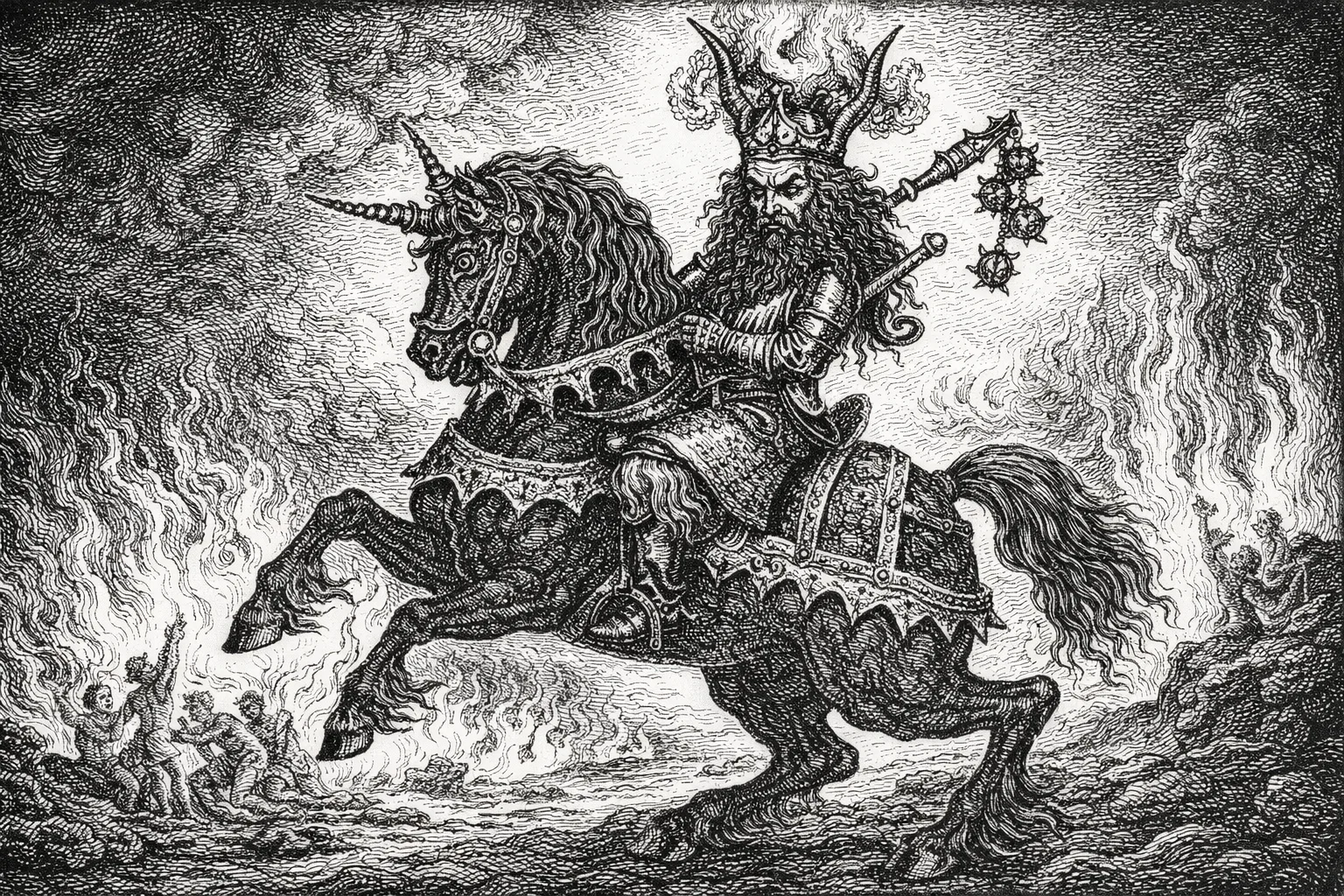
While many Goetic figures are known for their physical or moral corruption, Allocer stands out as a dark patron of intellect and the celestial arts. He is traditionally shown as a lion-faced knight riding a towering horse, visually connecting the predatory side of the infernal realm with the strict discipline of medieval chivalry.
Looking at his mastery of both the liberal sciences and the mysteries of the heavens, Allocer stands at the risky crossroads where human curiosity meets forbidden, organized knowledge.
When I wrote this article, I decided to focus more on the modern digital lore using the Ars Goetia and the Pseudomonarchia Daemonum to create a historical profile based on evidence. [View Full Bibliography ↓]
Summary
Key Takeaways
| Attribute | Details |
| Names | Allocer, Alocer, Alloces |
| Title | Duke, Great Duke of Hell |
| Gender | Male |
| Role | Grants knowledge in astronomy and liberal arts; incites lust; leads legions in hell |
| Rank | Duke |
| Hierarchy | Commands thirty-six legions of lesser spirits; serves under one of the Great Kings of Hell, potentially Zagan (in some interpretations) |
| Legions | Thirty-six |
| Powers | Teaches the secrets of astronomy and all liberal arts; incites lust and depravity; delivers true answers to hidden things; causes great tumult |
| Associated Figures | King Solomon (in the context of the Lemegeton), various other spirits of the Ars Goetia |
| Weaknesses | Bound by the binding triangle and pentagram of Solomon; constrained by the power of the Divine Name |
| Opposing Angel/Saint | The corresponding Shem HaMephorash angel is Imamiah |
| Pantheon | Christian Demonology (Goetic, Solomonic) |
| Primary Sources | Ars Goetia (The Lesser Key of Solomon), Johann Weyer’s Pseudomonarchia Daemonum |
Who or What is Allocer?
Allocer is an infernal entity known primarily from the Ars Goetia and similar grimoires, which detail the hierarchy and characteristics of the 72 Spirits of Solomon. He is generally recognized as a Duke in the ranks of Hell, holding a command position over a formidable army of lesser demonic entities.
At his core, Allocer is known for spreading dark knowledge and influence. Summoners called on him to uncover hidden mysteries in the heavens, especially in astronomy and the liberal arts.
However, his knowledge is not harmless. It is often linked to stirring up lust and tempting people with forbidden truths. His reputation comes from being featured in key Solomonic magic texts, where he is always described with a unique and frightening look, showing his power as a malevolent spirit of the underworld.
“Allocer” Meaning
The name “Allocer” and its variants, such as Alocer or Alloces, lack a clearly defined, universally agreed-upon linguistic root, unlike the names of some other demons, which derive from Hebrew or Greek terms. The primary sources for his name are the 16th- and 17th-century grimoires, which present his name as already established within an existing demonic catalog.
One possible, though uncertain, origin is that Allocer’s name comes from an earlier, non-Christian tradition. It may have changed over time due to translation and copying mistakes as the grimoires were put together. Some Goetia names have been traced back to pagan gods or altered classical terms through complex language changes.
Since Allocer’s name does not come from a major religious language like Hebrew, Aramaic, or Latin, its meaning is only connected to the demon himself—the 52nd Duke of the Ars Goetia.
The names Alocer and Alloces are probably just spelling differences that appeared as the Solomonic texts were copied over time. Today, Allocer is the most common spelling in modern versions of the grimoire.
How to Pronounce “Allocer” in English
In English, Allocer is usually pronounced Al-oh-sir, with the stress on the first syllable. Sometimes people say Al-low-ker, especially if they use a Latin-style’ c’ sound before ‘e’ or ‘i’, but Al-oh-sir is the most common.
What Does Allocer Look Like?
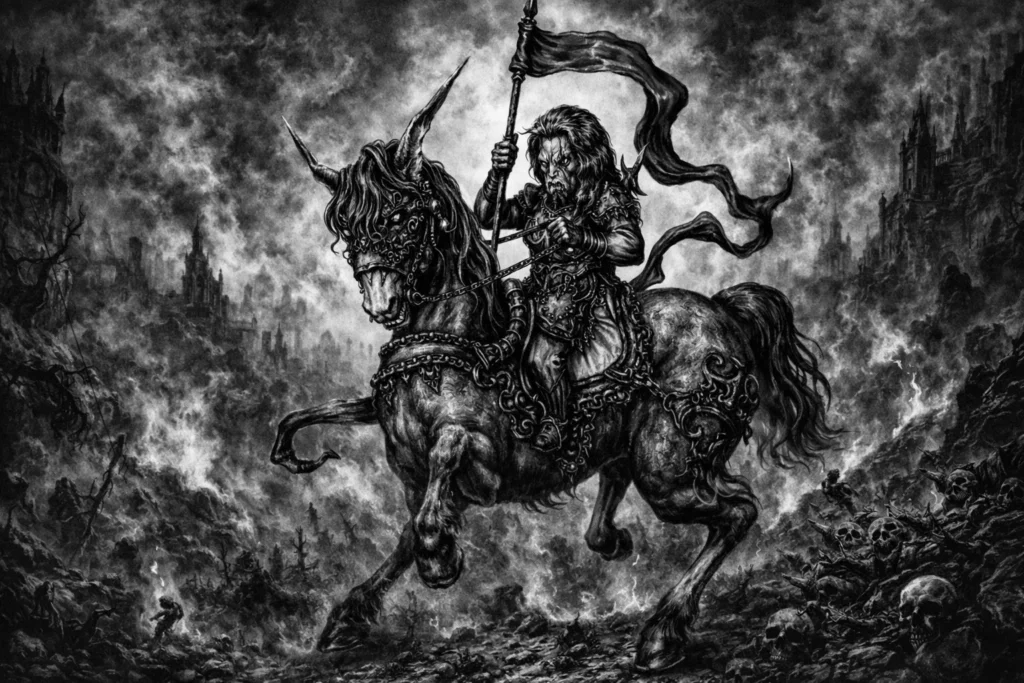
Allocer’s physical description is one of his most remarkable and memorable traits, and it appears the same way in all the main grimoires. He is usually shown as a great soldier or knight riding a huge, fearsome, demonic horse.
His head is his most remarkable and frightening feature: it is described as a lion’s head, large and reddish in color. This lion-like head often has fiery eyes that seem to burn with intense heat.
To make him even more sinister, his horse is often described as monstrous and extremely large. The descriptions highlight the mix of a noble knight’s body with the wild, lion-like head, creating a powerful image of untamed malice. He is said to speak with a loud, rough voice, which adds to his fierce and raw character.
Origins
The origins of Allocer are intrinsically linked to the compilation of the Solomonic cycle of grimoires in early modern Europe. He is not a demon that appears in ancient scripture or early Christian patristic writings. Instead, his earliest documented appearance is in the 16th and 17th-century texts that formalized the classification and hierarchy of demons.
Allocer’s most primary and essential documentation is found in Johann Weyer’s Pseudomonarchia Daemonum (1563) and, later, in the first book of The Lesser Key of Solomon, the Ars Goetia (mid-17th century).
Weyer’s text lists Allocer as a Great and Mighty Duke, detailing his physical form, rank, and powers. This description was largely preserved and integrated into the Ars Goetia, which codified the 72 spirits into a system associated with the legend of King Solomon binding the spirits into a brass vessel.
Allocer’s character, in conclusion, evolved from a collection of existing lore, potentially incorporating older folk traditions or earlier, lost demon lists that were systematized by Weyer and later compilers of the Lesser Key. His genealogy is entirely infernal—a Duke of Hell, with no known human or angelic pre-existence established in these foundational texts.
Historical & Grimoire Records of Allocer
While Allocer does not appear in the Bible, its historical record dates to the 16th century in the Pseudomonarchia Daemonum.
Original:
“Alocer princeps magnus est, procedens ut miles in equo immenso: Facies ejus leonina, rubicunda valde, cum oculis flammeis: Graviter loquitur: Docet astronomiam & omnes liberales artes: Adfert bonas familias.” [Verbatim from Weyer, Pseudomonarchia Daemonum, 1577]
Translation:
“Alocer is a great prince, appearing as a soldier riding on a huge horse: his face is like a lion’s, very red, with flaming eyes: he speaks with a heavy voice: he teaches astronomy and all the liberal arts: he brings good familiars.” [Translation by Reginald Scot, The Discoverie of Witchcraft, 1584]
Johann Weyer’s 16th-century work established the basic image of the demon. Unlike many other demons that came from ancient pagan gods, Allocer appears fully formed as a creation of High Renaissance occultism.
Calling Allocer a ‘Prince’ (later changed to ‘Duke’ in the Goetia) shows how the aristocratic military class was turned into something demonic. His ‘flaming eyes’ and ‘red face’ are not just scary features; they are also linked to the ‘choleric’ temperament in medieval medicine, which was connected to fire, yellow bile, and a warrior’s anger.
From a religious point of view, listing ‘liberal arts’ and ‘astronomy’ as Allocer’s skills shows a change in how the Church saw secular education. By giving an infernal prince control over the quadrivium, these texts reveal the Church’s worry that new scientific knowledge and intellectual pride could lead people away from spiritual safety.
“The Fifty-second Spirit is Alloces, or Alocas. He is a Duke, Great, Mighty, and Strong, appearing in the Form of a Soldier riding upon a Perpendicular Horse. His Face is like that of a Lion, very Red, and having Flaming Eyes. His Speech is hoarse and very big. His Office is to teach the Art of Astronomy, and all the Liberal Sciences. He bringeth unto thee Good Familiars; also he ruleth over 36 Legions of Spirits.” [Lemegeton Clavicula Salomonis: The Lesser Key of Solomon, mid-17th century]
The 17th-century Ars Goetia makes some important changes to Allocer’s rank and description. He is promoted from ‘Prince’ to ‘Duke,’ which more closely aligns the infernal court with the British system of nobility.
The phrase ‘Perpendicular Horse’ is likely a result of a copying mistake or a special occult term for a horse rearing up. This detail adds an unnatural, tense feeling to Allocer’s appearance.
Also, giving Allocer command over ’36 Legions’ adds a specific number to his influence. In numerology at the time, 36 was an important solar number because the numbers 1 through 36 add up to 666. This links Allocer to a twisted solar symbol—the lion, red face, and flaming eyes all suggest a ‘black sun’ or an intellect that burns hot but gives no spiritual light.
Original:
“Allocer, puissant démon, grand-duc aux enfers; il se montre sous la figure d’un chevalier monté sur un cheval énorme; sa figure rappelle les traits du lion; il a le teint enflammé, les yeux rouges; il parle avec gravité. Il rend savant dans l’astronomie et les arts libéraux. Il a sous ses ordres trente-six légions.” [Verbatim from Collin de Plancy, Dictionnaire Infernal, 1863]
Translation:
“Allocer, powerful demon, Grand Duke of hell; he appears in the figure of a knight mounted on an enormous horse; his face recalls the features of a lion; he has an inflamed complexion, red eyes; he speaks with gravity. He makes one learned in astronomy and the liberal arts. He has under his orders thirty-six legions.” [Modern Translation]
By the 19th century, Collin de Plancy’s Dictionnaire Infernal focuses more on Allocer’s visual ‘Romanticism’ than on ritual. Changing his title from ‘soldier’ to ‘knight’ (chevalier) highlights a move from the harsh reality of early warfare to a more legendary, chivalric image. The way his speech is described also changes—from ‘heavy’ or ‘hoarse’ to ‘with gravity’—which makes him seem less like a monster and more like a serious, dark scholar.
The 19th century’s interest in ‘demonic science’ shows the tension between faith and the fast growth of human knowledge during the Industrial Revolution. As a teacher of the sciences, Allocer becomes a symbol of the ‘Faustian bargain’—the idea that mastering the universe through science and the arts might mean giving up traditional morals.
Powers and Abilities
As a Great Duke of Hell and a commander of legions, the demon has a range of malevolent powers and functions sought by summoners:
- Imparts Knowledge of Astronomy: His foremost power is to teach the secrets of the field of astronomy, granting the summoner a profound, and potentially forbidden, understanding of the cosmos and the stars.
- Teaches the Liberal Sciences: He imparts knowledge in all the liberal sciences, implying a broad range of intellectual mastery that can be used for sinister or self-serving purposes.
- Incites Lust and Depravity: While not always explicitly mentioned, his connection to the incitement of lust is an implied or explicit part of his function in some texts, tying his intellectual gifts to temptation and sin.
- Delivers True Answers: The demon can reveal hidden and secret truths, offering insight into matters concealed from the human world that can be leveraged for wicked schemes.
- Causes Great Tumult and Trouble: His presence and nature as a fearsome, lion-headed Duke are associated with creating great tumult or disturbance, reflecting his power to bring chaos.
- Command over Legions: He has the supreme command over thirty-six legions of lesser spirits, giving him immense organizational and military power within the infernal hierarchy.
You may also enjoy:
Who Is Baal in Christian Demonology?
February 25, 2026
Jikininki: The Japanese Ghost That Feeds on Human Corpses
February 9, 2026
Who Is Asmodeus in Demonology and the Bible?
February 18, 2026
Rokurokubi: The Yōkai That Looks Human Until Midnight
February 3, 2026
Who Were the Hinn, the First Spirits of Creation?
November 12, 2025
Allocer as the Infernal Architect of Medieval Hegemony
Most Goetic entities are known for being chaotic or for breaking rules. Still, Allocer represents a more organized fear from the late medieval and early Renaissance periods: the idea of turning intellect into a weapon. His image as a lion-headed knight with ‘vulture’s eyes’ is not just meant to shock.
Instead, this image reflects changes in society during the 14th and 15th centuries, when the new officer class started to combine old feudal violence with the growing ‘Liberal Sciences.’ Allocer does not give raw power; he offers disciplined, mathematical force. By teaching astronomy and the arts, he becomes the patron of the ‘learned soldier,’ showing the shift from chaotic tribal battles to the planned, geometry-based warfare of the early modern era.
In language and myth, Allocer acts as a ‘dark mirror’ to the solar hero. The lion’s face, usually a sign of power and divine light, is turned upside down here. In the Ars Goetia, his voice is called ‘great and hoarse,’ which hints at a strained or twisted authority. This detail suggests the idea of a ‘stifled commander’—someone who rules with strict, harsh logic on the battlefield, where empathy is replaced by rigid rules.
Unlike passionate demons such as Asmodeus, Allocer is distant and cold. His ‘vulture’s eyes’ suggest he looks at human actions from above, seeing people and societies as just terrain or strategic resources.
Allocer’s role in giving ‘good familiars’ shows a deeper link to the idea of delegated authority. In the Pseudomonarchia Daemonum, being able to assign subordinates is what makes a Great Duke. This is similar to the vassalage system of the Holy Roman Empire, where power was granted through legal contracts rather than held directly.
Calling on Allocer is like trying to join a cosmic bureaucracy. He is the ‘Social Engineer’ of the underworld, showing that real power comes not from personal strength, but from mastering systems, aligning the stars, and using the precise, calculated force of a knight’s charge.
Allocer vs Other Christian Demons
| Demon Name | Associated Sin/Temptation | Rank/Origin | Key Traits/Powers |
| Vepar | Death/Sea Travel | Great Duke / Ars Goetia | Governs the sea, causes ships to perish, makes men die in three days from putrefying sores. |
| Buer | Philosophy/Medicine | President / Ars Goetia | Teaches philosophy and logic, herbalism, and provides healing; represented as a star or wheel. |
| Zagan | Deception/Transmutation | King/President / Ars Goetia | Transmutes liquids (e.g., wine to water), makes men witty, has a bull’s head with a man’s body. |
| Murmur | Necromancy/Philosophy | Duke/Earl / Ars Goetia | Teaches philosophy and can force the souls of the dead to appear and answer questions. |
| Barbatos | Knowledge/Hidden Treasure | Great Duke / Ars Goetia | Understands animal language, reveals hidden treasures, and reconciles friends and dignitaries. |
| Belial | Lawlessness/Arrogance | King / Bible & Ars Goetia | Creates lawlessness, grants titles and favors, speaks with a comely voice, rules 80 legions. |
| Asmodeus | Lust/Gambling | King / Book of Tobit & Ars Goetia | Prince of Lechery incites lust, destroys marriages, and is associated with the sin of Lust. |
| Azazel | War/Weaponry | High-Ranking Fallen Angel / Book of Enoch | Taught men to make weapons, ornaments, and cosmetics; leader of the rebellious Watchers. |
| Paimon | Sciences/Earthly Authority | King / Ars Goetia | Teaches all arts, sciences, and secret things; gives dignity; has a great clamor and roar at his coming. |
| Gremory | Love/Past, Present, Future | Duke / Ars Goetia | Reveals all things past, present, and to come, procures the love of women. |
| Valefor | Theft/Familiarity | Duke / Ars Goetia | Incites theft, appears as a lion-headed man, is a familiar spirit to those who summon him. |
Rank in the Hierarchy of Hell
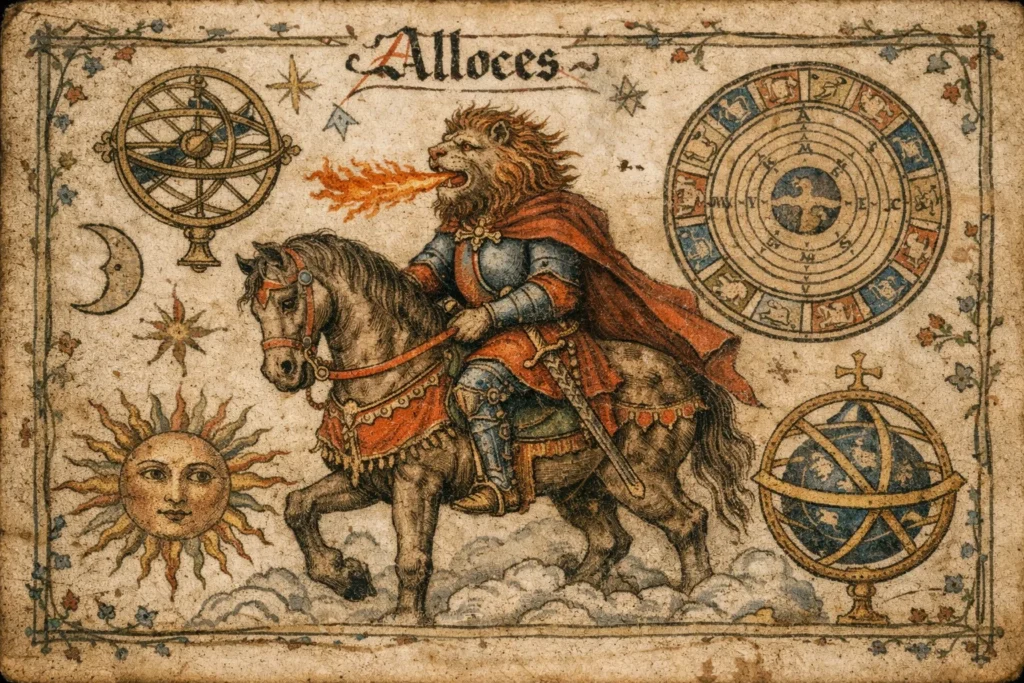
Allocer is consistently assigned the high status of a Duke in the infernal hierarchy. This rank places him among the most powerful and authoritative spirits beneath the Kings of Hell.
In the Ars Goetia, Dukes are generally listed in the middle-to-upper portion of the 72 spirits, signifying a blend of both executive command and specialized power.
His position is one of administrative and military control, allowing him to execute the will of the supreme rulers of Hell (such as Lucifer, Beelzebub, or one of the Kings of the Goetia, such as Bael).
His specific office—teaching the Liberal Sciences and Astronomy—further differentiates his rank from pure military commanders or demons of temptation. It suggests a sophisticated, strategic role where knowledge itself is a tool of corruption, fitting for a higher-ranking spirit who does more than merely incite petty sins.
Mystical Correspondences
| Attribute | Details |
| Planet | Jupiter |
| Zodiac Sign | Sagittarius |
| Element | Fire |
| Direction | East |
| Color | Blue, Violet, Red |
| Number | 9 (in some systems) |
| Crystal/Mineral | Topaz, Amethyst |
| Metal | Tin |
| Herb/Plant | Anise, Saffron |
| Animal | Lion (Head), Horse (Mount) |
Allocer’s mystical correspondences align with the infernal forces and the specific nature of his powers, particularly his knowledge of the heavens (astronomy).
His ruling planet is Jupiter, the classical planet associated with expansion, higher learning, and rulership. This celestial tie underpins his role as a Duke who grants knowledge of the Liberal Sciences. This function aligns with Jupiter’s domain over intellectual pursuits. However, in Allocer’s context, this expansive knowledge is a means to spiritual corruption.
The associated zodiac sign, Sagittarius, further focuses on this connection to higher learning, philosophy, and foreign travel (or strange lands, as mentioned in his description), making the period of the sign’s rulership (late November to late December) a time when his influence is deemed most potent.
His element is Fire, a classification that resonates with his appearance—a very Red and Fiery face—symbolizing his passion, commanding presence, and destructive potential as a powerful Duke. The metal Tin is also traditionally linked to Jupiter.
The colors Blue, Violet, and Red (Jupiter’s traditional colors, plus the color of his own fierce appearance) are recommended for use in the binding and summoning rites.
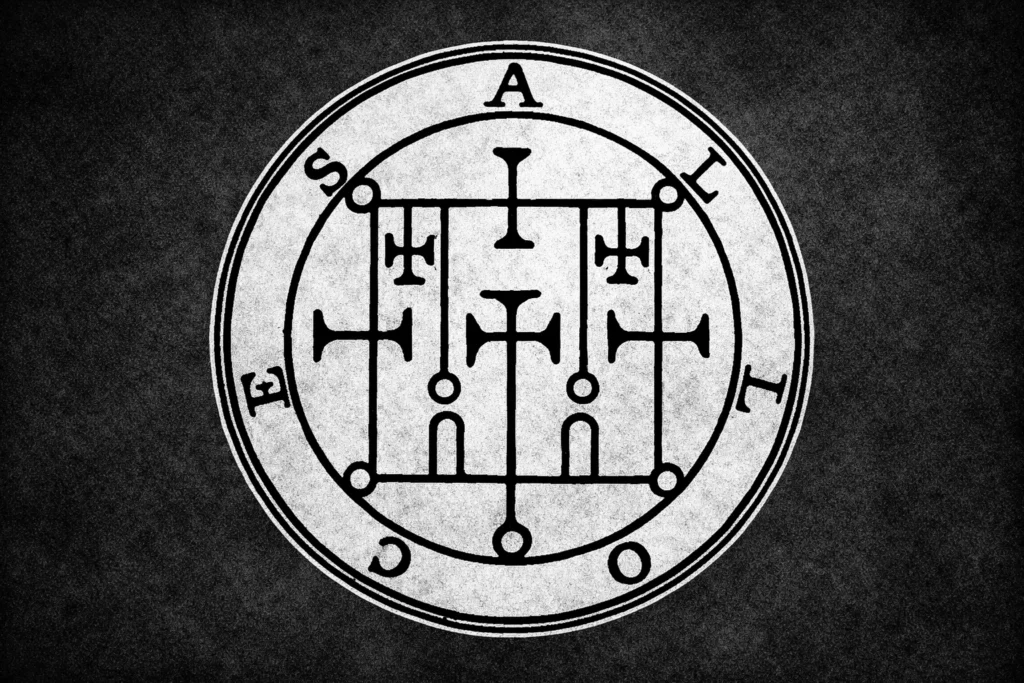
Allocer’s Sigil
Allocer’s sigil is a unique, complex entity used as a Seal of Authority within the Solomonic magical tradition. Like the seals of all 72 spirits in the Ars Goetia, his sigil is a distinctive linear entity composed of lines, curves, and angles, allegedly derived from a cryptographic transformation of the spirit’s name.
The primary purpose of the sigil is to command and compel Allocer. Historically, the sigil was engraved on a metal lamens (a protective plate or disc, often of tin due to its Jupiter association) or drawn on parchment with specific inks.
The mere display of this sigil during the ritual was said to bind Allocer to the will of the Magician, preventing him from causing harm and forcing him to answer truthfully. It served as a visual focus and a tool of spiritual authority, representing the covenant and constraint placed on him by the supposed power of King Solomon.
Summoning and Rituals
The historical methods for summoning Allocer, as detailed in the Ars Goetia and related texts, were complex and dangerous ritual operations that emphasized the magician’s authority over the demon. The primary goal of the ritual was to bind Allocer to ensure he provided the desired knowledge (astronomy, liberal arts) without causing the summoner harm.
The required tools included the Magical Circle drawn on the ground for the operator’s protection and the Triangle of Art where the spirit was commanded to appear.
Central to the operation was the use of the Seal of Allocer, which would be properly prepared and held forth. The ritual involved reciting a specific conjuration or invocation, naming Allocer and commanding him to appear by the power of a higher deity, such as Adonai or the Divine Name.
The purpose of the ritual was strictly for gaining the knowledge Allocer has—to teach Astronomy and all the Liberal Sciences—and, in some accounts, for his power to bring true answers to things hidden.
The process was intended to be one of force and constraint, relying on the alleged superior power of the magical implements and the Authority of the Seal of Solomon to subdue this Great Duke and his formidable legions.
You may also enjoy:
Bakeneko: A Supernatural Cat Yōkai in Japanese Folklore
January 27, 2026
Who Is the Demon Andras, The Great Marquis of Discord?
January 15, 2026
Who Is Abaddon, the Demon of the Abyss, in the Bible?
September 29, 2025
Chort: The Sinister Slavic Demon of Chaos and Bad Luck
March 10, 2026
Who Is Al-Abyad? The White King Jinn Who Rules Love and Chaos
January 26, 2026
Mahabali (Bali): The Benevolent Asura King
October 10, 2025
Bibliography
Author’s Note: While working on this demon profile, I noticed that the change from Weyer’s ‘soldier’ to de Plancy’s ‘knight’ shows how the infernal hierarchy was later made to fit 19th-century ideas of chivalry. What stood out to me was that, although the Ars Goetia gives Allocer a strict rank and legion count, it’s Hanegraaff’s analysis of Renaissance science that really shows Allocer’s role as a link between forbidden magic and the growing liberal arts. Balancing the ‘hoarse’ voice from 16th-century texts with the ‘gravity’ of later French accounts took careful editing to present him not just as a beast, but as a serious, intellectual creature of the abyss.
- Collin de Plancy, Jacques. Dictionnaire infernal: répertoire universel des êtres, des personnages, des livres, des faits et des choses qui tiennent aux esprits. 6th ed., Henri Plon, 1863. Internet Archive.
- De Laurence, L. W. The Lesser Key of Solomon, Goetia. Project Gutenberg, 7 Nov. 2023. Originally published by De Laurence, Scott & Co., 1916.
- Weyer, Johann. Pseudomonarchia Daemonum. Edited and translated by Joseph H. Peterson, digital edition, 2000. Twilit Grotto: Esoteric Archives.
- Gasdia, Russell. Frightful Demons and Faithful Prayer: Possession, Exorcism, and Religious Sentiments in Johann Weyer’s De Praestigiis Daemonum and Reginald Scot’s The Discoverie of Witchcraft. Academia.edu.
- Summers, Montague. The history of witchcraft and demonology. Project Gutenberg, 28 Oct. 2025. Originally published by Alfred A. Knopf, 1926.
- McCown, Chester Charlton, editor. The Testament of Solomon. J. C. Hinrichs’sche Buchhandlung, 1922. Internet Archive. Edited from manuscripts at Mount Athos, Bologna, Holkham Hall, Jerusalem, London, Milan, Paris, and Vienna.
- Bane, Theresa. Encyclopedia of Demons in World Religions and Cultures. McFarland & Company, 2012. Internet Archive.
- Nottingham, Gary St. M. Ars Theurgia-Goetia: Being an Account of the Arte and Praxis of the Conjuration of Some of the Spirits of Solomon. Avalonia, 2012. Internet Archive.
- Bufford, Rodger. Demonic Influence and the Christian: Issues and Implications for Counseling. 2008. Academia.edu.
- Hanegraaff, Wouter J. The Fragmentation of Renaissance Occultism and the Emergence of Scientism. Erasmus University Rotterdam, 2008. Academia.edu.