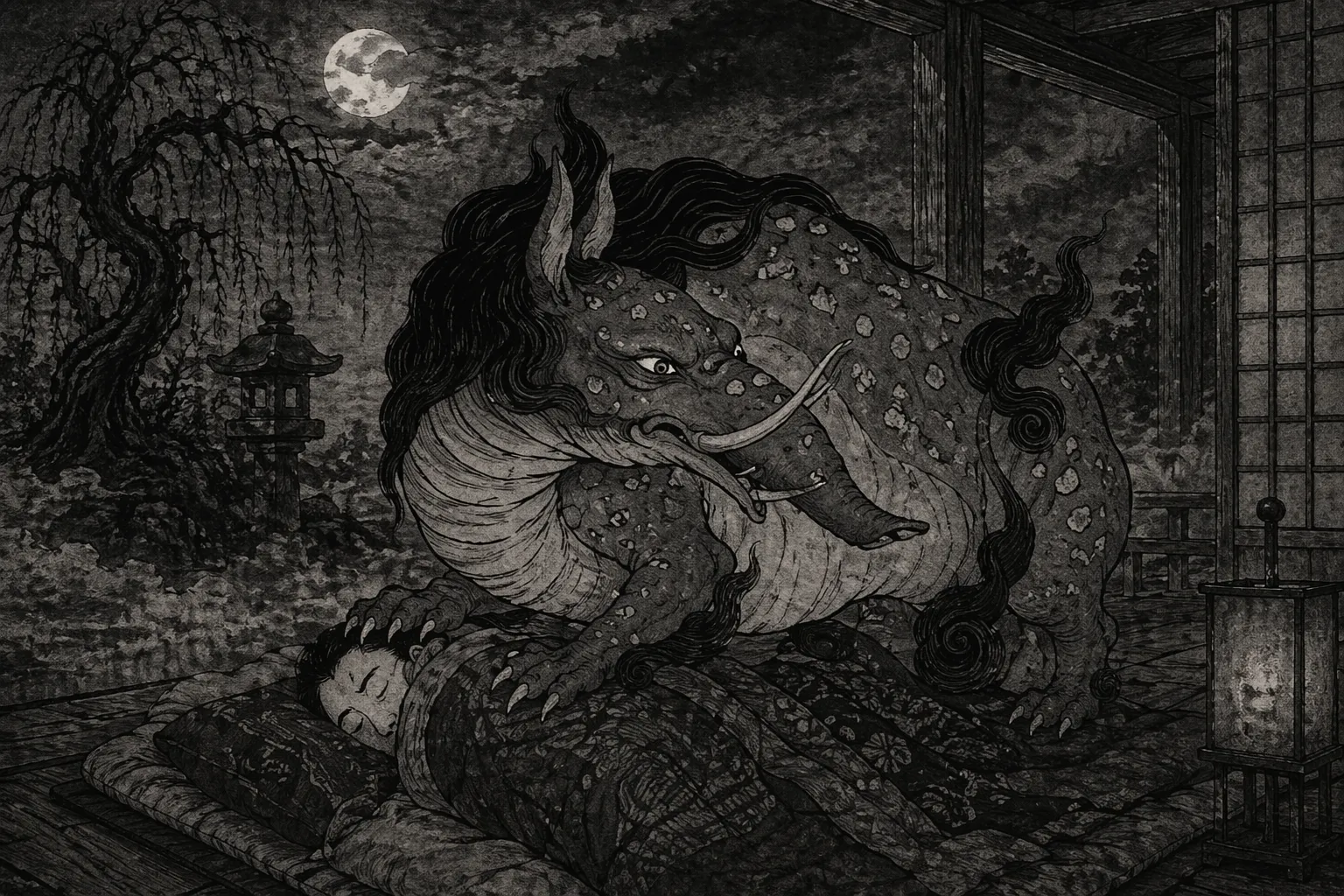
Many chimeric creatures in world mythology are seen as dangerous guardians or symbols of chaos. However, the Baku is remarkable because it helps by consuming psychic waste. Instead of representing outside threats, it is connected to the inner world of dreams.
Most yōkai are known for causing harm to humans, like the Kappa that steals souls or the Yuki-onna that brings deadly frost. Baku is different because it survives by providing a helpful service. It acts like a filter for the mind, turning nightmares into something that feeds it spiritually.
This relationship means that human fear and the spirit’s hunger work together, connecting the vulnerability of sleep with the supernatural’s protection.
To explain the Baku clearly, I look at the animal descriptions found in the Wakan Sansai Zue and compare them to the more abstract ideas from its earlier source, the Shan Hai Jing. This way, I can provide a better understanding of its history and significance. [View Full Bibliography ↓]
Summary
Key Takeaways
| Attribute | Details |
| Names | Baku, Hakutaku (historically conflated), Mo (Chinese origin) |
| Translation | The name translates to “Tapir,” though the mythical creature predates the Japanese discovery of the biological animal. |
| Title | Eater of Dreams, Guardian of the Night, Purifier of Nightmares. |
| Type | Chimerical Yōkai / Holy Beast. |
| Spirit Classification | Nigi-mitama (a gentle, protective spirit). |
| Origin | Imported from Chinese folklore during the Muromachi period; evolved from a pestilence-warding beast into a dream-eater. |
| Gender | Generally viewed as gender-neutral or ambiguous. |
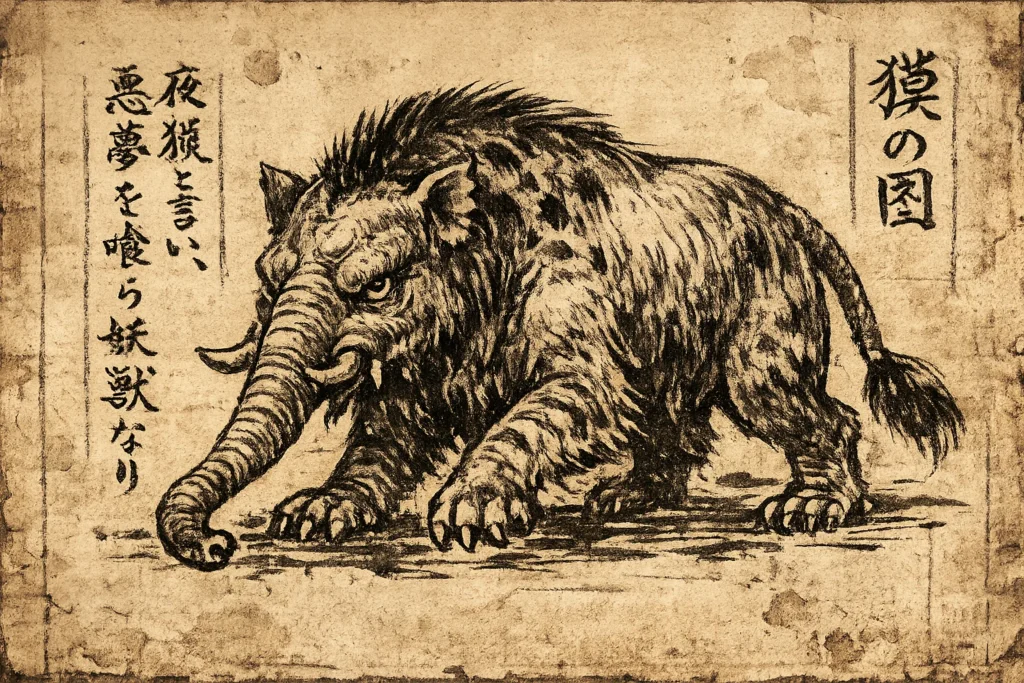
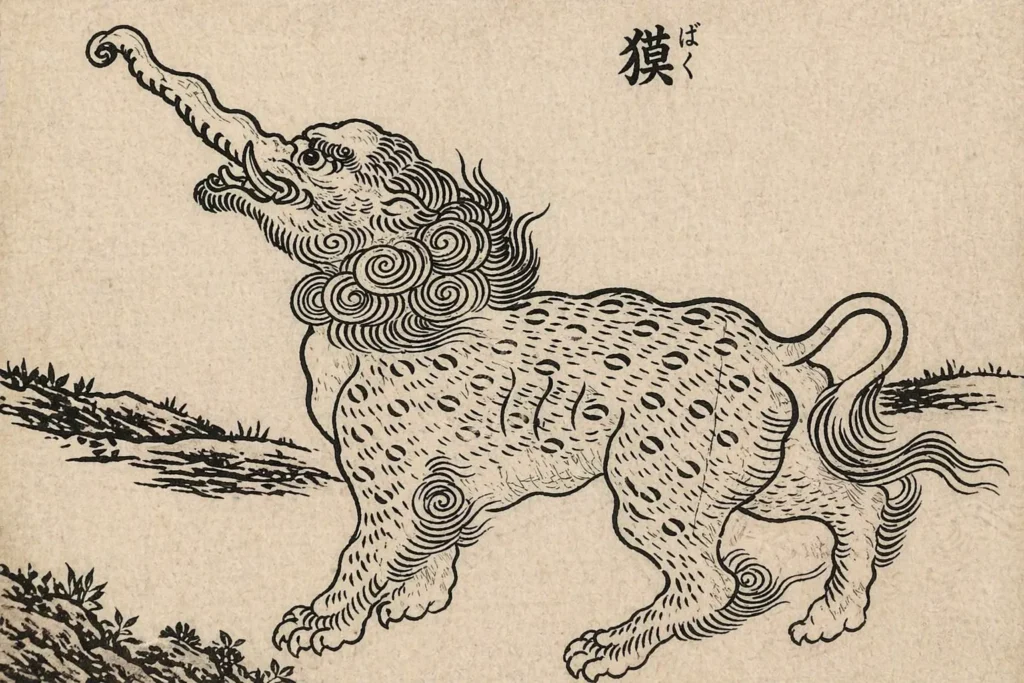
| Appearance | A composite beast with the trunk of an elephant, the eyes of a rhinoceros, the tail of an ox, and the paws of a tiger. |
| Kehai (Aura/Presence) | A calming, heavy atmosphere often described as a “stillness in the air” or a “softening of shadows” in the bedroom. |
| Powers/Abilities | Consumption of nightmares, protection against disease, conversion of bad dreams into good fortune. |
| Methods of Pacification | Invoked by reciting “Baku kurae” (Baku, come eat) three times; protected by placing its image or the kanji for its name under a pillow. |
| Habitat | The ethereal realm of dreams; historically associated with the bedrooms of nobility and the eaves of Shinto shrines. |
| Diet/Prey | Bad dreams, nightmares, and malevolent omens. |
| Symbolic Item | The “Baku” character (獏) written on paper or embroidered on pillows. |
| Symbolism | Protection, psychological purification, and the transformation of misfortune into prosperity. |
| Associated Kami | Occasionally seen as a companion to the Seven Lucky Gods or a guardian of the Directional Deities. |
| Sources | Sanko Igeta, Wakan Sansai Zue, Konjaku Hyakki Shūi. |
The Fundamental Identity of the Baku
This spirit is a kind of chimera in Japanese folklore, known for eating nightmares and the evil spirits behind them. Unlike most yōkai that bother people in the real world, these creatures mostly stay near the dream world. They are seen as holy beasts or protective spirits (zui-jū) and are often called on by people who frequent have nightmares or experience sleep paralysis.
These spirits reflect the human wish for safety during the night. They focus on the ‘poison’ in a person’s sleep—vivid, troubling dreams once thought to predict illness or bad luck. By eating these nightmares, the spirit helps the dreamer wake up feeling better and stops the bad omen from coming true.
Semantic Origins
The etymology of the name is ingrained in the Chinese character 獏 (pronounced mó in Mandarin). Originally, in ancient Chinese texts such as the Shan Hai Jing, the creature was described as a beast that could ward off evil and pestilence. When the lore was imported to Japan during the Muromachi period (1336–1573), the pronunciation shifted to its current form.
The word also means ‘tapir’ in modern Japanese. When Japanese people first saw tapirs in Southeast Asia, they noticed that the animals’ trunks and large bodies resembled those of the legendary dream-eater, so the two became linked. Edo-period texts like the Wakan Sansai Zue connect the name to stopping ‘evil vapors’ and keeping the sleeper’s space pure.
How to Pronounce “Baku” in English
To say this name in English, pronounce it as ‘Bah-koo.’ The first part sounds like ‘ah’ in ‘father’ or ‘bra,’ not like the ‘a’ in ‘back.’ The second part is a quick ‘koo,’ like the start of ‘cool’ but without the ‘L’ at the end.
What Does the Baku Look Like?
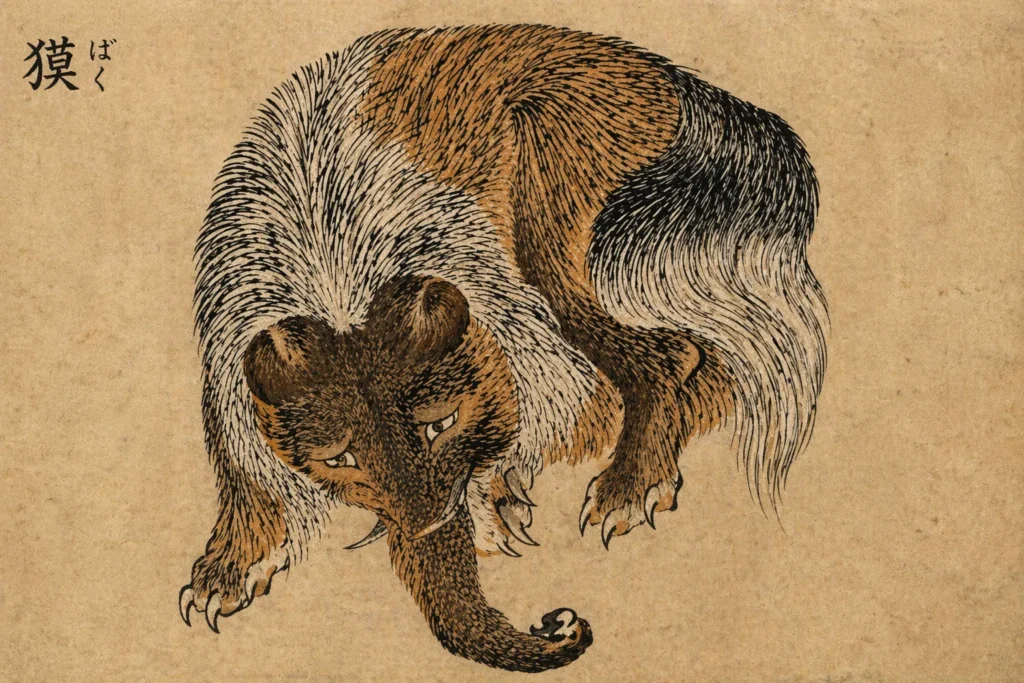
The Baku’s body is made up of parts from different animals. The Sanko Igeta, an old encyclopedia, says it was created from the ‘leftover parts’ after the gods made all other animals. This gave it a strange but balanced appearance.
It is typically depicted with an elephant’s trunk, which it uses to vacuum up nightmares from the air. Its head features rhinoceros eyes, said to pierce the illusions of the spirit world. Baku’s body is often stocky, resembling a bear or a large cat, with tiger paws and sharp claws for rending evil spirits.
The tail is usually said to be like an ox’s, but some old scrolls show it with a brush-like tail like a Kirin. Its fur can be spotted or multicolored, and in woodblock prints, it sometimes has scales or armor-like skin. This mixed look shows that it does not fit into any one group of animals.
You may also enjoy:
Chort: The Sinister Slavic Demon of Chaos and Bad Luck
March 10, 2026
Who Is the Infernal King Balam? Origins, Powers, and Occult History
February 26, 2026
Amaymon: The Infernal King Who Commands Death and Decay
November 17, 2025
Yuki Onna: The Terrifying Bride Who Feeds on Travelers
December 9, 2025
Mara: The Buddhist Demon King of Desire and Death
October 13, 2025
Who Is Baal in Christian Demonology?
February 25, 2026
Origins and History
The Baku became part of Japanese culture as Esoteric Buddhism spread and court life developed. In the Edo period, as cities grew, people increasingly cared about home safety and mental health. Nightmares were seen not just as brain activity, but as attacks from outside spirits.
I think this yōkai became popular because people felt a lot of pressure during the Tokugawa Shogunate. At that time, everything people said or did was watched, so dreams were the only private space. The idea that even dreams could be invaded by bad omens made people anxious.
Interestingly, the first reports of this spirit appeared around the same time as the rise of talismans in the 17th century. People started buying woodblock prints of the dream-eater to put under their pillows, making the myth into a real product for spiritual protection.
The creature transitioned from a general protector against ‘evil breath’ (like malaria or bad air) in China to a special’ dream surgeon’ in Japan. This evolution was likely influenced by the Japanese idea of kotodama, where saying a dream out loud or asking a spirit to eat it was thought to erase it from history.
From Plague-Warder to Psychic Purifier
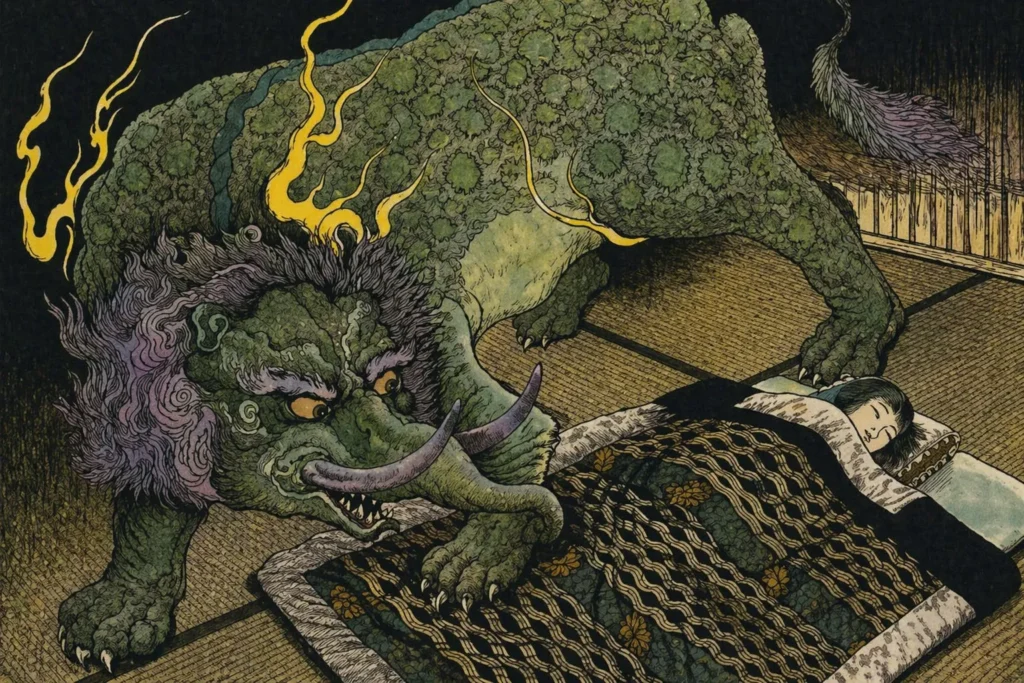
Seeing the Baku as a gentle ‘dream-eater’ is a recent idea. Early sources, such as the 17th-century Sankai Ibutsu, describe it not as a dream-eater but as a creature that ate iron and copper.
This shows that the Baku was first seen as purifying materials rather than minds. In the Muromachi period, features such as the elephant trunk and tiger paws symbolized the power to ‘digest’ tough things, especially the harmful ‘vapors’ believed to cause sickness and spiritual decay.
I believe the spirit evolved from a plague protector to a dream eater due to the growth of cities during the Edo period. As the ‘floating world’ (ukiyo) expanded, people worried less about plagues and more about stress and anxiety.
Baku’s power to eat metal, the hardest thing people knew, was later seen as a way to deal with ‘hard’ or troubling thoughts that cause nightmares. Instead of sleeping on its pelt to avoid illness, people began using the Baku kurae verbal charm, turning the idea of eating into a way to ward off bad dreams.
The trunk is not just an odd feature; it acts like a spiritual vacuum. In the Wakan Sansai Zue (c. 1712), the creature is shown as a force that brings stability to the home.
What is fascinating is its role as a ‘leftover’ deity. Folklore says it was made from the parts left over after the gods created other animals. This makes it a symbol of finding value in what is discarded or chaotic. Putting its image on a pillow means the sleeper is asking for protection from a spirit that can turn mental waste into something useful.
Habitat
This spirit mainly lives in the dream world, which links the human mind to the spirit world. In real life, people invite them into their homes. Legends say they can be found in temple eaves and in the bedrooms of important people.
As holy beasts, they are often carved into the wood of Shinto shrines and Buddhist temples, especially on pillars or lintels (kashira). They like these sacred places because they guard the boundaries. In city legends, they are said to stay in the quiet corners of a house during the day, waiting for people to fall asleep.
Famous Baku Legends and Stories
During the classical period, members of the Imperial Court and high-ranking Shoguns used pillows or headrests adorned with the image of the dream-eater.
One well-known legend tells of an Emperor troubled by a nightmare in which a skeletal hand reaches through his curtains. A court wizard advised him to write the creature’s character on a slip of paper and put it inside his silk pillow.
That night, when the skeletal hand appeared again, a trunk reached out from under the bed and ‘inhaled’ the vision. The Emperor was never troubled by the nightmare after that, and soon the use of ‘Baku-makura’ (Baku pillows) became popular among the aristocracy.
Another story comes from the Tohoku region. A poor woodcutter found a strange, injured animal in the forest that looked like a mix of many creatures. Instead of killing it for its fur, he cared for its wounds and shared his small amount of rice.
Years later, a plague of ‘nightmare sickness’ hit his village, causing people to die in their sleep from fright. The woodcutter saw the creature again, standing in his doorway. It went into every house, sniffed the air above the sleeping villagers, and swallowed the gray mists of their bad dreams. By morning, everyone in the village was healed.
Although Baku is usually kind, some stories warn against calling it too often. One tale tells of a man so afraid of even small bad dreams that he asked for the dream-eater’s help every night. After eating all the ‘bad’ dreams, the creature was still hungry. It started to eat the man’s ‘good’ dreams too: his hopes, ambitions, and joyful memories.
The man no longer had nightmares, but he spent the rest of his life feeling empty, without motivation or happiness. This legend is a reminder that balance is important and that some struggle is needed for a full human experience.
You may also enjoy:
Who Is Barqan, The Powerful Jinn King?
March 12, 2026
The Kumbhāṇḍa: Grotesque Demons of Buddhist Hell
November 13, 2025
Who Is Abaddon, the Demon of the Abyss, in the Bible?
September 29, 2025
Powers and Abilities
The dream-eater is seen as one of the most powerful ‘utility’ spirits in Japanese folklore. It may not have the destructive power of an Oni. Still, its ability to affect reality through the subconscious makes it strong.
In the yōkai hierarchy, it has a protected status. Even evil spirits like the Nurarihyon usually avoid it, since the dream-eater can ‘consume’ the intent behind an attack.
- Nightmare Consumption: The ability to physically draw out and swallow bad dreams, removing them from the victim’s memory and destiny.
- Auspicious Conversion: The power to take the negative energy of a bad omen and transform it into “good luck” or a positive fortune for the dreamer.
- Pestilence Warding: A passive aura that repels minor demons of disease and “evil winds” that cause colds or fevers.
- Ethereal Invisibility: The capacity to remain invisible to anyone who is not in a dreaming state or a state of deep meditation.
- Evil-Sensing: The trunk can “scent” the presence of a malevolent spirit or a cursed object from great distances.
Traditional Defenses Against the Baku
Since Baku is kind, ‘defense’ usually means managing its presence or making sure it does its job. The most common way to interact with it is by calling it out loud. If someone wakes up from a nightmare, they should quickly say: “Baku kurae! Baku kurae! Baku kurae!” (Baku, come eat!). People believe this calls the spirit to the bedside to finish eating any leftover bad dreams.
To keep nightmares away, traditional households would put a talisman (ofuda) with the creature’s image under the bed. In the Edo period, traveling merchants sold ‘Baku-e’ (Baku pictures) for this reason. Another way is to write the Kanji’ 獏’ on a fan or piece of paper and keep it near the head of the bed as a lasting invitation for the spirit’s protection.
To keep the spirit from becoming ‘greedy,’ as some legends warn, people offer incense or sometimes clean the shrine carvings where it is believed to live. These actions help keep the spirit gentle and peaceful, in its Nigi-mitama state.
Comparison with Similar Spirits
| Name | Category | Origin | Threat Level | Escape Difficulty |
| Hakutaku | Holy Beast | Chinese Myth (Bai Ze) | Zero (Benevolent) | N/A (Helps humans) |
| Kirin | Holy Beast | Ancient Legends | Low (Defensive) | Extreme (Divine speed) |
| Nue | Mononoke | Heian Literature | High | Hard (Chimera with lightning) |
| Makura-gaeshi | Zashiki-warashi | Edo Folk Beliefs | Low (Nuisance) | Easy (Just wake up) |
| Kanashibari | Spirit Phenomenon | Medical/Folklore | Medium | Moderate (Mental focus) |
| Dream-Eater (Western) | Urban Legend | Modern Folklore | Medium | Varies by intent |
| Satori | Mountain Spirit | Edo Period | Medium | Impossible (Reads minds) |
| Itsumade | Avian Yōkai | Taiheiki | Medium | Hard (Requires exorcism) |
| Kamaitachi | Animal Spirit | Wind Lore | High | Extreme (Too fast to see) |
| Nurikabe | Object Spirit | Coastal Legends | Low | Simple (Tap the bottom) |
Symbolism
| Attribute | Details |
| Element | Air (associated with the breath and the ethereal nature of dreams). |
| Animal | Tapir / Elephant (hybrid). |
| Cardinal Direction | Center (the heart/mind) or West (associated with the setting sun and sleep). |
| Color | Multi-colored or “Goshiki” (the five sacred colors). |
| Plant | Bamboo (often depicted in bamboo groves in art). |
| Season | All seasons, but specifically tied to “Hatsuyume” (the first dream of the New Year). |
| Symbolic Item | The Pillow (Makura). |
In Japanese culture, Baku represents order winning over the chaos of the mind. It shows that even our deepest fears can be managed and turned into something helpful. Its appearance in art and buildings highlights how much people value peace of mind and a safe home.
This spirit connects the frightening world of yōkai with the protective side of religion. While many monsters make children fear the dark, this dream-eater shows them there is a guardian in that darkness. It is still popular today, often appearing in video games and anime as a ‘dream-thief’ or psychic helper, keeping its old role as a protector of sleep.
You may also enjoy:
Who Are the Yaksha, and Why Did Buddhists Fear Their Wrath?
October 20, 2025
Who Is Ambolin, the Demon of Nighttime Dread
December 1, 2025
What Is a Dīv? The Terrifying Giant Demon of Persian Myth
January 22, 2026
Jikininki: The Japanese Ghost That Feeds on Human Corpses
February 9, 2026
The Ghul: The Flesh-Eating Demon of Arabian Folklore
October 1, 2025
Bibliography
Author’s Note: While working on this profile, I realized that there’s been a significant difference in how we view the entity depicted in the Wakan Sansai Zue compared to an earlier illustration in the Sankai Ibutsu. It used to be seen as a literal creature that consumed heavy metals. Still, now it’s understood more as a symbol for dealing with deep emotional pain. By examining these historical texts from the 18th century instead of relying on modern interpretations, I was able to move my perspective. I began to see this entity not just as a scary monster but as a kind of guardian that helped bring stability to communities during the busy urbanization of the Edo period. In this way, its physical appearance reflects its deeper role as a scavenger of our hidden fears and traumas.
- Night Parade of a Hundred Demons. Yōkai Senjafuda, Mellon Projects, University of Oregon, glam.uoregon.edu.
- Davisson, Zack. (2026). The Persistence of Yōkai. Education About Asia. 29. 10.65959/eaa.1847. ResearchGate.
- Marks, Andreas. Japanese Yōkai and Other Supernatural Beings: Authentic Paintings and Prints of 100 Ghosts, Demons, Monsters, and Magicians. Tuttle Publishing, 2023.
- Foster, Michael Dylan. The Book of Yokai: Mysterious Creatures of Japanese Folklore. University of California Press, 2015. Internet Archive.
- Terajima, Ryōan. Wakan Sansai Zue. 1712. Internet Archive.
- Hall, John Whitney, and Toyoda Takeshi, editors. Japan in the Muromachi Age. University of California Press, 1977. Internet Archive.
- Sun, Jiankun. Fantastic Creatures of the Mountains and Seas: A Chinese Classic. Translated by Howard Goldblatt, Arcade Publishing, 2021. Internet Archive.
- Stanca, Maria Doina. In Search for Chimeras: Three Hybrids of Japanese Imagination. Cogito, vol. IV, no. 2, 2012.