The Edimmu are fascinating entities that show us what happens when funerary rituals fail, acting as the clearest example of social and ritual breakdown. Most Mesopotamian spirits come from the gods or ancient chaos, but the Edimmu is remarkable as a spirit created by human actions.
It is a ghost that does not fully fit the usual idea of a ghost—a soul left restless because the living failed in their duties. This shows the ancient belief that only careful attention to rituals keeps the line between life and death in place.
In my research, I focus on sources instead of relying on popular myths. I focused on the differences in the Utukku Lemnutu series, the Epic of Gilgamesh, and the Third Dynasty of Ur. According to these sources, the Edimmu were non-physical results of neglected rituals, not the blood-drinking creatures seen in modern vampire stories. [View Full Bibliography ↓]
Summary
Key Takeaways
| Attribute | Details |
| Names | Edimmu, Ekimmu, Ekimmū |
| Title | The Restless Shadow, The Unburied Wanderer |
| Origin | Sumerian and Akkadian civilizations (c. 3000–500 BCE) |
| Gender | Ambiguous; reflects the gender of the deceased individual |
| Role | Underworld spirit and parasitic bringer of misfortune |
| Associated Deity | Ereshkigal (Queen of the Underworld) and Nergal |
| Brings | Physical illness, psychological torment, and family misfortune |
| Weaknesses | Proper funerary rites, water libations, and specific incantations |
| Realm/Domain | The Irkalla (Underworld) and the physical world of the living |
| Symbolism | The necessity of social order and the danger of neglecting the dead |
| Sources | Sumerian tablets, Utukku Lemnutu texts, Epic of Gilgamesh |
Who or What is an Edimmu?
In ancient Near Eastern beliefs, especially in Sumerian and Akkadian traditions, the Edimmu was seen as a harmful ghost of a deceased person. Unlike the Gidim, which were peaceful ghost, these spirits could not enter Irkalla, the underworld, because the proper rituals were not performed.
This often happened if the body was not buried, if family members did not make the required Kispu offerings, or if the person died suddenly or violently.
After becoming this kind of spirit, the Edimmu was seen as a parasite that preyed on the living. It would leave the dry underworld to haunt people, sometimes attaching itself to family or strangers.
People believed these spirits could possess the living and cause problems like headaches or wasting illnesses. Their presence reminded ancient Mesopotamians that the dead remained part of society and required ongoing care.
You may also enjoy:
Si’la: The Seductive Jinn Who Lures Travelers to Their Doom
October 9, 2025
Who Is Shiva, the Destroyer and the Lord of the Universe?
November 12, 2025
Barbas: The Lion Demon Who Spreads Disease
March 3, 2026
Who Is Azazel, the Demon Blamed for Human Corruption?
February 24, 2026
Who Were the Hinn, the First Spirits of Creation?
November 12, 2025
Banasura: The Thousand-Armed Demon King
October 10, 2025
“Edimmu” Meaning
The word comes from Sumerian, where ‘Gidim’ meant the spirit of the dead. As the language changed to Akkadian, the term became ‘Ekimmu,’ which sounds more threatening. In Akkadian, the verb ‘ekēmu’ means ‘to take away,’ ‘to seize,’ or ‘to snatch.’
This transition in language shows a shift in how people saw the spirit—from a simple ghost to a ‘Snatcher.’ It suggests the spirit actively takes health, energy, or peace from the living to make up for what it doesn’t have in the afterlife.
Some researchers believe the name also means being ‘deprived,’ especially of the water and bread needed in the underworld. Unlike other demons that come from the gods, the Edimmu suggests a lack of social and ritual care.
How to Pronounce “Edimmu” in English
This ancient word is usually pronounced with three syllables: eh-deem-moo. The first part sounds like the ‘e’ in ‘egg.’ The second part is stressed and sounds like ‘beam.’ The last part ends with a soft ‘u,’ like in ‘moon.’ In Akkadian, ‘Ekimmu’ is pronounced with a hard ‘k,’ as in eh-keem-moo.
What Does Edimmu Look Like?
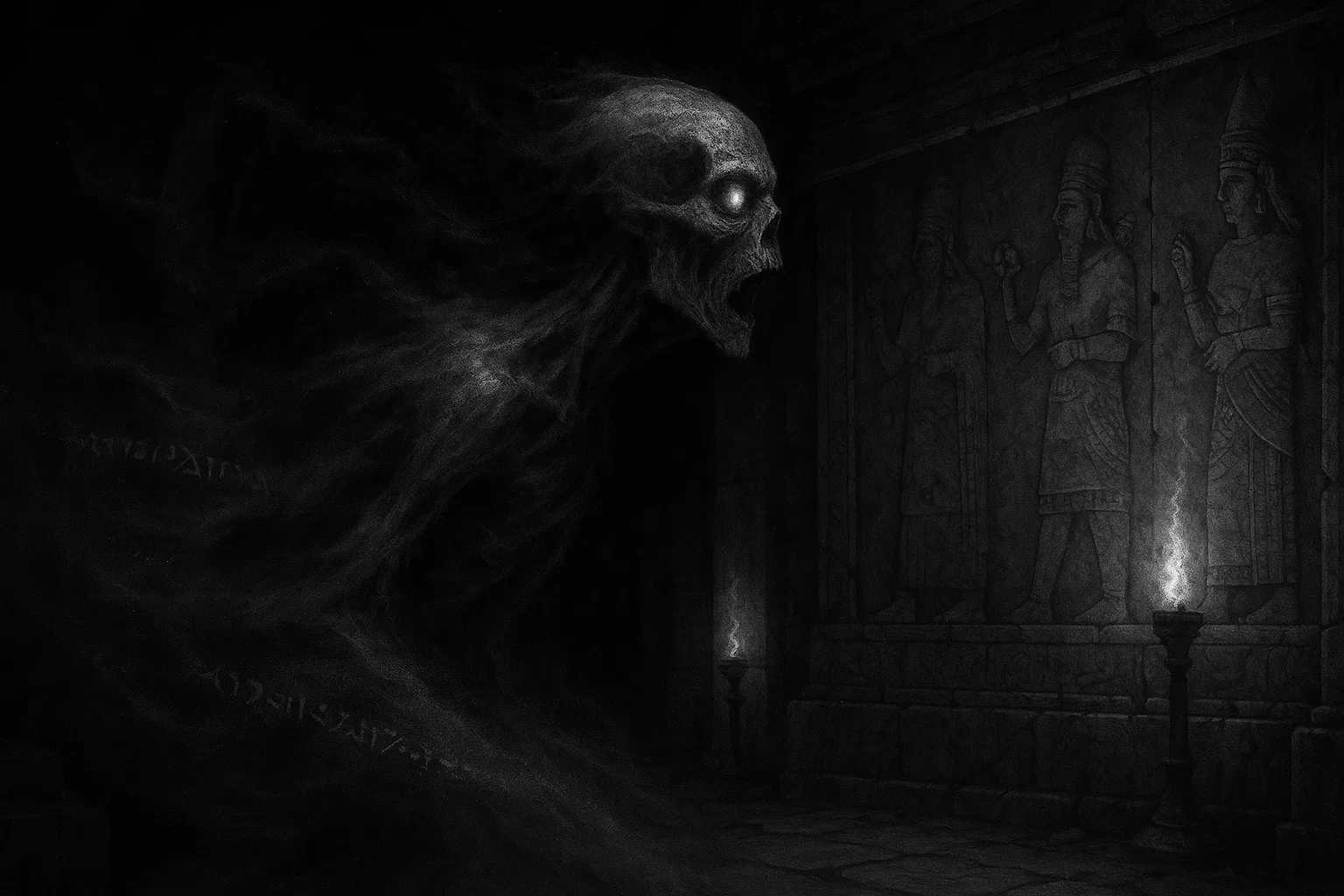
Ancient texts describe these spirits as purposeless, without a solid form, and frightening. The Edimmu are often called wind or shadow that can move through walls and doors. When they do appear, they look thin and withered, sometimes showing the wounds or sickness that caused their death. Because they lack ‘food and drink’ in the afterlife, they look ghostly and skeletal.
Some incantations say these spirits can take on scary features to frighten people, like having ‘limbs of a bird’ or ‘claws.’ This shows they are seen as predators that have lost their human qualities.
Observation: Modern stories often focus on the ‘vampire’ side of these spirits, but I notice that ancient art usually leaves them out, showing only darkness or wind marks. This suggests that ancient people found the idea of an invisible threat—a hidden parasite—much scarier than a monster you could see.
Origins of the Edimmu
The Edimmu first shows up in written records from the Early Dynastic Period of Mesopotamia (about 2900–2350 BCE), especially in Sumerian prayers and spells. The earliest mentions are in the openings of Sumerian tablets, where they are listed among the udug (spirits). However, they are called ‘evil’ (hul) due to external events.
In the Third Dynasty of Ur (about 2112–2004 BCE), a time known for strict organization and religious laws, the state’s focus on order even included the afterlife. The Edimmu was not seen as a normal part of the world, but as a mistake—a soul that was not properly recorded in the records of the underworld.
During the Neo-Assyrian period (about 911–612 BCE), the most detailed records of these spirits were found in the large library of Ashurbanipal. The Utukku Lemnutu (Evil Spirits) series explains that these spirits came from people who died in fires, were drowned, died in prison, or were killed in battle, and were left unburied.
This period saw many wars and plagues, so people often worried about bodies that were not claimed or buried. The fear of these spirits was closely tied to the breakdown of the social agreement between the living and the dead.
The “First Vampire” Mythos
Today, in pop culture and occult groups, the Edimmu is often called the ‘first vampire’ or an early version of a vampire. This idea mostly comes from stories about it draining people’s energy and leaving them unable to find peace.
People believed this spirit could attach itself to the living and drain their strength, making victims pale, thin, and sometimes leading to death. Because of this, modern writers have called it a vampire to match the popular idea of an ‘undead parasite.’
However, this modern view is not accurate and goes against the original Mesopotamian beliefs for several reasons:
- Lack of Hematophagy: There is no evidence in primary cuneiform sources that these spirits consumed blood. While they were “hungry” and “thirsty,” their diet consisted of the kispu (offerings of bread and water) or, in their lack, “dust and clay.” The “blood-drinking” trope belongs to later Slavic folklore. It has no basis in the Sumerian or Akkadian concept of the restless shadow.
- Incorporeality vs. Corporeality: A classic vampire is a reanimated body that leaves its grave. The Edimmu, on the other hand, is a spirit without a body (Gidim). It is the opposite of a body. Ancient people did not fear a corpse rising, but rather that the shadow of the dead would come back as wind or a presence if the body was destroyed or ignored.
- Method of ‘Infection’: Vampires are usually shown spreading their curse by biting. In Mesopotamian belief, you could not become a demon by contact. A person becomes a restless spirit only if they die in a certain way and their family does not perform the proper rituals.
In my view, calling these spirits ‘vampires’ is a Western idea that takes away their real cultural meaning. Both types show a fear of the dead harming the living.
Still, the original spirit represents a community’s failure, while the modern vampire is about personal infection. Calling them vampires ignores the ancient belief that the dead did not want to harm the living—they only did so because people failed to remember them properly.
Connections to Other Ancient Demons
| Name | Genealogy | Type | Appearance |
| Pazuzu | Babylonian | Wind Demon | Lion head, bird wings, scorpion tail |
| Lamashtu | Akkadian | Child-snatcher | Lion head, donkey teeth, hairy body |
| Gallu | Sumerian | Underworld Constable | Humanoid but cold and featureless |
| Utukku | Mesopotamian | Vengeful Spirit | A tall, shadowy human form |
| Alû | Assyrian | Nightmare Demon | Leper-like, missing limbs or features |
| Lemures | Roman | Restless Dead | Vague, terrifying skeletal wraiths |
| Vetalas | Hindu | Reanimated Corpse | Bat-like hanging from trees |
| Keres | Greek | Death Spirits | Dark-winged females with gnashing teeth |
| Dybbuk | Jewish | Possessing Spirit | Invisible; takes on the host’s form |
| Strigoi | Dacian/Romanian | Troubled Spirit | Pale human with animalistic traits |
You may also enjoy:
The Ghul: The Flesh-Eating Demon of Arabian Folklore
October 1, 2025
Pazuzu: The Ancient Demon Who Fought Evil with Evil
November 4, 2025
Who Is the Infernal King Balam? Origins, Powers, and Occult History
February 26, 2026
Who Is Asmodeus in Demonology and the Bible?
February 18, 2026
Who Is Hariti, the Mother of Ogres in Buddhist Mythology?
December 8, 2025
Aeshma: The Zoroastrian Demon of Wrath and Fury
January 13, 2026
Powers and Abilities
These spirits are powerful because they are persistent and invisible. They are not as mighty as beings like Tiamat, but they can be very dangerous to individuals and families. Their main power is spreading ‘The Hand of the Ghost’ (Qat Gidim), a supernatural illness that affects both the body and mind.
- Spiritual Possession: The ability to enter a human body through the ears or nose to cause madness.
- Vitality Siphoning: Acting as a parasite, they drain the strength of the living to sustain their own shadow-existence.
- Disease Manifestation: They are credited with causing specific ailments, including ear infections, muscle wasting, and chronic fevers.
- Environmental Corruption: Their presence can cause the “withering” of a household’s luck or the souring of food and drink.
The Parasitic Void
In my research, I have found a key difference between these spirits and other demons in Mesopotamian stories. Spirits like Pazuzu or Lamashtu are considered ‘divine’ because they come from the god Anu. Still, the Edimmu is completely created by humans—a monster born from human mistakes.
This shows that ancient people realized something frightening: the greatest threat to the order of the universe was not just chaos from the gods, but also people failing in their social duties.
I believe these spirits do not stand for ‘evil’ in a moral way, but for the breakdown of rituals. They represent the underworld spilling into the world of the living because funeral customs were not followed.
I find it interesting to look at these spirits’ symptoms from a medical and social point of view. In the Utukku Lemnutu and other medical texts, the ‘Hand of the Ghost’ is linked to symptoms that today might be called tuberculosis or wasting diseases.
Descriptions like ‘dryness,’ ’emaciation,’ and ‘constant cold’ are not just poetic—they are real observations of how bodies decay, similar to the dry, dusty underworld described in Mesopotamian beliefs.
I think that by blaming these wasting illnesses on restless spirits, ancient societies encouraged people to care for public health. Making proper burial and giving water to the dead a religious duty meant that people had to look after both the living and the dead, which helped stop the spread of real diseases.
My research also shows that fear of these spirits had a practical use in folk magic. While the official religion focused on the big system of Ereshkigal, folk magic saw the Edimmu as a problem that could be managed, like a social debt.
Using the arūtu (libation pipe) was an advanced way for ancient people to deal with grief. By pouring water through a pipe into the ground, the living were thought to calm or ‘ground’ the spirit. I see this as an early form of grief support and a way to keep society stable.
The ritual of ‘feeding’ the ghost helped people cope with sudden or violent loss by giving them something real to do, which made them feel the universe was back in balance.
In this way, the spirit played an important role: it ensured that everyone in the community, even those on the edges, was remembered and not forgotten, without consequences.
Rituals, Amulets, and Protective Practices
Ancient rituals had two main goals: to drive the spirit out or to calm it. If someone was possessed, the ritual tried to remove the spirit. If the haunting happened because of neglect, the ritual gave the spirit the ‘food’ it wanted. The main idea was to restore the boundary that had been broken.
Incantations and Ceremonies
The Āšipu (exorcist) led ceremonies that used sympathetic magic. This often meant making a clay or wax figure of the restless spirit. The exorcist would ‘feed’ the figure and then bury it, acting out the burial the spirit missed in life.
One primary incantation recorded in the Utukku Lemnutu (Evil Spirits) series follows:
“Zi Dingir Anna Kanpa, Zi Dingir Kia Kanpa”
(Spirit of the Heavens, be adjured! Spirit of the Earth, be adjured!)
“Whether thou art a ghost that hath come from the earth,
Or a ghost that hath no one to care for it,
Or a ghost that hath no one to pour libations,
Or a ghost that hath no name,
Be thou removed! Be thou far away!
Unto the House of Dust, may thy face be turned!”
These rituals required special offerings, especially clear water poured into a pipe (arūtu) buried with flour or roasted grain.
Amulets and Talismans
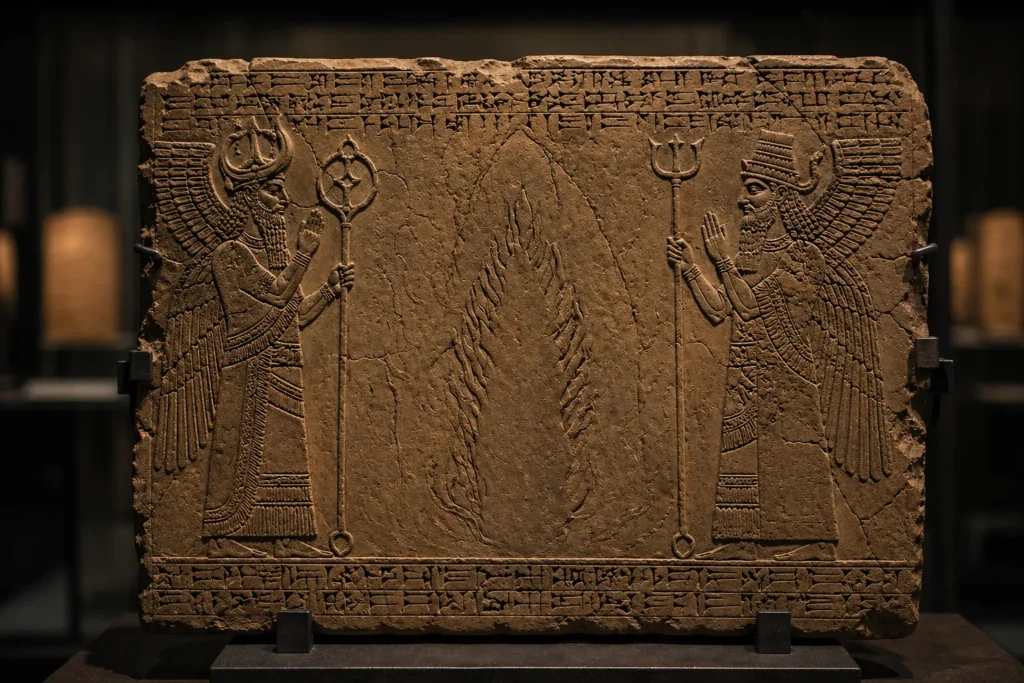
For protection, people often used hematite or black stone cylinders, which were thought to keep away shadows. Amulets often showed the god Pazuzu, who, even though he was a demon, was called on to drive away other spirits.
People believed that the sound of bronze bells or stone beads could stop the spirit from attaching itself to a person. These items were usually hung at the edges of a home, like windows and doorways, to keep the wind-like spirit from coming in.
Professional Practitioners
The Āšipu was the main expert for handling these spirits. Unlike the Bārû (diviner), the Āšipu was trained in sacred rituals and exorcism. They often worked with the Asû, who was the physician.
If a doctor’s herbs did not work, the Āšipu was called to deal with the spiritual cause of the illness. They acted as go-betweens, asking the dead to accept offerings and go back to the underworld, often using formal words to ‘evict’ the spirit from the sick person.
- Protective Figurines: Burying or placing clay figurines of benevolent protective demons or spirits (apkallu, ugallu, etc.) around the house to ward off evil.
- Amulets of Protective Deities: Wearing amulets depicting powerful deities or demons known for their protective qualities against evil, such as Pazuzu, who, despite being a demon himself, was often invoked to protect against other demons (like Lamashtu).
- Ritual Use of Water: Water, as a domain of Ea, the god of wisdom and exorcism, was integral to ritual purification, a key element in countering all malevolent spiritual influences.
You may also enjoy:
Ammit: Devourer of the Dead in Ancient Egyptian Mythology
November 10, 2025
Ifrit: Demon of Fire Who Serves Iblis in Islamic Tradition
September 30, 2025
What Is Baku? The Bizarre Yōkai That Eats Nightmares
January 28, 2026
What Is the Abumi-guchi Yōkai and Why Does It Wait Forever?
October 22, 2025
Bibliography
Author’s Note: My research focused on Kispu offering records and the Utukku Lemnutu series, making sure to highlight the difference between ritual neglect and true malice. Studying Tablet XII of the Epic of Gilgamesh helped me see the spirit’s lack as a social and legal problem, not a medical one, which let me clearly separate it from the ‘vampire’ idea. By comparing Neo-Assyrian medical spells with older religious texts, I developed a view of the spirit as a link between ancient public health and the preservation of community memory.
- Geller, Markham J. Healing Magic and Evil Demons: Canonical Udug-hul Incantations. De Gruyter, 2015. Internet Archive.
- Konstantopoulos, Gina. (2020). Demons and exorcism in ancient Mesopotamia. Religion Compass. 14. 10.1111/rec3.12370.
- Heidel, Alexander. The Gilgamesh Epic and Old Testament Parallels. University of Chicago Press, 1946 (repr. 1963).
- George, Andrew. Mesopotamian Incantations and Related Texts in the Schøyen Collection. CUSAS 32, ISBN 9781934309667, 2016. Academia.edu.
- Steinert, Ulrike. (2018). Catalogues, Texts and Specialists: Medicine, Magic and Divination. 10.1515/9781501504914-008. ResearchGate.
- Damsma, A. ‘Spirits of the Dead’ or ‘Necromancers’? The eṭemmū in an Old Assyrian Letter Reinterpreted in Light of Hebrew ’ōbôt, yidde‘ōnîm, and ’iṭṭîm. Religions 2025, 16, 614. https://doi.org/10.3390/rel16050614.
- Katz, Dina. Sumerian Funerary Rituals in Context. Academia.edu.