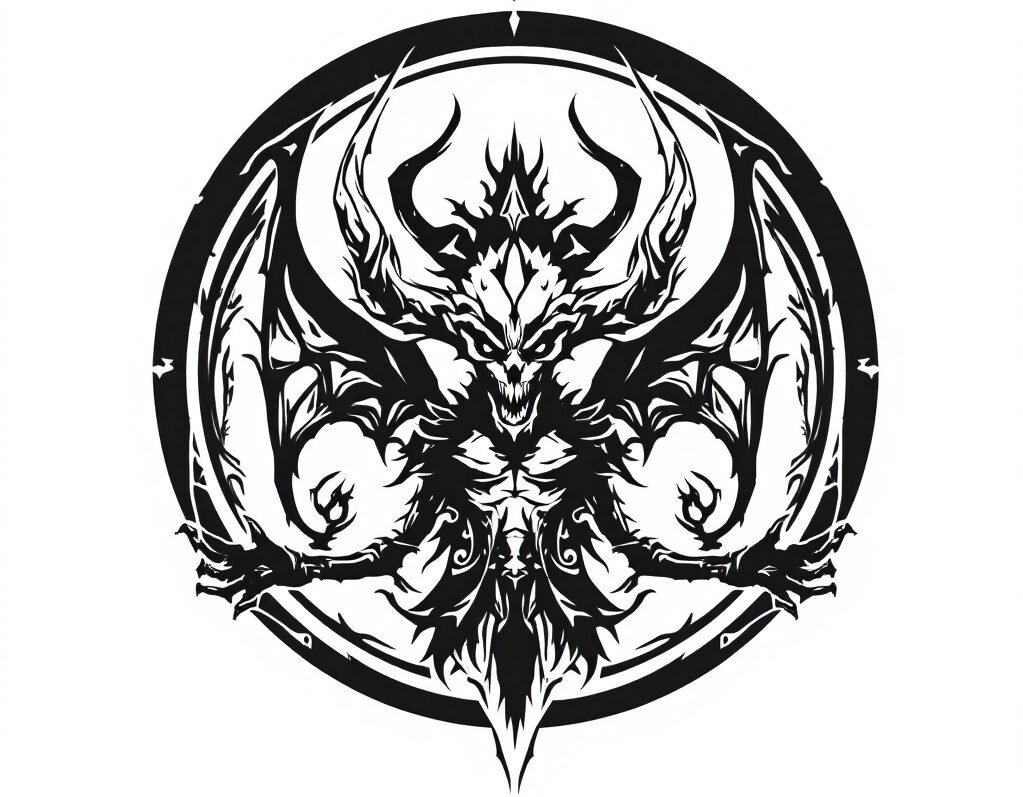
Astaroth’s story is one of the most complex examples of gender change in religious history. The Phoenician Queen of Heaven was deliberately transformed into a foul-breathed Grand Duke of the Abyss. Unlike most Goetic spirits, who are known for chaos, Astaroth uses intellect and the ‘Liberal Sciences’ to tempt people, turning the search for knowledge into a trap that leads to spiritual laziness.
By following Astaroth’s history from the respected goddess Astarte to a servant bound by Solomon, we see how Christian writers changed a deity’s image. Over time, her dignity was stripped away, turning her into a symbol of human indifference.
This article looks at modern digital stories about Astaroth using sources like the Ars Goetia and Pseudomonarchia Daemonum to build a historical profile based on evidence. [View Full Bibliography ↓]
Summary
Key Takeaways
| Attribute | Details |
| Names | Astaroth, Ashtaroth, Asteroth, Astarot |
| Title | Great Duke of Hell, Lord of Treasures, Prince of Accusers |
| Gender | Masculine (in demonic form), though derived from a feminine deity |
| Role | Sower of discord, tempter of sloth, and teacher of liberal sciences through deceit |
| Rank | Grand Duke; one of the first three of the infernal hierarchy |
| Hierarchy | Serves under Lucifer; superior to four sub-princes: Oriens, Paimon, Ariton, and Amaimon |
| Legions | 40 Legions |
| Powers | Grants knowledge of the past and future, reveals secrets, and induces laziness |
| Associated Figures | Lucifer, Beelzebub, Astarte, Solomon |
| Weaknesses | The magical ring of Solomon, specific holy names, and the presence of St. Bartholomew |
| Opposing Angel/Saint | St. Bartholomew |
| Pantheon | Christian demonology with Semitic origins |
| Primary Sources | Ars Goetia, Pseudomonarchia Daemonum, Dictionnaire Infernal, The Book of Abramelin |
Who or What is Astaroth?
Astaroth is a major demon in Western occultism and Christian demonology, known as a Grand Duke of the Abyss. He is often shown as a treasurer or high-ranking advisor in the spirit world. Unlike lesser demons who cause physical harm, Astaroth is said to tempt people by offering secret knowledge or encouraging laziness.
As the 29th spirit in the Goetia, Astaroth is seen as very powerful and should be approached with great care. He is not wild or chaotic, but rather a creature of authority among demons. His main role is to reveal secrets and teach the ‘liberal sciences,’ but these gifts are often seen as ways to lead people away from faith and into pride or laziness.
“Astaroth” Meaning
The name Astaroth comes from the Phoenician goddess Astarte, who was called Ashtoreth by the ancient Hebrews. In Hebrew, Ashtoreth is a plural form (Ashtarot) and was often used in the Old Testament to refer to goddesses in general or to the Canaanite fertility goddess.
Over time, the name changed from a female goddess to a male demon through a process called interpretatio Christiana, in which pagan gods were reinterpreted as evil spirits. Hebrew scribes probably changed the vowels in Astarte’s name, using those from the word bosheth, which means ‘abomination,’ to form Ashtoreth.
By the time medieval grimoires were written, the ‘th’ ending, which is common in Hebrew feminine plurals, became part of the name for a single male demon. In the Dictionnaire Infernal, the name Astaroth was set, and he was no longer linked to fertility or war but instead to the infernal treasury and the temptation to be idle.
How to Pronounce “Astaroth” in English
In English, Astaroth is usually pronounced as AS-tuh-roth or AS-tar-oth. The first part, ‘AS,’ rhymes with ‘pass.’ The middle is a soft ‘tuh,’ and the last part, ‘roth,’ rhymes with ‘moth’ or ‘broth.’ Some occultists say as-TAR-oth, stressing the second syllable, but the first way is more common in academic settings.
What Does Astaroth Look Like?
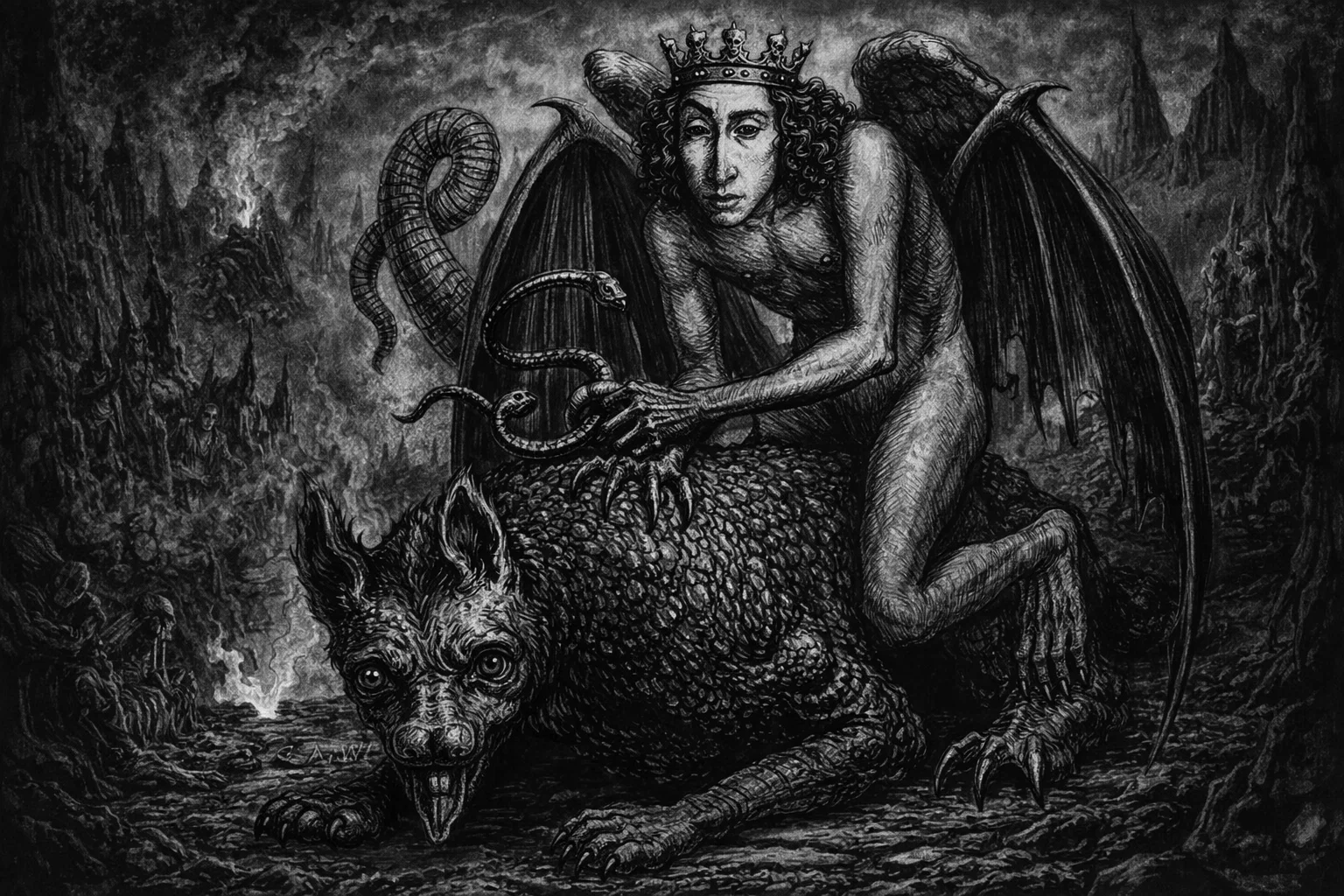
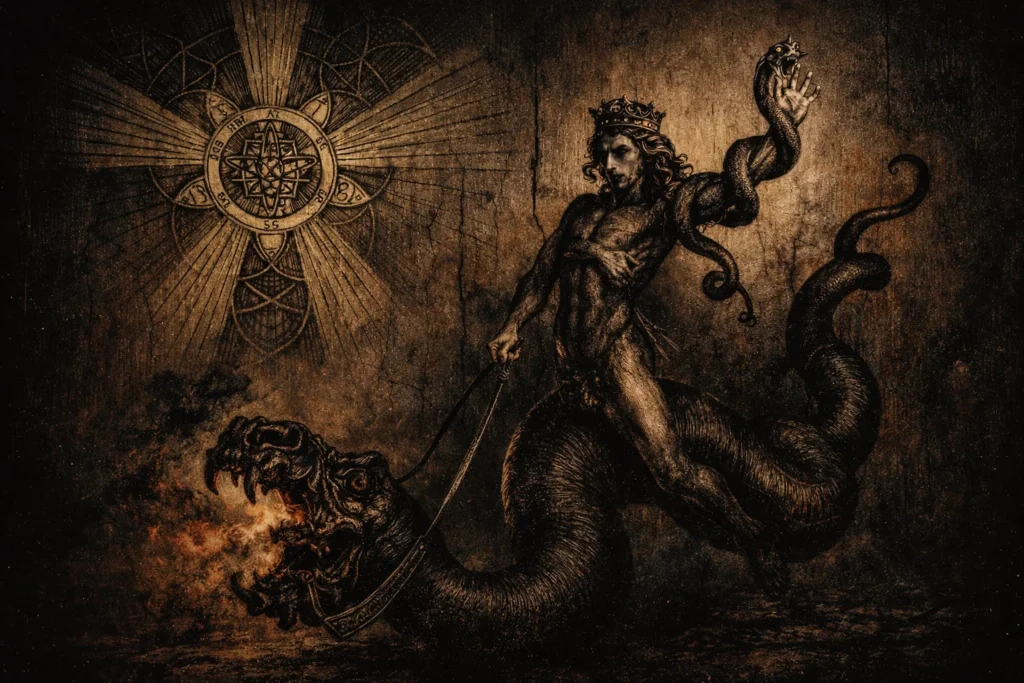
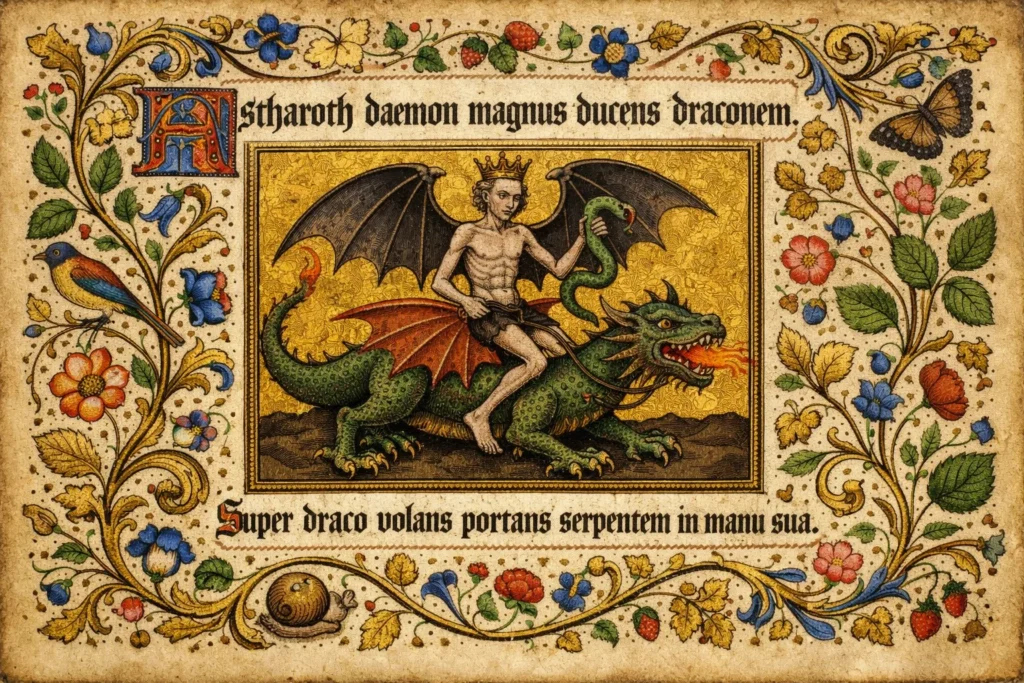
Astaroth is described in many grimoires as having a strange and unsettling appearance. In the Ars Goetia and the Pseudomonarchia Daemonum, he is shown as a ‘foul angel’. He is usually pictured riding a dragon or a dragon-like beast with a long tail.
He has a viper in his hands, symbolizing his poisonous influence and his link to the ancient serpent. Some say he still looks somewhat angelic, but he gives off a strong, foul breath that is said to be deadly or very harmful to anyone who inhales it.
To protect themselves from the smell, people were once told to hold a silver ring in front of their faces. Later images, like the woodcut in Collin de Plancy’s Dictionnaire Infernal, show Astaroth with thin, gaunt features and feathered wings, sitting on his reptilian mount.
You may also enjoy:
Marid: The Ocean Jinn That Defies Heaven and Earth
September 30, 2025
Bakeneko: A Supernatural Cat Yōkai in Japanese Folklore
January 27, 2026
Who Are the Yaksha, and Why Did Buddhists Fear Their Wrath?
October 20, 2025
Who Was Hiranyaksha, the Golden-Eyed Asura?
October 7, 2025
Who Is Shiva, the Destroyer and the Lord of the Universe?
November 12, 2025
Origins
The Devolution of the Queen of Heaven
Astaroth’s origins go back to the Bronze Age Levant, where the goddess Astarte was worshipped. Astarte was the Phoenician version of Ishtar and Inanna. As the ‘Queen of Heaven,’ she was a complex goddess linked to both war and love. Her connection to the Morning Star (Venus) showed her role as a symbol of light and order.
The transformation into a demonic entity was a deliberate act of linguistic and theological polemic by Israelite scribes. In the Hebrew Bible, the goddess’s name was altered to Ashtoreth. This was achieved through a “vowel-pointing” technique: the consonants of Astarte (STR−T) were combined with the vowels of the Hebrew word bosheth, meaning “shame” or “abomination.”
This language change was meant to insult the goddess and strip her of her heavenly status. The plural form Ashtaroth became a general insult for ‘foreign idols,’ turning a once important goddess into just another symbol of spiritual impurity.
Interpretatio Christiana
The transition from a “shameful goddess” to a masculine “Grand Duke of Hell” was finalized through the process of Interpretatio Christiana during the medieval and Renaissance periods. As Christian demonologists sought to categorize the “infernal court,” they used the Latinized, singular version of the Hebrew plural: Astaroth.
This change was more than just a matter of grammar; it changed the meaning. By the 15th century, books like the Livre des Esperitz had removed all links between Astaroth and fertility or war. Instead, the ‘Morning Star’ connection was now seen as a link to Lucifer.
This change made it possible for Astaroth to join the ‘Unholy Trinity’ with Beelzebub. He was now known for intellectual pride and harmful speech, which was very different from the life-giving or violent powers of the original Phoenician goddess.
The Fall of the Seraphim
According to the 1612 account by Sebastien Michaelis in The Admirable History, Astaroth’s origins are tied to the highest reaches of the celestial choir.
Before the foundations of the world were laid, he was a Prince of the Order of Seraphim, the six-winged entities who surround the Throne of God. When Lucifer began his dissent, Astaroth did not fall through a desire for violence, but through a refined, logical arrogance.
The legend suggests that Astaroth served as the rebellion’s primary “social recruiter.” He argued that the angelic host, beings of pure spirit and fire, should not be made subservient to the “clay” of the upcoming human creation. While other angels fell through blind passion, Astaroth fell through a calculated refusal to accept divine hierarchy.
After losing to the Archangel Michael, Astaroth was thrown into the abyss, but kept a ‘foul angelic’ appearance. Unlike other demons who became beast-like, Astaroth’s thin, twisted, and feathered look is a lasting sign of what happens when intellect is used for betrayal.
Relevant Historical & Grimoire Mentions
While Astaroth does not appear as a single male demon in the Bible, its historical record dates to the 13th century in the Livre des Esperitz, following a long linguistic evolution from the Semitic goddess Astarte.
Original:
“Le .vi.e. est appellé Astarot. Cil est mout grans sires. Et si a .xl. legions de malvais esperis en sa subjection. Et si donne responce de toutes choses qui sont demandees, soit de l’aventure qui est a venir, ou de ce qui est passé. Et si scet toutes les sciences. Et si se pert en guise d’un angle mout bel, et si chevauche un dragon.” [Livre des Esperitz (The Book of Spirits), 13th-century French Manuscript]
Translation:
The sixth is called Astarot. He is a very great lord. And he has 40 legions of evil spirits under his subjection. And he gives answers to all things that are asked, whether of the adventure which is to come, or of that which is past. And he knows all the sciences. And he appears in the guise of a very beautiful angel, and he rides a dragon.
This 13th-century record is among the earliest instances of Astaroth being described as a separate Western spirit. At this point, he was still called a ‘very beautiful angel,’ which shows that people still remembered his divine origins before later stories described him as foul and ugly.
In language, this is where Astarte changes from a female goddess to the male ‘Lord’ Astarot. The mention of ‘all the sciences’ as his power shows that even in the 1200s, the Church saw secret knowledge as possibly dangerous. The dragon he rides connects old serpent symbols from the Near East to the dragon images of the medieval devil.
“Astaroth is a great and a strong duke, comming foorth in the shape of a fowle angell, sitting upon an infernall dragon, and carrieng on his right hand a viper… he answereth truly of matters present, past, and to come, and of all secrets. He talketh willinglie of the creator, and of the fall of the angels, and how they sinned and fell: he saith he fell not of his owne accord. He maketh a man woonderfull learned in the liberall sciences.” [Pseudomonarchia Daemonum, Johann Weyer, 1577]
By the late 1500s, Johann Weyer’s description changed Astaroth’s image. The ‘beautiful angel’ from earlier times became a ‘foul angel.’ This matched the Reformation’s focus on the corruption and trickery of fallen spirits. The viper in his hand highlights his dangerous way with words.
Theologically, this source introduces the “Tragedy of the Rebel” motif. Astaroth is no longer just a source of information; he is a conversationalist who “talks willingly” about the Fall, specifically claiming he “fell not of his own accord.”
This made Astaroth the classic example of a Sophist—a demon who uses logic and claims to be a victim to gain sympathy. His link to the ‘liberal sciences’ became official, making him a symbol of intellectual pride during the Renaissance.
Original:
“Astaroth, grand-duc très-puissant aux enfers. Il a la figure d’un ange fort laid, et se montre assis sur un dragon infernal; il tient à la main droite une vipère. Quelques magiciens disent qu’il préside à l’occident, qu’il est trésorier des enfers, et qu’il ne vient que si on l’appelle par son nom… Il est le protecteur des sciences libérales.” [Dictionnaire Infernal, Collin de Plancy, 1863]
Translation:
Astaroth, very powerful grand-duke in hell. He has the face of a very ugly angel, and shows himself seated on an infernal dragon; he holds a viper in his right hand. Some magicians say that he presides over the west, that he is the treasurer of hell, and that he only comes if called by his name… He is the protector of the liberal sciences.
De Plancy’s 19th-century description shows the final step in making Hell seem like a bureaucracy. He keeps the ‘ugly angel’ image but adds the title ‘Treasurer of Hell.’ This change reflects the fact that, after the Enlightenment, demons were seen more as officials in a government of Hell than as cosmic rebels.
Assigning Astaroth to the ‘West’ is a big change from earlier Goetic texts, which were usually vague about directions or gave them to other spirits. In 19th-century occult beliefs, the West was linked to the setting sun and the border of the spirit world.
The insistence that he “only comes if called by his name” highlights the ritualistic precision required in modern ceremonial magic, moving away from the more narrative “interviews” found in 17th-century exorcism accounts.
Powers and Abilities
Astaroth’s powers mainly affect people’s minds and moral strength. Unlike demons who use physical force, his influence is more subtle and works on a psychological level. He is said to possess perfect knowledge of the past, present, and future, which enables him to manipulate people by revealing secrets they shouldn’t know.
He often uses the ‘Liberal Sciences’ as part of his power. Astaroth can quickly teach someone difficult subjects like math, astronomy, and philosophy. But this is seen as a trap, since the knowledge is meant to make people proud and pull them away from their faith.
Astaroth is also known as the main source of Sloth, one of the Seven Deadly Sins. He doesn’t make people lazy directly; instead, he fills their minds with doubt and distractions, making it feel pointless to do spiritual or physical work.
Astaroth is also said to have the power to reveal the location of hidden treasures. In 16th-century demonology, this could mean treasures of the mind or lost objects. Since he commands 40 legions, he can send spirits to watch any place on Earth, making his ‘vision’ almost everywhere in the physical world.
Astaroth and the Perversion of the Quadrivium
Astaroth’s role as a teacher of the ‘liberal sciences’ in the Ars Goetia is sometimes seen as less important, but it actually shows a medieval criticism of learning that is separated from religious purpose.
In the 16th and 17th centuries, as society moved from scholasticism to the scientific revolution, people became anxious about unchecked curiosity. The demon came to represent this dangerous desire for knowledge that feeds the ego instead of the soul.
By teaching subjects like astronomy, geometry, and philosophy, he leads people into a confusing search for knowledge that causes them to forget their faith.
This connection explains why Astaroth is called the Grand Duke of Sloth (Acedia). In old theology, acedia meant more than just laziness—it was a kind of spiritual emptiness or boredom with the divine. Astaroth’s role is to use intellectual excitement to cause spiritual paralysis.
He stands for the ‘Academic Trap,’ where someone gathers endless facts and secrets but cannot act morally or spiritually. His ‘foul breath’ is a symbol for knowledge that goes nowhere—information that is taken in and let out, but never turned into real wisdom.
The change from Astarte’s life-giving connection to Venus to Astaroth’s link with air and foul breath reflects a shift in Western ideas about the ‘Word.’ Astarte stood for creative power, while Astaroth stands for the corruption of breath or spirit. In the Pseudomonarchia Daemonum, the need for a conjurer to use a silver ring to block the smell suggests a way to guard against deceptive inspiration.
The demon is like the dark side of the Renaissance scholar. He knows everything about the past and future, but cannot live in the present. In this way, the ‘Morning Star’ of intuition becomes the ‘Setting Sun’ of cynicism.
You may also enjoy:
Yuki Onna: The Terrifying Bride Who Feeds on Travelers
December 9, 2025
Who Is Abaddon, the Demon of the Abyss, in the Bible?
September 29, 2025
Who Is the Demon Andras, The Great Marquis of Discord?
January 15, 2026
Who Is Abalam in Demonology? The Demon King That Serves Paimon
September 30, 2025
What Is a Qareen and Why Does It Follow Every Human Being?
October 8, 2025
Astaroth Myths, Legends, and Stories
The Debate with the Exorcist
In Francis Barrett’s The Magus (1801) and earlier Solomonic traditions, Astaroth is uniquely characterized not by roars but by a chillingly calm eloquence.
During the 17th-century exorcisms of Sister Madeleine de Demandolx, Astaroth famously engaged the priests in a sophisticated debate rather than retreating in terror. He is described as a “talkative” spirit who frequently complains of his “unjust” treatment.
The demon’s primary tactic is the Appeal to Sympathy. He claims he did not fall by choice, but was misled by the more powerful Lucifer, arguing that he is a tragic victim of a cosmic misunderstanding. This narrative was historically used by demonologists to warn practitioners of the “Sophistry of Hell.”
Astaroth does not tempt the flesh; he tempts the mind by making the practitioner feel superior to the “harsh” laws of God. By acting as a misunderstood scholar, he lures the curious into a state of spiritual pride, eventually leading them into the sin of Sloth (Acedia)—a total indifference to the divine.
The Apostle and the Idol
The 13th-century Legenda Aurea (The Golden Legend) by Jacobus de Voragine recounts an important confrontation between Astaroth and St. Bartholomew in “India.” The legend states that Astaroth resided within a massive, hollow idol, where he performed “miracles” of healing for the local populace.
However, the text reveals a darker mechanical truth: the demon would secretly afflict the people with invisible diseases, only to “withdraw” the ailment once they offered a sacrifice to his image. This created a cycle of false gratitude and spiritual entrapment.
When St. Bartholomew entered the temple, the Apostle’s presence “silenced” the demon, making the idol inert. Bartholomew challenged the demon to show its true form to the gathered crowd. Forced by the power of the Holy Spirit, the demon appeared as a “shaggy creature, blacker than soot, with a sharp face and a long beard,” breaking his own idols as he fled into the desert.
Historically, this story established St. Bartholomew as the demon’s spiritual antithesis; in the Ars Goetia, the magician is specifically instructed to invoke the Apostle’s name to bind the Duke’s “noisome breath” and compel him to speak the truth without deceit.
Astaroth vs Other Christian Demons
| Demon Name | Associated Sin/Temptation | Rank/Origin | Key Traits/Powers |
| Lucifer | Pride | Emperor / Fallen Seraph | Supreme ruler; source of all rebellion. |
| Beelzebub | Gluttony / Envy | Prince / Lord of Flies | Commanding lord of decay and false gods. |
| Asmodeus | Lust | King / Ars Goetia | Breaks marriages; grants invisibility. |
| Belphegor | Sloth / Discovery | Prince / Moabite Origin | Suggests ingenious inventions for wealth. |
| Mammon | Greed | Prince / Biblical | Personification of wealth and avarice. |
| Leviathan | Envy | Grand Admiral / Biblical | Monstrous sea serpent of the deep. |
| Belial | Lawlessness | King / Dead Sea Scrolls | The spirit of worthlessness and lies. |
| Azazel | Corruption | Chief / Book of Enoch | Taught smithing and weapon-making. |
| Pazuzu | Famine/Wind | King / Mesopotamian | Brings storms and locust plagues. |
| Bael | Invisibility | King / Ars Goetia | Speaks with a hoarse voice; grants wit. |
| Paimon | Obedience | King / Ars Goetia | Strongest of the sub-princes; loud voice. |
| Moloch | Sacrifice | Prince / Canaanite | Associated with the fire of child sacrifice. |
| Mephistopheles | Deception | Prince / Faustian Legend | Specializes in pacts and soul-buying. |
Rank in the Hierarchy of Hell
Astaroth has a very high rank in the infernal hierarchy. In the Grand Grimoire, he is called the Grand Duke and is part of the top trio of Hell with Lucifer (the Emperor) and Beelzebub (the Prince). This means Astaroth acts like a chief advisor to the ruler of Hell.
Astaroth’s connections with other demons follow strict feudal rules. He commands several spirits, like Sargatanas and Nebiros, who serve as his officers. Although he answers to Lucifer, some old texts show Astaroth as a rival to Beelzebub, showing how demons compete for power over human souls.
In the Book of Abramelin, Astaroth is listed as one of the Eight Sub-Princes, which means his power covers certain territories as well as ranking. He is said to rule over large ‘estates’ in the spiritual world.
Mystical Correspondences
| Attribute | Details |
| Planet | Venus (formerly), now associated with Mercury or Jupiter |
| Zodiac Sign | Capricorn or Libra |
| Element | Air (occasionally Earth) |
| Direction | West |
| Color | Brown or Copper |
| Number | 29 or 8 |
| Crystal/Mineral | Lapis Lazuli or Turquoise |
| Metal | Copper or Tin |
| Herb/Plant | Juniper or Sage |
| Animal | Viper or Dragon |
Astaroth’s cosmic connections come from his change from a heavenly goddess to a demon duke. He was linked to Venus because of his roots as Astarte, the morning star. But in demonology, he is often connected to Mercury because he teaches sciences and shares secrets. This change shows his clever use of Mercurial energy to spread laziness and confusion.
Astaroth is also linked to the Air element, which matches his foul breath and his power to move unseen through people’s thoughts. Air is tied to the mind, where Astaroth is most effective at planting ideas of laziness.
Copper was used in old talismans as a way to connect to his ancient ties with Venus. The West is also important for Astaroth, linking him to the setting sun and the coming darkness of the spirit world.
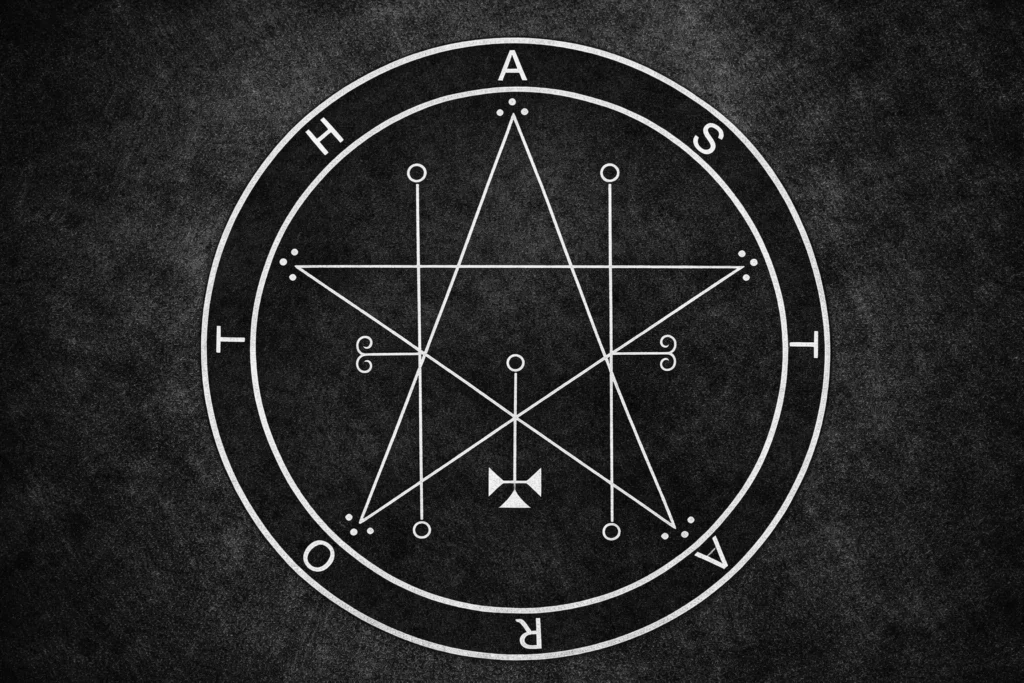
Astaroth’s Sigil
Astaroth’s sigil is a complex geometric symbol used in Solomonic magic to show his unique essence. In the past, people believed that drawing the sigil on paper or metal could make Astaroth appear. Magicians would wear the sigil as a protective breastplate, called a Lamen, to show authority over the demon and protect themselves from his harmful breath.
You may also enjoy:
Pazuzu: The Ancient Demon Who Fought Evil with Evil
November 4, 2025
Lamia: The Queen Cursed to Devour the Children of Others
January 7, 2026
Gandharva: God, Spirit, or Demon?
November 13, 2025
Who Is Abalam in Demonology? The Demon King That Serves Paimon
September 30, 2025
Who Is Al-Abyad? The White King Jinn Who Rules Love and Chaos
January 26, 2026
Bibliography
Author’s Note: While studying these manuscripts, I was intrigued by how the ‘beautiful angel’ from the 13th-century Livre des Esperitz changed into the ‘foul’ entity described by Weyer and de Plancy. It was a challenge to connect Astaroth’s quiet, symbolic role in the Ars Goetia with his talkative, defensive side in Barrett’s The Magus. My goal was to show how Astaroth’s image evolved, not just as a list of powers, but as a changing symbol of intellectual pride and spiritual stagnation.
- Collin de Plancy, Jacques. Dictionnaire infernal: répertoire universel des êtres, des personnages, des livres, des faits et des choses qui tiennent aux esprits. 6th ed., Henri Plon, 1863. Internet Archive.
- Weyer, Johann. Pseudomonarchia Daemonum. Edited and translated by Joseph H. Peterson, digital edition, 2000. Twilit Grotto: Esoteric Archives.
- De Laurence, L. W. The Lesser Key of Solomon, Goetia. Project Gutenberg, 7 Nov. 2023. Originally published by De Laurence, Scott & Co., 1916.
- Clymer, R. Swinburne. The Grand Grimoire. The Philosophical Publishing Co., 1910. Internet Archive.
- Abraham ben Simeon, of Worms. The Book of the Sacred Magic of Abra-Melin, the Mage. Translated by S. L. MacGregor-Mathers, The de Laurence Co., 1939. Internet Archive.
- Barrett, Francis. The Magus, or Celestial Intelligencer; Being a Complete System of Occult Philosophy. Printed for Lackington, Allen and Co., 1801. Internet Archive. Including works by Johannes Trithemius.
- Collin de Plancy, Jacques. Dictionnaire infernal: répertoire universel des êtres, des personnages, des livres, des faits et des choses qui tiennent aux esprits. 6th ed., Henri Plon, 1863. Internet Archive.
- Porter, John. A Book of the Offices of Spirits: The Occult Virtue of Plants and Some Rare Magical Charms & Spells (Liber Officiorum Spirituum). Translated by Frederick Hockley, Teitan Press, 2011. Internet Archive.
- Guiley, Rosemary Ellen. The Encyclopedia of Demons and Demonology. Visionary Living, Inc., 2009. Internet Archive.
- Bane, Theresa. Encyclopedia of Demons in World Religions and Cultures. McFarland & Company, 2012. Internet Archive.
- Sliedrecht, Bradley. The Defeated Foes: Demons, Deliverance, and the Authority of Christ. 2025. Academia.edu