The Palis’s main theme is its exploitation of travelers’ exhaustion and vulnerability as they fall asleep. Unlike other desert spirits known for dramatic illusions or violent changes, this one is defined by its focus on a single physical habit, giving it a unique place among parasitic folklore.
This specific behavior sets it apart from the broader hunting habits of the Ghul. Instead, it is a specialized night predator that preys by undermining a victim’s survival instincts rather than by direct attack.
In this article, I used the direct translations from Persian folklore and Arabic oral tradition to accurately describe the Palis. By comparing 19th-century travelers’ accounts with local legends, we show how views of this creature have changed across the Middle East. [View Full Bibliography ↓]
Summary
Key Takeaways
| Attribute | Details |
| Names | Palis, Pa-lis, Foot-licker |
| Type | Ghul (Desert-dwelling parasitic entity) |
| Title | The Foot-Licker of the Wilderness |
| Gender | Commonly described as female, though occasionally ambiguous |
| Powers | Inducing deep, unnatural sleep; blood-draining through the soles of the feet; vitality depletion |
| Appearance | A wizened, old woman or a grotesque, shadowy figure with a long, abrasive tongue |
| Etymology | Derived from the Persian “pa” (foot) and “lis” (licker) |
| Associated Figures | Ghul, Si’lat (other desert female spirits) |
| Weaknesses | Garlic, iron, or the protection of a companion; salt applied to the feet |
| Opposing Holy Figure | Prophetic figures associated with desert safety; local saints (Pir) |
| Social Structure or Tribe | Solitary; inhabits desolate, unpopulated regions |
| Primary Sources | Persian folklore, Arabic oral tradition, accounts by 19th-century travelers |
Who or What is Palis?
The Palis is a vampiric spirit found in Persian and Arabic folklore, grouped with other desert spirits. Unlike the well-known Jinn, who might interact with people or become involved in religious matters, the Palis is a simple parasite known for way single means of feeding.
It lives in remote areas and targets travelers who have to sleep alone in the desert. The Palis does not try to possess souls or share secret knowledge. Its only goal is to drain the victim’s life force and blood through the soles of their feet while they are too tired to resist.
“Palis” Meaning
The name comes from Persian and directly describes how the creature hunts. It combines “pā” (foot) and “līs” (to lick), so it means “foot-licker.” This clear name warns travelers about the specific danger posed by the Palis.
The name has changed very little over time because it is so closely linked to this one behavior. In some Arabic dialects, people mix it up with the Ghul. Still, in Persian stories, the name clearly refers to a creature that does not shape-shift like other spirits.
Because the name hasn’t changed much, it seems people see the Palis as a leftover from old folklore—a symbol of the dangers of the desert night, not a major creature in religious stories.
How to Pronounce “Palis” in English
The name is pronounced pah-LEESE. The first part, “pa,” sounds like the “a” in “father.” The second part, “lis,” rhymes with “fleece.” The stress is on the second syllable.
What Does Palis Look Like?
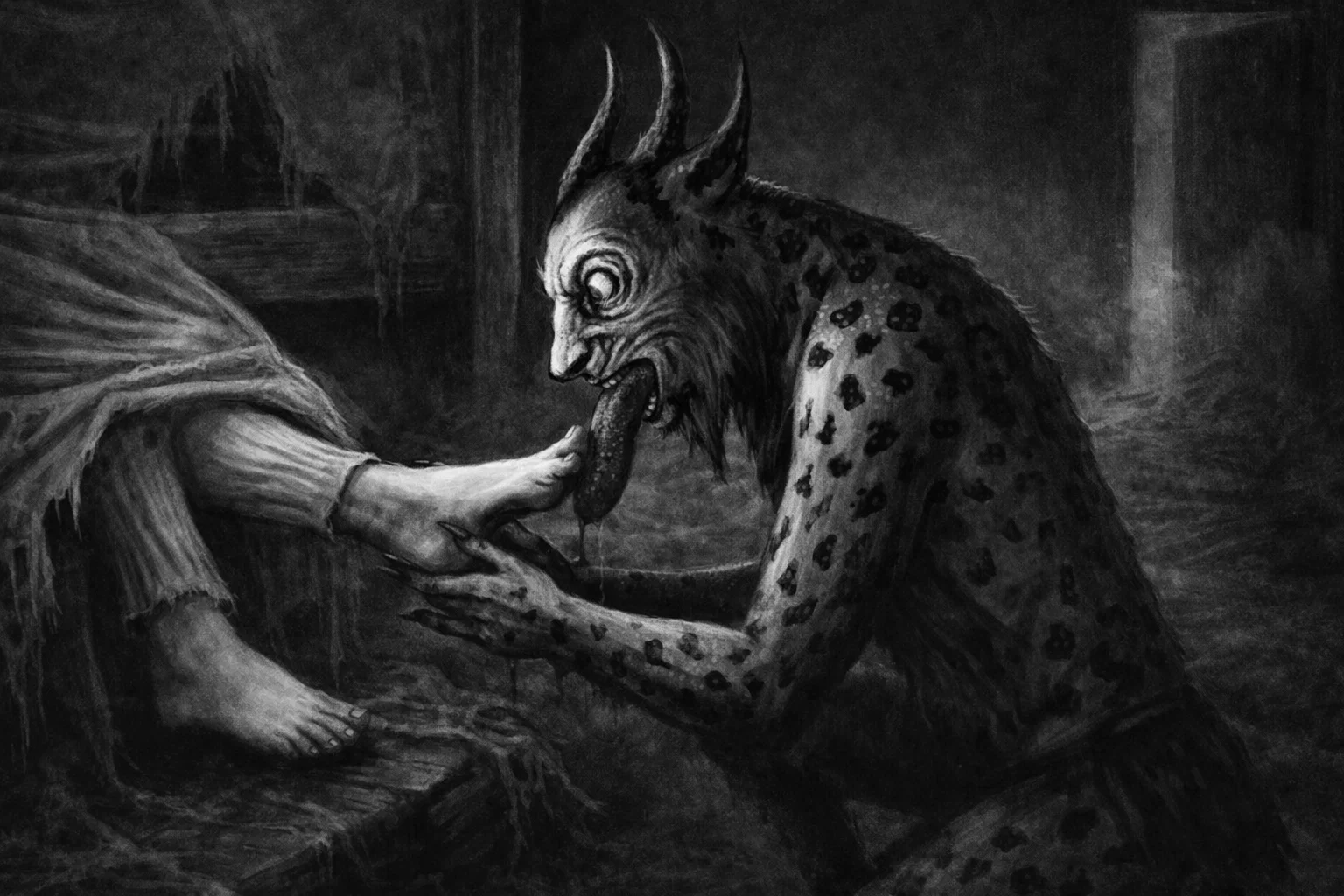
Stories usually describe the Palis as an old, short woman who looks thin or even skeletal. Her skin is dark and rough, like the desert itself. Her most remarkable feature is her tongue, which is very long, rough, and scratchy—like a cat’s tongue, but much bigger and more damaging.
She is usually shown crouching at the feet of a sleeping person. Some stories say her eyes glow faintly, but she does not have the impressive or frightening presence of a more powerful Jinn. She looks more like a starving human than a spirit. This weak appearance helps her hunt, since she does not seem dangerous until her victim is deeply asleep.
You may also enjoy:
Banasura: The Thousand-Armed Demon King
October 10, 2025
Ambri: The Imperial Duchess of Caspiel’s Empire
December 1, 2025
Gandharva: God, Spirit, or Demon?
November 13, 2025
Chort: The Sinister Slavic Demon of Chaos and Bad Luck
March 10, 2026
Amaymon: The Infernal King Who Commands Death and Decay
November 17, 2025
Pazuzu: The Ancient Demon Who Fought Evil with Evil
November 4, 2025
Origins
The Palis comes from pre-Islamic and early Islamic stories from the Iranian plateau and Arabian Peninsula. She was created to explain desert anemia and the mysterious deaths of travelers who died from the harsh environment. Unlike the Jinn, who are said to come from smokeless fire, her story is more closely tied to a specific place.
People saw her as the desert’s way of pushing back against humans. In the oldest stories, she was part of the Ghul family, especially the female type that haunted crossroads and graveyards.
As time passed, her habit of licking feet became what set her apart from other man-eating spirits. She came to symbolize the dangers of the empty desert, especially during the Silk Road and major caravan routes, when sleeping alone in the wild could be deadly.
The Somatic Parasite
The way this creature feeds shows a connection between old Persian medical ideas and desert folklore. While the Ghul attacks the main parts of the body, the Palis targets the feet. This may reflect old beliefs about nerve damage and tissue death caused by extreme desert temperatures.
By focusing on the feet, the myth acts as a metaphor for how people can die from the edges of their bodies first, during dehydration or frostbite, when blood flow leaves the limbs to protect the organs.
Sociologically, the “foot-licker” stands for the fear travelers had of losing the ability to move. During the Silk Road era, the greatest danger to a caravan was often not bandits but the gradual loss of strength and mobility.
A traveler who cannot walk cannot survive. By turning this danger into a story about a vampiric old woman, people made the medical problem of losing feeling and strength in the feet into a warning to stay alert. The Palis does not just take blood; she takes away the ability to move, trapping her victim in the desert.
The Palis is unusual because she is known for a specific feeling—the rough touch of her tongue—rather than for what she says or how she looks, which is how most Jinn and desert spirits are recognized.
This points to a link with the state between waking and sleeping, when it’s hard to tell real touches from dreams. The myth probably helped people explain sleep paralysis in the desert, when they felt something at their feet or a strange touch, and attributed it to a spirit rather than a medical issue.
Powers and Abilities
Compared to the Ifrit or Marid, the Palis is not very powerful. She cannot grant wishes, control the weather, or change shape. But when it comes to attacking a sleeping person’s feet, she is very effective.
- Lethargic Induction: The ability to cast a deep, heavy sleep on a victim, making it nearly impossible for them to wake up while she is feeding.
- Vitality Drainage: She uses her abrasive tongue to lick the soles of the feet until the skin becomes porous, allowing her to suck the blood and “moisture” from the body.
- Stealth and Invisibility: While not truly invisible, she has a supernatural ability to remain undetected by animals and humans until she begins her feast.
- Nocturnal Resilience: She can take on the harshest desert temperatures at night, though she is a lot weaker or forced to hide during the daylight hours.
Influence on Humans and Possession
She does not possess people in the usual way. She does not take over their minds or make them do bad things. Her effects are only physical. Signs of her presence include heavy limbs and a body that will not respond.
Survivors often feel deep, lasting tiredness and cold feet and legs. Since she removes the “heat” from the blood, people sometimes mistake her effects for a bad fever or a sudden illness caused by the desert wind.
Protection and Exorcism Methods
Protecting yourself from her mostly means taking precautions and using certain materials or smart tricks.
- Iron: Placing a piece of iron, such as a dagger or a needle, under the pillow or near the feet is believed to repel her, as she shares the common Jinn aversion to this metal.
- Garlic and Salt: Rubbing the soles of the feet with salt or garlic is a traditional remedy, as the sharp taste and purifying properties are said to be intolerable to her rasping tongue.
- The “Sleeping Head-to-Foot” Tactic: The most famous historical method involves two travelers sleeping with their feet touching each other’s heads. According to legend, when she arrives and finds a “creature with two heads and no feet,” she becomes confused. She flees, believing the traveler to be a superior demon.
- Talismans: Various paper amulets containing specific verses or geometric patterns are traditionally worn by caravaneers to create a spiritual barrier that she cannot cross.
Relevant Historical & Folkloric Mentions
While the Palis does not appear in the Quran or the primary canonical Hadith collections, its historical record is deeply ingrained in the broader Persianate and Arabic folkloric traditions that categorize the various subspecies of the Ghul.
“The Pa-lis is a kind of Ghul that lives in the desert. It is an old woman who licks the soles of the feet of sleepers until she has sucked all their blood. Two travelers, being aware of this, slept with their feet against each other’s heads. The Pa-lis came, and after wandering around them, exclaimed: ‘I have wandered through a thousand deserts, but never saw a man with two heads and no feet!’ and so it fled.” [The Adventures of Hatim Tai (English translation by Duncan Forbes), 1830 (Based on earlier Persian oral traditions)]
This 19th-century codification of the myth highlights the “Intellectual Defeat” motif, a common theme in Eastern folklore where a physically superior supernatural entity is thwarted by a simple logical paradox. Unlike the more violent accounts of the Ghul found in the One Thousand and One Nights, this source characterizes the creature as a specialized parasite with a limited cognitive range.
The focus on the “two-headed” deception suggests that the entity doesn’t have the sophisticated discernment of higher-ranking Jinn, operating instead on a primitive, instinctual level that can be easily manipulated by human ingenuity.
“Among the various species of Ghouls, the most singular is the Paliss… which infests the wilderness of Mazanderan. It is said to entice the lonely traveler to sleep, and then to lick the soles of his feet with its rough, sandpaper-like tongue, until it reaches the blood vessels. The only way to escape its fatal embrace is to sleep in pairs, head to foot.” [Sketches of Persia, Vol. II (Sir John Malcolm), 1827]
Sir John Malcolm’s account ties the Palis to the Mazanderan wilderness. This detail is important because it shows how the creature became a symbol of the slow, draining dangers of the Persian desert.
It is interesting to see how the Palis changed from a myth to something described almost like a biological threat by Western writers. Calling her tongue “sandpaper-like” shows an effort to explain her feeding as a physical process, not just magic.
“Palīs (پاليس): A desert-spirit in the form of an old woman who licks the feet of travelers until she kills them by sucking their blood. She is a sub-type of the Si’lat or the Ghul, but restricted to this singular habit. Her power is broken by iron or by the presence of salt on the skin.” [Persian-English Dictionary (Steingass), 1892 (Synthesizing earlier lexicographical traditions)]
This dictionary entry formally places the Palis in a specific category. Calling her a type of Si’lat links her to a more feminine, and often trickier, group of desert spirits rather than to the more animal-like Ghul.
Saying that iron and salt can stop the Palis fits with worldwide traditions in which basic minerals are used to ward off spirits. This idea shows the Palis as a raw force of nature that can be controlled by human-made things like iron and salt.
You may also enjoy:
Ifrit: Demon of Fire Who Serves Iblis in Islamic Tradition
September 30, 2025
Who Was Abezethibou, the Fallen Angel Who Opposed Moses?
October 1, 2025
What Is a Pishacha, the Flesh-Eating Demon of the Dead?
February 11, 2026
What Is the Akkorokamui, Japan’s Colossal Sea Monster?
November 14, 2025
Myths, Legends, and Stories
The Tale of the Two Clever Travelers
In a well-known folk tale from Khorasan, two merchants got stuck in a desert area known for the foot-licker. After hearing stories of travelers found dead with pale, bloodless feet, the older merchant came up with a trick. They slept so that one’s head was next to the other’s feet, both covered by one big cloak.
When the creature arrived at night, she lifted the cloak to start feeding. She walked around the pair several times, growing more upset. In the story, she mutters that after a thousand years in the desert, she has never seen a person with a head at both ends and no feet.
Afraid she had met a powerful sorcerer or a higher-level Jinn, she ran away into the dunes and never came back to that oasis.
The Drained Scout of the Caravanserai
Another story is about a young, proud scout who ignored the old protective customs. He slept alone, away from the group’s fire, thinking his strength would keep him safe. In the morning, his friends found him alive but unable to stand.
His feet were said to be as soft and pale as dough, with all color gone. He stayed weak and tired for the rest of his life, serving as a reminder that the desert respects old protective customs, not just strength.
Position Among Jinn
The Palis has a low place among the Jinn. She is not part of the Jinn royalty or the fighting Shayatin tribes. Instead, people see her as a lone scavenger, like a vulture or hyena. Other Jinn usually ignore her because she is not smart or important enough to join their groups. She is distantly related to the Ghul, but instead of eating flesh, she survives in a quieter, more parasitic way.
Comparison with Similar Entities
| Jinn Name | Associated Traits/Influence | Rank/Origin | Key Traits/Powers |
| Ghul | Gluttony and corpse-desecration | Folklore / Wilderness | Shape-shifting; devouring travelers |
| Si’lat | Seduction and trickery | Forests/Deserts | High intelligence; mimics human women |
| Hinn | Weakness and low-level mischief | Lower Jinn class | Often appears as dogs; minimal power |
| Nasnas | Physical deformity and madness | Yemen/Folklore | Half-human body; leaps with great speed |
| Qareen | Spiritual doubt and temptation | Quranic/Theological | Constant companion to humans; whispers |
| Ifrit | Wrath and rebellion | Infernal/Smokeless Fire | Immense strength; fire manipulation |
| Marid | Arrogance and water-dominance | Seas/High Rank | Commands water; incredibly difficult to bind |
| Shiq | Physical terror and predation | Pre-Islamic Folklore | A fragmented entity; attacks lone travelers |
| Umm al-Subyan | Infant mortality and jealousy | Arabic Folklore | Targets children and pregnant women |
| Zoba’ah | Chaos and wind-storms | Jinn King | Commands whirlwinds and dust storms |
| Dandaneh | Pain and tooth decay | Persian Folk Medicine | Small entity; causes dental agony |
| Div | Antagonism toward heroes | Shahnameh / Persian Myth | Giant size; sorcery; builds fortresses |
Mystical Correspondences
| Attribute | Details |
| Planet | Saturn (Coldness and desolation) |
| Zodiac Sign | Capricorn (Earthly grit and harsh environments) |
| Element | Earth (Dry desert sands) |
| Direction | North (Associated with cold winds and darkness) |
| Color | Ash-grey or dusty brown |
| Number | 0 (The void of the desert; lack of social standing) |
| Crystal/Mineral | Obsidian (Sharpness and night) |
| Metal | Lead (Heaviness and lethargy) |
| Herb/Plant | Asafetida (Pungent and repelling) |
| Animal | Lizard or leech |
The mystical traits linked to the Palis show her as heavy and unmoving. She is connected to Saturn, not for discipline, but for its sadness and coldness, like a dying fire.
Saturn’s influence is seen in her power to slow a victim’s heartbeat and cause a deep, heavy sleep. She is also tied to the element of Earth, living in dirt and sand and staying close to the ground to reach people’s feet.
She is linked to the color grey and the number 0, which shows her place as a scavenger on the edge of existence. She stands for the slow loss of life in the desert, where the environment gradually takes everything away.
These connections help explain her kind of “evil.” It is not dramatic or rebellious like Iblis, but more like an empty hunger that drains life from others just to keep going in the desert.
You may also enjoy:
Aim (Aym): The Great Duke of Hell in the Ars Goetia
November 11, 2025
What Is a Rakshasa? Meaning, Origins, and Dark Powers
January 23, 2026
What Is a Yūrei? The True Meaning of Japanese Ghosts
January 30, 2026
Gandharva: God, Spirit, or Demon?
November 13, 2025
Andhaka: The Blind Demon Born From Cosmic Darkness
February 6, 2026
Hitotsume kozō: One-Eyed Yōkai of Japanese Folklore
February 4, 2026
Bibliography
Author’s Note: While putting together this profile, I noticed an interesting contrast between medical reports of jinn-related tiredness and the old stories about the Palis’s hunting habits. Modern sources often skip over her unique anatomy. Still, older texts like al-Mas‘ūdī’s Meadows of Gold focus on her rough tongue as her main tool for draining life. It is also hard to ignore that the “head-to-foot” sleeping trick is the only survival method that appears again and again in stories from different times and places, showing a rare agreement on how to beat this kind of parasite.
- Khalifa, Najat, and Tim Hardie. Possession and Jinn. Journal of the Royal Society of Medicine vol. 98,8 (2005): 351-3. doi:10.1177/014107680509800805.
- Volkan, Kevin. The Jinn: Islam, Exorcism, and Psychology. Journal of Social and Political Sciences, 2023. 6. 1-14. 10.31014/aior.1991.06.03.425.
- Meri, Josef W. (editor). Medieval Islamic Civilization: An Encyclopedia. Routledge, 2006. Internet Archive.
- Al-Shaykh, Hanan. One Thousand and One Nights: A Retelling. Pantheon Books, 2013. Internet Archive.
- Duncan Forbes (translator). The Adventures of Hatim Taï: A Romance. Oriental Translation Fund, 1830. Internet Archive.
- al-Mas‘ūdī, ‘Alī ibn al-Ḥusayn. Historical Encyclopaedia: Entitled “Meadows of Gold and Mines of Gems”. Translated by Aloys Sprenger, Oriental Translation Fund of Great Britain and Ireland, 1841. Internet Archive.
- Bane, Theresa. Encyclopedia of Vampires, Werewolves, and Other Monsters. McFarland & Company, 2010