Most Goetic entities are sought for power or wealth, but Balam stands out as a ruler of time and knowledge. He is more than a fortune-teller; he connects the celestial Order of Dominations with the infernal need for ‘perfect’ knowledge, acting as a living record of the past, present, and future.
Looking at his unique imagery, which shifts from human to animal, we see a spirit that symbolizes the unsettling clarity of a complex mind. Here, the gift of wit is closely tied to the burden of seeing all outcomes at once.
This article examines modern stories about Balam using sources like the Ars Goetia and the Pseudomonarchia Daemonum to create a historical overview based on evidence. [View Full Bibliography ↓]
Summary
Key Takeaways
| Attribute | Details |
| Names | Balam, Balan, Baalam |
| Title | King of Hell |
| Gender | Male |
| Role | Granting invisibility, providing forbidden knowledge of time, and inciting wit or cruelty in speech. |
| Rank | King |
| Hierarchy | Serves under the higher infernal administration; commands fifty-one legions of lesser spirits. |
| Legions | 51 Legions |
| Powers | Bestows the ability to become invisible, grants perfect knowledge of the past and future, and makes men witty or provocative. |
| Associated Figures | King Solomon (who allegedly bound him), the prophet Balaam (linguistic association). |
| Weaknesses | The seal of Solomon, the names of the Tetragrammaton, and the intervention of opposing celestial entities. |
| Opposing Angel/Saint | Haziel |
| Pantheon | Christian / Abrahamic Occultism |
| Primary Sources | Ars Goetia, Pseudomonarchia Daemonum, Dictionnaire Infernal, The Discoverie of Witchcraft. |
Who or What is Balam?
Balam is a high-ranking entity in Western demonology. As a King, he has significant authority in the infernal world. People in occult traditions often seek him out because he is believed to know about events from the distant past and the future.
The demon is often seen as predatory and deceptive, linked to the darker side of human intelligence. He can give people ‘wit,’ but this often means a sharp or hurtful cleverness used against others. His ability to grant invisibility is used for hiding and spying, which makes him a symbol of secrecy and subversion in Christian occult beliefs.
“Balam” Meaning
The etymology of the name Balam is frequently linked to the biblical entity Balaam, a non-Israelite prophet mentioned in the Book of Numbers.
In Hebrew, the name Bileam (בִּלְעָם) is often thought to mean ‘glutton’ or ‘devourer of the people.’ Over time, medieval scholars turned figures like Balaam from human diviners into demons in the Goetia, grouping old ‘false prophets’ and foreign gods into the ranks of Hell.
The name has changed slightly in different languages. In Johann Weyer’s Pseudomonarchia Daemonum (1577), he is called Balan. The spelling Balam became standard in the 17th-century Ars Goetia. Some researchers think the name comes from the Semitic root Baal, meaning ‘Lord,’ a title used for many Levantine gods later turned into demons by Abrahamic religions.
However, Balam’s unique features, especially his three heads, show that he developed differently from other ‘Baal’ figures in the grimoire tradition. The name Baalam appears in some Spanish and French translations. Still, the pronunciation of the name remains the same in Western European occult texts.
How to Pronounce “Balam” in English
The name is usually pronounced as BAY-lam or BAH-lam, with the first syllable stressed. In English occult circles, the BAY-lam pronunciation is most common, following the pattern of biblical names like Balaam.
You may also enjoy:
Mahabali (Bali): The Benevolent Asura King
October 10, 2025
Andhaka: The Blind Demon Born From Cosmic Darkness
February 6, 2026
Who Is Hariti, the Mother of Ogres in Buddhist Mythology?
December 8, 2025
Aamon: The Infernal Marquis of Lust, Feuds, and False Prophecies
September 29, 2025
Iblis, the Jinn King of Darkness and Deception
September 29, 2025
Erinyes: The Chthonic Goddesses Who Enforced Blood-Guilt
November 20, 2025
What Does Balam Look Like?
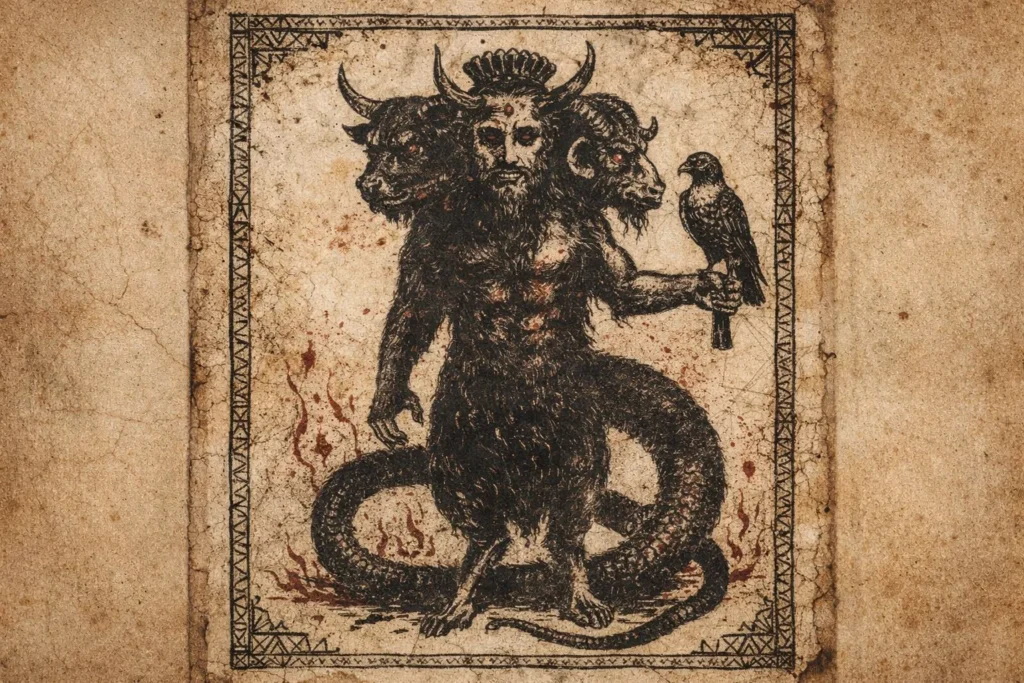
Balam is described as a monstrous demon composed of various parts. The Ars Goetia says he has three heads: one of a bull, showing strength and stubbornness; one of a man, showing intelligence and speech; and one of a ram, which stands for virility and mockery.
His body adds to his frightening image. He is said to have a serpent’s tail, linking him to the original tempter in Christian stories. His eyes are described as flaming, giving off a light that can scare or confuse those who see him.
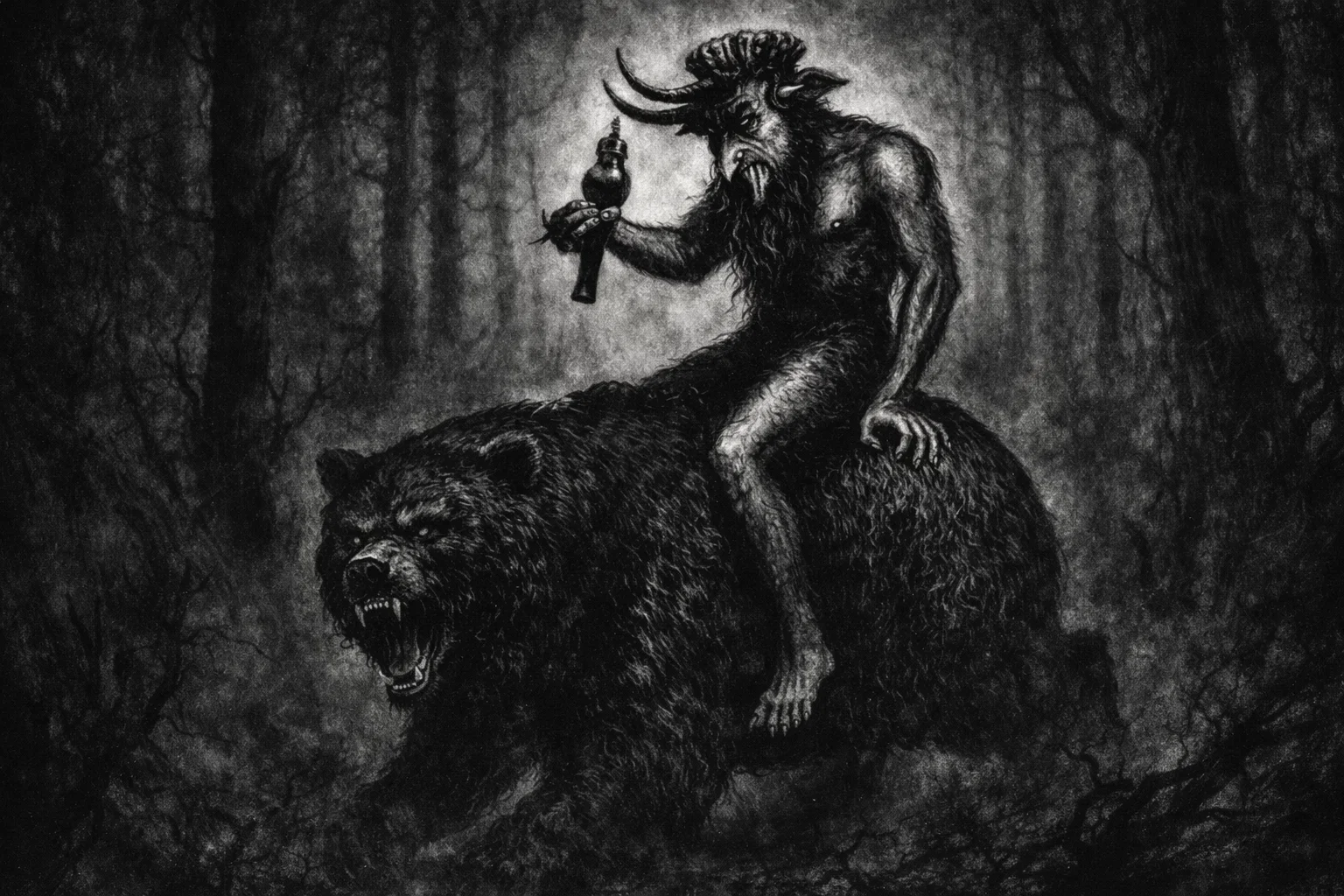
He is often shown riding a fierce bear, which stands for strength and wild power. He has a goshawk, a bird of prey, symbolizing his speed and his role as a hunter of souls or secrets. His voice is very hoarse, which many see as a sign of his corrupted nature.
Origins & History
Balam’s story is not just a simple myth. Over a thousand years, his legend moved from the deserts of the Levant to the handwritten books of the European Renaissance. Following his story shows how a prophet gradually became a King of Hell.
The Seer of the Steppes (c. 1200 – 800 BCE)
The story starts in the Transjordanian hills, not in Hell. Before becoming a demon, Balam was known as Balaam, son of Beor, a respected non-Israelite prophet. Early sources, such as the Deir Alla Inscription found in Jordan, describe Balaam as a ‘seer of the gods’ who had frightening night visions.
At this point, Balaam is an entity on the edge between worlds. In the Book of Numbers, he is known for the ‘Incident of the Ass,’ where his donkey sees an angel with a sword, but he does not. This story inspired his later demonic image, in which the animal he rides is a transformed version of the donkey that once saw what he could not.
The Great Divergence (c. 1st – 5th Century CE)
Over time, Jewish and early Christian writers came to view Balaam more negatively. He became a symbol of a prophet who had the ‘Gift of Truth’ but used it for personal gain instead of doing what was right.
In the Roman era, early occult texts such as the Testament of Solomon began listing different spirits. At this point, the ‘spirit of Balaam’ started to be seen less as a real person and more as a symbol or type of spirit.
This change from a real person to a spirit happened as theologians tried to explain why a prophet would try to curse the chosen people. They decided that while he spoke for God, his true loyalty was to a darker power.
The Grimoire Synthesis (1400 – 1600 CE)
By the late Middle Ages, the transformation was complete. The prophet had been fully “demonized” and absorbed into the complex bureaucracy of the Ars Goetia. In the cold libraries of European monks and occultists, Balam was assigned a rank: King.
The story changed from a journey in the desert to a tragedy in the heavens. Balam was now seen as a fallen high-ranking member of the Order of Dominations. During this time, his ‘Three Heads’ appeared in stories. The bull stood for his ancient roots, the man for the prophet he used to be, and the ram for the creative power he took from above.
He was no longer just a speaker of words; he was a master of “Information Control,” granting invisibility to those who wished to walk unseen through the treacherous halls of royal courts.
The Industrial Age (1800s – Present)
The final chapter of Balam’s evolution took place in the 19th century, during the “Occult Revival.” Artists like Louis Le Breton gave the narrative a permanent face in de Plancy’s Dictionnaire Infernal.
Balam was now shown as a strange king riding a bear and holding a hawk. This new image showed his control over wild forces. The bear stood for raw strength, and the hawk stood for quick thinking.
He became known as the patron of clever and cunning people. This was a big change for someone who was once outsmarted by a donkey. He finally gained the vision he once lacked, but lost his humanity in the process.
Historical & Scriptural Records
While Balam does not appear as a demonic entity in the New Testament, his historical record begins with the linguistic and theological evolution of a biblical prophet, eventually transitioning into the infernal hierarchy of the Renaissance.
“And God’s anger was kindled because he went: and the angel of the Lord stood in the way for an adversary against him. Now he was riding upon his ass, and his two servants were with him. And the ass saw the angel of the Lord standing in the way, and his sword drawn in his hand: and the ass turned aside out of the way, and went into the field: and Balaam smote the ass, to turn her into the way.” [The Holy Bible, Numbers 22:22-23, KJV (Authorized Version), 1611 (referencing 7th–6th Century BCE traditions)]
This foundational text establishes the “proto-Balam” as an entity of profound spiritual tension: a prophet who can hear the divine but is blinded by his own worldly ambitions. The divergence here is essential; in the Hebrew Bileam (בִּלְעָם), we see the origin of the entity’s primary attribute—the power of “perfect speech.” Just as the biblical Balaam was compelled to speak only what was put in his mouth, the later Goetic King Balam is sought specifically for “true answers.”
Theologically, this source explains why Balam is often depicted riding an animal (the bear in later lore, replacing the biblical ass) and carrying a bird of prey. The bird represents the “vision” he lacked in the desert.
At the same time, his transition from a human prophet to a three-headed king reflects the medieval process of “paganizing” or “demonizing” biblical antagonists to fill the ranks of Hell’s bureaucracy.
Original:
“Balam, Rex magnus & terribilis, prodit tribus capitibus, primo bubulo, altero humano, tertio arietino: cauda serpentina, oculis flammeis, equitans in urso, ficedulam in manu portans. Vocem reddit raucam: Respondet perfecte de præteritis, præsentibus & futuris: Reddit homines invisibiles & facetos. Quadraginta legionibus præest, & fuit ex ordine Dominationum.” [Pseudomonarchia Daemonum, Johann Weyer, 1577]
Translation:
Balam, a great and terrible King, comes forth with three heads, the first of a bull, the second of a man, the third of a ram: with a serpent’s tail, flaming eyes, riding upon a bear, carrying a small bird [ficedula] in his hand. He gives a hoarse voice: He answers perfectly concerning things past, present, and future: He renders men invisible and witty. He is in command of forty legions, and was of the order of Dominations.
Johann Weyer’s 16th-century catalog marks the shift from viewing the demon as a rogue prophet to a ‘Great and Terrible King.’ This source introduces his three heads: a bull, a man, and a ram. In the Renaissance, these heads were seen as a dark version of the Trinity or a twist on the ‘Prudence’ symbol, which often showed three faces looking to the past, present, and future.
Weyer places Balam in the Order of Dominations, a high celestial rank. This means Balam was not a minor spirit but a powerful creature who fell from a high position. The mention of the small bird (goshawk) and its power to make people ‘witty’ shows that his role shifted from that of a desert sorcerer to that of a patron of clever, sometimes dangerous, thinkers in European courts.
“The Fifty-first Spirit is Balam. He is a Terrible, Great, and Mighty King. He appeareth with three Heads: the first is like that of a Bull; the second is like that of a Man; and the third is like that of a Ram. He hath the Tail of a Serpent, and Flaming Eyes. He rideth upon a furious Bear, and carrieth a Goshawk upon his Fist. He speaketh with a hoarse Voice, giving True Answers of Things Past, Present, and to Come.” [The Goetia: The Lesser Key of Solomon the King, S.L. MacGregor Mathers & Aleister Crowley, 1904]
The 1904 Mathers and Crowley edition, based on Weyer, is the modern standard for Balam. This version introduced his Sigil (Seal), which was meant to control his ‘hoarse voice’ and force him to give ‘True Answers.’ This change turned Balam from a historical or religious figure into a practical tool for Western occult practices.
The ‘Hoarse Voice’ is important in theology. In medieval demonology, a rough or strange voice showed that a spirit was far from the ‘Divine Harmony.’ By the early 1900s, occultists saw this not as a flaw, but as a sign that Balam was an ‘Ancient One’ whose voice was too deep or ‘earthy’ for people to hear easily.
Original:
“Balam, grand et puissant roi aux enfers. Il paraît avec trois têtes, celle d’un taureau, celle d’un homme et celle d’un bélier. Il a la queue d’un serpent, les yeux jetant des flammes ; il monte un ours et porte un épervier sur le poing. Sa voix est rauque ; il répond juste sur le passé, le présent et l’avenir…” [Dictionnaire Infernal, Jacques Auguste Simon Collin de Plancy, 1863 edition]
Translation:
Balam, great and powerful king in Hell. He appears with three heads, that of a bull, that of a man and that of a ram. He has the tail of a serpent, eyes darting flames; he mounts a bear and carries a hawk on his fist. His voice is hoarse; he responds correctly on the past, the present and the future…
De Plancy’s 19th-century French book is important because it added to Balam’s visual story. While the text followed the Ars Goetia, the 1863 edition included well-known drawings by Louis Le Breton. These images turned Balam from just a written description into a frightening monster that people could see.
The main change in this period was how people saw Balam. He was no longer just a spirit for magicians, but also a figure of Gothic horror and curiosity for ordinary Victorians. The bear he rides became a symbol of wild strength, while the goshawk stood for precision, and the man’s head for intellect. This matched the 19th-century interest in the struggle between human reason and animal instincts.
Powers and Abilities
Balam is said to have powers that let him manipulate how people see things and gain hidden knowledge. His main ability is called Temporal Omniscience, which means he can see all of human history and the future at once.
When he gives ‘True Answers,’ he is believed to reveal real facts from the past or future, not just make guesses. People often seek this power to gain an advantage or avoid consequences.
Balam is also known for granting invisibility. This does not always mean becoming physically invisible, but rather making someone go unnoticed by others. This power lets people move around unseen, which can help with theft, spying, and other clandestine activities.
Balam is also said to give people’ wit’ or ‘wisdom.’ In this context, the wisdom is often negative, making someone clever in a way that can hurt others. It helps people use words to insult, break someone’s confidence, or cause arguments. This power sharpens the mind for selfish or harmful purposes.
The Occult Personification of Chronological Dissonance
Balam’s unusual image, especially his three heads (a bull, a man, and a ram), is often seen as just a scary decoration. However, a closer look shows that Balam combines the idea of the ‘Three Ages of Man’ with changing views of time in the late Renaissance.
In classical symbols, the bull stands for the strong past, the ram for the creative future, and the human face for the present moment. By combining these, the Ars Goetia shows Balam as more than a fortune teller—he becomes a symbol of ‘all times at once,’ where past, present, and future come together in a single, clear moment.
Balam’s special role is also shown by his connection to the biblical Balaam. Many Goetic spirits were once ancient gods who became demons, but Balam kept some of his original traits. In the Book of Numbers, Balaam could only speak the truth given to him by the divine, even if it went against his own interests.
When this trait became part of medieval magic books, it turned into Balam’s main feature: giving ‘perfect answers.’ The key point is that Balam became a dark version of the Prophet, forcing people to face truths that are correct but can be hard to accept socially or emotionally.
Balam’s link to invisibility and sharp wit shows an understanding of the ‘Invisible Observer’ in 16th-century society. In Elizabethan times, being witty meant having a sharp mind that could see through court lies. By giving both invisibility and wit, Balam became the patron of clever people who challenged authority.
He stands for the person who can see everything—past, present, and future—while staying hidden. This matches a time of political spying and religious change, when having ‘perfect knowledge’ without being noticed was key to survival.
Balam vs Other Christian Demons
| Demon Name | Associated Sin/Temptation | Rank/Origin | Key Traits/Powers |
| Asmodeus | Lust | King (Ars Goetia) | Three heads (bull, man, ram); destroys marriages. |
| Belial | Lawlessness / Worthlessness | King (Bible/Dead Sea Scrolls) | Created next after Lucifer; grants high titles. |
| Paimon | False Science / Vain Glory | King (Ars Goetia) | Rides a dromedary; teaches all arts and sciences. |
| Beelzebub | Gluttony | Prince (Hierarchy of Hell) | Lord of the Flies; causes decay and filth. |
| Mammon | Greed / Avarice | Prince (Middle Ages) | Influences the pursuit of material wealth. |
| Astaroth | Sloth | Grand Duke (Ars Goetia) | Rides a dragon; knows all secrets of creation. |
| Behemoth | Gluttony / Bestiality | Beast (Book of Job) | Unstoppable physical strength; lord of the land. |
| Leviathan | Envy | Prince (Book of Isaiah) | Serpent of the sea; represents chaos. |
| Bael | Deception | King (Ars Goetia) | First principal spirit; makes men invisible. |
| Zagan | Mockery / Deceit | King (Ars Goetia) | Turns water into wine and fools into wise men. |
| Purson | Curiosity of Secrets | King (Ars Goetia) | Man with a lion’s face; finds hidden treasures. |
| Vine | Witchcraft / Malice | King (Ars Goetia) | Lion riding a black horse; builds towers. |
| Beleth | Arrogance | King (Ars Goetia) | Rides a pale horse; causes love/obsession. |
| Lucifer | Pride | Emperor (Christian Lore) | The morning star; the original rebel. |
You may also enjoy:
Who Was Hiranyaksha, the Golden-Eyed Asura?
October 7, 2025
Marid: The Ocean Jinn That Defies Heaven and Earth
September 30, 2025
Bakeneko: A Supernatural Cat Yōkai in Japanese Folklore
January 27, 2026
Amaymon: The Infernal King Who Commands Death and Decay
November 17, 2025
Rank in the Hierarchy of Hell
Balam is ranked as a King, one of the highest titles in the Goetic system. As a King, he commands fifty-one legions and has more authority than Dukes, Marquises, or Earls.
He is often compared to other demons with similar traits. For example, he is linked to Asmodeus because both are shown with three heads (bull, man, and ram). This may mean they work together or share influence, especially in corrupting human intellect and senses.
Even as a King, he serves under the Infernal Emperor. He is in charge of time-related secrets and the hidden movement of spirits. He is said to be the rival of the angel Haziel, who stands for mercy and God’s truth, the opposite of Balam’s deceptions and secret knowledge.
Mystical Correspondences
| Attribute | Details |
| Planet | Sun (Gold) |
| Zodiac Sign | Sagittarius |
| Element | Fire |
| Direction | North |
| Color | Yellow / Gold |
| Number | 51 |
| Crystal/Mineral | Topaz |
| Metal | Gold |
| Herb/Plant | Sage / Sunflower |
| Animal | Bear / Goshawk / Serpent |
Balam is linked to the Sun and the metal gold, showing his royal status. In hermetic traditions, solar demons are the highest rank and have powerful, sometimes dangerous energy.
The Sun’s influence gives the demon his ‘flaming eyes’ and his ability to see through time, like the sun lighting up the world. But as a demon, this energy is twisted, giving him a hoarse voice and a frightening appearance instead of warmth.
He is also connected to the sign Sagittarius and the element of Fire, which match his speed (shown by the goshawk) and his gift of ‘wit.’ Sagittarius is linked to philosophy, travel, and higher thinking, but Balam twists these into forbidden knowledge and harsh words.
The fire element makes Balam unpredictable and gives him the power to ‘burn through’ time. Unlike earth-based demons, his evil is active, aggressive, and tied to a sharp intellect.
Balam’s Sigil
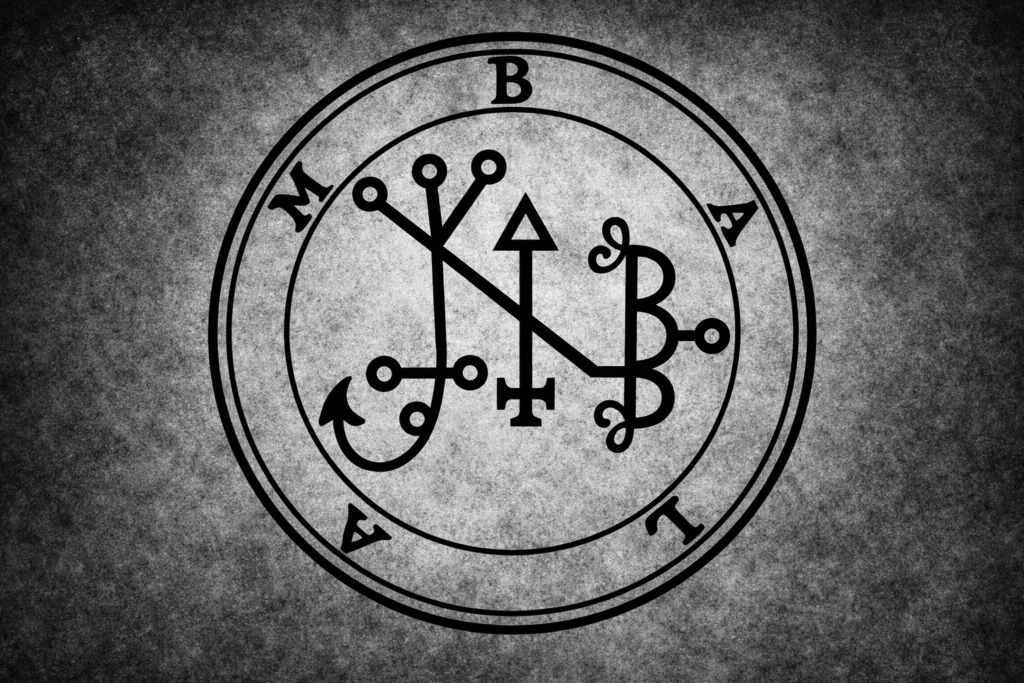
Balam’s sigil is a complex geometric symbol used in Goetic magic as his unique ‘signature.’ In old occult practices, the sigil was seen as more than just a symbol—it was thought to connect directly to Balam. It was usually engraved on a gold plate, showing his royal status.
The sigil served two main purposes: protection and control. Practitioners in medieval and Renaissance times used it to make sure they were dealing with Balam and not another spirit. The sigil acted like a contract, forcing Balam to answer truthfully and stopping him from using his invisibility to escape or harm the summoner.
You may also enjoy:
What Is a Dīv? The Terrifying Giant Demon of Persian Myth
January 22, 2026
Who Is Aka Manto, Japan’s Terrifying Red-Cloaked Yōkai?
October 24, 2025
What Is a Bhuta? The Backward-Footed Ghosts of Hindu Horror
February 5, 2026
The Kumbhāṇḍa: Grotesque Demons of Buddhist Hell
November 13, 2025
Si’la: The Seductive Jinn Who Lures Travelers to Their Doom
October 9, 2025
Bibliography
Author’s Note: In putting together this profile, I noticed a strong contrast between the organized, official descriptions in the Lesser Key of Solomon and the more unpredictable, prophetic origins in The Testament of Solomon. Later books describe Balam simply as a ‘King of Hell,’ but comparing these with Isaac Hershkowitz’s recent research shows that the idea of ‘perfect knowledge’ became a spiritual burden over time. The 19th-century images in the Dictionnaire Infernal made Balam’s identity fixed and frightening, often hiding his older, more complex roots. This change from a wandering seer to a strict infernal king shows how people have turned unknown figures into figures to fear throughout history.
- McCown, Chester Charlton, editor. The Testament of Solomon. J. C. Hinrichs’sche Buchhandlung, 1922. Internet Archive. Edited from manuscripts at Mount Athos, Bologna, Holkham Hall, Jerusalem, London, Milan, Paris, and Vienna.
- Collin de Plancy, Jacques. Dictionnaire infernal: répertoire universel des êtres, des personnages, des livres, des faits et des choses qui tiennent aux esprits. 6th ed., Henri Plon, 1863. Internet Archive.
- Solomon, King of Israel (attributed). The Key of Solomon the King (Clavicula Salomonis). Translated and edited by S. Liddell MacGregor Mathers, George Redway, 1889. Internet Archive.
- De Laurence, L. W. The Lesser Key of Solomon, Goetia. Project Gutenberg, 7 Nov. 2023. Originally published by De Laurence, Scott & Co., 1916.
- Hershkowitz, Isaac. Angels and Demons in Early Modern Musar Literature: A Big Data Analysis. The Journal of Jewish Ethics, vol. 9, no. 1, 2023, pp. 29-54. Academia.edu.
- Reed, Annette Yoshiko. Introduction. Demons, Angels, and Writing in Ancient Judaism. Cambridge University Press, 2020, pp. 1–26. Cambridge Core.
- Guiley, Rosemary Ellen. The Encyclopedia of Demons and Demonology. Visionary Living, Inc., 2009. Internet Archive.
- Reed, Jennifer. Christian Demonology | Origin, Demons & Importance. Study.com. Accessed 31 Mar. 2026.