Barqan stands at the crossroads of heavenly rule and the hidden world on earth. In Islamic occultism, he acts as a bridge between the planets and the spirit world.
Unlike most grimoires that highlight the unpredictable side of the Jinn, Barqan is important for his role in a structured system that connects each day of the week to both a worldly and spiritual leader. He reflects the balance between the usual wildness of his kind and the strict order of a higher power.
This research uses direct translations from Shams al-Ma’arif and Kitab al-Bulhan to ensure that Barqan’s description aligns with its cultural background.[View Full Bibliography ↓]
Summary
Key Takeaways
| Attribute | Details |
| Names | Barqan, Abu al-Adja’ib, The One of Wonders |
| Type | Aerial Jinn / Earthly King |
| Title | King of Wednesday, Master of the Planet Mercury |
| Gender | Male |
| Servitors | Hanzab, numerous lesser spirits of the Wednesday cycle |
| Powers | Inducing intellectual confusion, facilitating deception, causing swiftness in illness, and inciting verbal disputes. |
| Appearance | Often depicted with multiple heads or a crown, occasionally associated with the color blue or yellow depending on the source. |
| Etymology | Likely derived from the Arabic ‘Barq’ meaning lightning or ‘Abarq’ meaning variegated. |
| Associated Figures | Archangel Michael (Mikha’il), Prophet Solomon |
| Weaknesses | Subjugation through specific divine names, the seal of Solomon, and recitation of the Mu’awwidhatayn. |
| Opposing Holy Figure | Archangel Mikha’il (Michael) |
| Social Structure or Tribe | One of the seven great Jinn Kings ruling a specific day and direction. |
| Followers/Tribe Size | Commands a vast legion of Wednesday spirits. |
| Primary Sources | Shams al-Ma’arif (The Sun of Gnosis), Kitab al-Bulhan (Book of Surprises), Various medieval Arabic grimoires. |
Who or What is Barqan?
Barqan is known as one of the Seven Jinn Kings who rule over the days of the week in Middle Eastern esoteric tradition. He is linked to Wednesday. Unlike wandering or minor spirits, Barqan is a king with his own court, a special color, and a connection to a particular planet.
He oversees spirits influenced by the planet Mercury. In demonology, Barqan refers to the “intellectual” or “communicative” side of the spirit world, often associated with cleverness and trickery. As a high-ranking being, he must be approached with special rituals, usually by calling on the archangel who is above him.
Barqan Meaning
The name Barqan comes from the Arabic root B-R-Q, which means lightning or flashing. This points to a nature that is quick, bright, and unpredictable.
Many old texts connect his name to barq, showing his link to sudden, fleeting movements like those of air spirits. Some researchers also think the name is related to Abarq, meaning “variegated” or “speckled,” suggesting a multicolored appearance or a dual nature.
In different versions of the Shams al-Ma’arif and the Kitab al-Bulhan, his name stays mostly the same. Still, he is often called Abu al-Adja’ib, or Father of Wonders. This title points to his reputation for causing strange and puzzling events.
Over time, his name and image blended Hellenistic astrology with Arabian folklore. The qualities of the Roman god Mercury, known for speed and cleverness, were added to Barqan’s character, making him a symbol of quick, persuasive, and sometimes tricky energy.
How to Pronounce “Barqan” in English
The name is pronounced bar-KAAN. The first part sounds like “car,” and the second part has a long “a” as in “father,” ending with a clear “n.” The stress is on the second syllable.
The Mercurial Shadow
Barqan’s shift from a heavenly ruler to a spirit of “wonders” reflects how medieval Islamic society grew concerned about the trustworthiness of information.
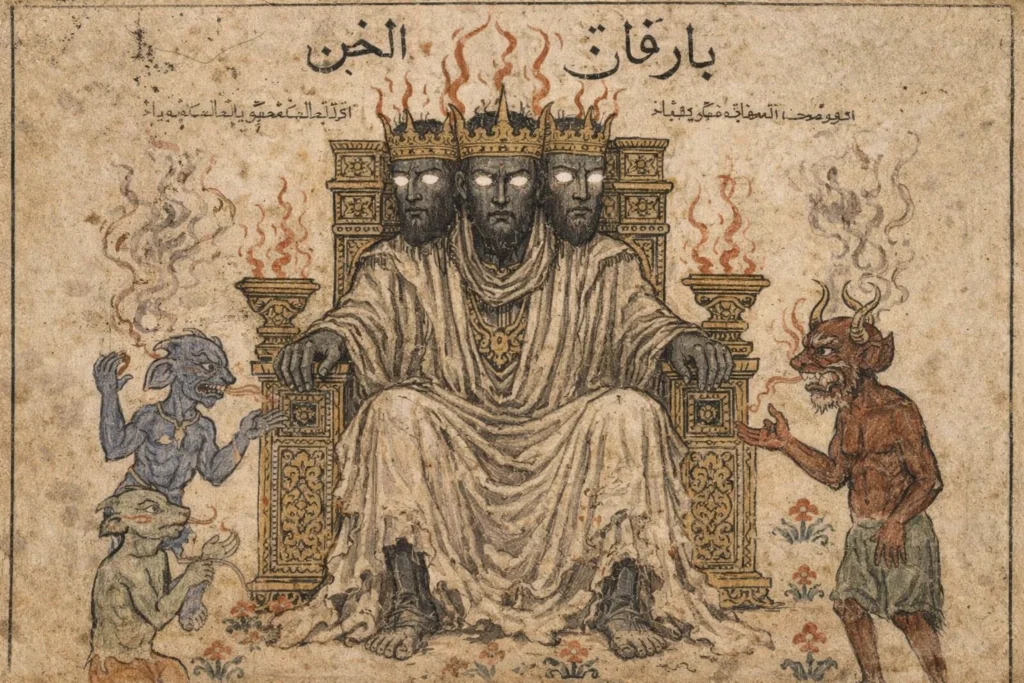
In the 14th-century Kitab al-Bulhan, he is shown with two heads, one looking up and one down, to show Mercury’s double nature. This image is more than just a symbol of astrology; it marks the point where information can change.
In the old Middle East, trade and messages were vital to the Caliphate. The King of Wednesday came to represent the risk of messages getting twisted. He became a symbol for both the genius who shares knowledge and the liar who spreads confusion.
The root B-R-Q (lightning) adds another layer when you consider Barqan’s link to Wednesday. Lightning both lights up and blinds; it gives a quick burst of truth, then darkness. This is like the Mercurial mind, which can quickly solve problems or create clever tricks just as fast.
Unlike the raw power of the Ifrit or the still fear of the Ghul, Barqan stands for the dangers of speed. The faster information moves, the more likely it is to get twisted. He watches over the moment when a truth is shared and quickly turns into a damaging rumor.
Barqan is also a warning against intellectual pride. In the Golden Age, stories about his “Wonders” were used to remind scholars about the limits of human understanding.
Theurgical texts link Barqan to the North, a place seen as unknown and cold. This makes him a symbol of logic without empathy. He stands for the risk of being clever without having real depth, and of chasing curiosity without morals. In this way, the King of Wednesday becomes more than just an entity from folklore; he represents the type of person who uses fancy words to hide emptiness.
What Does Barqan Look Like?
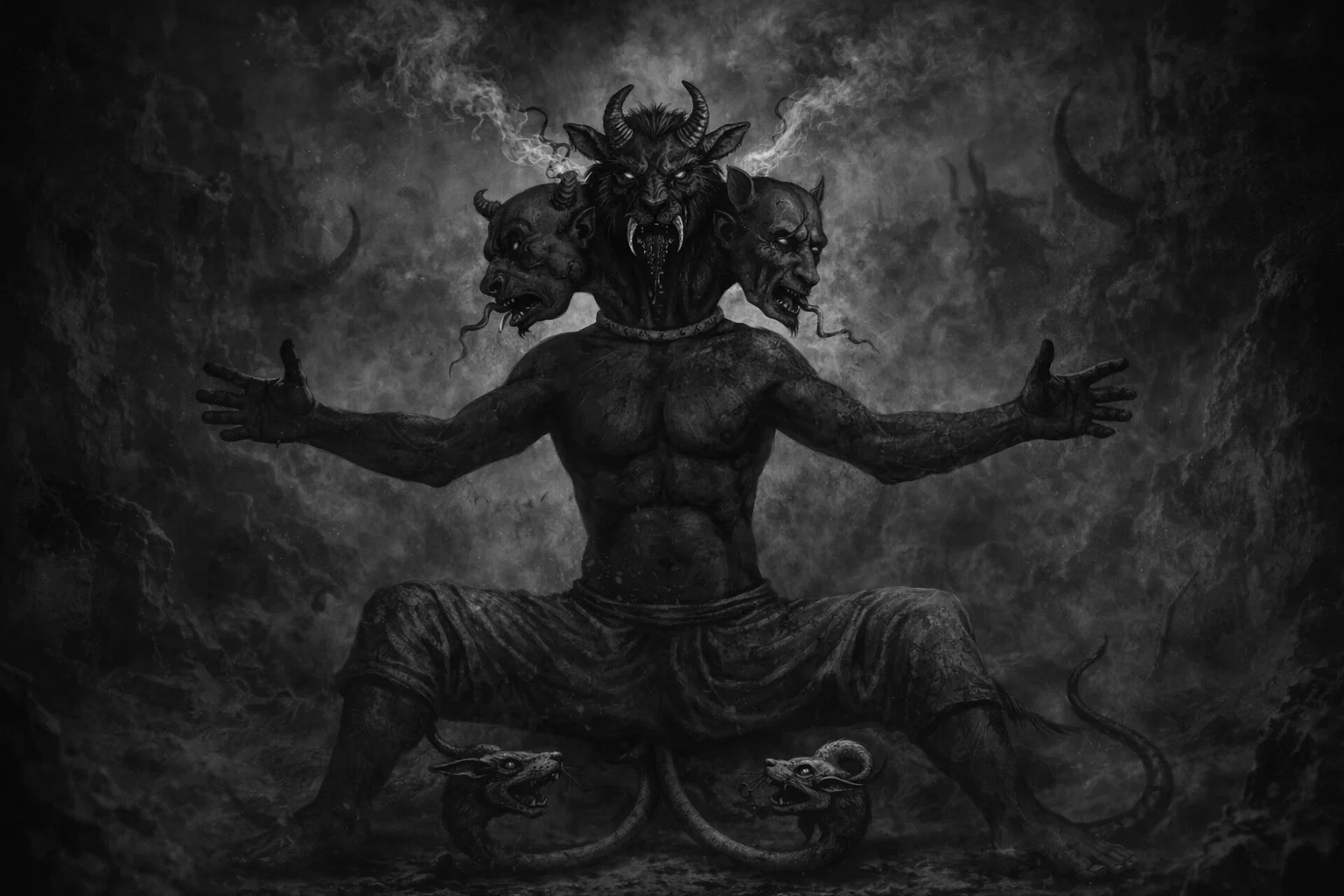
Descriptions of Barqan’s appearance differ in the Kitab al-Bulhan and on talismans. He is usually shown as a strong, human-like entity with a crown, marking him as a Jinn king. Some old pictures show him with two or three heads, symbolizing his ability to see in many directions or to control shifting thoughts.
Barqan’s skin or clothes are often blue or shiny yellow, showing his link to Mercury. Sometimes he is depicted riding a swift animal, such as a bird of prey or a big cat, to show his control over swift creatures. His eyes are often described as sharp or lightning-fast.
Unlike the more frightening Ifrit or Ghul, Barqan usually looks more royal and less beast-like. Still, features like claws or pointed ears are often shown in old art to remind us he is not human.
Origins
Barqan’s story is not based on a single creation myth. Still, it is part of the broader beliefs about Jinn in Islamic and earlier traditions. These stories say Jinn were made from smokeless fire before humans existed. Barqan became a leader in a tribe that joined the heavenly order.
Barqan’s role as the King of Wednesday became clear during the Abbasid era, when researchers translated Greek astrology into Arabic. At that time, each day of the week was linked to a planet, and the old gods were replaced with Jinn Kings under the rule of Archangels.
Barqan was chosen as the spirit connected to Mercury. Over time, he changed from just an astrological symbol to a key creature in Middle Eastern magic books. He became part of stories about Prophet Solomon, who was said to have controlled the seven kings to help build his temple and rule his land.
Historical & Folkloric Records
Barqan is not mentioned in the Quran, but his story starts in medieval Arabic manuscripts that set out the links between planets and spirits.
“The fourth day is Wednesday, its planet is Mercury, its angel is Michael, and its king among the Jinn is Barqan… and his sign is the color blue and his direction is the North.” [Kitab al-Bulhan (The Book of Wonders), 14th Century]
This 14th-century manuscript by Abd al-Hasan al-Isfahani outlines the main details of Barqan. By linking him to Wednesday and Mercury, it changes the Jinn from wild desert beings into organized cosmic officials. The color blue probably shows Mercury’s bright, airy appearance from Earth.
The North is important in this context. In medieval Islamic geography, the North symbolized the unknown, cold, and higher spiritual realms. By placing Barqan there, the author shows that his power over intellect and communication is cool and careful, not fiery and passionate like the Ifrit.
“I conjure you, O Barqan, by the right of the one who said to the heavens and the earth: ‘Come both of you, willingly or unwillingly,’ they said: ‘We come willingly.’ I conjure you by the seal of Solomon, son of David, peace be upon them both…” [Shams al-Ma’arif al-Kubra (The Sun of Great Gnosis), 13th-17th Century]
The main source for Arabic magic shows Barqan as a “Bound Monarch.” Calling on the Solomonic covenant was seen as a way to stay safe, based on the old belief that even the highest Jinn kings could be approached only through the rules set by Prophet Solomon.
The Quranic verse (41:11) about the heavens and the earth obeying shows that the author saw Barqan as part of the natural order, a being who must follow divine law. Unlike later Western ideas of demons as rebels, here Barqan is a “Legitimate King” who just needs the right spiritual approach.
“The King of Wednesday, Barqan, has two heads, and he is the one who brings news from the horizons and knows the secrets of the merchants… he is swift in his movement like the flashing of light.” [Al-Ajnas (The Book of Species/Genres), Late Medieval Period]
This folklore source introduces the idea of Barqan having two heads. This image is a clear symbol of his Mercurial nature: one head looks to the divine (the Archangel Michael), and the other to human matters (the merchants).
Showing Barqan as a patron of merchants and messengers fits the history of the Islamic Golden Age, when trade and news were key. The “speed of light” idea, tied to his name meaning lightning, shows he was inspired by the fast and unpredictable changes in markets and rumors. He is seen not as a bringer of harm but as the master of information change.
Powers and Abilities
Barqan is much more powerful than lesser spirits like the Hinn or simple Shayatin because he is a king. While ordinary spirits might haunt one place, Barqan’s influence covers all of Wednesday and a whole planet. He does not attack physically; instead, he works by confusing the mind.
- Intellectual Subversion: The ability to cloud judgment and cause confusion in scholars, traders, and messengers.
- Linguistic Manipulation: Inciting arguments through the distortion of words or the promotion of lies.
- Swift Affliction: Causing illnesses that appear suddenly and move quickly through the body, particularly those affecting the nervous system.
- Technological Interference: In modern interpretations of his Mercurial nature, he is associated with the breakdown of communication and transport.
- Invisibility and Flight: Like most high-ranking Jinn of the air, he can move across vast distances instantaneously.
Influence on Humans and Possession
Barqan’s influence is usually subtle, showing up as restlessness or a strong urge to lie. Unlike the violent actions of an Ifrit, his possession is marked by fast talking, manic actions, or obsessive counting.
People affected by him might suddenly find themselves caught up in complex legal or social problems. Signs of his presence include a sudden metallic taste or hearing quick whispers with no clear source.
Protection and Exorcism Methods
Traditionally, people used both spiritual and physical methods to protect themselves from Barqan and his followers. Since he is a King, he is believed to be under the Laws of Solomon, so the Seal of Solomon (a hexagram or pentagram) is the primary defense.
People believed that mercury in sealed vials or tin amulets could protect against Barqan. Plants like rue and black seed were also thought to bother him. The most common spiritual defense is calling on Archangel Mikha’il, who is said to be his superior. Reciting certain Quran chapters, especially Surah al-Jinn and the Throne Verse (Ayat al-Kursi), is the usual way to remove his influence.
Barqan Myths, Legends, and Stories
The Binding of the Seven Kings by Solomon
According to various accounts found in the Shams al-Ma’arif, the Prophet Solomon summoned the seven great Jinn Kings to his presence to ensure the safety of his kingdom. When it was the turn of the King of Wednesday, the entity appeared before the throne with a shimmering face.
Solomon demanded an oath of loyalty and a pledge that the king would not permit his subjects to harass the faithful or disrupt travelers’ paths. The King of Wednesday, acknowledging the divine authority granted to Solomon, submitted and provided a specific talismanic sign that could be used to summon him or bind his subordinates if they ever overstepped their bounds. This story establishes the precedent that while these entities are powerful, they are, in the end, subject to divine governance.
The Observation in the Kitab al-Bulhan
In the 14th-century Kitab al-Bulhan, a narrative is presented through illustrations and brief descriptions regarding the governance of the spheres. According to lore, each Jinn King must report to a specific archangel at the turn of each day. Barqan is described as the one who stands before Archangel Mikha’il on the fourth day of the week.
The legend suggests that during this meeting, the archangel provides the Jinn King with the “decrees of the day,” which include the movements of the winds and the distribution of messages.
If Barqan attempts to alter these messages for his own amusement or malice, the archangel uses a bolt of celestial light to correct him, a mythic explanation for the occurrence of sudden lightning on clear days.
Barqan vs Other Jinn
| Jinn Name | Associated Traits/Influence | Rank/Origin | Key Traits/Powers |
| Al-Mudhib | Greed and Pride | King of Sunday | Golden skin, commands solar spirits |
| Murrah | Malice and Grief | King of Monday | Two-headed, associated with the Moon |
| Al-Ahmar | Wrath and Bloodshed | King of Tuesday | Red appearance, associated with Mars |
| Shamhurish | Justice and Law | King of Thursday | Judicial role, associated with Jupiter |
| Zawba’ah | Lust and Desire | King of Friday | Four-headed, associated with Venus |
| Maymun | Misfortune and Toil | King of Saturday | Black skin, associated with Saturn |
| Ifrit | Rebellion and Strength | Quranic/Folklore | Pyrokinesis, immense physical power |
| Marid | Arrogance and Water | Folklore | High rank, shape-shifting, sea-dwelling |
| Ghul | Gluttony and Decay | Wastelands | Carrion eater, lures travelers to death |
| Si’lat | Seduction and Mimicry | Forests/Wilds | Expert shape-shifter, social manipulator |
| Qarin | Personal Temptation | Individual shadow | Invisible constant companion to a human |
| Palis | Exhaustion | Desert lore | Licks the feet of sleepers to drain life |
Position Among Jinn
Barqan has an important spot among the “Seven Kings of the Earth.” He is not the strongest or the weakest, but he is likely the busiest. His place in the group is set by the days of the week.
He comes after Al-Ahmar (the Red King of Mars/Tuesday) and before Shamhurish (the Judge King of Jupiter/Thursday). This shows he acts as a bridge, moving from the chaos of Tuesday to the order of Thursday, and is the messenger.
In Jinn society, Barqan leads a group of Aerial Jinn who watch over human activities. He is often linked to the Shayatin (demons) because he is known for trickery, but he is actually a neutral king. He can be made to do things that are not evil if the right rituals are used. He is also said to have a rivalry with Maymun, since Maymun’s slow, steady nature clashes with Barqan’s love of movement and change.
Mystical Correspondences
| Attribute | Details |
| Planet | Mercury |
| Zodiac Sign | Gemini and Virgo |
| Element | Air (occasionally related to Water) |
| Direction | North (or Center in some traditions) |
| Color | Blue, Turquoise, or Variegated |
| Number | 4 or 8 |
| Crystal/Mineral | Agate or Mercury (Quicksilver) |
| Metal | Mercury/Mixed Alloys |
| Herb/Plant | Hazel, Fennel, or Pomegranate |
| Animal | Stork, Ape, or Fox |
The mystical links of the King of Wednesday show he is a spirit of change and movement. His tie to Mercury is central, as the planet was seen as fast and unstable, ruling over communication and trade. He is also connected to Gemini and Virgo, which highlight his power over thinking and analysis. His influence is strongest when the sun is in these signs, making it a key time for those who want his help or protection from his tricks.
The element of Air shows that Barqan can move anywhere and has no fixed form. His colors, blue and turquoise, stand for the sky and the changing sea. Mercury in liquid form is used in talismans to show how hard it is to catch him—like quicksilver, his influence is hard to control once it starts. Animals like the fox are linked to him, highlighting his clever and tricky nature.
You may also enjoy:
What Is a Qareen and Why Does It Follow Every Human Being?
October 8, 2025
Andrealphus: The Peacock Demon Who Twists Minds and Bodies
January 19, 2026
Who Is Adrammelech in Demonology and the Bible?
October 1, 2025
Arāti: The Beautiful Demon of Aversion in Buddhist Mythology
October 15, 2025
Bibliography
Author’s Note: While working on this article, I noticed a strong contrast between the strict, astrological role shown in the 14th-century Kitab al-Bulhan and the more chaotic, psychological side seen in modern studies like Volkan’s. It was interesting to see how medieval writers turned Barqan from a wild creature in old stories into a more orderly “Bureaucratic Jinn.” Looking at these old texts alongside the rules of the Solomonic covenant, it becomes clear that Barqan is less a typical demon and more a symbol of the thin line between divine order and human confusion.
- Abu Ma’shar al-Balkhi. Kitab al-Bulhan (Book of Wonders). Bodleian Library, MS. Bodl. Or. 133, late 14th century. Internet Archive.
- Ali, Abdullah Yusuf (translator). The Holy Qur’an: English Translation and Commentary. 1934. Internet Archive.
- al-Ṭabarī, Abū Jaʿfar Muḥammad ibn Jarīr. The History of al-Ṭabarī, Vol. 39: Biographies of the Prophet’s Companions and Their Successors. Translated by Ella Landau-Tasseron, State University of New York Press, 1998. Internet Archive.
- al-Ṭabarī, Abū Jaʿfar Muḥammad ibn Jarīr. The History of al-Ṭabarī, Vol. 5: The Sasanids, the Byzantines, the Lakhmids, and Yemen. Translated by C. E. Bosworth, State University of New York Press, 1999.Internet Archive.
- Al-Shaykh, Hanan. One Thousand and One Nights: A Retelling. Pantheon Books, 2013. Internet Archive.
- Volkan, Kevin. The Jinn: Islam, Exorcism, and Psychology. Journal of Social and Political Sciences, 2023. 6. 1-14. 10.31014/aior.1991.06.03.425.
- Khalifa, Najat, and Tim Hardie. Possession and Jinn. Journal of the Royal Society of Medicine vol. 98,8 (2005): 351-3. doi:10.1177/014107680509800805.
- Ibn al-Kalbī, Hishām. The Book of Idols (Kitāb al-Aṣnām). Translated by Nabih Amin Faris, Princeton University Press, 1952. Internet Archive.