Calling the Ifrit just a “fire demon” overlooks the deeper religious tension in its nature, as it can show both great loyalty and total defiance. Most Jinn are known for being invisible, but the Ifrit stands out as the “smokeless flame” brought to life. It acts as a link between the old desert religions and the more structured beliefs of the Solomonic period.
Looking at how the Ifrit changed from a vengeful spirit tied to the earth to a powerful entity in Iblis’s court reveals a Middle Eastern symbol of power that is both practical and intimidating.
In this article, I created a clear distinction between formal Quranic accounts and the expansive folklore found in the Shams al-Ma’arif and One Thousand and One Nights. [View Full Bibliography ↓]
Summary
Key Takeaways
| Attribute | Details |
|---|---|
| Names | Ifrit, Afarit, Efreet, ‘Ifrīt |
| Type | Fire-based, rebellious jinn |
| Title | King or leader of fire jinn |
| Gender | Ambiguous, often male in depictions |
| Servitors | Lesser fire jinn or unnamed subordinates |
| Superior Jinn | Iblis (Shaytan) |
| Powers | Shape-shifting, fire manipulation, deception, inducing fear, temptation |
| Appearance | Smoky, fiery humanoid or beastly form, often with wings or horns |
| Etymology | From Arabic ‘afara, meaning “to rub with dust” or “to roll in dust” |
| Associated Figures | Iblis, King Sulayman, other rebellious jinn |
| Weaknesses | Repelled by Ayat al-Kursi, Surah Al-Falaq, iron, specific prayers |
| Opposing Holy Figure | Prophet Sulayman, Archangel Jibril |
| Social Structure | Leader of a tribe of fire jinn |
| Followers/Tribe Size | Commands a tribe of fire jinn, size unspecified |
| Element | Fire |
| Planet/Zodiac | Mars, Aries |
| Color(s) | Red, black |
| Number(s) | 7 |
| Crystal(s)/Mineral(s) | Ruby, obsidian |
| Primary Sources | Quran, Hadith, Shams al-Ma’arif, One Thousand and One Nights |
“Ifrit” Meaning
The word “Ifrit” carries important meaning in both language and culture, with its roots in Arabic. It comes from the Arabic word ʿifrīt, based on the root ʿ-f-r, which means to rub or roll in dust.
This root suggests traits like deception, malice, and cunning. These qualities fit well with how Jinn are often seen as clever and rebellious beings.
Over time, the meaning of Ifrit has changed. It began as a term in early writings for a powerful and wicked spirit. Forms like ‘ifriya’ and ‘ifr’ show up in records before the Quran, pointing to its ancient roots. Some experts think there might be a Middle Persian link, with āfrītan meaning “to create,” but this idea is still debated.
In Islam, the name Ifrit stands for both power and betrayal, showing its role in tempting and disturbing people’s lives. As different cultures mixed, Persian and Zoroastrian ideas may have influenced the term, adding connections to fire and the underworld.
Pronunciation
In English, “Ifrit” is pronounced as “IF-reet,” with the first syllable stressed. The “I” sounds like in “bit,” and “frit” rhymes with “feet.” In Arabic, it is “‘Ifrīt” (عفريت), starting with a guttural ‘ayn sound, though this is usually softened in English.
What Does the Ifrit Look Like?
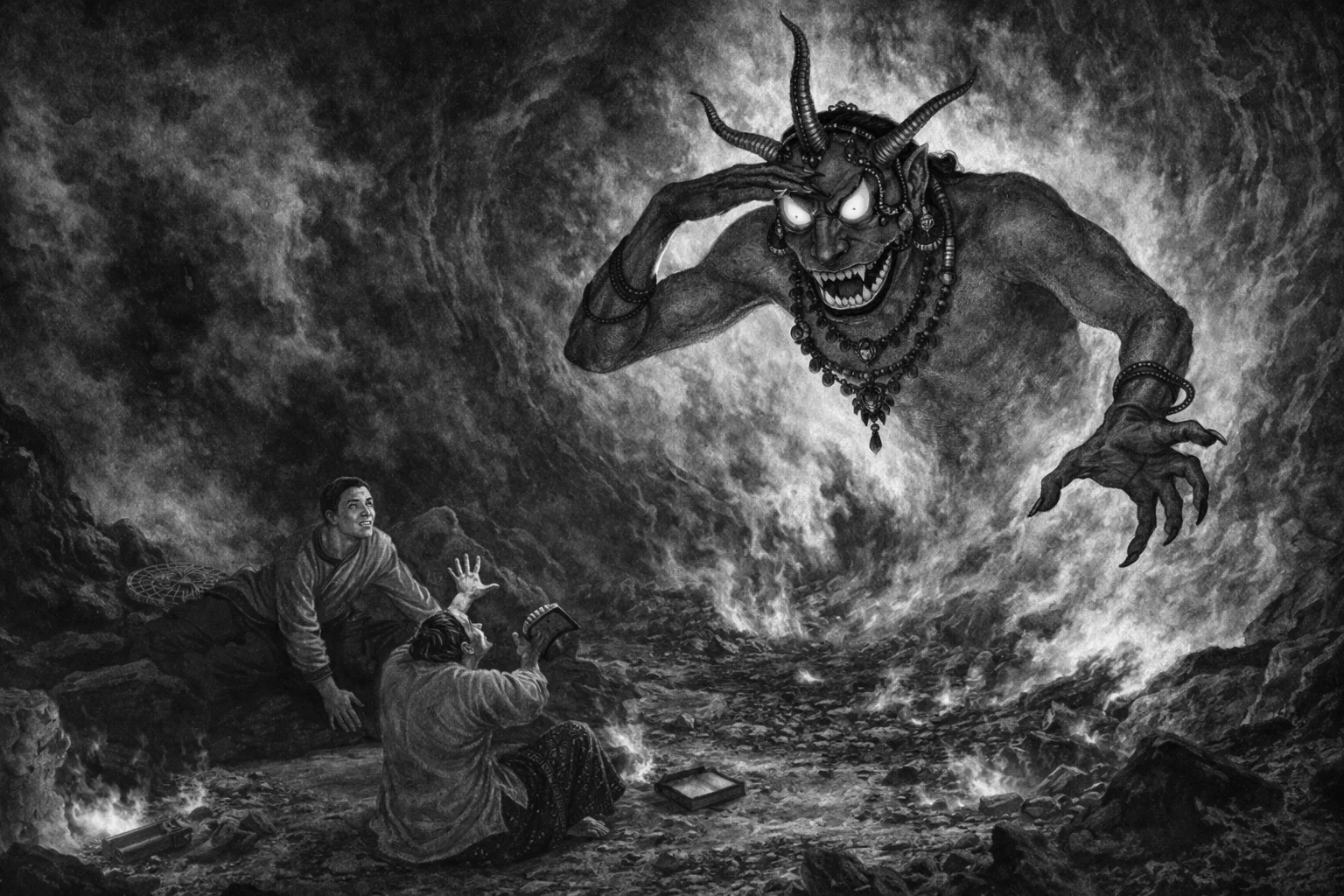
The Ifrit is often described as a large, fiery entity. Main sources like One Thousand and One Nights show this Jinn as tall and smoky, with glowing eyes, and it can look like a human or a beast.
Some stories mention that Ifrits have wings, horns, or hooves, making them seem even more supernatural. Their fiery nature, tied to being made from smokeless fire (Quran 55:15), often appears as a red or black glow, showing their link to destruction and chaos.
In ancient Arabic texts, the Ifrit sometimes appears as a shadow that emits fire and smoke. Thanks to its metamorphosis powers, it can also turn into animals like snakes or scorpions, or even appear human to trick people.
In some other stories, the Jinn stays invisible unless someone calls it forth.
You may also enjoy:
Arāti: The Beautiful Demon of Aversion in Buddhist Mythology
October 15, 2025
Who Is the Demon Andras, The Great Marquis of Discord?
January 15, 2026
Andrealphus: The Peacock Demon Who Twists Minds and Bodies
January 19, 2026
Rokurokubi: The Yōkai That Looks Human Until Midnight
February 3, 2026
Barbas: The Lion Demon Who Spreads Disease
March 3, 2026
Origins
The Ifrit comes from old Arabian folklore, where it was seen as a strong and dangerous spirit connected to wild places and natural forces. Before Islam, people thought the Ifrit hid in deserts, ruins, and far-off spots, maybe as a symbol of the dangers found in these harsh lands.
People saw the Ifrit as a spirit of the underworld, linked to the dead. Early forms of its name, like ifriya and ifr, show up in ancient records, pointing to its long history.
Old stories say the Ifrit was born from the blood of murder victims, seeking revenge for the dead. This explains why it was thought to haunt graveyards or ruins, punishing the living. Other tales show Ifrits as protectors of hidden treasures or cursed spots, tricking or tormenting travelers.
When Islam spread, the Ifrit was redefined in a new religious context. The Quran describes it as a rebellious Jinn made from smokeless fire, but still under Allah’s control.
This change put the Ifrit under Iblis, the main rebel. Islamic teachings set Ifrits apart from angels and humans, granting them a world of their own in which they could choose to believe or not. Over time, stories in Hadith and Tafsir added more details, showing Ifrits as tempters or as figures in religious tales, like interrupting prayers or troubling prophets.
In Egypt, people believed these spirits guarded the tombs of pharaohs, and they blended with local legends. In Morocco, stories often focused on their strange shapes and the strong influence of supernatural forces over people.
From Spilled Blood to the “Marid of the Dust”
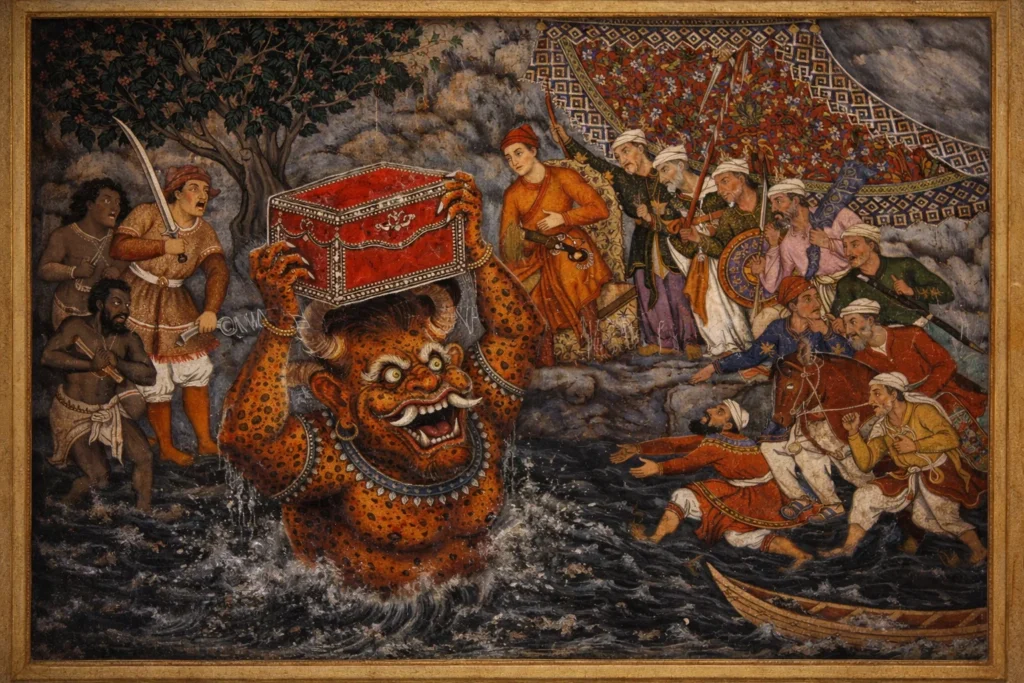
Today, people often see the Ifrit as a fire spirit, but looking back in history shows a connection to the older idea of the qutrub—a demon thought to come from the spirits of murder victims.
In old Bedouin stories, the Ifrit was more than just a type of Jinn—it was a sign of social pain. Called the “demon of the ruins” (khirba), it showed up where unavenged blood had soaked into the ground. This links the Ifrit to ideas of justice and social order in ancient Arabia.
The Ifrit acted as a supernatural enforcer of the law of retaliation. Until blood money was paid or revenge was taken, the Ifrit stayed at the site, becoming stronger the longer justice was delayed.
The change from a “ghost of the soil” to a “lord of the fire” shows a big shift in beliefs as Islam spread. The Kitab al-Azmat says that the Ifrit is heavier than other Jinn, allowing it to interact more forcefully with the physical world. This idea of “heaviness” comes from the Arabic root ‘afara, meaning “to roll in the dust.”
In psychological terms, the Jinn is like a Resentful Architect. While the Ghul feeds on bodies and the Sila tricks minds, the Ifrit creates barriers. In the stories about Solomon, the Ifrit offers to move the Throne of Bilqis, showing its role as a worker. It stands for the risky side of raw power when it doesn’t have moral direction and is driven by old, deep feelings of entitlement.
The Ifrit is also linked to the planet Mars and the metal iron, which connects it to Roman myths about spirits of scorched earth. In Moroccan Gnawa tradition, people try to “trap” the Ifrit using special rhythms, not worship it. This shows the Ifrit as a symbol of chaos through hard work. It is the spirit of the desert’s heat—a force that can either create or destroy.
If we look at the Ifrit from an environmental psychology angle, it reflects how desert people relate to their land. This place helps them survive, but also has the remains of lost cultures. The Ifrit is like the memory of ruins, guarding the “dust” that gives it both its name and its anger.
Relevant Historical & Text Records
While the Ifrit is a prominent entity in Islamic tradition, its historical record as a specific class of entity dates back to pre-Islamic oral traditions. It is later codified in the 7th-century Quran.
“An ‘ifrit (strong one) from among the jinn said, ‘I will bring it to you before you rise from your place, and indeed, I am for this [task] strong and trustworthy.’” [The Quran, Surah An-Naml (27:39), 7th Century CE]
This key scripture shows how the entity shifted from a vague desert spirit to a specific type of Jinn within a monotheistic system.
Unlike later Western stories that made the Ifrit seem purely evil, the Quran shows the Ifrit as a proud but skilled helper who can do great feats of building and moving things. Here, the word ‘ifrit means “strength” and “resourcefulness,” not just evil, making the Ifrit a powerful servant under King Sulayman (Solomon).
This scripture is the primary source tying the creature to the stories about Solomon. This theme has shaped its identity for centuries.
“The Ifrit is a creature of the third class of Jinn… they are the most powerful of all the classes of Jinn, and the most wicked. They are said to be created of fire, or of the smokeless flame of fire.” [Edward William Lane, An Account of the Manners and Customs of the Modern Egyptians, 1836 (Based on 18th/19th Century Cairene Folklore)]
This 19th-century study shows how people in Egypt saw the Ifrit after the Middle Ages. By then, the Ifrit had changed from an official creature in the Quran to a darker, more underworld-like spirit.
Lane’s work shows a big change: the Ifrit was now seen as the “most wicked” type of Jinn, often linked to the spirits of people who died violently. This shift made the creature less about free will and more about a clear divide between demons and humans in popular belief.
“Know that the Ifrits are the kings of the fire-jinn… their nature is entirely of the heat of the sun and the essence of the flame. When they appear, the air becomes acrid and the smell of sulfur precedes them.” [Ahmad al-Buni (attributed), Shams al-Ma’arif (The Sun of Gnosis), Reconstructed Manuscript Traditions (Late Middle Ages/Early Modern)]
This occult source explains why the Ifrit appears the way it does. In the Shams al-Ma’arif, the Ifrit is no longer just part of Solomon’s story. Still, it is now seen as an elemental king, tied to astrology and the elements. The focus is on its makeup—the “heat of the sun”—which links it to Mars and the qualities of anger and fire.
This period was important for changing the Ifrit from a scary desert ghost into a force that people thought they could control using special seals and powerful names.
Powers and Abilities
The Ifrit has many dangerous powers, making it a strong and frightening being. Its main abilities are manipulation, destruction, and causing chaos:
- Metamorphosis: The creature can transform into humans, animals (such as snakes or scorpions), or smoke, allowing for deception.
- Fire Manipulation: They control fire, creating flames or fiery illusions to intimidate or harm.
- Temptation and Deception: They whisper doubts or false promises, leading humans to sin or disbelief.
- Superhuman Strength: As seen in Quran 27:39, Ifrits possess immense physical power, capable of moving massive objects.
- Inducing Fear: They instill terror through terrifying forms or supernatural phenomena.
You may also enjoy:
Rāga: The Seductive Demon of Passion and Desire in Buddhist Lore
October 16, 2025
Who Is Azazel, the Demon Blamed for Human Corruption?
February 24, 2026
Who Was Ravana in Hindu Mythology and Why Was He Feared?
October 3, 2025
Tarakasura: The Dark Demon Who Ruled Hell on Earth
December 4, 2025
Who Is Hariti, the Mother of Ogres in Buddhist Mythology?
December 8, 2025
Who Is Shiva, the Destroyer and the Lord of the Universe?
November 12, 2025
Influence on Humans and Possession
Ifrits can strongly affect people, often through a Qarin, which is a personal Jinn companion. The Qarin is known for being especially evil. It whispers doubts, fears, or temptations to lead people away from faith and good behavior. This influence is called Sihr (sorcery) in Islamic belief, where Jinn, like the Ifrit, can cause mental or physical problems.
Signs that an Ifrit is involved include ongoing nightmares with fire or shadows, sudden anger, or deep sadness that can’t be explained. Folklore, especially in North Africa and the Levant, also attributes physical ailments such as pain, fatigue, and seizures to Ifrits. People often see these troubles as the Ifrit trying to control someone by exploiting their weaknesses, such as greed or pride.
In some narratives, the Ifrit’s possession is more overt, causing victims to speak in unfamiliar voices or exhibit unnatural strength, as noted in Moroccan and Egyptian tales. For instance, a possessed individual might display an aversion to sacred spaces or react violently to Quranic recitations, signaling the Ifrit‘s presence.
Stories say the Ifrit goes after people who break taboos, such as entering cursed places or performing forbidden rituals. It uses these chances to get into their minds. The Ifrit can also stir up emotions like envy or anger, which fits its link to the sin of wrath.
Protection and Exorcism Methods
Islamic writings and stories offer many ways to protect against or drive out an Ifrit.
The most well-known remedy is reciting Ayat al-Kursi (Quran 2:255), which is revered as a powerful shield against the Jinn. This verse, which affirms Allah’s sovereignty, is believed to create a spiritual barrier that repels the Ifrit’s influence.
Hadith narrations, such as those in Sahih Muslim, also recommend reciting Surah Al-Falaq and Surah An-Nas, known as Al-Mu’awwidhatayn (the two protectors), to ward off Sihr and possession. These surahs are recited three times, often at dawn or dusk, to counter the Ifrit’s nocturnal activity.
Ruqyah (an Islamic exorcism practice) involves reciting specific Quranic verses and supplications to expel the Ifrit. Practitioners typically use verses to weaken the Jinn’s hold.
In stories, people use iron—like swords, nails, or rods—because it is thought to hurt Jinn. Salt, seen as pure, is sprinkled around homes or beds to keep the evil spirit away.
In North Africa, burning certain incenses, especially frankincense or myrrh, is believed to weaken the Ifrit.
People wear or hang amulets with Sulayman’s seal or Quran verses written in saffron ink, using Prophet Sulayman’s power over Jinn for protection.
Myths, Legends, and Stories
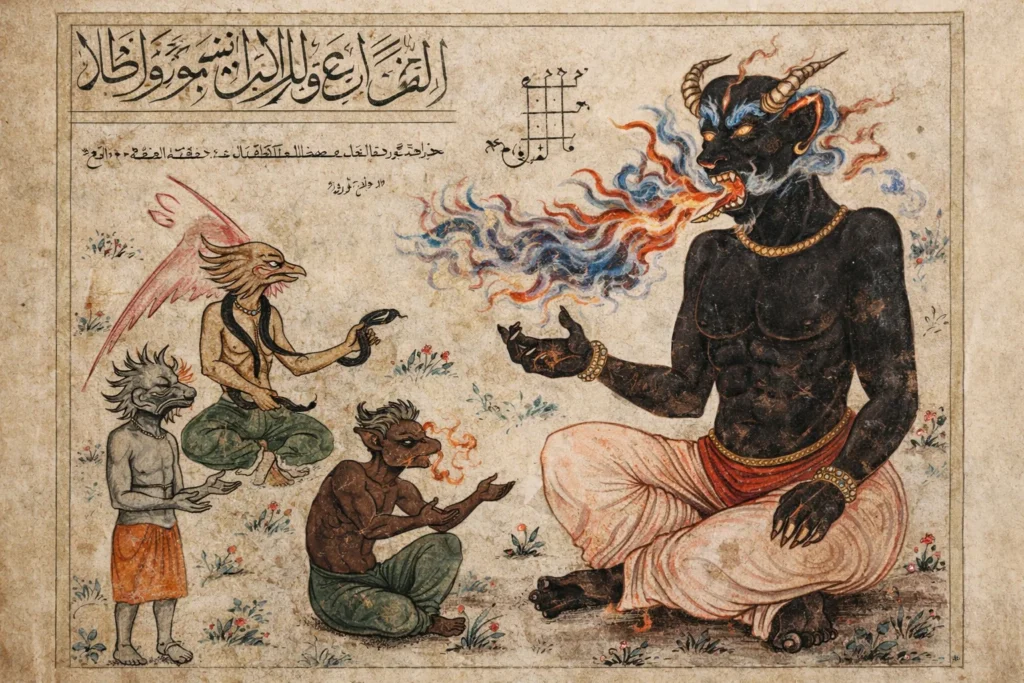
The Ifrit shows up in many stories from Islamic texts, magic books, and folklore, highlighting its cleverness, strength, and complicated ties to divine power.
The Ifrit and Prophet Sulayman
In the Quran (Surah An-Naml 27:39-40), Prophet Sulayman seeks to bring the throne of the Queen of Sheba, Bilqis, to his court to demonstrate divine power. An Ifrit among the Jinn steps forward, its voice resonant with confidence, declaring, “I will fetch it for you before you rise from your seat, for I am strong and trustworthy in this task.”
Immediately, its malevolent presence fills the court, exuding strength as it promises swift delivery of the massive throne across vast distances. Yet, before the Ifrit can act, a human scholar, gifted with knowledge of the Scripture, speaks up, claiming he can bring the throne before Sulayman’s glance returns.
Instantly, the throne appears before the Prophet, who looks on it in awe, proclaiming, “This is by the grace of my Lord, to test whether I am grateful or ungrateful.” The Ifrit, though powerful, is outdone by divine wisdom, highlighting its subordination to Allah’s will.
The Fisherman and the Evil Ifrit
In a renowned tale from One Thousand and One Nights, a humble fisherman, struggling to provide for his family, casts his net into the sea four times with no success. On his final attempt, he hauls up a heavy copper jar, sealed with a lead stopper bearing the seal of Prophet Sulayman.
Curious, he breaks the seal, and a thick, swirling smoke erupts, coalescing into a towering Ifrit with eyes like burning coals, a voice like rolling thunder, and a form that darkens the sky. The Ifrit, furious after centuries of confinement, declares, “Prepare to die, for I swore to kill whoever frees me!” It recounts its imprisonment: initially grateful, it vowed riches to its liberator, but as centuries passed in solitude, its gratitude turned to bitter rage.
The fisherman, trembling but clever, questions how so vast a being could fit in such a small jar. The Ifrit, eager to prove its power, transforms into smoke and re-enters the jar. Swiftly, the fisherman reseals it, threatening to cast it back into the sea.
Terrified by the possibility of being trapped again, the Ifrit pleads, offering wealth and sharing its tale of rebellion against Sulayman, who bound it with divine authority.
Moved by its story but wary, the fisherman negotiates, demanding a pledge of safety. The Ifrit agrees, guiding him to a lake teeming with colorful fish—red, white, blue, and yellow—which the fisherman presents to the sultan, earning great riches.
The Ifrit vanishes, leaving the fisherman prosperous but cautious of supernatural encounters.
The Ruins
In ancient Arabian folklore, a malevolent Ifrit haunts a crumbling desert ruin, its presence marked by flickering flames in the night. A weary merchant, traveling through desolate sands, hears seductive whispers promising untold treasures hidden within the ruin’s depths. Drawn by visions of gold and jewels, he ventures inside, where the air grows hot and heavy.
The Ifrit reveals itself in a burst of fire, its massive form wreathed in smoke, with glowing eyes and clawed hands. It traps the merchant in a maze of fiery illusions, where walls of flame shift and taunt, filling his mind with fear and despair. The poor merchant, lost and desperate, believes he will perish.
Meanwhile, a wise scholar, traveling nearby, senses the Ifrit’s malevolence. Armed with sacred knowledge, he enters the ruin, reciting powerful verses from the Quran, including Ayat al-Kursi. The Ifrit writhes, its flames dimming under the weight of divine words, and attempts to flee but is bound by the scholar’s invocations.
With a final recitation, the Ifrit dissolves into a wisp of smoke, freeing the merchant, who collapses in gratitude. The scholar warns him to shun deceptive promises, and the merchant vows never to heed such whispers again.
You may also enjoy:
What Is Akaname, The Filth-Licking Yōkai?
October 28, 2025
Agubanba: The Blind Yōkai That Preys on Young Women
October 23, 2025
Erinyes: The Chthonic Goddesses Who Enforced Blood-Guilt
November 20, 2025
What Is a Tengu? Origins, Powers, and Dark Folklore
January 29, 2026
Who Is Adrammelech in Demonology and the Bible?
October 1, 2025
Palden Lhamo: The Black Goddess of Blood and Protection
October 20, 2025
Māhān’s Torment
In Nizami Ganjavi’s Persian epic Haft Peykar, the Egyptian traveler Māhān strays from the path of virtue, wandering into a demon-haunted desert. An Ifrit, born of divine wrath, appears initially as a radiant fairy, its form alluring with promises of guidance.
Māhān, captivated, follows, only for the Ifrit to transform into a terrifying demon, its body wreathed in flames, eyes blazing with malice, and voice a guttural roar. It drags him through desolate valleys and treacherous ravines, subjecting him to visions of hellish torments—burning sands, shadowy beasts, and whispers of eternal despair.
The Ifrit accuses Māhān of moral failings, its fiery form shifting to mirror his fears: a snarling dog, a venomous scorpion, a towering inferno. Māhān, overwhelmed, pleads for mercy, confronting his sins in the Ifrit’s illusions.
Through repentance and fervent prayer, he weakens the Ifrit’s hold, its flames fading as his resolve strengthens. Finally, the Ifrit retreats, its purpose as a moral enforcer fulfilled, leaving Māhān to appear wiser, vowing to uphold righteousness.
The Ifrit and the Porter
In another tale from One Thousand and One Nights, a porter in Baghdad is hired by a group of young women to carry goods to a luxurious house filled with feasts, music, and laughter.
Among them is a prince, cursed by an Ifrit into the form of an ape, his eyes filled with sorrow. The woman explain that the Ifrit, consumed by jealousy, transformed the prince for falling in love with its daughter, a radiant Jinn. The Ifrit had declared, “No mortal shall touch my kin!” It used its fiery power to bind the prince in this humiliating form, separating the lovers.
The women, pitying the prince, seek to break the curse. They prepare a ritual with sacred oils and chants, confronting the monster when it appears in a storm of flames and smoke, its form monstrous with horns and a lashing tail.
The battle is fierce; the spirit unleashes fiery illusions, conjuring visions of burning cities and snarling beasts. One woman, skilled in exorcism, sacrifices herself, chanting divine words that turn the Jinn to ash.
In the end, the prince is restored but loses an eye in the ordeal, a mark of the creature’s wrath. He marries one of the women, who becomes his queen, and they honor the fallen heroine.
Ifrit vs Other Jinn
| Jinn Name | Associated Traits/Influence | Rank/Origin | Key Traits/Powers |
|---|---|---|---|
| Marid | Pride, rebellion | King of sea jinn, Quran | Grants wishes, immense strength |
| Ghul | Deception, grave-haunting | Follower, Arabian folklore | Shape-shifting, lures victims |
| Shaitan | Temptation, evil | Leader under Iblis, Quran | Incites sin, whispers doubts |
| Qarin | Personal influence | Companion jinn, Hadith | Influences thoughts, subtle |
| Jann | Neutral, desert-dwelling | Lower rank, folklore | Hides in oases, minor tricks |
| Nasnas | Mischief, chaos | Lesser jinn, folklore | Half-human form, causes confusion |
| Hinn | Servitude, animal-like | Lower rank, pre-Islamic | Serves higher jinn, weak powers |
| Si’lat | Seduction, trickery | Female jinn, folklore | Lures men, shape-shifts |
| Palis | Vampiric, foot-licking | Lesser jinn, folklore | Drains energy, nocturnal |
| Shiqq | Deformity, chaos | Lesser jinn, folklore | Half-bodied, causes fear |
| Jinnati | Neutral, community-based | Tribal jinn, folklore | Protects or harms tribes |
| Buraq | Evil, desert-bound | Lesser jinn, folklore | Haunts travelers, illusions |
| Hatif | Invisible voice, deception | Lower rank, folklore | Mimics voices, misleads |
| Mal’ak | Ambiguous, messenger-like | Neutral jinn, folklore | Delivers omens, neutral |
| Ruqyah Jinn | Healing or harm | Ambiguous, Hadith | Affects exorcisms, variable |
Position Among Jinn
Jinn society is similar to that of old Arab tribes, with kings, clans, and even marriages with humans that produce hybrids. In this world, the Ifrit has a top spot, seen as one of the strongest and most rebellious Jinn.
Islamic texts, such as Shams al-Ma’arif, say the spirit leads the fire Jinn tribes, commanding weaker spirits in acts of trickery and destruction. The Ifrit serves under Iblis, ranking with the Shayatin as a powerful devil—stronger than most Shaytan and similar to marids in strength.
Ifrits are stronger than lower Jinn like hinn or ghuls, but they can still be controlled by greater powers, as shown in the stories of Sulayman.
Sources don’t say exactly how many followers Ifrits have. Still, they are known to lead groups of fire spirits and carry out tasks of justice or revenge.
Ifrits sometimes team up with other rebellious Jinn to cause chaos. Still, they also compete with more obedient Jinn or marids for power.
Al-Buni’s writings classify Ifrits as underworld spirits, connected to the seven layers of the earth.
Associations
The Ifrit is usually linked to fire, the planet Mars, the ruby gemstone, the number 7, and the color red.
Zodiac and Astrological Links
The Ifrit is closely connected to Mars, the planet of war and energy, which adds to its power to create fire or start conflicts.
Occult books like Shams al-Ma’arif say Mars controls the Jinn’s power to rule or scare others. Martian hours, especially on Tuesday nights, are considered the best times for rituals using this power.
The zodiac sign Aries, ruled by Mars, matches the Ifrit’s bold and leader-like nature, since it leads fire Jinn tribes. Some magic books also link the Ifrit to Scorpio, another Mars sign, highlighting its vengeful and secretive side.
Elemental Associations
The Ifrit is deeply connected to fire, its main element, as the Quran (55:15) says, Jinn are made from smokeless fire. Fire stands for destruction, passion, and rebellion. The Ifrit often looks smoky and surrounded by flames, and it can control fire or create fiery illusions.
Stories say that Ifrits live in hot, dry places, such as deserts or near volcanoes.
In Islamic beliefs, the South stands for heat and strength, and Ifrits are often said to come from southern deserts, especially in Arabian and North African stories.
Some writings also link Ifrits to the earth, based on the meaning of their name, which refers to rubbing with dust. This hints at their power over ash or burned ground.
Colors, Numbers, and Crystals
The Ifrit is linked to the color red, which stands for anger, blood, and fire, and is used in charms or candles to call on it. It is also connected to black, which means chaos, the underworld, and hidden evil.
The number 7 is special, linked to the seven layers of the Earth where demons are believed to live, or to the seven sins, especially anger.
In Shams al-Ma’arif, ruby is linked to the Ifrit because of its fiery color and power, and it is used in rituals to boost the Ifrit’s influence. Obsidian, a black volcanic glass, symbolizes protection and darkness and is used to bind or drive away the demon.
Garnet, another red stone, is mentioned in Persian texts for its ties to passion and strength, making the Ifrit’s fiery nature stronger in magic.
Other Correspondences
The Ifrit is connected to iron, which stands for great strength. But in a twist, iron is also said to be its weakness, since folklore claims iron can drive Jinn away.
Animals in these stories include scorpions, which stand for treachery; snakes, for being sneaky and quiet; and dogs, for guarding cursed places.
Sulfur is linked to the Ifrit’s bad, hellish smell, showing its fiery and underworld nature.
Henbane, also called nightshade, is tied to poison and magic, and is mentioned in magic books as part of Ifrit rituals.
The Ifrit is known for causing anger and violence in people, as it is closely tied to the sin of wrath.
People often report sharp, burning smells and strong heat when an Ifrit appears. Modern magic also links cinnamon, for its strong scent, and coal, for its connection to burning, to the Ifrit.
You may also enjoy:
Allocer: Great Duke of Hell and the 52nd Spirit of the Ars Goetia
November 17, 2025
Abadir: The Demon Servant of Chaos and Dispersion
September 30, 2025
Palden Lhamo: The Black Goddess of Blood and Protection
October 20, 2025
Aim (Aym): The Great Duke of Hell in the Ars Goetia
November 11, 2025
Al-Ahmar: The Tuesday King of the Seven Jinn
February 13, 2026
Bibliography
Author’s Note: While working on this article, I noticed an unusual difference between Volkan’s clinical and psychological views and the vivid superstitions described by Edward William Lane in the 1800s. Modern medical journals call Ifrit possession a cultural syndrome, but comparing these with classic translations by Abdel Haleem and Yusuf Ali shows that the idea of “smokeless fire” still carries deep meaning. It’s interesting to see how the Ifrit changes from a powerful entity in the Quran to a more unpredictable and sometimes tragic character in Hanan Al-Shaykh’s version of Arabian Nights. This change from a tool of divine power to a warning in folklore shows how the Ifrit has lasted in both religious and everyday stories.
- M. A. S. Abdel Haleem (translator). The Qur’an: English Translation and Parallel Arabic Text. Oxford University Press, 2004. Quran Project Edition.
- Ali, Abdullah Yusuf (translator). The Holy Qur’an: English Translation and Commentary. 1934. Internet Archive.
- Al-Shaykh, Hanan. One Thousand and One Nights: A Retelling. Pantheon Books, 2013. Internet Archive.
- Lane, Edward William. An Account of the Manners and Customs of the Modern Egyptians, Written in Egypt During the Years 1833–1835. Ward, Lock and Co., 1842. Internet Archive.
- Meri, Josef W. (editor). Medieval Islamic Civilization: An Encyclopedia. Routledge, 2006. Internet Archive.
- Volkan, Kevin. The Jinn: Islam, Exorcism, and Psychology. Journal of Social and Political Sciences, 2023. 6. 1-14. 10.31014/aior.1991.06.03.425.
- Khalifa, Najat, and Tim Hardie. Possession and Jinn. Journal of the Royal Society of Medicine vol. 98,8 (2005): 351-3. doi:10.1177/014107680509800805.
- Volkan, Prof. Kevin. The Jinn: Islam, Exorcism, and Psychology. Journal of Social and Political Sciences, vol. 6, no. 3, Asian Institute of Research, 2023, pp. 1–14. Academia.edu.