Gandharvas shows the balance between enjoying beauty and being distracted from spiritual goals. They are often seen as minor celestial spirits who represent the “trap of the senses,” in which music and beauty can honor the divine but also bind one to desire. As attendants of Dhrtarastra, they act as a link between the physical world and the higher, more refined realms.
Gandharvas are also well-known celestial musicians in Hindu mythology. For more about their origins in the Rigveda, see the Hindu Demons category.
To ensure historical accuracy, I compared the embryological details in the Majjhima Nikaya with Vasubandhu’s 5th-century writings to better understand the entity’s role in the transition of consciousness. [View Full Bibliography ↓]
Summary
Key Takeaways
| Attribute | Details |
| Names | Gandharva (Sanskrit), Gandhabbā (Pali), Jian-da-po (Chinese), Ghandarba (Tibetan) |
| Title | Celestial Musicians, Spirits of Fragrance, Guards of the East |
| Region | India, Tibet, China, Southeast Asia |
| Type | Buddhist Deva-class entities / Nature spirits |
| Gender | Predominantly Male (associated with Apsaras) |
| Realm | Cāturmahārājika (Heaven of the Four Heavenly Kings) / Desire Realm |
| Obstacle/Threat | Attachment to sensory pleasure, distraction from meditation, pride |
| Associated Figures | Dhrtarastra (King of the East), Indra (Sakra), Apsaras |
| Weapon/Item | Vina (Lute) or various musical instruments |
| Weaknesses | Subjugation by Dharma, lower status compared to Arhats |
| Associated Deity | Dhrtarastra, Gautama Buddha |
| Pantheon | Buddhist (with deep Vedic/Hindu roots) |
| Primary Sources | Digha Nikaya, Lotus Sutra, Abhidharma-kosha |
Who or What is the Gandharva?
Gandharvas are a unique group of lower-level deities or spirits in Buddhist cosmology. They are best known as the celestial musicians of the Trayastrimsa Heaven. They are led by Dhrtarastra, the Guardian King of the East. Unlike the more frightening demons of the lower realms, Gandharvas are usually seen as kind. However, they are still limited by the Desire Realm (Kamadhatu).
In Buddhism, Gandharvas are unique because they do not eat regular food. Instead, they live on fragrances and scents. This makes them special as entertainers for the higher gods (Devas).
Still, as part of the Eight Classes of Non-human Beings (Aghtagatya), they have a dual role: they protect the Dharma. They are also affected by the same desires and rebirth cycles as other beings.
“Gandharva” Meaning
The word comes from the Sanskrit’ gandha,’ meaning ‘fragrance’ or ‘scent.’ This points to their main trait: they are spirits who ‘feed on scent.’ In the Pali Canon, they are called Gandhabbā. When Buddhism spread to East Asia, the name became Jian-da-po in Chinese.
The term also has a special meaning in Buddhist psychology. Sometimes, it refers to the antarabhava, or the ‘intermediate state’, that exists between death and rebirth. In this sense, the Gandharva is the spirit looking for a new birth, attracted by the ‘scent’ of the parents’ union.
So, the name points to a very subtle being, living on a level where physical form is replaced by smells and sounds. In Tibetan tradition, they are often connected to the ‘Bardo,’ which highlights their role in the transition from a sentient being to a new consciousness being reborn.
How to Pronounce “Gandharva” in English
The word is pronounced gan-DHAR-vah. The first part, ‘gan,’ sounds like ‘gun’ or the start of ‘gander.’ The second part, ‘DHAR,’ is stressed, with a soft ‘dh’ as in ‘the’ and ‘ar’ as in ‘car.’ The last part, ‘va,’ is a short, soft sound. In Chinese, Jian-da-po is said as jen-dah-paw.
You may also enjoy:
What Is a Dīv? The Terrifying Giant Demon of Persian Myth
January 22, 2026
Lamia: The Queen Cursed to Devour the Children of Others
January 7, 2026
Mahabali (Bali): The Benevolent Asura King
October 10, 2025
Hitotsume kozō: One-Eyed Yōkai of Japanese Folklore
February 4, 2026
Rāga: The Seductive Demon of Passion and Desire in Buddhist Lore
October 16, 2025
What Is Jorōgumo? The Deadly Spider Woman of Japanese Myth
February 2, 2026
What Does Gandharva Look Like?
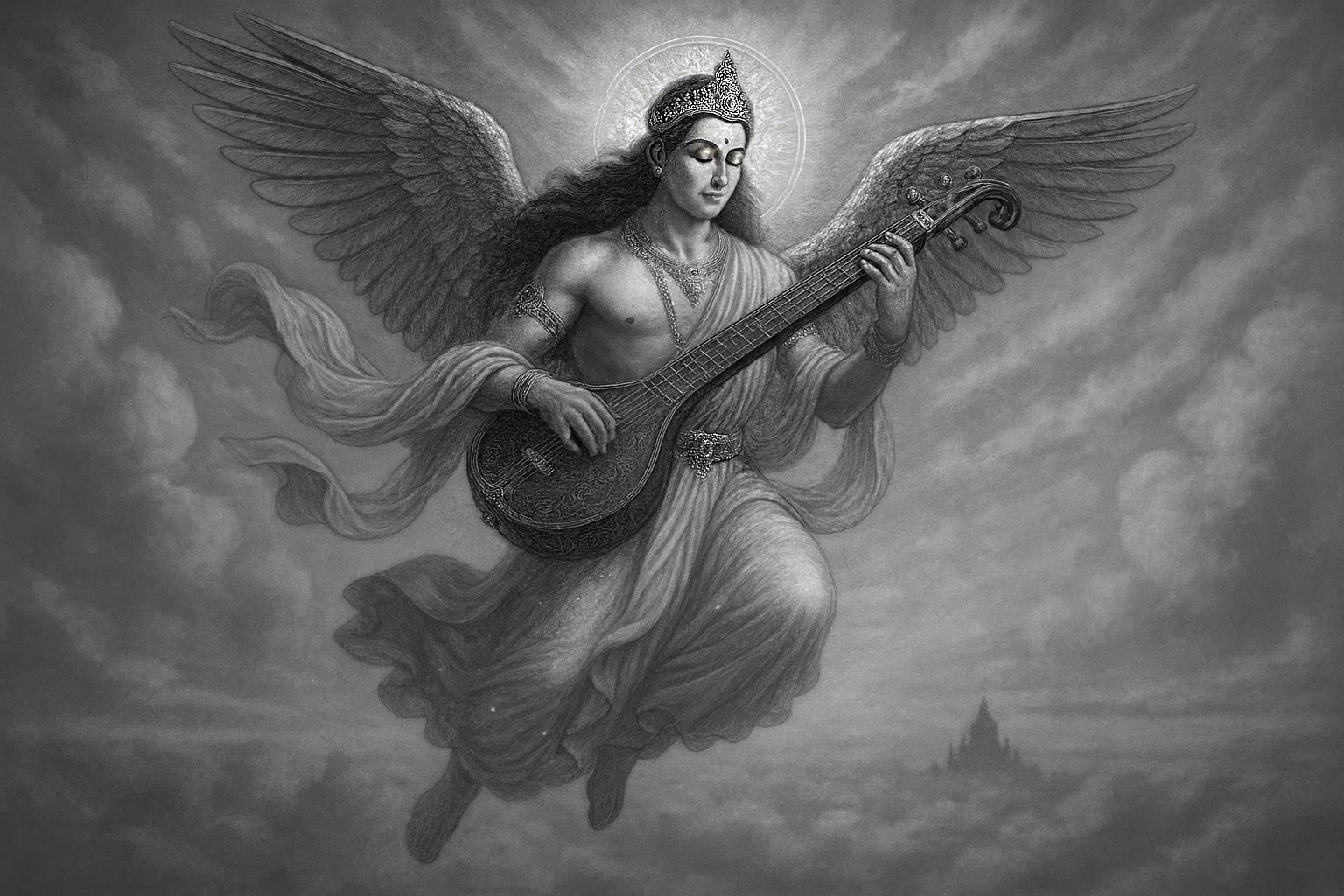
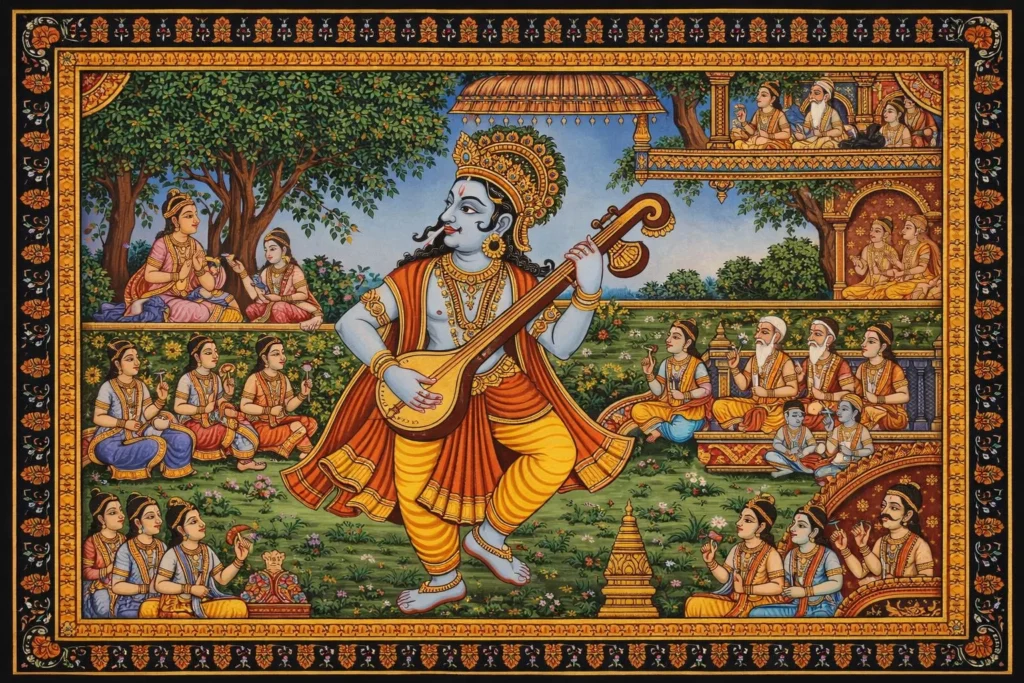
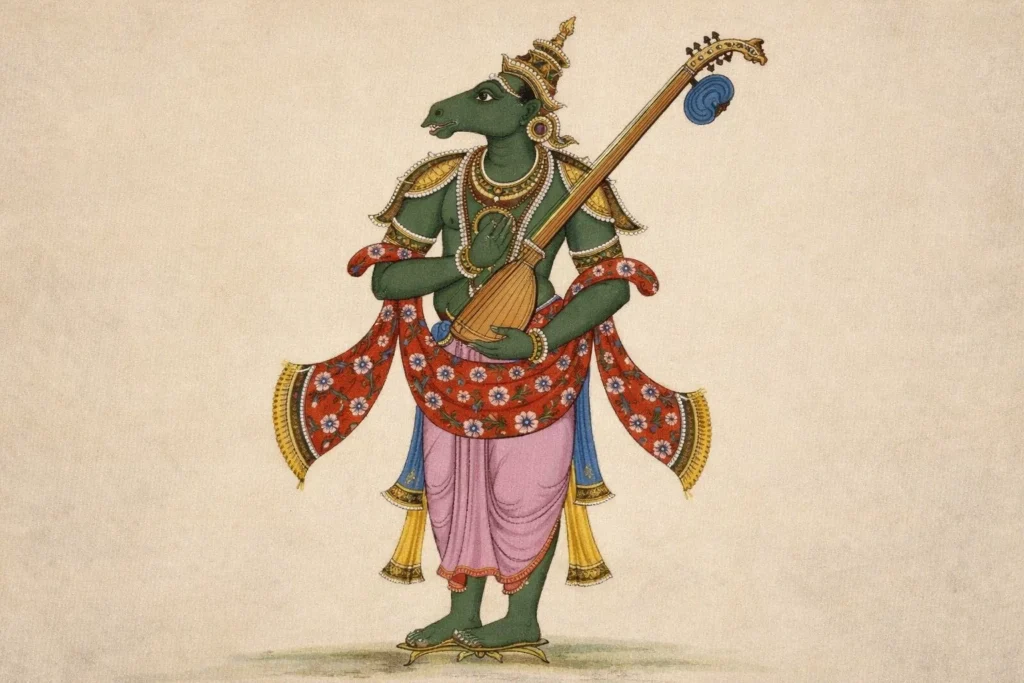
How the Gandharvas are shown changes a lot from early Indian art to later Mahayana images. In the oldest Buddhist carvings, such as those at Sanchi and Bharhut, they appear as handsome, young men. They usually look human but stand out because of their fancy clothes, flowing scarves, and musical instruments, especially the Vina, a kind of lute.
In many traditions, they are shown with wings or as part human, part bird (like the Kinnaras), which allows them to fly between the earth and the high peaks of Mount Meru. Their skin is often said to glow softly, showing their status as lower Devas.
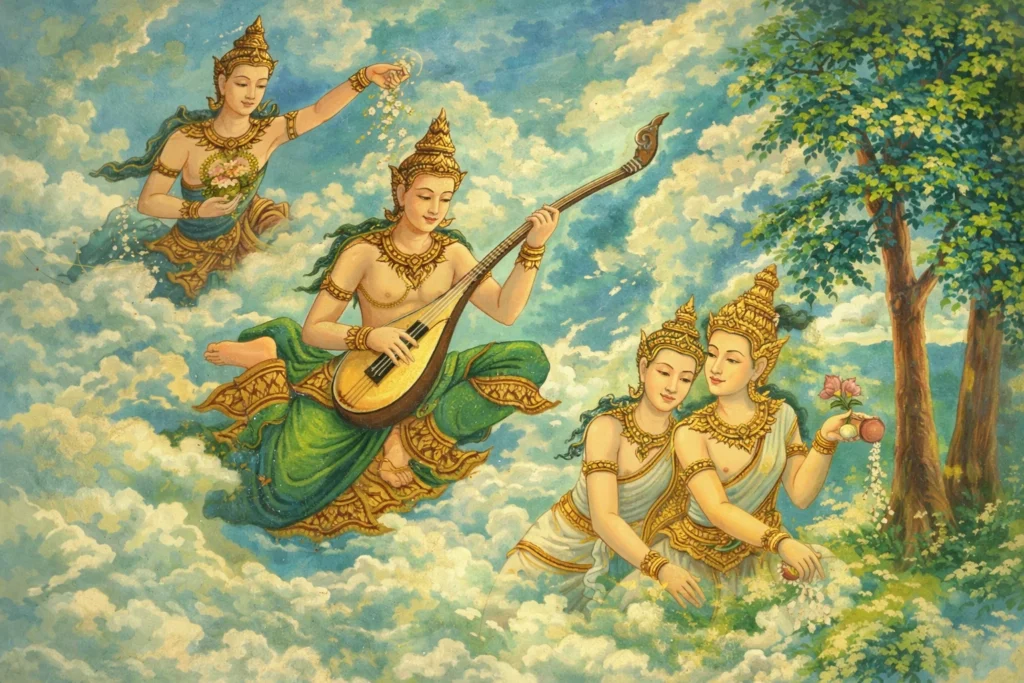
In Chinese Buddhist art, they are often shown in the clouds, with long bodies and ribbons around them to show movement and grace. When linked to the intermediate state of rebirth, they are invisible to most people and appear only as faint ‘shadows’ or ‘vapors’ to those with special vision.
Unlike Yakshas, Gandharvas are not muscular or fierce-looking. Instead, they always look calm and focused on their art.
Origins
Gandharvas existed before Buddhism and first appeared in the Rigveda as a single heavenly being who guarded the Soma, the divine nectar. Later, as Buddhist ideas developed, this entity came to represent a whole class of beings. The Abhidharma-kosha says they live in the lowest level of the Heaven of the Four Heavenly Kings.
They are called ‘demons’ or ‘spirits’ because they are part of the Eight Classes of beings who came to hear the Buddha teach. At first, they were wild nature spirits from the forests and air, but they were converted to the Dharma.
In Buddhist history, their main job is to serve the higher gods and protect the East. Over time, they transitioned from lone guardians of magical things to a group of artists and performers who live among the scents of trees and flowers.
Relevant Sources
Although later commentaries often discuss them, their history shows a significant shift—from being single heavenly guardians to becoming a complex group of spirits in the Buddhist universe.
“The Gandharva has moved his feet, looking toward the light; he has taken his place in the vault of heaven. He, the observer of the world, is the guardian of the Soma-plant; he watches over the tracks of the gods.” [Rigveda, Mandala 9, Hymn 83, c. 1500–1200 BCE]
This early text describes the Gandharva before Buddhist teachings were formalized. At this stage, the Gandharva is a single being with an important cosmic job: guarding the Soma, the nectar of immortality.
From an analytical view, there is a big change in status. The Gandharva starts as a powerful ‘guardian of the tracks of the gods,’ very different from the later Buddhist idea of a ‘scent-eating’ entertainer.
Phrases like ‘looking toward the light’ and being in the ‘vault of heaven’ suggest a solar or sky nature, which may have led to the later idea that they can fly and live in the higher realms of the Four Heavenly Kings.
“In the Eastern Quarter is the Great King named Dhatarattha, who rules over the Gandhabbā. He is a lord of great fame, and he has many sons, all of similar name, ninety-one in number, all called Inda.” [Āṭānāṭiya Sutta, Digha Nikaya, c. 3rd Century BCE]
This Buddhist scripture shows how the group became organized into a clear hierarchy. It marks the transition from a single Vedic spirit to a social, organized group led by Dhrtarastra (Dhatarattha).
The fact that all ninety-one sons are called ‘Inda’ (Indra) is an interesting detail. It shows that these spirits were once closely linked to the main god of the heavens and seen as part of his power. This text also confirms their strong connection to the East, which is still shown in Buddhist temples today, where the King of the East leads his celestial musicians.
“Because that scent-eating spirit (gandharva) is there, it is through the presence of these three things that the descent of the embryo takes place.” [Mahatanhasankhaya Sutta, Majjhima Nikaya 38, c. 3rd–2nd Century BCE]
In this philosophical context, the term refers to a technical idea in Buddhist embryology. Here, the Gandharva is not just a ‘musician,’ but an important part of the process of reincarnation.
This idea comes from the Gandharva’s subtle nature. Since they live on ‘scents,’ they became a good symbol (or even a real agent) for the consciousness that ‘smells’ its way to a new birth. This connects Gandharvas to Pretas (Hungry Ghosts). Still, Gandharvas are drawn to pleasant scents, while Pretas are attracted to bad smells or lack of them.
“The gandharvas are of two types: those who follow the gods and those who are scent-eaters. They are called gandharvas because they nourish themselves with scents (gandha) and because they are the musicians of the gods.” [Abhidharmakosha-bhasya of Vasubandhu, 4th–5th Century CE]
This 5th-century encyclopedia connects folklore with formal theology. Vasubandhu’s analysis introduces a ‘dual-class’ system that explains their roles as both divine artists and nature spirits.
Calling them ‘scent-eaters’ (from gandha) helps explain their invisible, ethereal nature. By the time of the Abhidharma-kosha, Gandharvas were fully part of the Desire Realm (Kamadhatu), representing the most refined sensory pleasures, like music and perfume.
“Then the Gandharva-king Manojna, with hundreds of thousands of followers, made an offering of music and song to the Lord, and having circumambulated the Lord seven times, sat down to one side.” [The Lotus Sutra (Saddharma Pundarika Sutra), c. 1st Century CE – 2nd Century CE]
This Mahayana source raises the Gandharva from just a ‘scent-eater’ to a true devotee of the Dharma. It highlights Manojna (meaning ‘Agreeable’ or ‘Pleasant’), showing that some Gandharvas started to have their own names and personalities in stories.
Describing Gandharvas making ‘hundreds of thousands’ of musical offerings shows the huge scale of Mahayana cosmology. It suggests that even lower-ranked musician spirits play an important role in the Buddha’s cosmic assembly, supporting the idea that all beings, regardless of their attachments, can make spiritual progress.
Powers and Abilities
These beings are more powerful than humans and hungry ghosts, but less powerful than the top Devas, such as Indra, or the Asuras. Their strength comes from their control over the senses and their agility, not from physical force.
- Sonic Mastery: They can produce music that influences the emotions of both gods and humans, potentially inducing trances or extreme joy.
- Aromatic Consumption: The ability to derive physical sustenance and energy purely from the “subtle essence” of smells.
- Flight: Natural levitation and high-speed travel across the desire realm.
- Invisibility: The capacity to remain unseen by mortal beings while remaining present in the environment.
- Intermediate Travel: In their role as antarabhava, they possess the power to locate appropriate rebirth conditions across vast distances.
Gandharva Myths, Legends, and Stories
The Conversion at the Great Assembly
In the Mahasamaya Sutra of the Digha Nikaya, a massive gathering of deities and spirits occurs in the Great Wood at Kapilavatthu to pay homage to the Buddha. The text describes the arrival of the various tribes. The King Dhrtarastra arrives from the East, leading his vast army.
The narrative records that these spirits, who were once known to be fickle and bizzare inhabitants of the forests, stood in the presence of the Tathagata. They were captivated not by the scent of flowers, but by the “fragrance of virtue” emanating from the Buddha.
This story is the primary “origin of loyalty” for the class, marking their transition from wild spirits to protectors of the Buddhist community.
You may also enjoy:
Who Is Shiva, the Destroyer and the Lord of the Universe?
November 12, 2025
Al-Ahmar: The Tuesday King of the Seven Jinn
February 13, 2026
Who Is Aka Manto, Japan’s Terrifying Red-Cloaked Yōkai?
October 24, 2025
Iblis, the Jinn King of Darkness and Deception
September 29, 2025
Ancient Demons: The Real Origins of the Setcheh Myth
November 11, 2025
Pancasikha and the Buddha’s Meditation
Perhaps the most famous narrative involving a specific member of this class is that of Pancasikha, a celestial musician who is a messenger between Sakra (Indra) and the Buddha.
In the Sakka-panha Sutra, Sakra wishes to visit the Buddha, who is deep in meditation in the Indasala Cave. Fearing to disturb the Enlightened One directly, Sakra sends Pancasikha ahead.
Pancasikha takes his lute of yellow Beluva wood and begins to play. He sings a song that intertwines the “beauty of a maiden” with the “glory of the Arahants.”
The Buddha, emerging from his meditation, commends the musician, noting that the sound of his lute blended perfectly with the melody of his voice. This story highlights the unique position of these spirits: they are the only beings capable of using sensory art to connect the desire and the stillness of Nirvana.
The Guardian of the East in the Lotus Sutra
In the Lotus Sutra, these spirits are listed among the audience of the Dharani Chapter. They are described as being present to receive the mystical chants that protect the preachers of the Sutra. Here, their role is more formal and protective.
Along with the Rakshasas and Yakshas, they vow to shield those who uphold the Dharma from any malignant spirits who might try to find a “weakness” in them. This narrative focuses on their transformation into divine sentinels who use their subtle nature to detect and repel negative influences.
Gandharva vs Other Similar Entities
| Demon Name | Associated Obstacle/Role | Origin/Source | Key Traits/Powers |
| Mara | Temptation and Death | Pali Canon | Illusion, mental corruption |
| Yaksha | Protection / Earthly Wealth | Early Sutras | Invisibility, immense strength |
| Rakshasa | Fear and Cannibalism | Lanka Sutra | Shape-shifting, terrifying form |
| Preta | Insatiable Hunger | Petavatthu | Wasted limbs, distended belly |
| Asura | Wrath and Warfare | Lotus Sutra | High power, combat prowess |
| Kinnara | Musical Entertainment | Jataka Tales | Half-human/half-bird forms |
| Naga | Water and Weather | Vinaya Pitaka | Serpent form, venom, rain |
| Garuda | Predation of Nagas | Mahayana Sutras | Giant wings, solar power |
| Kumbhanda | Sapping Vitality | Digha Nikaya | Pot-bellied, energy drainage |
| Mahoraga | Earthly Wisdom/Snakes | Avatamsaka Sutra | Large serpent-human hybrid |
Mystical Correspondences
| Attribute | Details |
| Planet | Mercury (for communication and music) |
| Zodiac Sign | Gemini (duality and artistic flair) |
| Element | Air (the medium for scent and sound) |
| Direction | East |
| Color | White or Pale Blue |
| Number | 8 (associated with the Eight Classes) |
| Crystal/Mineral | Lapis Lazuli |
| Metal | Silver |
| Herb/Plant | Sandalwood and Incense |
| Animal | Cuckoo or Songbirds |
| Trait/Role | Artistic Inspiration and Fragrance-feeding |
These spirits are mostly connected to hearing and smell. Their link to the East ties them to the rising sun and the idea of ‘new beginnings,’ which fits their role as beings of the intermediate state (antarabhava).
In rituals, burning good incense is thought to invite or offer something to these spirits. Since they ‘eat’ fragrance, people believe the better the scent, the better the spirits it attracts.
They are seen as patrons of sacred music and are believed to live in the ‘scent of blossoms’ on trees, which makes them protectors of gardens and fragrant groves. Their presence reminds us that even the most beautiful things in the world, like music and perfume, are only temporary.
You may also enjoy:
Andhaka: The Blind Demon Born From Cosmic Darkness
February 6, 2026
Nasnas: The Monstrous Demon Hybrid That Haunted Pre-Human Earth
November 12, 2025
Demon Alastor: The Grand Executioner of Hell
November 17, 2025
Erinyes: The Chthonic Goddesses Who Enforced Blood-Guilt
November 20, 2025
Ifrit: Demon of Fire Who Serves Iblis in Islamic Tradition
September 30, 2025
Who Is Futakuchi-onna, the Two-Mouthed Woman?
March 9, 2026
Bibliography
Author’s Note: For my research, I compared the Rigveda and the Abhidharma-kosha-bhasya to show how a single solar guardian became a group of scent-eating spirits. The technical details in the Majjhima Nikaya also shaped my research, helping me connect the Gandharva’s popular image as a celestial musician with its deeper role in Buddhist ideas about rebirth. By focusing on these main texts instead of modern views, I aimed to show how the Gandharvas bridge sensory pleasure and the process of rebirth.
- Kern, H., translator. Saddharma-Puṇḍarīka; or, The Lotus of the True Law. Dover Publications, 1963. Internet Archive.
- Buswell, Robert E., Jr., and Donald S. Lopez, Jr. The Princeton Dictionary of Buddhism. Princeton University Press, 2014. Internet Archive.
- Tauscher, Helmut. Kanjur. Brill’s Encyclopedia of Buddhism, Vol. 1, Brill, 2015.
- Vasubandhu. Abhidharmakośabhāṣyam. Translated by Louis de La Vallée Poussin, translated from French by Leo M. Pruden, vol. 1, Asian Humanities Press, 1988. Internet Archive.
- Sivananda, Swami, translator. The Devi Mahatmya: In Sanskrit Original with a Lucid Running Translation in English. By Rishi Markandeya, 5th ed., Divine Life Society, 2011. Internet Archive.
- De Nebesky-Wojkowitz, René. Oracles and Demons of Tibet: The Cult and Iconography of the Tibetan Protective Deities. Mouton & Co., 1956. Internet Archive.
- Griffith, Ralph T. H., and Arthur Berriedale Keith, translators. Complete Rigveda in English (Sakala Shakha). Edited by Rigvedacomplete, Internet Archive ed., 2018. Internet Archive.
- E. H. Johnston, translator. The Buddhacarita; or, Acts of the Buddha. Baptist Mission Press, 1936. Internet Archive.