
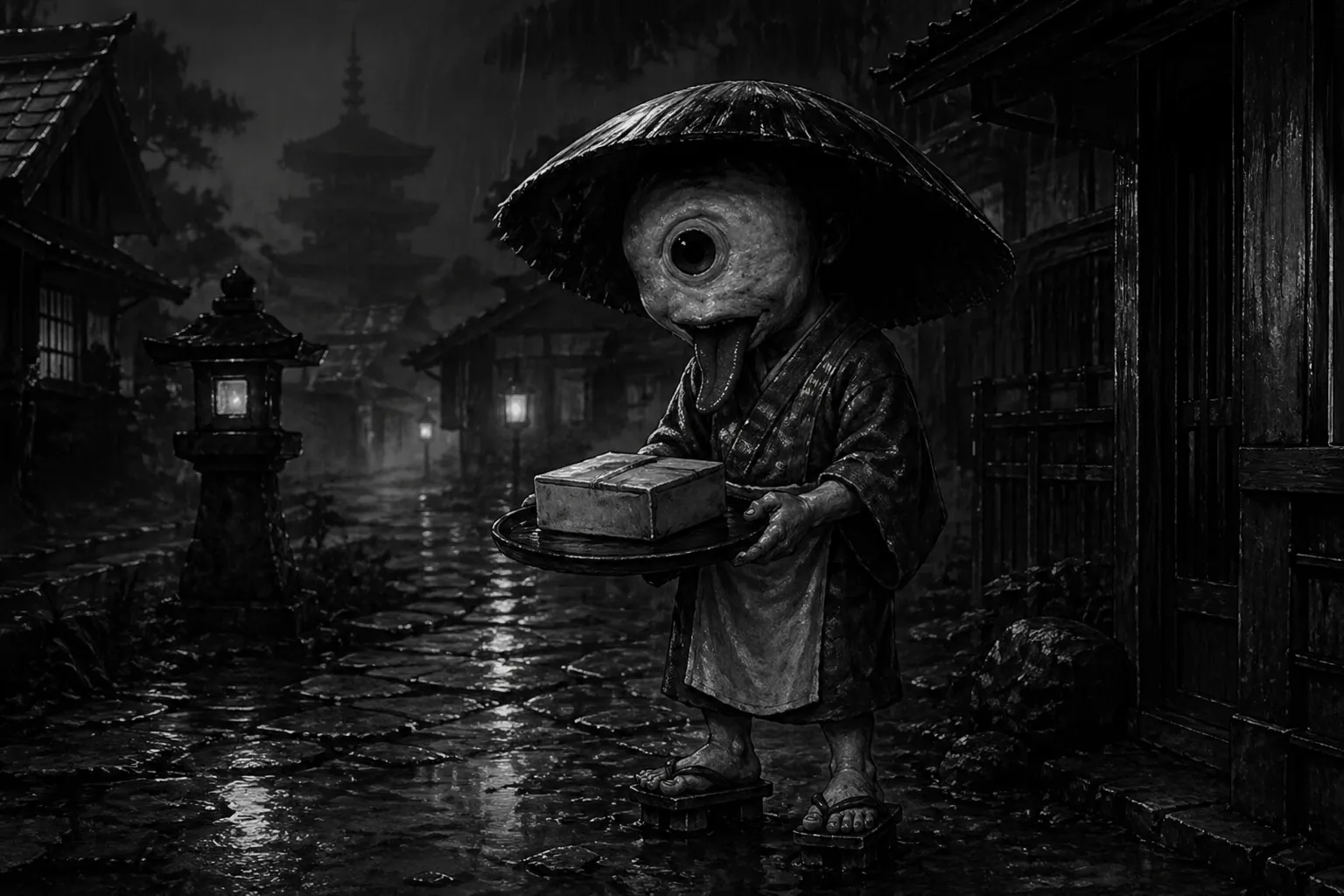
Many Japanese spirits are known for their physical violence or soul-harvesting. However, Hitotsume kozō is remarkable for its ability to disturb people psychologically. What makes it unique is the contrast between its innocent, childlike look and the deep sense of dread it inspires with its single, unusual eye.
Most mountain spirits try to stay hidden by blending into their surroundings, but this one does the opposite. It seeks out people, not to harm them, but to act as a reminder of the strange and unsettling things that can appear in everyday life.
I’ve focused my analysis on Kibyōshi stories from the Edo period to highlight the distinct characteristics of this spirit. By doing this, we can easily differentiate between a messenger of the mountain gods and a regular household ghost. [View Full Bibliography ↓]
Summary
Key Takeaways
| Attribute | Details |
| Names | Hitotsume kozō, One-eye boy, Ichime-kozō |
| Translation | One-eyed priest boy or One-eyed monk child |
| Title | The Garden Specter, The Messenger of the Mountain God |
| Type | Obake / Yōkai |
| Spirit Classification | Nigi-mitama (generally pacified/non-violent), though occasionally viewed as a fallen deity messenger. |
| Origin | Evolved from ancient fallen mountain deities or transformed monks who failed their ascetic training. |
| Gender | Male |
| Appearance | A small boy, roughly ten years of age, wearing clerical robes or a wide-brimmed hat, possessing a single large eye in the center of his forehead and a long, protruding tongue. |
| Kehai (Aura/Presence) | A sudden, localized silence followed by the sound of light, barefoot footsteps on wooden floorboards or the scent of damp garden soil. |
| Powers/Abilities | Surprise manifestation, omen-bearing, and the ability to record human misdeeds in a ledger. |
| Methods of Pacification | Displaying a “zaru” (bamboo sieve) or “meshi-kago” (rice basket) with many holes; reciting specific protective prayers; scattering roasted beans on the eighth day of the second or twelfth month. |
| Habitat | Gardens, dark street corners, abandoned temples, and rural households. |
| Diet/Prey | Does not consume flesh; targets human composure and peace of mind through shock. |
| Symbolic Item | A “chochin” (paper lantern) or a ledger/book. |
| Symbolism | The “all-seeing” eye of judgment, the boundaries between the sacred and the profane, and the transition of old gods into folklore. |
| Associated Kami | Often associated with the Mountain God (Yama-no-Kami) or the god of the hearth/kitchen. |
| Sources | Wakan Sansai Zue, Buson Yōkai Emaki, various Edo-period “kaidan” collections. |
Who or What Is Hitotsume kozō?
Hitotsume kozō appears both in cities and the countryside, taking the form of a young Buddhist apprentice with a shaved head. Unlike the more dangerous Oni, it is known for its single, large eye and a long, flickering red tongue.
These spirits rarely cause physical harm. Instead, they like to surprise people by showing up in dark corners or suddenly revealing their unusual face. In many places, they are seen as playful spirits who watch over people’s behavior, especially during certain times of the year.
As a male spirit from the kozō, or apprentice monk, group, he represents the ‘uncanny valley’ in Japanese folklore. Hitotsume kozō seems human until you notice his one frightening feature. People usually see his appearance as a warning, not a threat to their lives.
By showing up in places like gardens or verandas, he connects the wild mountain spirits with the everyday life of Edo-period homes, reminding people that the supernatural is always close by.
Semantic Origins
The name comes from the Japanese words hitotsu (one), me (eye), and kozō (young monk or apprentice). Originally, kozō referred to boys training in Buddhist temples with shaved heads. Still, over time, it came to mean any young boy, even in a teasing sense. So, the name means ‘One-eyed priest-boy.’
The term has stayed mostly the same since the Edo period. In some areas, especially in the Tohoku region, versions like Ichime-kozō are used. However, the main meaning is still the same.
The focus on the eye is key to this spirit’s identity. In Japanese traditions, a single eye is often connected to gods or smithing deities like Kanayago-kami. This suggests the name may have come from old god names that changed over time into more common folklore terms.
How to Pronounce “Hitotsume kozō” in English
To say the name correctly, break it into parts: He-tot-su-meh koh-zoh. ‘Hitotsume’ starts with a soft ‘he’ like in ‘heat,’ then ‘tot’ as in ‘total,’ ‘su’ like at the end of ‘cats,’ and ‘meh’ as in ‘met.’ ‘Kozō’ has a long ‘o’ sound in both parts, like in ‘go’ and ‘zone.’
What Does Hitotsume kozō Look Like?
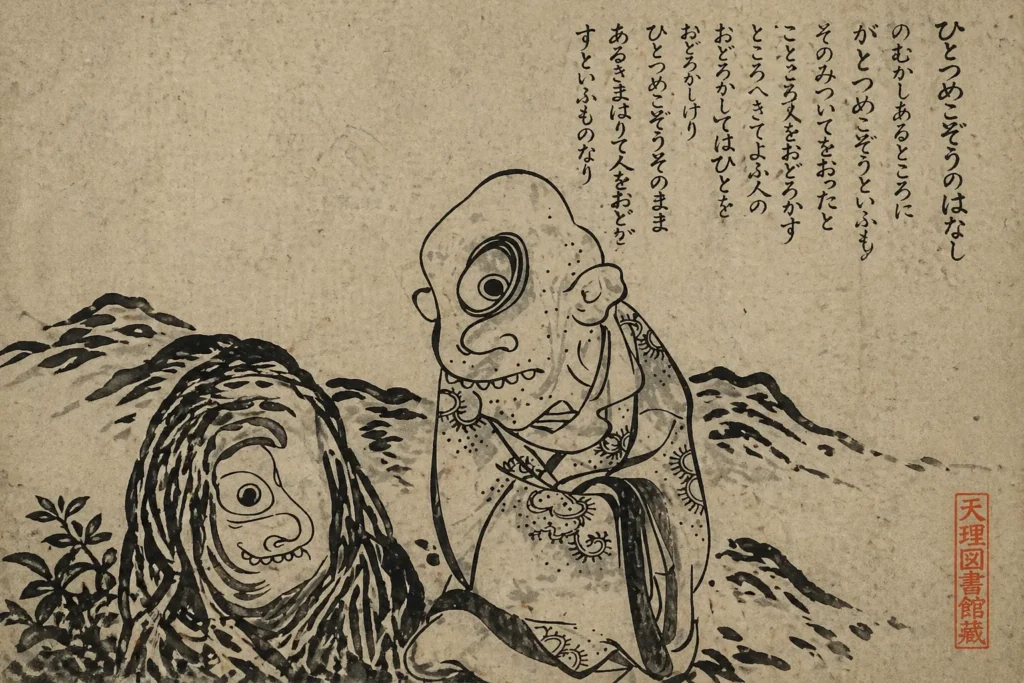
The way this yōkai is depicted has remained the same in Japanese art for centuries, especially in Ukiyo-e prints and scrolls. He is usually shown as a child between eight and twelve years old.
His most noticeable feature is a single, large eye without a lid, centered on his forehead. This eye is often shown as bright yellow or white with a sharp black pupil. The rest of his face looks human, but he is often drawn with a long, thin red tongue sticking out in a playful or teasing way.
He wears the simple, often dark kimono or monk’s robes of a Buddhist novice. His head is shaved, like other monks, which makes him look both young and a bit unsettling.
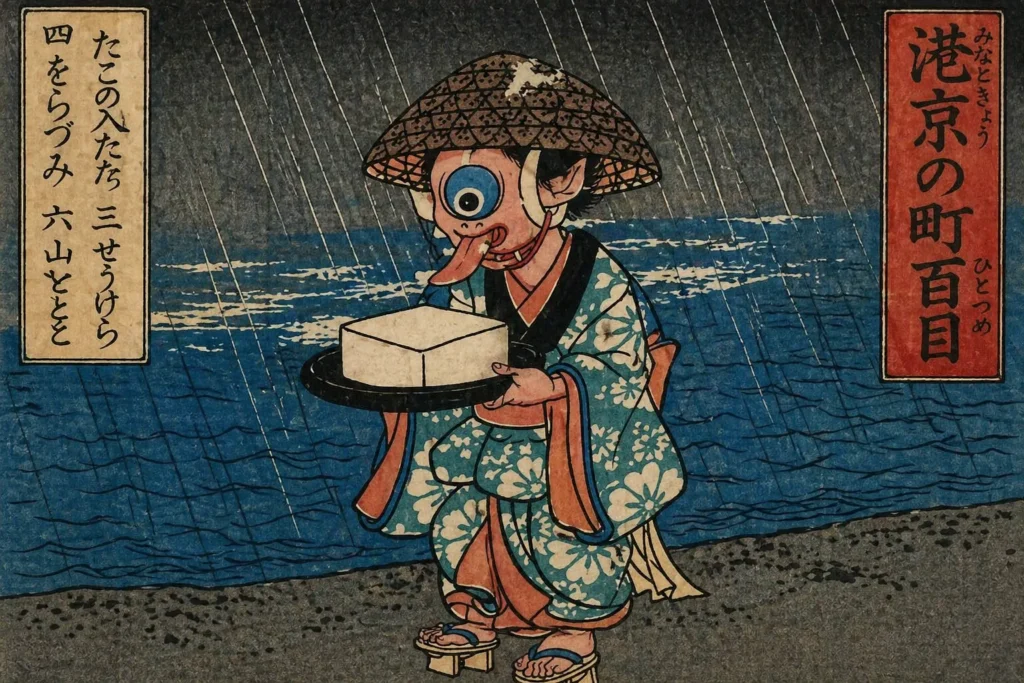
Hitotsume kozō is often shown wearing a wide, cone-shaped straw hat or carrying a small paper lantern to help him see at dusk. Even though he is small, the detailed way he is drawn makes his single eye stand out and seem even more unsettling.
You may also enjoy:
What Is the Abumi-guchi Yōkai and Why Does It Wait Forever?
October 22, 2025
Lamia: The Queen Cursed to Devour the Children of Others
January 7, 2026
Bakeneko: A Supernatural Cat Yōkai in Japanese Folklore
January 27, 2026
Kuchisake-onna: Folklore, Origins, and Urban Legend History
February 10, 2026
Who Is the Infernal King Balam? Origins, Powers, and Occult History
February 26, 2026
What Is Jorōgumo? The Deadly Spider Woman of Japanese Myth
February 2, 2026
Origins and History
This spirit became well known in Japan during the Edo period (1603–1868), a time of rapid urban growth and cultural shift. Although one-eyed monsters appeared in older stories, the ‘priest-boy’ version became popular in the 1700s, when people started collecting and sharing stories about spirits for fun.
Historically, this spirit might be a simpler version of the Mountain God (Yama-no-Kami). In ancient Japanese beliefs, mountain gods often had unusual features, such as a single eye or a single leg. As Japan became more urban, these powerful gods were transformed into less frightening, sometimes even funny, spirits that appeared in city gardens rather than in faraway mountains.
I think this spirit reflects the strict social rules for young people during the Tokugawa shogunate. The ‘One-eyed monk’ symbolizes someone who failed to maintain religious discipline and now haunts the living.
Interestingly, the first stories about him appeared around the same time as the rise of temple schools (Terakoya). As more children had to attend these schools, the image of the deformed apprentice became a way to express worries about failing in school and the pressures of religious life.
Also, the link to ‘Kotohitsugi’ (the custom of staying indoors on certain days) shows that this spirit may have been used to help enforce curfews. By the middle of the Edo period, he was no longer seen as a real religious threat. Still, he had become a common character in picture books, showing how art and humor made the supernatural less scary.
From Mountain Sovereign to Urban Prankster
Hitotsume kozō transitioned from a frightening sign to a playful household trickster, mirroring a wider Edo-period trend of making supernatural beings less scary and more familiar.
It’s interesting that today, people see this spirit as just a prankster, but old stories show he started as something much more serious—a ‘fallen’ god. My research suggests he comes directly from ancient mountain gods such as Yama-no-Kami and metalworking gods such as Ame no Mahitotsu no Kami.
In ancient Japanese shamanism, physical differences, such as having one eye or one leg, were not seen as monstrous but as signs of divinity. These traits were often linked to the sacrifices needed to gain special knowledge or skill with fire and metal.
The key point here is how this god’s role adjusted over time. As Japan shifted from farming villages to busy cities, the once-powerful mountain god became less intimidating. He was turned into a child monk (kozō) so that city people could handle the old fears in a smaller, more familiar form.
The mountain god, once a powerful ruler, became a messenger without a message, now appearing in gardens to surprise people with his single eye. This transition shows how fear of the wild gave way to surprise at the strange things in everyday life, as people felt more in control but still held on to their old beliefs.
I also found an interesting connection between how people tried to get rid of this spirit and the art of the time. Hanging a bamboo sieve or a basket with many holes was a clever way to scare off a one-eyed spirit. By showing him something with ‘many eyes,’ people challenged him in a kind of staring contest.
With only one eye, Hitotsume kozō is overwhelmed by objects with many holes. This is more than just a trick—it shows people taking back control. In the Edo period, a basket with many holes stood as a watchful eye for the whole community, shaming the spirit into leaving. This shows how people used everyday objects to protect themselves from playful but stubborn spirits.
Habitat
Hitotsume kozō mostly lives in places that are between the human world and the spirit world. He likes to appear in gardens or on the verandas of traditional Japanese houses. People also often see him on empty roads at dusk, especially near crossroads or stone bridges where the boundary between worlds is thin.
He often prefers abandoned temples and shrines, probably because of his monk-like look and his story as a failed monk. Unlike mountain spirits that stay away from people, Hitotsume kozō does well in cities like Edo (Old Tokyo) and Kyoto. He is said to hide in the shadows near gates or under the edges of roofs, waiting to surprise someone with his appearance.
Famous Hitotsume kozō Legends and Stories
The Bamboo Sieve Defense
In many Kanto villages, people say that on the eighth day of the second and twelfth months, called Koto-yōka, this spirit goes from house to house. He carries a large book in which he records the names of families who have been lazy, dishonest, or disrespectful to the gods. If your name ends up in his book, it is seen as a sign of very bad luck or even a fire in the coming year.
To stop this from happening, villagers created a special ritual. They would hang a bamboo sieve or a basket with many holes on a tall pole outside their homes.
When Hitotsume kozō arrives and sees the sieve, his single eye gets confused by all the ‘eyes’ (holes) in the basket. He becomes so distracted or embarrassed by his one eye compared to the many in the basket that he forgets to write in his book and leaves before morning.
The Encounter at the Gate
A popular tale from the Edo period describes a samurai walking home late at night near the city’s outskirts. As he passed an old gate, he noticed a young boy standing with his back to him, weeping softly. The samurai, moved by compassion, asked the boy what was wrong and if he was lost. The boy did not answer at first, continuing to sob into his sleeves.
When the samurai reached out to touch the child’s shoulder, the boy slowly turned around. Instead of a human face, the samurai saw a smooth, pale forehead dominated by one massive, blinking eye and a long tongue that licked the air with a wet, slapping sound.
The samurai was so overcome with “ki-ga-to-ku” (a loss of spirit) that he fainted on the spot. When he awoke, the boy was gone. Still, the samurai remained bedridden with a fever for three days, a common side effect of encountering the uncanny.
You may also enjoy:
Hitotsume kozō: One-Eyed Yōkai of Japanese Folklore
February 4, 2026
Who Is Aka Manto, Japan’s Terrifying Red-Cloaked Yōkai?
October 24, 2025
What Is the Akkorokamui, Japan’s Colossal Sea Monster?
November 14, 2025
Aeshma: The Zoroastrian Demon of Wrath and Fury
January 13, 2026
What Is Baku? The Bizarre Yōkai That Eats Nightmares
January 28, 2026
Who Is Azazel, the Demon Blamed for Human Corruption?
February 24, 2026
Hitotsume kozō Powers and Abilities
Hitotsume kozō doesn’t have the destructive power of a dragon or the soul-stealing skills of a Gaki. His main strength is in surprising people and causing psychological shock. He is very good at startling people, using his appearance to drain their energy and sometimes make them faint or get sick.
His most unusual power is keeping supernatural records. People believe he is an auditor for the gods, recording people’s wrongdoings. He can’t punish anyone himself, but his reports to higher spirits can lead to a family being cursed with bad luck or disasters, such as house fires.
- Manifestation: The ability to appear and disappear instantly in the blink of an eye.
- Aura of Silence: He can suppress ambient noise in a small area to make his eventual reveal more shocking.
- Illness Induction: Witnesses of his true form often suffer from lingering fevers or psychological trauma known as “spirit-sickness.”
- Ledger Recording: The ability to magically track and record the moral failings of an entire household.
Traditional Defenses Against Hitotsume kozō
The best way to protect yourself from Hitotsume kozō is to overwhelm him visually. Since he has only one eye, he is especially bothered by objects with many ‘eyes.’
As the legends say, hanging a bamboo sieve or any mesh container with lots of holes is the best protection. The spirit is either fascinated or scared by all the holes, which he sees as eyes staring back at him.
Besides using visual tricks, people also throw roasted soy beans at him during Koto-yōka, just like they do to drive away Oni during Setsubun. Some families put a piece of holly or a smelly sardine head near the door, since the strong smell and sharp leaves keep minor spirits away.
Keeping your home clean and tidy also helps, because the spirit is drawn to mess and disorder, which gives Hitotsume kozō more ‘sins’ to write down.
Hitotsume kozō vs Similar Spirits
| Name | Category | Origin | Threat Level | Escape Difficulty |
| Karakasa-obake | Tsukumogami | Discarded umbrella reaching 100 years old | Very Low | Easy; it is clumsy and hops on one leg. |
| Noppera-bō | Obake | Metamorph Mujina or Kitsune | Low | Moderate; the faceless reveal causes fainting. |
| Tofu-kozō | Obake | Derived from culinary folklore | Negligible | Very Easy; just don’t eat the tofu. |
| Mikoshi-nyūdō | Obake | Transformed weasel or monk | High | Hard; you must look down, or he will bite your throat. |
| Abura-akago | Obake | Spirit of an oil-stealing child | Low | Easy; it is preoccupied with licking oil lamps. |
| Amanojaku | Oni | Ancient minor deity of subversion | Moderate | Hard; it manipulates your deepest desires. |
| Zashiki-warashi | Kami/Yōkai | A house spirit of a deceased child | Beneficial | N/A; you generally want them to stay. |
| Kappa | Suijin | Fallen water deity | High | Hard; requires a bow or a cucumber offering. |
| Yuki-onna | Yūrei-like | A woman who died in a blizzard | Extreme | Very Hard; her breath freezes the heart. |
| Rokurokubi | Obake | A human cursed by karma or biology | Moderate | Moderate; easy to spot if you see the long neck. |
Symbolism
| Attribute | Details |
| Element | Earth (linked to gardens and the physical ground) |
| Cardinal Direction | Northeast (the Kimon or Demon Gate direction) |
| Color | Pale White (skin) and Red (tongue) |
| Plant | Bamboo (due to the protective sieves) |
| Season | Winter (specifically the 12th-month festivals) |
| Symbolic Item | Bamboo Sieve or Paper Lantern |
In Japanese culture, Hitotsume kozō represents the disruption of social harmony. He turns the innocent image of a child into something strange and scary.
In the past, he was seen as the ‘watchful eye’ of the community, reminding people that their bad actions were always being noticed, even if no one else was around. This idea helped keep order in the crowded cities of the Edo period.
Hitotsume kozō also shows how the ‘Old Gods’ survived in a changing world. He reminds us that the scary mountain gods didn’t vanish—they just took on new forms. They moved into city gardens, becoming ‘monsters’ for a more skeptical and educated society. In art and festivals, he still symbolizes the playful but deep line between what we can see and what we can’t.
You may also enjoy:
Who Is the Infernal King Balam? Origins, Powers, and Occult History
February 26, 2026
Vritra: The Dragon Who Swallowed the Sky in Hindu Mythology
October 7, 2025
Si’la: The Seductive Jinn Who Lures Travelers to Their Doom
October 9, 2025
Who Was Hiranyaksha, the Golden-Eyed Asura?
October 7, 2025
What Is Jorōgumo? The Deadly Spider Woman of Japanese Myth
February 2, 2026
Ifrit: Demon of Fire Who Serves Iblis in Islamic Tradition
September 30, 2025
Bibliography
Author’s Note: I explored two important books about spirits: the Wakan Sansai Zue and the Gazu Hyakki Yagyō. The Wakan Sansai Zue describes spirits straightforwardly and factually. At the same time, the Gazu Hyakki Yagyō presents them in a more colorful and relatable style for city residents. By comparing these two sources, I was able to see how the portrayal of spirits evolved. Originally, they were depicted as powerful and mysterious beings in older texts. Still, in Edo-period stories, they started to appear smaller and even amusing. This comparison reveals how religious figures can become elements of folklore as their original significance fades.
- Terajima, Ryōan. Wakan Sansai Zue. 1712. Internet Archive.
- Night Parade of a Hundred Demons. Yōkai Senjafuda, Mellon Projects, University of Oregon, glam.uoregon.edu.
- Kelsey, W. Michael. Konjaku Monogatarishū. Twayne Publishers, 1982. Twayne’s World Authors Series 621. Internet Archive.
- Kamiya, A. (2023, February 12). Oni Origins, Masks & Characteristics. Study.com.
- Reider, Noriko T. Japanese Demon Lore: Oni from Ancient Times to the Present. University Press of Colorado, 2010. JSTOR.
- Hearn, Lafcadio. Kwaidan: Stories and Studies of Strange Things. Houghton, Mifflin and Company, 1904. Internet Archive.
- Okuyama, Y., (2017). Semiotics of Otherness in Japanese Mythology. Disability Studies Quarterly 37(1). doi: https://doi.org/10.18061/dsq.v37i1.5380.
- Liu, Jianhua. 2024. The Sanctification of the Disabled: A Study on the Images of Fortune Gods in Japanese Folk Beliefs. Religions 15, no. 6: 671. https://doi.org/10.3390/rel15060671.