
Rakshasas are well-known supernatural beings in Hindu mythology, often described as man-eaters or evil spirits. They are usually shown as enemies of the gods and humans, but their role is more complex. Some, like Ravana, are powerful kings, while others are minor beings living in forests. Although they differ from Asuras, the two terms are sometimes conflated in later stories.
Summary
Key Takeaways
| Attribute | Details |
| Names | Rakshasa (masculine), Rakshasi (feminine), Yatudhana, Nirriti, Kravyad |
| Title | Night-stalkers (Nishichara), Man-eaters (Nushachas) |
| Gender | Male and Female |
| Role | Disrupters of sacrifices, man-eaters, guardians of water (in some Vedic contexts) |
| Clan | Pulastya lineage, descendants of Khasa or Surasa |
| Followers | Lesser spirits, Pishachas, and subordinate Rakshasa warriors |
| Powers | Maya (illusion), shape-shifting, flight, immense physical strength |
| Appearance | Often fanged, clawed, with red hair and protruding bellies; also capable of assuming beautiful forms |
| Etymology | Derived from the Sanskrit root ‘raksh’ meaning “to protect” or “to guard” |
| Associated Figures | Ravana, Vibhishana, Kumbhakarna, Surpanakha, Hidimba |
| Weaknesses | Sunlight (weakens their power), divine weapons (Astras), purification rituals |
| Opposing Deva/Avatar | Vishnu, Rama, Krishna, Indra |
| Pantheon | Hindu (Vedic and Puranic) |
| Primary Sources | Rig Veda, Ramayana, Mahabharata, Bhagavata Purana |
Who or What is a Rakshasa?
A Rakshasa is a supernatural being in Hindu mythology that primarily represents tamas, or darkness, chaos, and ignorance. Unlike Asuras, who usually fight the gods for control of the heavens, Rakshasas are shown as threats on earth or underground. They attack humans and disturb the rituals of sages. They are known for eating flesh and haunting cemeteries and forests.
Not all Rakshasas are mindless monsters. For example, Vibhishana shows that a Rakshasa can follow Dharma, or righteousness. Ravana is the most powerful Rakshasa, known for both his knowledge and his strength. Rakshasas are often called Nishichara, or night-walkers, because their magic is much stronger at night.
Note: The Rakshasa also appears as a demonic entity in Buddhist and Jain texts; for these specific interpretations, please refer to the Buddhist Demons category.
1,000+ SPIRITS, GODS & GODDESSES AWAITING YOUR CALL. Limited-Time: Up to 49% OFF!
The ultimate global spirit encyclopedia – 2,000+ entries from every culture on Earth. Fairies • Djinn • Demons • Loa • Angels • Deities • Ancestors Real names • True offerings • Ancient rituals that actually work. Judika Illes’ legendary masterwork – the one book every serious witch, mage, and spirit-worker owns.
Rakshasa Meaning
The word Rakshasa comes from the Sanskrit verb ‘raksh,’ which means ‘to protect’ or ‘to guard.’ This connects to a creation story in the Ramayana and the Puranas. In these stories, when Brahma created the waters, he made beings to guard them. One group shouted ‘Rakshama!’ meaning ‘Protect!’ and became the Rakshasas. Another group shouted ‘Yakshama!’ meaning ‘Adore!’ and became the Yakshas.
Over time, the word Rakshasa changed from meaning nature spirits or guardians to describing evil beings. In the Vedic period, the word Yatudhana was often used alongside Rakshasa to refer to sorcerers or those who ate raw flesh.
Later, the term Rakshasa also came to mean any being that used Maya, or illusion, to trick people. The name changed based on their habits. For example, they are called Niritas after the goddess Nirriti, who is linked to death and corruption.
How to Pronounce “Rakshasa” in English
Rakshasa is pronounced as rahk-shuh-suh. The first part, ‘Rak,’ sounds like ‘rock’ but with a softer ‘a,’ like ‘ah.’ The ‘sh’ is pronounced as usual, and the last ‘a’ sounds are short, like the ‘a’ in ‘sofa.’
What Does a Rakshasa Look Like?
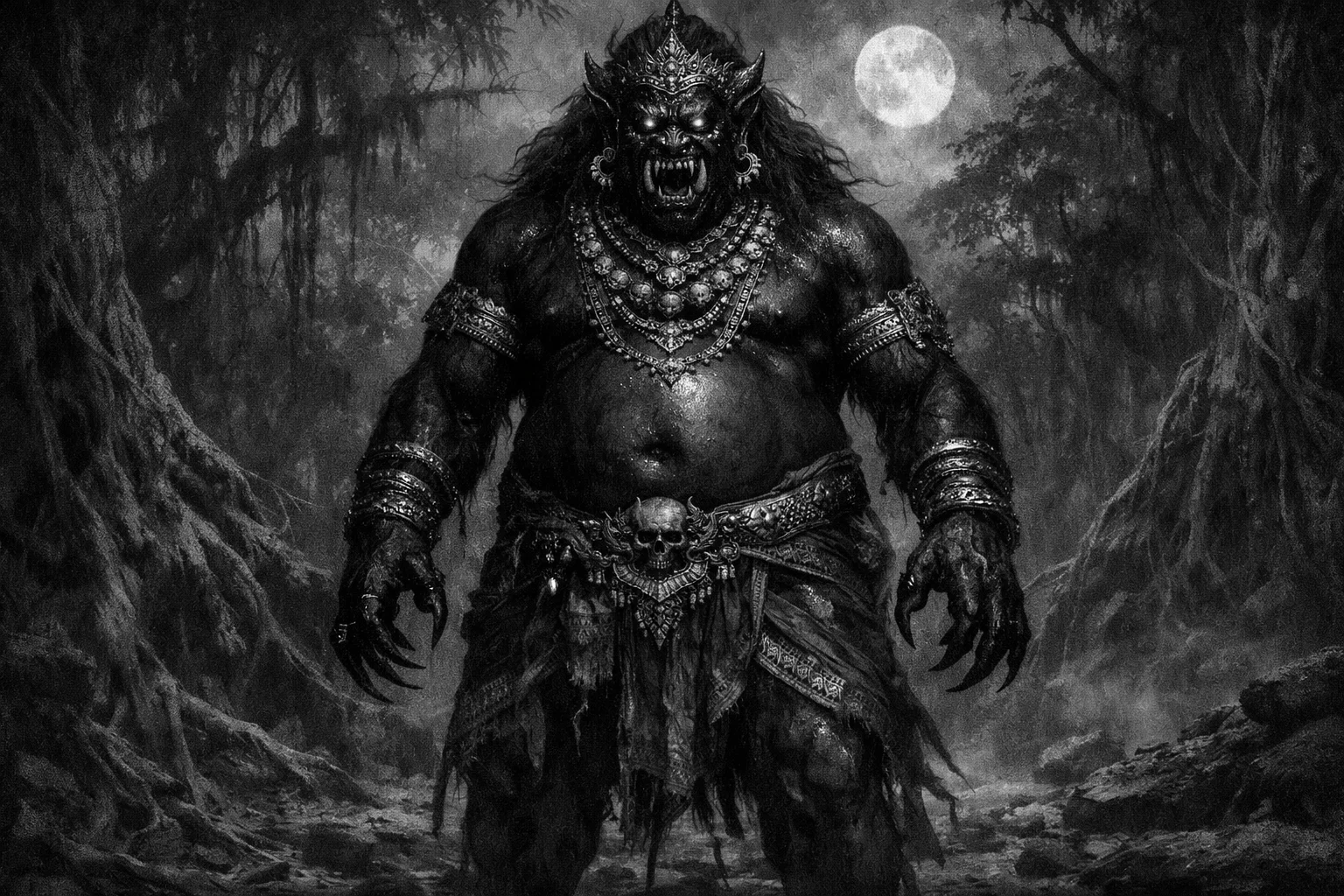
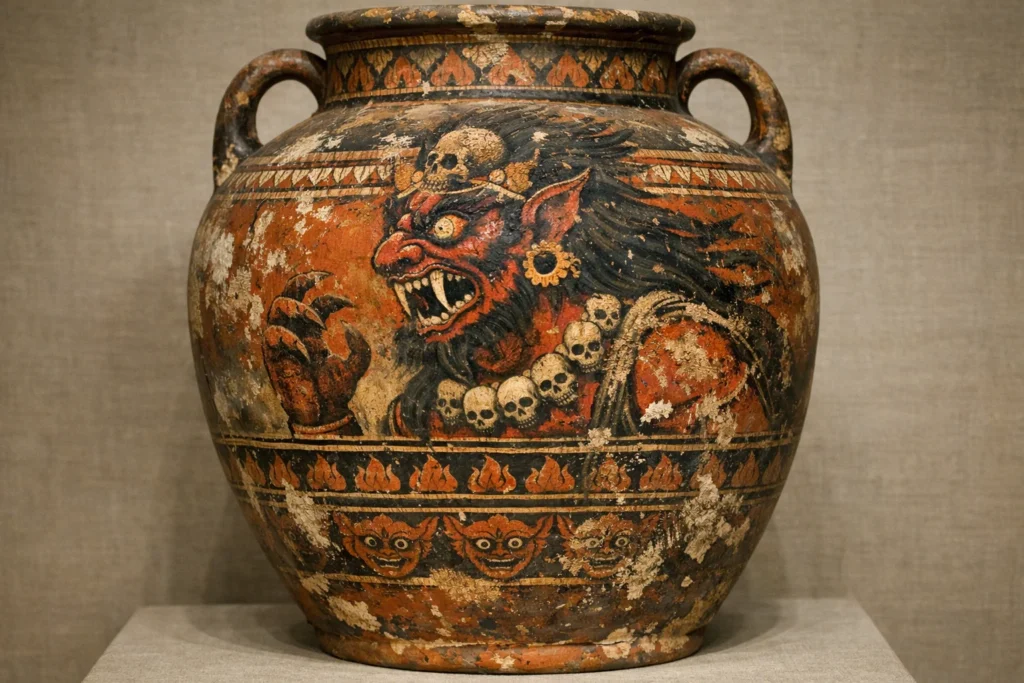
Rakshasas can look very different depending on the story and their power to change shape, called Kamarupa. In their natural form, they are usually shown with big bellies, red eyes, and long, sharp fangs. Their hair is often copper or flame-colored and stands up or is tangled.
Many stories, like the Aranya Kanda of the Ramayana, say Rakshasas have claw-like nails and skin that can be coal-black or deep blue. Some are shown with many heads or arms, or with animal features like horse ears or a tiger’s face.
When using Maya, or illusion, a Rakshasa can turn into a very beautiful human to trick people. For example, Surpanakha changed into a lovely woman to meet Rama. Even though they can look scary, Rakshasas, especially those from the royal family of Lanka, often wear gold jewelry and fine silks.
You may also enjoy:
Erinyes: The Chthonic Goddesses Who Enforced Blood-Guilt
November 20, 2025
Abura-sumashi: The Potato-Headed Yōkai That Punishes Greed
October 23, 2025
Who Is Ambolin, the Demon of Nighttime Dread
December 1, 2025
Andrealphus: The Peacock Demon Who Twists Minds and Bodies
January 19, 2026
Aim (Aym): The Great Duke of Hell in the Ars Goetia
November 11, 2025
What Is Qarin and Why Does It Follow Every Human Being?
October 8, 2025
Origins
The earliest stories about Rakshasas are found in the Rig Veda, where they are seen as shadowy beings who disturb rituals. Over time, they changed from vague evil spirits to a clear race with their own societies, kingdoms, and family trees.
In the Puranic period, Rakshasas became part of the Prajapati family tree. Most stories say they come from the sage Pulastya, but some say they were born from Khasha or even from Brahma’s foot. This background gives them a partly divine status, which explains why they can do great penance and get special gifts from the gods.
Birth
The main Rakshasa family is said to have started with the sage Vishrava and the Rakshasi princess Kaikasi. Kaikasi’s father, King Sumali, wanted her to marry a strong man to bring honor back to their family. Vishrava was a holy Brahmin, but because they married at an unlucky time, their children were born with fierce and demonic natures.
Their first child was Ravana, who had ten heads and twenty arms. Next came the giant Kumbhakarna and their sister Surpanakha. The youngest, Vibhishana, was good-hearted because of his father’s influence. These siblings started the Rakshasa dynasty of Lanka, which became the main enemy in the Ramayana.
Family
Rakshasa families are known for their strong loyalty to their tribe and a ranking system based on fighting skill. The most famous family is Ravana’s, whose main queen was Mandodari, the daughter of the builder Maya Danava.
| Category | Members |
| Parents | Vishrava (father), Kaikasi (mother) |
| Siblings | Ravana, Kumbhakarna, Vibhishana, Surpanakha, Khara, Dushana |
| Spouse | Mandodari (Ravana’s wife), Vajramala (Kumbhakarna’s wife) |
| Children | Meghanada (Indrajit), Akshayakumara, Atikaya, Trishira, Devantaka, Narantaka |
Asura-Deva Conflicts
Rakshasas are important in the battle between order and chaos. While Asuras fight for Indra’s throne, Rakshasas usually cause trouble on Earth. The main war involving Rakshasas is the fight between Rama, an avatar of Vishnu, and Ravana.
This fight was not just about land. It was a battle to bring back Dharma, or righteousness, after Ravana’s Rakshasas started attacking sages and upsetting the balance of the world. These stories show why the gods had to step in to stop their magic and metamorphosis.
Role in Hindu Cosmology
In Hindu cosmology, Rakshasas stand for tamas, which means darkness, laziness, and destruction. They are important in the cycle of ages, or Yugas.
When Rakshasas become powerful, it shows that goodness is fading, and an Avatar must appear. Even though they are often villains, they are still part of the system of Karma. A Rakshasa can reach liberation, or Moksha, either by being defeated by a god or by living a good life, like Vibhishana or Praheti.
Was Rakshasa Ever Mentioned in Vedic Texts?
Yes, Rakshasas are often mentioned in the Vedas, especially the Rig Veda and Atharva Veda. In these old texts, they are called ‘eaters of raw flesh’ and ‘disturbers of the sacrifice’ who act in the dark.
| Source | Quote |
| Rig Veda 7.104.1 | “Indra and Soma, burn the Rakshasa, crush them; destroy, ye two Bulls, those who wax strong in darkness.” |
| Rig Veda 10.87.2 | “O Agni, with thy heat do thou consume the Rakshasas who fly about as birds at night.” |
Rakshasa in Epics and Puranas
In the Ramayana by Valmiki and the Mahabharata by Vyasa, Rakshasas are shown as an advanced race with their own kings and strong cities. In the Mahabharata, the Rakshasa Ghatotkacha, who is the son of Bhima and the Rakshasi Hidimbi, is a hero who fights for the Pandavas.
| Source | Quote |
| Ramayana 3.32.1 | “A Rakshasa named Viradha, who was like a mountain peak, stood in the forest, blood-stained and formidable.” |
| Mahabharata 1.152.1 | “There lived a Rakshasa named Vaka, of cruel deeds and great strength, who ate a human being every day.” |
Powers and Abilities
Rakshasas are usually stronger than humans but not as powerful as top gods or Asuras, unless they get special gifts from the gods. Their main strength is their skill in Maya-yuddha, or fighting with illusions.
- Transformation (Kamarupa): The ability to assume any form, including animals or beautiful humans.
- Illusion (Maya): Creating false sights, such as rain of stones, blood, or illusory armies.
- Night Potency: Their strength increases a lot as the sun sets.
- Regeneration: High-tier Rakshasas like Ravana could regrow limbs or heads.
- Flight: Often described as flying through the air or moving at supernatural speeds.
Rakshasa Myths, Legends, and Stories
The Abduction of Sita and the Fall of Lanka
In the Aranya Kanda of the Ramayana, the Rakshasa king Ravana orchestrated the most important event of the Treta Yuga. Having heard of the exquisite beauty of Sita from his sister Surpanakha, Ravana sought to claim her as his queen. He summoned his kinsman, the sorcerer Maricha, and commanded him to assist in a grand deception.
Maricha, using the Rakshasa power of Kamarupa, transformed himself into a magnificent golden deer with silver spots and sapphire-tipped antlers.
He frolicked near the hermitage of Rama in the Dandaka Forest, successfully luring Rama away to hunt the creature. When Rama’s arrow struck Maricha, the Rakshasa mimicked Rama’s voice, crying out for help to draw Lakshmana away as well.
With Sita left alone, Ravana approached her disguised as a wandering Sanyasi (monk). The moment he realized she would not come willingly, he discarded his disguise, revealing his ten heads and twenty arms that “shone like dark clouds pierced by lightning.” He seized Sita by her hair and thighs, ignoring her cries, and forced her into his aerial chariot, the Pushpaka Vimana.
As they soared toward Lanka, the vulture-king Jatayu intercepted them. Ravana, proving the ruthless martial prowess of the Rakshasa race, sliced off the bird’s wings with his sword. He imprisoned Sita in the Ashoka Vatika, surrounded by fierce Rakshasi guards, setting the stage for the climactic war that would eventually lead to the destruction of the Rakshasa capital and his own death at the hands of Rama.
MEET THE MONSTERS THAT HAUNT JAPAN Limited-Time: Up to 28% OFF!
Kappa • Yuki-onna • Tanuki • Kitsune • Hundreds more legendary spirits Hilarious, horrifying, and downright bizarre tales from Japan’s shadow side. Fully illustrated encyclopedia by Thersa Matsuura – your passport to the world of yōkai. Anime origins • Real folklore • Things that go bump in the tatami. Dare you invite them in?
The Awakening and Slaughter of Kumbhakarna
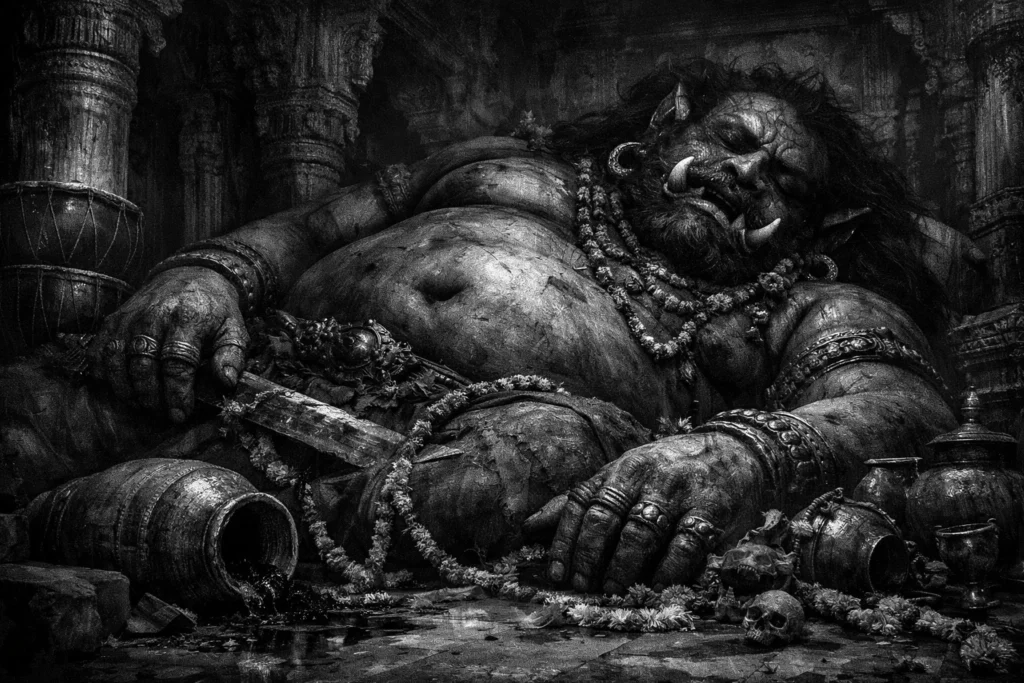
During the siege of Lanka, as recorded in the Yuddha Kanda, Ravana found his armies decimated by Rama and the Vanara host. In desperation, he ordered the awakening of his brother, the mountain-sized Rakshasa Kumbhakarna.
Because of a boon from Brahma that had gone awry, Kumbhakarna slept for six months at a time and was nearly impossible to rouse. Thousands of Rakshasa soldiers were deployed to his palace; they sounded trumpets, beat massive drums, and even drove elephants over his body to wake him. The air was filled with the scent of huge heaps of meat and jars of blood laid out to appease his legendary hunger.
Upon waking, the giant consumed mountains of food and wine before marching onto the battlefield. His presence alone caused the Vanara soldiers to flee in terror. Kumbhakarna fought with a massive iron mace, crushing hundreds of foes with every stride and snatching up Vanaras to eat them alive while he fought.
Even the most powerful commanders were unable to halt his progress. It was only when Rama intervened, using celestial Astras to systematically sever Kumbhakarna’s limbs and finally his head, that the giant was stopped. His massive body fell into the ocean, causing a surge that reached the walls of the city, marking the loss of the Rakshasas’ greatest physical asset.
You may also enjoy:
Who Is Taṇhā, the Seductive Demon of Craving in Buddhist Mythology?
October 15, 2025
Allocer: Great Duke of Hell and the 52nd Spirit of the Ars Goetia
November 17, 2025
The Kumbhanda: Grotesque Demons of Buddhist Hell
November 13, 2025
Kuchisake-onna: Folklore, Origins, and Urban Legend History
February 10, 2026
Abura-sumashi: The Potato-Headed Yōkai That Punishes Greed
October 23, 2025
Who Is Agaliarept, the General of Hell Under Lucifer?
October 8, 2025
Bhima’s Duel with the Tyrant Vaka
In the Adi Parva of the Mahabharata, the Pandavas, living in hiding at the village of Ekachakra, learned of a local terror named Vaka (or Bakasura). This Rakshasa lived in a cave outside the town. It had established a cruel pact with the villagers: every week, they were required to send a cartload of rice, two buffaloes, and the human driver to his cave for him to consume. When the Brahmin family sheltering the Pandavas was called to send a member, Kunti commanded her son Bhima to go instead.
Bhima arrived at the cave and, in a show of Rakshasa-like appetite and defiance, began eating the rice intended for Vaka. Enraged, the Rakshasa appeared, uprooting trees and hurling them at the prince. A colossal wrestling match ensued, vibrating the very earth. Bhima, possessing the strength of ten thousand elephants, eventually caught the Rakshasa by the waist and broke his back over his knee.
He dragged the lifeless body to the gates of the village, freeing the people from the Rakshasa’s tribute and showing that even the most feared man-eaters could be overcome by human strength aligned with Dharma.
The Devotion and Sacrifice of Ghatotkacha
The story of Ghatotkacha provides a rare glimpse into the “heroic” Rakshasa tradition. Born to Bhima and the Rakshasi Hidimbi, Ghatotkacha possessed all the magical traits of his mother’s race—flight, invisibility, and the ability to grow to the size of a mountain. During the Kurukshetra War, he was summoned by the Pandavas to fight at night, the time when the Rakshasa power is at its zenith.
On the fourteenth night of the war, Ghatotkacha unleashed a reign of terror on the Kaurava army. He used Maya to rain down weapons, fire, and illusory beasts from the sky. The Kaurava soldiers could not see him, yet they were being crushed by his massive form. To save his army from total annihilation, the hero Karna was forced to use the Vasavi Shakti, a divine spear he had been saving specifically to kill Arjuna.
As the spear struck him, Ghatotkacha used his final moments to expand his body to an enormous size and fall directly onto the Kaurava formations, crushing an entire Akshauhini (battle division) under his weight. His death was a calculated sacrifice that protected Arjuna and turned the tide of the war.
The Transformation of Bhasmasura
While often classified as an Asura, Bhasmasura is frequently cited in folklore as a Rakshasa-type entity due to his singular focus on destruction and consumption. He performed a grueling penance to Shiva, who granted him a unique power: anyone whose head Bhasmasura touched with his hand would instantly turn to ashes (Bhasma). Immediately after receiving the boon, the Rakshasa attempted to test it on Shiva himself.
Shiva fled, and the god Vishnu intervened, assuming the form of Mohini, a dancer of unparalleled beauty. Bhasmasura, overcome by the Rakshasa trait of lust, was entranced. Mohini agreed to marry him only if he could match her dance moves exactly.
As they danced, Mohini performed a move in which she placed her hand on her head. Bhasmasura, lost in the rhythm and her beauty, mimicked the gesture and was instantly incinerated by his own boon. This myth is a classic illustration of the Rakshasa’s inherent flaw: great power coupled with a lack of self-restraint leading to self-destruction.
NAME THEM. BIND THEM. CAST THEM OUT! Limited-Time: Up to 40% OFF!
The ultimate deliverance thesaurus by Apostle John Eckhardt. Hundreds of demonic names & attributes exposed alphabetically – from Jezebel to Python, infirmity to poverty. Hundreds of demons named & defeated Identify → Bind → Cast Out!
The essential weapon for every prayer warrior, intercessor, and deliverance minister. Victory starts with identification.

Rakshasa vs Other Asuras
| Asura Name | Associated Trait/Role | Clan/Origin | Key Traits/Powers |
| Mahishasura | Shapeshifting/Tyranny | Asura | Buffalo form, invulnerability to men |
| Baly | Sacrifice/Sovereignty | Daitya | Righteousness, immense wealth |
| Hiranyakashipu | Ego/Hatred of Vishnu | Daitya | Boon of conditional immortality |
| Vritra | Drought/Obstruction | Asura (Vedic) | Serpentine form, drought creation |
| Tarakasura | Heavenly Conquest | Daitya | Invincible except to a son of Shiva |
| Madhu | Cosmic Chaos | Origin from earwax | Primordial strength |
| Kaitabha | Cosmic Chaos | Origin from earwax | Primordial strength |
| Andhaka | Blindness/Desire | Asura | Multiplication from blood drops |
| Bhasmasura | Destruction | Asura | Ash-turning touch |
| Narakasura | Abduction/Greed | Asura | Earth-born (son of Bhudevi) |
Rank Among Asuras
In the hierarchy of Hindu demonic entities, the Rakshasa is often ranked as a terrestrial power. In contrast, the Asuras (specifically Daityas and Danavas) are cosmic powers. However, under the leadership of Ravana, the Rakshasas of Lanka rose to a position of supreme dominance, effectively ruling over the three worlds and subjugating even the Asuras.
Their rank is defined by their lineage from the Saptarishi Pulastya, which gives them a higher social and intellectual standing in Hindu mythology compared to the more bestial Pishachas.
You may also enjoy:
Who Is Jann in Islamic Mythology and Why Is He Feared?
October 2, 2025
What Is a Pishacha, the Flesh-Eating Demon of the Dead?
February 11, 2026
What Is the Akashita, the Red-Tongued Demon of Japanese Folklore?
November 5, 2025
Demon Amy, the 58th Goetic Spirit: Origin, Powers, and Rank
January 12, 2026
Who Is Ambolin, the Demon of Nighttime Dread
December 1, 2025
Abadir: The Demon Servant of Chaos and Dispersion
September 30, 2025
The Royal Lineage of Lanka
The most prominent Rakshasas belong to the family of Pulastya, who established a sophisticated civilization in the golden city of Lanka.
- Ravana: The King of Lanka and the primary antagonist of the Ramayana. A devotee of Shiva and a scholar of the Vedas, he was granted invincibility against gods and demons by Brahma. He is characterized by his ten heads and twenty arms.
- Kumbhakarna: Ravana’s giant brother. Known for his staggering physical size and appetite, he slept for six months at a time due to a distorted boon. He was a formidable warrior who could consume thousands of foes in a single day.
- Vibhishana: The youngest brother of Ravana. Unlike his siblings, he had a Sattvic (pure) temperament and was a devotee of Dharma. He defected to Rama’s side during the war and was crowned the King of Lanka after Ravana’s death.
- Surpanakha: The sister of Ravana. A powerful shapeshifter, her attempt to seduce Rama and Lakshmana, and her later mutilation, served as the primary catalyst for the war between Rama and Ravana.
- Indrajit (Meghanada): Ravana’s eldest son. He was the only warrior to possess the three ultimate weapons of the Trimurti: the Brahmastra, Vaishnavastra, and Pashupatastra. He earned the name Indrajit after defeating Indra, the king of the gods.
The Forest and Regional Terrors
These Rakshasas were typically local chieftains or independent entities who occupied specific territories, often terrorizing sages and travelers.
- Tataka: A beautiful princess turned into a man-eating Rakshasi by a curse. She laid waste to the forest of Malada and Karusha. She was the first major demoness slain by Rama.
- Maricha: Ravana’s uncle and a master of Maya (illusion). He famously transformed into a golden deer to lure Rama away from Sita, leading to her abduction.
- Vaka (Bakasura): A Rakshasa who forced the citizens of Ekachakra to provide him with a weekly cartload of food and a human victim. He was eventually slain by the Pandava prince Bhima.
- Hidimba: A forest-dwelling Rakshasa who attempted to eat the Pandavas during their exile. He was killed by Bhima in a wrestling match.
- Khara and Dushana: Younger brothers of Ravana who ruled the Janasthana (outpost) in the Dandaka forest with an army of 14,000 Rakshasas. They were both killed by Rama in a single battle.
- Viradha: A fierce Rakshasa encountered by Rama in the Dandaka forest. He was a celestial being (Gandharva) cursed to live as a Rakshasa until slain by an avatar of Vishnu.
Heroic and Hybrid Rakshasas
In certain narratives, Rakshasas are depicted as allies to the protagonists or as complex figures with honorable traits.
- Ghatotkacha: The son of Bhima and the Rakshasi Hidimbi. A powerful warrior in the Mahabharata, he used his Rakshasa magic to devastating effect during the Kurukshetra War before falling to Karna’s divine spear.
- Praheti: Mentioned in the Puranas as a righteous Rakshasa who abandoned his demonic nature to lead a life of penance and devotion, eventually attaining a high spiritual state.
- Aniruddha’s Guards: In some regional folklore, Rakshasas serve as guardians of sacred sites or as protectors of the virtuous, bound by oaths or divine command.
Significant Female Rakshasis
Female Rakshasas often play critical roles as guardians, spies, or mothers of heroes.
- Mandodari: Though the daughter of the Asura Maya, she was the Queen of the Rakshasas. Known for her piety and wisdom, she is considered one of the Panchakanya (five iconic women) whose names are said to dispel sin.
- Trijata: A Rakshasi guard in the Ashoka Vatika who befriended Sita. She was compassionate and used her prophetic dreams to comfort Sita and warn the other guards of Ravana’s impending doom.
- Simhika: A sea-dwelling Rakshasi who could capture victims by seizing their shadows. She was slain by Hanuman during his flight to Lanka.
Major Rakshasa Leaders
| Name | Primary Kingdom | Key Feat | Final Fate |
| Ravana | Lanka | Conquest of the Three Worlds | Slain by Rama |
| Ghatotkacha | Kamyaka Forest | Decimation of the Kaurava Army | Slain by Karna |
| Vaka | Ekachakra | Enslavement of a human village | Slain by Bhima |
| Kumbhakarna | Lanka | Defeat of multiple Devas | Slain by Rama |
| Tataka | Dandaka | Transformation of fertile land to desert | Slain by Rama |
Mystical Correspondences
| Attribute | Details |
| Planet | Rahu (the North Node) |
| Zodiac Sign | Scorpio (associated with secrecy and transformation) |
| Element | Earth and Fire (Kravyad fire) |
| Direction | Southwest (Nirriti’s direction) |
| Color | Black and Blood-Red |
| Number | 9 (associated with sorcery) or 10 (Ravana’s heads) |
| Crystal/Mineral | Hessonite (Gomed) or Black Onyx |
| Metal | Iron |
| Herb/Plant | Dhatura (poisonous plants) |
| Animal | Vulture or Jackal |
| Trait/Role | Maya and Consumption |
Rakshasas are linked to the planet Rahu, which is connected to illusions, sudden changes, and chaos. Since they are night-walkers, their power is strongest at night. They are also tied to the darker parts of the zodiac, especially Scorpio. Their connection to the earth shows their hunger and their job as guardians of hidden treasures or deep forests.
Spiritually, Rakshasas symbolize the challenges people face, such as physical desires and false beliefs that must be overcome. They are linked to the Southwest direction, which is connected to Nirriti, the force of decay and the end of the physical body.
Rakshasa’s Symbols
The main symbols of Rakshasas are the Khadga, a curved sword, and the Trishula, a trident. They are also linked to the Chandrahasa sword, which Shiva gave to Ravana.
Other symbols include the Yantra of Nirriti and special charms used in Tantric rituals for protection or to call on their help. In art, they are often shown with a severed head or a skull cap filled with blood, called a Kapala.
Worship and Boons
Most people fear Rakshasas, but some are worshipped in certain regions or Tantric groups for protection from evil spirits. Rakshasas usually gain power through Tapasya, or strict penance, to the gods like Brahma or Shiva. For example, Ravana offered his heads to Shiva to show his devotion.
In return, Rakshasas often get special gifts like invincibility, magic weapons, or long life. They usually use these powers to challenge the natural order, which leads to a final clash with the gods.
You may also enjoy:
Who Is Taṇhā, the Seductive Demon of Craving in Buddhist Mythology?
October 15, 2025
Andhaka: The Blind Demon Born From Cosmic Darkness
February 6, 2026
Pazuzu: The Demon Who Fought Evil with Evil
November 4, 2025
What Is the Abumi-guchi Yōkai and Why Does It Wait Forever?
October 22, 2025
Empusa: The Blood-Drinking Wraith of Greek Mythology
November 20, 2025
Who Was Abezethibou, the Fallen Angel Who Opposed Moses?
October 1, 2025
Frequently Asked Questions
What is the difference between an Asura and a Rakshasa?
While both are supernatural beings, Asuras are cosmic rivals to the Devas who fight for sovereignty over the heavens (Svarga). Rakshasas are primarily terrestrial entities associated with the earth and forests. Asuras are often depicted as powerful, structured clans. In contrast, Rakshasas are frequently portrayed as man-eaters and sorcerers who disrupt human rituals and social order on Earth.
Can a Rakshasa be good or righteous?
Yes, several Rakshasas are celebrated for their righteousness. The most prominent example is Vibhishana, Ravana’s younger brother, who defected to Rama’s side and was crowned King of Lanka for his virtue. Similarly, Praheti and Ghatotkacha are depicted as figures who followed the path of Dharma or aided heroic causes, proving that their nature is not exclusively malevolent.
What are the female Rakshasas called, and what are their traits?
Female Rakshasas are known as Rakshasis. Like their male counterparts, they possess the power of Kamarupa (metamorphosis). They can appear as beautiful women known as Manushya-Rakshasis. Famous Rakshasis include Surpanakha, who triggered the conflict in the Ramayana, and Hidimbi, the mother of Ghatotkacha, who became a protector and a goddess in certain Himalayan traditions.
Where is the kingdom of the Rakshasas located?
The most famous Rakshasa kingdom is Lanka, a golden city built by the celestial architect Vishwakarma (and later occupied by Ravana). However, Rakshasas are also said to inhabit Patala (the underworld) and various forests across the Indian subcontinent, such as the Dandaka Forest, where they lived in tribal colonies under leaders like Khara and Dushana.
How do Rakshasas gain their immortality or invincibility?
Rakshasas typically gain supernatural boons through Tapasya (extreme penance). By performing thousands of years of meditation and sacrifice to deities like Brahma or Shiva, they earn specific protections, such as being unable to be killed by gods, spirits, or animals. These boons usually contain a “loophole” (such as vulnerability to humans) that leads to their eventual defeat.
How does the power of a Rakshasa change between day and night?
The power of a Rakshasa is intrinsically linked to the solar cycle. They are known as Nishichara (night-walkers) because their strength, speed, and magical abilities (Maya) increase exponentially after sunset. During the day, their powers are dimmed, and they are more vulnerable to conventional weapons. In the Ramayana, battles against Rakshasas often became more perilous for the Vanara army as night fell, as the Rakshasas gained the ability to become invisible and manifest terrifying illusions in the dark.
What is the connection between Rakshasas and the Buddhist “Lord of the Dead”?
In the Buddhist context, the Rakshasas are often associated with the retinue of Virudhaka (one of the Four Heavenly Kings) or linked to the realm of Yama, the Lord of the Dead. While Yama himself is a Deva in Hinduism, in certain Buddhist and later Puranic traditions, Rakshasas serve as the executioners or guardians of the Hell realms (Naraka). They are tasked with punishing those who have accumulated negative karma, acting as the agents of suffering for the deceased who lived unrighteous lives.
Are there any instances where Rakshasas and humans intermarried?
Yes, intermarriage between humans (specifically Kshatriyas) and Rakshasas is documented in the epics. The most important instance is the marriage of the Pandava prince Bhima and the Rakshasi Hidimbi. Their union was a Gandharva marriage (based on mutual consent). It resulted in the birth of Ghatotkacha, a half-human, half-Rakshasa warrior who played a central role in the Kurukshetra War. These unions highlight that, despite their “demonic” classification, Rakshasas were considered a distinct race capable of forming social and marital alliances with humans.
Do Rakshasas have a specific language or scripts associated with them?
While most classical texts describe Rakshasas as speaking Sanskrit (Ravana was famously a master of the Vedas and a linguistic scholar), folklore often attributes a specific “demonic” tongue to them: Rakshasi Bhasha. This language is characterized by harsh sounds and is used for casting dark spells and necromantic incantations. In dramatic traditions like Kutiyattam, Rakshasa characters use specific stylized vocalizations to represent their supernatural and fierce nature.
