
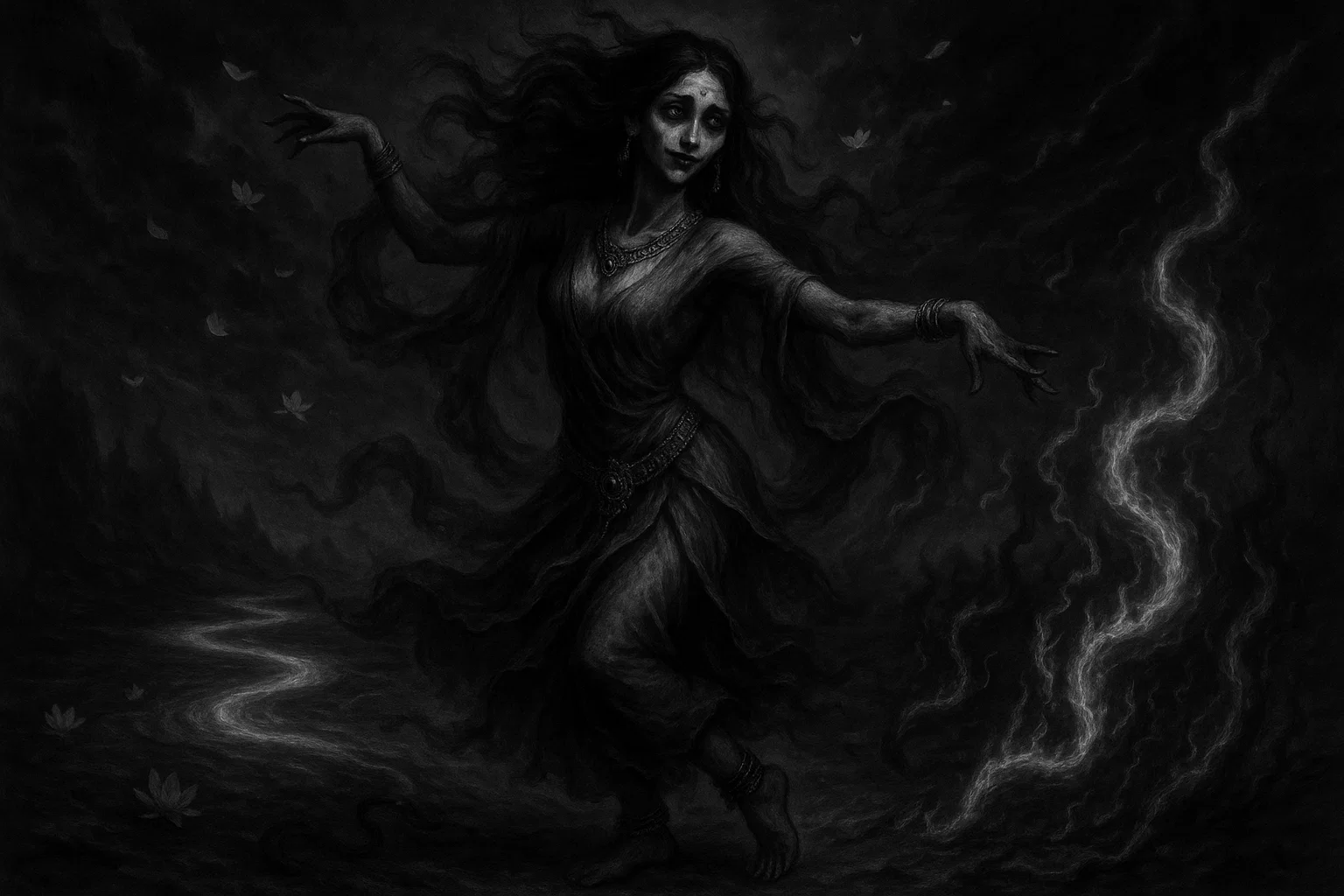
Taṇhā shows how psychological barriers persist in Buddhist thought. Instead of being an outside force of destruction, she represents our inner urge for sensory experience and the instinct to keep ourselves going.
In the story of the Buddha’s enlightenment, she represents the last and most hidden parts of the mind that must be understood and let go of to attain freedom. As one of the demon king’s three daughters, she represents the craving for existence that keeps beings trapped in the cycle of rebirth.
To understand how the image of the daughter of the demon king changed over time, I compared 19th-century translations of the Pali Canon with the visual records found in The Life of the Buddha According to the Ancient Texts and Monuments of India. [View Full Bibliography ↓]
Summary
Key Takeaways
| Attribute | Details |
| Names | Taṇhā (Pali), Tṛṣṇā (Sanskrit), Chanhā |
| Title | Daughter of Māra |
| Region | Ancient India (Magadha/Kosala), spanning Buddhist Asia |
| Type | Buddhist demoness; personification of craving |
| Gender | Female |
| Realm | Kamaloka (Desire Realm); specifically Paranimmita-vasavatti |
| Obstacle/Threat | Spiritual bondage through craving and sensory attachment |
| Associated Figures | Māra (father), Arati and Ragā (sisters), Siddhartha Gautama |
| Weapon/Item | Illusory physical beauty; various seductive guises |
| Weaknesses | Vipassana (insight meditation), realization of emptiness |
| Associated Deity/Figure | Gautama Buddha |
| Pantheon | Buddhist (Theravada and Mahayana) |
| Primary Sources | Sutta Nipata, Samyutta Nikaya, Buddhacarita, Lalitavistara Sutra |
Who or What is Taṇhā?
In early Buddhist stories and psychology, she is known as one of Māra’s three daughters, the Tempter. She is not a human being, but a powerful spirit living in the highest Heaven of the Desire Realm.
Together with her sisters, Taṇhā represents the mental forces that seek to prevent people from finding lasting peace. While her father stands for death and all worldly distractions, she is the thirst or longing that makes life in the world seem appealing and important.
Taṇhā is best known for appearing during Siddhartha Gautama’s last hours of meditation under the Bodhi tree. When the demon king’s monsters could not shake the Buddha’s focus with fear, he sent his daughters to tempt him. She stands for the strongest of these temptations: the deep craving for pleasure and existence that keeps the cycle of life going.
“Taṇhā” Meaning
The name comes from the Pali word for “thirst” or “craving,” which itself comes from the Sanskrit root tṛṣ, meaning an unquenchable dryness or longing.
Philosophically, it means the burning desire for something you don’t have. In the Pali Canon, this word describes the main cause of suffering, as explained in the Second Noble Truth. As a demoness, her name still means an endless thirst for experience.
In Sanskrit texts like the Buddhacarita by Ashvaghosa, she is called Tṛṣṇā. Although the name changes slightly, her character stays the same in Buddhist traditions from India, China, and Tibet.
In Chinese translations of Buddhist texts, the idea is often called Ai (love or attachment) or Ke (thirst). As a daughter of the demon king, she is usually part of a trio: Tan-ai (craving), Tan-yin (lust), and Lo-shua (pleasure), though the names can change depending on the translator. No matter the version, the main idea is the “clinging” that stops suffering from ending.
How to Pronounce “Taṇhā” in English
The name is pronounced TUN-haa. The first part sounds like “bun,” and the second part has a long “a” with a soft “h.” In Sanskrit, Tṛṣṇā is pronounced TRISH-naa.
You may also enjoy:
Yuki Onna: The Terrifying Bride Who Feeds on Travelers
December 9, 2025
Who Was Abezethibou, the Fallen Angel Who Opposed Moses?
October 1, 2025
Ammit: Devourer of the Dead in Ancient Egyptian Mythology
November 10, 2025
What Is a Pishacha, the Flesh-Eating Demon of the Dead?
February 11, 2026
Empusa: The Blood-Drinking Wraith of Greek Mythology
November 20, 2025
Who Was Hiranyakashipu, the Demon King of Hindu Mythology?
October 6, 2025
What Does Taṇhā Look Like?
Descriptions of her appearance are closely tied to her role as a temptress. According to the Lalitavistara Sutra and the Buddhacarita, she does not have a fixed, monstrous form like other demons.
Instead, she is shown as extremely beautiful, meant to show the ideal of feminine grace in ancient India. She is often depicted with golden skin, dressed in fine silks, and wearing elaborate jewelry, such as necklaces, armlets, and belts.
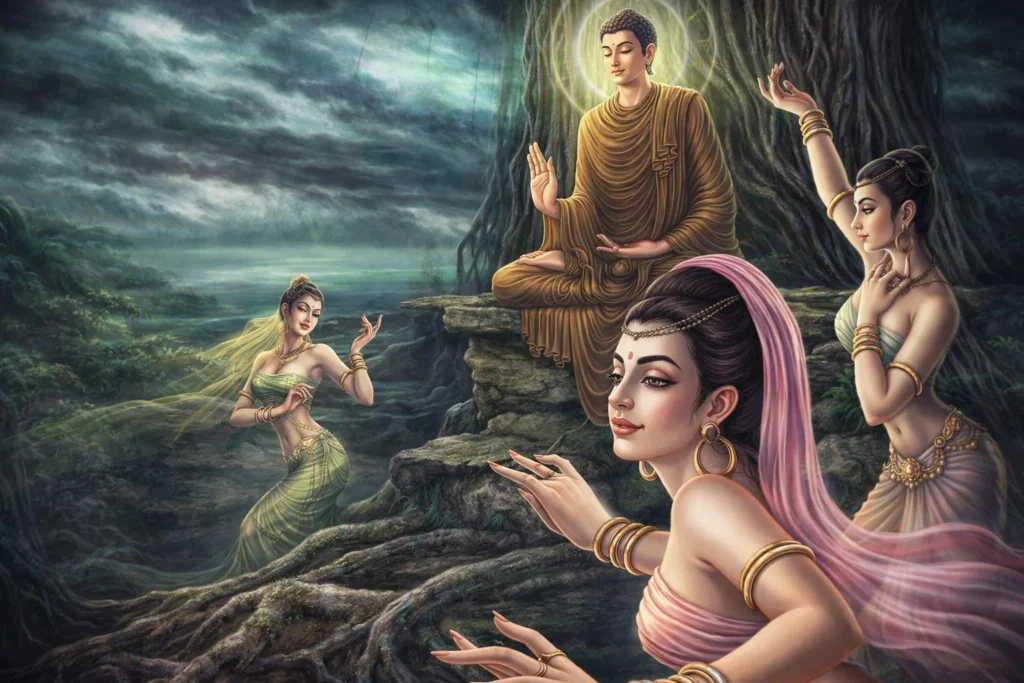
In classic Buddhist art, especially in Gandhara stone carvings and Ajanta paintings, Taṇhā and her sisters are shown in attractive poses, often dancing or playing music. One special feature in stories about her is her ability to change her appearance.
When she met the Buddha, she reportedly changed into different forms to appeal to men at different ages—sometimes a young maiden, sometimes a woman in her prime, and sometimes a graceful older woman. This ability to change shows that physical beauty is just an illusion, hiding the deeper spiritual problem she stands for.
Origins
The first stories about her appear in the Sutta Nipata and the Samyutta Nikaya of the Pali Canon, written in the last centuries BCE. These texts tell how the demon king grew frustrated when he could not defeat the Buddha. After he gave up, his daughters tried their own ways to tempt him. She is said to come from the demon king’s own mind and his wish to keep control over the cycle of rebirth.
In Buddhist cosmology, she lives in the Paranimmita-vasavatti Heaven, which is the home of the “Devas who control the creations of others.” This is the highest part of the Desire Realm, where beings enjoy pleasures made for them by others.
Over time, Taṇhā shifted from being merely a philosophical idea in early texts to a fully developed mythological character in later Mahayana stories about the Buddha. Although she is similar to Hindu apsaras or seductive spirits, her role is always as an opponent to the path of self-control, making her a unique Buddhist demon.
How Taṇhā Personifies the Crisis of Continuity
In my research, I noticed that making Taṇhā a daughter of the demon king shows a move from abstract philosophy to a more psychological view of demons.
Early Buddhist texts use her name as a technical term for the “thirst” that perpetuates the cycle of rebirth. Still, later stories, such as the Samyutta Nikaya and the Buddhacarita, turn this idea into a living character who tries to lead people astray.
I find it interesting that she is not just about “desire” in general; she stands for the Crisis of Continuity. In ancient India, Vedic rituals aimed to sustain life and family lines, but Buddhism introduced a new concern about the “trap” of continually becoming something new. She is the guardian of that trap.
From what I’ve seen, her special look in Gandharan art—mixing Greek-style grace with Indian sensuality—serves two purposes. For someone in the 2nd century, her beauty was not just a temptation from outside, but also a “Projective Mirror” reflecting their own desires.
She changes her form to match the age of the person looking at her—sometimes as a peer, a mother, or a daughter. This shows that her power comes from the observer’s own ideas about what makes life worth living. She is the only one among the demon king’s forces who needs the person’s imagination to work.
I’ve also noticed an interesting link between this demoness and the Preta, or Hungry Ghost. Even though they live in different parts of the Buddhist universe, both are marked by never-ending hunger or desire.
But while the Preta symbolizes the pain of never satisfying physical hunger, Taṇhā symbolizes the mental and sensory “thirst” that comes before it. She creates the hunger, while the Preta suffers from it. This shows a kind of ranking among demons: higher ones, like her, set traps that lead to lower states of suffering. In a way, she is the starting point for all other demonic states.
The way people tried to get rid of her changed over time, showing what ancient societies feared most. In earlier times, the Buddha overcame her by staying calm and steady—a win through willpower. Later, in Tantric traditions, the focus shifted from banishing her to changing her “thirst” into energy that could help reach enlightenment.
This change shows a deeper understanding of human flaws: people no longer saw her as an outside threat. They began seeing her as part of themselves, to be understood and accepted. She is still seen as a “Necessary Evil” in Buddhism; without her temptation, the Buddha’s victory would not be as meaningful.
Powers and Abilities
Among the spirits of the Desire Realm, Taṇhā’s power is seen as greater because she affects the mind, not the body. While a Yaksha might hurt someone physically, she works through subtle mental influence, which is harder to notice or resist.
In the demon king’s world, her power is considered “divine,” making her a tough challenge for anyone who hasn’t reached deep meditation.
- Illusion Projection: She can create convincing sensory environments that appear entirely real to the observer.
- Transformation: The ability to alter her age, clothing, and physical features to match the specific desires of her target.
- Emotional Manipulation: She can amplify practitioners’ feelings of longing, nostalgia, and sensory hunger.
- Vocal Seduction: Taṇhā’s speech has the power to “melt the mind,” using sweet words to justify abandoning the spiritual path.
- Immortality (Relative): As long as craving exists in the universe, she remains a potent force within the cycle of Samsara.
Taṇhā Myths, Legends, and Stories
The Temptation Beneath the Bodhi Tree
The primary narrative featuring this entity occurs in the Māra-Samyutta of the Samyutta Nikaya.
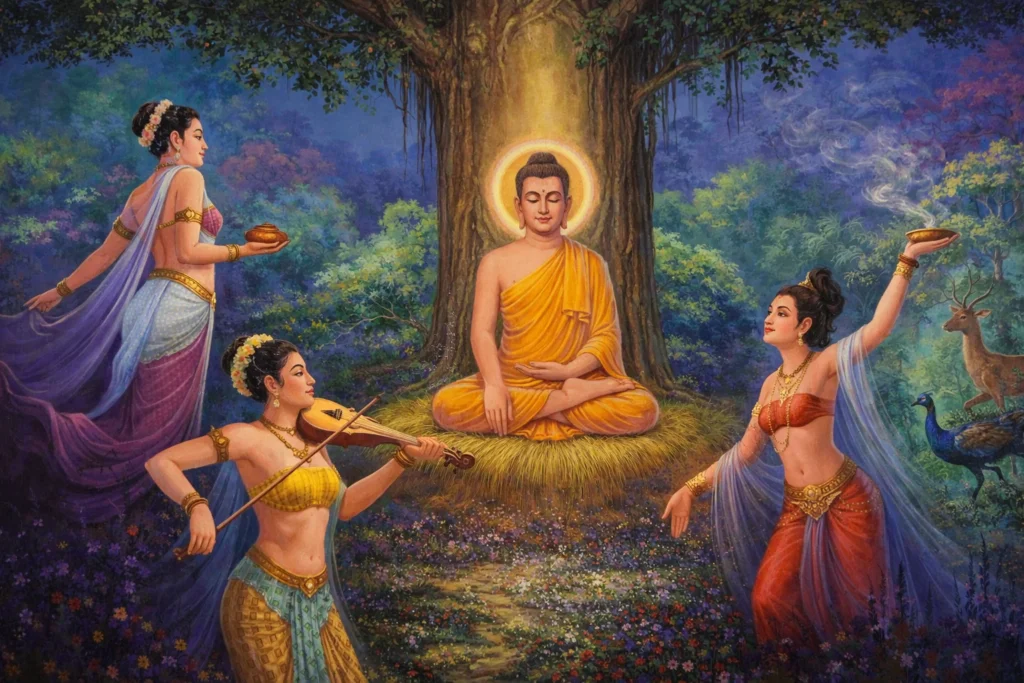
After Siddhartha Gautama had remained unmoved by the terrifying apparitions and elemental storms conjured by the demon king, the daughters—including this entity—noted their father’s despondency. They approached the demon king and said, “Father, do not be grieved. We will catch him with the snare of passion. We will bring him back like a forest elephant bound by ropes.”
They approached the Bodhi tree and displayed their charms. They asked the Great Physician why he sat in the forest instead of enjoying the pleasures of the senses and the company of women.
The Future Buddha, however, had already uprooted the tendencies toward passion. He remained in a state of perfect equanimity. In some versions of the story, he responded by pointing out the foulness of the physical body hidden beneath the skin, causing the daughters to realize the futility of their beauty.
You may also enjoy:
Aamon: The Infernal Marquis of Lust, Feuds, and False Prophecies
September 29, 2025
Who Is Hariti, the Mother of Ogres in Buddhist Mythology?
December 8, 2025
Aži Dahāka: The Three-Headed Dragon of Zoroastrian Mythology
January 14, 2026
What Is the Abumi-guchi Yōkai and Why Does It Wait Forever?
October 22, 2025
Who Is Astaroth in Demonology and the Ars Goetia?
February 20, 2026
Aim (Aym): The Great Duke of Hell in the Ars Goetia
November 11, 2025
The Transformation into Hags
In the commentaries on the Dhammapada, there is an expansion of the encounter in which the sisters attempted to appeal to the Buddha’s specific tastes. They realized that men have different preferences, so they each manifested in a hundred different forms: as women who had not yet given birth, as women who had given birth once, as middle-aged women, and so on.
As they circled the Buddha, displaying these various stages of womanhood, he remained as unmoving as a pillar. He eventually spoke, stating, “You should go away. What do you see in this body that is full of impurities?”
According to some later legends, at the Buddha’s word or through his psychic power, the youthful forms of the daughters withered instantly. They were transformed into decrepit, wrinkled hags with grey hair and broken teeth, forced to see the reality of the “thirst” they promoted. They fled back to their father, admitting that the Great Man was beyond the reach of worldly allure.
The Dialogue of the Daughters
In the Sunda-rika-bharadvaja Sutta and related texts, a brief dialogue is recorded in which the daughters question the Buddha’s motivation for seeking the “far shore” of Nirvana. She specifically represents the argument for becoming (bhava). She questioned why anyone would want to extinguish the “delight” of existence.
The Buddha’s rebuttal emphasized that the “delight” was actually a form of burning. He explained that just as a fish is caught by a hook hidden in bait, the pleasure she offered was merely the bait for the “hook” of suffering and rebirth. This dialogue serves to cement her role as the philosophical personification of the very “thirst” that the Four Noble Truths seek to quench.
Taṇhā vs Other Similar Entities
| Demon Name | Associated Obstacle/Role | Origin/Source | Key Traits/Powers |
| Arati | Discontent/Aversion | Pali Canon | Instilling boredom and restlessness |
| Ragā | Lust/Passion | Sutta Nipata | Arousing intense sexual desire |
| Mara | Death and Delusion | Early Buddhist Texts | Lord of the Desire Realm; illusion |
| Namuchi | Spiritual Hindrance | Vedic/Buddhist texts | Holding back the seeker from the goal |
| Papiyan | Evil Influence | Agama Sutras | Corrupting the dharma/teachings |
| Preta | Insatiable Hunger | Abhidharma | Physical manifestation of greed |
| Kumbhanda | Vitality Theft | Mahayana Sutras | Draining energy from the unwary |
| Rakshasa | Physical Consumption | Lalitavistara | Superhuman strength; shape-shifting |
| Yaksha | Resource Guarding | Pali Canon | Nature spirits; can be benevolent/malevolent |
| Asura | Pride and Wrath | Cosmological texts | Constant warfare with the gods |
| Ahi | Stagnation | Samyutta Nikaya | Serpentine form representing “the stay” |
| Kali (Buddhist) | Temporal Ruin | Tantric texts | Destruction of the ego |
Mystical Correspondences
| Attribute | Details |
| Planet | Venus (in its aspect of sensory attraction) |
| Zodiac Sign | Taurus (fixed sensory desire) |
| Element | Water (representing the fluid, thirst-like nature) |
| Direction | West (the setting sun/twilight of the senses) |
| Color | Saffron or Lustrous Gold |
| Number | 3 (The daughters) or 108 (Types of craving) |
| Crystal/Mineral | Amber (trapping things in its beauty) |
| Metal | Gold (the luster of worldly wealth) |
| Herb/Plant | The Poppy (bringer of oblivious dreams) |
| Animal | The Deer (representing the pursuit of the mirage) |
| Trait/Role | Craving, Seduction, Continuity |
Her mystical connections are based on the idea of the “Golden Fetters.” She does not stand for the “dark” or “ugly” side of evil, but for the “bright” and “beautiful” side, which can be even more dangerous for someone on a spiritual path. Her element is water, especially salty ocean water, which only makes a person thirstier the more they drink.
She is linked to the number three, which connects her to the “Three Poisons” in Buddhism: greed, hatred, and delusion. Her sisters, Arati and Ragā, are more closely tied to hatred and greed, but she is often seen as the main link between them through the basic “thirst” for self.
In rituals to overcome addiction or strong desire, her name is used not for worship, but to recognize and “dissolve” her influence through awareness.
You may also enjoy:
The Kumbhāṇḍa: Grotesque Demons of Buddhist Hell
November 13, 2025
Amdusias in the Ars Goetia: The Demon of Dark Music
December 2, 2025
Abadir: The Demon Servant of Chaos and Dispersion
September 30, 2025
What Is a Yūrei? The True Meaning of Japanese Ghosts
January 30, 2026
Si’la: The Seductive Jinn Who Lures Travelers to Their Doom
October 9, 2025
Bibliography
Author’s Note: In putting together this article, I focused on the balance between the simple, psychological style of the Suttanipāta and the more detailed, visual stories in the Buddhacarita and Lalitavistara. By comparing these stories with Foucher’s archaeological work, I found that the changing ways these figures are shown are not just poetic, but a way to make inner cravings visible. This approach helped me connect abstract Pali ideas with the lively character descriptions in the Mahāvastu, showing how the entity has changed over time.
- E. H. Johnston, translator. The Buddhacarita; or, Acts of the Buddha. Baptist Mission Press, 1936. Internet Archive.
- Mitra, Rajendralala, translator. The Lalita-Vistara; or, Memoirs of the Early Life of S’ākya Siñha. Fasciculus 1–2, Baptist Mission Press, 1881–1882. Bibliotheca Indica. Internet Archive.
- Bodhi, Bhikkhu, translator. The Suttanipāta: An Ancient Collection of the Buddha’s Discourses Together with Its Commentaries. Wisdom Publications, 2017. The Teachings of the Buddha. Internet Archive.
- Rosenfield, J. M. (1964). Alfred Foucher, The Life of the Buddha According to the Ancient Texts and Monuments of India. Abridged translation by Simone Brangier Boas, Middletown, Connecticut, Wesleyan University Press, 1963. Published originally as La vie du Bouddha d’apres les textes et les monuments de de, Paris, Payot, 1949. The Art Bulletin.
- Buswell, Robert E., Jr., and Donald S. Lopez, Jr. The Princeton Dictionary of Buddhism. Princeton University Press, 2014. Internet Archive.
- Jones, J. J., translator. The Mahāvastu: Volume I. Vol. 1. Book from the Archaeological Survey of India. Central Archaeological Library, New Delhi. Internet Archive.
- Jones, J. J., translator. The Mahāvastu: Volume II. Luzac & Company Ltd., 1952. Sacred Books of the Buddhists. Internet Archive.