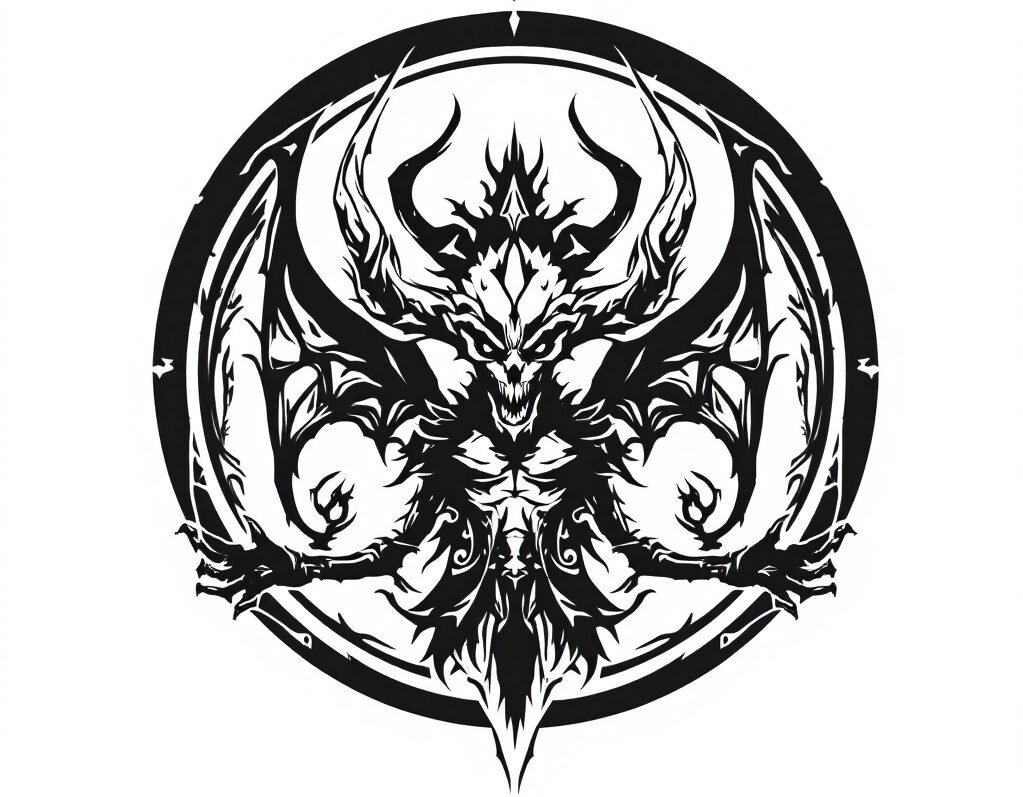
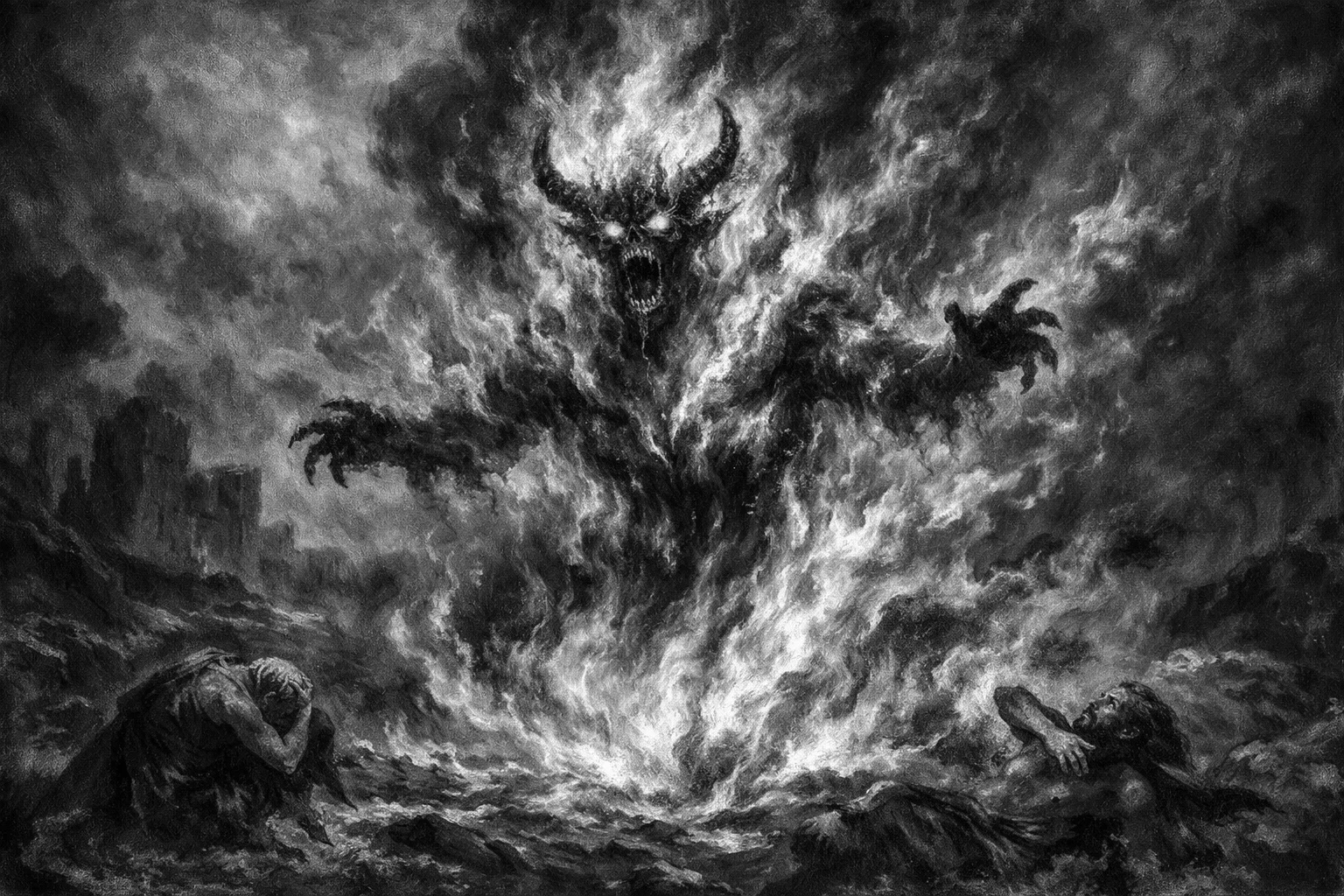
Many Goetic entities are known for their destructive power, but Amy (or Avnas) stands out as a “hopeful” fallen spirit. He first appears as a pillar of flame, then takes on a human form. As President of Hell, he balances the wild force of fire with the order and knowledge of the liberal sciences.
The demon is different from other demonic entities because he has a long-term goal. While most accept their exile, grimoires like the Pseudomonarchia Daemonum suggest that Amy still hopes—though in vain—to return to the Seventh Throne of Heaven after 1,200 years.
This makes Amy a rare case in demonology. He offers both earthly treasures and celestial knowledge. Yet, he is still driven by a desperate and misplaced hope for his own redemption.
This article uses sources such as the Pseudomonarchia Daemonum (1577) and the Dictionnaire Infernal (1863) to provide a well-researched historical profile of this demon. [View Full Bibliography ↓]
Summary
Key Takeaways
| Attribute | Details |
| Names | Amy, Avnas |
| Title | Great President of Hell |
| Gender | Male |
| Role | Deceiver, seeker of treasures, teacher of forbidden knowledge |
| Rank | President |
| Hierarchy | Governs 36 legions; serves under the infernal kings of the Goetia |
| Legions | 36 Legions |
| Powers | Grants knowledge of astrology, teaches liberal sciences, locates hidden treasures, provides familiars |
| Associated Figures | King Solomon, Johann Weyer, Aleister Crowley |
| Weaknesses | Binding through the Seal of Solomon, holy names of the Tetragrammaton |
| Opposing Angel/Saint | Mebahel |
| Pantheon | Christian Occultism / Abrahamic |
| Primary Sources | Ars Goetia, Pseudomonarchia Daemonum, Dictionnaire Infernal, The Discoverie of Witchcraft |
Who or What is Amy?
Amy is a high-ranking demon, a President. He is usually described as a fallen angel who once belonged to certain angelic groups before becoming a demon. In demonology, Amy acts as a teacher, sharing technical knowledge with those who summon him.
Amy’s main role is to share knowledge and help find hidden treasures. People summon him for his skill in revealing treasures protected by other spirits and for his expertise in the liberal sciences. Even though he teaches, he is still considered a harmful spirit who seeks to expand his influence and control his 36 legions.
“Amy” Meaning
The name Amy (and its variant Avnas)appear in many old manuscripts. It’s hard to trace the name’s exact language origin, but it shows up often in Latin and English grimoires. In the Pseudomonarchia Daemonum (1577), Johann Weyer calls the spirit Amy, and this name continues in later versions of the Lesser Key of Solomon.
Amy’s name is different from most Hebrew or Greek demon names, so it might be a variant of a classical name or a medieval invention.
Some researchers think it could come from the Latin word amicus, but that doesn’t match Amy’s character. The name Avnas appears in the Dictionnaire Infernal. For the last 500 years, the name has remained mostly the same in European occult books.
How to Pronounce “Amy” in English
In English, Amy is usually pronounced as “AY-mee” (IPA: /ˈeɪmi/). Some people who study classical demonology or the Ars Goetia say “AH-mee” (IPA: /ˈɑːmi/) to sound more traditional or Latin.
What Does Amy Look Like?
According to available texts, the demon has two main forms. At first, he appears in rituals as a large mass of flames with no human features, showing his wild and destructive side as a powerful demon. Afterward, Amy takes on a human form. He appears as a man, but old texts rarely describe his face or clothing. Some later drawings in the Dictionnaire Infernal show him as more monstrous.
The main Goetic sources focus on his shift from fire to human form. He needs to take on a human form to clearly share knowledge and reveal hidden treasures.
You may also enjoy:
Mara: The Buddhist Demon King of Desire and Death
October 13, 2025
Aim (Aym): The Great Duke of Hell in the Ars Goetia
November 11, 2025
The Kumbhāṇḍa: Grotesque Demons of Buddhist Hell
November 13, 2025
Who Is Al-Abyad? The White King Jinn Who Rules Love and Chaos
January 26, 2026
Who Is Agaliarept, the General of Hell Under Lucifer?
October 8, 2025
Apophis: The Great Serpent of Egyptian Chaos
November 11, 2025
Order of Powers and Angels
Amy told King Solomon that he belonged partly to the Order of Angels and partly to the Order of Powers. In angelology, the Order of Angels is the lowest of the nine groups. It handles divine tasks and messages to people. The Order of Powers is higher up and is responsible for keeping cosmic order and holding back evil forces.
Amy’s link to both orders means he had overlapping roles. As an Angel, he was a messenger and helper. As a Power, he enforced and defended the divine order. This rare mix set him apart from other fallen spirits and suggests he had special authority or knowledge before his fall.
After his rebellion and fall, Amy’s mixed background shaped his role as President in Hell. He commands both knowledge and authority, and still feels connected to his former angelic status. His ongoing hope to return to Heaven is unusual among demons.
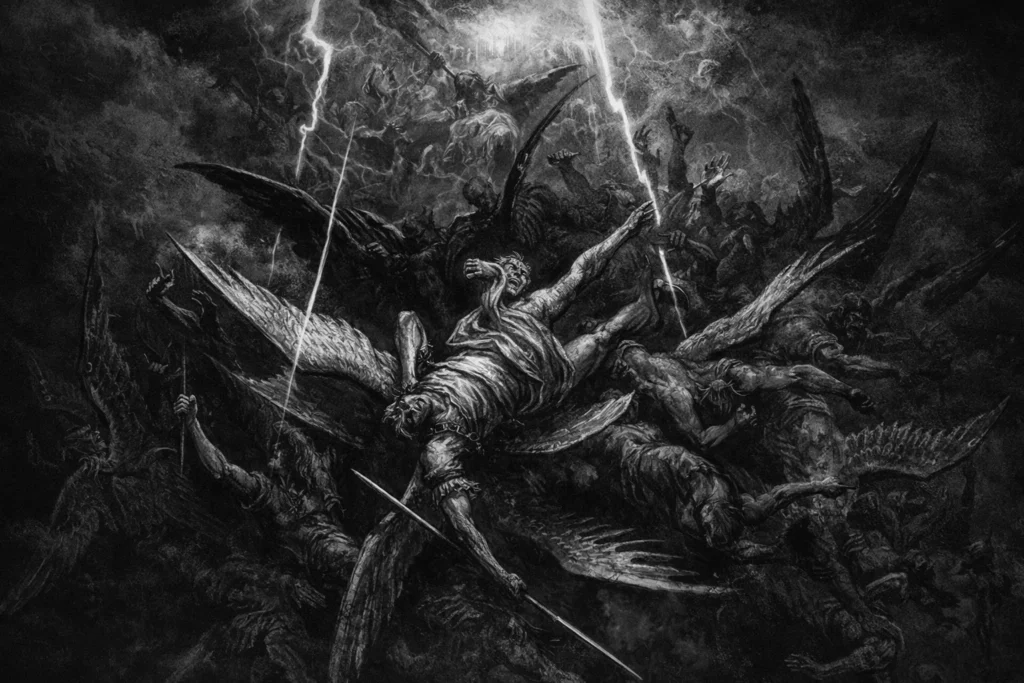
The Futile Aspirations of the Seventh Throne
Most Goetic entities accept their place in Hell, but Amy is different. He stands out for his belief that after 1,200 years, he will return to the Seventh Throne in Heaven.
The Pseudomonarchia Daemonum keeps this detail, showing Amy as more than just a teacher of the liberal sciences. He is a “Tragic Rationalist”—a spirit with great intellect who teaches astrology and grammar, but still believes in a false hope of redemption. This creates a strong contrast: he gives knowledge to others. Still, he is trapped by a countdown that, according to traditional theology, can never end in his favor.
Amy’s appearance in 16th-century manuscripts reflects the era’s interest in lost knowledge and recovering classical wisdom. As a President of Hell who helps people excel in astrology, the demon mirrors the Renaissance scholar’s struggle to use hidden or forbidden knowledge to regain lost understanding or grace.
Avnas’ two forms—a flaming fire and a human shape—show the shift from the wild power of medieval demons to the more intellectual, human-focused occultism of the early modern era. He represents the “Intellectual Fall,” in which the main fault is believing that gaining sufficient secret knowledge can restore someone to the divine.
Major Historical & Grimoire Mentions
While the demon Amy does not appear in the Bible or in early Patristic writings, his historical record begins in the late medieval period, in the inventories of the infernal hierarchy.
Original:
“Amy est Præses magnus, apparet in flamma ignea: sed humana assumpta forma, reddit hominem admirabilem in Astrologia & omnibus artibus liberalibus. Dat famulios optimos: thesauros à spiritibus custoditos ostendit. Præest triginta sex legionibus, ex parte est ordinis Angelorum, ex parte Potestatum. Sperat se post mille ducentos annos ad septimum thronum reversurum, quod credibile non est.” [Pseudomonarchia Daemonum, Johann Weyer, 1577]
Translation:
Amy is a great President, and appeareth in a flame of fire, but having taken mans shape, he maketh one marvelous in astrologie, and in all the liberall sciences, he giveth excellent familiars, he sheweth treasures preserved by spirits, he hath government of thirty six legions, he is partly of the order of angels, and partly of powers, he hopeth after a thousand two hundred yeares to returne to the seventh throne: which is not credible.
In this important 16th-century text, Weyer shows Amy’s dual nature as both a force of fire and a teacher. The change from flame to man marks Amy as a bridge between wild energy and human logic. Weyer also adds a skeptical note, saying Amy’s hope for redemption is “not credible.”
This matches the strict views on salvation during the Protestant Reformation. By calling Amy’s hope impossible, Weyer supports the idea of eternal damnation and removes any suggestion of a second chance found in older stories.
“The Fifty-eighth Spirit is Amy, or Avnas. He is a Great President, and appeareth at first in the Form of a Flaming Fire; but after a while he putteth on the Shape of a Man. His office is to make one Wonderful Excellent in Astrology and all the Liberal Sciences. He giveth Good Familiars, and can bewray Treasures that be kept by Spirits.” [Lemegeton: Clavicula Salomonis (Ars Goetia), Anonymous/Sloane MS 2731, 17th Century]
The Ars Goetia clarifies the names “Avnas” and “Amy” for this demon. While the description is similar to Weyer’s, it focuses more on Amy’s role or “office.” The word “bewray” (meaning to “reveal”), when it comes to treasures kept by spirits, points to a special hierarchy among demons.
At a time when science was growing, Amy’s link to the “Liberal Sciences” (like grammar, logic, math, and astronomy) shows that people saw the occult as a shortcut to academic knowledge before the Enlightenment.
Original:
“Amy, grand président aux enfers, l’un des sept princes de la hiérarchie infernale. Il se présente entouré de flammes ; mais, quand il prend la forme humaine, il rend l’homme profond dans les sciences libérales et l’astrologie. Il commande trente-six légions, et fut autrefois de l’ordre des Anges et de celui des Puissances. Il se flatte de retourner au septième trône dans douze siècles.” [Dictionnaire Infernal, Jacques Collin de Plancy, 1863]
Translation:
Amy, a great president in Hell, one of the seven princes of the infernal hierarchy. He presents himself surrounded by flames; but, when he takes human form, he makes man profound in the liberal sciences and astrology. He commands thirty-six legions, and was formerly of the order of Angels and that of Powers. He flatters himself to return to the seventh throne in twelve centuries.
By the 19th century, Collin de Plancy’s entry elevates Amy’s status to “one of the seven princes,” a status not mentioned in earlier texts. The French phrase “il se flatte” (he flatters himself) replaces Weyer’s “he hopes,” making Amy seem more delusional or arrogant.
During the Romantic and Gothic periods, writers often gave demons more human traits. Amy’s 1,200-year wait became less of a theological point and more of a character trait, fitting the “fallen aristocrat” theme common in 19th-century stories about demons.
“Amy is a great president, and appeareth in a flame of fire, but having taken mans shape, he maketh one marvelous in astrologie, and in all the liberall sciences, he giveth excellent familiars, he sheweth treasures preserved by spirits, he hath government of thirtie six legions, he is partlie of the order of angels, and partlie of powers, he hopeth after a thousand two hundred yeares to returne to the seventh throne, which is not credible.” [The Discoverie of Witchcraft, Reginald Scot, 1584]
Reginald Scot’s inclusion of Amy is historically significant because it is essentially the first English-language appearance of the entity. Scot was not a practicing occultist but a skeptic; he included the “inventory of idols” (translated directly from Weyer’s Pseudomonarchia Daemonum) to expose what he considered the absurdities and “cousenage” of popish magic and conjuration.
This source is the main reason Amy’s name became known in English. Although it is a direct translation of Weyer, its use in a skeptical book changes its meaning. In the Elizabethan era, subjects such as the “liberal sciences” and “astrology” were shifting from mystical ideas to formal academic fields.
By listing the demon in a book meant to disprove witchcraft, Scot inadvertently preserved the ritual details and the “1,200-year” story for later readers. This shows that the “Hope of Redemption” was so important to Amy’s story that even a skeptic like Scot included it as a key trait.
You may also enjoy:
Who Is Azazel, the Demon Blamed for Human Corruption?
February 24, 2026
Lamia: The Queen Cursed to Devour the Children of Others
January 7, 2026
Who Were the Hinn, the First Spirits of Creation?
November 12, 2025
What Is a Yūrei? The True Meaning of Japanese Ghosts
January 30, 2026
What Is Jorōgumo? The Deadly Spider Woman of Japanese Myth
February 2, 2026
Powers and Abilities
Amy’s powers focus on knowledge and discovery. As a President of Hell, his main job is to share information. He is said to help people become skilled in astrology by providing them with direct insight into how the stars and planets affect the world.
Besides astrology, Amy can help people learn the liberal sciences, such as grammar, logic, rhetoric, math, geometry, music, and astronomy. His influence allows conjurers to understand difficult subjects that would usually take years to master.
Another main ability is finding treasures. This includes not just gold, but also objects or knowledge guarded by other spirits. Amy can force other entities to reveal what they are hiding.
Amy’s power comes from his rank and his command over 36 legions. He can also provide good familiars—minor spirits that help magicians with tasks or offer protection and surveillance.
Amy vs Other Christian Demons
| Demon Name | Associated Sin/Temptation | Rank/Origin | Key Traits/Powers |
| Asmodeus | Lust | King / Ars Goetia | Destroys marriages, teaches arithmetic and geometry. |
| Belial | Lawlessness | King / Bible & Goetia | Grants senatorships, creates civil strife. |
| Bael | Murder / Invisibility | King / Ars Goetia | The first principal spirit; teaches invisibility. |
| Paimon | Falsehood / Bindings | King / Ars Goetia | Teaches all arts and sciences, binds people to the conjurer’s will. |
| Astaroth | Sloth / Vanity | Duke / Ars Goetia | Gives true answers to things past, present, and to come. |
| Beelzebub | Gluttony | Prince / Bible | Lord of the Flies, controls infestations. |
| Mammon | Greed | Prince / Bible | Influence over material wealth and avarice. |
| Leviathan | Envy | Prince / Bible | Sea monster representing chaos and pride. |
| Berith | Homicide / Blasphemy | Duke / Ars Goetia | Turns all metals into gold, tells of the past. |
| Foras | Theft / Loss | President / Ars Goetia | Teaches the virtues of herbs and precious stones. |
| Gaap | Incitement / Lust | President / Ars Goetia | It can cause love or hatred and deliver people across nations. |
| Malphas | Deception / Strife | President / Ars Goetia | Builds houses and high towers, reveals enemies’ thoughts. |
| Haagenti | Gluttony / Alchemy | President / Ars Goetia | Makes men wise, turns water into wine, and metals into gold. |
| Buer | Impiety / Sickness | President / Ars Goetia | Teaches moral and natural philosophy, heals distempers. |
| Marbas | Hidden Secrets | President / Ars Goetia | Reveals hidden or secret things, causes, and cures diseases. |
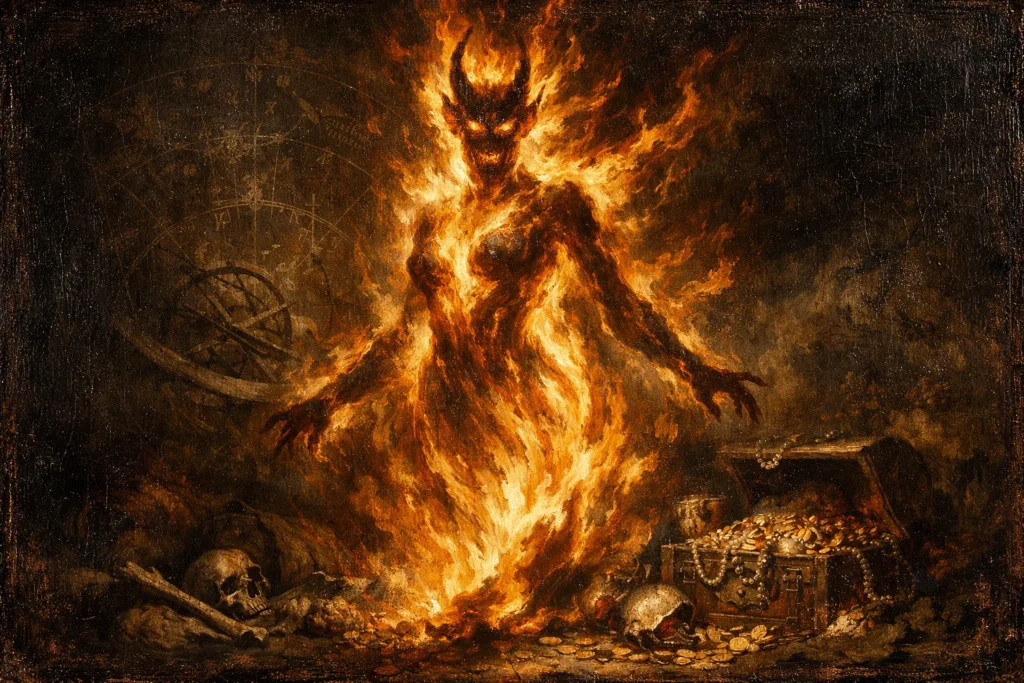
Rank in the Hierarchy of Hell
To understand Amy’s rank in Hell, it helps to look beyond the usual “rebellion” story and consider the Order of Powers. In medieval angelology, the Powers were like celestial border guards, keeping balance between the physical and spiritual worlds and stopping chaos from spreading.
When Amy fell, he kept his role as an administrator, but used it differently. He went from protecting order for the Divine to being a “President of Hell.” Now, he uses his knowledge of the universe—like the liberal sciences and astrology—as a kind of currency. His teaching skills come from his old job of managing how the universe works.
The “Seventh Throne” and the 1,200-Year Protocol
The story of Amy and King Solomon about the Seventh Throne is often seen as a trick, but it shows a deeper legal idea in Goetic lore. In the Testament of Solomon and later stories, Amy’s claim of a 1,200-year term suggests he believes there is a time limit on divine punishment.
The number 1,200 is not random. It connects Amy to the Joachite Heresies from the 12th and 13th centuries. Joachim of Fiore divided history into three ages, and many medieval occultists thought that certain time cycles could cleanse sins.
By giving Solomon a specific timeline, Amy tried to show his fall as a punishment with an end date rather than as eternal damnation. This makes him unique—a demon who accepts Divine Law but also tries to find loopholes to get back his old status.
The Authority of the “Inter-Infernal” Arbiter
Amy is known for revealing treasures guarded by spirits, which brings up the idea of Infernal Law. Unlike demons such as Mammon or Raum, who focus on stealing or gathering gold, Amy’s power is about authority. In the Greater Key of Solomon, he acts like a high-level auditor.
Amy can force other spirits to give up their treasures, showing he still has some celestial authority that lesser spirits must respect. The treasures he reveals are often not gold, but knowledge—like scrolls, secrets, or forbidden information.
He is the keyholder to the secret archives of the demonic world, making him important to those who seek deeper knowledge, not just material wealth.
Mystical Correspondences
| Attribute | Details |
| Planet | Mercury |
| Zodiac Sign | Capricorn (Dec 31 – Jan 4) |
| Element | Air |
| Direction | East |
| Color | Orange or Mixed |
| Number | 8 |
| Crystal/Mineral | Agate |
| Metal | Mercury (Quicksilver) |
| Herb/Plant | Vervain |
| Animal | Viper or Phoenix (Fire association) |
Amy is linked to the planet Mercury, which matches his role as a communicator and teacher. Mercury rules intellect, trade, and travel, which fits Amy’s skills in sharing knowledge and finding hidden things. He is also connected to the zodiac sign Capricorn, especially its first part, which is tied to structure and ambition. These qualities reflect his power to find treasures.
The element of Air and the direction East are common for spirits known for intelligence and those who appear in changing forms like fire. The color orange and the number 8 are used in rituals to tune the setting to Amy’s specific energy.
These connections help explain Amy’s evil nature. They show how his powers are set up to take advantage of human curiosity and the wish for material or intellectual superiority.
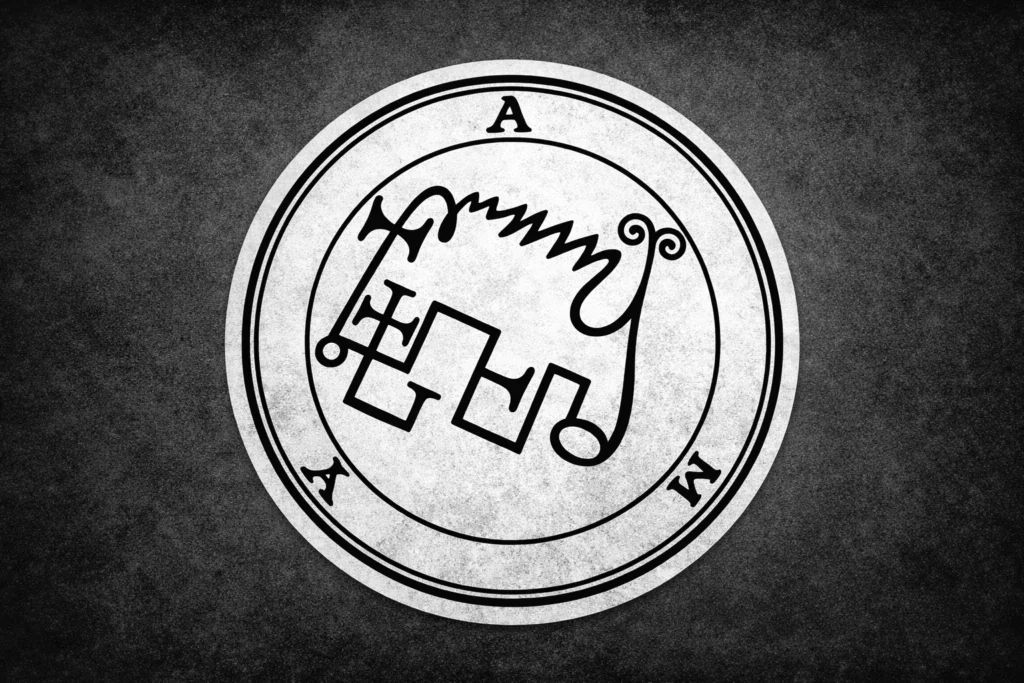
Amy’s Sigil
The sigil of Amy is a complex geometric symbol used for his invocation and binding. According to the Ars Goetia, the sigil must be worn as a Lamen by the conjurer to ensure the demon’s obedience. Without the presence of this specific mark, Amy is not obligated to assume his human form or reveal the truths he possesses.
Historically, the sigil worked as a spiritual contract. It personifies the President’s essence and serves is a focus for the ritualist. In the past, people engraved these sigils on metal or drew them on parchment to make sure the spirit would appear.
The sigil is important because it acts as a protective barrier. It keeps Amy’s fiery first form from harming the practitioner and makes him follow the rules of the summoning.
You may also enjoy:
The Kumbhāṇḍa: Grotesque Demons of Buddhist Hell
November 13, 2025
Who Is Aka Manto, Japan’s Terrifying Red-Cloaked Yōkai?
October 24, 2025
Who Is the Jann in Islamic Mythology and Why Is He Feared?
October 2, 2025
What Is a Pishacha, the Flesh-Eating Demon of the Dead?
February 11, 2026
Empusa: The Blood-Drinking Wraith of Greek Mythology
November 20, 2025
Bibliography
Author’s Note: When it comes to this demon, there is an obvious, strong contrast between the dry lists in the Pseudomonarchia Daemonum and the more hopeful ideas in the Testament of Solomon and later French writings. Modern summaries often portray Amy as nothing more than an astrology teacher. Still, the main sources show a deeper story: his mastery of the liberal sciences is a tragic replacement for his lost angelic rank. Comparing the different accounts of his 1,200-year term meant examining Renaissance philosophy and medieval ideas about penance. My research shows that Amy is best seen as a “rational exile,” not just a destroyer. The “Seventh Throne” idea is more than trivia—it is a key link between divine order and the infernal world.
- Solomon, King of Israel (attributed). The Key of Solomon the King (Clavicula Salomonis). Translated and edited by S. Liddell MacGregor Mathers, George Redway, 1889. Internet Archive.
- Summers, Montague. The history of witchcraft and demonology. Project Gutenberg, 28 Oct. 2025. Originally published by Alfred A. Knopf, 1926.
- Henson, Mitch, and Jeff Wellman, editors. Lemegeton: The Complete Lesser Key of Solomon. Metatron Books, 1999. Internet Archive.
- Weyer, Johann. Pseudomonarchia Daemonum. Edited and translated by Joseph H. Peterson, digital edition, 2000. Twilit Grotto: Esoteric Archives.
- Collin de Plancy, Jacques. Dictionnaire infernal: répertoire universel des êtres, des personnages, des livres, des faits et des choses qui tiennent aux esprits. 6th ed., Henri Plon, 1863. Internet Archive.
- Geretto, M. Angels and Demons in the Renaissance. In: Sgarbi, M. (eds) Encyclopedia of Renaissance Philosophy. Springer, Cham, 2019.
- Ruys, Juanita Feros. Demons in the Middle Ages. Arc Humanities Press, 2017. JSTOR.
- McCown, Chester Charlton, editor. The Testament of Solomon. J. C. Hinrichs’sche Buchhandlung, 1922. Internet Archive. Edited from manuscripts at Mount Athos, Bologna, Holkham Hall, Jerusalem, London, Milan, Paris, and Vienna.
- Zhai, Ruobing. Astrology and Astronomy in Renaissance Works. Journal of Education, Humanities and Social Sciences. 11. 220-225, 2023.
- Malz, D. Astrology in the Renaissance. In: Sgarbi, M. (eds) Encyclopedia of Renaissance Philosophy. Springer, Cham, 2022.