Many yūrei reflect the lingering sorrow of the Edo period. Still, Kuchisake-onna is fascinating as a link between old folklore and the worries of modern city life. Her story highlights the contrast between outward beauty and hidden flaws, showing how social judgment and the dangers of urban spaces can take shape in legend.
Most yōkai are connected to natural places like mountains or rivers, but this entity is different. Kuchisake-onna exists because of modern cities, appearing in busy streets and school areas rather than in wild landscapes.
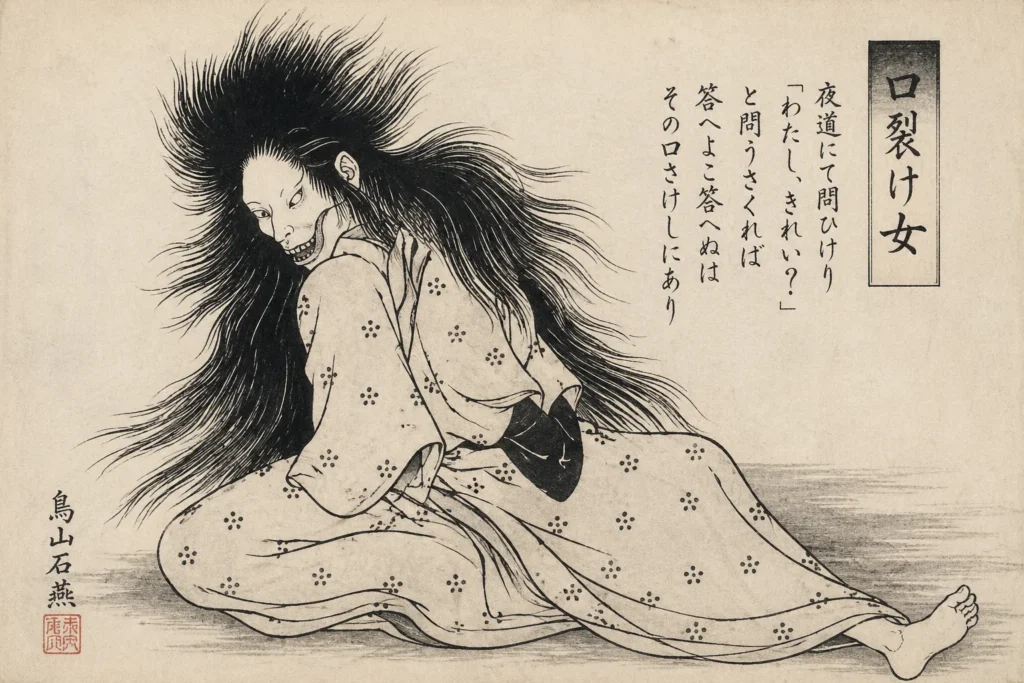
For this research, I compared the 1979 press archives from the Gifu Nichinichi Shimbun with the classic Edo-period illustrations in Toriyama Sekien’s Gazu Hyakki Yakō. This helped me connect old stories with modern reports. [View Full Bibliography ↓]
Summary
Key Takeaways
| Attribute | Details |
| Names | Kuchisake-onna, Slit-Mouthed Woman |
| Translation | The name translates to “Mouth-裂 (sake) – Woman (onna),” literally “The woman with a torn mouth.” |
| Title | Urban Legend Spirit, Masked Woman |
| Type | Onryō (Vengeful Spirit) / Obake |
| Spirit Classification | She is categorized as an Ara-mitama (violent spirit) and a Goryō, specifically a vengeful manifestation of a deceased human. |
| Origin | Historical accounts suggest she was a mutilated wife; modern lore cites her as a victim of a failed medical procedure or a car accident. |
| Gender | Female |
| Appearance | A tall woman with long black hair, wearing a beige trench coat and a surgical mask (or scarf) concealing a mouth slit from ear to ear. |
| Kehai (Aura/Presence) | The encounter is preceded by the rhythmic “clack-clack” of high heels on pavement and a sudden, oppressive sense of being followed in a confined alleyway. |
| Powers/Abilities | Superhuman speed, teleportation, and the use of large industrial scissors or surgical tools. |
| Methods of Pacification | The subject must provide an ambiguous answer to her question, or throw hard “bekko ame” candy or pomade (hair wax) to distract her. |
| Habitat | Urban environments, specifically telephone poles, school routes, dark alleys, and desolate parks. |
| Diet/Prey | Children and young adults; specifically those who fail her interrogation. |
| Symbolic Item | Surgical mask and oversized scissors. |
| Symbolism | Representing the fear of strangers (stranger danger), the vanity of beauty, and the coldness of urban modernization. |
| Associated Kami | None; she is a rogue spirit unaffiliated with the traditional Shinto pantheon. |
| Sources | Gazu Hyakki Yakō (variant interpretations), various 1979 Japanese newspaper archives, and the “Mimizuku” folklore journals. |
Who or What Is Kuchisake-onna?
Kuchisake-onna is a vengeful ghost from the onryō tradition, showing how a woman’s vanity turned into a lasting and terrible curse. She usually appears at dusk or late at night, always seeking a deadly encounter. Unlike other yōkai who might protect or play tricks, she actively hunts her victims, following a strict set of questions and answers that decide their fate.
She usually goes after people who are alone in public, especially students coming home from cram school. Her story highlights the fear that a friendly or attractive appearance can mask something dangerous.
Kuchisake-onna doesn’t just haunt places; she forces people into situations where giving the wrong answer can lead to harm, reflecting the strong pressure to fit in in Japanese society.
Semantic Origins
The name comes from the Japanese words saku (裂く), which means ‘to tear’ or ‘to rip,’ and onna (女), meaning ‘woman.’ Kuchi (口) means ‘mouth.’ In the Edo period, this term described monsters with large mouths, but the current name became common during the Shōwa era. The name itself points to a lasting injury, focusing more on her wound than on who she was.
Different regions have their own versions of her name, but the standard city version is most common.
In the early 1900s, some called her ‘mask-woman’ (masuku-onna), but the more detailed name took over. This transition shows how the language moved from old supernatural terms to a more modern, medical style, fitting the age of surgical masks.
How to Pronounce “Kuchisake-onna” in English
To say the name in English, break it into four parts: Koo-chee-sah-keh Oh-n-nah. ‘Koo’ rhymes with ‘too,’ ‘chee’ with ‘cheese,’ ‘sah’ with ‘saw,’ and ‘keh’ with the start of ‘kettle.’ For ‘onna,’ use a short ‘o,’ double ‘n,’ and a soft ‘ah’ at the end.
What Does Kuchisake-onna Look Like?
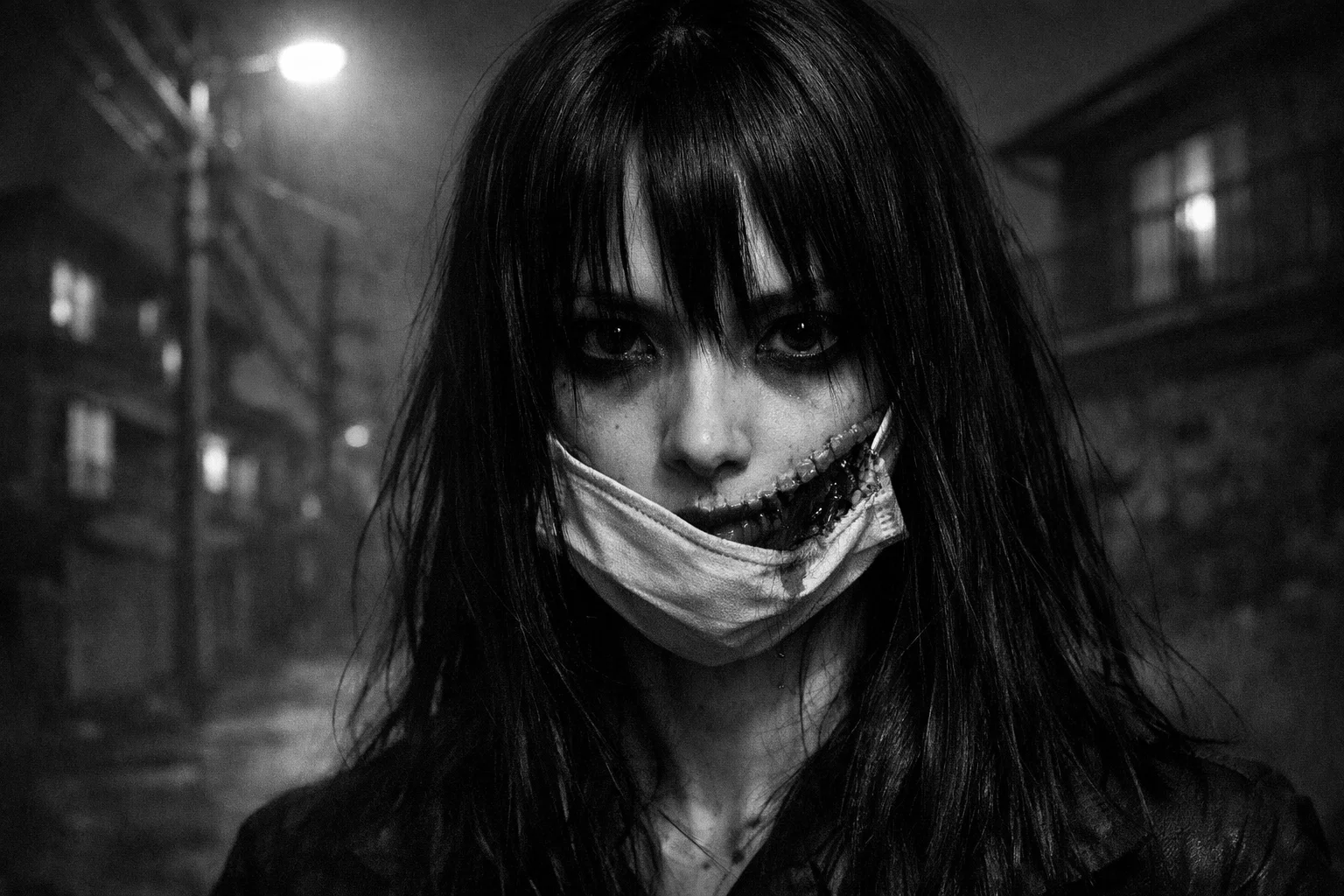
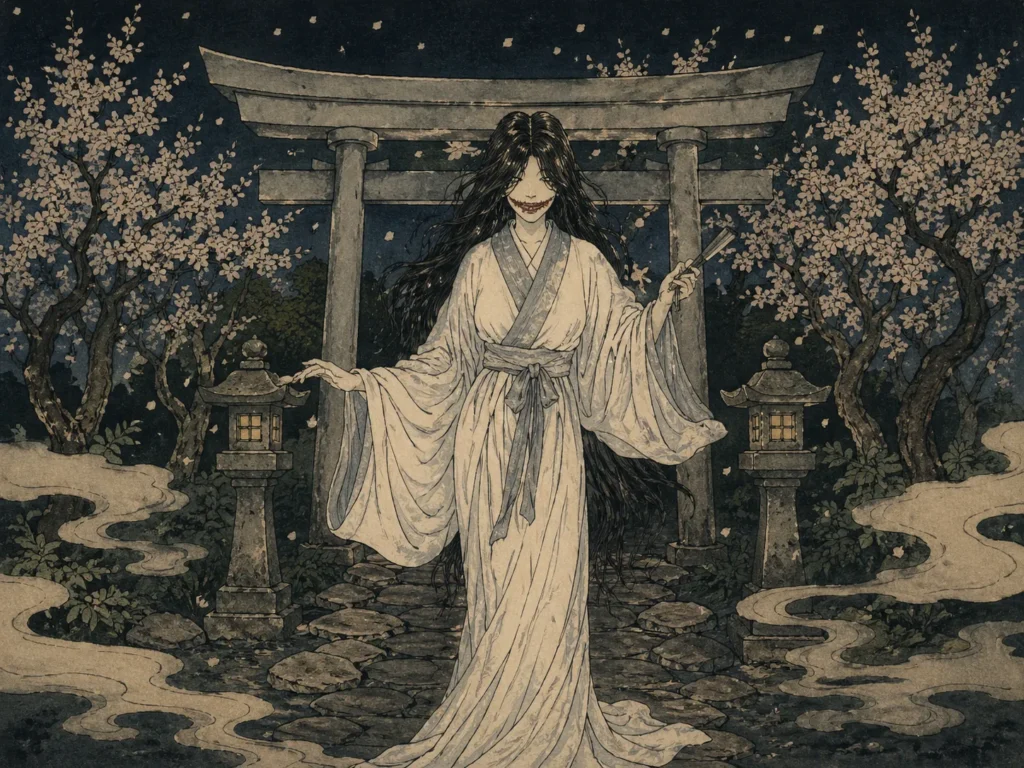
Kuchisake-onna’s physical appearance is a mix of beauty and horror. Most stories describe her as tall and thin, with long, straight black hair down her back and very pale skin. Today, she is often seen wearing a long beige or tan trench coat, which helps hide her weapon and shape.
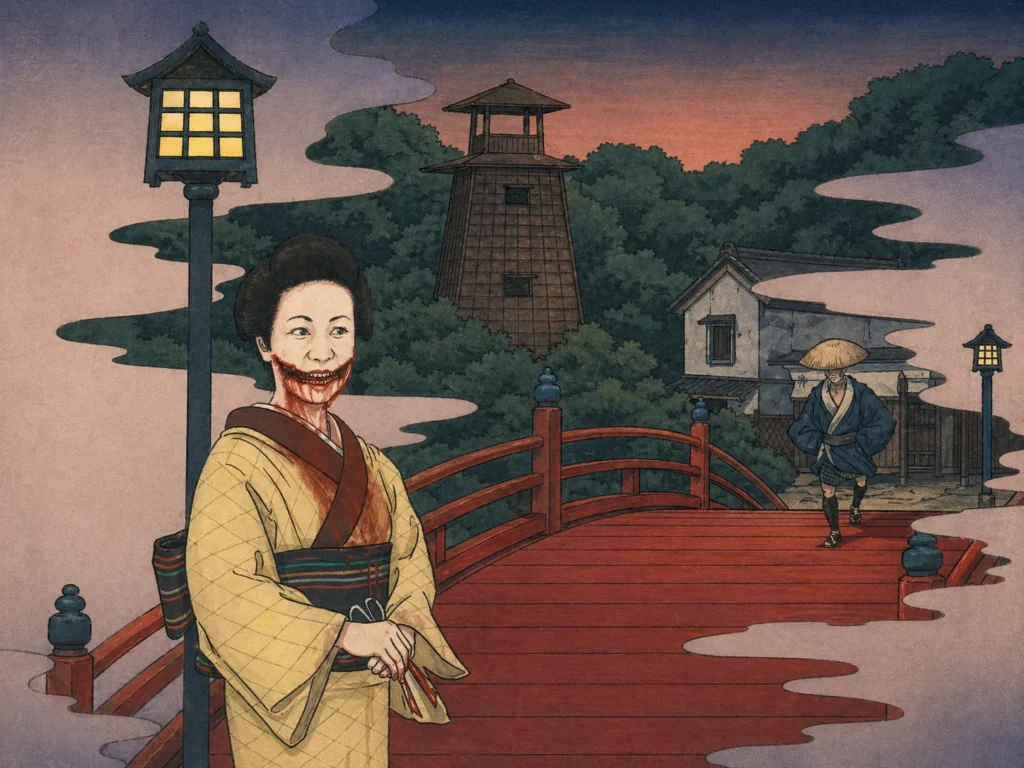
Her most remarkable feature is her face, usually hidden by a white surgical mask, which is common in Japan. When she takes off the mask, it shows a mouth cut open from ear to ear. The wound looks jagged and raw, with teeth and gums showing in a bloody, permanent ‘smile.’
Some versions of the story say her eyes are a bit upturned or look like a fox’s, which might link her to fox possession or other animal adaptations. Still, the main detail people remember is her slit mouth.
Origins and History
The history of Kuchisake-onna dates back to old stories, but it became much more popular in the late 1900s. Some experts trace her origins to a Heian-period tale about a samurai’s wife who her jealous husband attacked. However, most reports come from the late 1970s, a time when Japan was quickly modernizing, and children often traveled alone to after-school classes.
The first modern wave of sightings happened in Gifu Prefecture in 1979. The panic was so strong that schools had teachers walk children home in groups, and police stepped up patrols. This was more than just a reaction to a ghost story—it became a local crisis that affected whole towns.
Looking at the timeline, I think this entity reflects the ‘stranger danger’ fears that grew as Japanese villages turned into big, anonymous cities. It’s also interesting that the first sightings happened just as white surgical masks became common in Japan, making it easy to imagine that anyone in public could be hiding something.
I think this story worked as a ‘safety myth’ to help keep children cautious in a world that felt less safe. The evolution from the ‘mutilated wife’ in old stories to the ‘masked lady’ in modern times shows how society was dealing with less privacy and more fear of random violence in public.
You may also enjoy:
Akateko: The Bloody Hand Yōkai That Guards a Cursed Temple Tree
November 14, 2025
What Is Jorōgumo? The Deadly Spider Woman of Japanese Myth
February 2, 2026
What Is the Akkorokamui, Japan’s Colossal Sea Monster?
November 14, 2025
Who Is Aka Manto, Japan’s Terrifying Red-Cloaked Yōkai?
October 24, 2025
Ifrit: Demon of Fire Who Serves Iblis in Islamic Tradition
September 30, 2025
Demon Alastor: The Grand Executioner of Hell
November 17, 2025
Habitat
Where Kuchisake-onna manifests has changed a lot, just like Japan has transformed from a farming society to a modern city. In old stories from the Edo period, she was found on the edges of towns or near dark, unlit bridges.
These early places were dark and hard to see, so the ‘mutilated woman’ haunted spots where people couldn’t easily watch out for danger. She often appeared near rivers or post stations, where travelers and locals were passing through and more likely to have a surprise encounter.
Today, stories place her right in the middle of modern city life, especially in places that are part of many people’s everyday routines.
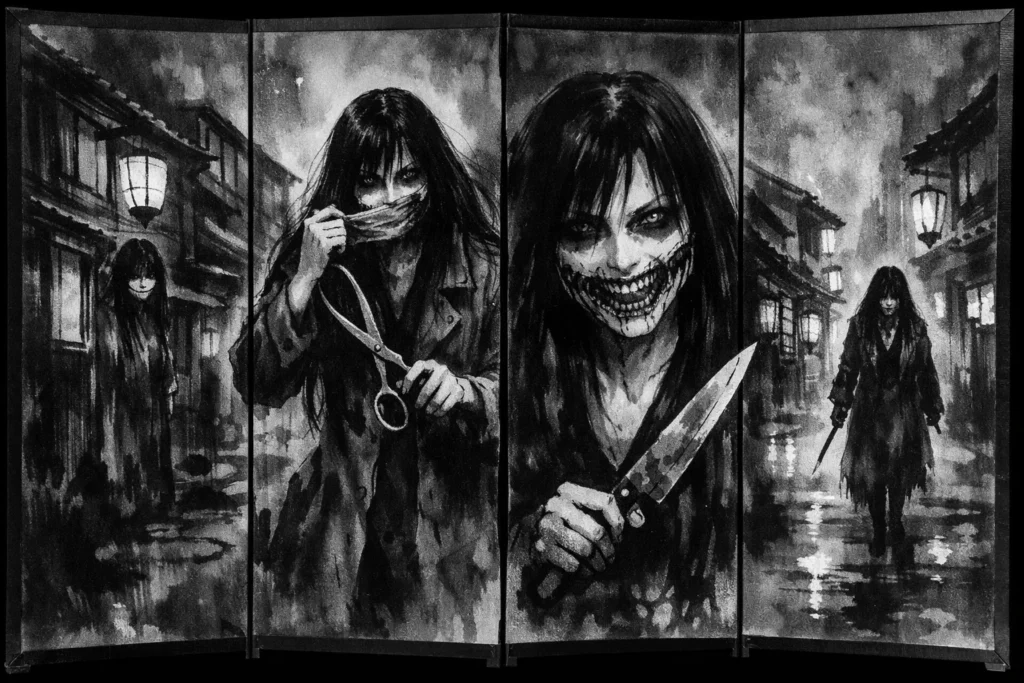
Modern stories often place her near neighborhood telephone poles, especially along routes between schools and cram schools. Surveys from the late 1970s in Gifu and Aichi Prefectures found that most sightings happened in empty tunnels and underpasses, where footsteps echo and make the place feel even more eerie.
Unlike old spirits who stayed in the wild, this entity is now tied to city buildings. People say she appears in public restrooms, the shadows of apartment buildings, and on empty park benches after dark.
How Kuchisake-onna Personifies the Crisis of Modern Anonymity
When I looked at the 1979 Gifu outbreak, I noticed a significant shift in how Kuchisake-onna is portrayed compared to older stories. Traditional yōkai, like Kappa and Yuki-onna, are tied to nature. Still, the slit-mouthed woman is the first major spirit defined by the in-between spaces of modern city life.
Interestingly, she started appearing just as cram schools and big suburbs became common in Japan. My research suggests she’s more than just a ghost—she represents the ‘stranger danger’ fears that grew when the anonymous city replaced close-knit villages.
One important detail is how the story uses the surgical mask. In the late 1970s, masks became common in Japan for health reasons, but they also made people less recognizable. By hiding the lower face, the mask draws attention to the eyes, and when she asks, ‘Am I pretty?’, it forces people to face the hidden horror underneath.
I believe this story is a comment on the ‘front’ and ‘back’ (Honne/Tatemae) sides of Japanese social life. The entity shows the fear that a polite, masked stranger in a crowd could be hiding something dangerous that can’t be avoided by just following social rules.
I’ve also noticed that Kuchisake-onna’s weakness to pomade is more than just a strange detail. While many experts see it as a quirky part of the story, I think it connects to old rituals in which strong scents, such as incense or salt, were used to keep spirits away.
Pomade, a modern, petroleum-based product, represents the artificial side of city life where she appears. Using its scent against her interrupts her ritual, turning the haunting into a kind of modern exorcism, where today’s fears are fought with today’s inventions.
Famous Kuchisake-onna Legends and Stories
A Tale of Mutilation and Vengeance
Back when samurai ruled society, there was a woman whose beauty was so remarkable that people across the region talked about her. She was married to a respected warrior, known for both his pride and his skill. Aware of her looks, she often spent hours in front of her bronze mirror, carefully brushing her long black hair and putting powder on her pale skin.
Stories say she wanted more attention than just her husband’s. She often walked through town, enjoying how people and other warriors would stop to look at her.
Over time, rumors spread that she was unfaithful, and her husband heard about them. Whether these stories were true or not, the samurai became profoundly jealous and obsessed.
One night, the samurai saw his wife looking at herself in the mirror again, and he lost control. He came up behind her, pulled out his short sword, and grabbed her by the hair. Before she could react, he pressed the blade to her mouth and cut through her cheek all the way to her ear. He did the same on the other side.
She fell to the floor, holding her wounded face and blood-soaked kimono. The samurai leaned over and asked, “Who will think you are beautiful now?” She died soon after, but her spirit did not move on to the underworld.
Her strong vanity kept her in the world as an onryō, a vengeful ghost who believed that if she could not be beautiful, no one else should stay unharmed.
You may also enjoy:
Ambri: The Imperial Duchess of Caspiel’s Empire
December 1, 2025
Who Are the Yaksha, and Why Did Buddhists Fear Their Wrath?
October 20, 2025
Chort: The Sinister Slavic Demon of Chaos and Bad Luck
March 10, 2026
Gandharva: God, Spirit, or Demon?
November 13, 2025
Who Is Asmodeus in Demonology and the Bible?
February 18, 2026
Andhaka: The Blind Demon Born From Cosmic Darkness
February 6, 2026
The Gifu Prefecture Outbreak of 1979
The modern version of this story is more than just a ghost tale. It became a real social event in Gifu Prefecture during the winter of 1978 and 1979. The first reported sighting happened in December 1978 in Minokamo City, when an elderly woman said she saw a woman with a slit mouth standing in her garden.
The story spread across Japan after January 26, 1979, when the Gifu Nichinichi Shimbun (now the Gifu Shimbun) published an article about rumors among schoolchildren of a “masked woman” attacking people.
By June 1979, the panic had spread from Gifu to Aichi Prefecture and then to the Kantō region. Records show that the fear was so strong that in cities like Hachinohe and Misawa, teachers walked groups of children home for safety.
In Kasugai City, police increased their patrols. In Himeji, a 25-year-old woman was arrested for carrying a kitchen knife and wearing a mask. She said she was just acting out the rumor.
Major newspapers, such as The Asahi Shimbun, reported that the rumors affected the economy. Sales of surgical masks rose, and the word “pomade” became popular after a rumor spread that a woman in Yaizu City scared off a “strange woman” by shouting it.
The panic started to fade in late August 1979, but by then, the story had become part of Japan’s national memory. It turned an old legend into a real example of modern group behavior.
Kuchisake-onna Powers and Abilities
Kuchisake-onna has supernatural powers that make it almost impossible to escape her in normal ways. She looks human, but she is much faster and stronger than any person, and she can even alter the space around her. She is very dangerous because she does not just haunt a place—she chases her victims over long distances.
- Superhuman Speed: She is reportedly able to run 100 meters in approximately 3 seconds, allowing her to overtake any fleeing victim.
- Phasing/Teleportation: Some accounts suggest she can appear instantly in front of a victim even after they have turned a corner or entered a building.
- Selective Invisibility: She can remain unnoticed by large crowds, appearing only to her intended target.
- Weapon Proficiency: She wields industrial scissors or a kama (scythe) with lethal precision and strength.
- Cursed Interrogation: Her speech carries a localized compulsion; victims often feel frozen or forced to engage in her “pretty” dialogue.
Traditional Defenses Against Kuchisake-onna
To protect yourself from Kuchisake-onna, you need to be clever, not strong. Since she follows a set pattern, the best way to defend yourself is to break that pattern.
One well-known method is to give her an unclear answer. If she asks if she is pretty, say “So-so” or “You look average.” This confuses her because it doesn’t fit her usual yes-or-no thinking, giving you a few seconds to get away while she considers your answer.
Another common defense is Bekko Ame, a hard, amber-colored candy. People say she loves these sweets, so if you throw them or offer them to her, she will stop eating them, giving you a chance to escape.
The word “Pomade” is also thought to protect against her. Saying it three times or carrying the smell of hair wax is believed to make her go away. This may come from a story about a failed surgery caused by a doctor’s hair wax.
In some places, people also write the kanji for “dog” (inu) on their palm for protection, but the candy and “pomade” tricks are the most popular today.
Kuchisake-onna vs Similar Spirits
| Name | Category | Origin | Threat Level | Escape Difficulty |
| Teke Teke | Yūrei | Victim of a train accident | Fatal | Very High; she is incredibly fast despite lacking legs. |
| Hanako-san | Yūrei | WWII bombing victim | Moderate | Low; she is confined to the third stall of the school toilets. |
| Yuki-onna | Yōkai | Personification of winter | Fatal | High; she can freeze victims instantly in blizzards. |
| Aka Manto | Obake | Spirit of a masked man | Fatal | Impossible; he presents a deadly choice in stalls. |
| Hachishakusama | Urban Legend | Ancient sealed spirit | Fatal | Very High; requires complex Shinto rituals to block. |
| Ubume | Yūrei | A woman who died in childbirth | Low | Moderate; she usually just wants her child held. |
| Oiwa | Onryō | Betrayed and poisoned wife | Fatal | High; she causes psychological ruin and madness. |
| Okiku | Yūrei | Servant thrown down a well | Low | Easy; she stays near her well, counting plates. |
| Futakuchi-onna | Yōkai | Cursed by greed or starvation | Moderate | Moderate; she targets the food supply of households. |
| Kurote | Yōkai | Spirit of a disembodied hand | Low | Easy; mostly found in dark bathrooms. |
| Taka-onna | Yōkai | A woman who stretches her body | Low | Easy; she mainly peeks into second-story windows. |
Symbolism
| Attribute | Details |
| Element | Air/Wind (Associated with the speed and the “whisper” of her question). |
| Animal | Fox (due to the slit-eyed, cunning nature of the spirit). |
| Cardinal Direction | West (Associated with the setting sun and the transition to the world of the dead). |
| Color | Beige (the trench coat) and Crimson (the blood and inner mouth). |
| Season | Autumn (The season of twilight and thinning veils). |
| Symbolic Item | Industrial Scissors. |
In Japanese culture, Kuchisake-onna represents the risks that come from vanity and society’s expectations. She shows the fear of the pressure on women to be perfect and what can happen when that image is broken.
Her story warns us about how fragile our social masks are, both in appearance and in meaning, and reminds us that even modern cities can have their own ghosts.
Kuchisake-onna has transformed yōkai stories by showing that supernatural beings can fit into modern life and technology. In art and movies, she often represents body horror and the loneliness of city life, making her a key entity in J-Horror.
She also represents the guilt of a society that cares more about looks than inner well-being, reminding us that some hurts never fully go away.
You may also enjoy:
Gandharva: God, Spirit, or Demon?
November 13, 2025
Who Is Agaliarept, the General of Hell Under Lucifer?
October 8, 2025
Kuchisake-onna: Folklore, Origins, and Urban Legend History
February 10, 2026
Banasura: The Thousand-Armed Demon King
October 10, 2025
The Ghul: The Flesh-Eating Demon of Arabian Folklore
October 1, 2025
Akateko: The Bloody Hand Yōkai That Guards a Cursed Temple Tree
November 14, 2025
Bibliography
Author’s Note: While writing this article, I noticed something interesting about the Kuchisake-onna legend and her evolution over time. In older newspaper stories from 1979, she was mainly seen as a scary monster—a “mutilated woman.” However, looking at news reports from Gifu, I realized that her story had become much more real and concerning to people. This transition shows how a traditional ghost story adapts to current events, like the use of surgical masks in modern society.
- Night Parade of a Hundred Demons. Yōkai Senjafuda, Mellon Projects, University of Oregon, glam.uoregon.edu.
- Kelsey, W. Michael. Konjaku Monogatarishū. Twayne Publishers, 1982. Twayne’s World Authors Series 621. Internet Archive.
- Murguía, Salvador Jimenez, editor. The Encyclopedia of Japanese Horror Films. Rowman & Littlefield, 2016.
- Yoda, Hiroko, and Matt Alt. Yōkai Attack! The Japanese Monster Survival Guide. Kodansha International, 2008. Internet Archive.
- Foster, Michael Dylan. The Question of the Slit‐Mouthed Woman: Contemporary Legend, the Beauty Industry, and Women’s Weekly Magazines in Japan. Signs, vol. 32, no. 3, 2007, pp. 699–726. JSTOR, https://doi.org/10.1086/510542. Accessed 27 Apr. 2026.